AI Job Creation Statistics and Facts (2026)

Updated · Dec 23, 2025


Table of Contents
Introduction
AI Job Creation Statistics: The transformation brought about by AI is like a double-edged sword: at first, it is blamed for taking away jobs, then it is credited with creating new industries. The year 2025 has that tension more than ever. Automation is still displacing workers in the heaviest-trafficked areas, and at the same time, businesses and economies are forming a vast, largely invisible workforce of AI employees across domains such as AI-ops specialists, prompt engineers, and others. The following are the most critical AI job-creation statistics for 2026 that will help clarify the issues of job creation, wage levels, and necessary policies for both workers and governments.
Editor’s Choice
- In 2025, artificial intelligence is expected to generate 5 million new positions globally, with AI-driven job growth projected to gradually increase to 13 million per year by 2030 as the technology becomes more widespread across sectors.
- The value of the global AI employment market is projected to reach US$1.84 trillion by the end of 2025, encompassing both direct AI positions and employment in supporting areas indirectly related to AI.
- The increase in AI-related jobs is occurring in 164 countries, with developing markets accounting for approximately one-third of the total new AI jobs generated globally.
- The Asia-Pacific region is the first globally in terms of adding new AI jobs, with nearly 1.1 million in 2025, representing nearly 47% of global growth in AI employment.
- Among developing countries, India was the top AI job creator with more than 490,000 jobs in 2025.
- North America has the largest share of AI jobs worldwide, with AI employment growing by 24%. The U.S. accounted for about 18%, and over 280,000 new roles in 2025 came from it.
- The healthcare sector, manufacturing, and financial services were the areas in which the most AI jobs were created in 2025; together, they accounted for approximately 1.7 million jobs worldwide.
- In turn, manufacturing created about 620,000 AI jobs, and the healthcare sector created 640,000 positions, making AI’s influence widespread even in non-software-centric sectors.
- Although AI-assisted coding tools are available, the demand for software developers is projected to increase by 57% over the next few years due to growing demand for software and productivity gains.
- Currently, 46% of companies worldwide have internal AI upskilling programs for their employees, indicating that companies are increasingly inclined to upskill rather than replace employees.
- In 2025, at least 58 million workers received AI training or certifications, indicating substantial efforts to transition the workforce.
- AI learning saw a strong increase in enrollment, as evidenced by LinkedIn Learning’s 62% growth and Coursera’s 14.2 million AI-track enrollments, with more than half from mid-career professionals.
- Governments are helping reskilling actively: the U.S. provided funding for AI certifications for 120,000 laid-off workers, while there was a 39% increase in AI retraining enrollments across Europe.
- The average price for employee AI upskilling declined to US$1,400, a 19% decrease from the previous year; thus, open and digital platforms made AI education more affordable.
AI Job Creation Forecast
(Reference: sqmagazine.co.uk)
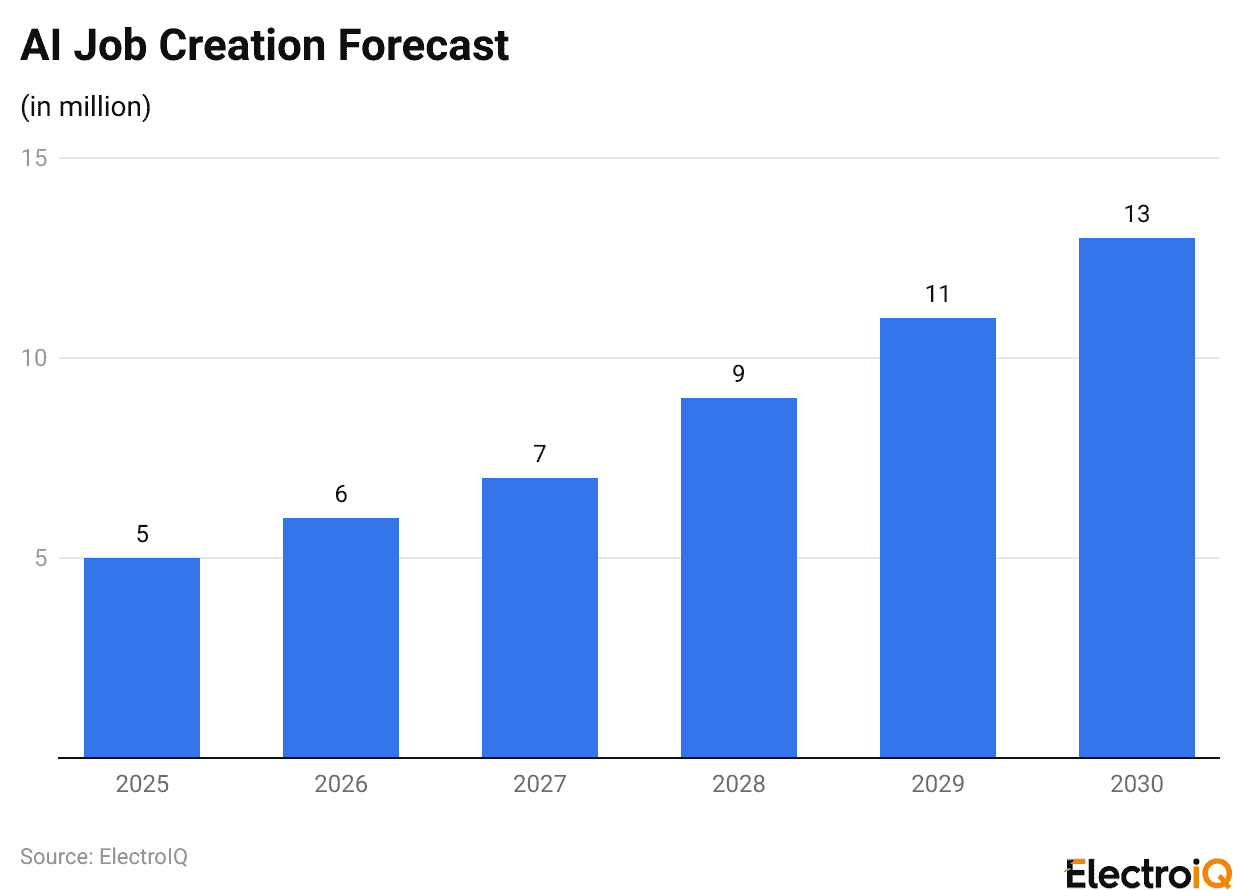
- The predictions indicate a gradual, continuous increase in AI-powered job creation during the second half of the decade.
- Approximately 5 million new jobs will be created by AI in 2025, indicating sustained growth rather than an explosion.
- This increase will be followed by 2026, when annual job creation is expected to be approximately 6 million due to the widespread adoption of AI tools across departments.
- By the year 2027, the number of new roles related to AI expected to be created annually will hit somewhere around the 7 million mark, signifying that AI has been assimilated in various areas like technology, healthcare, finance, manufacturing, and service industries.
- The rate at which AI-based job openings will be coming in is going to speed up the next year 2028, when the annual count might even get to as high as 9 million, since the adoption of AI, along with automation in daily tasks, will be widespread by then.
- In 2029, the annual creation of AI jobs is estimated to increase to approximately 11 million, a considerable increase compared with 2025, but still consistent with gradual adoption trends.
- By 2030, the annual number of new AI jobs could be nearly 13 million, indicating AI’s continued penetration into the global economy and its increasing role in shaping workforce demand, skill development, and employment structures.
Global AI Job Creation Trends
- Job creation, and artificial intelligence has risen to become one of the major employment-generating factors globally, hence, net job creation in 164 countries.
- It is noteworthy that the emerging markets garnering over 33% of the total increase, thus representing AI’s spreading influence beyond the advanced economies.
- On the other hand, the global AI job market is projected to be worth approximately US$1.84 trillion at the end of 2025, reflecting not only direct AI roles but also indirect employment across supporting industries.
- A remarkable 19% growth in AI-related job opportunities has been observed across Europe.
- The majority of this growth is in countries such as Germany, France, and the Netherlands, where factors such as enterprise adoption and public-sector AI initiatives are driving the trend.
- The scenario in India, however, is completely different, as the country is experiencing a 42% year-on-year AI employment boom in 2025, driven by the rapid growth of generative AI service providers and outsourcing hubs.
- Sub-Saharan Africa experienced a 12% increase in job creation attributable to AI activities in 2025, marking the highest growth rate in the region and indicating the technology’s early yet rapid adoption.
- Households in the Asia-Pacific region accounted for nearly half (47%) of all AI job openings worldwide by mid-2025, with China and South Korea as the leading investors in AI infrastructure.
- The U.S. remains the leading destination for AI employment, accounting for 18% of all jobs in the field worldwide.
- Moreover, Latin America has experienced 17% AI-related job growth, driven by fintech innovations and the rise of language-processing startups.
- In the Middle East, India and the UAE have pooled over US$3.2 billion for AI education and workforce programs, thereby collectively gaining 28% more regional AI workers.
Job Net Growth
(Reference: boterview.com)
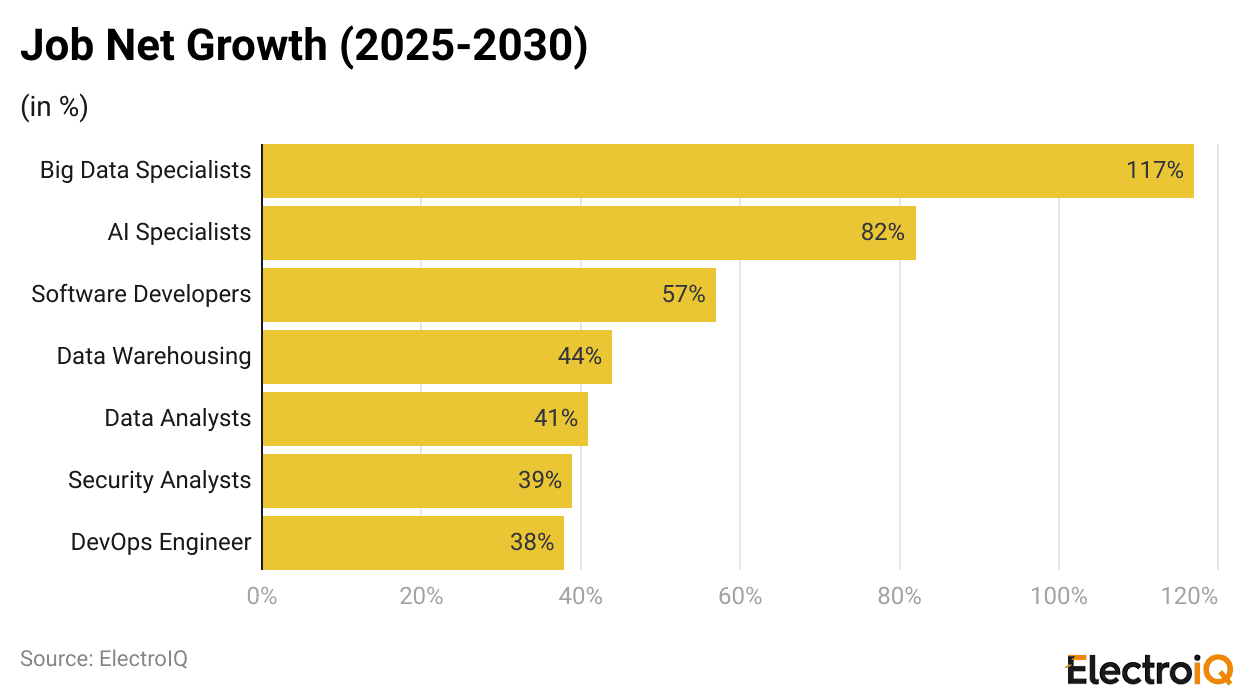
- The next five years are expected to see continued strong demand for proficient digital and analytical skills, according to the data.
- The World Economic Forum predicts an 82% increase in machine learning roles, indicating that AI models are becoming increasingly widely used in the finance, healthcare, retail, and manufacturing sectors.
- With the deployment of AI systems, organizations are not only looking for experts who can develop the AI models but also train them and maintain their functioning.
- The results of an employer survey conducted by the World Economic Forum further indicate that demand for big data specialists will increase the fastest, with a projected 117% increase in their number.
- This underscores the deep interconnection among data gathering, processing, and analysis, AI, automation, and data-driven decision-making.
- Indeed, handling large and complex datasets is still a fundamental requirement for the successful deployment of AI.
- However, it is surprising that employers also predict that software developer roles will increase by 57% during the same period.
- This prediction remains valid despite the presence of AI-powered coding tools such as GitHub Copilot, which enhance developer productivity.
- The situation seems to be that the tools are not supplanting the developers but rather enabling them to produce more and faster, thus creating a demand for the development of software products and digital services.
- Therefore, it is anticipated that the need for proficient developers will continue to increase rather than decrease as AI becomes more widely used.
Sector-Wise Distribution Of AI-Created Jobs
- In 2025, the healthcare sector was among the top three AI talent-embracing sectors, creating more than 640,000 positions linked to AI use for automated diagnostics, predictive healthcare analytics, and virtual patient support systems.
- The global financial services industry saw a net increase of almost 470,000 AI positions in 2025, primarily attributable to the use of AI for fraud prevention, algorithmic trading, and advanced risk assessment models.
- A substantial increase in the workforce due to AI was observed in manufacturing, with approximately 620,000 jobs created in 2025.
- Most of these jobs were associated with the management of robotics, the implementation of predictive maintenance solutions, and the usage of AI for quality inspection in manufacturing.
- In the retail sector, the employment of AI specialists exceeded 360,000 in 2025, and they worked on improving demand forecasting, supply chain optimization, and installing smart inventory as well as customer analytics platforms.
- The education sector employed AI to the level of approximately 210,000 roles in 2025, which included the posts of adaptive learning architects, AI curriculum designers, and the engineers of personalized education technologies.
- By the middle of 2025, the transportation and logistics sector had absorbed nearly 315,000 AI experts, with the rapid adoption of automated delivery solutions, clever routing software, and logistics optimization being the main drivers of this increase.
- Companies in the energy and utilities sector added approximately 188,000 new positions to their AI departments in 2025, primarily for smart grid management, demand forecasting, and infrastructure resilience maintenance through predictive techniques.
- The legal technology sector experienced a 21% increase in AI-related employment in 2025, with most positions focused on automated document review, compliance workflows, and AI-assisted research.
- The hotel and travel industry created approximately 96,000 new AI-enhanced jobs in 2025, including positions in developing virtual concierges, dynamic pricing analysis, and predicting consumer behaviour in travel.
- The cybersecurity industry created over 210,000 AI-integrated positions in 2025, driven by increased demand for machine-driven threat detection, behavioural analytics, and real-time response systems.
- Media and entertainment contributed about 143,000 new jobs centered on AI in 2025, mainly in the areas of content recommendation systems, the detection of deepfakes, and AI-aided creative production.
AI Job Growth Regional Distribution
- In North America, AI jobs grew by 24% in 2025, with the US adding an impressive 280,000+ net new AI jobs.
- AI hiring in Canada surged up 33% compared to the previous year, owing to the provincial funding programs, which strongly promoted deep-tech innovation and sustainable AI development.
- More than 850,000 AI jobs were created in Europe in 2025, with Germany, France, and Sweden leading, as companies adopted AI across manufacturing, finance, and public services.
- AI-related job growth in Eastern Europe in 2025 accounted for approximately 11% of the continent’s overall increase, driven by AI outsourcing and data annotation in Poland and Romania.
- The Asia-Pacific region accounted for more than twice the 2025 global total of new AI jobs, totalling approximately 1.1 million, with China, India, and South Korea leading.
- India’s contribution to the global AI workforce in 2025 was more than 490,000 jobs, thereby securing the status of the largest AI job creator among less-fortunate and developing countries.
- Australia and New Zealand experienced a 17% increase in AI job creation in 2025, driven by the healthtech, agritech, and environmental AI sectors.
- The Middle East made significant strides in AI hiring, driven by innovation zones, resulting in more than 128,000 AI jobs created in Saudi Arabia, the UAE, and Qatar in 2025.
- Initially, in Africa, regional AI adoption was largely driven by South Africa, Nigeria, and Kenya, which together recorded an annual growth rate of 14% in AI employment in 2025.
- Secondly, the South American continent was the second largest market for AI employment, which practically comprised 230 thousand jobs by the end of 2025.
- The Brazilian and Chilean markets were the most advanced, rapidly integrating AI across sectors such as agriculture, logistics, and manufacturing.
- Another reason for this global increase in AI employment was the upskilling and crossing over of the workforce.
- Organizations worldwide had increasingly introduced in-house AI upskilling programs in 2025, and actually, almost 46% of them used this method to train their staff on the new job requirements.
- AI education received a global boost, with over 58 million workers completing at least one AI-related course or certification in 2025, largely due to major workforce transitions and reskilling requirements.
- LinkedIn Learning witnessed a 62% increase in enrollments for courses related to AI in the first half of 2025, which was a clear indicator of the growing need for hands-on AI skills.
- In 2025, Coursera’s AI foundations pathway was a pulling factor of 14.2 million learners, among whom 50% were mid-career professionals adjusting to AI-influenced job changes.
- By the end of the second quarter of 2025, in the United States, government-supported workers’ programs had helped approximately 120,000 laid-off workers obtain AI-related certificates.
- Vocational retraining institutes across Europe reported a 39% increase in AI skills enrollments in 2025, with Spain and the Netherlands recording the largest increases.
- The Asia-Pacific region accounted for 44% of global AI reskilling activities in 2025, underscoring its strong commitment to developing talent ready for future challenges.
- The participation of professionals in AI bootcamps in the U.S. and Canada increased by 51% in 2025, primarily because professionals seeking career transitions into AI-related roles showed greater interest in AI.
- The average cost of AI upskilling per employee declined to approximately US$1,400 in 2025, a 19% reduction attributable to the growth of open-access learning platforms and digital training resources.
Conclusion
AI Job Creation Statistics: In 2025, artificial intelligence is a hard-to-ignore force reshaping global employment. According to some estimates, the number of newly created roles attributable to AI is approximately 3 million per year across all regions, industries, and skill levels. The major ones are healthcare, manufacturing, finance, and security, while Asia-Pacific and developing economies are the fastest-growing regions when it comes to hiring.
Moreover, large-scale AI training illustrates how workers and companies can adapt to this transformation. Rather than driving talent away, AI is reinventing positions, accelerating workflows, and making continuous education part of the long-standing company’s workforce resilience.
FAQ.
AI is expected to create about 5 million jobs worldwide in 2025, and the annual job creation will gradually rise to roughly 13 million per year by 2030 as the AI adoption spreads across industries around the globe.
The Asia-Pacific province is at the top of the list in terms of AI job creation, contributing close to 47% of the new AI jobs, followed by North America and Europe. India is marked as the biggest AI job creator in the developing world, while the U.S. keeps its position as the leading AI employment hub.
The leading sectors for AI job creation are healthcare, manufacturing, and financial services, which together are expected to generate more than 1.7 million new jobs in 2025. The same goes for the sectors of cybersecurity, retail, logistics, education, and energy, where strong AI impact is causing employment growth.
No doubt, AI is automating routine tasks, but at the same time, research by the World Economic Forum and other organizations points to a net job increase because of new roles that are driven by AI and the workflow restructuring of businesses intending to collaborate with human and AI.
A large part of the adaptation is being done through large-scale reskilling. In 2025, 46% of companies provided internal AI upskilling programs, and more than 58 million workers have successfully completed AI courses or gotten certification, all this thanks to lower training costs and greater access to online learning resources.

I hold an MBA in Finance and Marketing, bringing a unique blend of business acumen and creative communication skills. With experience as a content in crafting statistical and research-backed content across multiple domains, including education, technology, product reviews, and company website analytics, I specialize in producing engaging, informative, and SEO-optimized content tailored to diverse audiences. My work bridges technical accuracy with compelling storytelling, helping brands educate, inform, and connect with their target markets.