Remote Work Cybersecurity Statistics and Facts (2026)

Updated · Jan 06, 2026


Table of Contents
- Introduction
- Editor’s Choice
- Remote Work Security Market
- Most Popular Reasons For Working From Home (By Country)
- Rise In Cybersecurity Threats Due To Remote Work
- Most Common Cybersecurity Incidents In Remote Settings
- Top Cybersecurity Concerns Among Business Owners
- Shifting Workplace Trends – Remote, Hybrid, and Office-Based Work
- Jobs Most Frequently Done Remotely In The U.S.
- Security Issues With Cloud For Teams Working Remotely
- Compliance And Regulatory Trends In Remote Cybersecurity
- Best Practices For Securing Remote Workforces
- New Trends In Remote Work Cybersecurity
- Future Trends Of Remote Work Security
- Conclusion
Introduction
Remote Work Cybersecurity Statistics: In 2025, remote work is no longer just a trend; it has become the basis of global business operations. This shift from traditional offices to work-from-home arrangements has inadvertently increased the corporate attack surface area for cybercriminals. The security issue that was once considered a minor inconvenience has now evolved into a complex challenge, with significant financial, operational, and reputational damages possible.
The full range of threats, from credential theft and ransomware to home Wi-Fi vulnerabilities and insider threats, paints the remote work scenario in dark colours: it has heightened cybersecurity risk across all industries globally.
This article presents the latest Remote Work Cybersecurity statistics and research-based insights shaping the cybersecurity landscape in the era of remote work.
Editor’s Choice
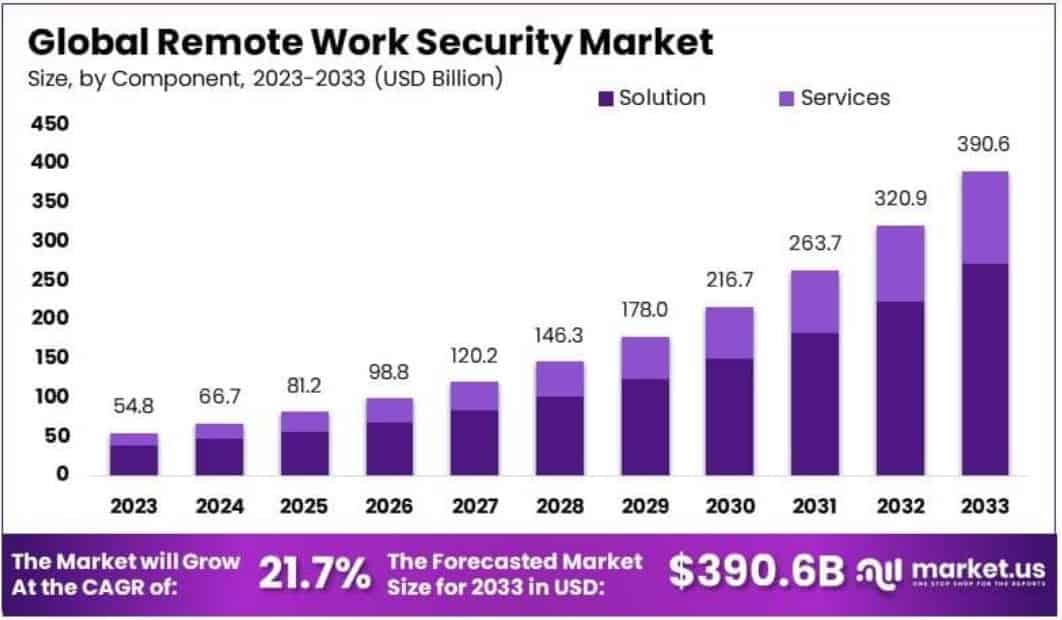
- The global remote work security market increased significantly, from USD 54.8 billion in 2023 to an anticipated USD 390.6 billion by 2033.
- 14% of adults in the U.S. have fully home-based jobs, 41% have mixed working arrangements, and the number of remote workers is projected to reach 32.6 million by 2025, representing 22% of the total workforce.
- Currently, about 16% of the companies in the world are completely remote, and remote work is most prevalent among the 24-35 age group and is accepted by both genders.
- Although the flexibility factor is present, more than half of remote workers report feeling less connected to their coworkers, which highlights challenges in collaboration and the need for engagement.
- 43% employed mainly in offices, and 16% in factories or production roles.
- Cloud computing is at the heart of remote working, but still poses a huge security risk because of access misconfigurations, unauthorized file sharing, third-party integrations, and shadow cloud accounts.
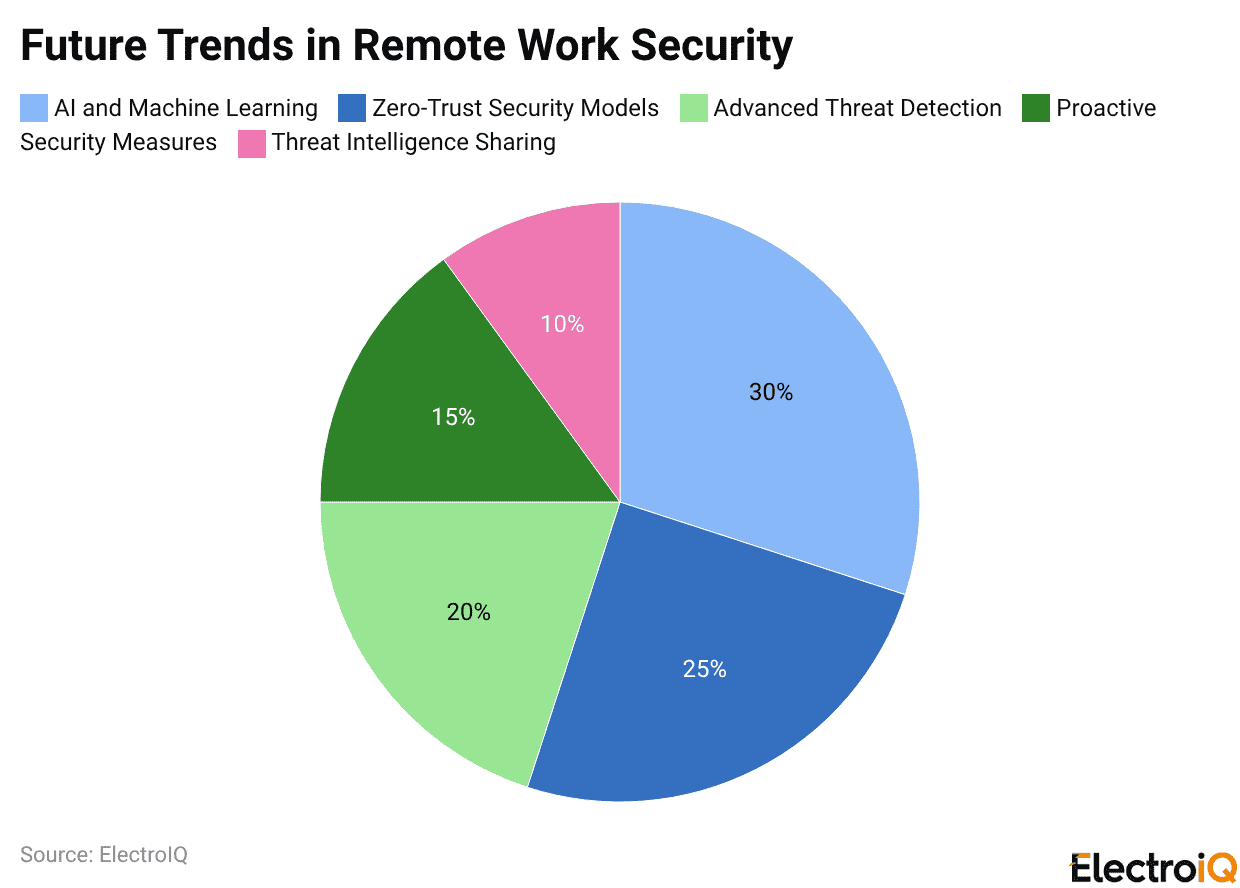
- Future remote work security strategies are increasingly driven by AI and machine learning (30%), zero-trust models (25%), advanced threat detection (20%), proactive security measures (15%), and threat intelligence sharing (10%).
Remote Work Security Market
(Source: market.us)
- The global market for remote work security is experiencing rapid growth and is projected to be a major winner, as remote and hybrid work models gain traction among the modern workforce.
- The market, valued at USD 54.8 billion in 2023, is projected to reach approximately USD 390.6 billion in 2033, indicating a 21.7% CAGR from 2024 to 2033.
- The return on such an investment is achieved through the increased use of cybersecurity tools, which are necessary for protecting distributed workforces, cloud systems, and remote access networks.
- Currently, approximately 14% of people work entirely from home, and nearly one-third of full-time workers opt for remote work, provided the option is available.
- Among all, 41% of hybrid employees have been transitioning between home and office-based setups.
- It is expected that this change will occur quickly, with Upwork projecting that 32.6 million Americans—approximately 22% of the total workforce—will work remotely in 2025.
Most Popular Reasons For Working From Home (By Country)
(Reference: sqmagazine.co.uk)
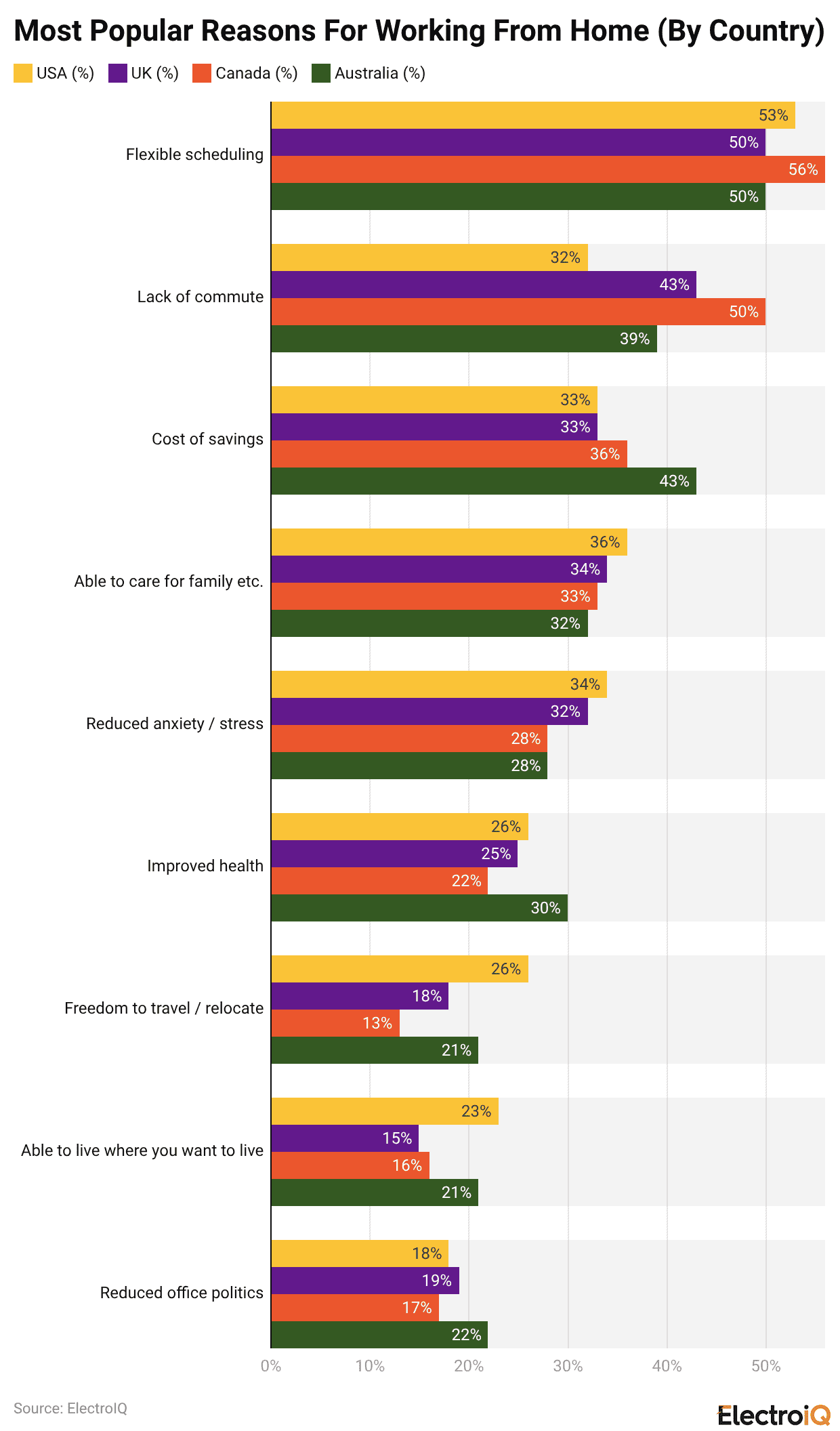
- Flexible Working Hours were among the most important overall benefits across all countries surveyed, and in particular in Canada, where 56% of respondents cited it as their first choice, while the USA ranked second at 53%.
- The elimination of everyday commuting is another substantial advantage that Canadians particularly value, as 50% of them consider it an advantage, compared with 43% in the UK and 39% in Australia.
- Cost-related factors have maintained their leading position, with cheaper life being most attractive in Australia (43%), followed by Canada (36%). In contrast, the USA and the UK report the same level of attention (33%).
- Caring for family members, pets, or ailing relatives is very important for respondents in the USA, where 36% cite this as a major benefit, followed by the UK at 34%.
- Another considerable driver is reduced anxiety and stress, with the USA at 34%, followed by Canada and Australia at 28% each.
- Overall health improvements, whether mental, physical, or spiritual, are most commonly reported in Australia, where 30% of people report this, and 26% in the USA.
- Among Americans, 26% consider the freedom to travel or relocate a major advantage, whereas among Canadians, only 13% do.
- The same pattern holds for where one lives: 21% of Australians and 23% of Americans find it an appealing factor, whereas in the UK it is 15% who consider it the least influential.
- Less office politics is a reason that varies by country, being the most significant factor for Australians at 22%, and pretty much less so for Canadian respondents at 17% and American respondents at 18%.
Rise In Cybersecurity Threats Due To Remote Work
- In the year 2025, the dangers of cybersecurity related to remote work are at the top of the list of risks that organizations are worried about all over the world.
- A whopping 92% of IT specialists think that the adoption of full remote and hybrid work has a direct impact on the increase of cybersecurity threats.
- The number of attacks against remote infrastructure has been increasing, with 38% of all cyberattacks targeting home routers, VPNs, and other remote-access methods.
- The remote devices that employees use have also become a popular entry point for ransomware, as 29% of the total ransomware attacks in 2025 came from home offices.
- The extent of these threats is huge, since the average number of attempted cyber attacks related to remote work faced by organizations per month in 2025 is 1,000.
- The security of credentials remains the primary weakness, as 54% of CISOs report an increase in credential theft incidents related to remote access tools.
- A recent survey revealed that 62% of the security breaches were due to the use of poor or stolen remote access credentials.
- To counteract these risks, 81% of companies carry out quarterly risk assessments that specifically focus on remote access points, which is a sign of a more proactive and organized approach to dealing with the security of remote work.
Most Common Cybersecurity Incidents In Remote Settings
- Phishing remains the most frequent attack type in remote work environments, accounting for 43% of initial breach attempts in 2025.
- Unsecured personal devices also pose a significant security risk, with 22% of endpoint weaknesses exploited due to them.
- One of the main problems with remote work appears to be the lack of appropriate hardware or outdated hardware.
- In the case of remote work, the misconfigured VPNs led to 14% of data leaks, while a total of cloud-based misconfigurations accounted for 17% security incidents regarding remote workers in 2025.
- The issue of malware infections remains a concern, as among the treatments provided to infected users, drive-by downloads from insecure sites accounted for 9% of infections among remote workers.
- Misuse of RDP (Remote Desktop Protocol) was another cause of unauthorized access and accounted for 11% of such incidents.
Top Cybersecurity Concerns Among Business Owners
- Business owners in 2025 are more concerned than ever with AI-associated security threats and modern digital infrastructures.
- The hacking of the GenAI model prompts is a major concern, with 46% of business owners reporting fears that the attackers could either corrupt AI outputs or access sensitive data.
- After that, 38% identify LLM data poisoning as a significant threat that can undermine the reliability and trustworthiness of AI-based systems.
- The old-fashioned threats are still very much alive, with 37% of entrepreneurs sharing the concern about ransomware as a service, indicating that cybercrime has gone through an evolution where it is now an organized, scalable business model.
- Hardware-level risks are increasingly recognised, and thus 26% fear attacks on GenAI processing chips that could undermine AI infrastructure at the ground level.
- Additionally, 24% consider API breaches a notable threat, emphasizing the growing importance of securing integration points as businesses rely more heavily on interconnected platforms and services.
Shifting Workplace Trends – Remote, Hybrid, and Office-Based Work

(Source: statista.com)
- In the past couple of years, the trend has been that very large companies—primarily in the fields of finance and technology—have either begun promoting or mandating that their employees return to the office.
- For instance, Microsoft, now one of the major firms, expects employees to work on-site more frequently; moreover, Amazon has adopted an even stricter policy, requiring employees to return to the office five days a week.
- In this context, these measures are the first signals of a gradual return to the pre-pandemic era, when work was conducted primarily in the office.
- According to the Statista Consumer Insights survey, approximately 20% of U.S. adults still work from home regularly, a figure that has not changed much since 2022. However, one might say that remote work is not the leading model.
- A greater number of workers—43%—indicate that their company’s office is the primary place of work, while 16% work primarily in the factory or at the production site, reinforcing that on-site work remains important across industries.
Jobs Most Frequently Done Remotely In The U.S.
(Source: statista.com)
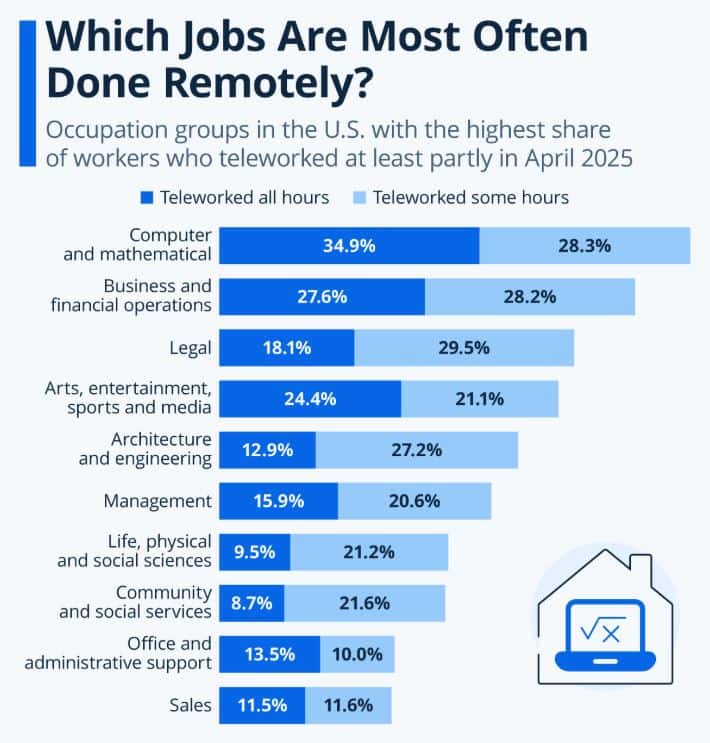
- In the U.S., the remote work trend has affected primarily computer and math professionals, with 34.9% of employees working from home for the entire workday and an additional 28.3% doing so for part of their schedule.
- Business and financial operations roles are close, with 27.6% of employees working entirely remotely and 28.2% working between home and the office.
- The legal field leans strongly toward hybrid arrangements: 18.1% are fully remote, and 29.5% telework part of the day, the highest rate for any category.
- The creative sectors, such as arts, entertainment, sports, and media, still had considerable remote involvement, with 24.4% of workers fully remote and 21.1% part-time.
- On the other hand, the Architecture and engineering professions have reported low adoption of full-time remote work (12.9%), but a significant number (27.2%) work part-time from home.
- The management area is more evenly shared, with 15.9% of the managers working fully remotely and 20.6% doing so part-time.
- In the life, physical, and social sciences, 9.5% of workers are fully remote, while 21.2% work only some hours.
- Although remote work has been widely viewed as a benefit for employees, employers are also likely to benefit, and one way to do so is through more strategic use of HR resources.
- Community and social services, on the other hand, are where 8.7% of the workers are reported to be fully remote and 21.6% partially.
- Office and administrative support roles remain more office-based: 13.5% work fully remote and only 10.0% part-time.
- The sales roles registered the lowest total remote participation of 11.5% for full-time and 11.6% for part-time remote workers.
Security Issues With Cloud For Teams Working Remotely
- The use of cloud platforms has become indispensable for remote working, yet they keep bringing risks.
- In 2025, nearly 90% of companies reported that cloud applications were essential for their remote operations, yet they remained a significant security concern.
- Misconfigured access controls accounted for 24% of security breaches during the year.
- The problems caused by a lack of visibility are common: 51% of IT administrators reported difficulty monitoring data flows among the cloud tools used by teams working in different locations.
- Due to unauthorized file transfers via cloud platforms, 17% of data exposures occurred, while 13% breaches through indirect access were due to third-party integrations in the cloud ecosystem.
- 28% of U.S. firms using international cloud providers faced data residency and compliance issues.
- The implementation of Cloud Security Posture Management (CSPM) tools increased by 32% in 2025 to manage these risks.
- At the same time, shadow cloud accounts and unmonitored access to Google Drive-type services grew by 26%, thus making it more difficult to oversee security measures.
Compliance And Regulatory Trends In Remote Cybersecurity
- In 2025, regulatory pressure on remote work security intensified.
- Approximately 71% of U.S. companies indicated that new compliance regulations were among the factors most affecting their remote work policies.
- There was a 15% increase in the number of GDPR enforcement actions linked to remote data handling in the U.S.-EU operations.
- The new CISA instructions explicitly require federal contractors to use remote endpoint monitoring.
- At the state level, privacy laws such as the California CPRA greatly impacted the broad scenario and affected the remote compliance practices of 43% of U.S. companies.
- PCI DSS version 4.0 strengthened the security of remote payment processing environments by mandating additional controls.
- SOX audits increased the detection of violations related to remote system access by 24% and 32% of U.S. companies were subjected to compliance assessments by third-party auditors specifically for remote cases.
- As a consequence of these gaps, 21% of organizations suffered penalties due to insufficient logging of cloud and VPN during security investigations.
Best Practices For Securing Remote Workforces
- The organizations have made the decision to enhance the remote security infrastructures. Zero-trust models were the basic strategic approach for 63% of companies in 2025.
- 91% of companies made it compulsory to use multi-factor authentication for all remote access points. 44% of remote-first firms performed weekly or biweekly patching.
- Endpoint Detection and Response (EDR) systems were installed on 57% of remote device fleets.
- To prevent social engineering, 76% of companies employed phishing simulations and interactive training programs.
- Virtual desktops, a type of browser-based secure environment, accounted for 34% of the market among remote users.
- Maintaining an inventory of IT assets was a top priority for 58% of security chiefs responsible for hybrid work models, and 39% of companies used user behaviour analytics to detect insider threats in real time.
New Trends In Remote Work Cybersecurity
- Technological advancements continued to reshape remote security strategies in 2025. The use of AI-powered threat detection software for remote endpoints was up by 46%.
- SASE (Secure Access Service Edge) was employed by 35% more organizations, thus enabling companies to integrate their communication and security for remote teams.
- 62% of medium-to-large businesses have adopted a cloud-native SIEM solution for the purpose of analyzing remote access logs.
- Remote working policies were responsible for a 31% increase in the need for location-independent identity and access management systems.
- Also, the realization of high-security postures was accompanied by the quantum-resilient encryption test run by 11% of highly protected organizations.
- FIDO2 security keys as hardware-based authentication for home offices were accepted by 28% of remote workers.
- Additionally, continuous authentication methods, including keystroke biometrics, entered pilot programs in 19% of large enterprises.
Future Trends Of Remote Work Security
(Reference: cloudthat.com)
- Data-driven and collaborative methods are increasingly shaping the development of cybersecurity strategies, with AI and machine learning as key technologies accounting for about 30% of current attention.
- Through the use of these technologies, organizations are able to quickly respond to possible attacks as the security is upheld in real-time and the potential threats are detected through the analysis of large amounts of data to find patterns, anomalies, and threats.
- The zero-trust security models are the other way around, comprising approximately 25% of cybersecurity adoption priorities, as they are the ones that continuously verify the identity and trust level of each user and device, thus minimizing the risk of unauthorized access in widely spread and remote areas.
- Advanced threat detection solutions account for nearly 20% of total security investments, indicating a growing need to protect against complex, sophisticated cyberattacks that traditional tools may not detect.
- The proactive security measures are responsible for around 15%, which means that the organizations prefer to use methods such as continuous monitoring, timely patching, and early risk identification instead of reactive approaches.
- Lastly, 10% of the total resources are allocated for the sharing of threat intelligence, where the partnerships among the companies lead to the rapid discovery of new threats and to the reinforcement of the shared defenses against the continuously changing cybersecurity problems.
Conclusion
Remote Work Cybersecurity Statistics: In the end, a remote working style has drastically altered the cybersecurity scene in 2025, and along with that, the organizations have also intermingled the unthinkable risk and flexibility. As the remote and hybrid models grow to be staples, the range of threats that the organizations face will continue to grow, mainly due to the reliance on the cloud, remote endpoints, and the ever-changing threat vectors like ransomware, phishing, and AI-powered attacks. The data indicate that weak credentials, misconfigurations, and non-compliance remain the primary vulnerabilities.
However, increasing investments in zero trust, AI-based detection, regulatory compliance, and good security measures indicate that the technology companies are coming of age in dealing with these problems. To sum up, if remote work is to be successful, it will have to rely on always-on security innovations, well-informed staff, and resilient, adaptive security systems.
Sources
FAQ.
The move of employees from secured office networks to home Wi-Fi, personal devices, and cloud-based tools has expanded the attack surface. In 2025, 92% of IT professionals report that remote and hybrid work has increased cybersecurity threats.
The data from different sources suggests that phishing still is the primary attack vector and is responsible for 43% of the initial breach attempts in remote environments. Other important incidents consist of cloud misconfigurations (17%), unpatched personal devices (22%), misconfigured VPNs (14%), and Remote Desktop Protocol (RDP) misuse (11%).
The worldwide remote work security market was pegged at USD 54.8 billion in 2023 and is expected to escalate to USD 390.6 billion by 2033, attaining a CAGR of 21.7%.
Among the concerns of business owners in the year 2025, 46% highlight GenAI prompt hacking as their main issue, while LLM data poisoning takes second place with 38%. Traditional threats are still considered major problems; 37% are concerned about ransomware-as-a-service.
Top companies take up layered security approaches. In 2025, it will be found that 91% of companies will make use of mandatory multi-factor authentication, 63% will apply zero-trust models, and 57% will implement Endpoint Detection and Response (EDR) tools.

I hold an MBA in Finance and Marketing, bringing a unique blend of business acumen and creative communication skills. With experience as a content in crafting statistical and research-backed content across multiple domains, including education, technology, product reviews, and company website analytics, I specialize in producing engaging, informative, and SEO-optimized content tailored to diverse audiences. My work bridges technical accuracy with compelling storytelling, helping brands educate, inform, and connect with their target markets.