Mahindra Two-Wheelers Statistics And Market Trends (2026)

Updated · Jun 03, 2026


Table of Contents
Introduction
Mahindra Two-Wheelers Statistics: Mahindra Two-Wheelers kinda went through a big change in the last decade, and it’s not just one move either. Over time, the company moved away from the mass market motorcycle and scooter business, though it still kept a solid foothold in the premium motorcycle space. It basically did that via its strategic investment in Classic Legends, which is the group behind Jawa, Yezdi, and BSA. Then, during 2025–2026, Mahindra’s whole two-wheeler plan sort of shifted, from trying to compete purely on volumes toward premium lifestyle riding.
The focus moved to better margins, overseas sales, heritage style branding, and a wider global push. Because of this, Mahindra now looks like a more niche but still increasingly important name in India’s expanding premium motorcycle market. And recently, the Mahindra-backed two-wheeler operations logged what is being called their strongest showing since the Jawa and Yezdi brands were brought back. More customers wanting retro motorcycles, stronger demand for global exports, plus quick dealership roll-outs were the main reasons behind that growth.
Editor’s Choice
- In February 2026, India’s two-wheeler market jumped 35.2% YoY to 18.71 lakh units, showing consumers were buying again, and the market recovery is real.
- Hero MotoCorp stayed on top with 5.17 lakh units, up 44.7% YoY, and with market share climbing to 27.62%.
- Meanwhile, the top three manufacturers—Hero, Honda, and TVS together—controlled 74.6% of total sales, so the market is pretty concentrated.
- Classic Legends, the Mahindra-backed company, reached record FY26 retail sales of 45,409 motorcycles, and that came with 39.8% YoY growth vs FY25.
- Also, FY26 became Classic Legends’ first profitable year since 2018, which is a major turnaround after almost eight years of investment-driven losses.
- On the bigger scale, Classic Legends actually beat the broader industry, which grew 13.4% to 21.4 million units in FY26.
- The company’s market share sort of improved from 0.17% to 0.21%, showing a growing acceptance of the Jawa, Yezdi, and BSA brands overall.
- Classic Legends is looking to ramp up from around 56,000 units sold in FY26 to over 70,000 units in FY27, aiming at a steady 100,000 annual sales in the longer run.
- Exports volumes went up about six times, moving from 1,000 units in FY25 to 6,000 units in FY26, and exports now seem to be contributing roughly 10% of total sales.
- Mahindra’s commercial mobility strength stayed pretty visible, with 1,142 cargo vehicles sold (+59% YoY) and 37,222 three-wheelers, plus commercial vehicles sold (+23.24% YoY) in January 2026.
Two-Wheeler Market
(Source: autopunditz.com)
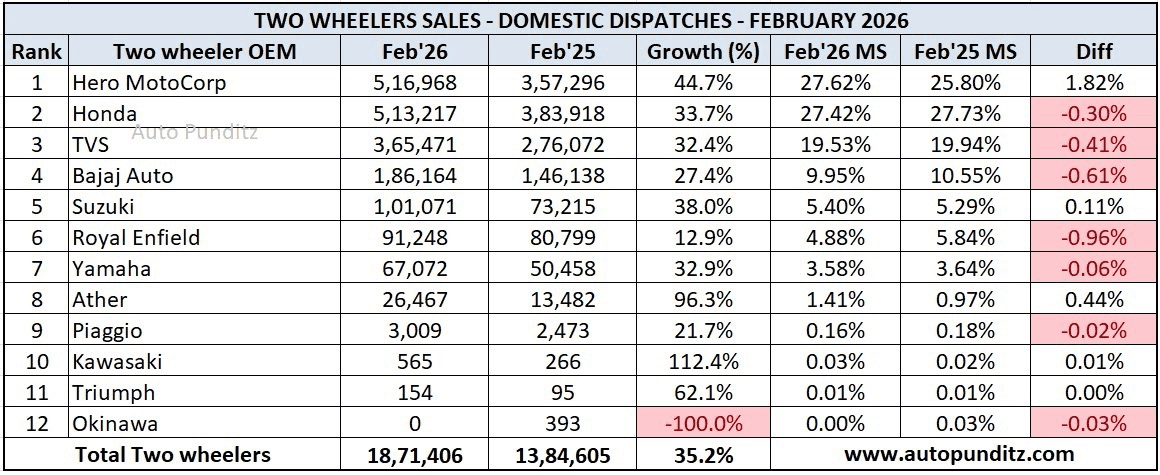
- In February 2026, the domestic two-wheeler space put up a pretty commanding show, touching 18,71,406 units, against 13,84,605 units in February 2025, so that worked out to a solid 35.2% year-on-year rise. It sort of points toward a firm buyer appetite and a steadily improving market mood.
- Hero MotoCorp came in first, moving 5,16,968 units and showing a strong 44.7% uptick, plus it nudged its market share from 25.80% to 27.62%, that’s 1.82 percentage points, which is basically the largest share jump among the big OEMs.
- Honda was right behind, selling 5,13,217 units, up 33.7%, but its market share slipped a bit from 27.73% to 27.42%.
- TVS Motor held onto the third spot, with 3,65,471 units and 32.4% growth, though its market share softened by 0.41 percentage points to 19.53%, you know, not a huge but noticeable trim.
- Bajaj Auto posted 1,86,164 units on 27.4% growth, but it gave up 0.60% in market share too, pointing to sharper rivalry in commuter and also in the premium lanes.
- Suzuki kept climbing; it actually crossed the 1 lakh-unit mark with 1,01,071 units, up 38.0%, and the market share ticked up slightly to 5.40%.
- Royal Enfield logged 91,248 units, with 12.9% growth, the slowest pace among the major players, and that fed into a clear 0.96 percentage-point fall in market share.
- Yamaha delivered 67,072 units, rising 32.9%, and it mostly stayed put in positioning, even though market share slipped a tiny 0.06 percentage points.
- Electric vehicle specialist Ather came out as a standout performer, sort of nearly doubling its sales to 26,467 units, with an exceptional 96.3% growth rate, and it also lifted market share from 0.97% to 1.41%.
- Kawasaki landed the top growth in percentage terms at 112.4%, but its impact stayed pretty niche at 565 units, which signals growing curiosity around premium motorcycles.
- Triumph posted 154 units, plus a fairly strong 62.1% growth, pointing to a steady expansion in the premium space, even if the overall slice of the market is still small.
- Piaggio added 21.7% to reach 3,009 units; it saw a small contraction in market share, hinting at stiff rivalry from bigger brands.
- The Government of India’s VAHAN Dashboard shows zero dispatches, against 393 units a year before, so that works out to a 100% fall, and it ended up being the only manufacturer with negative growth.
- Taken together, the top three players—Hero MotoCorp, Honda, and TVS—were responsible for roughly 74.6% of total industry sales, which really underlines how concentrated India’s two-wheeler market is.
The Rise of Mahindra’s Premium Motorcycle Ambitions
- According to Cartoq, the Mahindra-backed Classic Legends delivered a kind of strongest-ever performance in FY26, retailing 45,409 motorcycles compared with 32,482 units in FY25. That works out to a strong 39.8% year-over-year growth, and also seems to underline the growing acceptance of the Jawa, Yezdi, and BSA brands inside India’s premium motorcycle space.
- The headline win wasn’t only the sales ramp-up, but the company’s shift into profitability, because FY26 turned out to be the first profitable year since Classic Legends kicked off in 2018. It basically ended nearly eight years of continuous, investment-led losses and suggests that the premium heritage motorcycle plan is finally getting real financial traction.
- Cartoq also notes that the turnaround really picked up speed in the second half of FY26, when sales jumped by 100% versus the same period the year before. In other words, newer product launches, firmer festive demand, and favorable market conditions came together to create a lot of forward momentum.
- India’s overall two-wheeler industry moved ahead by a healthy 13.4% to 21.4 million units during FY26.
- Classic Legends clearly outpaced the broader market. That outperformance points to it capturing market share faster than industry averages, and it helps reinforce its competitive footing.
- The company’s retail market share rose from 0.17% to 0.21%. Even if that sounds small on the surface, in absolute terms it’s still a meaningful tell, showing that brand awareness and customer confidence are improving steadily.
- Looking ahead, Classic Legends is kind of positioning FY27 as a major scale-up year, aiming for more than 70,000 units of production versus roughly 56,000 units, including exports, in FY26, while still keeping that long-term desire to cross the 100,000-unit annual sales line.
- Retail expansion is staying a key growth lever, the company plans to push its network to 500 outlets by the festive season, and then to well over 700 touchpoints by FY28, which should improve customer access and also the after-sales support across India.
- Capacity expansion looks like the next big strategic challenge, too, because the Pithampur manufacturing facility is already at 100% utilization, yet supplier and vendor capacity, not factory infrastructure, is where the real constraint is sitting right now.
- Exports are getting more relevant by the day; they contribute about 10% of total volumes today, with management wanting to double that to 20% as international momentum increases, especially in Europe, where BSA’s heritage brand recognition is still much stronger than in India.
Mahindra Two-Wheelers Strategic Focus
- Mahindra’s strategic focus in the two-wheeler segment seems to land more with enterprise and fleet solutions than, let’s say, with individual retail buyers, so the brand ends up looking like it supplies cost-effective and long-lasting vehicles for last-mile delivery, online commerce fleets, and logistics operators.
- This approach also sort of matches the company’s bigger, broader strength in last-mile mobility, where Mahindra managed 1,142 cargo vehicles in January 2026, up 59% YoY, and 37,222 three-wheelers plus commercial vehicles in January 2026, up 23.24% YoY. All of that hints at better pull in commercial mobility rather than consumer two-wheelers.
Strategic Outlook and Future Priorities
- For the near future, Mahindra’s two-wheeler unit will likely keep functioning like a niche, enterprise-first space rather than turning into a mass-market challenger, not through 2026 and also not really after that.
- In other words, the company will likely keep prioritizing last-mile mobility, three-wheelers, and commercial vehicles, because those areas have shown stronger market grip and better profitability.
- Then, during 2026-2027, electrification will probably get more attention across the whole mobility landscape, but Mahindra’s electric two-wheeler plan will likely stay aimed at fleet and enterprise customers.
- And since the company’s consolidated finances look strong, with 14% revenue growth and 20% PAT growth in FY25, Mahindra should have the money side to selectively push two-wheeler innovation.
- Still, the division’s strategic weight should remain a bit secondary to the company’s core four-wheeler, farm equipment, and last-mile mobility businesses.
- The global two‑wheeler market’s projected growth at a CAGR of 5.94% to USD 165.38 billion by 2030, and India’s achievement of 20 million unit annual sales in 2025, really confirmed that strong industry tailwinds are underway.
- Still, Mahindra being more of a niche participant means its growth path is going to lean on fleet and enterprise take‑ups, instead of retail volume expansion, with the company likely to hold a sub‑1% market share in the consumer two‑wheeler space while it uses its wider mobility ecosystem for indirect two‑wheeler wins via corporate tie-ups and last‑mile logistics solutions.
Classic Legends’ Global Expansion and Export Strategy
- Classic Legends is stepping into a new growth phase, with an assertive international expansion approach, targeting seven new markets spanning the United States, Europe, and South America as a part of its FY26–FY27 roadmap.
- The company has locked in roughly ₹1,000 crore in investments between 2023 and FY26 to back product development, manufacturing scaling, dealer network growth, and export readiness, while close to ₹350 crore has already been put to work by mid‑2025.
- From an analyst’s point of view, this kind of spending hints at a directional shift, away from being mostly domestic and more toward becoming a globally visible heritage motorcycle brand that taps into the appeal of Jawa, Yezdi, and BSA.
- Management has also outlined an ambitious export target of 20,000–30,000 units for FY26, with expectations of 25,000–30,000 units being dispatched to important overseas markets such as the US, Europe, and South America.
- Export momentum is already building, with overseas shipments jumping sixfold from 1,000 units in FY25 to 6,000 units in FY26, even though the US market launch faced regulatory friction and tariff-related delays.
- Classic Legends wrapped up FY26 with roughly 56,000 total motorcycle sales, and exports were around 10% of the overall volumes, which kinda shows the early win of its international plan.
- Management is now saying exports should get to about 20% of total sales in the near term, and maybe reach 30–35% of volumes within the next couple of years, as distribution networks get more settled across markets.
- Brazil, Mexico, and Argentina have turned into the priority South American spaces where retro-styled, mid-capacity motorcycles get strong attention from riders, and they can still carry premium pricing.
- Next, total production capacity is projected to go beyond 100,000 units each year, so it can support both export growth and domestic expansion efforts.
- Then FY27 should be one more major step, with management expecting total sales to climb over 70,000 units, a real jump compared to FY26 levels.
Conclusion
Mahindra Two Wheelers pretty much managed to reposition itself, from that usual mass market two-wheeler maker vibe, to a more premium motorcycle-focused mobility player thing, basically by putting money in Classic Legends. The FY26 showing by Jawa, Yezdi, and BSA signals that buyers are increasingly into heritage styled bikes, and it kind of backs Mahindra’s premiumization approach too.
Sales growth stayed strong, profitability was achieved, the dealer ecosystem is getting broader, and export plans are getting more ambitious… all of this suggests the company is moving into some newer phase for steadier expansion. Even so, Mahindra still sits as a niche player in the wider two-wheeler space, but its tilt toward premium motorcycles, lifestyle branding, and cross-border growth gives it a separate route for longer-term value creation.
Sources
FAQ.
Classic Legends retailed 45,409 motorcycles in FY26, which works out to 39.8% year on year growth.
Yes. FY26 was the first profitable year for Classic Legends since it began operations in 2018.
Classic Legends owns and operates the Jawa, Yezdi and BSA motorcycle brands.
The company is aiming for more than 70,000 units of production in FY27.
Exports are around 10% of volumes right now, and the longer-term idea is to take it up to 20%, especially by expanding into European markets.

Barry Elad is a passionate technology and finance journalist who loves diving deep into various technology and finance topics. He gathers important statistics and facts to help others understand the tech and finance world better. With a keen interest in software, Barry writes about its benefits and how it can improve our daily lives. In his spare time, he enjoys experimenting with healthy recipes, practicing yoga, meditating, or taking nature walks with his child. Barry’s goal is to make complex tech and finance information easy and accessible for everyone.