3D Printing Statistics By Market Analysis, Adoption Rates, Trend, Disruptions Impact, Patent, Recent Developments and Facrts (2025)

Updated · Dec 16, 2025


Table of Contents
- Introduction
- Editor’s Choice
- Global 3D Printing Market Statistics
- 3D Printing Adoption Rates And Trends
- Trends and Disruptions Impact
- 3D Printing Material Market
- 3D Printing Companies And Market Share
- 3D Printing In Fashion
- Leading Innovative Countries for 3D Printing
- Global Patent Holders in Additive Manufacturing
- Recent Developments
- Conclusion
Introduction
3D Printing Statistics: A decade back, if 3D printing was a fun little experiment from the tech world, 2025 was the year that it no longer played the role of supporting act but rather became the one that dictated the performances in the industrial times. Besides custom medical implants, aerospace brackets that are ready for use in flights, and consumer desktop printers with output up to a million units, additive manufacturing (AM) emerged as a combination of Research & Development, industrial manufacturing, and mass market hardware, and the data verifies it.
To support this claim, we will show below the most significant 3D Printing statistics for 2025: market size and growth, material and equipment, and company highlights all through the lens of the most recent reports and industry research.
Editor’s Choice
- The global 3D printing market was valued at US$19.8 billion in 2023.
- In 2033, the market is expected to grow to US$135.4 billion with a 21.2% CAGR (2024–2033).
- The engineering companies’ 3D-printed end-use components usage had increased by 54% during the year 2020.
- The worldwide 3D printing business had a total value of US$13.8 billion in 2021, where the North American market share stood at US$5.72 billion.
- The total number of 3D printers shipped around the world in 2021 was 2.2 million units.
- The North American market accounted for US$8.61 billion of 3D printing in 2024, with a growth rate of 18.6% CAGR through 2034.
- The U.S. market for 3D printing products alone was US$5.93 billion in 2024.
- Rapid prototyping, along with 3D printing services, in the U.S. is projected to be worth US$4.3 billion in 2025 with a compound annual growth rate (CAGR) of 17.2%.
- Over 60% of the total 3D printing revenue from around the globe comes from hardware.
- The automotive industry possessed more than 25% of the overall revenue generated from the 3D printing industry in the year 2024.
- The healthcare/dental market for 3D printing is expected to grow at a CAGR of 17.5% until the year 2029.
- The global 3D printing materials market was evaluated at US$3.2 billion in 2024, and it is anticipated to grow to US$12.4 billion by 2033 with a CAGR of 15.6%.
- According to another estimate, the market for the materials would be increasing from US$2.99 billion (2025) to US$8.10 billion (2030) at a compound annual growth rate of 22.05%. Reports from 3D printing users reveal cost cuts in 82% of the businesses, while 22% are implementing the technology in fashion and manufacturing just to cut off on waste.
- The 3D printing arena reported a US$17 billion market in 2022 and a revenue of US$19.9 billion in the following year with a 17% CAGR.
Global 3D Printing Market Statistics
(Source: scoop.market.us)
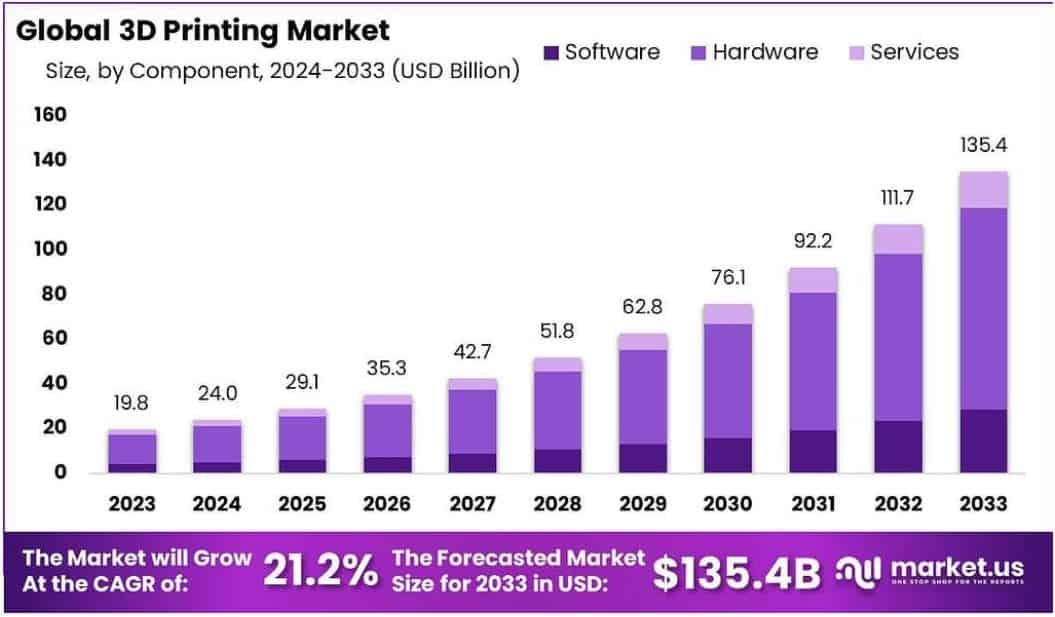
- The worldwide 3D printing market has been walking hand in hand with the global economic meltdown, and the numbers quite vividly depict such a rapid growth process in the industry.
- The approximate market worth in 2023 was around USD 19.8 billion, and the future, according to the forecasts, might, at the highest rate, reach USD 135.4 billion in 2033.
- This enormous hike is accompanied by a great CAGR of 21.2% which is expected for the years 2024 through 2033 and is a reflection of the increasing adoption via the medical, aerospace, automotive, and consumer goods sectors.
- The signs of such expansion have already been apparent during the first half of the decade.
- In 2020, the engineering sector began utilizing 3D-printed functional end-use components by 54% more, which was a clear indicator of the transition from 3D printing as prototyping to a real production tech replacement.
- The following year, the global 3D printing market reached USD 13.8 billion, with North America participating with USD 5.72 billion, thereby showcasing a very strong regional influence.
- The majority of analysts are in agreement that the market would continue to be very dynamic, with most expecting the annual rate of growth to be somewhere in the range of 18% to 27%.
- A number of factors, like the decreasing price of hardware, the advent of better materials, and the growing industrial cooperation, have all been playing their part in the rapid ascent.
- The year 2021 saw 3D printer shipments reaching around 2.2 million units, which is indicative of the technology being firmly rooted in both consumer and professional markets.
3D Printing Adoption Rates And Trends
- The 3D printing industry is still developing all over the map, and North America is the major pole that is leading the way.
- In 2024, the North American market was valued at US$8.61 billion, and it is expected to grow every year at a stable rate of 18.6% CAGR up to 2034.
- The state of California in the USA shows the same trend with its 3D printing market estimated to be worth US$5.93 billion in 2024 across the board, including hardware, materials, and systems.
- Moreover, the industrial sector has adopted 3D printing technology along with the increasing affordability and capability of these technologies as the main drivers for this growth.
- Another strength in the U.S. market is the sector of rapid prototyping and 3D printing services.
- The sector is estimated to earn US$4.3 billion in 2025, which is quite an impressive figure and reflects a CAGR of 17.2% over the last five years.
- This indicates that businesses have considerably moved from having their own equipment to heavily relying on on-demand printing services.
- When taking into account all the different segments, hardware is the largest one, since it generates more than 60% of the total market revenue globally.
- Although hardware still takes the lead in monetary terms, the software and services segment is growing faster in percentage terms, especially because industries are now requiring tools for workflow automation, design optimization, and digital inventory management.
- While the manufacturers give various reasons for the adoption of 3D printing, being able to make intricate designs and highly customized products are the main ones, as these do surpass the capabilities of conventional manufacturing.
By Industry/Vertical
- The industries that have embraced 3D printing have done so to different extents, with some areas moving much faster than others.
- The automotive industry was one of the biggest 3D printing users in 2024, as it accounted for more than 25% of the global revenue share.
- The car makers, along with their suppliers, are the main users of additive manufacturing for the purposes of making prototypes, tooling, producing lightweight components, and customizing parts.
- The fastest-growing segment within the healthcare sector— dental applications in particular— estimates a 17.5% CAGR up to 2029.
- This increase is mainly caused by the rising need for individualized implants, surgical guides, dental prosthetics, and biocompatible materials.
- The aerospace industry heavily relies on 3D printing to manufacture parts that are lighter, have intricate shapes, and are made through rapid tooling.
- The industry is progressively becoming more dependent on additive manufacturing because it can lead to a lesser number of parts and thus, better efficiency in terms of fuel consumption.
- The education and research sectors are also major users of 3D printing technology, primarily for prototyping, teaching, and development projects.
- Even though their growth is not as rapid as that of the industrial sectors, the adoption is constant and supports skill-building.
- The consumer goods market is still very much dependent on basic, desktop 3D printers, which are mostly used for product design, hobbyist applications, and small-scale production.
- However, the construction and housing industry is beginning to be perceived as a promising area for application.
- The sector is considering employing large-scale 3D printing for the construction of walls, structural elements, and formwork, which is an indication that additive manufacturing might eventually revolutionize the whole construction sector.
Trends and Disruptions Impact
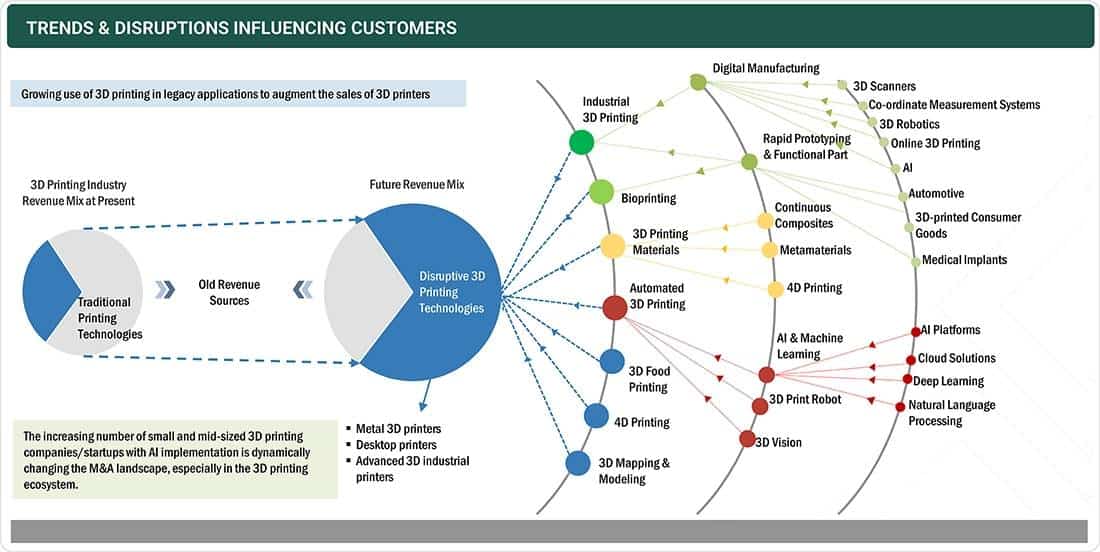
- According to MarketsandMarkets, newer additive technologies are helping companies build prototypes faster and produce usable end parts with less delay.
- These tools also make it easier to create highly customized products, which can directly improve how customers run their businesses.
- Automation is reducing manual work in printing workflows and improving consistency across production.
- AI features are making printing smarter by improving setup decisions and cutting avoidable errors.
- Material advances like composites and biocompatible options are expanding what can be made, while supporting lower costs, more design freedom, and better sustainability.
(Source: marketsandmarkets)
3D Printing Material Market
(Reference: sqmagazine.co.uk)
- The market of 3D printing materials has experienced rapid growth as different sectors have been transitioning from prototyping to mass production.
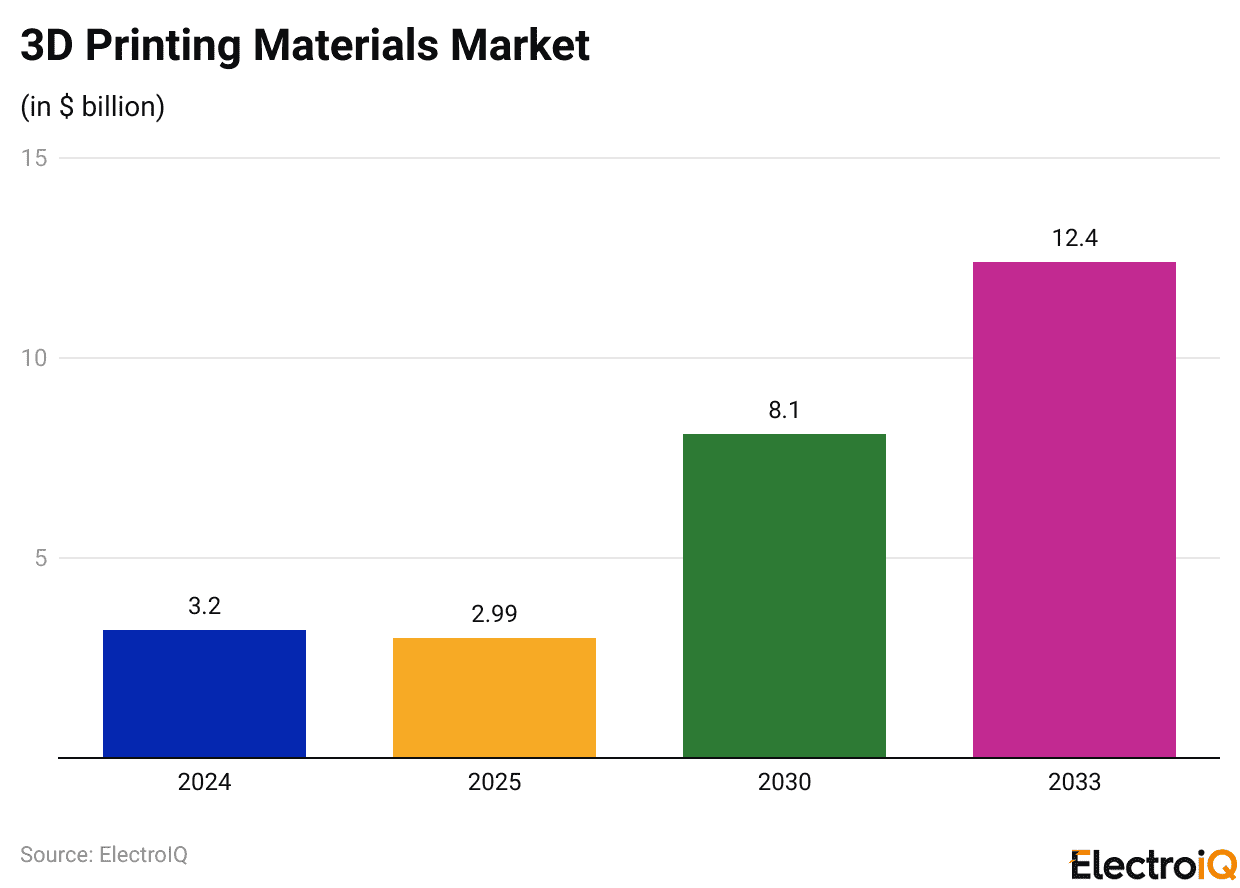
- The value of the global market for such materials, which includes such things as polymers, metals, resins, and composites, was about US$3.2 billion in 2024.
- Strong growth is expected in the following ten years, with projections indicating that the market will reach around US$12.4 billion by 2033, underpinned by an uninterrupted ~15.6% CAGR from 2025 to 2033.
- The growth is a result of the increasing demand for high-performance materials by the sectors of automotive, aerospace, healthcare, and consumer goods, all of which are dependent on these materials for the production of their end-use parts.
- A different projection sees the market value at US$2.99 billion in 2025, going up to US$8.10 billion in 2030, which translates into an even larger ~22.05% CAGR.
- The gap between the forecasts results from the different assumptions and methodologies of the research firms, but both point out the same trend: the materials sector is becoming one of the prime drivers of the entire 3D printing industry in terms of growth.
- The improvement in printing technologies has brought about the need for more durable, lighter, and specialized materials, which is why the market has been expanding at such a rapid pace.
- The year 2025 will see the 3D printing industry being led by several major companies from the U.S. and Europe, having been established for a long time.
- The main actors in the field are Stratasys, EOS, HP, 3D Systems, General Electric, Materialise, Nano Dimension, voxeljet, SLM Solutions, and Renishaw.
- These companies control the market not only through the provision of very sophisticated hardware systems but also by offering specially developed materials and having established a wide industrial customer base.
- Their technologies cater to various applications from rapid prototyping to full-sized production in aerospace and medical fields, which gives them a strong position to influence the direction of the global market significantly.
- Strategic alliances are becoming more popular since they help companies to develop their abilities and to gain wider acceptance more quickly.
- An impressive case of such a partnership is the one between 3D Systems and Daimler Truck AG.
- They were able to produce almost 40,000 bus spare parts that were ordered as needed, which meant a significant decrease in delivery times of up to 75% incorporated into the supply chain and to be part of traditional inventory replacement, and thus, lead times were shortened.
3D Printing In Fashion
(Source: shopify.com)
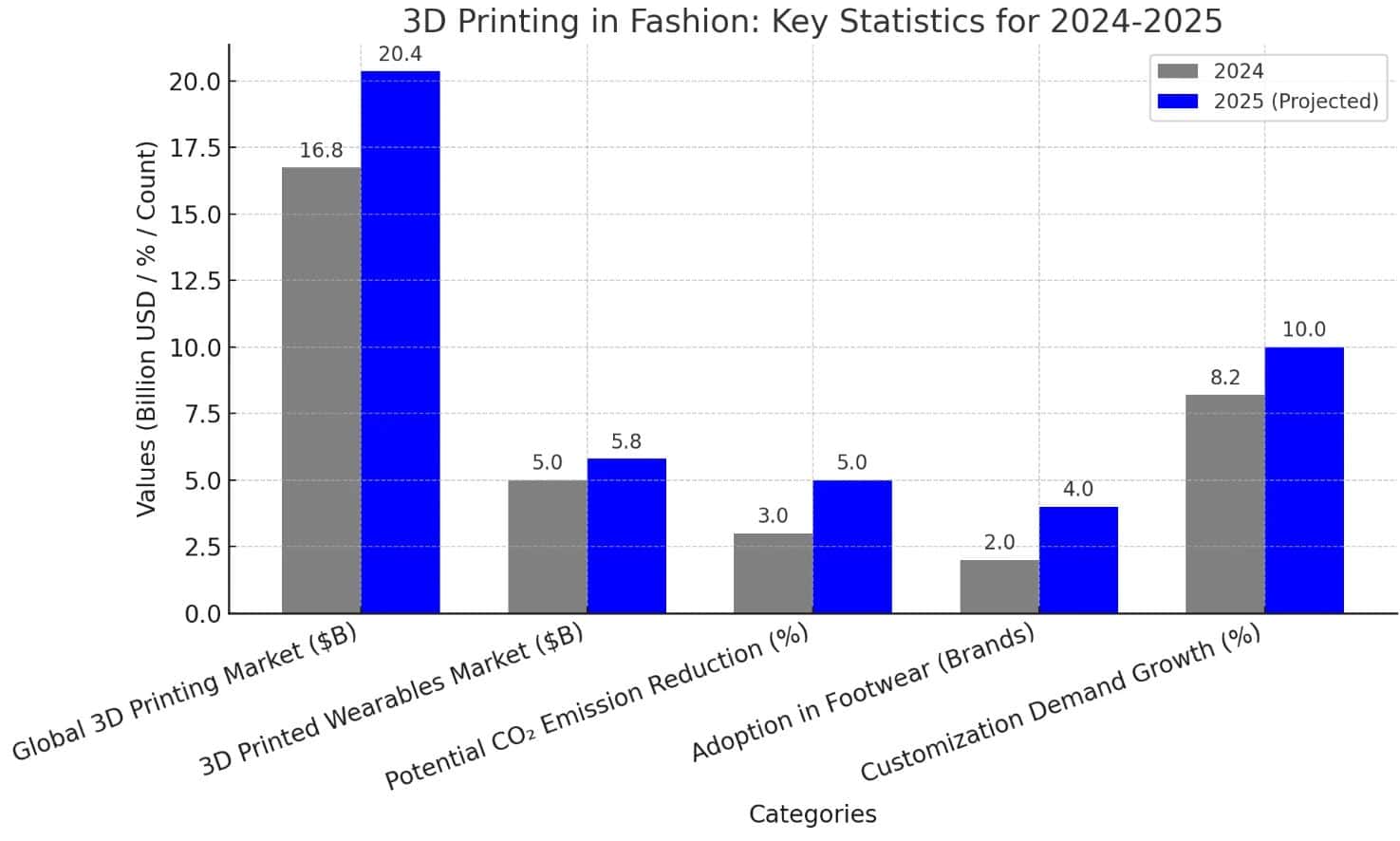
- 3D printing is fast becoming one of the major technologies for the fashion industry, and it is all because of the strong market figures and technological acceptance.
- The global 3D printing market is valued at more than US$20 billion in 2023, and the growth is nearly 20% every year; various fashion brands are adopting the methods of on-demand, customized, and sustainable production.
- One of the main factors is cost; 3D printing technology is 82% of the businesses that are using this technology report lower costs, one of the main advantages for the fas,hion houses making heavy investments in samples and prototypes.
- Sustainability is a factor that strongly influences fashion: 22% of firms are employing 3D printing techniques to minimize waste generation.
- Many are anticipating significant environmental improvement within five years that will be in accordance with the fashion industry’s shift towards circular and zero-waste models.
- The trend toward bespoke clothing made with digital precision is backed by consumer demand for personalized goods that is growing at an annual rate of 8.2%.
- The footwear brands are already hinting at this future with 3D-printed midsoles that make the shoes more comfortable and perform better, while at the same time, the creation of fully printed, customizable shoes is being opened up.
- The innovation of materials has thus far been a major driving force; the 3D printing materials market is projected to be worth US$6.6 billion by 2033, and the light and wearable fabrics with self-repairing capabilities are just some of the possibilities that will come with it.
- The use of 3D printing in the production process is nearly half, thus educational institutions are preparing designers in digital fabrication, the future of fashion is pointing to automation, personalization, and disruptive new manufacturing models.
Leading Innovative Countries for 3D Printing
- 3D printing has moved beyond a niche tool and is now changing how products are made by reducing waste and enabling mass customization.
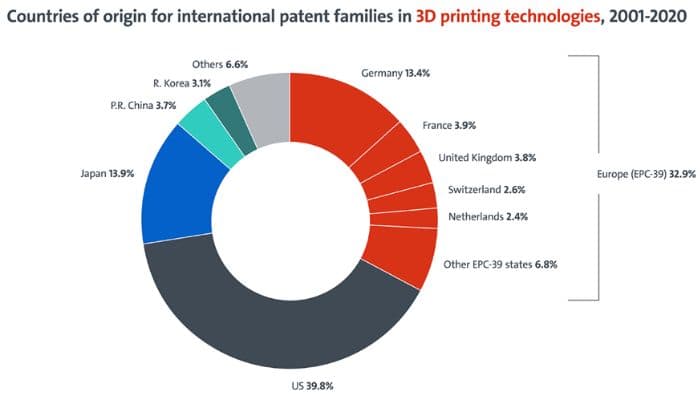
- According to the European Patent Office, the U.S. represents 40% of global patenting activity in additive manufacturing.
- Since the technology began in the U.S. nearly 40 years ago, its continued leadership in this field is not unexpected.
- The EPO report “Innovation trends in additive manufacturing: Patents in 3D printing technologies” reviews worldwide patent data to show where innovation is strongest.
- The U.S. and Europe dominate global invention activity, with the U.S. at 40% and Europe at 33%.
- Combined, these two regions contribute roughly 73% of 3D printing inventions worldwide.
(Photo credits: European Patent Office)
Global Patent Holders in Additive Manufacturing
- According to the EPO study, additive manufacturing patent activity accelerated strongly from 2013–2020.
- International patent families grew by 26.3% per year on average in 2013–2020, while all technology fields together rose by 3.3% in the same period.
- U.S. inventors produced 19,941 international patent families in 2013–2020, rising from 542 in 2013 to 3,024 in 2020.
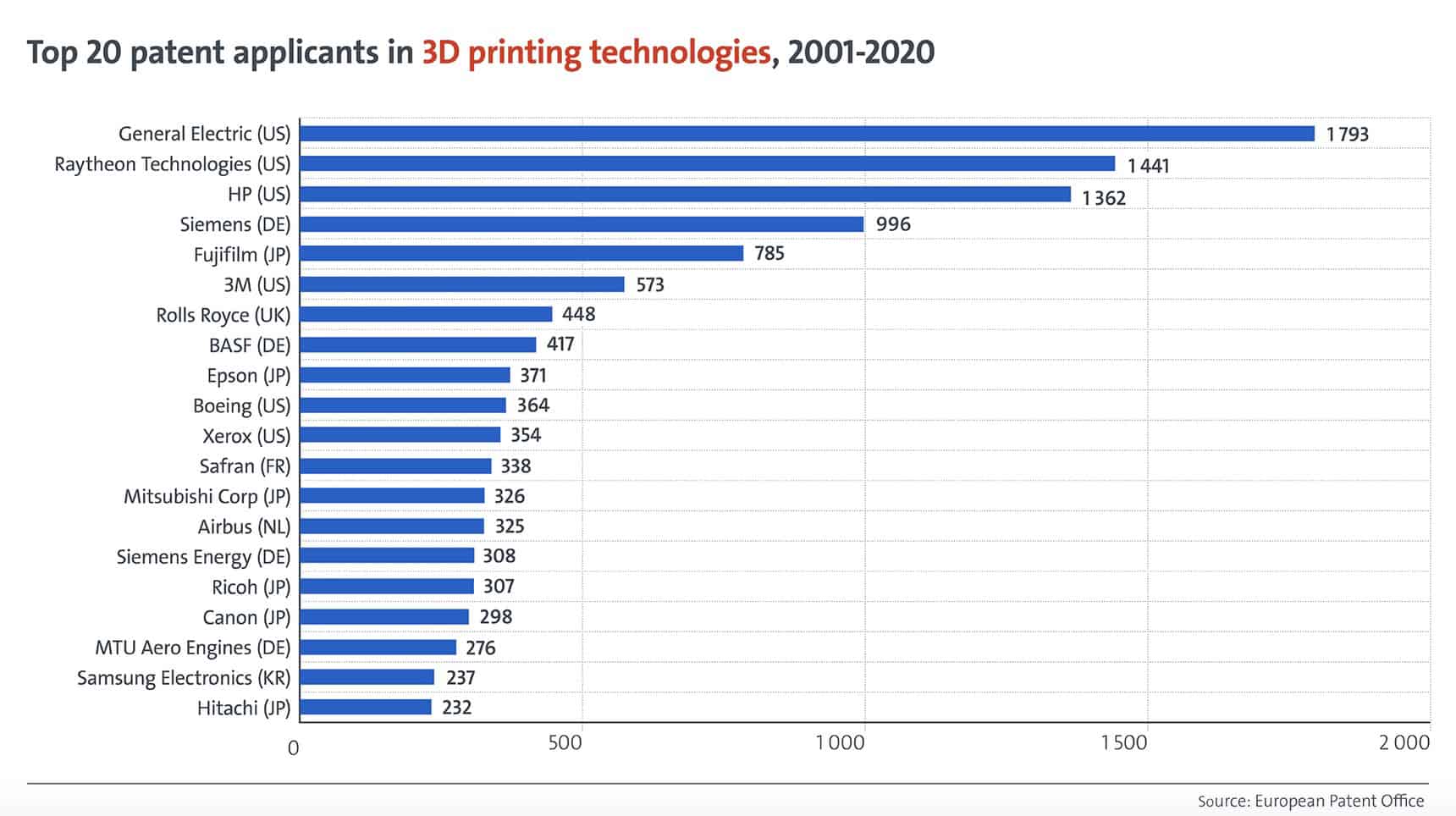
- General Electric, Raytheon Technologies, and HP sit in the top 3 for 3D printing patent families, and 3M, Boeing, and Xerox also rank in the top 20.
- The leading 20 applicants include 6 U.S. companies, 7 European companies, and 6 Japanese companies.
- Johnson & Johnson leads patent filings tied to medical equipment, and Ford holds the lead in vehicle-related 3D printing inventions.
- Startups are also visible in the field, with names such as Divergent 3D, Continuous Composites, and Evolve Additive Solutions.
- Universities and public research groups contribute 12% of global 3D printing patent families, which is close to 2× their usual share.
- In the top 10 research applicants, 5 include MIT, the University of California, Harvard University, the University of Texas System, and the University of Michigan, and in artificial organs and tissue, 6 of the top 7 applicants are U.S. universities.
(Photo credits: European Patent Office)
Recent Developments
- April 2025 — 3D Systems: Launched three application-focused solutions, led by Figure 4 135 for high-mix, low-volume production, plus upgrades for EXT Titan Pellet printers and QuickCast Diamond for precision casting—aimed at fast, tooling-free, accurate manufacturing.
- March 2025 — Stratasys: Unveiled the Neo800+ large-format SLA printer with ScanControl+, claiming up to 50% faster printing, plus reliability features like collision detection and environmental monitoring for aerospace, automotive, and industrial users.
- June 2024 — Materialise + ArcelorMittal: Signed an MOU to improve steel LPBF by combining Materialise’s next-gen build processor with ArcelorMittal’s AdamIQ powders to boost speed, quality, and cost efficiency, and develop new alloys/applications.
- The 3D printing sector’s recent activities show major mergers, technological progress, and excellent financial momentum as the main aspects.
- Among the most remarkable was the announcement of the merger of Stratasys and Desktop Metal for about US$1.8 billion, which already made the market visibly more consolidated.
- Also, 3D Systems took over Xerox Elem Additive, whose technology relates to the metal printing process, thus the company gained a stronger foothold in the industrial applications area.
- HP is determinedly scaling additive manufacturing and opened its automation tools, as well as three Direct Metal Printing systems, at the RAPID + TCT event.
- Nexa3D’s XiP Pro was focused on faster and more precise printing, while KOKONI promoted its AI-based SOTA system, which has an innovative upside-down design for enhanced stability and lower noise levels.
- The investment front is also very active. Major investors like Bosch have supported ARRIS Composites to the tune of US$34 million for the company’s composite 3D printing technology.
- Alloy Enterprises has received US$26 million for the ramp-up of 3D-printed aluminium components production, which are considered to have the biggest industrial demand.
- These trends come at a time when the worldwide 3D printing market is still on an upward path that extended to US$17 billion in 2022 and is expected to reach US$19.9 billion in 2023 with a robust 17% CAGR.
- The main application area is prototyping, especially in automotive, aerospace, and defence sectors, because of the method’s accuracy and reliability.
Conclusion
3D Printing Statistics: The 3D printing field is maturing and gradually becoming a high-growth technology for various industries such as manufacturing, healthcare, aerospace, consumer goods, and even fashion. The market values and forecasts indicate a rapid growth trend with a double-digit CAGR; the main drivers are the better hardware, superior materials, and acceptance in more industries.
North America is still the leading region, while automotive, dental, and construction sectors are speeding up the use of additive manufacturing, not only for prototyping but also for production. Innovations, mergers, and significant investments are the signs of the industry’s movement towards large-scale, automated, and personalized manufacturing. In conclusion, 3D printing is no longer a niche technology but is rather developing into a globally accepted and economically transformative manufacturing technology.
FAQ.
The global 3D printing market was valued at US$19.8 billion in 2023 and is expected to reach US$135.4 billion by 2033, growing at a CAGR of 21.2%. Analysts commonly estimate industry growth between 18% and 2.7% annually.
Major adopters include automotive (over 25% revenue share in 2024), healthcare and dental (17.5% CAGR through 2029), aerospace, consumer goods, education, and construction. These sectors use 3D printing for prototyping, tooling, lightweight components, customization, and large-scale builds.
Rising demand for polymers, metals, composites, and resins used in end-use production is pushing for strong growth. The materials market was US$3.2 billion in 2024 and is projected to reach US$12.4 billion by 2033 (~15.6% CAGR), with some forecasts predicting US$8.10 billion by 2030 (~22% CAGR).
Key players include Stratasys, EOS, HP, 3D Systems, GE, Materialise, SLM Solutions, Nano Dimension, voxeljet, and Renishaw. These companies dominate through advanced hardware, specialized materials, industrial solutions, and strategic partnerships.
Fashion brands are adopting 3D printing for on-demand production, customization, and sustainability. About 82% of businesses report cost savings, while 22% use 3D printing to reduce waste. The trend is growing as material innovation enables flexible, wearable, and customizable products, including 3D-printed footwear.

I hold an MBA in Finance and Marketing, bringing a unique blend of business acumen and creative communication skills. With experience as a content in crafting statistical and research-backed content across multiple domains, including education, technology, product reviews, and company website analytics, I specialize in producing engaging, informative, and SEO-optimized content tailored to diverse audiences. My work bridges technical accuracy with compelling storytelling, helping brands educate, inform, and connect with their target markets.