Bring Your Own Device (BYOD) Security Statistics By Market Size, Adoption, Usage, Compliance, Insights and Facts (2026)

Updated · Mar 12, 2026


Table of Contents
- Introduction
- Editor’s Choice
- Bring Your Own Device (BYOD) Market Size Global
- BYOD Adoption And Impact
- General BYOD Statistics
- Rising Cyber Risks In The BYOD Era
- BYOD Usage
- BYOD Vs. COPE
- BYOD Policy Enforcement, Visibility Risks, and Regulatory Pressure
- Core Elements of A Bulletproof BYOD Policy
- Regulatory Compliance And BYOD (GDPR and HIPAA)
- Conclusion
Introduction
Bring Your Own Device (BYOD) Security Statistics: By 2025, Bring Your Own Device (BYOD) had become an essential element that modern workplaces across the world used. Employees now access corporate resources through their personal smartphones, laptops, tablets, and wearables, driven by remote work, flexible hours, and global mobile technology usage. The new work method produces better work results while organizations face increased cybersecurity problems, network security risks, and financial threats, which they must manage.
The BYOD statistics show how BYOD will change future work because they demonstrate its advantages and dangers and its effects on business economics, which every IT leader and security expert must comprehend.
Editor’s Choice
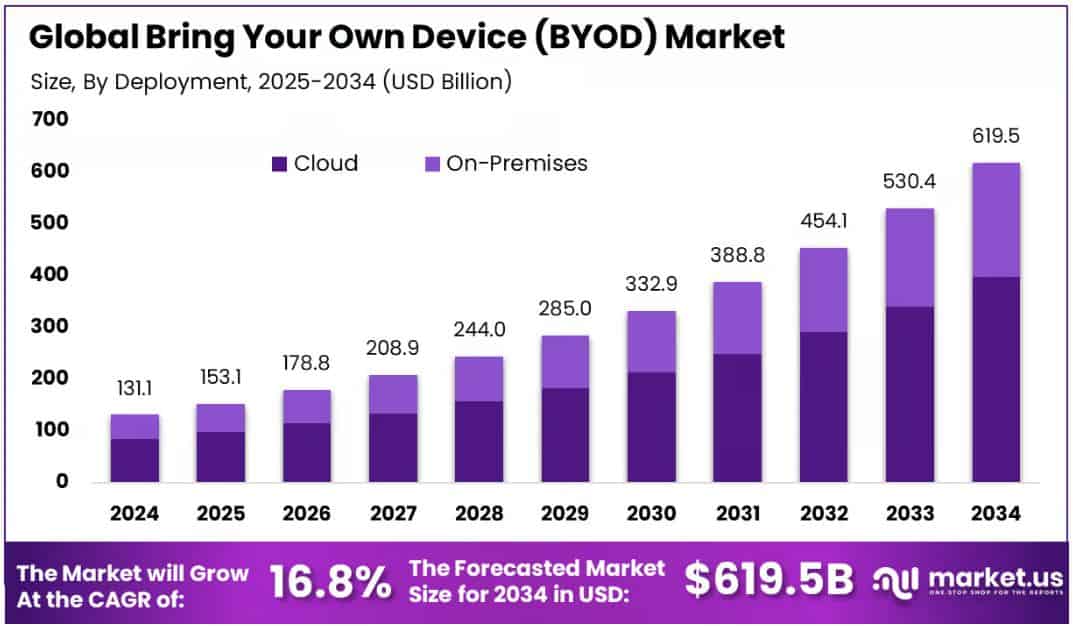
- The worldwide BYOD market valuation reached USD 153.1 billion in 2025 and is expected to grow to USD 619.5 billion by 2034 through a compound annual growth rate of 16.8 %.
- North America commands a market share of 39.1%, resulting in revenue of USD 51.2 billion.
- More than 80% of organizations have implemented some form of BYOD policy in their workplaces.
- 95% of businesses permit workers to use personal devices in the workplace, while 82% of them enforce official BYOD guidelines.
- Smartphones represent 50.1% of BYOD device usage because only 15% of organizations supply their employees with company smartphones.
- Workers in organizations require an average of 2.5 devices for their professional duties, which demonstrates the existence of a multi-device enterprise environment.
- The adoption of BYOD systems produces productivity improvements of 55%, which leads to increased job satisfaction by 56%.
- 46% of organizations identify network attacks as their primary cybersecurity risk, while 31% of organizations report that ransomware attacks constitute their main security threat.
- Only 67% of organizations have established official BYOD security measures, which results in security governance deficiencies.
Bring Your Own Device (BYOD) Market Size Global
(Source: market.us)
- The latest BYOD statistics reveal a transformative shift in enterprise mobility strategy.
- The global Bring Your Own Device (BYOD) market generated USD 131.1 billion in 2024 and reached USD 153.1 billion in 2025, and is projected to expand to USD 619.5 billion by 2034, growing at a robust 16.8% CAGR.
- North America leads the landscape, commanding 39.1% market share and USD 51.2 billion in revenue, signaling mature enterprise adoption and strong cloud infrastructure.
- Organizations have fully adopted BYOD policies since 80% of companies now use these policies.
- The smartphone market shares 50.1% of overall device usage, but only 27% of users receive smartphones from their employers, which shows organizations now aim to minimize expenses.
- Mobile Device Management (MDM) maintains a market share of 41.5% while cloud deployments secure 64.2% of the market, which provides evidence for scalable AI-powered security solutions.
- The BYOD statistics demonstrate that organizations use productivity measurements to achieve a balance between efficient work processes and their increasing need for cybersecurity protection.
BYOD Adoption And Impact
- Organizations today establish their workplace technology systems through their current BYOD statistics, which show a complete shift from their previous methods.
- More than 95% of organizations currently allow personal devices in some capacity within the workplace, with permitted personal devices, while 82% of organizations implement official BYOD guidelines.
- Smartphones function as the primary technology for enterprise mobility, according to analysts, because they generate more than 50% of BYOD revenue and account for 66% of work devices.
- The central function of smartphones in hybrid work environments becomes evident because 87% of organizations permit their staff members to use smartphones for accessing corporate software.
- Workers complete their professional responsibilities by using 2.5 devices, which shows the existence of a work environment that depends on multiple devices.
- Employees under flexible work arrangements show productivity improvements of 55% because they achieve 56% higher job satisfaction while working approximately two extra hours per week.
- Security concerns create the main obstacle for 39% of organizations, which shows that organizations still face security problems.
- The 69% of U.S. IT leaders who support BYOD as a beneficial long-term strategy show their assessment of BYOD.
General BYOD Statistics
(Source: market.biz)
- According to market.biz, Current research shows that workplace mobility now functions as a main workforce model which evolved from its origins as an IT operational choice.
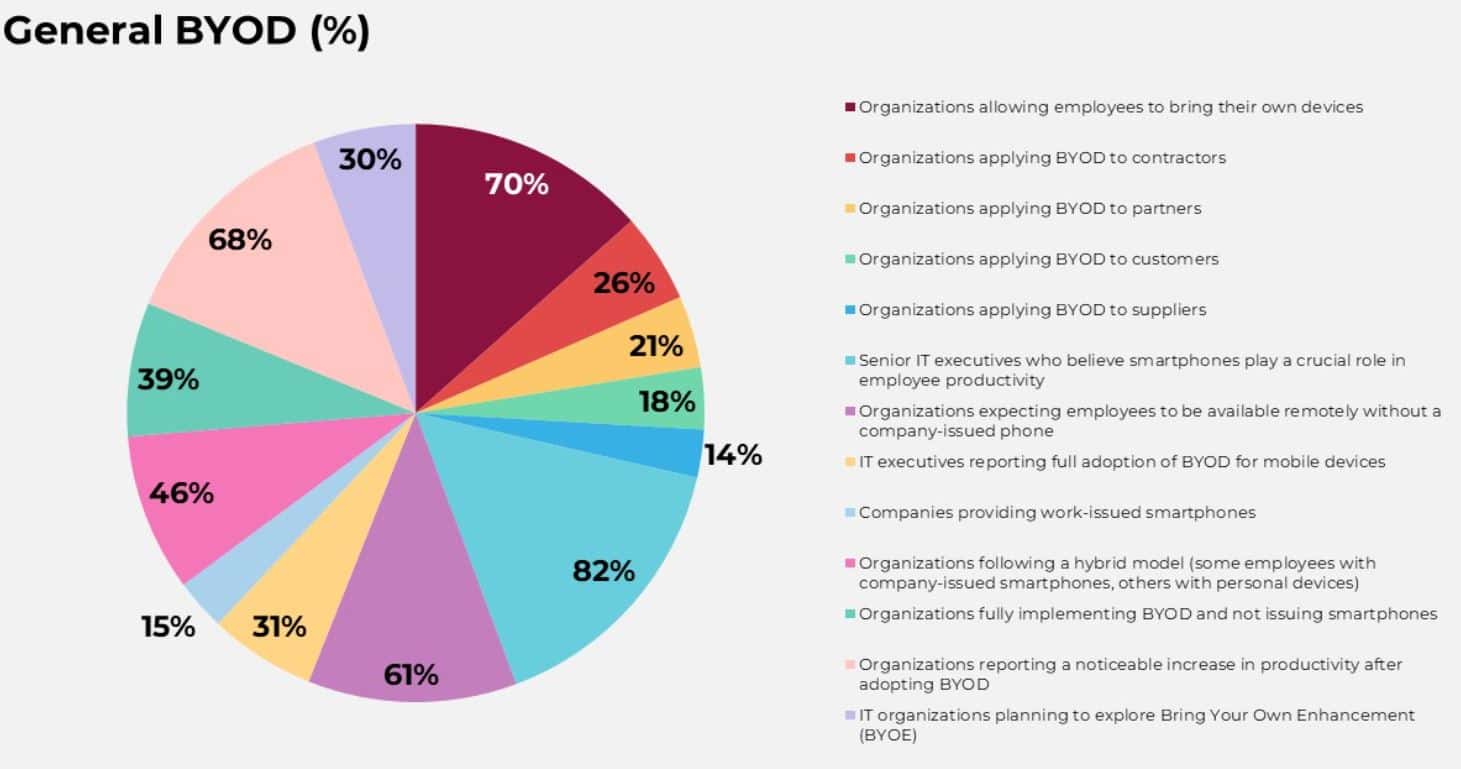
- The study included 271 cybersecurity experts, who showed that 70% of companies now permit staff members to use their personal devices, which demonstrates that BYOD has become a common industry practice.
- BYOD now enables organizations to provide system access to all external users because 26% of organizations allow contractors, 21% allow partners, 18% allow customers, and 14% allow suppliers to access their systems.
- 82% of senior IT directors believe smartphones are critical for productivity and faster decision-making, while 61% of organizations expect remote availability even without issuing company devices.
- Yet only 15% of companies provide work-issued smartphones, reinforcing the cost-efficiency argument.
- 31% of IT executives report fully embracing BYOD for mobile, 46% operate hybrid models, and 39% rely entirely on employee-owned smartphones.
- 68% of organizations report productivity improvements.
- The 30% of IT departments that investigate Bring Your Own Enhancement (BYOE) show that organizations still drive their innovation forward.
- The BYOD statistics that organizations have collected show that businesses design their mobility strategies to achieve cost savings and productivity improvements.
Rising Cyber Risks In The BYOD Era
(Source: market.biz)
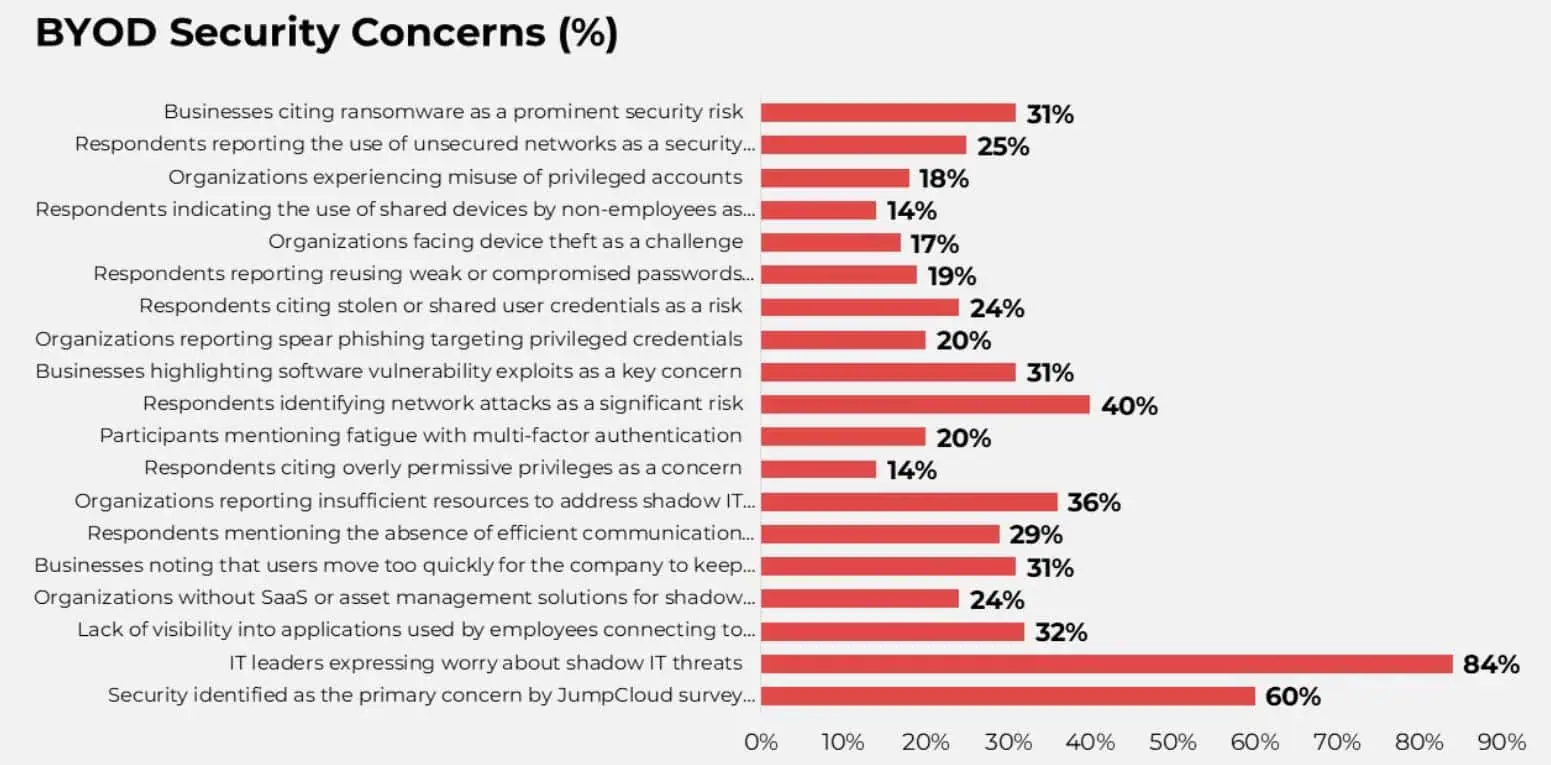
- The newest BYOD statistics show that enterprise mobility improves productivity but also creates major security dangers.
- According to JumpCloud research, 60% of IT professionals consider security their most important BYOD concern, while 84% of IT leaders worry about shadow IT, which refers to unauthorized applications and devices that access corporate systems.
- The visibility gap presents an urgent situation because 32% of respondents said they could not monitor applications that accessed company resources, while 24% of respondents did not have access to SaaS or asset management solutions that could protect against these threats.
- More than 20% of companies reported malware outbreaks originating from unmanaged devices in the previous year, while about half did not know whether they had experienced similar security incidents, suggesting they may not have reported all their security breaches.
- Organizations face their most significant risk from network-based threats because 40% of organizations report network attacks as their top threat, and 31% of organizations focus on software vulnerability exploits, while 31% of organizations consider ransomware their primary security issue.
- The study found that 24% of participants experienced credential theft or sharing incidents, 19% used their passwords in unsafe ways, and 20% encountered spear-phishing attacks targeting their admin accounts.
- The study found that 18% of participants experienced abuse of their privileged access rights, while 14% of participants identified excessive access rights as an organization-wide security flaw.
- The study found that 20% of users refuse to use multi-factor authentication because they experience authentication exhaustion.
- Organizations face three main security dangers, which include 25% of organizations using insecure networks, and 17% of organizations experiencing device theft, and 14% of organizations using non-employee devices for sharing purposes.
- The BYOD statistics show that organizations need to implement zero-trust architectures together with strong identity management systems and ongoing system oversight to achieve both adaptable work processes and complete enterprise security protection.
BYOD Usage
(Source: market.biz)
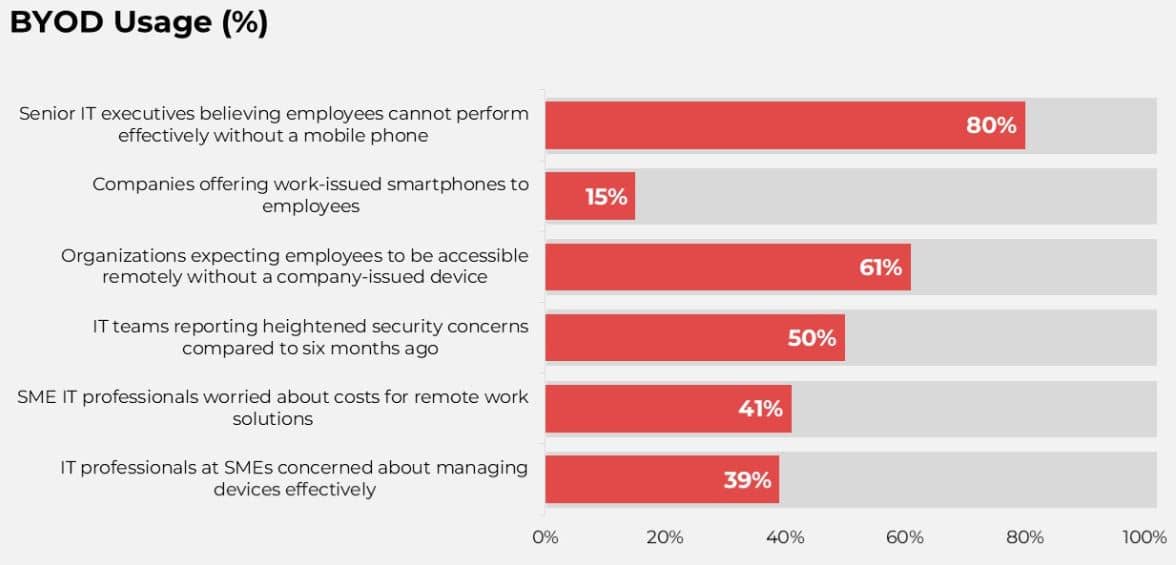
- The most recent BYOD statistics show that small and medium enterprises face increasing operational challenges because of their bring your own device programs.
- Device management challenges affect about 39% of IT professionals in small and medium enterprises, while 41% of these professionals show worries about remote work security system support expenses.
- The security anxiety among organizations has reached new heights since 50% of IT teams now display increased worry about their organization’s cybersecurity protection than they did six months ago.
- Accessibility expectations have grown beyond what analysts can currently provide with their available devices.
- The majority of organizations, which totals 61%, expect their employees to maintain remote availability, whereas only 15% of these organizations supply smartphones to their staff members.
- The gap creates dependency on personal devices because 80% of senior IT executives believe employees need mobile access to work successfully.
- Businesses can save up to USD 341 per employee annually by shifting from corporate-issued smartphones to BYOD, while the average annual cost to enable BYOD remains under USD 900 per employee, which makes it an effective mobility solution.
- Companies that provide devices to over 20% of their staff members tend to implement advanced mobile strategies that deliver maximum business benefits.
BYOD Vs. COPE
| Model | Ownership and choice | Typical cost profile | Security and control characteristics |
| BYOD (Bring Your Own Device) | The employee has full ownership of the device, which he or she selects with the power to choose both the device’s manufacturer and model and operating system. | The organization achieves its lowest hardware and service expenses through Cisco, Forrester and JumpCloud, which estimate annual employee savings of USD 341 to USD 350 and total BYOD benefits of USD 1650. | The security system depends on user actions together with MDM system adoption, while 60% of IT professionals observe increased security risks when employees use their personal devices. |
| CYOD (Choose Your Own Device) | The organization establishes standard hardware and operating system requirements for all devices, which employees can choose from their approved list. | Organizations face higher expenses through device procurement costs, which exceed the expenses of BYOD yet remain more affordable than complete COPE. | The IT department can enforce security policies through MDM systems because all devices satisfy minimum requirements, which enables employees to select their preferred devices. |
| COPE (Corporate‑Owned, Personally Enabled) | The organization owns all mobile devices, which it purchases but restricts employees from using personal applications and services according to established organization policies. | The organization must spend the most money on hardware equipment because BYOD provides more opportunities to save direct device expenses. | The NIST framework demonstrates that COPE architectures provide organizations with complete control over their security frameworks through centralized policy management, which includes encryption processes, patching protocols, application supervision, and remote data deletion features. |
BYOD Policy Enforcement, Visibility Risks, and Regulatory Pressure
- The enforcement of BYOD policy, together with its visibility risks and regulatory pressure, represents a crucial security challenge.
- The 2025 Bring Your Own Device (BYOD) Security Statistics report shows that governance gaps have emerged because organizations need to establish security controls.
- The worldwide growth of BYOD usage continued through 2024, yet only 67% of businesses implemented formal BYOD security policies.
- The absence of a defined policy framework enables organizations to operate without systematic security management.
- The security risks create security weaknesses that need protection because 60% of IT workers consider security issues as their main concern about BYOD.
- The complexity deepens as 63% of enterprises report difficulty enforcing consistent security controls across diverse operating systems, device types, and personal apps.
- The system breaks into multiple parts, which allows attackers to find new ways to attack while making it harder to detect security breaches.
- The regulated sectors of finance and healthcare face increased risks because compliance requirements demand stricter data protection and audit requirements.
- The complete Bring Your Own Device (BYOD) Security Statistics report shows that organizations face security risks when they lack unified governance and compliance alignment, which requires them to adopt both policy standardization and Zero Trust security frameworks.
Core Elements of A Bulletproof BYOD Policy
| Core BYOD policy element | Concrete requirement in a “bulletproof” policy | Key rationale and supporting insight |
| Mobile Device Management (MDM) | All work devices must register with MDM systems, which require them to protect data through encryption and remote wipe capabilities, application control, and compliance monitoring functions. | The NIST organization, together with MDM vendors declare that organizations must use MDM as their main method to enforce BYOD security protection standards and handle situations involving lost or stolen devices. |
| Zero Trust Network Access (ZTNA) | The system requires ZTNA or equivalent zero-trust controls, which allow users to access specific applications based on their identity and device security status and operational environment instead of their current network connection. | The experts from Forcepoint and other organizations advise businesses to implement zero-trust security systems so they can prevent network breaches while stopping unauthorized employees from accessing protected resources through their various endpoint devices. |
| Acceptable Use Policy (AUP) | The organization establishes a written BYOD policy, which specifies the devices that employees may use and the applications they are allowed to install, along with the data handling procedures. | Gartner and BYOD best‑practice guides emphasize that clear, enforceable AUPs are foundational to aligning user behavior with security and compliance needs. |
| Employee phishing and security training | The organization requires all BYOD users to complete their initial training and subsequent training sessions on mobile phishing and social engineering, password security practices, safe browsing techniques, and incident reporting procedures. | Lookout, Venn, and NIST‑aligned sources all note that user awareness is a critical “last line of defense” in BYOD scenarios where devices operate outside traditional perimeter controls. |
Regulatory Compliance And BYOD (GDPR and HIPAA)
| Compliance dimension | BYOD risk without strong controls | How containerization and related controls mitigate the blind spot |
| GDPR data protection and breach notification | Personal and corporate data intermingle on employee devices, making it hard to track where personal data is stored and to detect, document, and report breaches within 72 hours. | Containerization creates isolated, encrypted workspaces where business data is processed, enabling centralized logging, selective remote‑wipe, and easier breach detection and reporting while limiting access to personal content. |
| HIPAA protection of ePHI on mobile devices | Clinicians may store ePHI in personal apps, email clients, or photo galleries on unsecured devices, increasing the likelihood of reportable breaches if devices are lost, stolen, or compromised. | Work containers restrict ePHI to vetted, encrypted apps and allow admins to enforce MDM policies, strong authentication, and remote‑wipe on the container only, satisfying HIPAA’s requirements for technical safeguards without overreaching into personal data. |
Conclusion
The implementation of Bring Your Own Device (BYOD) in 2025 has developed into both a strategic asset and a major cybersecurity challenge. The BYOD security market has shown rapid expansion as organisations increase their investments in security solutions, ranging from endpoint protection to Zero Trust systems. The research demonstrates that organizations that want to implement BYOD must develop strong security policies and combine modern technological systems with effective organizational management and security training programs.
The implementation of comprehensive security strategies makes BYOD an appealing yet challenging component of contemporary digital business operations for organizations that choose to adopt it.
FAQ.
The global BYOD market is expected to reach USD 1531 billion in 2025 and to grow to USD 6195 billion by 2034 with a 168 % compound annual growth rate because of enterprise mobility and cloud technology adoption.
Over 95% of organizations allow BYOD in some form, and 82% have formal policies, while more than 80% actively use BYOD programs to enhance flexibility and reduce hardware costs.
The main hazards include data loss, which affects 62% of organizations shadow IT, which concerns 84% of IT leaders, malware infections, which 22% of organizations have confirmed and network attacks that have impacted 40% of organizations.
BYOD enables businesses to achieve a 55% productivity increase, which results in a 56% rise in job satisfaction and creates annual cost savings of up to USD 341 per employee.

I hold an MBA in Finance and Marketing, bringing a unique blend of business acumen and creative communication skills. With experience as a content in crafting statistical and research-backed content across multiple domains, including education, technology, product reviews, and company website analytics, I specialize in producing engaging, informative, and SEO-optimized content tailored to diverse audiences. My work bridges technical accuracy with compelling storytelling, helping brands educate, inform, and connect with their target markets.