Subaru Statistics By Performance, Production And Sales (2026)

Updated · Apr 15, 2026


Table of Contents
- Introduction
- Editor’s Choice
- Number of Passenger Cars registrations in Japan
- Subaru Global Production and Sales
- Subaru Corporation U.S. Sales Performance 2025
- Subaru’s Latest Product Launches and Innovation Pipeline Overview
- Subaru Corporation Inventory Digestion and Retail Strategy
- Toyota-Subaru Synergy – The 2026 Hybrid Pivot
- Conclusion
Introduction
Subaru Statistics: Subaru Corporation faces difficult challenges during the 2025 to 2026 period, which require the company to maintain its SUV production while managing financial losses caused by international trade tariffs, electric vehicle development expenses, and supply chain recovery. The company maintains a strong market presence in important regions such as the United States, yet its worldwide sales and profit margins have experienced slight reductions. Subaru keeps generating more than 30 billion dollars in annual income because its brand maintains a strong market presence through its safety performance, all-wheel-drive technology, and customer base retention.
The automotive market transition towards hybrid and electric vehicles, together with Subaru’s pricing strategy changes, will drive the company towards gradual recovery and sustainable expansion in the international automotive sector.
Editor’s Choice
- Subaru Corporation’s global production reached 878,016 units in CY2025, indicating a stable manufacturing base.
- Japan accounted for ~61% of production (540,194 units), reflecting strong domestic manufacturing reliance.
- Overseas production stood at 337,822 units, highlighting a balanced global footprint.
- Exports totalled 447,367 units, meaning over 50% of production is export-driven.
- Japan domestic sales were 111,297 units, signalling a relatively small home-market contribution.
- Early CY2026 production reached 141,381 units, indicating gradual recovery momentum.
- Exports in early 2026 totalled 68,068 units, pointing to improving global demand.
- U.S. sales declined 3.6% YoY to 643,591 units, reflecting demand normalization.
- Subaru Crosstrek led with 191,724 units (+5.5%), achieving record sales.
- Subaru Forester delivered 175,070 units (-0.3%), showing stable demand.
- Subaru Outback sold 157,716 units (-6.6%), indicating softening demand.
- Subaru Solterra sales fell 13.9% to 10,715 units.
- Combined Forester and Outback U.S. sales exceeded 330,000 units.
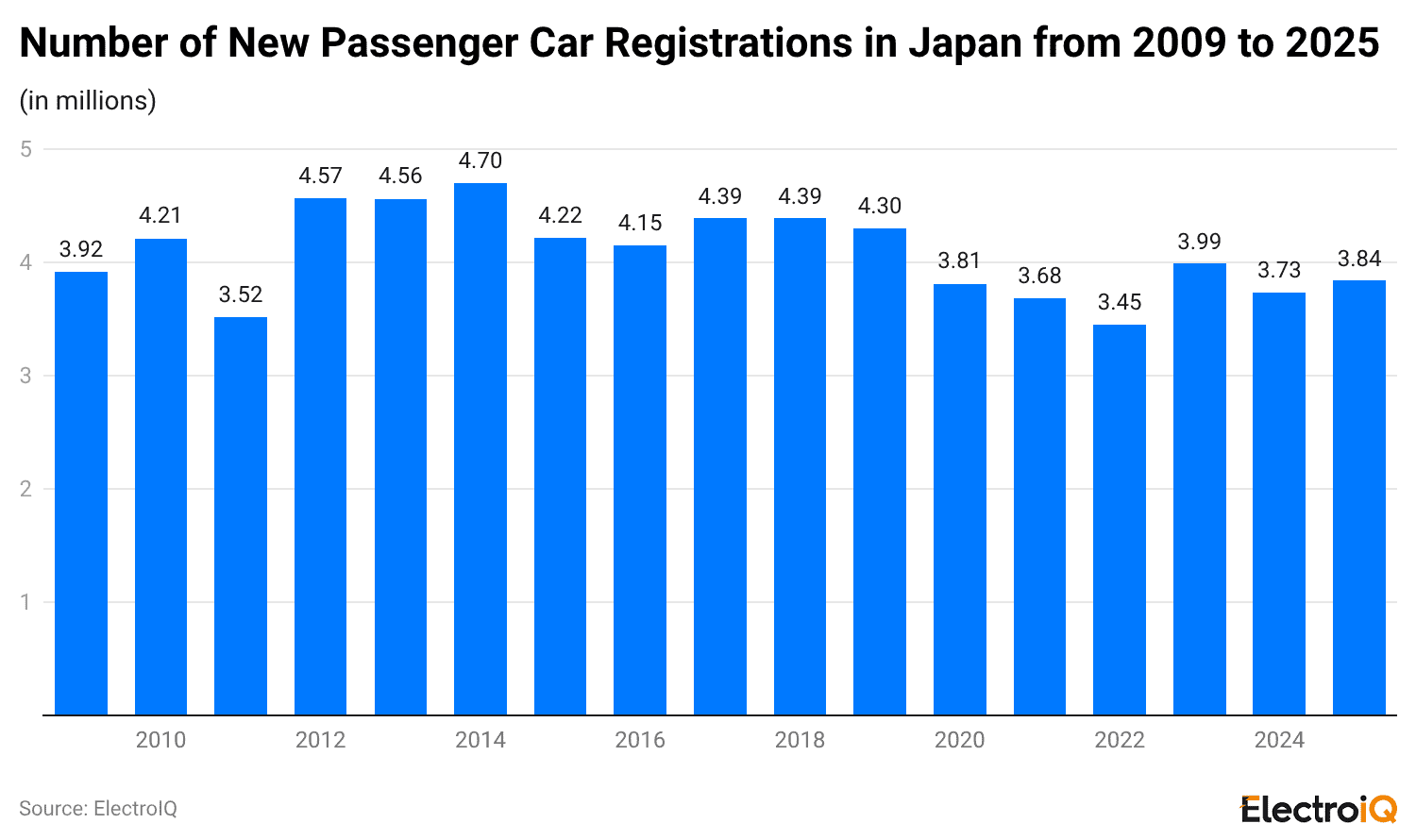
- Japan passenger car registrations declined ~27% from 4.7M (2014) to 3.45M (2022), before stabilizing at 3.84M in 2025.
Number of Passenger Cars registrations in Japan
(Reference: statista.com)
- Japan experiences a cyclic market pattern, which currently shows signs of stable development through its passenger car registration process.
- The market reached its highest point in 2014 when 4.7 million units were sold, but then experienced a gradual decline to 3.45 million in 2022, which resulted in a 27% reduction that occurred because of an ageing population and economic decline.
- The market shows signs of recovery through 3.99 million unit sales in 2023 and 3.84 million unit sales in 2025, which demonstrate post-COVID demand recovery.
- The main search terms for this content consist of auto registrations, market demand recovery trend, and the automotive cycle.
- The domestic market for Subaru Corporation shows stable conditions, which will generate minimal growth for the company, according to Industry Reports from Statista.
Subaru Global Production and Sales

(Source: subaru.co.jp)
- Subaru Corporation shows its production stability for CY2025 through its initial indication of rising production volumes and strong export performance, which demonstrates improved worldwide market conditions and supply chain recovery.
- Global production for the year reached 878016 units in 2025 because Japan produced 540194 units, while international operations generated 337822 units.
- The data shows Subaru operates a manufacturing network that achieves balanced output because domestic production generates approximately 61% of total manufacturing capacity.
- The Japanese market exhibited moderate demand stability through its total domestic sales of 111297 units, which included 95610 passenger vehicles and 15687 minicars.
- Subaru exported 447367 vehicles, which showed that more than half of its total production went to international markets, while this pattern confirmed the company’s strong dependence on worldwide markets, especially in North America.
- The company exhibits initial expansion for its operations, which extend into CY2026 (Year-to-Date).
- The organization produced 141381 units, which included 80921 units from Japan and 60460 units from other countries, showing better geographic production distribution than in 2025.
- The organization sold 16114 units to customers, which included 13163 passenger vehicles and 2951 minicars, showing that domestic sales maintained consistent performance while bringing in smaller revenue than usual.
- The export performance reached its highest point through the export of 68068 units during early 2026, which shows that global demand continues to increase while the overseas shipping system becomes more robust.
- The current trend indicates that exports will experience mid-single-digit growth if the current pattern continues because exports represent a vital source of revenue for the business.
Subaru Corporation U.S. Sales Performance 2025
- Subaru Corporation achieved moderate success in the U.S. market during CY2025 because its total sales decreased by 3.6% to 643591 units.
- The company experienced this minor decline because it changed its product lineup, its vehicle models reached their maturity point, and customer preferences changed.
- The Crosstrek emerged as the leading model for the company because it sold 191724 units, which represented a 5.5% increase over the previous year and reached its highest annual sales performance for the year, confirming its status as the main driver of Subaru’s growth in the compact SUV market.
- The Forester followed closely with 175070 units remaining stable with only a 0.3% decline, which showed that people continued to buy mid-size SUVs.
- The Outback generated 157716 units for the company, which dropped 6.6% from the previous year, showing that people purchased fewer legacy crossover vehicles.
- The Legacy sedan attained 22212 units, which represented a 13.4% increase from the previous year because its final production year showed increased demand through phase-out dynamics.
- The performance-oriented and niche models showed a significant decline because the WRX model experienced a 41.2% drop in sales to 10930 units, and the Solterra electric vehicle sales fell 13.9% to 10715 units because of reduced electric vehicle demand and increased competition in the electric SUV market.
- The Impreza model, which sold 27942 units, experienced a 10.9% sales drop, and the Ascent model, which sold 44400 units, experienced a 21.1% sales drop because these products showed demand normalization in sections that did not include core business areas.
- The Crosstrek and Forester high-volume SUV models serve as essential components of Subaru’s business strategy while the company experiences ongoing portfolio changes that drive its transition toward electric vehicles and next-generation vehicle models.
Subaru’s Latest Product Launches and Innovation Pipeline Overview
- Subaru Corporation has accelerated its product innovation strategy in 2025–2026, aligning with global automotive trends, electrification, and SUV dominance.
- The brand’s recent launches highlight a balanced portfolio of internal combustion (ICE), hybrid, and electric vehicles (EVs), reinforcing its market competitiveness and customer-centric engineering.
- The updated Subaru Crosstrek serves as one of the company’s most important product launches because it remains the top-selling vehicle for Subaru in international markets, while North America accounts for almost 30 % of total sales.
- The new Crosstrek integrates enhanced fuel efficiency, AWD performance, and safety technologies, strengthening Subaru’s core brand identity.
- The refreshed Subaru Forester and Subaru Outback continue to perform strongly in the SUV market, which results in annual U.S. sales that exceed 330,000 units for both vehicles.
- The models focus on advanced driver assistance systems (ADAS), better connectivity features, and more comfortable interior spaces because customers increasingly want upscale sports utility vehicles.
- Subaru is increasing its electric vehicle (EV) presence through its partnership with Toyota Motor Corporation to develop the Subaru Solterra electric vehicle.
- The Solterra electric vehicle (EV) marks Subaru’s first move into the battery electric vehicle (BEV) market, although the company produces only about 10,000 to 15,000 units each year.
- The future vehicle models will deliver better performance because they will enhance driving range, battery efficiency, and charging speed capabilities.
- Subaru has disclosed its upcoming vehicle models, which include the Trailseeker and Uncharted electric vehicles, as part of its commitment to developing future transportation technologies.
- These launches are expected to support Subaru’s global electrification target, where EVs and hybrids could account for 40–50% of total sales by 2030.
Subaru Corporation Inventory Digestion and Retail Strategy
- Subaru Corporation has turned its “Share the Love” campaign into an inventory management system that helps accelerate retail operations.
- The program functions as a charitable initiative while enabling Subaru to achieve its target of selling 675,000 units in 2025 through structured demand generation at year-end.
- The campaign, which operates from late November until early January, matches the inventory digestion cycle, which marks the period when automakers work to remove their previous model year inventory.
- Subaru uses emotional marketing together with financial incentives, which offer customers USD 250 to USD 500 donations for each vehicle purchase, to create a system that combines corporate social responsibility with conversion methods.
- The program has achieved annual sales of more than 100000 vehicles from its inception to 2024, when it received 317 million in donations, which brought total donations to almost 350 million since 2008.
- Subaru management established existing inventory sales as a key factor to reach its 675000 unit sales target, which included plans to decrease the 2024 model year inventory before the 2026 vehicle introductions. This timing is crucial. Subaru needs dealer floor space and working capital, and inventory turnover optimization for its 2026 lineup, which features a redesigned Subaru Outback and next-generation Subaru Forester.
- Subaru protects its brand equity and pricing power by increasing the pace of selling through inventory during the Share the Love period because this strategy helps the company avoid substantial discounting.
- The reports show that inventory reclamation efforts led to a brief reduction in sales during the first part of 2026, which included a 42.9 % yearly decrease that occurred during specific months.
- The business report from AOL and Industry Reports shows that companies face difficulties when they try to balance inventory needs and their current sales operations.
- Subaru establishes its performance targets for FY2026 production and sales at 900000 units and 920000 units, respectively, which demonstrates its dedication to adding more business while managing its operational capabilities through improved inventory handling and product mix management.
Toyota-Subaru Synergy – The 2026 Hybrid Pivot
- Subaru Corporation uses its 2026 hybrid program to extend its electrification partnership with Toyota Motor Corporation through product development partnerships.
- While market narratives often focus on battery electric vehicles (BEVs), the real strategic leverage lies in how Subaru is adapting Toyota’s hybrid architecture to scale efficiently across its SUV portfolio.
- The two companies established their partnership through shared e-TNGA and e-Subaru Global Platform (e-SGP), which allows them to develop four electric vehicles and multiple hybrid SUVs until 2026 while saving more than half the extra research expenses needed to develop each vehicle.
- Subaru’s global operations face a major advantage from standardized components, which include battery packs, motors, and inverters, because analysts believe this will decrease development expenses by 20 to 30 %.
- The main statistical finding shows that Subaru will produce electric vehicles through its Yajima facility in Gunma, which will operate between 15000 and 20000 vehicles each month beginning in 2026.
- Toyota plans to invest over USD 35 billion in electrification until 2030, which will enable the company to develop 30 electric vehicle models for international markets.
- The 2026 Subaru Forester Hybrid combines Toyota’s power-split hybrid system with Subaru’s Boxer engine and all-wheel drive system. ‘
- Subaru uses a mechanical prop-shaft system instead of Toyota’s standard e-AWD system because this choice keeps symmetrical all-wheel drive as a fundamental brand identity.
- The system enables Subaru hybrids to achieve superior off-road performance and steady traction control, which distinguishes them from other SUV models.
- By 2026, Subaru plans three electrified SUVs: an updated Forester Hybrid, an Outback-class hybrid, and a compact hybrid SUV below the Toyota bZ4X and Subaru Solterra segment.
- All will share Toyota-derived hybrid components, enabling up to 40% parts commonality across models—an important cost and margin lever.
- Subaru’s hybrid SUVs compete directly with the RAV4 Hybrid and Crown Signia, but they attract customers who prefer outdoor activities.
- The result is a dual-benefit model: Toyota gains AWD robustness insights, while Subaru achieves hybrid scalability with reduced R&D exposure.
- The data shows that Subaru’s hybrid transition process involves two components, which include both electric vehicle development and cost-effective branding solution development.
- The branding solution will create cost-efficient business operations, which enable the company to achieve better profit margins while maintaining its market position.
Conclusion
Subaru Corporation continues to demonstrate resilience through its strong SUV portfolio and export-driven business model, despite moderate volume declines and EV transition challenges. Subaru maintains consistent revenue through its Crosstrek and Forester models because over 50% of its production goes to exports, while the U.S. market remains important.
The current situation shows that people stop buying electric vehicles while niche markets do not perform well, which creates a need to speed up electric vehicle development. The Toyota partnership provides a cost-efficient pathway to hybrid expansion, positioning Subaru for long-term growth through balanced innovation, operational discipline, and sustained brand loyalty in the global automotive market.
Sources
FAQ.
Subaru produced 878,016 vehicles globally in 2025.
The Subaru Crosstrek is the top-selling model with 191,724 units in 2025.
Over 50% of Subaru’s production (447,367 units) is exported globally.
U.S. sales declined 3.6% YoY to 643,591 units in 2025.
Yes, Subaru is expanding EV and hybrid offerings, targeting 40–50% electrified sales by
2030.

I hold an MBA in Finance and Marketing, bringing a unique blend of business acumen and creative communication skills. With experience as a content in crafting statistical and research-backed content across multiple domains, including education, technology, product reviews, and company website analytics, I specialize in producing engaging, informative, and SEO-optimized content tailored to diverse audiences. My work bridges technical accuracy with compelling storytelling, helping brands educate, inform, and connect with their target markets.