NIO Statistics By Market Trends And Growth (2026)

Updated · Apr 23, 2026


Table of Contents
Introduction
NIO Statistics: NIO Inc. operates as a fast-growing mobility company that develops electric vehicles for its operations between 2025 and 2026 while moving towards profitable results. The company’s delivery performance and revenue growth have accelerated because it strategically concentrates on developing smart electric vehicle technology and building battery-swapping systems, and expanding its three brands, NIO, ONVO, and FIREFLY.
NIO has established itself as a global electric vehicle competitor that operates efficiently after reaching its highest sales to date, improving gross margins, and recording its first profitable quarter in late 2025. NIO statistics show significant progress as it enters 2026 through strong Chinese market demand and its growing international operations.
Editor’s Choice
- NIO Inc. delivered 124,807 vehicles in Q4 2025, a 72% increase compared to the previous year.
- Q1–Q4 2025 deliveries grew from 42,094 to 124,807 units, almost three times the previous volume.
- Full-year 2025 deliveries reached 326,028 units, a 46.9% increase compared to the previous year.
- Average quarterly deliveries increased from approximately 55,000 in 2024 to around 81,000 in 2025, a 47% growth.
- Total revenue reached RMB 87,487.5 million, which equals approximately USD 12 billion, and this amount increased by 33.1% compared to the previous year.
- Vehicle sales generated RMB 76,883.9 million, which grew by 32% compared to the previous year.
- Gross profit increased by 83.5% to reach RMB 11,915.7 million.
- Gross margin reached 13.6%, which showed a 370 basis points increase compared to the previous year.
- The vehicle margin reached 14.6% for FY2025 and 18.1% during Q4.
- The net loss decreased by 33.3% to reach RMB 14,942.6 million, which indicated the company achieved better profitability results.
- The company achieved its first quarterly non-GAAP operating profit, which reached RMB 1.25 billion.
- Q1 2026 delivery guidance stands at 80,000–83,000 units, which represents a 90% to 97% increase compared to the previous year.
- Power Swap Stations reached 2,454 stations worldwide, which aimed to achieve 3,500 stations by early 2026.
- Each swap station enables up to 480 daily swaps,s which require approximately 2 minutes and 24 seconds for each swap operation.
- BaaS model scaled to ~USD 480 million annual revenue with 320,000+ subscribers and 70%+ adoption rate.
NIO Deliveries
(Source: ir.nio.com)
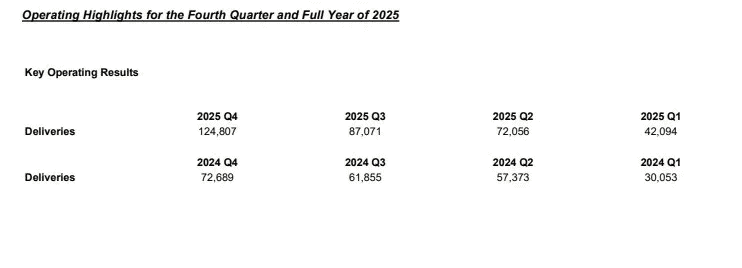
- NIO’s delivery results between 2024 and 2025 show evidence of enhanced business growth and market development.
- The company delivered 124,807 vehicles in Q4 2025, a sharp increase from 72,689 units in Q4 2024, which led to an impressive annual growth rate of approximately 72 %.
- The increase demonstrates that demand has become fully operational while production capacity operates at new levels and multiple products achieve market success.
- The company experienced delivery growth, which began at 42,094 units during Q1 and progressed to 72,056 units in Q2 and reached 87,071 units in Q3, until it reached its maximum point in Q4.
- The development pattern shows that operations achieved their execution goals, while supply chain operations reached their established performance standards, and new product introductions achieved their desired outcomes.
- The delivery numbers for 2024 increased less than the previous year, when total deliveries grew from 30,053 in Q1 to 72,689 in Q4, because 2025 represents the year when business operations will achieve their first major success.
- NIO achieved a 47 % delivery increase between 2024 and 2025, which resulted in a company-wide delivery growth from 55,000 to 81,000 between these two years.
- NIO is moving away from its current period of steady growth toward its upcoming period of rapid business expansion.
- The delivery momentum will improve revenue forecasting because it will bring the company nearer to achieving operational profitability in the highly competitive electric vehicle industry.
NIO Inc. Financial Turnaround
(Source: ir.nio.com)
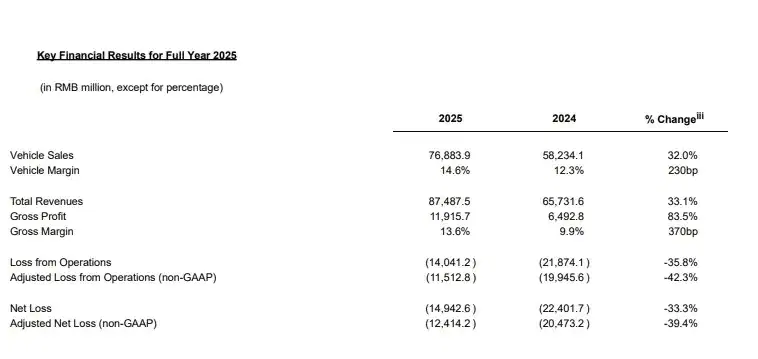
- NIO demonstrates operational maturity progress through its 2025 financial results, which show the company achieves sustainable growth while controlling its expenses.
- The total revenue reached RMB 87,487.5 million, approximately USD 12 billion, which represents a 33.1% increase from the previous year when it generated RMB 65,731.6 million in 2024. This growth shows that market demand and production capacity both continue to rise.
- The company generated revenue through vehicle sales, which reached RMB 76,883.9 million after showing a 32 % YoY growth because of increased delivery numbers and a larger product range.
- The vehicle margin rose to 14.6 % from 12.3 % while the total gross margin increased to 13.6 %, showing a year-over-year growth of 370 basis points.
- The company achieved gross profit growth of 83.5 %, which resulted in RMB 11,915.7 million because of better cost management and operational efficiencies that brought down expenses.
- NIO continues to operate at a financial loss, although its financial deficits show significant improvement.
- The net loss decreased to RMB 14,942.6 million because of a 33.3 % annual improvement, while the adjusted net loss dropped by 39.4 %.
- The company showed a 35.8 % improvement in operating losses, which demonstrates better operational results because of its commitment to operational efficiency and expense management.
- NIO has shifted from its previous pattern of rapid business growth to a period of systematized business expansion.
- NIO expects to achieve sustainable profitability by establishing 30 % revenue growth combined with expanding operational margins.
NIO Inc. 2025 Breakthrough
- NIO shows through its recent results that it has moved away from testing new markets because the company now operates through established business practices.
- The company delivered 124,807 vehicles in Q4 2025, marking a strong 71.7% year-on-year growth, while full-year deliveries reached 326,028 units, up 46.9% YoY.
- NIO has transformed into a multi-brand platform because its current operations exceed the scope of niche premium electric vehicle markets.
- The ES8 premium model maintains its market lead in the RMB 400,000+ price segment, while the ONVO L60 became the top-selling large BEV SUV in 2025, and Firefly established itself as the leading product in the premium compact segment.
- The company needs this balanced portfolio because it allows the business to secure various market segments while minimizing demand fluctuations.
- The financial situation is even more impressive than before. Vehicle margin improved to 18.1% in Q4 2025, reflecting better product mix and cost efficiencies.
- NIO reached its first quarterly non-GAAP operating profit milestone of RMB 1.25 billion, which demonstrates its better operational performance.
- The company achieved this turnaround through increased production volume, internal technology development, and cost-saving programs.
- NIO projects that it will deliver between 80,000 and 83,000 vehicles during Q1 2026, which will result in a 90% to 97% year-over-year sales growth that shows the company has strong market demand and operational expansion.
- The company enhances its competitive strength through investment in 12 essential core technologies and the development of battery swapping facilities and charging networks.
- NIO is entering a new phase where growth, margin expansion, and profitability are aligning together. If execution remains consistent, the company is well-positioned to transition into sustained profitability while maintaining leadership in China’s premium EV ecosystem.
NIO Inc. Margin Expansion
- NIO shows its development to better operational efficiency through its 2025 cost and margin changes, which occur during its fast growth period.
- A 64.3 % yearly increase and a 52.2 % quarterly increase in sales costs, which reached RMB 28,576 million (approximately USD 4.1 billion) during Q4 2025.
- The company uses rising expenses as proof of its strong market demand, which requires its aggressive growth strategy to succeed while showing no operational problems to investors.
- The company demonstrates a significant rise in its financial performance through its noticeable profit growth.
- Gross profit of RMB 6,074 million, which represented a 163.1 % yearly increase and a 100.8 % quarterly increase.
- A gross margin of 17.5 %, which increased from 11.7 % in the previous year and 13.9 % in Q3 2025, because of its improved ability to set prices and manage expenses.
- The vehicle margin reached 18.1 % in Q4, which shows an increase from the 13.1 % level during Q4 2024 because customers preferred premium models, which generated better profit results.
- NIO achieved a full-year gross margin of 13.6 % while vehicle margin reached 14.6 %, which shows that the company has achieved constant progress throughout its different business operations.
NIO Inc. Operating Expenses
- NIO’s 2025 operating expense profile shows a complete transition towards cost control methods that improve operational efficiency.
- The most notable development shows a complete decrease in research and development (R&D) funding.
- The R&D expenses for Q4 2025 decreased to RMB 2,026 million, approximately USD 290 million, which represents a 50 % decline from the previous year and a 15.3 % decrease from the previous quarter.
- The non-GAAP basis shows that R&D expenses reached RMB 1,744.9 million, which marked a 47 % decrease from the previous year.
- The organization needs this reduction because its strategic technology development process has reached production after completing its design phase.
- The full-year R&D expenses reached RMB 10,605 million, which showed an 18.7 % decrease from the previous year, while adjusted R&D expenses decreased by 22.6 %, which showed that the company implemented tighter control over research expenses while still maintaining technology development.
- NIO must achieve this critical balance because the company needs to decrease operational waste while continuing its investments in fundamental electric vehicle technologies.
- The selling general and administrative expenses for Q4 2025 decreased to RMB 3,537 million, which represents a 27.5 % decrease from the previous year and a 15.5% decrease from the previous quarter because the company decreased its marketing expenses and implemented more efficient business practices.
- The company achieved better cost management through its adjusted SG&A expenses, which dropped to RMB 3,388 million.
- The SG&A expenses for the entire year increased by 2.2 %, which indicates that the company needed to spend more money to support its business growth, even though it achieved better quarterly operational efficiency.
- NIO achieved strong operating leverage from its reduced research and development spending of 18.7% and, its managed selling and administrative expenses, which increased by 2.2%, and its revenue growth.
- NIO can achieve consistent profitability sooner because the company maintains strict cost control measures
(Source: NIO Investor Relations, Bloomberg, Reuters).
NIO ‘Firefly’ Impact: Penetrating Europe in 2026
- NIO is entering Europe’s compact EV segment with its Firefly brand at an aggressive starting price of around €29,990, positioning itself below the critical €30,000 psychological threshold.
- NIO has established a high-priced entry method that will face difficulties in the market where electric vehicles cost more than 50000 and only a few domestic products exist, which cost less than 30000 (Source: Bruegel). Firefly intends to use the value gap as its market advantage.
- The European Union has imposed additional countervailing duties ranging from 20.8% to 37.6% on top of the existing 10% import tariff.
- The total tariff costs escalate to almost 45% in certain situations, which increases Firefly’s landing expenses by €4200 to €8300 for each vehicle.
- The combination of logistics costs, insurance expenses, and distribution charges will push total extra expenses beyond €10000 for each unit, which will result in initial profit margins dropping to between single-digit amounts and negative figures.
- NIO uses a distributor-based expansion system to reduce operational hazards by working with distribution partners such as Hedin Automotive to operate in Belgium and Luxembourg and additional European Union markets.
- The asset-light business model decreases permanent operational expenses while the company must distribute revenue with regional partners, which reduces its ability to generate profits.
- European Union member states are currently experiencing increased electric vehicle adoption rates, which face obstacles because electric vehicles remain too expensive for most people to purchase.
- Firefly offers electric vehicles at a price below 30,000 euros, which enables budget-conscious urban customers and fleet operators to make purchases while establishing market entry points that existing competitors like Volkswagen Group lack in this specific pricing range.
- The financial strategy of the organization adopts a business model that prioritizes volume sales instead of generating high profits from each sale.
- Market analysts predict that NIO will focus on establishing its market presence and building its brand value instead of generating immediate financial returns because the company plans to operate multiple brands across premium and mainstream market sectors.
- The company may rely on cross-subsidization from higher-margin models in China and future scale efficiencies to stabilize margins.
- The company sees Firefly as a business expansion opportunity that offers both significant risks and potential high returns.
- If NIO can maintain pricing discipline while navigating tariffs and scaling volumes, it could disrupt Europe’s entry-level EV segment.
- The organization will need to achieve success through effective cost management, implementation of new policies, and development of its supply chain network.
(Sources: Bruegel, European Commission Trade Reports, CleanTechnica, NIO Official Announcements)
Battery-as-a-Service (BaaS) and the 2026 Secondary Market
- NIO redefines electric vehicle value retention through its Power Swap Station 4.0, which serves as the main component of this process.
- By mid-2024, NIO had already deployed 2,454 swap stations globally, with a roadmap targeting 3,500+ stations by early 2026 and potentially 4,600+ by the end of 2026, reflecting an aggressive infrastructure expansion strategy.
- The stations enable the operation of 23 battery compartments while performing 480 battery swaps throughout the day and achieving a 22% reduction in swap duration, which results in 2 minutes 24 seconds of total time.
- The current operational capacity of NIO network operations supports utility-based systems, which deliver fast service to customers who require efficient access to charging stations that active electric vehicle buyers need.
- The Battery-as-a-Service (BaaS) business model creates a strong financial base that generates continuous income for the company.
- The first case studies revealed that a small fleet generated USD 54 million in annual subscription revenue, but BaaS will reach USD 480 million in annual revenue by 2025 with more than 320000 active subscribers.
- The business transformation enhances customer lifetime value through subscription sales, which NIO follows according to its subscription-based revenue model.
- The company achieves essential structural benefits through its business model because it separates battery ownership from vehicle ownership.
- The system enables users to replace their battery packs whenever they need to do so because it solves all battery degradation issues, which cause electric vehicle value loss.
- NIO data shows that BaaS became the choice of more than 70% of first-time NIO customers who made their purchases in 2024.
- The majority of used NIO vehicles will become part of this subscription service by 2026, according to industry forecasts.
- NIO’s swap-enabled cars provide drivers with assured battery performance because of their battery system and upgradeable battery system, which means resale value remains intact for NIO cars.
- The ecosystem gets additional strength through Swap 4.0, which enables multiple brands to operate their systems together.
- The network’s value increases through improved utilization rates, which result from more OEMs joining the system, thus decreasing infrastructure expenses according to digital marketplace platform economics.
Conclusion
NIO Inc. has entered a vital stage of its business transformation, which requires the three elements of scale, efficiency, and innovation to work together. The company demonstrates operational maturity through its strong delivery growth, revenue increase, and margin expansion, which show progress towards its business objectives. The company maintains its unique competitive edge through its battery-swapping ecosystem and Battery-as-a-Service business model, which generates recurring revenue streams while increasing the value of its vehicle lifespan.
NIO uses aggressive infrastructure development and its multi-brand approach to create a strong base for its Chinese market leadership while pursuing international expansion and maintaining a balance between short-term growth and long-term financial stability in the electric vehicle market.
Sources
FAQ.
NIO delivered 326,028 vehicles in 2025, which marked a 46.9% year-on-year increase.
NIO achieved its first quarterly non-GAAP operating profit of RMB 1.25 billion, although it still experiences annual financial losses.
BaaS allows users to subscribe to batteries that produce approximately USD 480 million in yearly revenue through more than 320,000 active subscribers.
NIO has established 2,454 operational swap stations across the world while aiming to reach more than 3,500 stations by the start of 2026.
NIO predicts its Q1 2026 vehicle deliveries will range between 80,000 and 83,000 vehicles, which translates to a maximum yearly growth rate of 97%.

I hold an MBA in Finance and Marketing, bringing a unique blend of business acumen and creative communication skills. With experience as a content in crafting statistical and research-backed content across multiple domains, including education, technology, product reviews, and company website analytics, I specialize in producing engaging, informative, and SEO-optimized content tailored to diverse audiences. My work bridges technical accuracy with compelling storytelling, helping brands educate, inform, and connect with their target markets.