AI In Social Media Tools Statistics By Usage And Trend (2025)

Updated · Dec 19, 2025


Table of Contents
- Introduction
- Editor’s Choice
- AI In The Social Media Global Market
- Most Effective Tools For Managing Multi-Platform Social Media Strategies
- Social Media Analytics Demographics Changed By AI
- AI In Social Media Marketing
- AI Tools Usage And Trends
- AI Adoption In Social Media Platforms
- AI In Customer Service And Chatbots
- Automation of Social Media Management Tasks
- AI Audience Segmentation
- ROI And Efficiency With AI Tools
- Recent Developments
- Conclusion
Introduction
AI in Social Media Tools Statistics: In the year 2025, the world of artificial intelligence has moved from being merely an experimental accessory to a main player in the social media industry. In fact, it has become the engine under the hood. The various AI-powered tools are now creating new channels and styles of communication. These involve marketing, content creation, users, and even the social media platforms themselves.
This review not only updates readers with the latest AI in Social Media Tools statistics and research-based findings for the year 2025. It also presents a clear picture of the status of AI in social media today and what the numbers that lie ahead imply. These implications affect marketers, product leaders, and regulators.
Editor’s Choice
- The global AI in social media market is estimated to grow from USD 2.45 billion in 2024 to around USD 3.34 billion in 2025, and it is expected to reach about USD 54.07 billion by 2034 due to a CAGR of over 36%.
- Companies and organizations handling several social media platforms depend highly on real-time engagement monitoring (24.7%) plus in-house experts on the platform (21.4%), whereas AI tools and cross-platform scheduling are each used by around 18% of teams.
- AI-enabled advertising, combined with strong Gen Z engagement, helped Pinterest achieve a revenue of US$998 million, which is a 17% increase year on year.
- 69% of marketers regard AI as a revolutionary tool that creates new jobs, and 83% consider that generative AI makes major contributions to their capability of producing content in bulk.
- 88% of marketers are using AI daily, the majority doing so to quicken their content production process (93%), decision-making (90%), and data analysis (81%).
- 86% of marketers affirm that AI is a time saver of more than one hour every day, and almost 20% of them invest more than 40% of their budget in AI-assisted content campaigns.
- The highest AI usage is in large companies (57%), while only 40% of small firms have accepted it, but still, the rate of adoption in the small business sector is increasing as technology is becoming cheaper and easier to access.
- The investments in chatbots have increased gradually from US$2.47 billion in 2021 to US$15.57 billion in 2025, and they are expected to continue growing until US$46.64 billion, with nearly 1 billion people using them worldwide.
- The use of AI in customer service is so widespread that 70% of CX leaders affirm that chatbots provide extremely customized journeys.
- AI segmentation is responsible for over 80% of content suggestions and can increase sales by about 5% on major channels.
- The practitioners of the brand are increasingly the micro- and mid-tier influencers (73%) due to AI-assisted targeting and the incremental engagement-to-cost ratio efficiency.
- Social media has come to represent more than 17% of the total online sales by the year 2025, and it is predicted that the global social commerce will exceed the US$1 trillion mark by 2028.
- Influencer marketing is expected to reach US$32.55 billion by 2025, where the top campaigns will yield as much as US$20 in returns for every US$1 spent.
- 71% of marketers indicate that AI-based content is superior to content that is not supported by AI, and the only AI support in customer service could add US$16.6 billion to Meta’s revenue in 2025.
AI In The Social Media Global Market
(Reference: precedenceresearch.com)
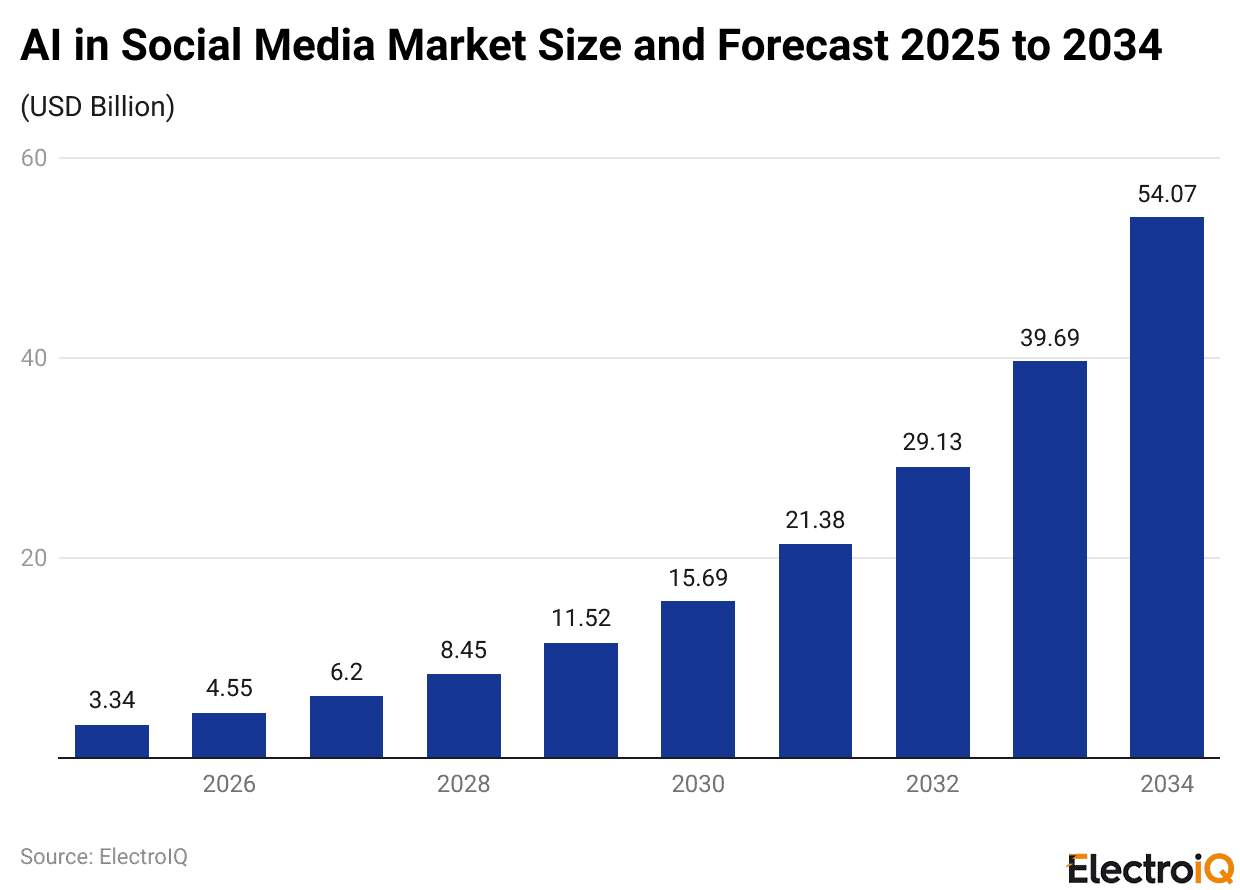
- In 2024, the worldwide AI market for social media was assessed at USD 2.45 billion and is likely to experience a quick ascent, reaching nearly USD 3.34 billion by 2025.
- The count of businesses that have already decided to test the waters with AI social media is impressive and reflects acceptance of and the need for AI tools.
- The longer-term forecast is not at all modest, as the market might already have raked in about USD 54.07 billion by 2034, helped along by a remarkable compound annual growth rate of 36.26% from 2025 to 2034.
- One of the main reasons for this tremendous growth would be the unabating demand to detect and scrutinise the massive yet significant data sets for marketing and strategic decisions.
- AI is becoming a vital tool for companies that want to catch the audience’s pulse, master their campaign strategies, and draw productive conclusions from the flood of social media data.
Most Effective Tools For Managing Multi-Platform Social Media Strategies
(Source: sqmagazine.co.uk)
- Organizations that are managing numerous social media accounts tend to rely on a combination of technology, data, and human skills rather than a single option.
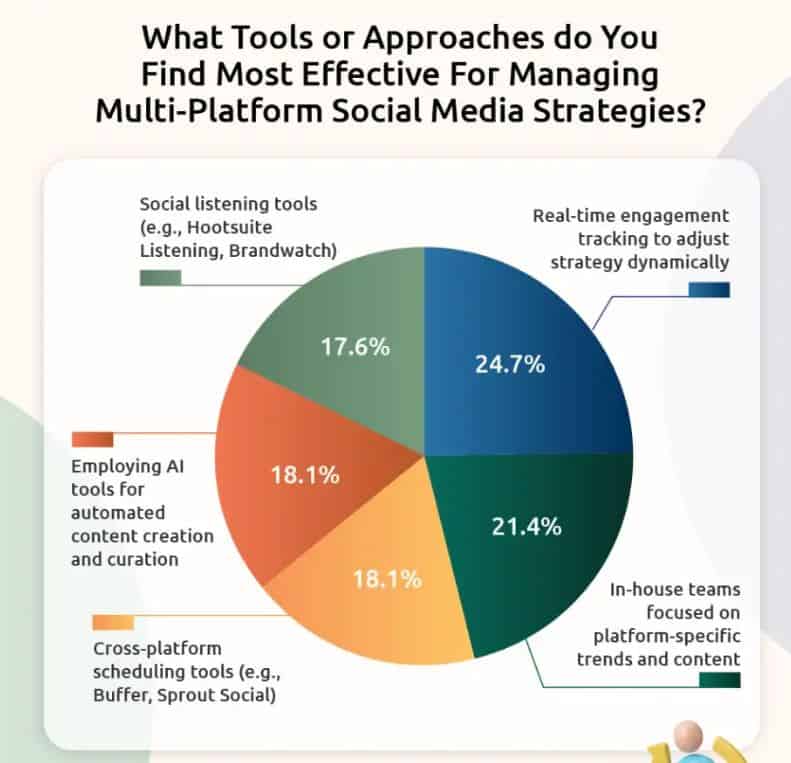
- Real-time engagement tracking, which is used actively by 24.7% of the organizations, is the most popular method to monitor likes, comments, shares, and conversations.
- In-house teams that concentrate on understanding each platform are the primary support for about 21.4% of the organizations.
- These teams study platform-specific trends, algorithms, and audience behaviour, thus making sure that the content is very much like the channel it is being presented through, rather than being a total recycling across all platforms.
- Approximately 18.1% of organizations are relying on AI-powered tools for the automated content creation and curation.
- These tools support the work of generating captions, suggesting topics, repurposing the content, and maintaining the posting consistency; the latter is especially important when dealing with the high volume of content across several platforms.
- Another 18.1% rely on cross-platform scheduling tools, such as Buffer or Sprout Social.
- Lastly, around 17.6% of the organizations are using social listening tools like Hootsuite Listening or Brandwatch. Such tools are capable of monitoring the brand mentions, sentiment, and discussions on a wider scale across social media.
- They also assist organizations in understanding the audience’s perception, identifying emerging trends, and addressing feedback or issues quietly by either responding or erecting a barrier.
Social Media Analytics Demographics Changed By AI
- Instagram’s user distribution is nearly equal among the different genders, as there are 50.6% males and 49.4% females, with males aged 18–34 representing the biggest group.
- Users’ visibility on this social media platform is significantly influenced by AI-based recommendation systems, which work by evaluating users’ behaviours, preferences, and interactions.
- The outcome of this strategy is that the platforms can provide content that precisely corresponds with the interests of particular demographic groups, thus elevating the relevance and engagement.
- Users’ interest in AI-generated content is especially strong in the entertainment sector, with the trend continuing to grow.
- AI-generated music attracts the attention of about 60% of users, while the percentage of those curious about comedy videos is 57%, indicating a strong acceptance of creative AI content.
- However, there is less “hype” when it comes to AI-driven ads (34%) and podcasts (35%), which means that users prefer AI to play a creative or entertaining role rather than a direct marketing one.
- Younger consumers, mainly Gen Z and millennials, heavily rely on user-generated content when they make purchasing decisions; 70% of Gen Z and 78% of millennials trust UGC.
AI In Social Media Marketing
- Social media marketing is one area where AI adoption is happening at a fast pace, with 61% of businesses implementing AI to lessen the manual workload and make daily operations more efficient.
- About 38% of marketers view increased efficiency as the main advantage of AI, as it takes over the activities of content production, planning, targeting, and performance evaluation.
- The impact of AI can be seen in real-world cases, for example, Unilever’s AI-powered influencer approach that resulted in 3.5 billion social impressions and attracted 52% of new customers.
- AI systems are estimated to take over the whole campaign management on platforms such as Meta by 2026, controlling every aspect from images and videos to copy and audience targeting, thus allowing brands to run ads with very little human involvement.
- Pinterest’s adoption of AI advertising tools resulted in a 17% increase in revenue year-on-year, reaching US$998 million, which was driven by the engagement of Z-generation users.
- On the other hand, the AI products for advertising, like Advantage+ and automated campaign tools from Meta, are expected to generate additional revenue of billions of dollars every year until 2030, subject to the buoyancy of the market.
- Moreover, AI is not only helping big companies but also small companies and SMEs by taking care of the entire social media creation and lessening the dependence on costly agencies.
- TikTok’s Symphony-like tools are the ones that go beyond such automation, where ad scriptwriting, video translation, and AI avatar creation come under the roof of one tool, thus allowing small and big brands to reach out and compete digitally in the social media world very effectively.
AI Tools Usage And Trends
(Reference: sqmagazine.co.uk)
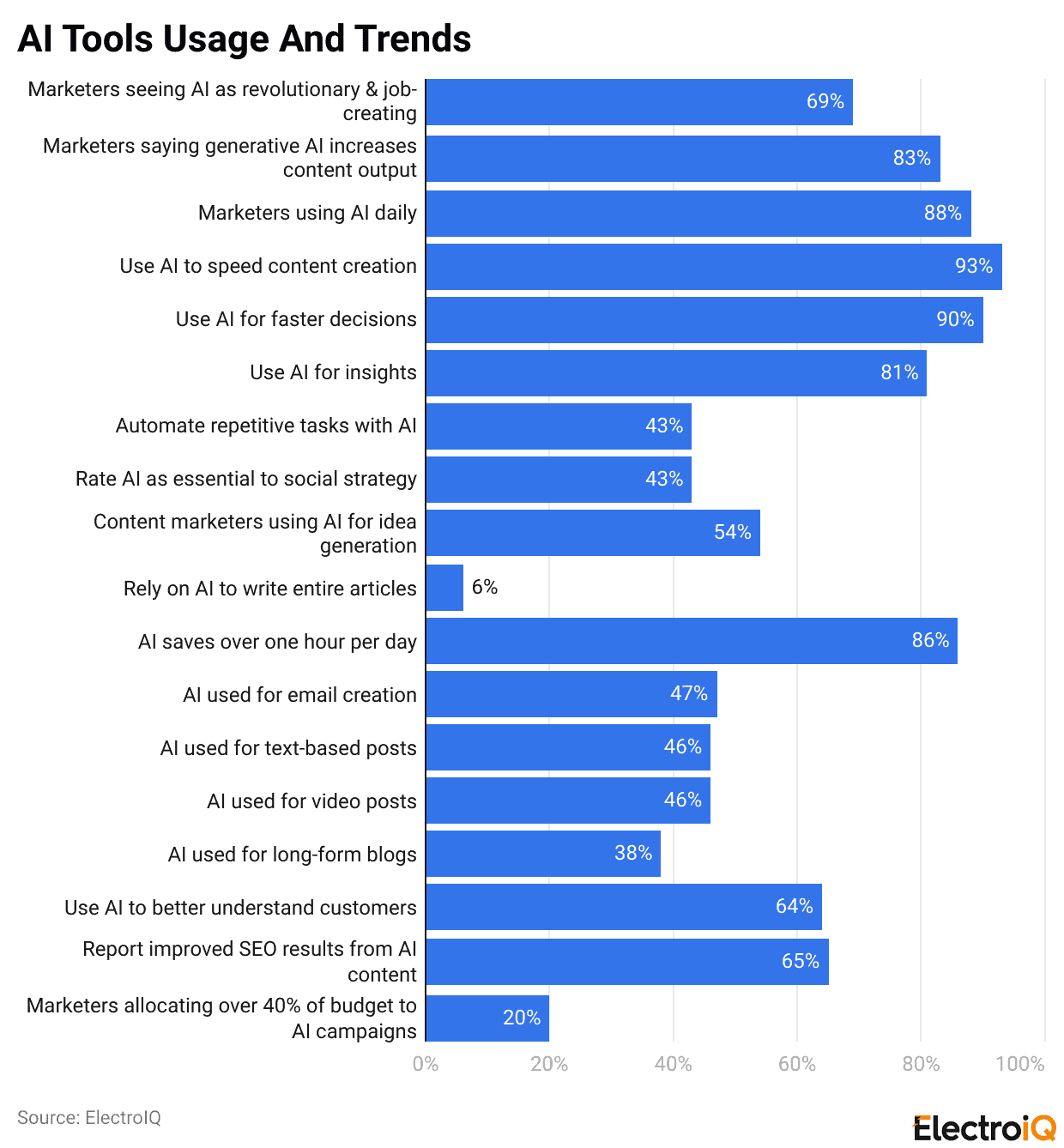
- The majority of marketers consider AI as a good and helpful tool instead of a threat.
- Approximately 69% of people think it is revolutionary, and the job market will be positively impacted by it.
- A large portion, 83%, claims that generative AI is the main reason for their current levels of content production, which is much higher than before.
- For a lot of professionals, 88% use AI daily, and it has become part of their everyday work life.
- Approximately 93% of them use it for speedy content creation, 90% for fast decision-making, and 81% for deriving better insights from data.
- AI is still at the forefront of technology, automating the most basic tasks, and marketing professionals continue to rely on it as 43% admit using AI in day-to-day tasks, and the same percentage sees AI as being vital to their general social media strategy.
- Nearly 54% of content marketers are using AI for brainstorming, but only about 6% are fully relying on it for producing the entire article in one go.
- The majority of the marketers claim they have cut down time in the process, and 86% of them say AIs even save them over 1 hour each day when coming up with a creative idea.
- AI is widely used across different content formats like emails, short text posts, videos, and long blog articles.
- It is also a tool that helps marketers know their customers better because, for example, 64% of marketers use AI for audience insights, and 65% is the percentage who say AI-generated content has helped their SEO.
- Acknowledgement of the technology’s rising importance can be seen in the fact that nearly 20% of marketers are now using over 40% of their budget for AI-powered content campaigns.
AI Adoption In Social Media Platforms
- The use of AI has become an essential part of organizations’ workflow in the management and growth of their social media presence.
- It is estimated that about 80% of the companies worldwide are in some way interacting with AI.
- Among these, 35% have already completely incorporated AI into their business processes, while 42% are still in the trial phase and experimenting with AI tools.
- Only a small minority, around 13%, currently have no plans to adopt AI, showing how widespread acceptance has become.
- In the United States, AI adoption is particularly strong, with 60% of companies using generative AI to support always-on content strategies. This means brands are able to continuously create, optimize, and publish content with minimal manual effort.
- The growth rate of 35.9% between 2025 and 2030 is a consequence of the long-term investment and assurance in AI reliability and adoption.
- A survey indicates that 69% of marketers consider AI as a revolutionary, job-creating technology, implicitly rather than a threat.
- This favourable view has become more widespread due to the practical benefits, since 83% of the marketers state that generative AI is enabling them to create content in much larger quantities than they would without this tool.
- Consequently, 71% of the social media marketers have fully incorporated AI tools into their strategies, and it has been observed that AI-assisted content often outperforms the content that was created without using AI.
- The large corporations are the ones to seek the adoption of AI, with 57% of enterprise marketing teams ready to use AI, while smaller firms are less than half, with only 40% planning to use AI.
- This difference underlines the disparities in the availability of resources and the willingness to adopt the technology.
AI In Customer Service And Chatbots
- The chatbot industry has been on a rollercoaster ride, climbing hills that took it from US$2.47 billion in 2021 to US$15.57 billion in 2025, and skyrocketing to US$46.64 billion by 2029.
- More than 987 million people in the world are utilizing AI chatbots today, and nearly 80% of the companies have either started using or are planning to use AI chatbots for customer support by 2025.
- Analysts are suggesting that in the near future, around 95% of customer interactions, whether texting or via voice call, will be handled by AI.
- The worth of the AI-powered customer service market was about US$308 million in 2022, and it is projected to nearly reach US$3 billion over the next decade.
- These numbers include a whopping US$1.43 billion increase in the chatbot market value forecasted for 2025 alone, as a result of advancements in natural language processing and machine learning.
- The changing wave in customer perceptions is taking place alongside this trend, where the majority of the users, up to half, are adamant that AI agents can feel and express empathy, while the majority.
- 69% of organizations affirm that generative AI will help in making digital interactions more humane.
- Moreover, 70% of the customer experience leaders agree that chatbots are skilled at providing personalized customer journeys to the utmost.
Automation of Social Media Management Tasks
- AI is becoming the mainstay for social media facilitators aiming to automate their daily activities like scheduling, publishing, and optimizing content.
- Influencer marketing has improved its adoption rate by about 35% every year, mainly through the support of AI tools, which have sped up the whole process from planning to matching the right creator and targeting the appropriate audience.
- The use of AI in clipping and editing tools has made it possible for creators to transform their long-form content into short viral clips quickly, with some teams generating as much as US$30,000 monthly from short video performance.
- The Meta AI Campaign tools are among the best in terms of content and posting time, which allows marketing teams to invest more time in strategy rather than execution.
- Besides, AI-driven data analysis has enabled marketers to adjust the content’s frequency and formats in accordance with the current engagement trends.
- AI agents are now responsible for handling the mundane customer support queries; Zendesk is one of the platforms that predicts the automation of up to 80% of customer inquiries by the year 2027.
AI Audience Segmentation
- The content recommendations that are powered by AI now account for more than 80% of what the user sees; thus, the personalized content discovery has been greatly enhanced.
- The Meta AI targeting tools are able to provide conversion rates that are 5% higher because they are employing more precise audience segmentation.
- AI contributes to marketers through the segmentation of their messages according to demographic, geographic, psychographic, and behavioural factors.
- The TikTok Symphony tool is able to create ad scripts and digital avatars, which are aimed specifically at niche or micro-audience segments.
- Thus, the preference of 73% of brands for micro and mid-tier influencers is a clear reflection of an AI-induced change toward such creators who are more engaged and cost-efficient.
- Personalized influencer campaigns that have been backed by AI are capable of driving conversion rates up to 20%, while revised attribution models can hike the efficiency of a campaign by as much as 30%.
ROI And Efficiency With AI Tools
- Initially, social media platforms did play a minor role in online sales, but now they have come to stay, and their sales percentage crossed 17.11% of the whole e-commerce transactions in 2025.
- The global social commerce is underpinned by a 13.7% compound annual growth rate and is subsequently projected to surpass US$1 trillion mark by 2028.
- Influencer marketing is still living the dream, with the global market anticipated to be worth US$32.55 billion by 2025, which is a whopping 35% increase from 2024.
- In exceptional cases, a campaign might give back as much as US$20 for each dollar spent.
- The majority of the brands are covering the way for the future by informing the investors; therefore, 80% are keeping or raising influencer marketing budgets, and 47% are increasing their expenditure by a minimum of 11%.
- AI-powered content wins monthly, as witnessed by 71% of social media marketers declaring AI-assisted content as performing better than non-AI content.
- For example, AI tools prevent outside creatives from wasting more than an hour on brainstorming and production daily, thus allowing them to produce at a higher rate without incurring significantly higher costs.
- At Meta’s customer service line, AI assistance alone might add another US$16.6 billion to the company’s revenue in the year 2025.
Recent Developments
- AI media generation is rapidly gaining ground, as it has been reported that the focus of 9 out of the 100 fastest-growing YouTube channels in July 2025 was on content that was produced entirely through AI.
- Simultaneously, the major platforms have started to either label or reduce the monetization of such low-quality, mass-produced AI content, which is often referred to as “AI slop”.
- Legal tensions are escalating at the same time, and this is evident by the lawsuits filed against each other by the established media companies and AI startups, a good example being Disney’s case against Midjourney, which outlines the growing disputes over content ownership and intellectual property rights.
- The Public’s confidence in internet content continues to drop, with only 41% of Americans considering the information they find online to be unbiased and human-made, and 78% expressing that it is more difficult than ever to tell apart human-created content from machine-generated content.
- Governments around the world have become more interested in regulating AI as a consequence of these problems.
- In the first quarter of 2025, there was a marked increase in legislative activities, including the introduction of 59 AI-related rules in the U.S. in 2024, which is almost twice as many as the previous year.
Conclusion
AI in Social Media Tools Statistics: By 2025, AI will have undoubtedly become the backbone of the modern advertising world. Content creation, distribution, optimization, and monetization have all been dictated by AI. The rapid growth of the market and total immersion in use by all types of companies have contributed. Additionally, huge performance improvements have all contributed to the marketing, customer engagement, and commerce categories. In these areas, AI is playing a critical role.
The tools applied vary from personalized recommendations and automated campaign management to chatbots and audience segmentation. Ultimately, they all lead to the same result: efficiency at a measurable ROI. As the social networks turn more and more to data-driven intelligence, the businesses that have already absorbed the AI tools will be the ones fastest to scale. They will have the most genuine connections with their audiences and be able to keep their place in the increasingly automated digital ecosystem.
Sources
FAQ.
AI has become an integral part of social media, as it is responsible for the creation of content, targeting the right audience for ads, moderating the whole process, personalizing, and making it easier for analysts to interpret the data. By using AI, social media platforms and brands are able to grow at a higher pace, make reliable decisions based on data, increase interaction and above all, give personalized experiences to users with less manual labor and cost.
The AI in the social media market was valued at USD 2.45 billion in 2024, and it is estimated that the market will reach USD 3.34 billion by 2025. The market will continue to grow at a very high rate and will be around USD 54.07 billion by 2034 with a CAGR of 36.26% and thus, the adoption across industries will be very strong.
AI is used by marketers in numerous ways, such as content creation, scheduling, audience targeting, performance optimization, and analytics. More than 60% of companies are applying AI to lighten their workload, while 83% of marketers claim that generative AI accelerates their content production. It is even said that AI-assisted content is taking the lead over traditional content.
Almost all content recommended to users is backed by AI, and it is also the reason why the audience segmentation is accurate in terms of age, location, interests, and behavior. Consequently, there comes a lot of relevant content that gets users engaged and converted, and sometimes even the conversion rates in influencer and ad campaigns get doubled.
A huge impact as AI chatbots and agents are changing customer service by taking care of repetitive questions, giving tailored answers, and supporting both text and voice channels. Almost 80% of firms will have AI chatbots in place by 2025 for support, while the AI is expected to handle up to 95% of the customer interaction in the future.

I hold an MBA in Finance and Marketing, bringing a unique blend of business acumen and creative communication skills. With experience as a content in crafting statistical and research-backed content across multiple domains, including education, technology, product reviews, and company website analytics, I specialize in producing engaging, informative, and SEO-optimized content tailored to diverse audiences. My work bridges technical accuracy with compelling storytelling, helping brands educate, inform, and connect with their target markets.