Personalised Email Marketing Statistics By Strategy, Frequency, Timing and Facts (2026)

Updated · Jan 12, 2026


Table of Contents
- Introduction
- Editor’s Choice
- General Statistics of Personalised Email Marketing
- Key Trends of Email Personalisation
- Types of Email Marketers Send Analyses
- Email Personalisation Statistics
- Top Email Personalisation Marketing Elements
- Leading Motivations For Personalised Email Campaigns
- Personalised Email Marketing Statistics By Frequency And Timing
- Effectiveness Of Email Marketing Statistics
- Top Email Marketing Personalisation Tactics
- Email Marketing Strategy Statistics
- Distribution of Key Personalised Email Marketing Statistics
- Challenges In Personalised Email Marketing Statistics
- Conclusion
Introduction
Personalised Email Marketing Statistics: Getting noticed in a crowded inbox is tough, and emails that feel “okay” today can be ignored tomorrow. So audiences expect timely, relevant messages tailored to their needs and interests, making personalisation essential. It can be as simple as using a name or grouping subscribers by their purchases. This article covers sending emails based on actions and suggesting products to boost opens, clicks, and sales while building trust. But if it feels too pushy or strange, it may lead to unsubscribes or spam reports.
In this article, you’ll see key personalisation email statistics and what they mean so that you can plan smarter campaigns.
Editor’s Choice
- Personalised emails get about a 29% open rate and a 41% click-through rate.
- Emails with personalised subject lines get opened about 50% more often.
- 81% of marketers mainly preferred sending newsletters, and 79% prefer welcome emails.
- Personalised emails were six times more likely to drive conversions and delivered six times the transaction rate.
- 82% indicates that personalised email campaigns lead to a higher open rate.
- Most subscribers preferred weekly promo emails (61%), while 38% wanted them even more often.
- Most emails were sent often on Thursdays (18%), followed by Tuesdays (17%) and Wednesdays (16%).
- A report shared by SQ Magazine, in 2025, email personalization was implemented by 91% of brands worldwide use it.
- Email marketing performs well overall, with an average open rate across industries of 32.55%.
- The leading tactics were email list segmentation at 51%, individualized email messaging at 50%, and behavior-triggered emails at 45%.
- As of 2025, around 18.8% represented consumers who were more likely to buy from personalized brands.
- Litmus.com reported that 24% of respondents said insufficient data made email personalisation difficult.
General Statistics of Personalised Email Marketing
- According to mailmodo.com, around 72% of shoppers respond only when messages feel personal.
- Personalised emails get about a 29% open rate and a 41% click-through rate.
- Nearly 49% of people want promo emails from their favourite retail brands once a week.
- After a tailored shopping experience, 60% are likely to buy again.
- But if an email isn’t personalised, 52% may shop somewhere else.
- About 70% of millennials get annoyed by irrelevant emails.
- On the marketer side, 57% say personalisation improves visitor engagement.
- Moreover, 55% of consumers believe targeted deals and discounts would improve the effectiveness of email.
- Marketers also see up to a 760% increase in email revenue with segmented personalisation.
- Lastly, personalised CTAs convert 202% better than standard CTAs.
- 80% of financial services firms customise email body copy, while only 55% of retail, e-commerce, and consumer goods/services do.
- However, 55% of client-side marketers cite data integration as the biggest hurdle to implementing personalisation.
Key Trends of Email Personalisation
- According to market.us, about 75% of survey respondents report disliking email content that doesn’t match their interests.
- In fact, 43% unsubscribe from emails mainly because the messages feel irrelevant.
- Targeted and personalised emails drive around 58% of total email marketing revenue.
- Also, 75% of shoppers are more likely to buy from a brand that remembers what they bought before and recommends products that fit.
- 74% of Baby Boomers say it’s their most intimate way to communicate.
- Small changes help: adding a reader’s first name can raise open rates by 35%, and personalised subject lines are 26% more likely to be opened.
- Segmenting your email list can be a game-changer, with reports showing up to a 760% increase in revenue.
- Nearly all companies (96%) say personalisation helps email marketing succeed.
- It can cut acquisition costs by 50%, improve spending efficiency by 10-30%, and lift revenue by 5-15%.
Types of Email Marketers Send Analyses
(Reference: porchgroupmedia.com)
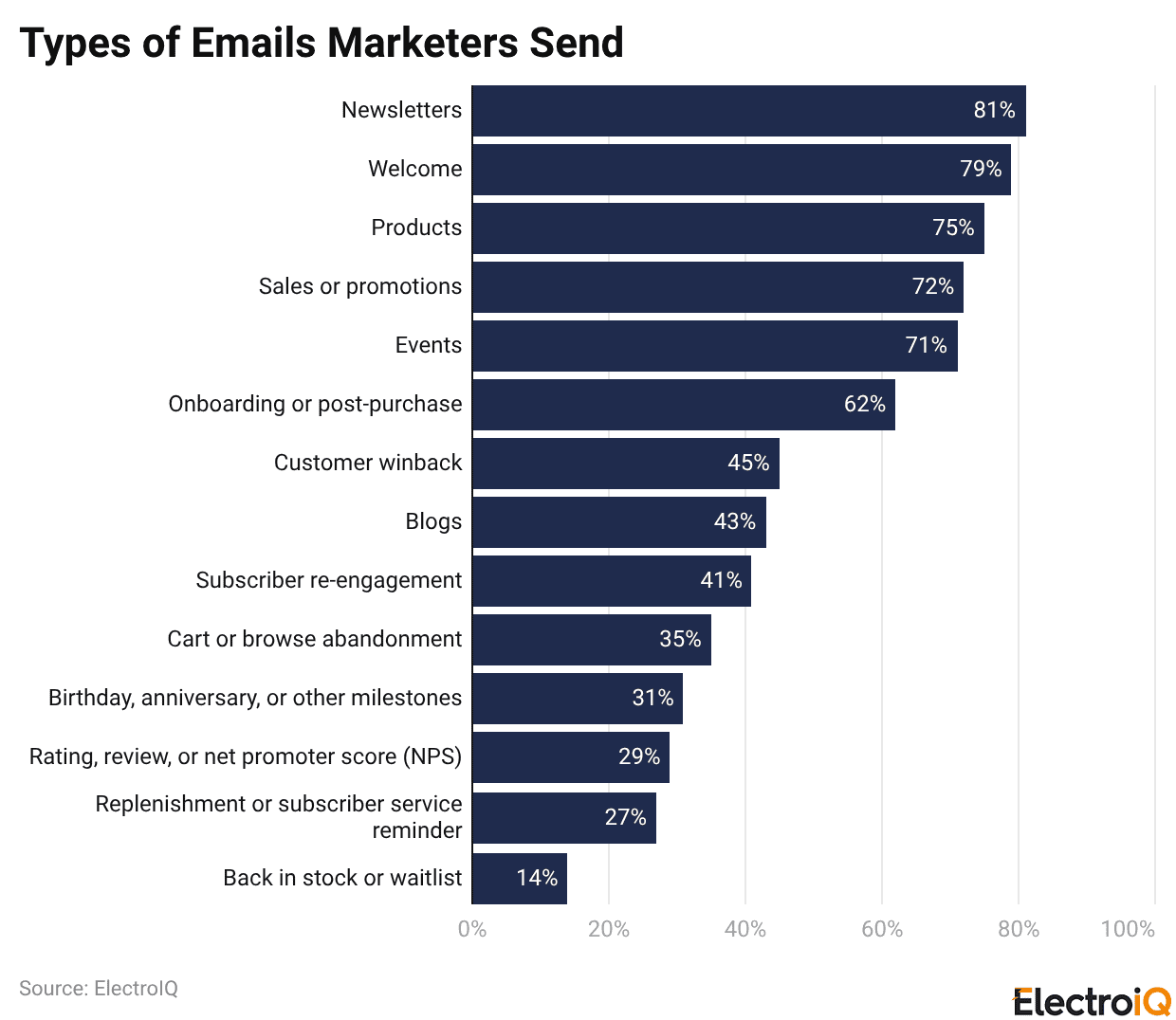
- 81% of marketers mainly preferred sending newsletters, followed by 79% (welcome emails), 75% (product emails), 72% (sales or promotion emails), 71% (event emails), and 62% (onboarding or post-purchase messages).
- Other common types email preferred by marketers are customer winback (45%), blogs (43%), subscriber re-engagement (41%), cart or browse abandonment (35%), birthday/anniversary or milestone emails (31%), rating/review or NPS emails (29%), replenishment or subscriber service reminders (27%), and back-in-stock or waitlist emails (14%).
Email Personalisation Statistics
- As of 2026, around 80% of shoppers reported being more likely to buy when the experience felt tailored, according to porchgroupmedia.com.
- Marketers said their best tactics had been subscriber segmentation (78%), message personalisation (72%), and automated email campaigns (71%).
- Personalised emails were six times more likely to drive conversions and delivered six times the transaction rate.
- Moreover, 88% of respondents reported feeling more positive about emails that appeared to be personally written.
- Email had been seen as the most personal brand channel by 74% of Baby Boomers, 72% of Gen X, 64% of Millennials, and 60% of Gen Z users.
- About 74% of people said they hated irrelevant content, so personalisation mattered a lot.
- Also, 77% of marketers said they used email for personalised content, 66% used age data to personalise, and personalised subject lines increased open rates by 26%.
Top Email Personalisation Marketing Elements
| Personalization element | Marketers Share |
| Name, company name, or other profile data | 80% |
| Customer segment | 64% |
| Past email interactions | 42% |
| Location or geolocation | 40% |
| Past purchases or donations | 34% |
| Past interactions with products or services | 33% |
| Expressed preferences or interests | 33% |
| Past website interactions | 26% |
| Member or reward status, or points | 23% |
| Gender, race, or other demographics | 14% |
- 80% of marketers use personal details such as the customer’s name, company name, or basic profile information to personalize email campaigns, as this data is easy to collect and highly effective for engagement.
- 64% of marketers personalize emails based on customer segments, where audiences are grouped by shared characteristics to improve message relevance and response rates.
- 42% of marketers rely on past email interactions, such as opens and clicks, to adjust future email content and timing.
- 40% of marketers use location or geolocation data to tailor messages according to regional preferences, local events, or language needs.
- 34% of marketers personalize emails using past purchases or donation history, allowing more accurate product recommendations or cause related messaging.
- 33% of marketers use previous interactions with products or services to customize email content, helping align communication with the customer’s usage behavior.
- 33% of marketers also personalize emails based on expressed preferences or stated interests, which supports more targeted and relevant messaging.
- 26% of marketers use past website interactions, such as page visits or downloads, to guide personalization strategies.
- 23% of marketers personalize emails based on membership level, reward status, or loyalty points to encourage repeat engagement and retention.
- 14% of marketers use gender, race, or other demographic factors for email personalization, reflecting more cautious adoption due to privacy and compliance considerations.
Leading Motivations For Personalised Email Campaigns
(Reference: shortpixel.ai)
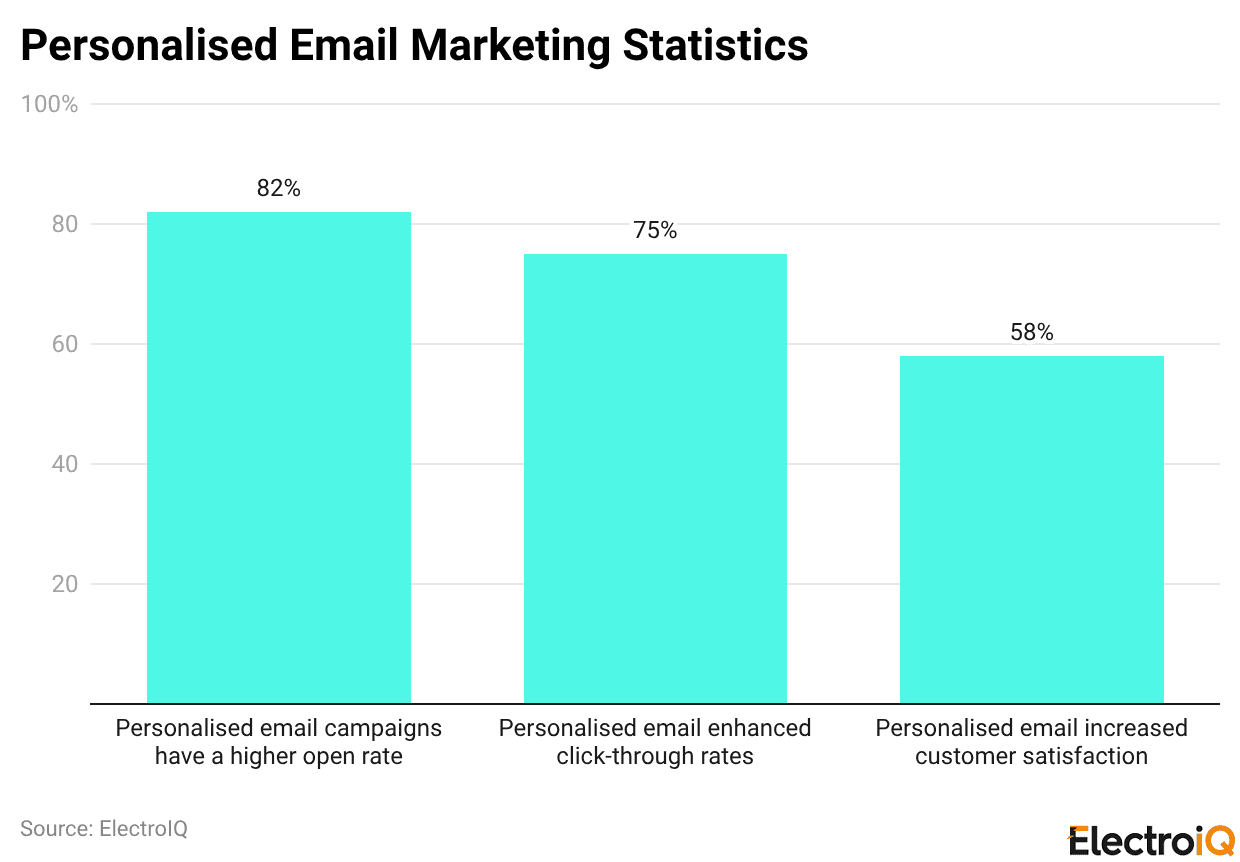
- 82% indicates that personalised email campaigns lead to a higher open rate.
- Meanwhile, 75% shows that personalisation improves click-through rates.
- 58% reflects that personalised emails increase customer satisfaction.
Personalised Email Marketing Statistics By Frequency And Timing
- Most subscribers preferred weekly promo emails (61%), while 38% wanted them even more often.
- Marketers contacted customers each month, mostly 2-3 times (32%), then 4-6 times (19%), once (17%), or more than 6 times (16%).
- Some subscribers (28%) said they wanted offers two or three times a week.
- Most emails were sent often on Thursdays (18%), followed by Tuesdays (17%) and Wednesdays (16%).
- Weekend campaigns delivered the weakest open and click rates.
- Around 11 AM worked best for sending, and 12 PM produced the highest click-through rate.
- Website visits rose most in autumn and winter.
- Traffic spiked on Black Friday, Cyber Monday, and December 23.
- Half of marketers (50%) believed there was no single “best” time because every audience differed.
- Overall, Tuesday and Thursday were seen as the best days for email sends.
By Adoption Rates
- A report shared by SQ Magazine, in 2025, email personalization was implemented by 91% of brands worldwide use it.
- North America is the highest, with 97% of email marketers adding personalization tools.
- Western Europe is close at 89%, and APAC is at 82%.
- Latin America has risen 14% in a year, reaching 71% in early 2025.
- Firms with more than 500 staff are 3.7 times more likely to use advanced methods.
- For retailers, 49% rank personalized email as best channel.
- AI personalization is used by 64% of enterprise teams.
By Demographics
| Metrics | Descriptions |
| Email feels most personal | 74% (Baby Boomers), 72% (Gen X), 64% (Millennials), and 60% (Gen Z). |
| Preferred channel for brand messages | 68% of all age groups prefer email |
| A smartphone is the main email device | 53% (overall), 67% (Gen Z), and 59% (Millennials) |
| Too many emails (daily) | 67% (overall), 81% (Baby Boomers), and under 50% (Gen Z) |
| Personalisation is important | 57% (Gen Z), 55% (Millennials), and 25% (Baby Boomers). |
| Comfortable sharing data for personalisation | 51% (Gen Z), and 20% (Baby Boomers) |
- Email is considered the most personal communication channel by 74% of Baby Boomers, 72% of Gen X, 64% of Millennials, and 60% of Gen Z consumers. This indicates that email remains highly emotionally relevant across all age groups, with higher attachment observed among older adults.
- Email is the preferred channel for receiving brand messages for 68% of consumers across all age groups. This confirms email’s continued role as the most trusted and widely accepted medium for brand communication.
- Smartphones are the primary device for reading email among 53% of users. Usage is significantly higher among younger audiences: 67% of Gen Z and 59% of Millennials access email primarily on mobile devices.
- Receiving too many emails each day is a concern for 67% of consumers overall. This concern is most pronounced among Baby Boomers at 81%, while it remains below 50% among Gen Z users, indicating higher tolerance among younger audiences.
- Personalisation in email communication is considered important by 57% of Gen Z and 55% of Millennials. In comparison, only 25% of Baby Boomers consider personalisation a key factor, highlighting a generational gap in expectations.
- Willingness to share personal data for better email personalisation is highest among Gen Z at 51%. In contrast, only 20% of Baby Boomers are comfortable sharing data, reflecting stronger privacy concerns among older users.
Effectiveness Of Email Marketing Statistics
- A report published by constantcontact.com stated that Email marketing performs well overall, with an average open rate across industries of 32.55%.
- Some sectors do even better: childcare emails are opened 47.17% of the time, nonprofits reach 38.56%, and faith-based groups see 41.30% open rates.
- Email engagement rate means the share of people who spend more than 10 seconds reading an email.
- On average, campaigns get a 2.03% click-through rate and a 10.31% bounce rate.
- Email also delivers strong returns, with about USD 36 in revenue for every USD 1 spent.
- 40% of small business owners report delaying marketing because they “don’t have time.”
- Around 16.8% of B2B and B2C marketers send newsletters, and 15.3% send promotional emails.
Top Email Marketing Personalisation Tactics
(Reference: sqmagazine.co.uk)
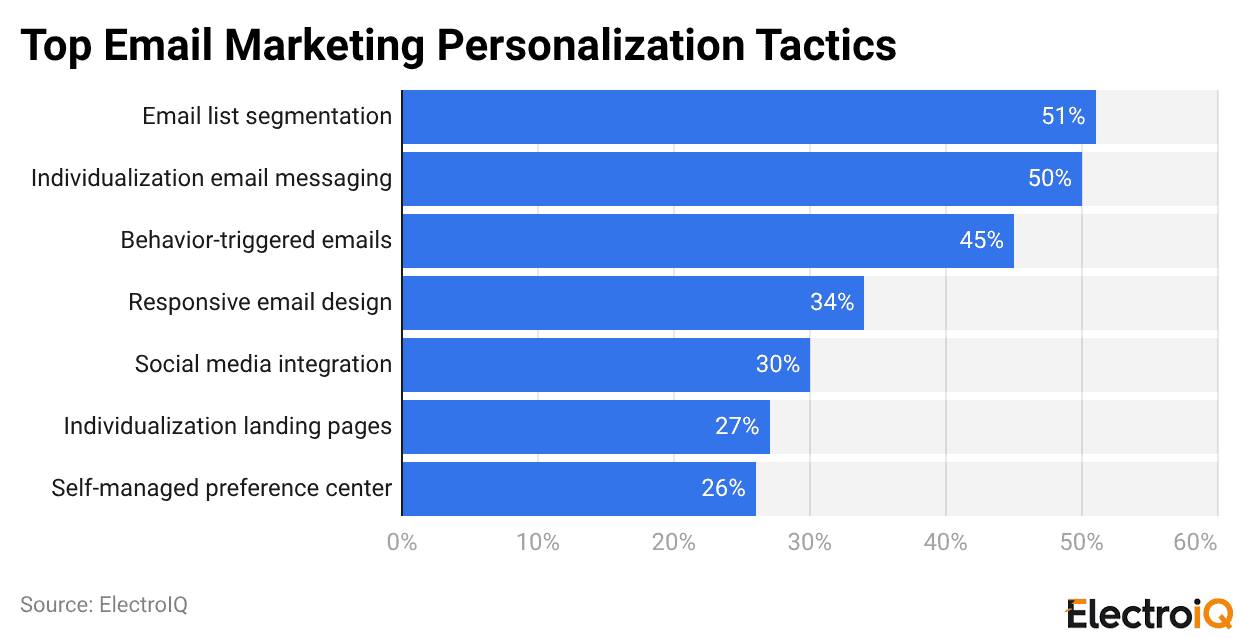
- The leading tactics were email list segmentation at 51%, individualized email messaging at 50%, and behavior-triggered emails at 45%.
- Other common approaches included responsive email design (34%), social media integration (30%), individualized landing pages (27%), and a self-managed preference center (26%).
Email Marketing Strategy Statistics
- Putting the word “video” in an email can boost opens a lot (up to 300%), and using a video thumbnail can raise clicks by about 22%.
- Welcome emails generate 320% more revenue per email than promo emails and have an open rate of over 8 in 10, resulting in 4 times more opens and 10 times more clicks than other emails.
- About 45% are opened, 21% are clicked, and about half of those clickers end up buying.
- Adding an emoji to the subject line can increase open rates by 45%.
- People often decide to open based on the sender (45%) and the subject line (33%).
- Emails with images have a 1.12% higher click-through rate than text-only emails.
- 67% of buyers prefer emails with discounts or coupons, followed by quick check-ins (33%), and business updates (28%).
- After a good email, people usually buy online (27.1%), visit the website (26.2%), or shop in-store (21.6%).
- Writing CTA button text in “I/me” style can lift clicks by 90%, and using a button instead of a text link can raise conversions by up to 28%.
- Sending no more than five newsletters per week improves engagement, and nearly 22% of campaigns are opened within the first hour.
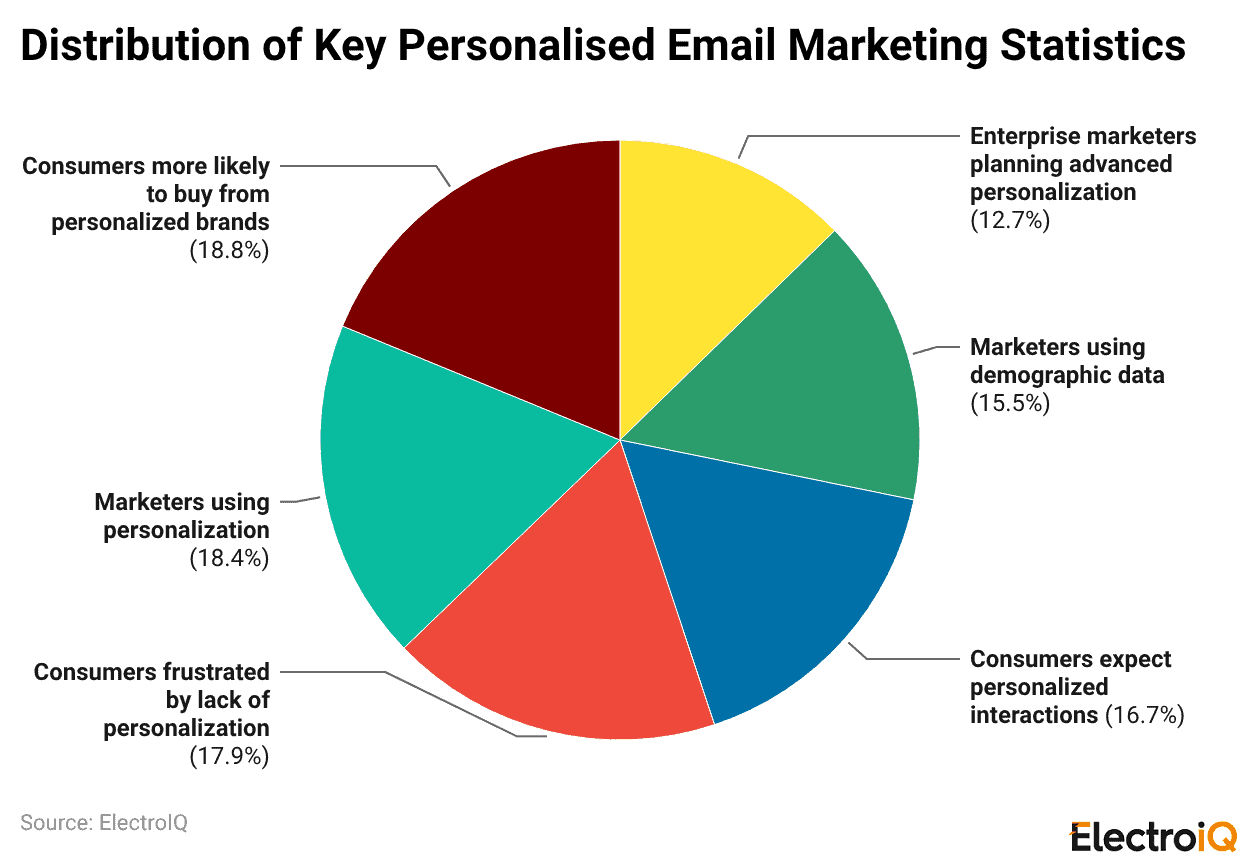
Distribution of Key Personalised Email Marketing Statistics
(Reference: amraandelma.com)
- As of 2025, around 18.8% represented consumers who were more likely to buy from personalized brands.
- Meanwhile, 18.4% reflected marketers using personalization, and 17.9% covered consumers frustrated by a lack of personalization.
- It was followed by 6.7% for consumers who expected personalized interactions, 15.5% for marketers using demographic data, and 12.7% for enterprise marketers planning advanced personalization.
Challenges In Personalised Email Marketing Statistics
- Litmus.com reported that 24% of respondents said insufficient data made email personalisation difficult.
- Another 21% cited limited resources to test personalisation ideas.
- Technical skill was also a barrier, with 17% citing the need for expertise to implement.
- 13% reported a lack of inspiration for how to use personalisation.
- 12% said they could not fully QA highly personalised content.
- On the tools side, 11% reported lacking the technology to create and manage personalised content.
- Smaller shares included 4% who were unsure, 3% who selected other reasons, and 2% who cited long vendor turnaround times.
Conclusion
Email personalisation is no longer optional; it is one of the strongest ways to improve results. All the above statistical analyses showed that tailoring emails to customers’ stages, interests, and needs increased opens, clicks, and purchases while reducing unsubscribes. The key is relevance that cuts through noise and makes the message feel useful.
Brands are now treating personalisation emails as an ongoing process to maintain clean, permission-based data, smart segments, dynamic content, automated triggers, and frequent testing. Just as important, they build trust by staying clear, respectful, and non-intrusive.
FAQ.
True personalisation changes the offer, products, timing, and message based on behaviour (views, clicks, purchases), not only the name.
Basic (name, location), preference (topics, categories), and behaviour (browse history, past orders, email clicks). Use only permission-based data.
Yes, relevant emails usually achieve higher open and click-throughs and higher sales, and fewer unsubscribes, than generic blasts.
Welcome series, abandoned cart reminders, product recommendations, back-in-stock alerts, birthday offers, and post-purchase tips.
Segmentation groups subscribers by behaviour, helping brands send the right message to the right people.

Maitrayee Dey has a background in Electrical Engineering and has worked in various technical roles before transitioning to writing. Specializing in technology and Artificial Intelligence, she has served as an Academic Research Analyst and Freelance Writer, particularly focusing on education and healthcare in Australia. Maitrayee's lifelong passions for writing and painting led her to pursue a full-time writing career. She is also the creator of a cooking YouTube channel, where she shares her culinary adventures. At Smartphone Thoughts, Maitrayee brings her expertise in technology to provide in-depth smartphone reviews and app-related statistics, making complex topics easy to understand for all readers.