Headphones Statistics By Market Size, Usage, Ownership and Facts (2025)

Updated · Nov 18, 2025


Table of Contents
- Introduction
- Editor’s Choice
- Global Headphones Market Statistics
- By Users
- By Usage
- Comparison By Country
- Types of Headphones
- Wireless Headphones Market Size
- Sports Headphones Market Size
- Premium Headphones Market Size
- On-ear Noise-Cancelling Headphones Market Size
- Monitor Headphones Statistics
- Headphones Market Share Statistics
- United States’ Most Used Headphones Brands
- Headphones Ownership Statistics
- Reasons For Using Headphones Analysis
- Features of Purchasing New Headphones
- Popular Headphones Comparison Analysis (2025)
- Conclusion
Introduction
Headphones Statistics: Headphones are used as simple gadgets, either with or without wires, but now they have become an integral part of daily life. People use them to listen to music, answer phone calls, attend online classes, play games, and block outside noise in busy places like streets or offices. Currently, billions of people use headphones in various ways; thus, the headphone market is growing rapidly, and a wealth of information is available about how often people use them and for what purposes.
This article on Headphone Statistics includes market size, growth rate, technological advancements, brands, types, the rise of wireless and noise-cancelling models, user preferences by age and region, listening habits, and other relevant factors. All the above analyses are based on current data, drawn from various insights, which will guide you accordingly in understanding the global headphone market and its influence on lifestyle changes over recent years.
Editor’s Choice
- According to a Statista report analysis, the global headphones market is expected to reach approximately USD 45.26 billion by 2025.
- In 2025, China’s headphone market is expected to earn about USD 10.23 billion in revenue.
- In Asia, the headphones market will generate USD 19.63 billion in revenue, with a 2.14% CAGR from 2025 to 2030.
- The global wireless Headphones market valuation is estimated to reach around USD 78.4 billion, and grow at a CAGR of 12.6% from 2025 to 2033.
- According to Coherent Market Insights, the market size of premium headphones is estimated to reach around USD 25,407.2 million by the end of 2025.
- As of 2025, the global noise-cancelling headphones market is expected to reach around USD 15.8 billion, growing at a CAGR of 12.1% from 2024 to 2033.
- The global in-ear monitor (IEM) headphones market size was USD 393.57 million in 2024 and is expected to reach USD 414.52 million by 2025.
- Across all age groups, wireless earphones are the most common devFice, used by 65% of people, followed by wired earphones at 53%.
- In 2024, Sony became one of the leading headphone brands globally, holding approximately 30% of the market share.
- The global smart headphones market size is expected to reach around USD 13 billion in 2024, and is projected to increase to approximately USD 15.52 billion by 2024.
- As of 2024, Apple is recognised as the leader in the U.S. headphone market, with approximately 34.4% of respondents using Apple headphones, and an additional 15.3% using Beats.
- In the United States, as of 2025, approximately 37% of people own two pairs of headphones, while 34% own only a single pair.
- Approximately 87% of people reported that headphones were their primary listening device.
- The most preferred features before purchasing headphones are sound quality (75%), comfort (71%), Price (54%), Durability (42%), and Weight (29%).
Global Headphones Market Statistics
- According to a Statista report analysis, the global headphones market is expected to reach approximately USD 45.26 billion by 2025.
- The market growth rate is expected to increase at a compound annual growth rate (CAGR) of 1.98% from 2025 to 2030.
- When comparing global revenue, China is expected to account for the largest share, reaching USD 10.2 billion by 2025.
- Furthermore, in 2025, the per-person revenue in the Headphones market was around USD 5.77.
- By 2030, the global headphone market is expected to reach a volume of 896.06 million units.
- In terms of average volume per person, it is predicted that each individual will account for 0.100 pieces in the Headphones market in 2025.
- Additionally, a volume growth of 3.0% is anticipated by the end of 2026.
By Users
- In 2025, 28% of headphone users are men aged 0 to 30 years, while 8% are men aged 30 and above.
- 48% of headphone users are women aged 0 to 30 years, while 16% are women aged 30 and above.
- Among children aged 5 to 12 years, about two-thirds use headphones or earbuds, with older children (9 to 12 years old) showing around 80% usage.
- For teens and young adults aged 13 to 29 years, headphone usage ranges from 60% to 80%, with an average of 7 to 9 hours of use per week.
- Middle-aged adults aged 30 to 49 years still frequently use headphones, although less so than younger age groups, with an average of 5 to 6 hours per week.
- Older adults aged 50 to 79 years in the U.S. average 5 hours of usage per week, while in Japan, only about one-third of people in their 70s use headphones or earbuds.
| Age Group (years) |
Detailed Information |
| Kids (5 to 12) | About two-thirds of users employ headphones/earbuds, with older kids (9 to 12 years old) having around 80% usage. |
| Teens & Young Adults (13 to 29) | Often, 60% to 80% use rate and 7 to 9 hours/week |
| Middle-aged adults (30 to 49) | Usage is still high, but lower than in the 20s; roughly 5 to 6 hours/week. |
| Older adults (50 to 79) | The average usage in the U.S. is around 5 hours per week, and in Japan, only about one-third of people in their 70s use headphones/earbuds. |
By Usage
- People in the 19 to 29 age group use headphones an average of 7.8 hours per week, 33.9 hours per month, and 405.6 hours per year.
- The 30 to 49 age group uses headphones for 5.5 hours per week, 23.9 hours per month, and 286.0 hours per year.
- For the 50 to 79 age group, headphone usage is 5.2 hours per week, 22.6 hours per month, and 270.4 hours per year.
|
Age group
(Years) |
Per week | Per month | Per year |
| (hours) | |||
| 19 to 29 | 7.8 | 33.9 | 405.6 |
| 30 to 49 | 5.5 | 23.9 | 286.0 |
| 50 to 79 | 5.2 | 22.6 | 270.4 |
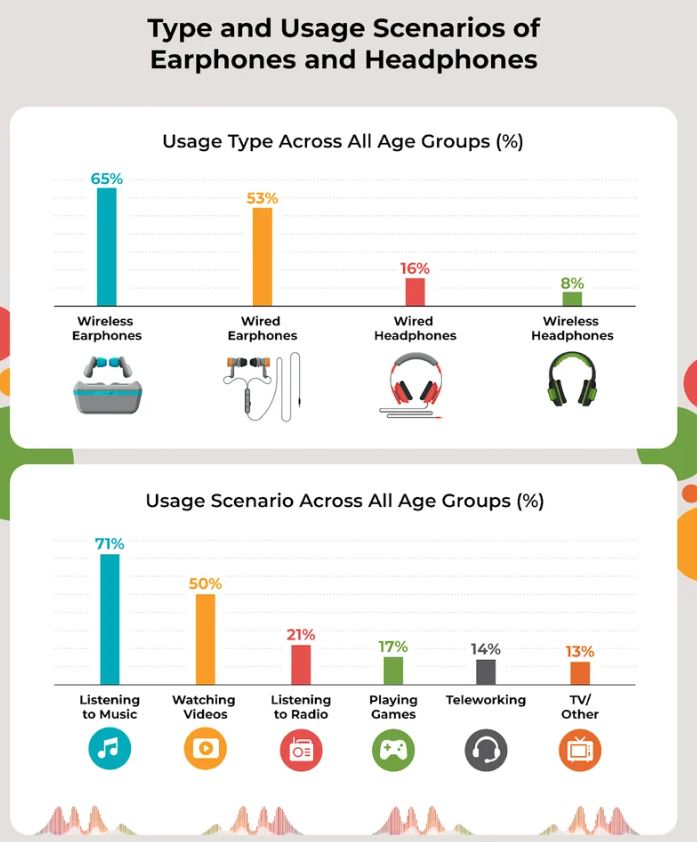
- Among the different types of headphones, 65% of people prefer wireless earphones, while 53% use wired earphones.
- Wired headphones and wireless headphones are less popular, with only 16% and 8% of people using them, respectively.
- The most common use for headphones is listening to music, with 71% of people using them for this activity.
- Watching videos is the second most popular activity, with 50% of people using headphones for this purpose.
- Listening to the radio comes next, at 21%, followed by playing games at 17%.
- Teleworking is a usage scenario for 14% of people, while 13% use headphones for watching TV or other devices.
(Source: kadence.com)
Comparison By Country
- In 2025, China’s headphone market is expected to generate USD 10.23 billion in revenue, the highest among all countries. The market is predicted to grow at a slow pace of 2.20% annually from 2025 to 2030.
- Each person in China is projected to spend about USD 7.19 on headphones in 2025, with an average consumption of 0.121 headphones per person.
- By 2030, the total number of headphone units in China is expected to reach 196.17 million units. The sales volume in 2026 is expected to grow by approximately 3.1%.
- In the United States, the headphone market will generate USD 8.54 billion in revenue in 2025. The market will grow at a CAGR of 1.05% from 2025 to 2030, with an average spend of USD 24.58 per person. On average, each person is expected to consume 0.238 headphones in 2025. The volume growth for 2026 is estimated at 2%, and by 2030, the total market volume will reach 90.37 million units.
- India’s headphone market will generate USD 2.56 billion in revenue in 2025, with a CAGR of 2.45% from 2025 to 2030. Each person in India is expected to spend USD 1.75 on headphones in 2025, with an average of 0.063 headphones per person. The market is projected to grow by 4.40% in 2026, reaching 110.61 million units in 2030.
- In Japan, the headphone market will be valued at USD 1.75 billion in 2025. The market will grow at a slow pace of 0.26% annually from 2025 to 2030, with each person spending USD 14.24 on headphones. The average consumption is expected to be 0.165 headphones per person, with minimal growth of 0.30% in 2026. By 2030, Japan’s market volume will be 20.49 million units.
- Brazil’s headphone market will generate USD 1.47 billion in 2025. The market will grow at a CAGR of 1.92% from 2025 to 2030. Each person in Brazil is expected to spend USD 6.90 on headphones, with an average consumption of 0.131 headphones per person. The sales volume is projected to grow by 2.30% in 2026, reaching 31.06 million units by 2030.
Furthermore, other four countries market analysis is stated in the table below:
| Country | Revenue (USD) |
CAGR (2025 to 2030) |
Revenue per person (USD) |
Average volume per person (pieces units) |
volume growth (2026) |
Market volume (2030) (million units) |
| United States | 8.54 billion | 1.05% | 24.58 | 0.238 | 2% | 90.37 |
| India | 2.56 billion | 2.45% | 1.75 | 0.063 | 4.40% | 110.61 |
| Japan | 1.75 billion | 0.26% | 14.24 | 0.165 | 0.30% | 20.49 |
| Brazil | 1.47 billion | 1.92% | 6.9 | 0.131 | 2.30% | 31.06 |
By Region (2025)
- In Asia, the headphones market is expected to generate USD 19.63 billion in revenue, with a 2.14% CAGR from 2025 to 2030.
- On average, each person is projected to spend USD 4.28 on headphones and use about 0.090 pieces (units) in 2025.
- The market’s volume is forecast to grow by 3.4% in 2026, reaching around 478.08 million units by 2030.
Other regional analyses are mentioned in the table below:
| Region | Revenue (USD) |
CAGR (2025 to 2030) |
Revenue per person (USD) |
Average volume per person (pieces units) |
volume growth (2026) |
Market volume (2030) (million units) |
| Africa | 3.29 billion | 4.63% | 2.45 | 0.065 | 3.90% | 103.72 |
| Americas | 13.19 billion | 1.34% | 12.9 | 0.16 | 2.2% | 180.24 |
| Australia & Oceania | 652.13 million | 0.64% | 14.85 | 0.143 | 2.0% | 6.87 |
| Caribbean | 213.46 million | 1.88% | 5.28 | 0.096 | 2.5% | 4.33 |
| Europe | 8.49 billion | 1.64% | 10.01 | 0.135 | 1.7% | 127.14 |
- The headphones market in Asia is projected to generate USD 19.63 billion in revenue by 2025, with a 2.14% compound annual growth rate (CAGR) from 2025 to 2030. On average, each person in Asia is expected to spend USD 4.28 on headphones and purchase around 0.090 units in 2025. The market volume is expected to grow by 3.4% in 2026, reaching 478.08 million units by 2030.
- Africa’s headphones market will generate USD 3.29 billion in 2025, growing at a 4.63% CAGR through 2030. Revenue per person is expected to be USD 2.45, with an average of 0.065 units purchased. The market volume in Africa is forecast to grow by 3.90% in 2026, reaching 103.72 million units by 2030.
- In the Americas, the market is expected to reach USD 13.19 billion in revenue in 2025, with a 1.34% CAGR from 2025 to 2030. Each person is projected to spend an average of USD 12.90 on headphones, purchasing about 0.16 units. The market volume in the Americas is expected to grow by 2.2% in 2026, resulting in 180.24 million units by 2030.
- The Australia & Oceania region is forecast to generate USD 652.13 million in 2025, with a slower growth rate of 0.64% CAGR from 2025 to 2030. Each person in the region is expected to spend USD 14.85 on headphones, with an average of 0.143 units purchased. The market volume is expected to grow by 2.0% in 2026, reaching 6.87 million units by 2030.
- The Caribbean region is expected to generate USD 213.46 million in revenue from headphones in 2025, with a 1.88% CAGR through 2030. Each person is projected to spend USD 5.28 on headphones and purchase an average of 0.096 units. The market volume in the Caribbean is forecast to grow by 2.5% in 2026, reaching 4.33 million units by 2030.
- Europe’s headphones market is expected to generate USD 8.49 billion in 2025, with a 1.64% CAGR from 2025 to 2030. On average, each person in Europe is projected to spend USD 10.01 on headphones and purchase about 0.135 units. The market volume in Europe is expected to grow by 1.7% in 2026, reaching 127.14 million units by 2030.
Types of Headphones
| Types | Use Cases |
| Over-ear (circumaural) | Home listening, studio work, and long sessions. |
| On-ear (supra-aural) | Portable listening, office, and commuting. |
| In-ear monitors (IEMs) | Stage monitoring, commuting, gym, and phone use. |
| Earbuds (classic / semi-in-ear) | Casual listening, calls, office, and walking. |
| Open-back (over-ear or on-ear) | Critical listening at home, mixing/mastering, and hi-fi. |
| Closed-back (over-ear or on-ear) | Commuting, studio tracking, office, and gaming. |
| Noise-cancelling (ANC) headphones | Flights, commuting, and open offices. |
| Wireless / Bluetooth headphones & earbuds | Every day music, calls, TV, and gaming (casual). |
| Bone-conduction / open-ear | Running, cycling, and environments where you must hear both traffic and people. |
Wireless Headphones Market Size
(Source: market.us)
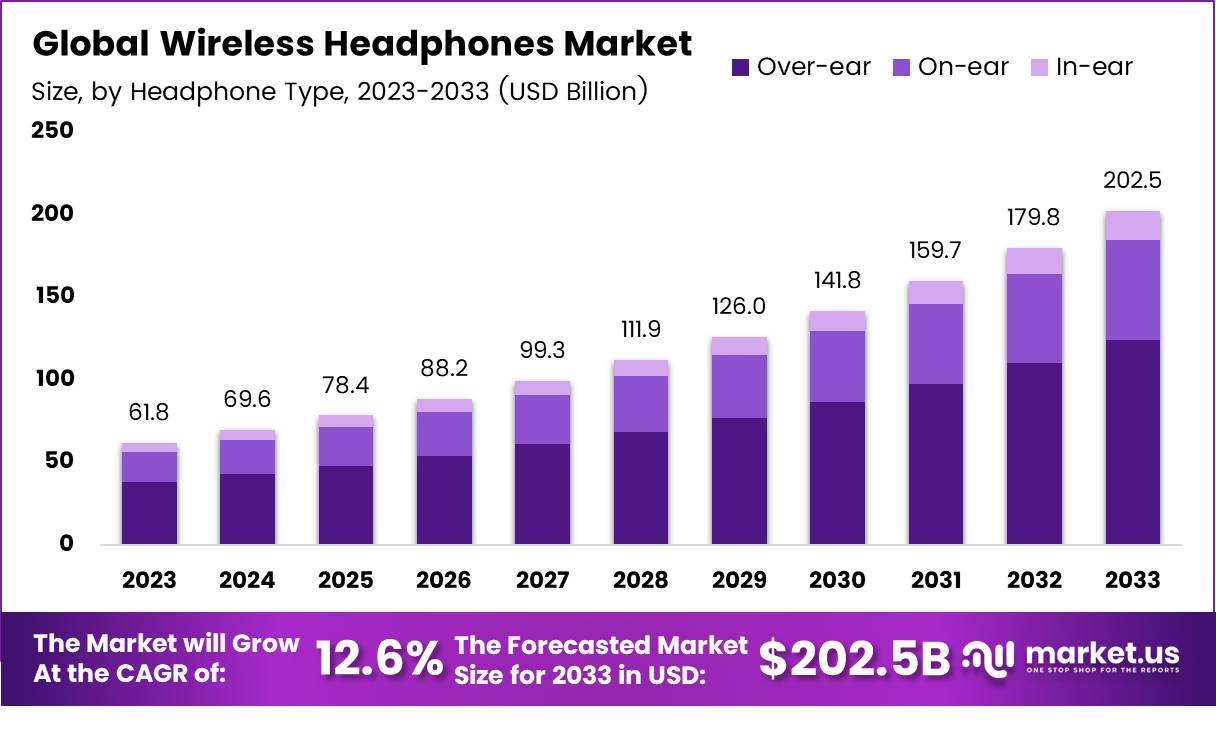
- The Global Wireless Headphones Market is projected to reach USD 202.5 billion by 2033, growing from USD 61.8 billion in 2023 at a CAGR of 12.6% between 2024 and 2033.
- The market is experiencing significant growth, particularly in emerging markets. For example, in Brazil, unit sales of wireless headphones increased by 45.3% in Q1 2023, showing a strong demand driven by higher disposable incomes and increased mobile device usage.
- True Wireless Stereo (TWS) earbuds are a dominant trend, representing 73% of all smart personal audio shipments in Q3 2023. This reflects a growing preference for compact, functional devices.
- Government regulations and investments are shaping the market by setting standards for wireless technology safety, energy efficiency, and environmental impact. Investments in digital infrastructure also support the market’s expansion.
- A study by Mimi revealed that 60% of users wear headphones for several hours a day, emphasizing the importance of comfort and long battery life in product design.
- In 2023, over-ear headphones led the market with a 47.9% share, offering superior sound quality and noise cancellation.
- Asia-Pacific is the largest regional market for wireless headphones, accounting for about 40% of the global market in 2024, valued at USD 24.7 billion.
Sports Headphones Market Size
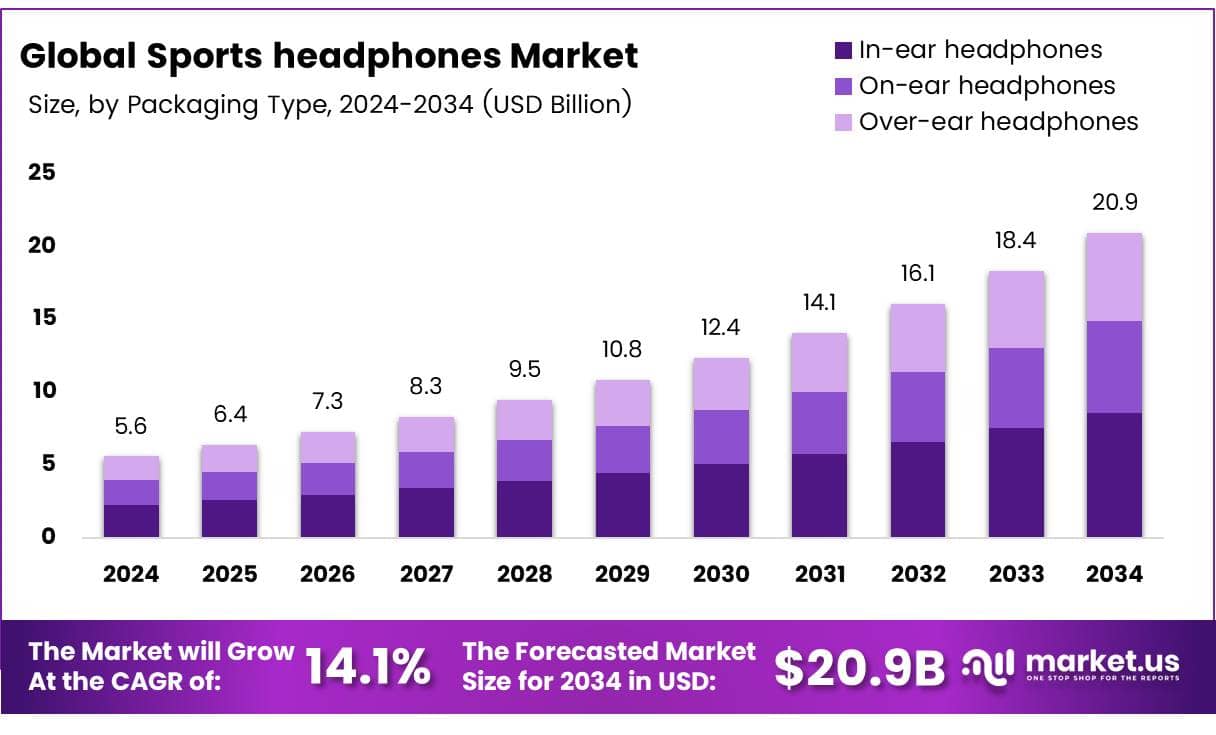
- The global sports headphones market is expected to grow from USD 5.6 billion in 2024 to USD 20.9 billion by 2034, with a compound annual growth rate (CAGR) of 14.1% over the forecast period from 2025 to 2034.
- In 2022, 42.41% of people reported that they always wear headphones, while 25% use them frequently. This indicates a large consumer base that may be interested in sports-specific audio products.
- The growth in the sports headphones market is driven by advancements in technology and increasing consumer spending on health and fitness products. For example, the battery life of sports headphones has improved by 50% from 8 hours in 2022 to 12 hours in 2024, meeting consumer demands for longer workout sessions without interruptions.
- In-ear headphones lead the market in 2024 due to their compact design, portability, and comfort for active users.
- Smart headphones are expected to be popular in 2024, offering features like fitness tracking, heart rate monitoring, and integration with mobile apps, adding value to fitness enthusiasts.
- True wireless headphones are the preferred choice in 2024, as they provide ease of use, portability, noise cancellation, and sweat resistance, making them ideal for sports activities.
- Online retail is expected to dominate the sports headphones market in 2024, offering convenience, competitive pricing, and a broad range of product options to consumers.
- North America holds the largest market share of 35.2% in the global sports headphones market, valued at USD 1.9 billion in 2024, driven by growing demand for fitness products and technological innovations.
Premium Headphones Market Size
- According to Coherent Market Insights, the market size of premium headphones is estimated to reach around USD 25,407.2 million by the end of 2025.
- The market is expected to grow at a CAGR of 15.9% from 2025 to 2032, reaching a value of USD 71,375.1 million.
- In 2025, headphones priced between USD 500 and USD 1000 are expected to hold the largest share.
- Headphone buyers are expected to be under 30 and earning above 85,000 USD.
- Meanwhile, wired technology is projected to lead with a 54.7% share due to its strong sound quality, minimal lag, and reliability.
- In 2024, AI-powered smart headphones accounted for over 40% of premium launches.
- In the headphones market, the Asia Pacific is expected to hold a 34.6% share, while North America is expected to reach a 30.1% share overall.
- The United States is forecast to make up 27.6% of premium headphone demand, with the UK contributing 6.1%.
- In September 2025, Yamaha introduced its YH-4000 and YH-C3000 premium models, priced at USD 399.95 and USD 229.95.
- In April 2025, Sennheiser launched HD 505 Copper Edition wired headphones in India for ₹27,990.
On-ear Noise-Cancelling Headphones Market Size
(Source: market.us)
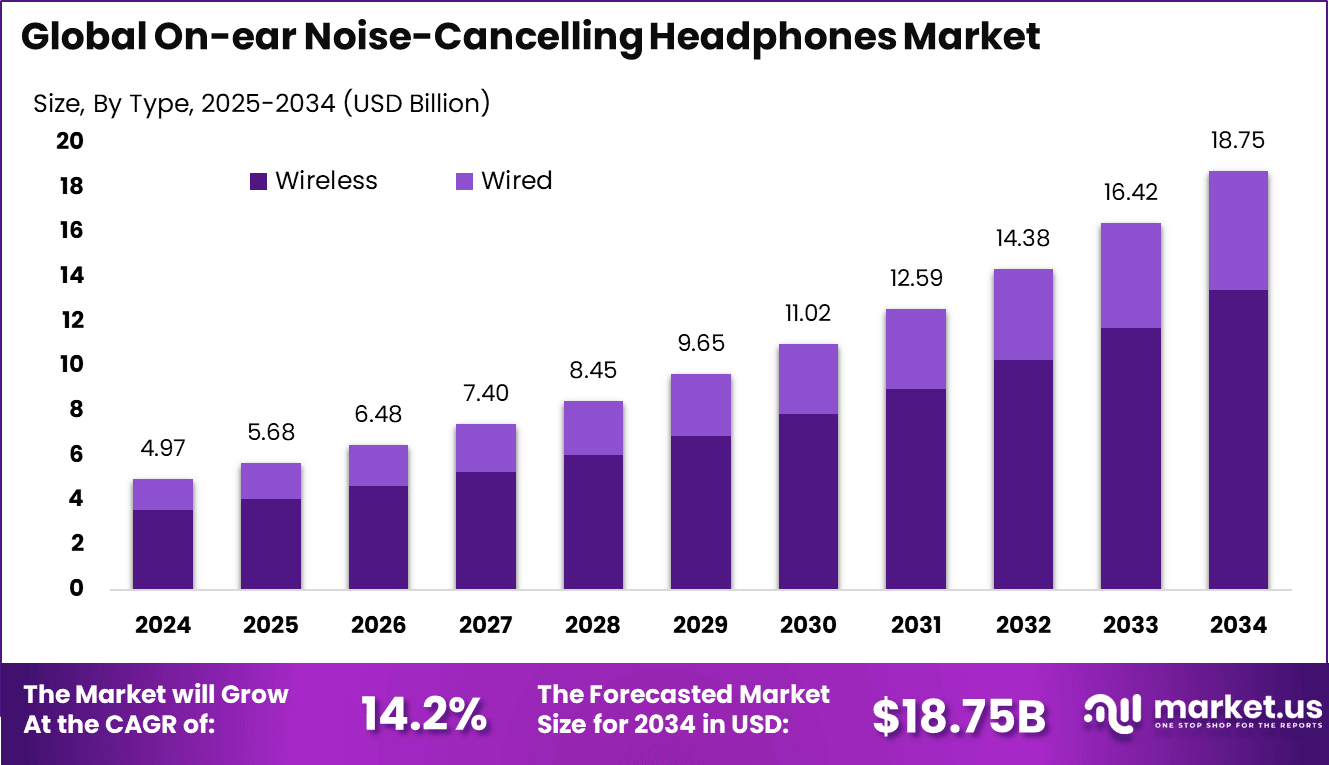
- The global market for on-ear noise-cancelling headphones is expected to reach USD 18.75 billion by 2034, up from USD 4.97 billion in 2024, with a compound annual growth rate (CAGR) of 14.2% from 2025 to 2034.
- In 2024, North America held the largest share of the market, capturing more than 34.1%, with revenue of USD 1.69 billion.
- Wireless headphones dominate the market, accounting for 71.5% of total sales, driven by the growing preference for convenience and portability.
- The demand for noise-cancelling headphones is primarily fueled by the music and entertainment sector, which holds a 41.2% share, showing that most consumers use them for entertainment purposes.
- The market is largely driven by offline distribution channels, which account for 58.4% of sales, highlighting the ongoing importance of physical retail stores.
- North America remains the leading region, with the U.S. being the largest contributor to the market’s growth and expansion.
Monitor Headphones Statistics
(Reference: Precedence Research)
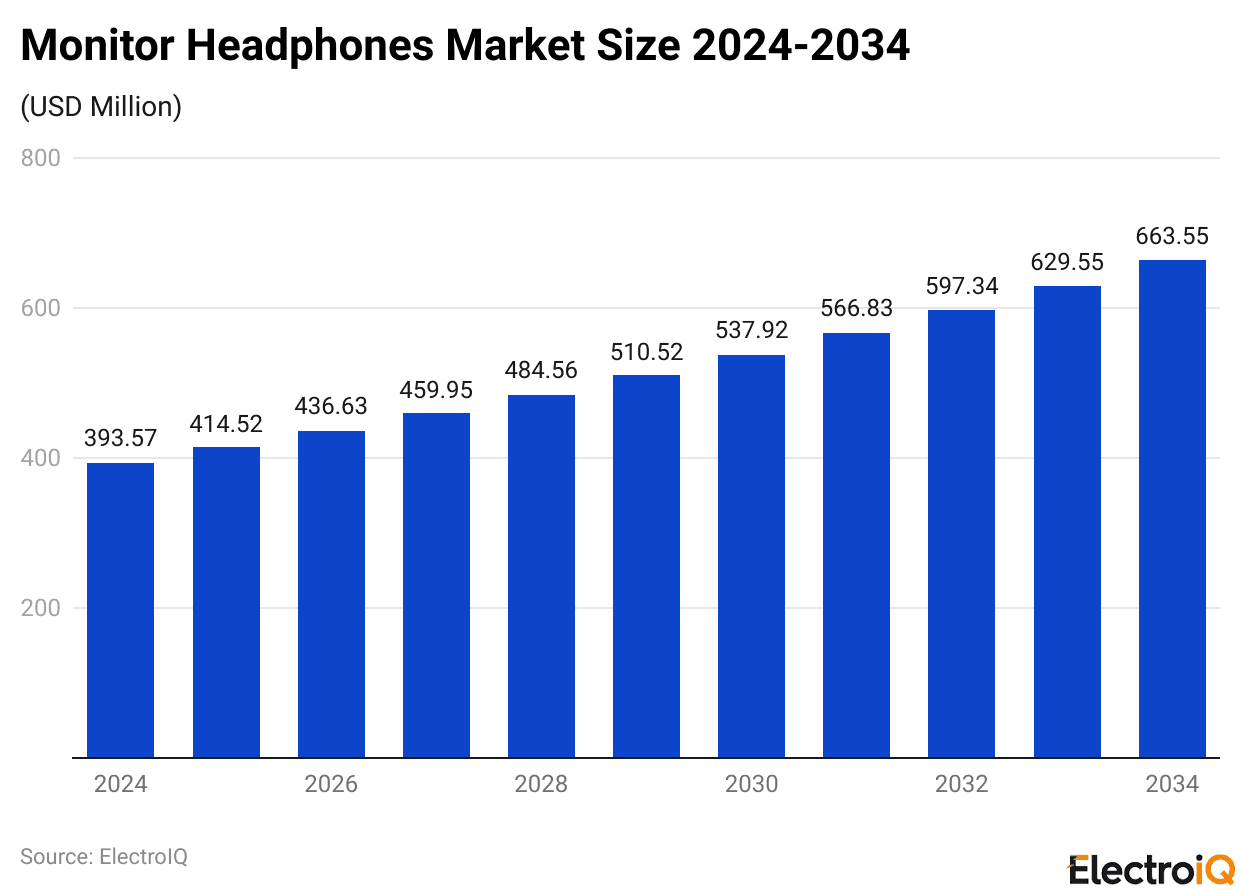
- The global in-ear monitor (IEM) headphones market size was USD 393.57 million in 2024 and is expected to reach USD 414.52 million by 2025.
- It is projected to grow to approximately USD 663.55 million by 2034, expanding at a CAGR of 5.37% from 2025 to 2034.
- Furthermore, the estimated market size in the coming years is expected to reach USD 436.63 million (2026), USD 459.95 million (2027), USD 484.56 million (2028), USD 510.52 million (2029), USD 537.92 million (2030), USD 537.92 million (2031), USD 597.34 million (2032), and USD 629.55 (2033).
By Regional Share
| Region | Market Share |
| North America | 33% |
| Europe | 25% |
| Asia Pacific | 28% |
| Latin America | 9% |
| MEA | 5% |
(Reference: audioviser.com)
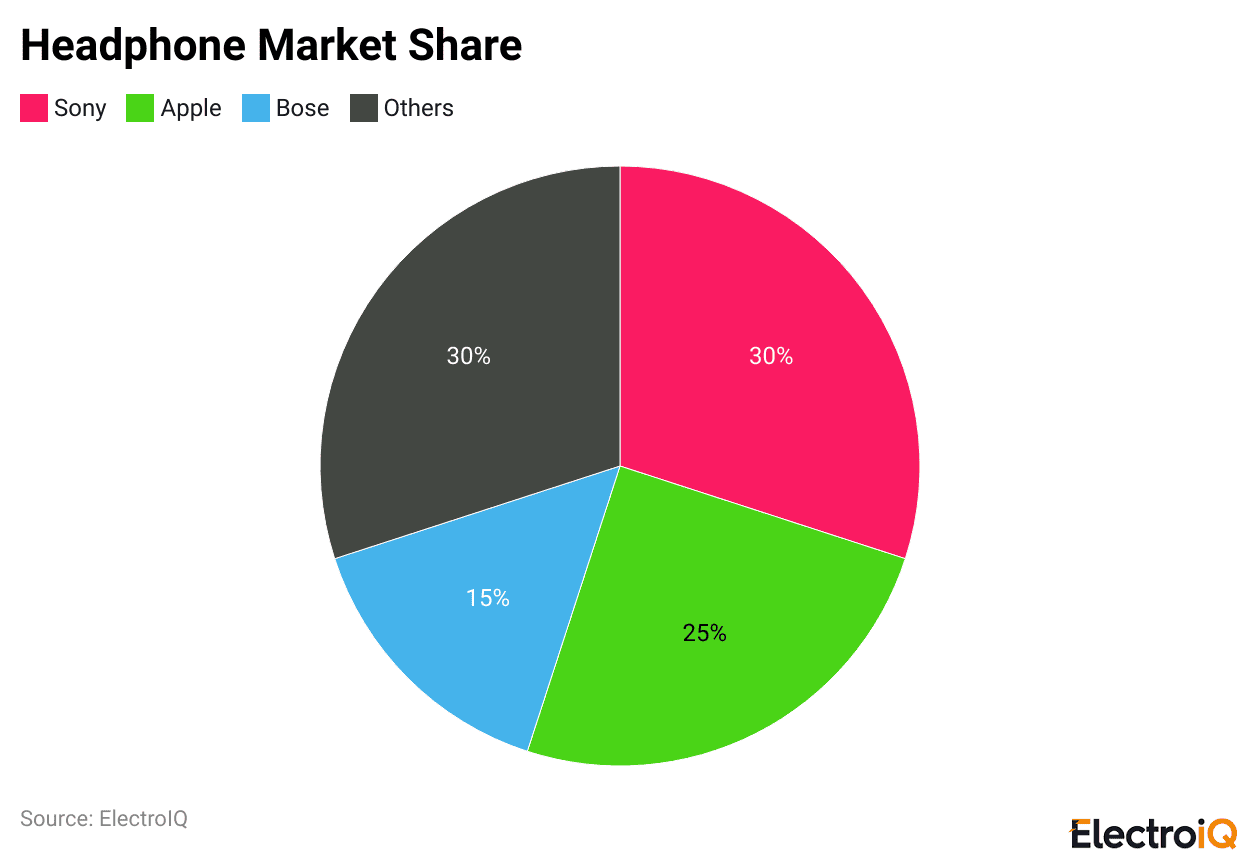
- In 2024, Sony became one of the leading headphone brands globally, holding approximately 30% of the market share.
- Followed by Apple, which secured a 25% share, and Bose (15%).
- Lastly, all other brands captured a 30% share.
United States’ Most Used Headphones Brands
(Reference: maximizemarketresearch.com)
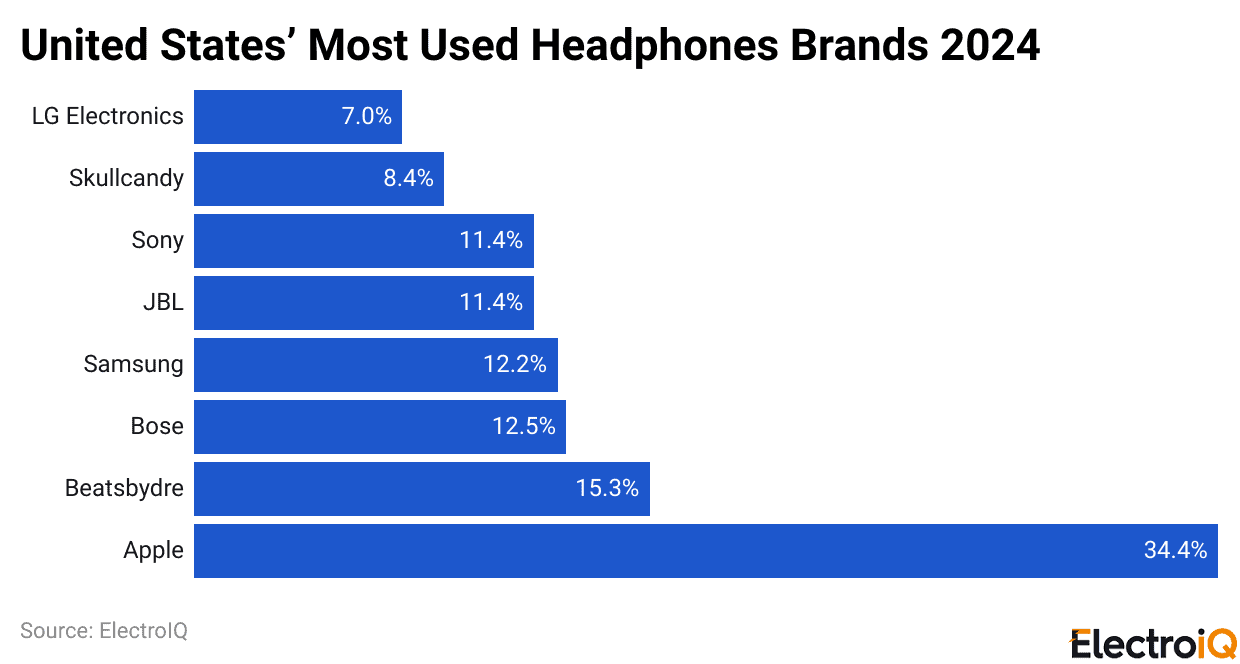
- As of 2024, Apple is recognised as the leader in the U.S. headphone market, with approximately 34.4% of respondents using Apple headphones, and an additional 15.3% using Beats.
- Meanwhile, other popular headphone brands include Bose (12.50%), Samsung (12.20%), JBL (11.40%), Sony (11.40%), Skullcandy (8.40%), and LG Electronics (7%).
Headphones Ownership Statistics
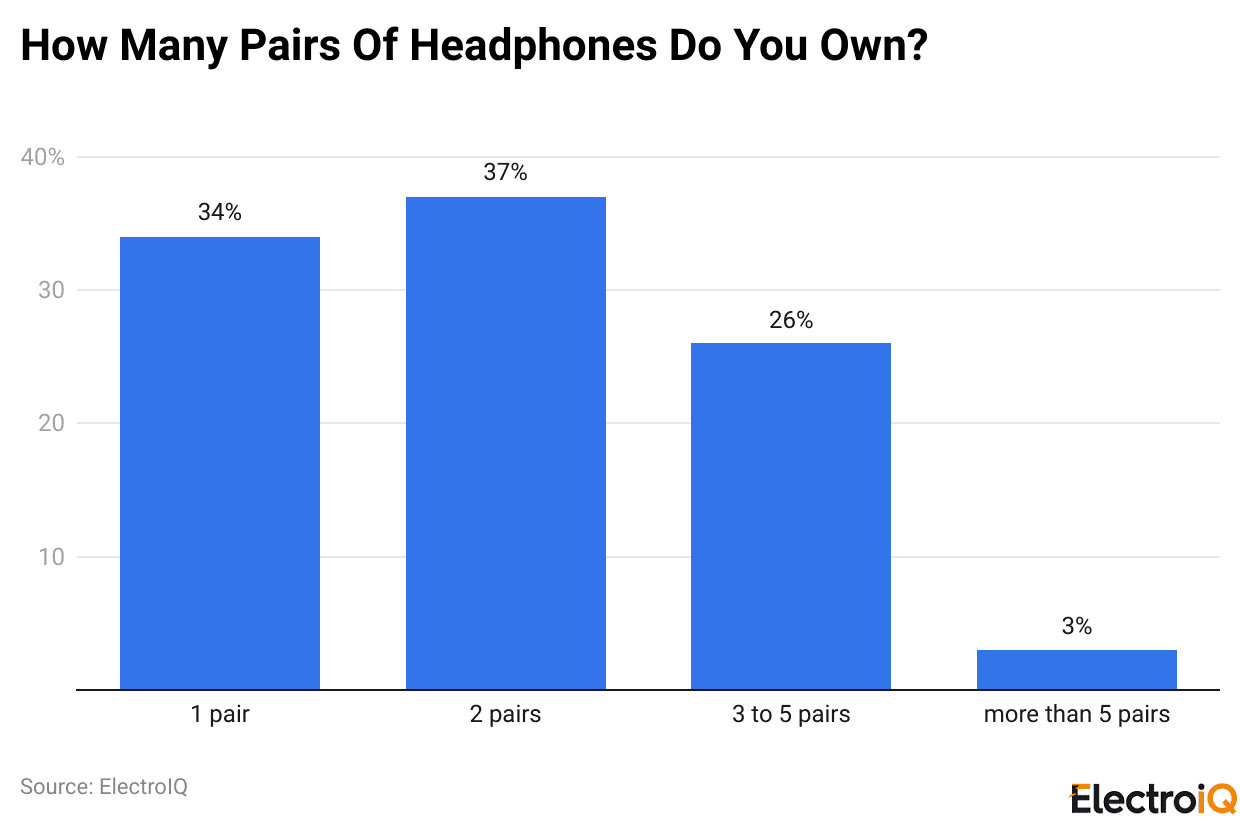
(Reference: statista.com)
- In the United States, as of 2025, approximately 37% of people own two pairs of headphones, while 34% own only a single pair.
- Meanwhile, 26% Americans own 3 to 5 pairs of headphones, followed by 3% with five pairs.
The table below covers the reasons behind having more than one pair of Headphones in the U.S.:
| Reasons | Shares |
| Different kinds for different occasions | 46% |
| Users like to have a pair on hand whenever they need them | 39% |
| In case one pair breaks | 33% |
| Users like to have one i each bag, so they never forget them anywhere | 23% |
| Users like different styles for different outfits | 21% |
| Users received them as gifts | 17% |
| Others | 3% |
| Don’t know | 1% |
Reasons For Using Headphones Analysis
(Reference: statista.com)
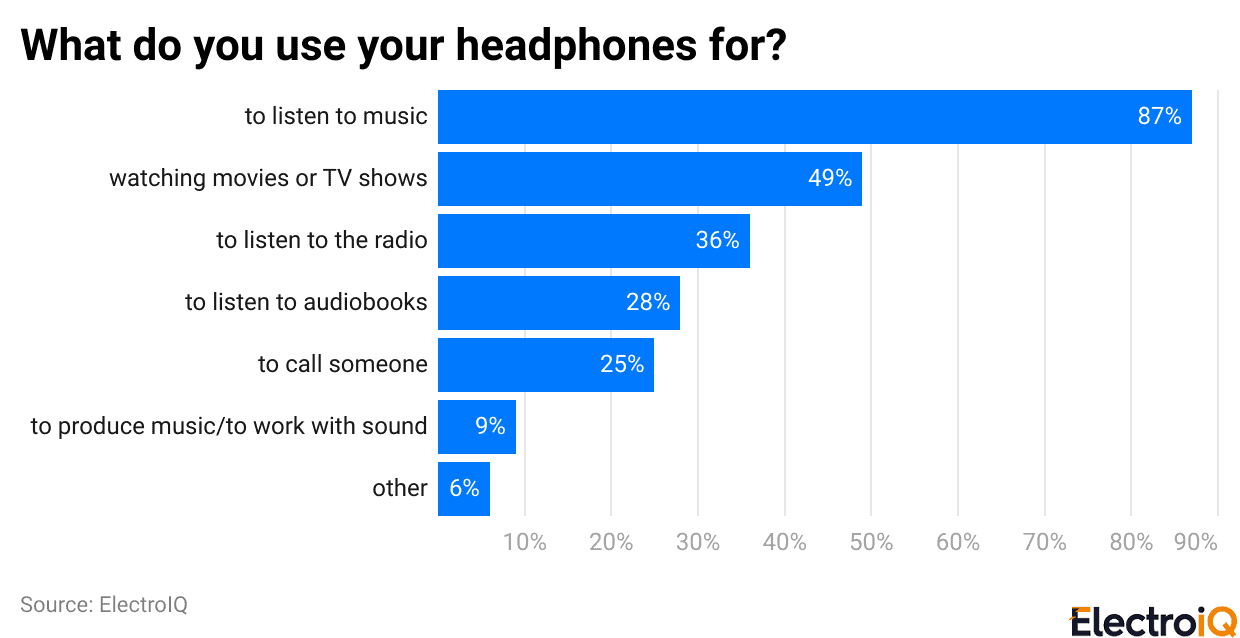
- In the United States, approximately 87% of people reported that headphones were their primary listening device.
- Furthermore, other reasons for headphone usage shares are followed as watching movies or TV shows (49%), listening to the radio (36%), listening to audiobooks (28%), calling someone (25%), producing music/working with sound (9%), and other (6%).
Features of Purchasing New Headphones
(Reference: statista.com)
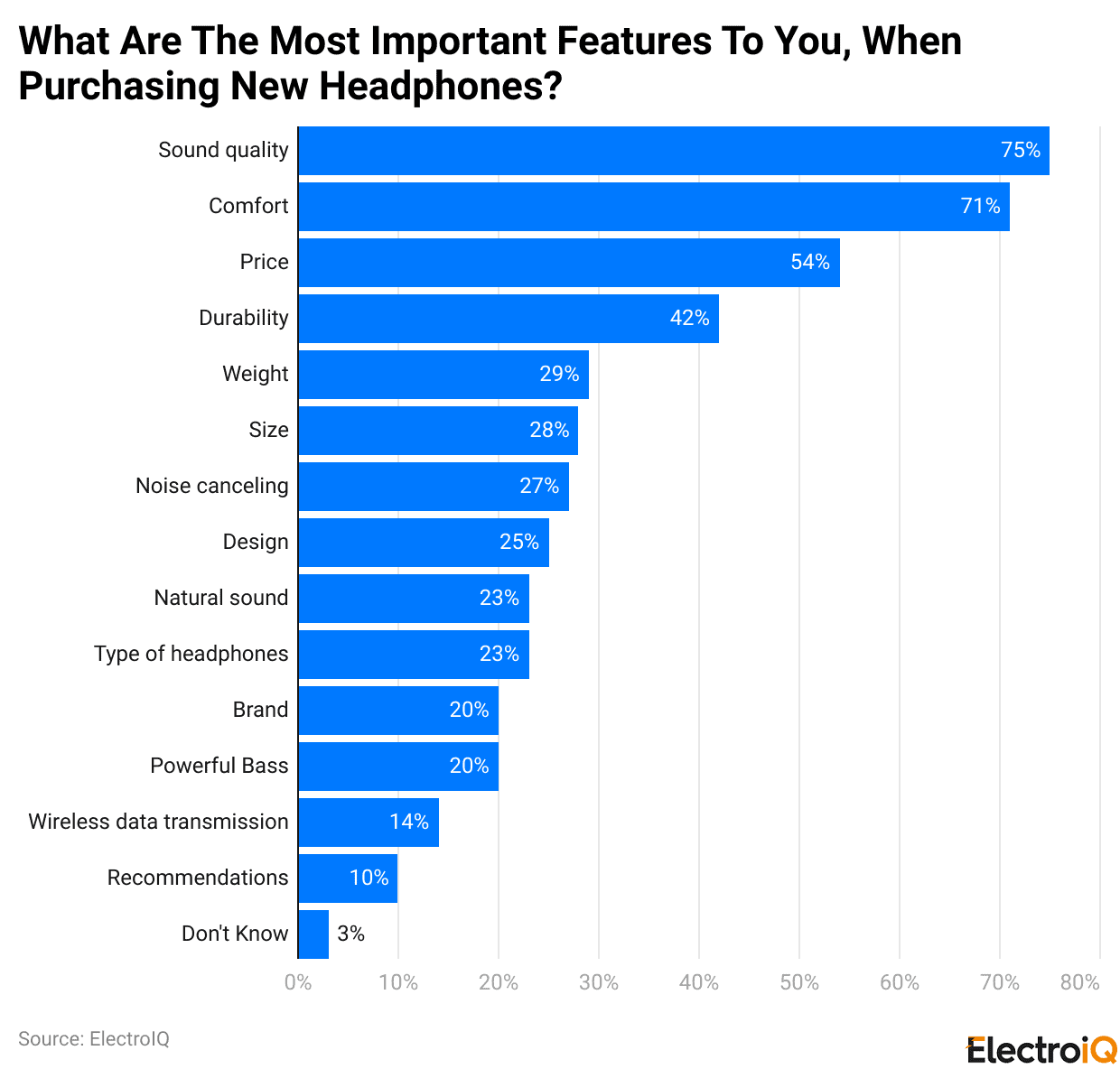
- The most preferred features before purchasing headphones are sound quality (75%), comfort (71%), Price (54%), Durability (42%), and Weight (29%).
- Furthermore, other features are mentioned as size (28%), noise cancelling (27%), design (25%), natural sound (23%), type of headphones (23%), brand (20%), wireless data transmissions (14%), recommendations (10%), and don’t know (3%).
Popular Headphones Comparison Analysis (2025)
| Model | Driver size (mm) |
Frequency Response (Hz) |
Impedance (Ω) |
Weight (g) |
Bluetooth version | Battery life (music) | 2025 Approximate Price (USD) |
| Sony WH-1000XM6 | 30 | 4 to 40,000 | 48 (on) / 16 (off) |
254
|
5.3 | 30 h (ANC on), 40 h (ANC off) | 449 |
| Sony WH-1000XM4 |
40
|
4 to 40,000 | 16 to 47 | 5 | 30 h (ANC on), up to 38 h (ANC off) | 199 | |
| Anker Soundcore Space Q45 | 20 to 20,000 |
16
|
292 to 294 | 5.3 | 50 h (ANC on), 65 h (ANC off) | 149 | |
| Anker Soundcore Life Q30 | 16 to 40,000 | 260 | 5 | 40 h (ANC on), 60 h (standard) | 80 | ||
| Focal Bathys | 15 to 22,000 | – | 350 | 5.1 | 30 h (BT + ANC), 35 h (jack), 42 h (USB-DAC) | 699 | |
| Sennheiser HD 800 S | 56 | 4 to 51,000 | 300 | 330 | Wired only (no Bluetooth) | passive wired headphones | 1,999.95 |
| Technics EAH-AZ100 | 10 | 20 to 40 |
Not specified
|
5.9 per earbud |
5.3
|
10 h (earbuds, ANC on, AAC); 28 h with case | 299.99 |
| Apple AirPods Pro (2nd gen, USB-C) |
Not disclosed
|
Not specified officially
|
5.3 per earbud | 6 h listening (ANC on); 30 h with MagSafe/USB-C case | 249 | ||
| Bose QuietComfort Ultra Headphones (2nd Gen) | 250 | 5.4 | 30 h (ANC on); 23 h with Immersive Audio | 449 | |||
| Apple AirPods Max (USB-C refresh) | 40 | 385 (without case) | 5 | 20 h (ANC and Spatial Audio on) | 549 |
Conclusion
After completing the article on Headphone Statistics, it is very clear that these devices are an essential part of our daily lives, primarily used for listening to music, studying, working, travelling, and gaming. Due to technological advancements, we have seen the rise of wireless headphones, Bluetooth headphones, and other noise-cancelling models that offer significant comfort, improved sound quality, and the freedom to move without hassle.
This article provides an overall market analysis, detailing the various types of headphones available and used by people, and how technology is enhancing the current market, as well as its future implications. If you are a user or an investor, this article will be beneficial to you, and I hope you will gain some valuable ideas.
FAQ.
Keep the volume low, take breaks, be aware of your surroundings, and respect others by avoiding sound leaks.
Wired headphones use physical cables, never need charging, and offer lower latency. Wireless headphones, on the other hand, utilise Bluetooth, offering convenience and mobility, but they do require batteries at times.
Gaming headphones prioritise game sounds and chat, while regular headphones focus on music quality and balance.
Check weight, soft ear pads, gentle clamp, padded headband, and if they feel okay after wearing for thirty minutes without pain.
Good headphones typically last three to five years if used gently and stored carefully.

Maitrayee Dey has a background in Electrical Engineering and has worked in various technical roles before transitioning to writing. Specializing in technology and Artificial Intelligence, she has served as an Academic Research Analyst and Freelance Writer, particularly focusing on education and healthcare in Australia. Maitrayee's lifelong passions for writing and painting led her to pursue a full-time writing career. She is also the creator of a cooking YouTube channel, where she shares her culinary adventures. At Smartphone Thoughts, Maitrayee brings her expertise in technology to provide in-depth smartphone reviews and app-related statistics, making complex topics easy to understand for all readers.