Audiobook Statistics By Market Share, Genre and Facts (2025)

Updated · Dec 11, 2025


Table of Contents
Introduction
Audiobook Statistics: Audiobooks have evolved significantly since they were considered a niche format, and 2024 has marked a significant milestone in the audiobook industry. The number of listeners has never been higher, and the revenues are increasing steeply.
In this article, we examine the statistics underpinning this growth: the number of listeners, the market size, the favourite categories in audiobooks, and the trends that will shape the future. We will draw on the latest audiobook statistics and market trends.
Editor’s Choice
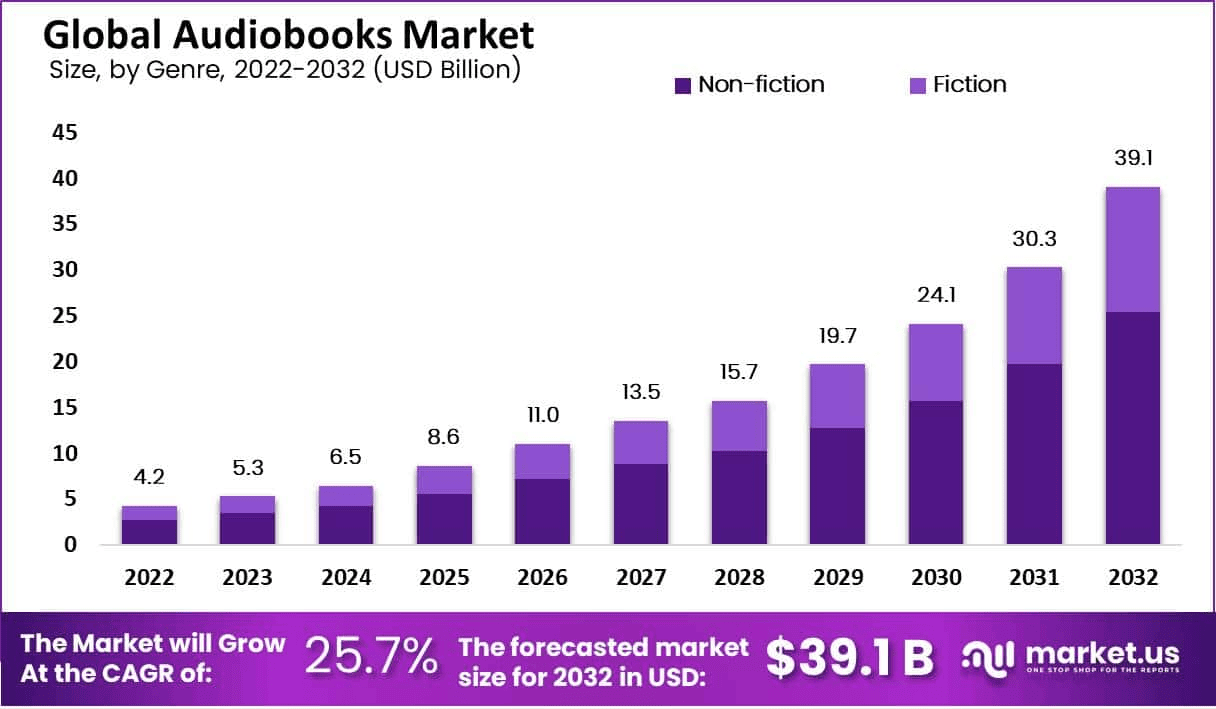
- Between 2022 and 2032, the global audiobook market is expected to grow at a high CAGR of 25.7%, rising from USD 4.2 billion in 2022 to USD 39.1 billion by 2032, nearly a tenfold increase over a decade.
- Revenue has already reached USD 6.5 billion in 2024 and is projected to increase to USD 8.6 billion in 2025 and to USD 24.1 billion by 2030, indicating strong and steady growth.
- 57% of audiobook listeners are aged 18-44, with the largest share in the 25-34-year-old cohort (29.28%), followed by 18-24-year-olds (20.41%), supporting the argument that younger consumers are driving growth.
- The gender distribution is relatively equal, with 25% of women and 22% of men as annual audiobook listeners, but preferences vary significantly by genre.
- The popularity of Children’s and YA audiobooks is increasing rapidly, with 53% of children listening and 77% of parents claiming that audiobooks decrease screen time; this category saw a 26% growth in 4.
- In the UK, audiobook sales are expected to reach 35 million units by 2024, and consumer spending will exceed £250 million for the first time.
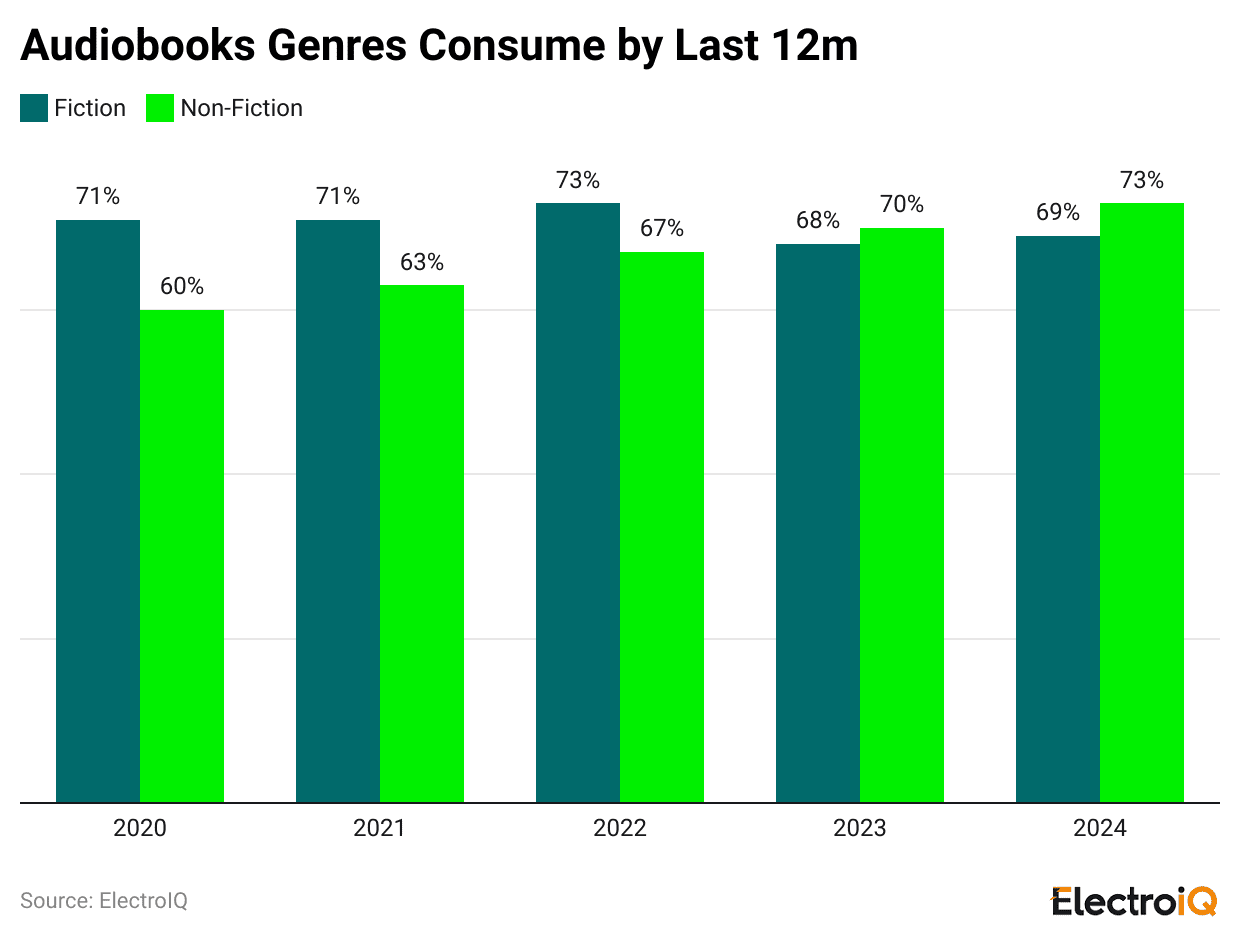
- Currently, 73% of listeners consume non-fiction, compared with 69% for fiction; non-fiction surpassed fiction in 2023, but fiction has lost only 2 percentage points since 2020.
- Romance is the leading genre among women aged 18–34, whereas crime/thrillers predominate among older age groups (35–84).
Audiobooks Market Size
(Source: Market.us)
- The global audiobooks market is projected to reach approximately USD 39.1 billion by 2032, up from USD 5.3 billion in 2023, reflecting a 25.7% CAGR from 2024 to 2033.
- The non-fiction category accounted for more than 65% of total consumption in 2022, indicating strong listener interest in educational, self-improvement, and professional development content.
- The smartphone segment accounted for over 44% of usage in 2022, indicating that mobile devices remain the primary access point for audiobook listeners worldwide.
- The adult listener group accounted for more than 78% of total consumption in 2022, indicating high engagement among working professionals and mature learners.
- The one-time download model accounted for more than 65% of the market in 2022, as many users preferred permanent access to purchased titles to recurring subscription plans.
- North America continued to dominate the global landscape in 2022 due to strong digital access and high subscription adoption, while the Asia Pacific is expected to record the fastest growth, supported by rising smartphone penetration and increased demand for English-language content in countries such as India, Japan, and South Korea.
- A study by WordsRated estimated that the audiobook industry could reach nearly USD 35.05 billion by 2030, underscoring continued expansion across North America, Europe, and key Asia-Pacific markets.
- Audible remained the leading platform with a 63.4% market share. However, Apple Books, Kobo, Google Play Books, and Blinkist continued gaining visibility across the United States, Canada, the United Kingdom, and Australia.
- Royalty structures differed across platforms: Audible applied a 75% fee on audiobook sales, reducing to 60% for exclusive listings, whereas Apple Books provided a 70% royalty rate across all book categories.
- Kobo reported that the typical audiobook file size averaged 28 MB for a 10-hour listening duration. In contrast, Kindle ebooks generally contained approximately 75,000 words, spanned 300 pages, and had a file size of approximately 2.6 MB.
- Kobo’s royalty structure offered 55% for audiobooks priced above USD 2.99, 65% for titles priced below USD 2.99, and 68% for authors who opted for Kobo tokens.
- Consumer insights from Publishers Weekly indicated that more than 50% of listeners preferred to listen to audiobooks at home, 30% chose in-car listening, and the remaining 15% selected alternative locations.
- The same study found that 70% of audiobook users multitasked during listening sessions, suggesting that the format is frequently consumed alongside daily routines.
- Survey findings showed that 50% of listeners spent 1 to 4 hours per week on audiobooks, while 33% spent 5 to 10 hours per week, indicating consistent engagement across the United States, the United Kingdom, and Germany.
- Listening during commuting or travel was favoured by 63% of respondents, household chores by 54%, and about 44% preferred listening during relaxation activities such as bathing or falling asleep.
Audiobooks Genre Statistics
(Reference: nielseniq.com)
- The UK audiobook market exhibits strong growth trends that can be traced throughout 2024.
- The ongoing monthly survey data predicts that total sales will amount to approximately 35 million units, and around 250 million pounds will be spent on consumers in the UK for the first time.
- All major categories—fiction, non-fiction, and children’s audiobooks—are performing more than 20% better than in previous years.
- In fact, by August 2024, both fiction and non-fiction audiobooks had already exceeded the total sales achieved in any full year between 2012 and 2019, thereby demonstrating the extent of the market’s growth.
- A different study that, in addition to measuring how much people are buying, investigates what people are listening to and how their habits are changing.
- The 2024 results indicate that 73% of audiobook listeners consume nonfiction content, whereas 69% listen to fiction.
- Non-fiction surpassed fiction for the first time in 2023 and slightly extended that lead in 2024. However, this does not mean that listeners are abandoning fiction.
- Five years ago, the difference was much bigger, and fiction listening has dropped by only 2 percentage points since 2020.
- This indicates that nonfiction is gaining readers alongside fiction, slowly drawing more attention away, but not completely replacing it.
Cost of Producing and Publishing an Audiobook
- The process of publishing an audiobook can be time-consuming and entails expenses such as recording equipment or studio rental, editing software, sound engineering, and hiring a professional narrator.
- Ultimately, the overall cost will be determined by production quality and the author’s or publisher’s decisions.
- Typically, narrators charge about USD 200 per hour of finished audio.
- An average audiobook, however, lasts approximately 10 hours, which is equivalent to about 100,000 words, and thus the narrator’s fee would be approximately USD 2,000. To put it into perspective, roughly 9,300 words correspond to one finished hour of audio.
- In addition to narration, costs include renting a professional recording studio or purchasing recording equipment for home use, as well as paying audio editors and sound engineers to improve the final product’s quality.
- When all these costs are combined, the total cost of an audiobook production typically ranges from USD 4,000 to USD 8,000.
- Some companies make it easier for clients by providing comprehensive audiobook production packages at a fixed price, typically around USD 6,000.
Shifting Preferences in Audiobook Genres Across Age and Gender
(Reference: nielseniq.com)
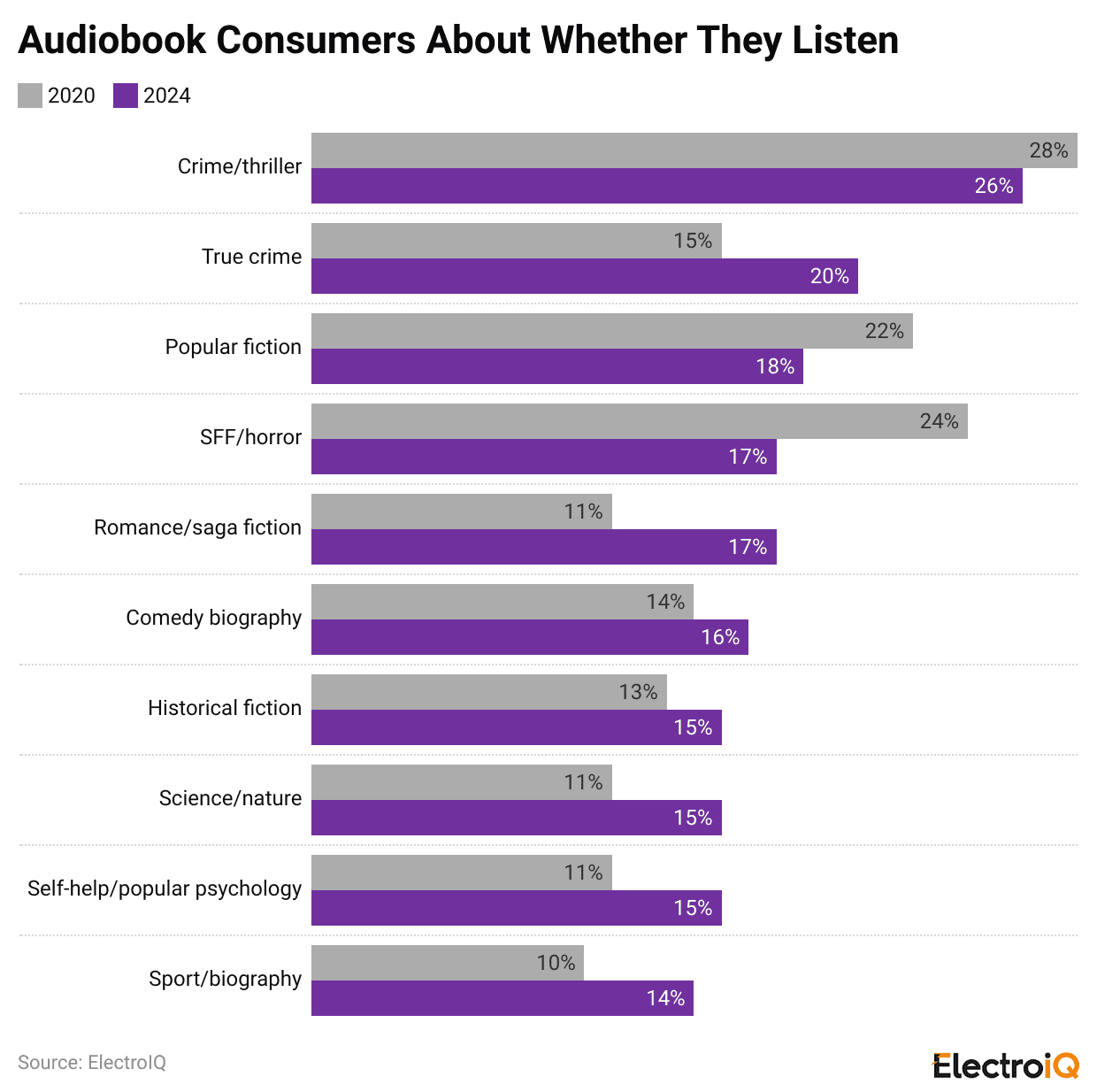
- In the UK, crime and thriller audiobooks remain the most popular, but their dominance has gradually been eroding over the past five years.
- Genres that have long been established, such as popular fiction, science fiction, fantasy, and horror, have also experienced a decline in demand. Yet they still attract sufficient listeners to rank among the top five most consumed genres.
- This trend points more toward a gradual shift in listeners’ preferences than to a sudden move away from the classics.
- Meanwhile, the pandemic has led to massive growth in demand for certain genres since 2020.
- True crime has become the second most popular genre overall and is the favourite among males aged 18 to 54.
- Romance and saga fiction rank fifth overall and are the most-played genres among women aged 18 to 34.
- Crime and thrillers still maintain their front-runner status in older demographics, being the top choice for men aged 55-84 and women aged 35-84, and staying within the top three for every demographic group.
- Sport and biography are among other genres that are rising in popularity, and they, together with science and nature, are the strongest for men in the age group of 18 to 54.
- Self-help and popular psychology, meanwhile, are highlighted as the most appropriate options for women aged 35 to 54.
- These developments indicate that the audiobook market is increasingly diversified and segmented by age and gender, with the rise of new genres continuously reshaping the listening landscape.
The Relationship Between Audiobook and Podcast Preferences Across Genres and Gender
(Source: nielseniq.com)
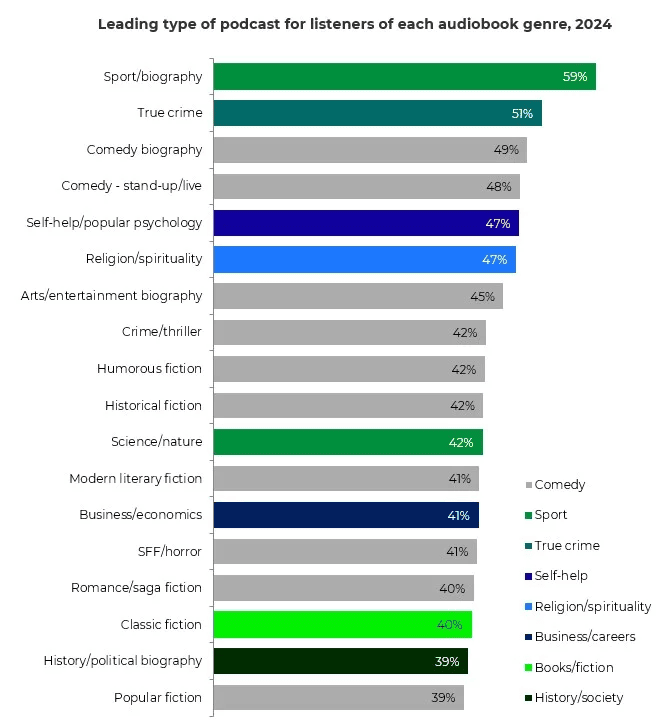
- Audiobooks consumers who are also into podcasts pick comedy podcasts as their favourite
- This will be especially true for listeners across nearly all major fiction genres, as well as for those who appreciate arts and entertainment biographies, live comedy audiobooks, and comedy biographies, where the overlap between those listeners’ interests and the popularity of comedy podcasts is natural.
- One exception, however, is classic fiction listeners, who are more inclined toward book and literature podcasts than comedy.
- The same subject matter across formats is typical among non-fiction listeners, indicating a strong overlap between audiobook genre and podcast type; however, science and nature are clear outliers.
- Listeners choosing this genre of audiobooks are more likely to be engaged with sports podcasts than with science and nature podcasts. This, of course, is linked to the fact that the group of science and nature audiobook listeners consists primarily of men under 55, and the sport genre of podcasts is the most appealing to men in general.
- The crossover of audiobooks and podcasts is most evident in the genres of sport and true crime.
- A sizeable 59% of sports listeners who have switched to audiobooks also listen to sports podcasts, and 51% of listeners of true crime audiobooks also listen to true crime podcasts.
- Among podcast listeners, the true crime category is preferred by women, ranking second among female audiobook listeners (30%) and only sixth among men (24%).
- When audiobooks are considered alone, men are more likely than women to listen to true-crime audiobooks (22% vs. 18%).
- This shows that preferences for audiobooks and podcasts are closely linked, but they don’t always follow the same paths and can even move in opposite directions, depending on the format.
Conclusion
Audiobook Statistics: The audiobook sector has become one of the fastest-growing digital media segments, driven by convenience, mobile access, and changing consumer habits. The rise in revenues has been very steep, with a tenfold increase projected by 2032; thus, audiobooks are no longer a specialty product but a mainstream format. The growing audience of young listeners, the increasing demand for nonfiction and true crime, and the adoption of audiobooks in schools and families are the main factors reshaping the market.
Alongside this, genre preferences are becoming increasingly personal by age and gender. The close relationship between audiobooks and podcasts has expanded the role of audio content in daily life, pointing to sustained growth and innovation.
FAQ.
The global audiobook market is on the rise with a solid compound annual growth rate (CAGR) of 25.7% throughout the period from 2022 to 2032. The projected market value for 2032 will be about US$39.1 billion compared to US$4.2 billion in 2022, nearly a tenfold increase over the decade.
The younger generation is mostly responsible for this trend. The majority of the listeners, about 57%, are between the ages of 18 and 44. The largest group of consumers come from the 25-34 age bracket (29.28%), followed by the 18-24s (20.41%). The male-female ratio of usage is close to even, though there are differences in the genres they prefer to listen to.
From the overall market perspective, crime and thriller have slightly lost their position, but they remain the most liked genres. On the other hand, true crime and romance/saga fiction have gained considerable ground since 2020. Romance takes the lead among women of the age 18–34, while crime and thriller are the favourites of older generations.
Usually, the total cost of audiobook production fluctuates between US$4,000 and US$8,000. Narration itself for a ten-hour audiobook might cost about US$2,000, with additional costs incurred for studio rent, equipment, editing, and sound engineering.
People’s preferences for audiobooks and podcasts show a considerable overlap in genres. Among audiobook listeners, the most popular podcasts are related to comedy, while sports and true crime are among the topics that have the highest crossover between audiobooks and podcasts.

I hold an MBA in Finance and Marketing, bringing a unique blend of business acumen and creative communication skills. With experience as a content in crafting statistical and research-backed content across multiple domains, including education, technology, product reviews, and company website analytics, I specialize in producing engaging, informative, and SEO-optimized content tailored to diverse audiences. My work bridges technical accuracy with compelling storytelling, helping brands educate, inform, and connect with their target markets.