Daihatsu Statistics By Revenue And Growth Insights (2026)

Updated · Mar 31, 2026

Table of Contents
- Introduction
- Editor’s Choice
- Daihatsu Production Recovery and Sales Momentum Analysis
- Daihatsu Revenue Outlook 2023–2028
- Number of New Passenger Car Registrations in Japan
- Daihatsu Fuel or Drive-Type Share
- Daihatsu Number of Employees
- ARCHION Ecosystem Strategy 2026
- Daihatsu’s Certification Reform and Compliance Transformation
- Conclusion
Introduction
Daihatsu Statistics: The period from 2025 to 2026 marks a critical transition period for Daihatsu Motor Co., Ltd., which operates as a main subsidiary of Toyota Motor Corporation following its operational disruptions and supply chain modifications. Daihatsu operates as a dominant force in the compact and kei car market while serving as a vital market entry point for Japan, Indonesia, and Malaysia. The company’s recent performance shows a combination of operational recovery and structural challenges because its domestic sales have improved while its international production capacity remains unpredictable.
Daihatsu plans to establish long-term growth through trust reconstruction by implementing compliance changes, cost management strategies, and developing eco-friendly transportation methods, which Toyota’s worldwide network supports.
Editor’s Choice
- Daihatsu Motor Co., Ltd. global production reached 140,522 units in Dec 2025, up 114.2% YoY, signaling a strong recovery.
- Japan production surged 134.0% YoY to 69,401 units, reflecting normalization after disruptions.
- Overseas production remained stable at 71,121 units (99.8% YoY), indicating limited external growth.
- Cumulative global production rose to 1.53 million units, increasing 116.3% YoY.
- Domestic sales climbed 123.3% YoY to 40,823 units in Dec, showing a strong demand rebound.
- Annual domestic sales reached 536,566 units, up 146.1%, driven by kei car demand.
- Mini vehicles contributed 511,799 units annually (+146.2%), dominating Daihatsu’s portfolio.
- Global sales exceeded 1.03 million units, growing 115.5%, supported by domestic strength.
- Overseas cumulative sales declined ~5.7% to 497,160 units, highlighting international weakness.
- Passenger vehicle revenue grew to USD 21B in 2024 but is projected to plateau at ~USD 20B (2025–2028).
- Minivans account for ~50–55% of revenue (USD 10–11B), remaining the core segment.
- Petrol vehicles dominated with 89.06% share in 2024, though gradually declining.
- EV share is projected to rise from 7.01% (2025) to 12.79% (2028), showing slow electrification.
- Workforce remained stable at 12,577 employees in 2025, reflecting controlled expansion.
- Certification crisis impacted 64 models and 3 engines, with 174 irregularities across 25 categories.
Daihatsu Production Recovery and Sales Momentum Analysis
(Source: daihatsu.com)
- The year 2025 sees Daihatsu Motor Co., Ltd. achieve strong operational recovery and market demand growth through post-disruption recovery and mini vehicle (kei car) market restoration.
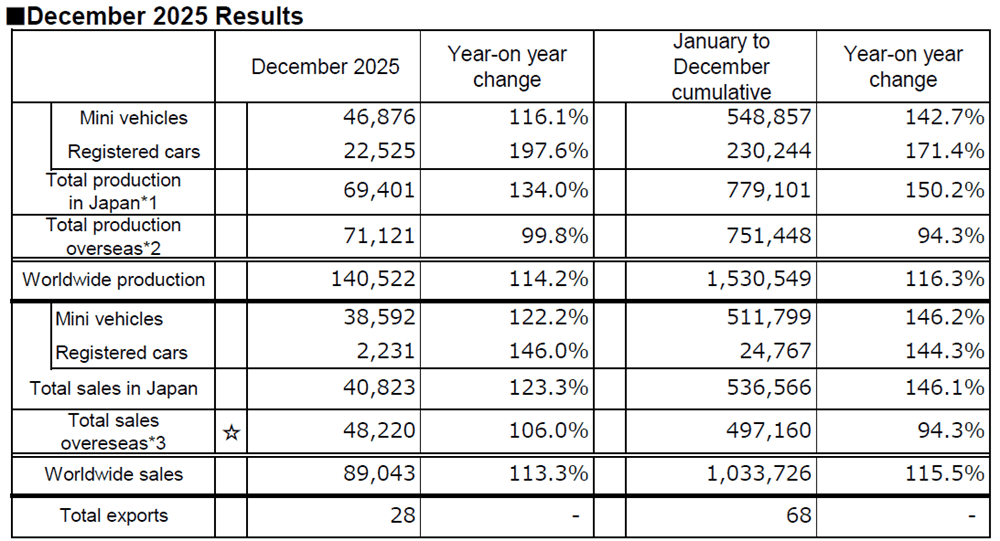
- The December 2025 data showed a significant increase in both automotive production and sales results.
- Total Japan production reached 69,401 units, reflecting a robust +134.0% year-on-year growth, while overseas production stood at 71,121 units, nearly stable at 99.8% YoY.
- The global manufacturing output reached 140,522 units, which represented a 114.2% increase, indicating the facility regained its complete manufacturing output capability.
- The total worldwide production reached 1.53 million units, which represented a 116.3% increase, showing that supply chains had recovered and factories operated at high capacity.
- The domestic market in Japan achieved 40,823 unit sales during December, which represents a 123.3% increase, while the total sales for the period reached 536,566 units, which shows a 146.1% increase.
- Mini vehicles made up the majority of sales during December because they sold 38,592 units, which shows a 122.2% increase, and 511,799 units during the entire year, which shows a 146.2% increase, confirming Daihatsu’s position as the top brand in the low-priced compact car market segment that drives business growth through price-influenced buying.
- The December export volume reached 48,220 units, which shows a 106.0% increase, but the total international sales for the period decreased to 497,160 units, which represents a 5.7% annual drop, approximately, showing that local markets experienced weaker demand and international sales faced higher competition.
- The worldwide sales reached 1.03 million units, which shows a 115.5% increase because the market strongly depended on domestic purchases.
- The registered car market experiences cyclic volatility, which shows that the vehicle market grew by 197.6% in December and 171.4% during the entire year, indicating that consumer interest developed beyond kei cars to include other types of passenger vehicles.
Daihatsu Revenue Outlook 2023–2028
(Source: statista.com)
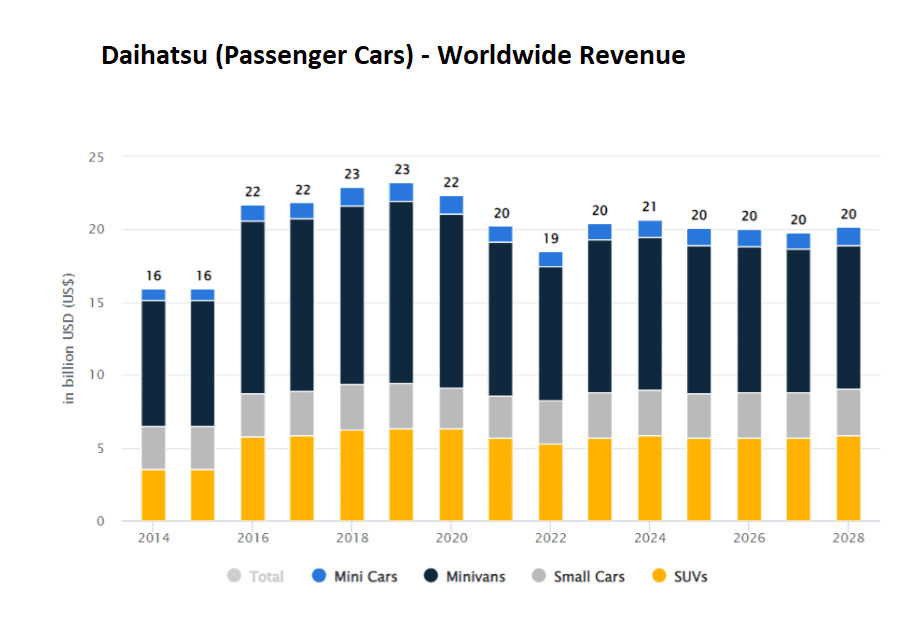
- Daihatsu Motor Co., Ltd. shows a steady revenue pattern that has reached a business peak because of its compact vehicle market entry.
- The company’s passenger vehicle revenue increased from USD 19 billion in 2022 to USD 20 billion in 2023 (+5.3%), and revenue reached USD 21 billion in 2024 (+5.0%), which demonstrates that the company will achieve short-term revenue growth through rising customer demand and higher product prices.
- The 2025 to 2028 revenue projections show a steady revenue performance that will maintain itself at approximately USD 20 billion every year.
- The market has reached its maximum capacity because companies face intense competition and their product sales do not provide sufficient growth potential. This plateau indicates that Daihatsu has entered a stage where its business will operate at a constant level of earnings and cost effectiveness while stopping all aggressive growth efforts.
- Minivans lead the revenue distribution by generating USD 10–11 billion each year, which accounts for 50–55% of total revenue, thus providing the company with its strongest growth potential.
- The SUV segment shows steady performance through its USD 6 billion revenue stream, which demonstrates ongoing market interest in urban utility vehicles.
- The small car segment generates approximately USD 3 billion in revenue, while mini cars generate around USD 1 billion, although these vehicles serve as vital components for Japan’s kei car industry.
- The 2025 segment consistency demonstrates that the business maintains operational stability across different market conditions, with no potential for innovative growth.
Number of New Passenger Car Registrations in Japan
(Reference: statista.com)
- The Japanese passenger car market shows three main patterns: repeated demand fluctuations, sensitivity to economic conditions, and a slow recovery after market interruptions.
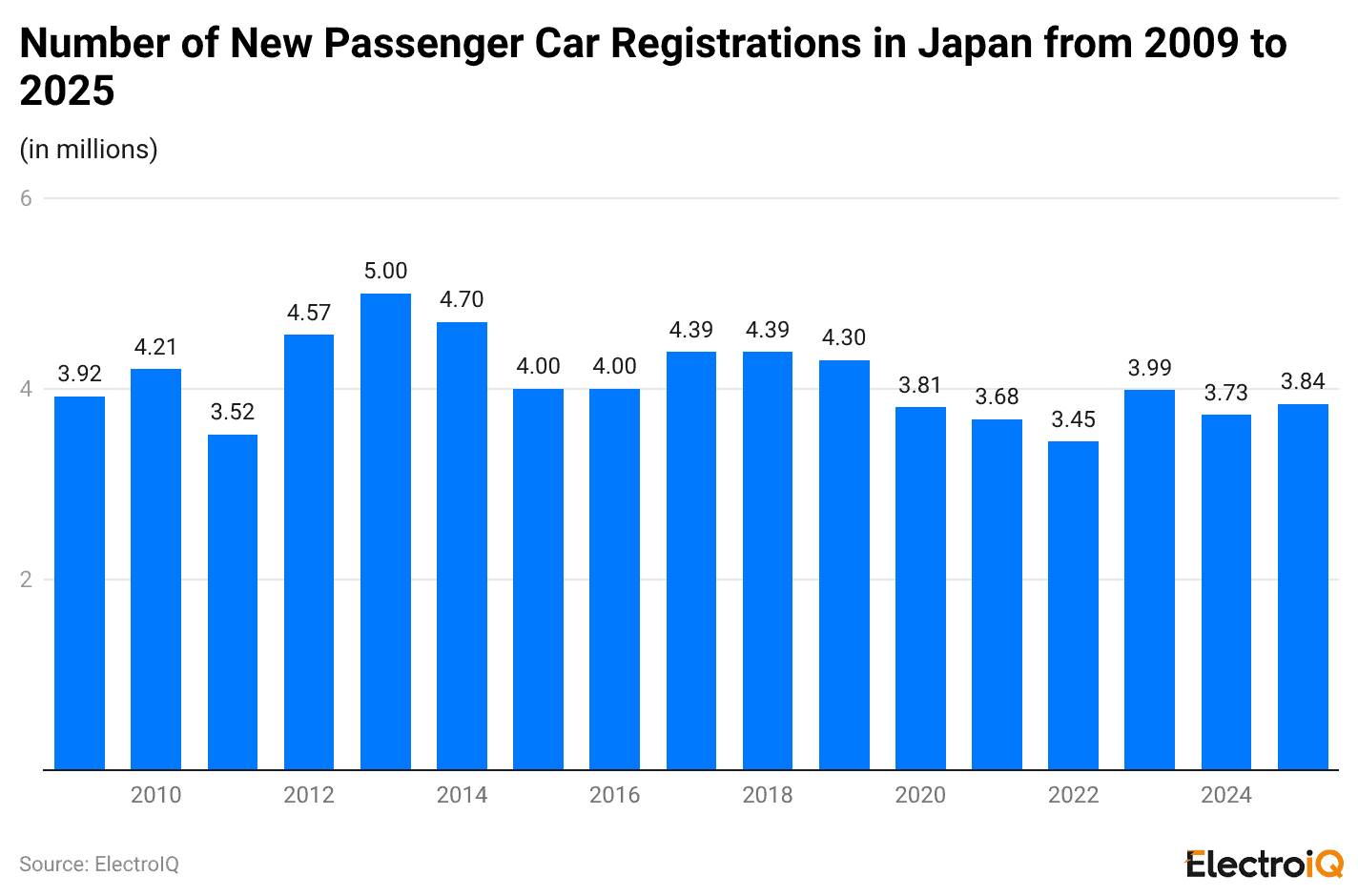
- The period between 2009 and 2025 saw annual new passenger car registrations range from 3.45 million to 4.70 million units, which demonstrates the mature nature of the market that has reached its saturation point.
- The market achieved its highest point in 2014 when 4.70 million units were sold because customers bought products before tax increases, and customers felt positive about the market.
- The period after this peak period entered a stabilization phase, which maintained volume levels between 4.1 and 4.4 million units during the time period between 2015 and 2019.
- Replacement demand exists in the automotive market as a major factor that acts as a primary keyword for market research in this industry.
- The time period from 2020 to 2022 experienced a major decline, which resulted in a decrease of registrations to 3.81 million in 2020 and 3.68 million in 2021 and a minimum value of 3.45 million in 2022.
- The production decline occurred because of three main factors, which included pandemic-related disruptions, semiconductor shortages, and supply chain limitations, which affected both vehicle manufacturing and dealership stock levels.
- The market demonstrates positive development because it has begun to recover since 2023 and reached 3.99 million registrations in 2023, which increased to 3.73 million in 2024 and 3.84 million in 2025.
- The current recovery, which exists below earlier operational highs, demonstrates that supply conditions have improved while consumer demand remains strong.
- Japan’s passenger car market shows both stability and minimal growth at the present time. The market will grow when people adopt electric vehicles, vehicle prices become more affordable, and population patterns change.
(Source: statista.com)
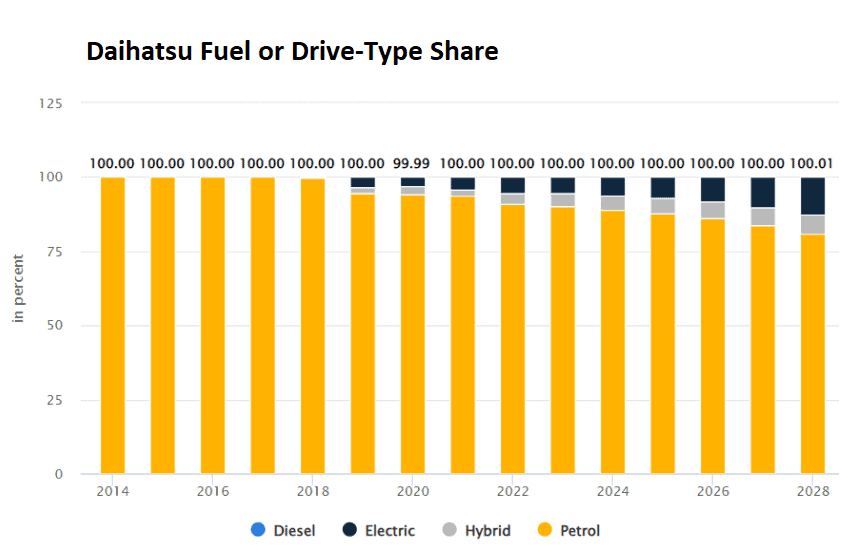
- Daihatsu Motor Co., Ltd. is proceeding with its gradual shift towards electric vehicle manufacturing, yet the company still maintains its primary focus on gasoline-powered vehicles, which is a common practice for markets that require affordable small automobiles.
- The sales distribution for 2024 shows that petrol-powered vehicles achieved 89.06% of total sales, while their 2023 figure reached 90.28% which results in a shift of -1.22 %age points.
- The market share for electric vehicles (EVs) increased from 5.32% in 2023 to 6.07% in 2024, while hybrid vehicles experienced a growth from 4.40% to 4.87%, which demonstrates the ongoing process of adopting new vehicle technologies that serve as the main focus for automotive electrification research.
- The time period between 2025 and 2028 will demonstrate a definitive path toward electric vehicle adoption, according to forecasting methods.
- The EV market share will increase from 7.01% in 2025 to 12.79% in 2028, resulting in a market share increase of 5.78 %age points.
- The market for hybrid vehicles displays steady progress as it grows from 5.31% to 6.21%, but the market for petrol vehicles experiences a strong decline, which results in a drop from 87.68% to 81.01% during the same time frame.
- The emergence of new markets and local markets and their consumer behaviour make petrol the preferred fuel despite the fact that diesel vehicles now dominate the market.
Daihatsu Number of Employees
(Source: daihatsu.com)
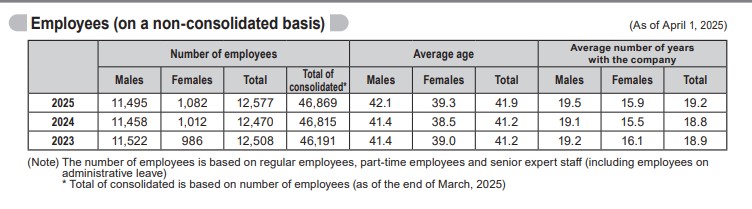
- Daihatsu Motor Co., Ltd. demonstrates steady workforce expansion and demographic stability, which shows its effective implementation of human resource strategies and operational needs.
- Total employees increased from 12,508 in 2023 to 12,577 in 2025, which shows a controlled hiring process that supports production recovery instead of company growth.
- The 2025 gender distribution shows a major imbalance because there are 11,495 male workers 91.4% of the workforce and 1,082 female workers 8.6% of the workforce, which creates a substantial gender diversity gap that serves as a main search term used in workforce research.
- The average age of employees stays constant at about 41.9 years for 2025, which shows that the company has an experienced workforce.
- The average tenure of employees reached 19.2 years, which shows that the company experienced two years of growth from its previous 2024 average tenure of 18.8 years.
- These two elements determine how efficiently a manufacturing plant operates and how well an organization retains its institutional knowledge.
- Daihatsu has publicly committed to developing 3,000 digital transformation (DX) personnel by 2027.
- Daihatsu’s international business operations maintain their current status because the entire workforce increased from 46,191 in 2023 to 46,869 in 2025.
ARCHION Ecosystem Strategy 2026
- The April 2026 launch of ARCHION Corporation marks a structural transformation in the global commercial vehicle ecosystem, with Daihatsu Motor Co. Ltd. emerging as a strategic enabler of last-mile logistics and electrification instead of a secondary stakeholder.
- The ARCHION structure, which Toyota Motor Corporation and Daimler Truck AG own at approximately 25 % each, together with public shareholders who own about 50 % of the company, establishes a governance framework that supports business expansion, efficient capital usage, and international market competitiveness.
- The company differentiates itself through its complete product suite, which includes heavy-duty trucks and kei-class urban vehicles as its core products.
- Daihatsu’s role within this architecture is best understood through the “main artery-capillary logistics model”, which uses heavy trucks Hino and Fuso as its main transportation system and Daihatsu’s kei commercial vehicles as its last-mile delivery system.
- The kei vehicle segment operates as a mainstream market segment because these vehicles make up approximately 60 % of Japan’s commercial vehicle fleet, and they account for 31 million units out of 78 million total vehicles in the country.
- The e-Hijet Cargo and e-Atrai BEVs will launch in February 2026 as a revolutionary development for electric last-mile delivery systems.
- The vehicles that operate on the e-SMART ELECTRIC platform come equipped with a 36.6 kWh battery that delivers a 257 km WLTC range and supports 50-minute fast charging for battery levels between 20 % and 80 %.
- The 350 kg payload parity with gasoline models removes operational trade-offs that have historically restricted commercial EV adoption.
- Daihatsu’s choice to manufacture battery electric vehicles together with internal combustion engine vehicles on common production lines leads to improved factory performance because it will save costs and provide operational flexibility.
- The partnership with Commercial Japan Partnership Technologies Corporation provides Daihatsu with increased value through its strategic development.
- The integration of data-driven fleet insights together with connected logistics platforms makes Daihatsu’s kei vehicles part of a digitally linked supply chain system, which enables simultaneous management of heavy trucks and final delivery vehicles—a vital function for current logistics systems.
- Market dynamics strongly support this positioning. Japan’s last-mile delivery market, which had a value of USD 13.18 billion in 2025, will grow to USD 39.94 billion by 2034 through a 13.1 % compound annual growth rate, which results from e-commerce expansion, urban development, and the government requirement for zero-emission zones.
- The kei-BEV adoption rate will experience substantial growth because of the fleet electrification requirements, which will become effective from 2027 onward.
- Daihatsu has established itself as the leading expert in mini-vehicle production through its 69 years of experience, which started with the 1957 Midget launch, because this vehicle segment has unique characteristics that make it essential for Japan’s logistics system.
Daihatsu’s Certification Reform and Compliance Transformation
- The certification crisis at Daihatsu Motor Co., Ltd. establishes a fundamental turning point that changes corporate governance and risk management and regulatory compliance practices throughout the global automotive sector.
- The discovery of 174 procedural irregularities across 25 test categories, which affected 64 models and 3 engines, revealed a complete system failure that had existed since 1989.
- The intervention by the Ministry of Land, Infrastructure, Transport and Tourism (MLIT) in January 2024 marked a turning point, which required three-pillar reforms that included operational restructuring, cultural transformation, and governance reinforcement.
- The Daihatsu reforms established three main commitments that create an international standard for automotive compliance reforms and risk management practices.
- The most important operational change has been the creation of separate development and certification departments, which ended previous conflicts between product development schedules and compliance with regulations.
- The organization will expand its certification team by six times to solve resource shortages, which previously caused testing violations.
- The new testing standards and technical assessment methods now require production models to be used, which results in improved data integrity and better regulatory compliance.
Conclusion
Daihatsu Statistics: Daihatsu achieves its 2025 to 2026 performance results through domestic market demand and restored production capacity, which specifically benefits the kei car market. The company faces ongoing structural problems because its revenue streams do not increase, its international business operations perform poorly, and its electric vehicle development initiatives progress at a slow pace. The certification crisis has created major problems that affect both governance and financial stability, thus requiring the organization to implement extensive modifications.
The company’s future success will depend on its ability to recover compliance standards while achieving cost reductions and expanding electric vehicle adoption. Daihatsu maintains its strategic position because of Toyota Motor Corporation’s support, yet its future growth will depend on both innovative development and its ability to compete worldwide.
Sources
FAQ.
Global production reached 1.53 million units, growing 116.3% YoY.
Mini (kei) vehicles dominate, contributing over 511,000 units annually.
Revenue peaked at USD 21B in 2024 but is expected to remain flat around USD 20B through 2028.
The electric vehicle market share has been increasing, which will reach 12.79% by 2028.
A certification issue involving 174 irregularities across 64 models impacted operations and trust

Rohan Jambhale is a senior editor at Smartphone Thoughts. He specializes in digital marketing, SEO, and social media optimization. Rohan excels in creating and editing detailed articles, ensuring they are packed with accurate statistics that readers find valuable. As a senior editor, he meticulously reviews and verifies the quality of content from various writers before it goes live. Additionally, Rohan designs infographics to accompany the statistics, making the information more understandable and engaging. His dedication ensures that Smartphone Thoughts delivers high-quality and informative content to its readers.