Hyundai Statistics By Market Growth And Sales (2026)

Updated · Apr 07, 2026


Table of Contents
Introduction
Hyundai Statistics: The automotive industry of Hyundai Motor Company expands its worldwide manufacturing strength through its current transition into electric vehicles, digital mobility, and international market development. The company maintained its financial stability during 2025-2026 because of its capacity to handle geopolitical events, changing electric vehicle demand, and tariff restrictions. Hyundai maintains its core business through internal combustion engine products while developing its electric vehicle and hybrid systems, which drive its sales growth and record-breaking revenue performance.
Through its performance, Hyundai demonstrates its strategic change towards sustainable development, innovative solutions, and emerging market growth, which positions the company as an important force in the development of the global automotive sector.
Editor’s Choice
- In 2025, Hyundai Motor Company achieved vehicle sales of 4.13 million vehicles, which represented a slight decrease of 0.1% compared to the previous year.
- Q4 2025 sales experienced a year-over-year decline of 3.1%, which resulted in sales of 1.03 million units because demand decreased during the final months of the year.
- The company reported annual revenue growth of 6.3%, which resulted in total revenue of 186.3 trillion KRW because of higher prices and an increased share of premium products.
- The operating profit decreased by 19.5% from the previous year to 11.47 trillion KRW, which resulted in reduced profit margins for the company.
- The company experienced a net profit decrease of 21.7%, which resulted in net earnings of 10.36 trillion KRW because of increased expenses and economic challenges.
- Internal combustion engine vehicles made up 3.17 million units, which represented 77% market share, while the total market volume decreased by 4% from the previous year.
- Sales of electrified vehicles reached 932,123 units, achieving 27% Year-over-Year growth, resulting in an electrified vehicle share of approximately 23%.
- Hybrid sales led electrification with 611783 units (+32% YoY).
- The market recorded electric vehicle sales of 269,169 units, representing a year-over-year increase of 17%, indicating consistent growth in product use.
- North America achieved 8% Year-over-Year sales growth, which resulted in 1.19 million units sold, making it the most successful region for sales.
- European electric vehicle sales experienced a 49% increase because electric vehicles constituted almost 66% of all vehicle sales.
- India achieved a 750% Year-over-Year increase in electric vehicle sales, which reached 7661 units, demonstrating the beginning stages of widespread market acceptance.
- Standalone turnover declined ~1.6% YoY to ₹63,584 crores, while EBITDA fell ~8%.
- Net worth increased ~53% YoY to ₹15,842 crores, strengthening the balance sheet position.
- Hyundai plans KRW 17.8 trillion investment, including KRW 7.4 trillion in R&D for electrification.
Hyundai Financial and Sales Performance 2025
(Source: hyundai.com)
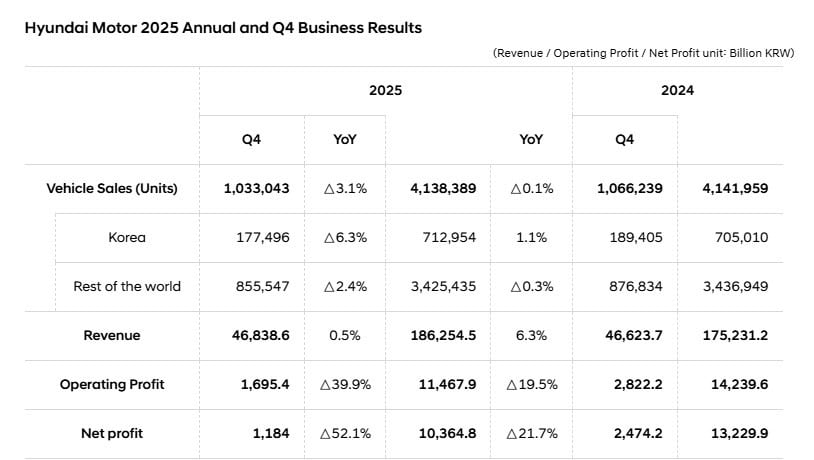
- Hyundai Motor Company achieved mixed financial results in 2025 because vehicle sales remained stable while its profitability metrics experienced significant reductions, which showed the international automotive industry and expense trends of the company.
- The company achieved total vehicle sales of 4.13 million units during 2025, which showed almost no change from the previous year because 2025 sales dropped 0.1% from 4.14 million units in 2024.
- Sales reached 1.03 million units during Q4 2025, which marked a 3.1% YoY decrease that showed decreasing demand between Q3 and Q4.
- Korea experienced an annual growth of 1.1%, which translated to 712,954 units, while worldwide sales dropped by 0.3%, which demonstrated different sales patterns between regions.
- Hyundai achieved stable revenue performance when it reported 186.3 trillion KRW in annual revenue growth of 6.3% from the previous year because its pricing strategies, product mix development, and premium vehicle sales performance had positive effects.
- The company currently faces operational difficulties, which show through its profitability metrics.
- The company experienced a 19.5% decrease in operating profit, which reached 11.47 trillion KRW, while net profit decreased 21.7% to 10.36 trillion KRW because higher input expenses, customer incentives, and economic conditions created complete margin erosion.
- 9% YoY operating profit decline in Q4, while net profit dropped 52.1% YoY because of rising expenses for materials, currency fluctuations, and higher promotional costs.
- Q4 revenue increased by 0.5%, but profitability declined because operating procedures became less efficient.
- Hyundai Motor Company demonstrates its fundamental strength through consistent sales volume and revenue growth, yet its profitability challenges require the company to achieve cost savings while it rebuilds profit margins through electric vehicle sales in the upcoming years.
Hyundai Powertrain Mix 2025
(Source: hyundai.com)
- Hyundai Motor Company is implementing a gradual powertrain transition that establishes a strategic framework for developing its electric vehicle market while its internal combustion engine vehicles maintain their current market share.
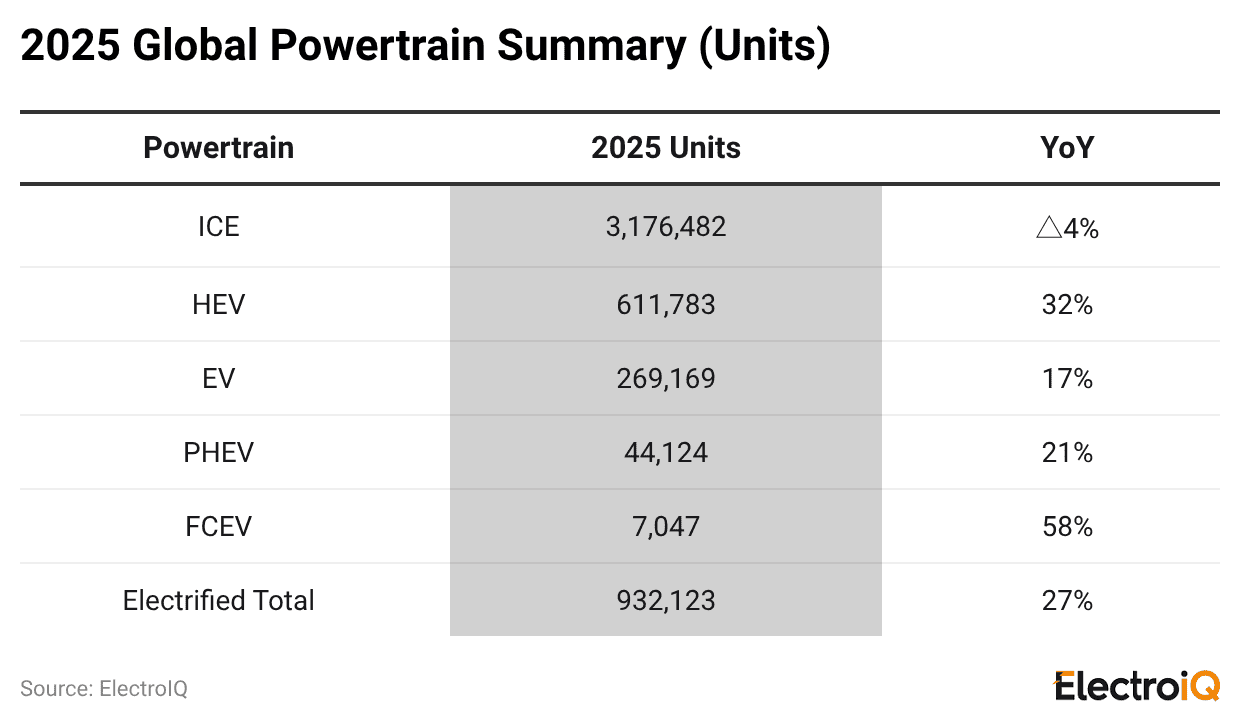
- In 2025, Hyundai sold 3.17 million ICE vehicles, which represented a 4% decrease from the previous year but accounted for approximately 77% of total sales volume, thus demonstrating ongoing dependence on conventional powertrain systems.
- The primary focus of this situation shows how electrification adoption is growing, which serves as the main identification term for electric vehicle adoption patterns.
- The electrified portfolio reached 932123 units, which represents a 27% year-on-year increase and now provides almost 23% of total sales. This development indicates a fundamental transformation of Hyundai’s product distribution.
- Hybrid electric vehicles (HEVs) increased their sales by 611783 units, which represents a 32% growth. This development shows that HEVs became the most popular solution because they offer affordable prices and existing infrastructure support.
- The global electric vehicle market experienced competitive growth as battery electric vehicles (EVs) reached 269169 units, which represents a 17% increase.
- The plug-in hybrid electric vehicle (PHEV) market total reached 44124 units, which represents a 21% increase. This development aids the implementation of transitional electrification methods. Fuel cell electric vehicles (FCEVs) maintained a small market presence with 7047 units.
- Despite this fact, FCEV sales experienced a 58% annual growth rate, which demonstrates Hyundai’s commitment to future hydrogen-powered transportation development.
- Hyundai Motor Company implements a dual powertrain approach, which enables it to achieve short-term internal combustion engine profits while it develops its electric vehicle market. This positioning allows the company to compete effectively in the worldwide trend toward environmentally friendly transportation solutions.
Hyundai Global Regional Performance 2025
- Hyundai Motor Company delivered a geographically diversified growth performance in 2025, with North America and emerging markets driving volume expansion, while electrification trends accelerated across all major regions.
- The global positioning of Hyundai Motors, which operates worldwide, depends on its primary markets and standards for electrification development, electric vehicle sales, and hybrid vehicle growth, as well as its international automotive business plan.
- North America emerged as the strongest growth engine, with retail sales reaching 1.19 million units (+8% YoY), accounting for a significant share of global volumes.
- The United States led with 984,017 units (+8%), marking a third consecutive record year, supported by strong demand for SUVs and EVs like IONIQ 5.
- Customers increasingly choose fuel-efficient transportation options, which led to hybrid sales growth of 47%, while electric vehicles made up 26% of retail sales with 308,376 units.
- Hyundai recorded 321,338 units (+3%) in Central and South America, while hybrid sales experienced explosive growth of 188% from a limited base, which demonstrates that customers at this stage are starting to adopt electric vehicles.
- Europe maintained its market size at 603,782 units, but achieved higher electric vehicle adoption through its 49% increase in EV sales (112,266 units), which resulted in two-thirds of total sales coming from electrified vehicles that customers purchased to comply with emissions rules.
- The Indian market has become a key growth market for Hyundai, which achieved 574,536 unit sales to strengthen its brand value through its regional production network.
- The market showed early adoption of electric vehicles, which led to a 750% increase in sales to 7661 units because of this high-growth market.
- Hyundai plans to establish India as its primary domestic and export manufacturing facility through its plan to introduce 26 new vehicle models and increase production at its Pune plant.
- The Middle East and Africa region delivered 317,270 units because of hybrid growth, which reached 61%, while the Asia Pacific region recorded 193,454 units because hybrids generated positive growth of 61% compared to last year.
- The Chinese market presents difficulties for Hyundai, which has three strategic priorities of operational efficiency, product differentiation, and export-led recovery.
- The Korean market achieved consistent growth with 712,954 units sold, which represented a 1% increase, while Hyundai maintained its position as the hydrogen mobility market leader through electrification efforts that included 22% EV sales growth, and 21% hybrid sales increase, and 78% FCEV sales growth.
- Genesis Motor achieved 221,482 global units through its premium brand, which also experienced a 10% sales increase in the US market to 82,331 units.
- The GV70 model saw a 26% increase, and the GV80 Coupe model experienced a 166% increase, which demonstrates how successful luxury demand has been for the Genesis automotive brand to reach its goal of 350,000 units in annual sales by 2030.
(Source: hyundai.com)
- The financial records of Hyundai Motor Company show steady growth because their long-term revenue increase and asset protection outweigh their temporary loss of profits.
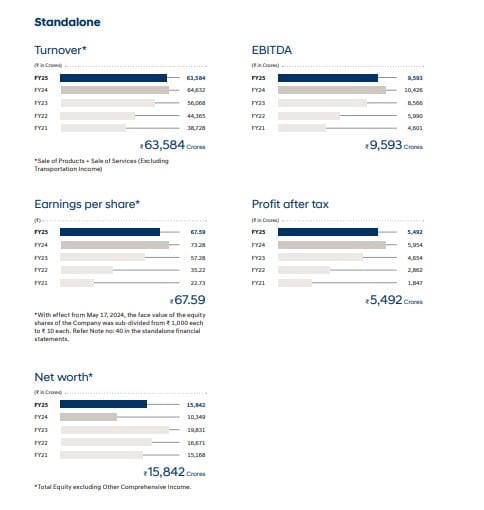
- The company reported turnover of ₹63,584 crores in FY25, which showed a decline from the previous year when it reached ₹64,632 crores, resulting in an annual decrease of approximately 1.6%.
- Yet, the revenue has expanded substantially from ₹38,728 crores in FY21, resulting in a strong revenue growth rate of approximately 13%, indicating ongoing demand and market development.
- The profitability results show that EBITDA reached ₹9,593 crores in FY25, while it declined to ₹10,426 crores in FY24, showing an approximately 8 % decrease.
- The company experienced lower profit margins because it faced rising input expenses and returned to normal supply chain operations while investing in electrification and technological development.
- The company achieved more than two times EBITDA growth since FY21, which demonstrates their ability to develop operations and maintain lower expenses over time.
- Profit After Tax (PAT) of ₹5,492 crores, a decline from the previous period’s ₹5,954 crores, which represented a yearly drop of approximately 7.8%.
- The PAT figure indicates that the company faces temporary earnings challenges, but it currently stands nearly three times higher than the FY21 level, which demonstrates past success and current profit stability.
- The company achieved a major accomplishment through its net worth increase, which reached ₹15,842 crores in FY25, compared to its earlier net worth of ₹10,349 crores in FY24, which shows a remarkable net worth increase of approximately 53%.
- The company experienced a substantial equity base expansion, which resulted in better financial health and increased capital productivity, that enables them to pursue its investment plans and growth initiatives.
Global Economic Outlook 2024–2026
(Source: hyundai.com)
- The global macroeconomic landscape presents a balanced mix of resilience and caution, which determines the business environment for companies such as Hyundai Motor Company.
- The global economy experienced a 3.3% expansion in CY 2024, which demonstrated economic stability through the period of geopolitical conflicts and strict financial conditions. ‘
- Advanced economies achieved a 1.8% growth rate while emerging markets exceeded this with 4.3% growth, which emerged from their strong domestic demand and infrastructure investment.
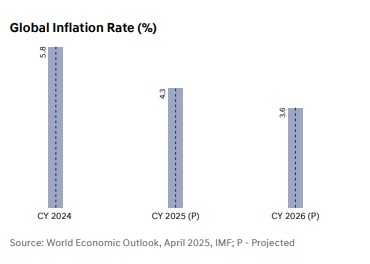
- Global inflation has experienced a significant positive change because it decreased to 5.8% in 2024 through the combination of monetary tightening and decreased energy costs.
- The services industry continues to demonstrate inflation, which indicates that all sectors will face ongoing cost increases.
- The International Monetary Fund forecasts that global growth will decrease to 2.8% major economic expansion will return to 3.0% in 2026, which suggests that the economy will experience a soft landing instead of an abrupt decline.
- The advanced economies will experience economic growth between 1.4% and 1.5% because of low consumer spending and restrictive government policies.
- Emerging markets will achieve economic growth between 3.7% and 3.9%, which establishes them as essential drivers of worldwide economic expansion.
- Inflation will decrease to 4.3% in 2025 and 3.6% in 2026, which establishes a path toward price stability and greater purchasing power for consumers.
Hyundai Motor Company Production Mix
(Source: hyundai.com)
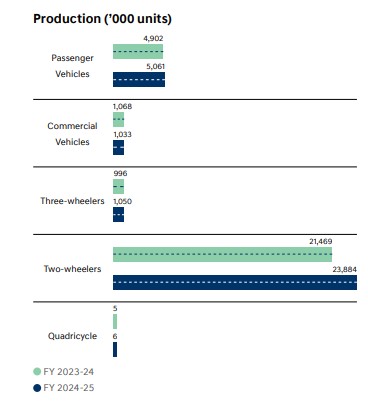
- The production data shows different trends for various vehicle segments, which demonstrate changes in consumer behavior and new transportation preferences.
- Hyundai Motor Company achieves successful passenger vehicle production, which rose from 4,902 (‘000 units) in FY23–24 to 5,061 (‘000 units) in FY24–25, to show a 3.2% yearly increase.
- The data shows that consumer demand remains strong because people prefer SUVs, and urban areas develop better transportation systems.
- The production of commercial vehicles showed a slight decrease because output dropped from 1,058 to 1,033 (‘000 units), which represents a 2.4% decline that most likely happened because economic conditions remained uncertain, freight demand decreased, and companies restricted their vehicle purchases.
- The three-wheeler segment experienced a slight decline, which brought output down from 1,050 to 996 (‘000 units), showing that rural demand decreased and markets returned to normal after pandemic-related disruptions.
- The two-wheeler segment shows the strongest production growth because its output increased from 21,469 to 23,884 (‘000 units), resulting in an 11.2% production increase.
- The volume of this segment remains the highest because its products offer low prices and high fuel efficiency, and emerging markets show increasing product demand.
- The production of quadricycles stayed limited because it dropped from 6 to 5 (‘000 units), which shows that the product has not yet achieved widespread market adoption.
- The data shows that consumer behavior drives growth because mass mobility segments generate more revenue than commercial sectors, which depend on economic circumstances.
Hyundai Workforce Composition and Diversity
(Source: hyundai.com)
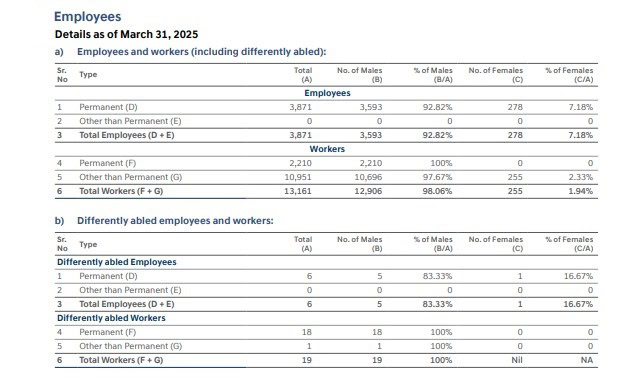
- The employee data from Hyundai on March 31, 2025, shows a workforce that follows strict organizational systems to achieve high work efficiency.
- The company reports 3871 employees who work at the organization, with 92.82% of its workforce being male and 7.18% of its workforce being female, which shows a substantial gender imbalance.
- The company employs only permanent staff members, which results in a permanent workforce that operates without needing temporary employees.
- Hyundai has a workforce of 13161 employees who operate in its production facilities, with 98.06 % of its workers being male and only 1.94 % being female, which creates a major gender imbalance in its essential production workforce.
- The permanent workforce (F) forms the backbone with 2210 workers, all male, while contractual workers (G) contribute 10951 individuals who create slight diversity through 2.33 % female participation.
- Hyundai tracks its employment of 25 differently-abled workers who represent its total workforce of employees and workers.
- The employee group has 83.33% male workers, while the worker group has 100% male workers, which shows that both groups lack gender diversity.
- The company maintains a stable workforce who operate at high capacity while using male workers for most positions, although it needs to improve its gender diversity and inclusive hiring practices.
Hyundai Motor Company 2026 Outlook
- The Hyundai Motor Company implements a disciplined yet forward-oriented strategy that requires its operations to generate moderate growth while it invests aggressively in its electrification efforts and other company projects.
- The company achieved 2025 revenue growth of 6.3%, which surpassed its 2025 guidance because it maintained an operating margin of 6.2% that proved its financial resilience against tariff impacts and worldwide economic fluctuations.
- Hyundai forecasts 1–2% revenue growth for 2026 because it expects global automotive demand to decrease and market competition to increase.
- The company has established an operating margin range of 6.3–7.3% because it intends to increase its profitability through cost efficiency and effective price management.
- The company intends to exceed 4.16 million vehicle sales, which supports its strategy to dominate vehicle sales volume in the market.
- The KRW 17.8 trillion investment plan serves as a major highlight because it demonstrates Hyundai’s dedication to developing new technologies and maintaining its competitive advantages throughout the upcoming years.
- The company plans to spend KRW 9 trillion in capital expenditures, KRW 7.4 trillion on research and development, and KRW 1.4 trillion on key projects, which will focus on electric vehicle development, hybrid growth, and the development of future mobility systems.
- The company needs to implement these investments because they will help establish its position as a leader in electric vehicle technology and its ability to produce vehicles within the local market.
- Hyundai offers shareholders a strong capital return plan, which includes a total dividend distribution of KRW 10,000 per share for 2025 and a KRW 400.7 billion share buyback initiative, which demonstrates the company’s ability to generate substantial cash flow and the high level of investor trust in the organization.
- Hyundai uses its flexible powertrain system, which includes electric vehicles, hybrid electric vehicles, and internal combustion engine cars, to meet the various demand needs of different regions, especially in developing countries.
- Combined with supply chain localization and cost-efficiency initiatives, this approach enhances operational agility.
Conclusion
Hyundai Statistics: Hyundai Motor Company maintains its operational strength by achieving consistent revenue growth through its worldwide production capacity and active market presence, which face challenges to its profit margins. The company maintains its current cash flow from internal combustion engine vehicles through its multi-powertrain system while it speeds up its transition to electric vehicles through hybrid and electric vehicle development. The company experiences long-term success because of its operations across different regions and its growth in North America, India, and other emerging markets.
The company currently faces two challenges because its expenses have increased, and new competitors in the electric vehicle market have entered the industry. Hyundai established itself as a leader in the automotive industry through its substantial research and development investments in electrification and future mobility solutions, which enable the company to handle industry changes while sustaining its market position.
FAQ.
Hyundai sold 4.13 million vehicles globally in 2025, nearly flat YoY.
Electrified sales grew 27% YoY to 932,123 units, reaching ~23% of total sales.
North America led growth with an 8% YoY increase to 1.19 million units.
The company experienced decreased operating and net profit because of three factors which included increased input costs and higher marketing costs and fluctuating currency rates.
Hyundai plans to invest KRW 17.8 trillion, focusing heavily on EVs, R&D, and mobility innovation.

I hold an MBA in Finance and Marketing, bringing a unique blend of business acumen and creative communication skills. With experience as a content in crafting statistical and research-backed content across multiple domains, including education, technology, product reviews, and company website analytics, I specialize in producing engaging, informative, and SEO-optimized content tailored to diverse audiences. My work bridges technical accuracy with compelling storytelling, helping brands educate, inform, and connect with their target markets.