Polestar Statistics By Sales And Performance (2026)

Updated · Apr 17, 2026



Table of Contents
Introduction
Polestar Statistics: Polestar operates between 2025 and 2026 as its critical business period. The company is transitioning from niche EV producer to a global premium electric brand, which operates through its expanding model range that includes Polestar 3 and Polestar 4. Polestar deals with multiple challenges that include profitability difficulties, geopolitical threats, and pricing pressures despite increased demand and sales.
The period presents two opposing stories, which show that commercial operations expand through new global retail outlets, yet the company continues to experience financial difficulties. The company demonstrates how difficult it is to expand operations within the challenging international electric vehicle market.
Editor’s Choice
- Polestar delivered 13,126 units in Q1 2026, up 7% YoY.
- The retail network expanded to 230 locations, which represents a 50% increase from 154 locations that existed in Q1 2025.
- The target aims to establish approximately 250 sales points by the end of 2026, which will require approximately 20% additional growth.
- Q3 2025 retail sales achieved 14,192 units, which showed a 13.1% year-over-year growth.
- 9M 2025 sales reached 44,482 units, which represented a 36.5% year-over-year increase.
- Q3 2025 revenue increased 36% year-over-year, reaching USD 748 million.
- The carbon credit revenue generated USD 33 million for the company during Q3 2025.
- Gross margin dropped to -6.1%, which represents a decrease of 4.9% age points from the previous year.
- Adjusted gross margin decreased to -7.9%.
- Net loss increased to USD 365 million during Q3 2025.
- Adjusted EBITDA loss reached USD 259 million.
- The company operates in 28 markets, which include 192 sales points that increased by 16.4%.
- Service network expanded to 1,269 locations, which represents an 8.5% increase.
- The total funding capacity of the company reached USD 3.2 billion, which includes USD 1.0 billion in new debt.
- The 2026 volume growth guidance stands at approximately 10% to 12%, while the company expects to reach more than 100000 units.
Plostar Q1 2026 Sales Growth

(Source: investors.polestar.com)
- The financial results from Polestar for the first quarter of 2026 demonstrate their ability to grow steadily because they opened new retail stores and maintained consistent customer demand within their main electric vehicle markets.
- The company reported 13,126 retail sales, which represent a year-on-year (YoY) increase of 7 % from 12,263 units in Q1 2025. The company used this data to strengthen its position within the premium electric vehicle (EV) market segment.
- The expansion of Polestar’s retail network, which now includes 230 operational sales points compared to 154 locations in Q1 2025, serves as the main factor driving this business growth.
- The business expansion process enables the company to reach new customers while increasing brand recognition and acquiring customers more effectively in areas where electric vehicle adoption is growing rapidly.
- The company operates in Germany, the United Kingdom, Australia, Sweden, and South Korea to access markets with rising electric vehicle adoption rates.
- Polestar achieved its highest-ever first-quarter sales performance despite facing geopolitical tensions and economic challenges.
- The management team plans to increase sales points to approximately 250 locations through 2026, which marks a 20% growth.
- The business operations analysis shows that 7% sales growth and 50% network expansion together demonstrate early operational deficiencies, which will result in better sales outcomes once the new locations reach their full operating capacity.
- Polestar achieved balanced growth during the first quarter of 2026 through three strategies, which included limited volume growth and aggressive retail expansion, together with market entry into new regions.
Polestar Q3 2025 Financial Performance
(Source: investors.polestar.com)
- Polestar’s Q3 2025 financial performance demonstrates an electric vehicle growth paradox because the company achieved strong revenue growth and increased production, but suffered ongoing profit declines, together with mounting financial losses because of market pricing challenges and rising operational expenses.
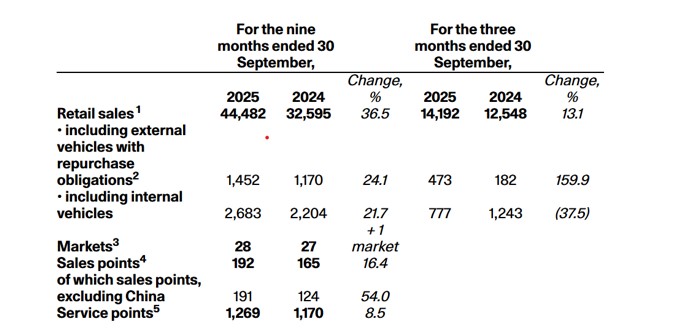
- The retail sales reached 14192 units, which represented a 13.1 % year-over-year increase, and this achievement contributed to the 9M 2025 volume total of 44482 units, which showed a 36.5 % increase.
- The company used its expanded product range and better European distribution system, which indicates strong market demand.
- The inclusion of higher-priced models such as the Polestar 3 and Polestar 4 into the product range has created a new pricing pattern that increases average selling prices.
- The product mix change has caused revenue increases, which reached USD 748 million in Q3 because of 36% YoY growth, and this growth happened because of premiumization together with pricing power in particular market segments.
- The company generated USD 33 million in carbon credit revenue, which resulted in non-core earnings expansion that reduced operational challenges, according to Company Report data.
- The gross margin experienced a decline that brought it down to -6.1%, which showed a 4.9 %age point yearly decline, and the adjusted gross margin dropped to -7.9% because of tariff expenses, increased sales costs, negative product mix effects, and residual value guarantee costs in North America.
- The sector faces a fundamental issue because electric vehicle production needs to achieve profitability while countries maintain international trade disputes and companies engage in price wars.
- A net loss of USD 365 million, which showed a rise from the previous year’s USD 323 million loss, while the adjusted EBITDA loss reached USD 259 million because of rising gross losses and higher sales incentives and currency exchange rate challenges, which occurred during systematic SG&A cost reduction plans.
- The data shows that Polestar operates in a period where it invests heavily but has not yet reached profitability.
- Polestar expanded to 28 global markets (+1 YoY) and increased sales points to 192 (+16.4%), with sales points outside China surging 54% to 191, reflecting a strategic pivot toward direct retail expansion in Europe and North America.
- Expanded service points to 1,269 (+8.5%) by using Volvo Cars’ worldwide network to enhance its aftersales service capacity.
- The addition of 11 new retail partners (for a total of 141) highlights Polestar’s transition to an active selling model, which improves customer engagement and conversion efficiency.
- The company needs to optimize its cost structure because it currently operates with negative profit margins, which require cost structure optimization and scale efficiencies as its primary operational drivers.
- Polestar’s Q3 2025 performance reflects a high-growth EV scaling phase, which sees its revenue grow while its product mix shifts to premium products and its retail presence expands worldwide.
Polestar 2025 Funding Strategy
- Polestar’s 9M 2025 funding activity reflects a proactive liquidity reinforcement strategy, essential for sustaining its high-growth, capital-intensive EV expansion model.
- The headline development is a USD 200 million PIPE investment from PSD Investment Limited, which Li Shufu controls as Chairman of Geely Holding Group.
- The capital injection from insiders demonstrates their strong confidence in the company, which provides emergency balance sheet assistance during the company’s current EBITDA losses and cash burn.
- Polestar carried out its entire refinancing procedure, which included renewing its existing debt facilities worth approximately USD 2.2 billion.
- The company obtained new funding, which increased its total available financial resources to USD 3.2 billion after it secured an additional USD 1.0 billion in debt financing.
- The third quarter of the year saw Polestar complete USD 290 million in new facilities and USD 1.1 billion in facility renewals, which demonstrated increased financing activity during that time.
- The primary structural change entails the modified debt covenants that Polestar established with its club loan banks.
- The new covenants that Polestar established enable the company to handle its short-term revenue and margin fluctuations without experiencing liquidity problems.
- Polestar currently benefits from improved financial stability because its combination of equity investment, debt restructuring, and covenant suspension creates greater financial flexibility for the company. This new financial capacity enables Polestar to fund its upcoming product launches and retail expansion efforts while meeting its operational expenses.
- The funding base of USD 3.2 billion, compared to quarterly revenue below USD 1 billion, demonstrates a growth strategy that depends on capital market access for business success.
Polestar 2026 Product Strategy
- Michael Lohscheller established Polestar’s February 2026 strategy transition, which signifies a controlled shift toward sustainable capital growth based on a four-model product launch strategy instead of extensive platform development.
- The main strategy element uses a balanced portfolio method,d which integrates both upgraded existing Polestar 2 and Polestar 4 models and two new key products.
- The approach helps the company save research and development costs while reducing platform duplication, which becomes essential as the company aims to sell more than 100000 vehicles annually within the upcoming period.
- The Polestar 5 serves as a halo product because it competes in the premium EV GT segment with its 650 kW power output, and 3.2 second acceleration time, and 678 km driving range.
- The specifications establish direct competition between the product and premium electric vehicles such as the Tesla Model S and Mercedes-Benz EQS, which create brand value and generate high profit margins.
- The model will begin deliveries in summer 2026, which will help increase the company’s revenue stream during the second half of 2026.
- The new Polestar 4 variant features an estate-SUV hybrid body design, which enhances its market reach to different consumer groups.
- The variant functions as a volume multiplier because it targets family-oriented buyers while delivering performance credentials of the existing Polestar 4, which stands as the brand’s top-selling product.
- The delivery window opens in Q4 2026 with the delivery schedule set to occur at the end of the year (zecar).
- Polestar expects to achieve double-digit volume growth between 10 and 12 % in 2026, according to their guidance, which they support by their plan to increase their retail network by approximately 30%.
- The company plans to achieve European Union electric vehicle market expansion through two strategies, which include product updates and retail network development.
- Polestar chooses to develop existing platforms through affordable improvements instead of developing multiple new platforms, which allows them to maintain their financial resources until they receive their external funding, which includes a USD 400 million equity injection, as reported by Reuters Intellectia.
- The company needs this funding because it currently faces negative profit margins and continues to lose cash.
- The staggered launch timing helps to decrease execution risk because Polestar 5 presents advanced technology through its low-production capacity, while the Polestar 4 variant delivers flexible production capabilities, which establish an even distribution of risk and return potential.
Polestar’s Tariff Mitigation and U.S./Europe Production Pivot
- Polestar’s 2026–2028 industrial strategy represents a textbook response to rising global EV tariffs, which requires the company to establish local manufacturing facilities as a solution to protect its profit margins and maintain its market position and achieve future business expansion.
- The U.S. government has implemented tariffs exceeding 100 % on electric vehicles made in China, which results in effective tariff rates reaching above 135%, thus making it economically impractical to import mid-level to high-end vehicles.
- The EU has implemented tariffs ranging from 17% to 38%, which increases the expenses associated with electric vehicles that originate from China.
- Polestar has decided to shift its operational strategy from producing all its products in China to establishing manufacturing facilities in two different regions.
- The Polestar 3 functions as the essential element that drives this transition in the United States. The complete production process, which started in Chengdu, now operates from Volvo’s Ridgeville facility in South Carolina.
- The facility, which has received USD 1.3 billion in total investment and can produce approximately 150000 units each year, operates as the worldwide manufacturing center for this vehicle model.
- The upcoming Polestar 7 will be produced at Volvo’s new facility in Košice, which Polestar plans to use as its European implementation site for its existing business model.
- The plant will produce between 250000 and 250000 units each year, which establishes it as a major production center for electric vehicles that will serve the European Union market.
- The electric vehicle industry needs this method because it helps companies maintain reliable supply chains while satisfying legal requirements for their operations.
- Academic research suggests that localization is the most effective strategy to balance trade protectionism and EV adoption, a framework that Polestar is actively executing.
- Polestar has implemented a manufacturing shift that creates new operational processes, which bring about strategic changes to its business.
- The company establishes its industrial presence through production facilities in critical markets, which results in lower costs and enhanced security against tariffs while meeting customer demand requirements. This strategy helps the company achieve sustainable profit growth while increasing production capacity beyond 100000 units each year.
Conclusion
The 2025 to 2026 path of Polestar shows its typical high-development electric vehicle expansion period because the company achieves significant volume growth and increasing revenue while building its retail network, but faces ongoing difficulties with profitability. The company establishes international market presence and high-end brand status through its development of new products and its establishment of manufacturing facilities in different countries. The company depends on outside funding because it faces negative financial results and increased operational costs, which represent the common challenges encountered by businesses that are in their initial stages of electric vehicle development.
The company shows that it will follow strict procedures through its product development strategy, which requires less capital, and through its approach to managing tariffs. Polestar needs to develop its operations into effective business processes while increasing profit margins and maintaining customer interest because the global electric vehicle market is becoming more competitive.
Sources
FAQ.
Polestar sold 13,126 vehicles in Q1 2026, which represents a 7% increase from the previous year.
The company experiences negative financial results because its operational expenses, tariff charges and market price declines create high production costs.
Polestar obtained about 3.2 billion dollars through its equity and debt financing activities.
The company expects its business to achieve high single-digit growth between 10 and 12 % during 2026.
The company moves its production operations to both the United States and Europe to minimize tariff expenses while achieving better operational efficiency.

Tajammul Pangarkar is the co-founder of a PR firm and the Chief Technology Officer at Prudour Research Firm. With a Bachelor of Engineering in Information Technology from Shivaji University, Tajammul brings over ten years of expertise in digital marketing to his roles. He excels at gathering and analyzing data, producing detailed statistics on various trending topics that help shape industry perspectives. Tajammul's deep-seated experience in mobile technology and industry research often shines through in his insightful analyses. He is keen on decoding tech trends, examining mobile applications, and enhancing general tech awareness. His writings frequently appear in numerous industry-specific magazines and forums, where he shares his knowledge and insights. When he's not immersed in technology, Tajammul enjoys playing table tennis. This hobby provides him with a refreshing break and allows him to engage in something he loves outside of his professional life. Whether he's analyzing data or serving a fast ball, Tajammul demonstrates dedication and passion in every endeavor.