Payoneer Statistics By Management, Revenue And Growth (2026)

Updated · May 06, 2026


Table of Contents
- Introduction
- Editor’s Choice
- General Payoneer Statistics
- Payoneer B2B Growth Statistics
- Payoneer Headcount Statistics
- Payoneer Employees by Location Statistics
- Payoneer Business Fourth Quarter 2025 Statistics
- Payoneer Business Full Year 2025 Statistics
- Payoneer Revenue by Regions Statistics
- Payoneer Projected Income Statement Statistics
- Payoneer Management Statistics
- Payoneer Corporate Statistics
- Conclusion
Introduction
Payoneer Statistics: Imagine a scenario in which businesses and freelancers around the world can effortlessly exchange payments, transcending the limitations of geography and currency. Payoneer, a prominent digital payment platform, has been equipping individuals and businesses with its innovative solutions. As remote work and global commerce continue to expand, Payoneer has emerged as an essential resource in the financial sector, providing cross-border payment services to millions globally.
In this article, we will examine Payoneer’s performance metrics for 2025, highlighting its significant milestones, financial achievements, and technological progress to offer you a thorough understanding of its evolution.
Editor’s Choice
- In 2025, Payoneer processed 6.2 million transactions each month, maintaining a robust upward trajectory in platform engagement.
- The company has experienced considerable growth with larger clients, as demonstrated by a 21% rise in B2B volume during the fourth quarter of 2025.
- The Marketing & Product division constitutes the largest segment of the workforce, accounting for approximately 19% of the total headcount (232 employees), closely trailed by the Engineering department, which comprises 225 members.
- Sales projections for Payoneer indicate a more than twofold increase, rising from USD 475 million in 2020 to USD 970 million by 2024, reflecting strong revenue growth.
- Payoneer attained an impressive governance score of 92 out of 100, as determined by independent evaluations of its board.
General Payoneer Statistics
- In 2025, Payoneer completed 6.2 million transactions monthly, maintaining its robust upward trajectory in platform activity.
- The total processed volume (TPV) experienced a significant increase, reaching USD 82 billion in 2025, which represents a 17% year-over-year growth.
- Payoneer strengthened its collaborations with Amazon, Walmart, and eBay to facilitate cross-border payouts across more than 120 countries.
- The company expanded its global presence to over 210 countries and territories, operating in more than 160 currencies.
- According to Payoneer’s SEC filings for 2025, approximately 2 million active customers were reported; however, when considering indirect users such as freelancers and marketplace sellers, the total user base may range from 5 to 8.1 million.
- In 2025, Payoneer’s AI-driven fraud prevention system successfully reduced fraud rates by 48%.
- As of 2025, the platform proudly reports a customer satisfaction rate of 97.2%, indicative of enhanced support and service quality.
Payoneer B2B Growth Statistics
- Payoneer is an international financial technology firm that focuses on cross-border payments and B2B transactions, having reported a 28% increase in B2B revenue in 2025, which now represents around 30% of its overall revenue.
- In January 2026, Payoneer obtained in-principle authorization from the Reserve Bank of India to function as a Payment Aggregator, thereby improving its ability to facilitate cross-border transactions for Indian small and medium-sized businesses.
- The company has experienced considerable growth with larger clients, as demonstrated by a 21% rise in B2B volume in Q4 2025, and is presently concentrating on broadening partnerships and enhancing product offerings, which include stablecoin functionalities.
- Payoneer’s target customers are small and medium-sized enterprises involved in international trade, as they offer solutions that simplify cross-border payments, lower transaction expenses, and improve cash flow management.
Payoneer Headcount Statistics
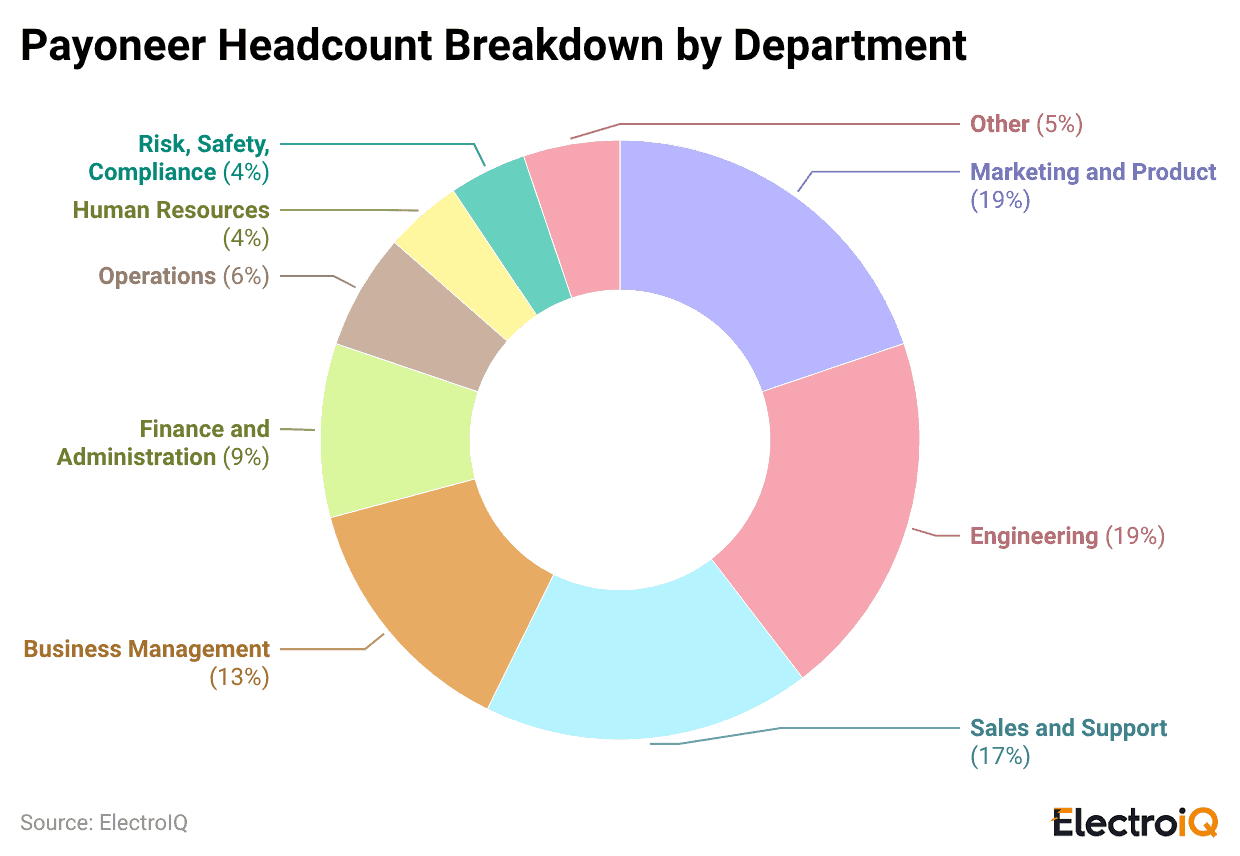
- Marketing & Product constitutes the largest individual group, accounting for approximately 19% of the total workforce with 232 employees, closely trailed by Engineering, which has 225 team members.
- Sales & Support, with 202 employees, and Business Management, comprising 162 employees, also represent substantial segments of the organization, highlighting Payoneer’s commitment to both product development and customer-oriented functions.
- The staff composition is completed by Finance & Administration (110), Operations (78), Human Resources (48), Risk & Compliance (46), and Information Technology (39), providing the company with a well-rounded structure across technical, commercial, and corporate sectors.
Payoneer Employees by Location Statistics
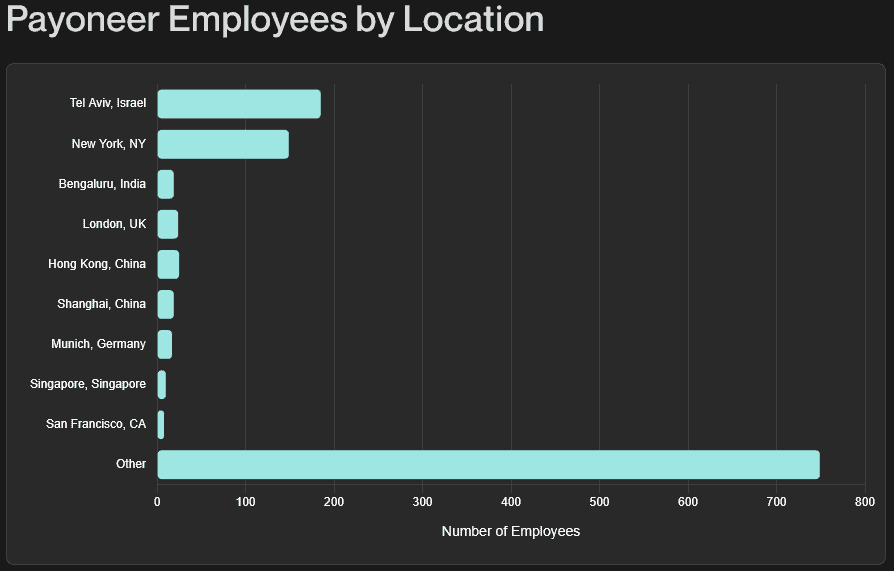
- Payoneer’s workforce is highly distributed: approximately 62% of employees (749) operate outside the nine specifically listed offices.
- Among named locations, Tel Aviv hosts the largest concentration with 185 employees, while New York accounts for 149.
- Additional hubs include Hong Kong, London, Bengaluru, Shanghai, Munich, Singapore, and San Francisco, each supporting between 8 and 25 team members, reflecting the company’s need for regional presence in key commercial and technology centers.
Payoneer Business Fourth Quarter 2025 Statistics
- Small and Medium-sized Businesses (SMBs) operating on marketplaces reported a revenue of USD122 million, reflecting a 4% increase year-over-year.
- B2B SMBs achieved a revenue of USD65 million, marking a 17% rise year-over-year, which constitutes 30% of revenue excluding interest.
- Checkout revenue reached USD11 million, representing a 25% year-over-year growth.
- Payoneer cards experienced USD1.6 billion in spending, up 6% year-over-year, indicating sustained, albeit more subdued, growth among large e-commerce sellers at 15%. This trend is likely influenced by tariff-related challenges affecting spending patterns and a downturn in Latin America.
- As of December 31, 2025, customer funds totaled USD7.9 billion (comprising both short-term and long-term funds). The growth of customer funds at 13% year-over-year partially mitigated the decline in interest income due to lower interest rates compared to the previous year.
- The company accelerated share repurchases during the quarter, amounting to USD80 million at a weighted average price of USD5.76.
- In January 2026, Payoneer acquired Boundless for USD13 million, with a potential earn-out of up to USD4 million contingent on achieving specific performance and tenure milestones. This acquisition enhances and expands Payoneer’s global workforce management capabilities.
- In January 2026, Payoneer received in-principle approval as a Payment Aggregator-Cross Border (PA-CB) in India, marking a significant milestone in the company’s efforts to broaden its operations and offer comprehensive cross-border payment solutions for Indian enterprises.
- In February 2026, the company announced its intention to introduce a suite of stablecoin functionalities integrated within the Payoneer platform, powered by Bridge.
- In February 2026, Payoneer submitted an application to the Office of the Comptroller of the Currency (OCC) to establish an uninsured national trust bank in the United States, aimed at supporting the company’s wider stablecoin strategy.
Payoneer Business Full Year 2025 Statistics
- ARPU increased by 15% year-over-year, and when excluding interest income, it rose by 21%, marking six consecutive quarters of growth exceeding 20%.
- ARPU growth was fueled by sustained performance with larger clients, an increase in higher take-rate B2B, as well as advancements in the Checkout and Card sectors, alongside strategic pricing measures.
- Annual spending on Payoneer cards reached USD6.1 billion, reflecting an 18% year-over-year increase, driven by greater usage per customer.
- Furthermore, in July, Payoneer extended its long-term partnership with Mastercard to bolster its multi-currency card services for clients with cross-border accounts payable requirements.
- The acquisition of a licensed payment service provider based in China, Easylink Payment Co., Ltd., which is now known as Payoneer Payments (Guangdong) Co., Ltd., has been completed.
- This acquisition enhances Payoneer’s global regulatory framework and positions the company to better assist its customers in China as they engage in global exports.
- A partnership with Stripe has been launched to improve and broaden Payoneer’s Checkout services, merging their top-tier technology with Payoneer’s local market knowledge and extensive financial resources to provide superior capabilities.
- The ecosystem of enterprise relationships has been strengthened and expanded, including collaborations with Upwork, Alibaba, TikTok Live, Airbnb, Mercado Libre, and Best Buy.
- In 2025, USD175 million worth of shares were repurchased at a weighted average price of USD6.41, an increase compared to USD137 million in repurchases during 2024.
Payoneer Revenue by Regions Statistics
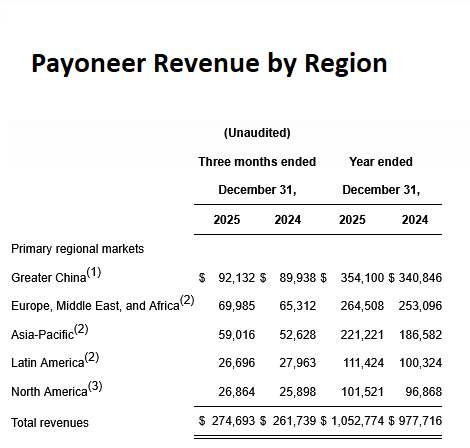
- The United States serves as the country of domicile for the Company. In terms of revenues from North America, the U.S. accounted for USD25,967 and USD28,194 for the three months ending December 31, 2025, and 2024, respectively, and USD97,221 and USD95,794 for the years ending December 31, 2025, and 2024, respectively.
Payoneer Projected Income Statement Statistics
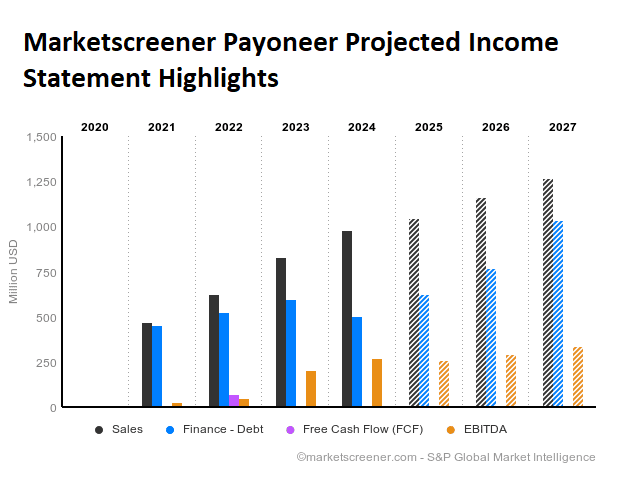
- Sales forecasts indicate a more than twofold increase from USD475 million in 2020 to USD970 million in 2024, demonstrating robust top-line growth.
- Finance – Debt levels are expected to remain relatively stable, fluctuating between USD460 million and USD520 million from 2020 to 2024, which implies consistent leverage ratios.
- Free Cash Flow (FCF) is projected to show significant improvement, increasing from USD0 in 2020 to USD250 million by 2024, highlighting enhanced operational efficiency.
- EBITDA is anticipated to follow a strong upward trend, rising from USD0 in 2020 to USD250 million in 2024, indicating improved profitability margins.
(Source: coinlaw.io)
Payoneer Management Statistics
- Return on equity (ROE) increased to 17% in 2025, indicating improved capital efficiency.
- The executive retention rate remained robust at 96% in 2025, which ensured stability in leadership and the continuation of consistent growth strategies.
- Quarterly reviews enhanced team productivity by 24% in 2025, maintaining the momentum from previous operational enhancements.
- The representation of female leaders rose to 46% in 2025, propelled by hiring practices focused on diversity.
- The flat organizational structure reduced project turnaround time by 28% in 2025, thereby accelerating innovation and delivery cycles.
- Employee satisfaction reached 93% in 2025, demonstrating the positive impact of improved engagement and workplace wellness and creativity.
- Each employee engaged in an average of 29 hours of training in 2025, ensuring that their skills remained aligned with technological advancements.
Payoneer Corporate Statistics
- Payoneer attained an impressive governance score of 92 out of 100, as determined by independent evaluations of the board.
- The board of directors was expanded to incorporate two additional independent members, thereby improving oversight.
- Quarterly disclosures were implemented to guarantee transparency, achieving a compliance rate of 98% with regulatory standards.
- Payoneer introduced an internal whistleblower platform, which received over 100 reports, with 85% of these being resolved within a 30-day timeframe.
- A 20% rise in Environmental, Social, and Governance investments demonstrated a strong commitment to sustainability.
- Payoneer’s anti-money laundering (AML) program reached a compliance rate of 99%, receiving praise from financial regulators.
- Policies regarding conflicts of interest were updated to ensure compliance with the highest ethical standards.
Conclusion
Payoneer’s achievements in 2025 reinforce its position as a frontrunner in the financial technology sector. With notable progress in revenue growth, profitability, and market valuation, the company has shown both resilience and innovation. By investing in technology, improving governance, and streamlining operations, Payoneer is strategically positioned to address the increasing needs of global businesses and freelancers.
Its ongoing commitment to sustainability and customer satisfaction guarantees its significance and leadership in the changing fintech environment.
FAQ.
Payoneer operates as a digital platform designed for global, cross-border transactions, enabling freelancers, e-commerce merchants, and companies to receive, manage, and transfer funds in various currencies. It offers virtual receiving accounts (USD, EUR, GBP, etc.) that act like local bank accounts, facilitating easy and cost-effective international transfers.
Payoneer imposes an annual account fee of $29.95 USD. This charge applies if you have received less than $2,000 USD (or its equivalent) in total payments over the past 12 months. If you reach or surpass this $2,000 threshold, the annual fee is waived. The fee is generally billed 12 months following account registration.
Amazon, Fiverr, eBay, and several others integrate with Payoneer effortlessly. For businesses and freelancers, it provides a secure, intelligent, and efficient method to receive payments from marketplaces, utilize your funds, and withdraw locally.

Tajammul Pangarkar is the co-founder of a PR firm and the Chief Technology Officer at Prudour Research Firm. With a Bachelor of Engineering in Information Technology from Shivaji University, Tajammul brings over ten years of expertise in digital marketing to his roles. He excels at gathering and analyzing data, producing detailed statistics on various trending topics that help shape industry perspectives. Tajammul's deep-seated experience in mobile technology and industry research often shines through in his insightful analyses. He is keen on decoding tech trends, examining mobile applications, and enhancing general tech awareness. His writings frequently appear in numerous industry-specific magazines and forums, where he shares his knowledge and insights. When he's not immersed in technology, Tajammul enjoys playing table tennis. This hobby provides him with a refreshing break and allows him to engage in something he loves outside of his professional life. Whether he's analyzing data or serving a fast ball, Tajammul demonstrates dedication and passion in every endeavor.