Navistar Statistics By Revenue And Facts (2026)

Updated · Apr 27, 2026


Table of Contents
Introduction
Navistar Statistics: International Motors LLC operates as the new name for Navistar International, which Traton Group purchased. The company operates from a new structural foundation that defines its current state in global commercial vehicle operations for the 2025-2026 period. The company uses group synergies and electrification strategies while its freight market operations face a temporary downturn. In 2025, Navistar shows stable revenues, which reach USD 9.26 billion despite current economic challenges.
The company developed its business model through zero-emission truck solutions, connected vehicle systems, and cost-saving methods, which enable it to serve as an essential player in North America’s heavy-duty truck market, which undergoes transformative changes driven by increasing demand, new regulations, and technological advancements. This article will show the trending Navistar statistics and the future roadmap.
Editor’s Choice
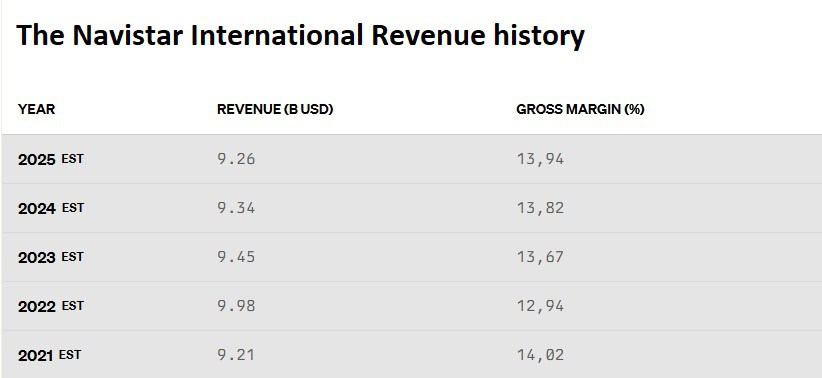
- Navistar International revenue remained within USD 9.21B–USD 9.98B (2021–2025), reflecting stable top-line performance.
- Company revenue reached its highest point of USD 9.98B during 2022, but it fell to USD 9.26B by 2025E, which represents a decline of approximately 7.2%.
- Gross margins improved from 12.94% (2022) to 13.94% (2025E), a +100 bps expansion.
- The autonomous network operates on Interstate 35 to conduct freight operations that use actual cargo.
- The S13 powertrain delivers ≥5% better fuel economy vs competitors.
- Fleet savings reach approximately 550 gallons per 100,000 miles, which results in annual savings above USD 2,000 for each truck.
- The S13 engine system achieves fuel efficiency improvements of up to 15% when compared to traditional engines.
- DEF consumption increases by approximately 3.5%, but total expenses maintain a beneficial outcome.
- By 2025, S13 adoption reached approximately 50% of Class 8 truck sales.
- The eRH electric truck provides battery capacity options between 300 and 500 kWh.
- Maximum driving range reaches up to 300 miles, targeting regional haul routes.
- Electrification aligns with 60–70% of U.S. freight routes under 300 miles.
- Electric trucks can reduce energy costs by 20–40% vs diesel, improving the total cost of ownership.
(Source: eulerpool.com)
- The financial performance of Navistar International shows consistent revenue performance throughout. Navistar International begins to derive greater profit between 2021 and 2025.
- The business demonstrates mature operations that experience cyclical patterns that drive its revenues to stay within the range of USD 9.21 billion to USD 9.98 billion since its volume growth depends on macroeconomic elements such as freight demand and fleet replacement cycles.
- The data shows revenue peaking at USD 9.98 billion in 2022, which decreases to USD 9.26 billion (2025E) through a total revenue drop of approximately 7.2% from its highest point.
- The current decline in sales1 does not create a harmful situation1 because it shows the business entering its regular state after achieving strong growth through its post-pandemic recovery period.
- Gross margins improved from 12.94% in 2022 to 13.94% in 2025E, marking a 100 basis point expansion.
- The company demonstrates strong cost management abilities together with effective pricing methods based on its ability to sell products, which include high-value trucks, components, and services.
- The business maintains its operating margins below the 2021 14.02% peak because it has achieved better performance, but its input expenses for materials and labor continue to affect its operations.
- Navistar has begun to redirect its business operations inside the capital-intensive sector 1, which handles growth through efficient production processes while it manages decreased market demand.
(Sources: Company estimates, industry financial summaries, commercial vehicle market analysis reports.)
- The S13 Powertrain system from Navistar International represents both a breakthrough development and a crucial link to its future zero-emission truck production plans, which it will develop under the Traton Group.
- The S13 system combines three components through its 13-litre diesel engine, T14 automated manual transmission, and dual-stage SCR aftertreatment system.
- The clean-sheet design enables full component optimization, which prevents the inefficiencies that arise from using multiple suppliers. The powertrain achieves measurable improvements in both fuel efficiency and operating costs.
- The testing conducted by TMC Type IV methodology through company-supported tests shows that S13-equipped International LT Series tractors achieve fuel efficiency that exceeds their main competitors, Freightliner, Volvo, and Kenworth aero models by 5%.
- The actual fleet operation shows this method results in diesel savings of approximately 550 gallons for every 100000 miles driven, which costs the company about USD 2000 for each truck every year, based on current diesel prices of 3.70 dollars per gallon.
- The total fuel savings for large fleets that operate hundreds of trucks result in cost savings that reach million-dollar amounts every year.
- The system requires 3.5% more diesel exhaust fluid (DEF) for its operation. The operating expenses stay positive because DEF costs much less than diesel, which strengthens the value of this powertrain solution.
- By 2025, approximately 50% of International’s Class 8 trucks were spec’d with the S13, effectively making it the brand’s default diesel offering.
- The company experiences customer savings through rapid market entry, while its higher efficiency trucks generate premium revenue, which strengthens Navistar’s pricing abilities.
- The S13 system uses Traton’s international modular framework to develop its research and development activities and its assembly processes.
- The system decreases unit expenses while enabling producers to achieve mass production with customised products, which results in better profit margins together with production flexibility.
- The system provides customers with decreased total cost of ownership (TCO) because it delivers fuel savings, dependable performance, and streamlined maintenance operations.
- The system serves as a profitability tool for Navistar during the transition from internal combustion engines to electric vehicles because it generates substantial cash flow while zero-emission technologies progress through their development process.
- The S13 functions as more than a diesel engine because it operates as a platform that delivers high operational efficiency to generate substantial profits for Navistar while supporting its future development of electric and hydrogen-powered trucks.
(Sources: International Truck Technical Documentation, Rush Truck Centers Analysis, Commercial Carrier Journal, Fleet Equipment Magazine, Transport Topics, Heavy Duty Trucking (HDT).)
- The International eRH Series introduction represents a major milestone for Navistar’s electrification efforts because it allows the company to enter the Class 8 electric truck market early.
- The truck has a battery range that extends between 300 kWh and 500 kWh, and it can operate up to 300 miles, which makes it suitable for established port drayage and hub-to-hub logistics operations.
- Industry data indicates that 60 to 70 % of U.S. freight routes operate within 300 miles, which makes these routes suitable for electrification.
- Navistar provides fleet operators with various battery options, which help them achieve their capital expenditure goals while maintaining their operational performance because they can select battery sizes that meet their needs.
- Electricity usage leads to energy savings between 20 and 40 % compared to diesel fuel, which varies according to local electricity rates.
- The implementation of regenerative braking systems combined with simpler mechanical designs leads to decreased maintenance expenses for operations.
- The combination of three-level regenerative braking and Bendix Fusion ADAS technology creates a system that improves operational efficiency while maintaining safety standards, resulting in lower total cost of ownership (TCO).
- The vehicles will generate savings that reach tens of thousands of dollars for every vehicle during their typical 5 to 7 year operational period, which does not include the benefits from regulatory incentives.
- The eRH system builds upon Navistar’s existing electric vehicle framework, which includes the eMV and IC Bus Electric CE, by extending its operational capabilities from 100-mile medium-duty deployments to 300-mile capabilities in heavy-duty operations.
- The Traton Group corporate structure helps Navistar achieve better operational efficiency through its battery supply chain and software development and product distribution capabilities, which help the company enhance its profitability during this expensive transition period.
- The timing also aligns with industry targets. Traton has publicly stated that zero-emission vehicles could account for at least 10% of sales by 2030, and the eRH is central to achieving that milestone in North America.
- The eRH system presents itself as a significant business prospect because it will bring in 25,000 to 30,000 units through its 10 % electrification status in the U.S. Class 8 truck market, which usually sells between 250,000 and 300,000 units each year.
- The current battery expenses, together with the existing charging stations and the limitations on payload capacity, all create barriers that prevent people from adopting the technology.
- Yet Navistar’s decision to focus on depot-based charging and regional routes mitigates these risks, allowing fleets to deploy electric trucks without relying heavily on public fast-charging networks.
- In essence, the eRH is less about technological disruption and more about practical electrification at scale.
- By aligning product design with real-world logistics patterns, Navistar is not just entering the EV race—it is choosing a lane where profitability, adoption, and operational feasibility intersect.
(Sources: International Trucks press releases, Transport Topics, Charged EVs, Fleet Equipment Magazine, Traton Group strategy reports, NREL studies on electric truck deployment.)
Conclusion
The company is shifting its business model from producing diesel-powered vehicles, which experience cyclical demand, to developing its technological capabilities for commercial vehicle operations. The business shows steady revenue growth, although management has achieved better profit margins through effective cost control and superior product selection. The S13 powertrain improves short-term financial results while the company uses autonomous testing and the eRH electric platform development to establish itself in future market changes.
Traton Group integration enables the company to achieve better research and development capabilities while improving supply chain operations. The company maintains current cash flow through its dedication to practical electrification solutions and actual autonomous system testing while creating new mobility technologies that will keep its commercial vehicle business competitive in a fast-changing market.
Sources
FAQ.
Navistar revenue remained stable between USD 9.2B–USD 10B (2021–2025), with a slight decline after the 2022 peak.
The S13 engine delivers fuel savings that exceed 5 % while providing 15 % better performance than previous engine models.
The eRH electric truck offers up to 300 miles of range with 300–500 kWh batteries.
Electric trucks can reduce energy costs by 20–40% compared to diesel.
The company operates Level 4 autonomous vehicles to complete 600-mile daily routes, which connect Texas freight corridors.

I hold an MBA in Finance and Marketing, bringing a unique blend of business acumen and creative communication skills. With experience as a content in crafting statistical and research-backed content across multiple domains, including education, technology, product reviews, and company website analytics, I specialize in producing engaging, informative, and SEO-optimized content tailored to diverse audiences. My work bridges technical accuracy with compelling storytelling, helping brands educate, inform, and connect with their target markets.