Renault-Nissan-Mitsubishi Statistics And Trends (2026)

Updated · May 14, 2026


Table of Contents
- Introduction
- Editor’s Choice
- The Renault–Nissan–Mitsubishi Alliance 2030
- Renault Group’s Q1 2026 Sales
- Nissan Net Sales By Region
- Nissan Production By Country
- Mitsubishi Production and Export Growth
- The ‘Ampere’ Factor – Renault’s EV Pure-Play in 2026
- Nissan’s ‘Arc’ Strategy – Retail vs. Fleet Dynamics
- ASEAN Dominance – Mitsubishi’s 2026 Growth Engine
- Conclusion
Introduction
Renault-Nissan-Mitsubishi Statistics: The Renault–Nissan–Mitsubishi Alliance entered the 2025–2026 period facing one of the most transformative phases in its history. The alliance implemented changes to its shared stock ownership system while it expanded its financial backing for electric vehicle development and software-based automotive systems, hybrid technology, and vehicle platform development. The Renault Group achieved high profitability and cash flow while it suffered through major accounting losses, which came from Nissan’s financial results. Nissan Motor completes major organizational changes to respond to decreasing profit margins and increasing competition from international markets.
Mitsubishi Motors focused on Southeast Asian growth through hybrid technologies and product sharing with its business partners. The alliance operated as one of the biggest automotive organizations in the world because its members sold more than 6 million vehicles each year while investing billions in electric vehicles and transportation solutions.
Editor’s Choice
- Renault–Nissan–Mitsubishi Alliance committed €23 billion toward EVs, batteries, and connected mobility under the Alliance 2030 roadmap.
- The Alliance plans to increase common platform utilization from 60% to more than 80% by 2026, which will result in substantial cost savings for the organization.
- Renault, Nissan, and Mitsubishi aim to launch 35 new electric vehicles globally by 2030.
- More than 90% of future Alliance EVs will be built on only five common EV platforms.
- The Alliance has already sold over 1 million EVs globally, which have driven more than 30 billion electric kilometers of travel.
- The organization plans to achieve a battery production capacity of 220 GWh by 2030 to meet the demands of upcoming electric vehicle production needs.
- The Alliance plans to achieve a 50% decrease in electric vehicle battery expenses by 2026 and a 65% reduction by 2028.
- Renault Group Q1 2026 sales declined 3.3% year-on-year to 546,183 passenger and commercial vehicles.
- The Renault brand experienced a 2.2% sales increase, reaching 397602 units, because of strong market demand for light commercial vehicles.
- The Alpine brand at Renault Group became the company that experienced the highest sales growth during Q1 2026, with a 54.7% increase in sales.
- Nissan experienced a 7% decline in global sales during March 2026 because the company sold 328860 units.
- Nissan U.S. sales experienced a significant drop of 18.8% during March 2026 because North American customers showed decreased interest in Nissan products.
- Nissan China sales increased by 23% during March 2026, which established China as one of the company’s top-performing markets.
- Mitsubishi exports increased to 27444 units in February 2026, which represents a 24% year-on-year growth rate that demonstrates rising international demand.
- The Renault Group achieved 52.3% of its Q1 2026 sales through electrified vehicles, while European EV sales experienced a 72.2% annual growth.
The Renault–Nissan–Mitsubishi Alliance 2030
- The three companies, Renault Group, Nissan Motor Co., and Mitsubishi Motors, created an extensive long-term electrification plan for the automotive industry through their “Alliance 2030” roadmap.
- The alliance will make a €23 billion investment in electric vehicles and battery technology, and connected mobility systems over the next five years, according to the Renault Group’s official website.
- The Alliance aims to increase common platform utilization from 60% today to more than 80% by 2026 across a combined portfolio of around 90 vehicle models.
- Companies will achieve development and manufacturing cost reductions worth billions through this component sharing method, which will also enhance production capacity throughout Europe, Asia, and North America.
- The electric vehicle targets established by both parties display the same level of intensity. The Alliance will introduce 35 electric vehicles through its upcoming product line.
- The company has dedicated more than €10 billion to electric vehicle development since its inception across 15 electric vehicle manufacturing facilities, which have enabled it to achieve worldwide sales of more than 1 million electric vehicles, which have travelled over 30 billion electric kilometers on roads worldwide.
- The Nissan Ariya and Renault Megane E-Tech Electric use the CMF-EV platform, which is expected to support more than 15 models by 2030, with annual production capacity reaching 1.5 million vehicles per year.
- The CMF-BEV compact EV platform will enable Renault, Alpine, and Nissan brands to produce 250,000 vehicles each year.
- The Alliance targets a global battery production capacity of 220 GWh by 2030, helping secure supply for future EV demand.
- The group intends to achieve a 50% reduction in battery expenses by 2026 and a 65% reduction by 2028, according to the Mitsubishi Motors Global Media Center, through economies of scale and technological advancements.
- Nissan is developing all-solid-state batteries (ASSB), which will provide double the energy capacity of current lithium-ion batteries and enable electric vehicles to charge within one-third of existing charging times.
- The Alliance also targets battery-pack costs of around USD 65 per kWh in the future, a level widely viewed as critical for achieving price parity between EVs and traditional gasoline vehicles.
- The Alliance is set to achieve its goal of producing 10 million vehicles with autonomous driving capabilities across 45 different models by 2026.
- The Alliance Cloud currently connects approximately 3 million vehicles, but this figure will increase to 25 million connected vehicles worldwide by 2026, with more than 5 million connected systems delivered each year.
- The Alliance developed its first fully software-defined vehicle under Renault’s leadership, which launched in late 2025 to provide over-the-air updates, predictive maintenance, and advanced digital services.
- A strategic approach that allows the company to compete with leading electric vehicle manufacturers, who are now prioritizing software development instead of traditional mechanical design.
Renault Group’s Q1 2026 Sales
(Source: media.renaultgroup.com)
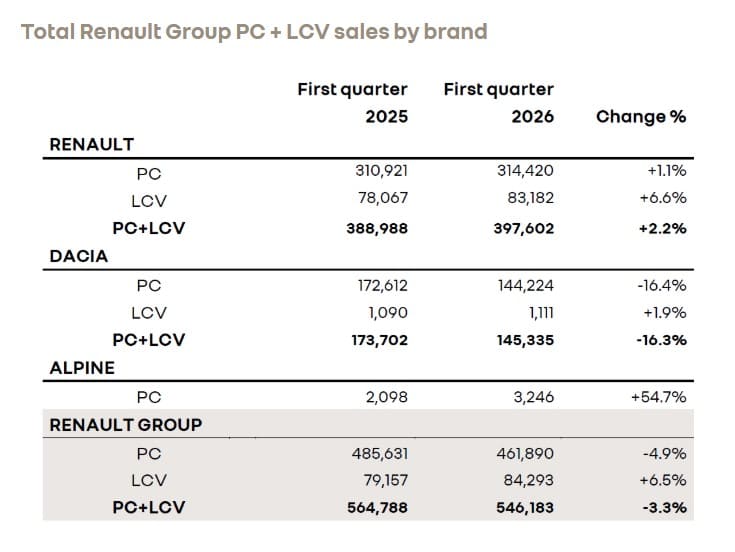
- Renault Group delivered its first quarter results for 2026 with mixed results that contained strategic significance, demonstrating both operational strength through its core activities and difficulties through its value-driven business units.
- The official website of Renault Group shows that the company sold 546183 passenger cars and light commercial vehicles in Q1 2026, which marks a decrease of 3.3 % compared to Q1 2025 when the company sold 564788 units.
- The combined PC and LCV sales for the company increased from 388988 units to 397602 units, which resulted in a growth of 2.2 %.
- The total number of passenger-car sales decreased by 1.1 % to 314420 units, while the LCV sales showed a 6.6 % increase to 83182 units.
- The total sales for the company decreased from 173702 units in Q1 2025 to 145335 units in Q1 2026, which represents a 16.3 % decline.
- The passenger-car volumes experienced a drop of 16.4 % as they decreased by more than 28000 units when compared to the previous year.
- The European demand patterns have changed, Low-cost competition has intensified, and the budget-car segment has been affected by model transition cycles, according to Reuters and Renault investor updates.
- Alpine became the fastest-growing brand within the group. The company experienced a 54.7 % increase in sales when its total sales grew from 2098 units to 3246 units.
- The growth of Alpine volumes holds strategic value to analysts because premium performance brands create better profits, which improve brand image.
Nissan Net Sales By Region
(Source: nissan-global.com)
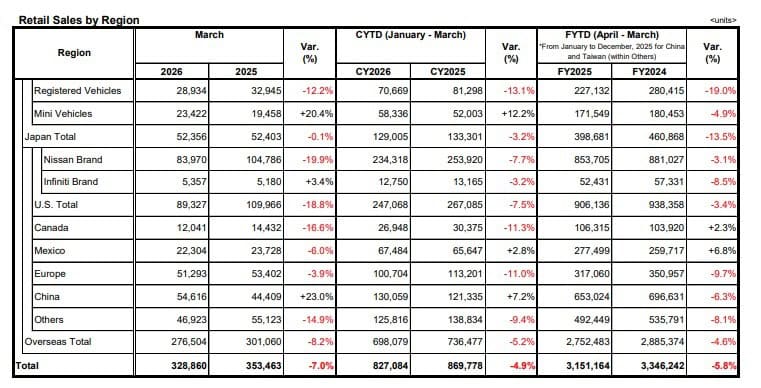
- Nissan Motor Co. began 2026 with difficult conditions because its worldwide retail sales experienced a severe decline in important overseas markets.
- Nissan sold 328860 vehicles worldwide in March 2026, which represented a 7% decrease from its March 2025 sales of 353463 vehicles.
- The company recorded a 4.9% decrease in sales, which amounted to 827084 units during the January through March 2026 period, and fiscal year-to-date sales dropped 5.8% to 3.15 million vehicles.
- The most significant problem created was the biggest concern, which came from North America. U.S. sales dropped sharply by 18.8% in March to 89,327 units, compared with nearly 110,000 units a year earlier.
- In the United States, Nissan brand sales experienced a 19.9% decrease while Infiniti sales achieved a 3.4% increase for the same period.
- European sales remained weak as March sales decreased by 3.9% and year-to-date sales dropped to 100704 units, which represented a 11% decrease.
- China emerged as a bright spot. Nissan experienced 23% sales growth in China during March 2023, with 54616 units sold, while January through March sales increased by 7.2% to over 130000 vehicles.
- Reuters reports that Nissan improves its Chinese market position through better EV demand and local partnership development.
- Japan produced mixed outcomes, which created an uneven performance. Mini-vehicle sales rose 20.4% in March, but registered vehicle sales declined 12.2%, leaving total domestic sales nearly flat at 52,356 units.
Nissan Production By Country
(Source: nissan-global.com)
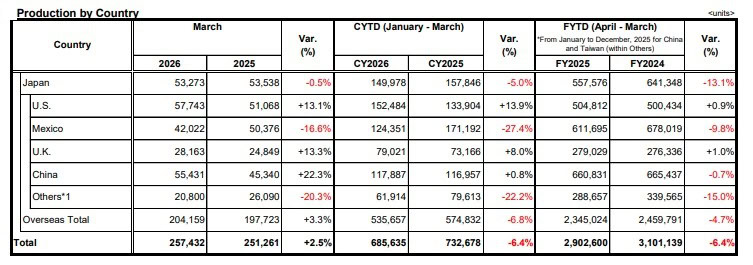
- Nissan Motor Co. shared its global production results for 2026, which showed strong international market growth but suffered from reduced production capacity.
- Nissan produced 257,432 vehicles globally in March 2026, which represented a 2.5% increase over the 251,261 units produced in March 2025.
- The overall trend continues to show weakness because production between January and March 2026 decreased by 6.4% to reach 685635 units.
- China delivered the highest increase in production output. Nissan’s Chinese factories produced 55431 vehicles in March 2026, which represented a 22.3% yearly growth.
- According to Reuters, China continues to play a crucial role in Nissan’s long-term electrification and manufacturing strategy.
- The United States also delivered positive results. Production increased 13.1% in March to 57,743 units, while cumulative January–March output climbed 13.9% to more than 152,000 vehicles.
- The Nissan North American facilities now show improved efficiency because the company has expanded its production of SUVs and crossovers.
- Mexico faced a complete production halt. March production dropped 16.6% while quarterly production experienced a significant decline of 27.4%, which resulted in 124351 vehicles produced.
- Japan also recorded declines, with fiscal-year production falling 13.1% to around 558,000 units.
- The United Kingdom experienced production stability through March because production increased 13.3% due to steady European demand.
- The overseas production for March showed a 3.3% increase, but the total overseas production for the entire fiscal year experienced a 4.7% decline.
Mitsubishi Production and Export Growth
(Source: mitsubishi-motors.com)
- Mitsubishi’s current performance assessment shows its operations have greater efficiency because international product demand has increased.
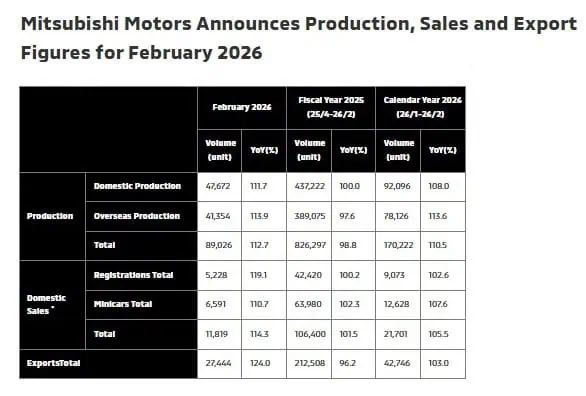
- The total number of vehicles produced reached 89026 units in February 2026, which represents a 127% increase compared to the same month last year.
- The Mitsubishi Production Report shows that domestic production reached 47672 units, while international production increased at a faster rate of 139% compared to the previous year.
- Mitsubishi demonstrates effective operations through its ability to maintain strong domestic production while achieving international market growth.
- The company achieved impressive export results, which rose to 27444 units, showing an exceptional 24% increase compared to the previous year.
- The data demonstrates increased international demand and better operational performance throughout the supply chain.
- The domestic market achieved total sales of 11819 units, which represents a 143% increase from the previous year.
- Japanese consumers still prefer affordable compact vehicles, which contributed 6591 units to the market, according to the minicars, which account for 6591 units of this market segment.
- Dealerships experienced strong business activity, which built customer trust as demonstrated by the 19.1% increase in registrations.
- The production output for fiscal year 2025 remained stable at 826297 units, which decreased only 1.2% when compared to the previous international automotive industry standards.
- The production volume for the first month of 2026 increased by 10.5 % compared to the same period last year, which indicates that production will continue to grow throughout the coming months.
The ‘Ampere’ Factor – Renault’s EV Pure-Play in 2026
- Renault Group is moving forward with its mission to become an all-electric transportation business, and the strategic plan shows its first results starting from 2026.
- The Renault Group Official Website states that Renault Group sold 52.3% of its total sales through electrified vehicles during the first quarter of 2026, which indicates a 12% increase compared to the previous year.
- More than 65% of all Renault passenger car sales in Europe now involve electrified vehicles, which demonstrates that consumer preference for electric vehicles and hybrid cars is rapidly increasing.
- The main reason for this growth is Renault’s dedicated electric vehicle and software business called Ampere.
- The company started its EV business in 2023 as a separate entity with plans to go public, but it merged back into Renault Group in January 2026 because this move helped lower costs and improve operational efficiency.
- The Renault 5 E-Tech electric vehicle achieved success in the European market by becoming the top-selling B-segment electric vehicle.
- The company sold 26,285 units in France through October 2025, which included 4,551 units sold in October to secure the top spot in that category.
- European electric vehicle sales experienced a 72.2% increase from the previous year, which resulted in 151,939 units sold.
- The new Renault 4 E-Tech has started to build momentum by reaching 3,982 total sales during its initial production phase.
- Renault plans to achieve a 40% decrease in manufacturing expenses for its second-generation C-segment electric vehicles by 2028 through its implementation of advanced engineering and manufacturing process improvements.
Nissan’s ‘Arc’ Strategy – Retail vs. Fleet Dynamics
- Nissan Motor Co. follows a different strategic path through its Arc business plan.
- The business achieved 9.6% US retail sales growth during the first quarter of 2026, according to Yahoo Finance, while total sales experienced a 7.5% decline compared to the previous year.
- The Arc strategy targets the launch of 30 new models globally by FY2026, including 16 electrified vehicles and seven all-new models for North America.
- The company intends to renew 78% of its U.S. passenger vehicle collection while expanding sales in the Americas by 330,000 vehicles.
- The company aims to raise global sales by 1 million units compared with FY2023 levels while improving operating margins above 6% by FY2026.
- The refreshed Nissan Rogue and Nissan Kicks vehicles serve as essential components of the company’s recovery strategy.
- The Infiniti QX65 introduces premium features that include 268 horsepower, 286 lb-ft of torque, and a 6,000-pound towing capacity.
ASEAN Dominance – Mitsubishi’s 2026 Growth Engine
- Mitsubishi Motors has identified Southeast Asia as its most important growth market.
- The Global Media Center of Mitsubishi Motors reports that the company’s production capacity improved by 18% in March 2026, when it produced 86982 vehicles through its overseas manufacturing operations.
- The best market performance comes from ASEAN regions, where the Mitsubishi Triton and Mitsubishi Xforce exhibit strong sales results.
- The Triton contributed to a 16% sales increase in Mexico during FY2025, while the Xforce has become a strategic regional product across Indonesia, Malaysia, Vietnam, and the Philippines.
- Xforce pre-orders in Malaysia surpassed 2000 units within a short period after its April 2026 launch.
- Mitsubishi projects its annual vehicle production to reach between 900000 and 1000000 units during the upcoming two years because of its global model expansion activities.
- Mitsubishi’s production expansion in fiscal year 2025 reached 913279 vehicles, which makes the 2026 period a vital point for operational improvements that will result from increased demand from ASEAN markets and higher export volumes.
Conclusion
The Renault–Nissan–Mitsubishi Alliance is undergoing one of its most important transformations because it needs to combine its restructuring efforts with its plans to spend money on making electric vehicles, developing software-controlled cars, and establishing international vehicle development standards. The Alliance maintains its competitive advantage through its vast resources and expertise in electric vehicle technology and its capability to produce vehicles at worldwide facilities, although Nissan faces reduced profits and some markets experience decreased customer demand.
The combined growth potential of Renault’s electric vehicle development, Nissan’s retail-based recovery strategy, and Mitsubishi’s ASEAN market expansion demonstrates the company’s ability to operate successfully in different areas. The Alliance controls more than 30 electric vehicle platforms and battery systems, and connected mobility resources, which make it one of the key players in the automotive industry that drives the shift toward electric and software-based transportation systems.
Sources
FAQ.
The Alliance intends to allocate €23 billion for investments in electric vehicles, battery systems and connected mobility solutions.
The Alliance plans to introduce 35 electric vehicles to global markets before 2030.
In Q1 2026, electrified vehicles made up 52.3% of Renault Group’s total sales.
Nissan China’s sales increased 23% in March 2026 because of rising electric vehicle demand and new partnerships with local companies.
ASEAN markets serve as the primary growth engine for Mitsubishi because customers show high interest in Triton and Xforce vehicle models.

I hold an MBA in Finance and Marketing, bringing a unique blend of business acumen and creative communication skills. With experience as a content in crafting statistical and research-backed content across multiple domains, including education, technology, product reviews, and company website analytics, I specialize in producing engaging, informative, and SEO-optimized content tailored to diverse audiences. My work bridges technical accuracy with compelling storytelling, helping brands educate, inform, and connect with their target markets.