AI In Healthcare Statistics By Adoption, Market Size and Facts (2025)

Updated · Dec 11, 2025


Table of Contents
- Introduction
- Editor’s Choice
- AI In Healthcare Market Size
- Projected AI In Healthcare Revenue By Region
- High-Impact AI Adoption Trends In Healthcare
- Public Attitudes Toward AI in Healthcare in US
- FDA-Approved AI Medical Devices by Clinical Discipline
- AI In Drug Discovery
- Annual Count of FDA-Cleared AI/ML Medical Devices
- AI In Healthcare Investments
- Healthcare Market Top Companies In AI
- Recent Developments
- Conclusion
Introduction
AI in Healthcare Statistics: Envision a scenario inside a medical center where an AI detects a stroke five minutes sooner than a doctor. Consider a pharmaceutical research pathway that discards candidate molecules within a few weeks. This is much faster compared to years. Medical clerks are no longer overworked with authorisation requests because AI has processed them overnight.
The present situation is like the one described in the future. By 2025, the use of artificial intelligence (AI) will be widespread. It will have a tangible effect on clinical practice, research, and health system economics. A comprehensive list of AI in Healthcare statistics indicates the current state of artificial intelligence in healthcare. This is accompanied by implications for patients, physicians, and insurers.
Editor’s Choice
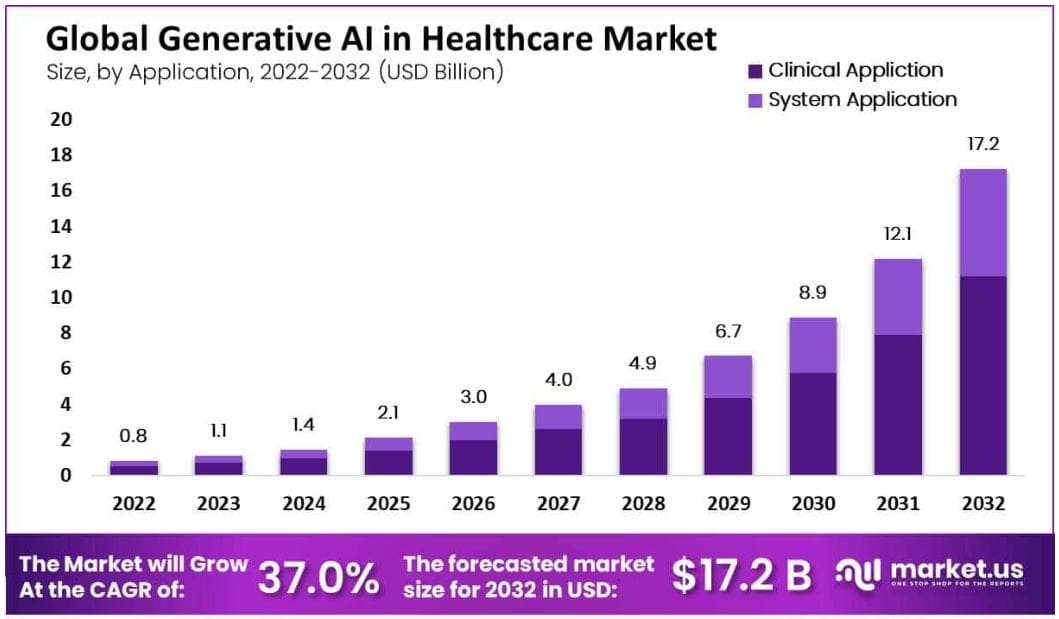
- According to Market.us, the global market for generative AI in healthcare is projected to increase from USD 0.8 billion in 2022 to USD 17.2 billion by 2032, reflecting a 37% CAGR, which indicates strong and sustained investment across clinical and operational applications.
- The United States continues to lead AI healthcare revenue growth, with spending rising from USD 11.8 billion in 2023 to an expected USD 102 billion in 2030, reflecting the fastest commercial adoption among advanced markets.
- Countries such as India, China, Japan, South Korea, and Singapore are experiencing annual growth in AI healthcare adoption exceeding 40%, driven by national digital health programs and the rapid integration of automation tools in hospitals.
- In 2025, 71% of healthcare organisations are using generative AI, primarily to support clinical documentation tasks and streamline workflow automation across departments.
- Adoption of related technologies remains widespread, as 70% of organisations use speech recognition systems, 68% rely on agentic AI applications, 66% utilise machine learning models, and 65% incorporate robotics into care delivery.
- Approximately 60% of healthcare AI investments in 2024 and 2025 have focused on administrative automation, reflecting the sector’s priority of reducing operational burden and improving staff efficiency.
- Studies show that 35% of clinicians continue to spend more time on paperwork than on direct patient care. In comparison, 57% of organisations identify administrative automation as the single greatest opportunity for AI value creation.
- Adoption of AI-powered ambient scribes is advancing rapidly, as 30% of providers already use these systems, 22% are in the process of implementation, and 40% are currently piloting the technology to reduce documentation workloads.
- Investment in AI for drug discovery increased from USD 0.9 billion in 2023 to USD 1.86 billion in 2024, reflecting a 29.9% CAGR and underscoring growing interest in predictive modelling and computational chemistry tools.
- Approximately 66% of life sciences leaders are directing funds toward generative AI solutions to accelerate research timelines and strengthen discovery pipelines.
- Evidence suggests that AI may increase drug approval speeds by 10% to 40%, particularly through improved trial design, faster hypothesis testing, and enhanced success-rate prediction.
- Among organisations already using AI, 52% report moderate returns on investment, while 30% indicate very high or high ROI, demonstrating improved operational performance and faster throughput.
- Approximately 45% of users of generative AI have reported measurable financial returns within 12 months, reinforcing the technology’s early impact on healthcare operations.
- Surveys demonstrate that 69% of top managers feel pressure to show AI ROI; however, 85% continue their AI projects despite uncertainty, signalling confidence in long-term value.
- In the first half of 2025, healthcare AI startups raised USD 6.4 billion in funding, accounting for 62% of all digital health investment, underscoring the sector’s strategic importance.
- The average funding round for AI-driven health companies is 83% larger than that of non-AI digital health firms, highlighting investor preference for automation and predictive technologies.
- Major funding rounds include Abridge (USD 550 million), Truveta (USD 320 million), Innovaccer (USD 275 million), and Hippocratic AI (USD 141 million), demonstrating substantial financial backing for advanced clinical intelligence platforms.
- The AI healthcare landscape is currently shaped by leading companies such as IBM Watson Health, NVIDIA, Microsoft, GE Healthcare, and Medtronic, which continue to influence the development of next-generation healthcare AI ecosystems.
AI In Healthcare Market Size
(Source: scoop.market.us)
- The AI in healthcare market is projected to reach USD 696.0 billion by 2034, rising sharply from USD 26.8 billion in 2024, as the industry records a strong 38.5% CAGR during the forecast period from 2025 to 2034.
- The product type analysis shows that hardware accounted for a leading 45.3% share in 2023, supported by growing demand for advanced computing chips, accelerated servers, and edge devices required for clinical AI deployments.
- Machine learning captured a significant 46.2% share within the technology segment, reflecting its widespread use in predictive analytics, diagnostic support tools, drug discovery modelling, and intelligent automation in care delivery.
- Robot-assisted surgery represented 25.4% of total revenue, making it the dominant application in the market, as hospitals continue to invest in AI-driven robotic platforms that support precision procedures and improve patient recovery outcomes.
- Healthcare companies accounted for 50.5% of total market revenue, making them the largest contributor within the end-user segment, as these organizations increasingly integrate AI into drug development, clinical trials, and digital health platforms.
- North America held a leading 43.5% market share in 2023, driven by rapid AI adoption across the United States and Canada. The U.S. has been witnessing accelerated investments in clinical AI, with regulatory bodies guiding safe deployment across hospitals, diagnostics, and medical device ecosystems.
- In July 2024, a partnership between Microsoft, Mass General Brigham, and the University of Wisconsin-Madison was announced to develop AI imaging models capable of diagnosing more than 23,000 medical conditions, strengthening the role of AI in radiology and clinical decision support systems.
- AI systems are increasingly being implemented across administrative workflows in hospitals in the United States, Germany, Japan, and India, where automated scheduling, billing, and patient record management are helping reduce operational delays and improve patient throughput.
- Countries such as the United Kingdom and South Korea have been accelerating national AI-health strategies, contributing to large-scale digital health modernisation, improved diagnostic accuracy, and expanded AI-enabled remote-care capabilities.
- Recent industry facts indicate that more than 60% of U.S. hospitals are now integrating at least one AI-based clinical support tool. At the same time, Japan has recorded a steady rise in AI-assisted elderly-care robotics to address workforce shortages. Additionally, India is experiencing rapid growth in AI-enabled telemedicine, supported by increasing internet access and rural healthcare digitisation.
Projected AI In Healthcare Revenue By Region

(Source: aiprm.com)
- Global data illustrate the rapid growth of AI-based healthcare revenue across the principal worldwide markets from 2023 to 2030.
- The USA tops the list with a significant lead, starting at approximately USD 11.8 billion in 2023 and projected to increase to more than USD 102 billion by 2030, reflecting strong acceptance and investment.
- The case is similar to Canada, with a range from USD 1.1 billion to almost USD 10.8 billion and one of the highest growth rates at 37.9%.
- Germany and France are both moving up from less than USD 750 million in 2023 to more than USD 6–7 billion by 2030.
- However, they are also witnessing an almost 38% increase in annual revenues.
- Another significant European market experiencing a similar surge is the UK, which is expected to increase from USD 1.3 billion to approximately USD 12.5 billion, making it among the fastest-growing European markets.
- Italy and South Africa are also experiencing growth, but at a slower pace, with about 33–34% rate.
- The Asian region is characterized by the fastest growth; the strongest being Japan, moving from USD 917 million to nearly USD 10.9 billion, hence registering a 42.4% growth rate.
- China and India are even more impressive: China increased from USD 1.58 billion to almost USD 19 billion, while India rose from USD 758 million to USD 8.7 billion, both exceeding 41% growth.
- The rest of the Asia-Pacific region, which includes South Korea, Australia, and Singapore, has also experienced annual growth of 40% or more, driven by rapid digital adoption and robust healthcare improvements.
- Thus, the Latin American markets, which consist of Brazil, Mexico, and Argentina, will have their sales growing modestly in absolute numbers; however, their percentage expansion will range from 36% to nearly 40%, thus still being considered strong.
- At the same time, Middle Eastern nations such as Saudi Arabia and the UAE will not be left behind, as they also exhibit positive growth, supported by state investments in healthcare innovation, and by 2030, each will have multiplied its revenue several times.
- All countries registered show substantial revenue growth in the AI-assisted healthcare market, with most reporting growth rates of 35% to 42%, thereby confirming the widespread global adoption of AI across clinical, administrative, and research domains.
High-Impact AI Adoption Trends In Healthcare
- The most recent information indicates that the use of AI in healthcare is benefiting from a few highly powerful, large-scale use cases.
- In 2025, generative AI will be at the top of the list, with 71% of the healthcare organizations using it mainly for clinical documentation, summarization, workflow efficiency, and support in decision-making.
- Closely related is speech recognition at 70%, which reflects the increasing need for hands-free documentation and voice-enabled clinical tools.
- Agentic AI, which can take autonomous actions within set limits, is seeing its usage increase to 68%, indicating growing trust in AI’s automation of tasks.
- Machine learning (66%) remains the most powerful tool in diagnostics and predictive analytics, while robotics (65%) is making surgery, logistics, and patient support more efficient.
- The main factor supporting the explosive growth is the heavy administrative burden on healthcare workers.
- Approximately 35% report spending more time on paperwork than on patient care, while another 45% report an equal division of time, resulting in administrative overload being one of the major obstacles in healthcare.
- In 2024, nearly 60% of all investments in healthcare AI were directed toward administrative tools, a trend expected to continue strongly into 2025.
- To reduce workload, physicians are adopting AI: 68% report increased use of AI for documenting clinical routines, thereby enabling more precise patient records with less manual effort.
- An additional 36% have witnessed the range of areas such as scheduling, claims processing, and revenue cycle management—where AI can increasingly speed and improve accuracy, expanding its administrative uses.
- In a grander scheme, 57% of healthcare organizations claim that the opportunity for AI lies in the reduction of administrative responsibility via automation.
- One of the most vivid examples is the introduction of AI-driven ambient scribes, which effortlessly record and organize medical discussions.
- These scribes are being adopted at an astonishing rate: 30% of healthcare providers have integrated them across the board, 22% are in the process of doing so, and 40% are testing various options.
- This indicates a marked shift in the sector toward tools that enable clinicians to reclaim their time, ensure the quality of documentation, and reduce burnout.
Public Attitudes Toward AI in Healthcare in US
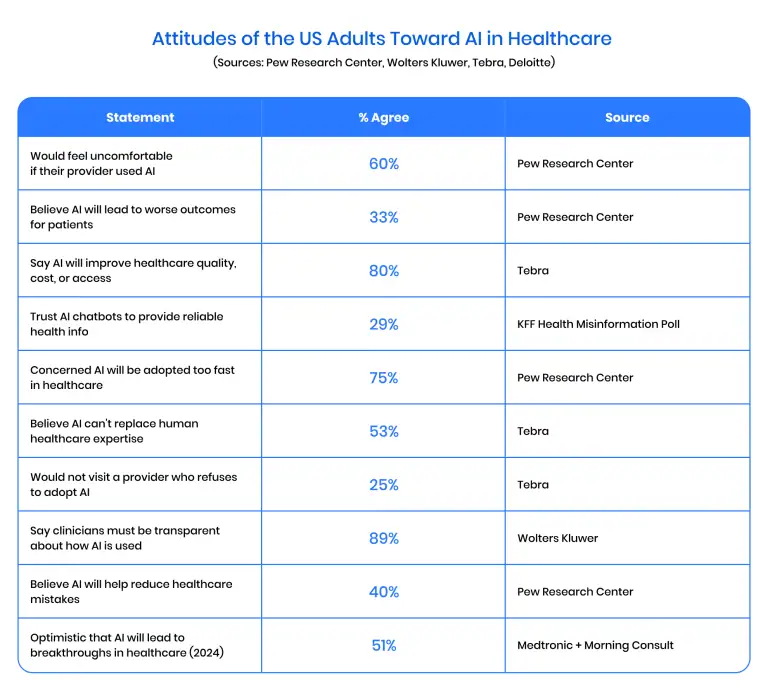
- A survey in the United States indicates that 60% of adults would feel uncomfortable if their healthcare provider used AI, reflecting a cautious stance toward the use of automated clinical support.
- Approximately 33% of Americans believe that AI could lead to worse patient outcomes, indicating continued concern about safety and reliability in medical decision-making processes.
- In contrast, 80% of respondents say that AI has the potential to improve healthcare quality, cost efficiency, or access, demonstrating strong confidence in AI’s ability to enhance system-wide performance.
- Only 29% of U.S. adults trust AI chatbots to provide reliable health information, which highlights skepticism toward fully automated patient-facing tools.
(Source: binariks.com)
- Concern about rapid deployment remains high, with 75% of respondents reporting that AI may be adopted too quickly in healthcare environments.
- A separate finding indicates that 53% of adults do not believe AI can replace the expertise of human healthcare professionals, reinforcing the perception that AI should support, rather than substitute for, clinical judgment.
- About 25% of respondents reported that they would avoid visiting a provider who refuses to adopt AI, indicating that a segment of the population expects modernised digital care.
- Transparency is strongly valued, with 89% of U.S. adults stating that clinicians must clearly explain how AI is used in care.
- Approximately 40% of participants believe AI will help reduce healthcare errors, suggesting growing optimism about AI’s role in improving patient safety.
- In 2024, 51% of Americans expressed optimism that AI could lead to scientific and clinical breakthroughs in healthcare, supporting future investment in AI-driven research.
FDA-Approved AI Medical Devices by Clinical Discipline
- Radiology accounts for 76% of all FDA-approved AI-enabled medical devices, indicating that imaging continues to be the dominant field where AI demonstrates strong clinical value through detection, classification, and workflow assistance.
- Cardiovascular care represents 10% of approved devices, showing that AI is increasingly being used to support heart-related diagnostics and treatment planning, especially in regions such as the United States and Japan where cardiovascular disease remains a leading health burden.

(Source: binariks.com)
- Neurology accounts for 4% of the market, reflecting steady adoption of AI tools for stroke detection, seizure monitoring, and early screening for neurodegenerative conditions.
- Gastroenterology accounts for 2%, supported by systems that assist with polyp detection and digestive-tract imaging.
- Ophthalmic care accounts for 2%, with AI assisting in retinal imaging, diabetic eye screening, and early-stage vision loss assessment.
- Clinical chemistry accounts for 1%, showing limited but emerging use of AI for laboratory automation and biomarker interpretation.
- Hematology also contributes 2%, supported by AI tools that help identify blood abnormalities and improve laboratory throughput.
- General and plastic surgery accounts for 2%, with AI assisting in preoperative planning and postoperative assessment, particularly in technologically advanced healthcare systems in the United States and South Korea.
- Pathology represents 1%, driven by early adoption of AI-powered digital slide analysis in markets such as Germany and the United States.
- Anesthesiology accounts for 2%, where AI is gradually being introduced for monitoring patient responses and optimizing medication decisions during complex procedures.
AI In Drug Discovery

(Source: ventionteams.com)
- AI is rapidly transforming drug discovery and becoming one of the most significant advances in healthcare innovation.
- In 2023, the application of AI in drug discovery accounted for the largest share, constituting 28% of the AI-in-healthcare market, which was valued at USD 0.9 billion.
- Within a year, the market nearly doubled, reaching USD 1.86 billion, indicating a remarkable 29.9% CAGR. This dramatic increase is a clear indication of how rapidly investment, adoption, and trust in AI-assisted research are growing.
- The year 2025 brings even greater momentum. It is reported that approximately 66% of executives at life sciences companies allocate part of their budgets to generative AI to accelerate research pipelines.
- Such technologies are being deployed in areas such as forecasting chemical reactions, identifying potent drug molecules, and elucidating new protein structures—activities that typically take months or years but can now be accelerated significantly with the help of AI.
- The long-term forecasts indicate the potential economic impact of AI. A study predicts that in the year 2050, AI will be responsible for USD 100 billion to USD 600 billion in healthcare cost savings.
- The major contributors to these savings would be the faster, more efficient delivery of more effective drugs to patients, as well as a reduction in the frequency of expensive hospital treatments and physician consultations.
- On top of that, AI could also keep the new drugs’ approval rates 10-40% faster, owing to the proper facilitation in the discovery phase, better trial design, and being majorly regulatory success-oriented.
- In brief, the rapid rise in demand and a major economic driver underscore the role of AI in future drug manufacturing and in the overall provision of health care.
Annual Count of FDA-Cleared AI/ML Medical Devices
(Source: ventionteams.com)
- Among healthcare organisations that closely monitor their AI programs, just over half (52%) report moderate returns on investment, while 30% report high or very high ROI.
- Only 18% report low, break-even, or negative returns, implying that the majority of organisations using AI are reaping significant benefits.
- What is even more striking is that 45% of organisations using generative AI achieved measurable returns within 12 months, demonstrating how quickly value can be created with this technology.
- Concurrently, as many as 69% of healthcare executives report being pressured by shareholders to demonstrate the financial impact of their AI initiatives.
- It indicates that the AI investments are expected to deliver not only theoretical promise but also concrete results.
- Nevertheless, top management recognises that the benefits of AI are not always immediately apparent.
- Early gains often take the form of improved workflows, reduced administrative burden, and time savings—improvements that eventually translate into financial returns but may not appear immediately on financial statements.
- Despite uncertainty, 85% of executives continue to pursue AI initiatives, even when ROI is not guaranteed.
- This indicates strong confidence in AI’s long-term potential to transform operations, improve patient care, and ultimately deliver significant economic value.
AI In Healthcare Investments
(Source: ventionteams.com)
- The early advantages, as a rule, are better workflows, less burden on the administration, and time savings—these improvements, in the long run, translate into financial returns but do not appear on the financial statements immediately.
- Despite uncertainty and doubt, 85% of top management, including executives, continue pursuing AI projects, even when the return on investment (ROI) is not assured.
- This suggests a strong belief in AI’s long-term capacity to transform operations, enhance patient care, and, in turn, generate substantial economic value.
- Digital health financing has been consistent, and the main drivers behind that are AI startups.
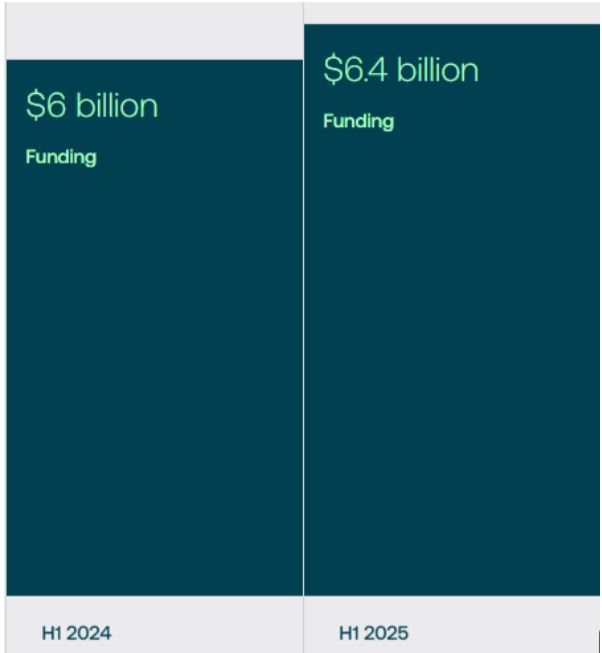
- Venture capital in the first half of 2025 reached USD 6.4 billion, slightly exceeding the USD 6 billion in the comparable period in 2024, despite fewer transactions overall.
- The smaller number of transactions was offset by significantly larger investment amounts, with the average deal size reaching USD 26.1 million as later-stage rounds became more pronounced.
- In 2025, AI healthcare ventures received 62% of total VC funding, amounting to USD 3.95 billion.
- Moreover, these AI startups raised rounds that were, on average, 83% larger than those of other digital health companies.
- Moreover, they led the largest transactions of the year, accounting for nine of the eleven mega-rounds that exceeded USD 100 million.
- Abridge raised USD 550 million in two rounds over four months; Innovaccer raised USD 275 million; Truveta raised USD 320 million; and Hippocratic AI raised USD 141 million. Investor trust is increasingly focused on AI in healthcare, as these instances make the picture clear.
- Among the solutions the most are those aimed at clinical documentation, data platforms, and autonomous clinical support.
Healthcare Market Top Companies In AI
IBM Watson Health
- IBM Watson Health is a subsidiary of IBM, which is a company specializing in the use of AI and cognitive computing in healthcare.
- The company provides state-of-the-art clinical decision support systems based on AI and natural language processing.
- In 2022, IBM’s software division reported a profit of USD 25 billion, while the company’s overall revenue was USD 60.53 billion.
- Watson Health provides AI-based services, including Watson Natural Language Understanding (NLU) for processing medical texts, and sophisticated multidisciplinary healthcare communication tools to increase patient participation and streamline clinical workflows.
NVIDIA Corporation
- NVIDIA is a firm whose name has become synonymous with high-performance GPUs widely used for training and deploying sophisticated medical AI models.
- Their technology is widely used in diagnostic imaging, digital surgery, pathology, genomic sequencing, patient monitoring, etc.
- The company’s revenue for the first quarter of 2023 was USD 6.05 billion, 21% lower than in the same quarter of the previous year.
- Nevertheless, NVIDIA remains a major player in AI-driven healthcare, owing to its powerful computing platforms.
Microsoft
- Microsoft is a major player promoting the use of AI in the healthcare sector, particularly through its Azure cloud platform, which provides robust AI and machine learning tools for healthcare systems.
- For the fiscal year ending March 31, 2023, Microsoft reported revenue of USD 207.591 billion, up 7.81% from the previous year.
- The corporation provides healthcare institutions with technology such as Microsoft Cloud, Azure Space, and Microsoft Viva, which enables improved data management, interoperability, and clinical intelligence.
GE Healthcare
- GE Healthcare employs AI across its imaging technologies, including CT, MRI, and ultrasound systems. The firm earned USD 17.72 billion in 2022.
- With the help of the AI-based Edison™ platform, the company can deliver more precise diagnostics, efficient operations, and broader access to advanced treatments.
Medtronic
- Medtronic applies AI techniques to surgical robotics, aiding decision-making and enhancing modern medical devices.
- The company’s total revenues amounted to USD 30.77 billion for the year ending on January 31, 2023.
- AI-assisted tools, such as ablation systems, electrosurgical instruments, and vessel-sealing technologies, which are included in the company’s offerings, are designed to enable more accurate and effective clinical interventions.
Recent Developments
- Recent developments in AI in healthcare reveal trends that are significantly transforming the landscape.
- These include, among others, acquisitions, innovations in product, continuous funding, forming alliances, easing of regulations, and widening market possibilities.
- Google’s unilateral purchase of Verily Life Sciences in a USD 2.1 billion deal indicates the tech giant’s intent to strengthen AI-driven healthcare. At the same time, Philips’ merger with BioTelemetry, valued at around USD 2.8 billion, brings the company’s AI capabilities to remote patient monitoring.
- Besides, new products are also changing the ground rules—IBM Watson Health launched Watson Health Imaging AI with a view to elevating the standard of diagnostic accuracy via the application of advanced medical imaging analysis, and NVIDIA rolled out Clara Holoscan AI, aiming at the facilitation of high-quality medical visualization and the consequent streamlining of clinical workflows.
- Healthcare administration’s automation tools are scaling up with USD 400 million in Series E funding, secured by Olive AI and USD 150 million contributed by Caption Health, to improve ultrasound techniques that are part of AI technology for better early detection of heart diseases.
- Moreover, strategic partnerships are further promoting innovation: Nference collaborating with Mayo Clinic to leverage AI for faster biomedical discoveries and improved patient outcomes; Cerner and AWS working together to integrate AWS’s AI and ML capabilities into Cerner’s digital health ecosystem.
- Many new AI-powered diagnostic tools, such as IDx-DR, have received FDA approval, marking an important step toward the acceptance of AI in clinical decision-making and improving patient treatment accuracy and timeliness.
- Alongside this, the EU is developing new regulations that would open up healthcare to AI, while ensuring safety and accountability, thereby indirectly monitoring the flow of innovation.
Conclusion
AI in Healthcare Statistics: AI has become a fully developed tool in the global healthcare landscape. The year 2025 is expected to be marked by surprises, discoveries, and advancements in diagnostics, drug development, administration, and patient care. The adoption of AI in healthcare has had a positive impact across many areas. These include reducing clinician burnout, shortening drug supply, and teaching precision medicine.
The immediate economic and clinical applications of AI are directly linked to regulatory support. Additionally, the innovation of major tech and healthcare firms is connected. AI will only get stronger. The future of healthcare is indeed intelligent, data-driven, and shaped by the ever-expanding capabilities of AI.
FAQ.
From 2022 to 2032, Generative AI is expected to increase in value at a compound annual growth rate (CAGR) of 37%, going from USD 0.8 billion to USD 17.2 billion in the end. Besides that, the major countries that are the U.S., China, India, Japan, and the UK are enjoying revenue growth rates of 35% and 42%, respectively, owing to rapid digital transformation and increased investment in AI solutions.
The most common AI use cases in the year 2025 comprise the following: generative AI (adoption rate of 71%), speech recognition tools (70%), agentic AI (68%), machine learning for predictive analytics (66%) and robotics (65%). This set of tools is involved mainly in documentation, workflow automation, diagnostics, and surgical or logistical help.
The staff attending to patients in healthcare settings have heavy administrative workloads; 35% of them spend more time doing paperwork than actually caring for patients. Because of this, 60% of healthcare AI investments in 2024 will go to administrative automation. Ambient scribes, scheduling tools, billing automation and claims processing systems are just some of the AI-powered tools being quickly and widely adopted to counteract clinician burnout and to bring about a more efficient workflow.
The market for AI in drug discovery, which was US$0.9 billion in 2023, has increased to US$1.86 billion in 2024, and life sciences executives have begun to invest more in generative AI. In the long run, AI will be able to produce between US$100 billion–600 billion in healthcare savings by 2050 due to its ability to shorten trial timelines and thereby increase drug approval success rates.
The sector is advancing through major acquisitions, product launches, and regulatory approvals. Google acquired Verily for US$2.1 billion, Philips merged with BioTelemetry for US$2.8 billion, and new tools like IBM Watson’s Imaging AI and NVIDIA’s Clara Holoscan AI hit the market. Funding is strong too—companies like Olive AI and Caption Health raised hundreds of millions.

I hold an MBA in Finance and Marketing, bringing a unique blend of business acumen and creative communication skills. With experience as a content in crafting statistical and research-backed content across multiple domains, including education, technology, product reviews, and company website analytics, I specialize in producing engaging, informative, and SEO-optimized content tailored to diverse audiences. My work bridges technical accuracy with compelling storytelling, helping brands educate, inform, and connect with their target markets.