AI Tools Usage Statistics By Country, Facts and Trend (2025)

Updated · Dec 22, 2025


Table of Contents
- Introduction
- Editor’s Choice
- Trust In Companies Collecting Data Through AI Tools
- AI Tool Usage By Industry
- AI Integration In Business Operations
- Estimated Weekly Time Spent On AI Tools By Age Group
- Reasons Students Are Not Using AI Agents
- Emerging AI Tools And Platforms
- Most Trusted AI Tools Among Content Marketers
- Regional Distribution of AI Tool Adoption
- AI Tools For Data Analysis
- Impact of AI Tool Usage On Productivity
- AI Tools Usage In Healthcare
- AI Tools For Content Creation
- Conclusion
Introduction
AI Tools Usage Statistics: By the year 2025, AI had made its way into the charts of corporate P&Ls. It was also used by at least a few million employees who considered it a daily productivity tool, and—most importantly—a public forum for discussing value, risk, and regulation. The shadows of AI experimentation in 2018-2021 became early adopters of the technology. Marketing, customer service, finance, R&D, and HR no longer are to be assisted by generative AI, agentic assistants, or embedded ML features alone.
Below, we present a data-rich, research-grounded overview of the largest AI usage statistics, adoption patterns, and research insights that reveal the true nature of these numbers in terms of their impact on business and people.
Editor’s Choice
- AI adoption is practically universal, with 96% of organizations having AI in place through its various forms.
- 50% of Fortune 1000 companies are pursuing it at a high level, thereby embedding AI in their operations.
- AI usage patterns vary by position: 33% of American managers are frequent AI users, compared with only 16% of frontline workers.
- The technology sector leads in AI adoption, at 50%, followed by professional services at34% and finance at 32%.
- In India, business leaders are on the verge of adopting AI agents in 93% of cases; in Brazil, they have begun using them across a variety of industrial applications.
- Companies that have implemented generative AI are achieving an average return on investment of 3.7 times, with a higher figure in the financial sector at 4.2 times.
- 72% of organizations employ generative AI in more than one department, and 47% of executives in the USA claim that there is a productivity increase.
- 60% of companies have introduced ethical AI practices.
- It is expected that the generative AI market will be worth US$356B by 2030 and will also have a considerable impact on the global economy.
- The youngest adults (those under 30) are the heaviest and most impatient users of AI, consuming a total of 4.2 hours per week, whereas users aged 30-44 spend nearly the same time but distribute it across longer sessions.
- A large number (83%) of students do not want AI agents; their primary reasons are a lack of trust (64%) and a lack of knowledge (55%), which are the two main barriers.
- AI tools are restricted (23%) or not available (15%) to many students.
- Most of the codebases (95%) of Y Combinator startups consist of AI-generated portions.
- OpenAI Academy in India will engage 1 million teachers for training and 50 startups for mentoring.
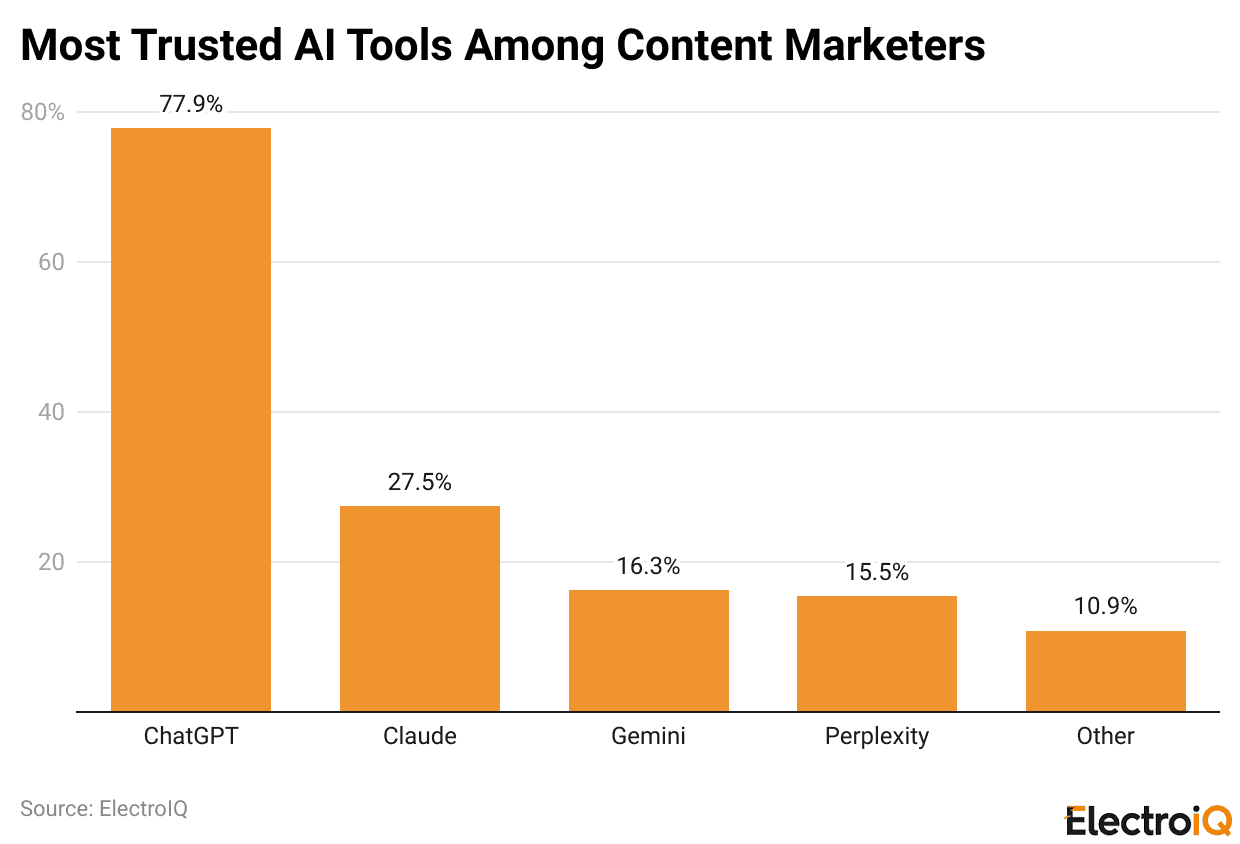
- ChatGPT is the most reliable tool among content marketers, with trust at 77.9%, whereas Claude (27.5%), Gemini (16.3%), and Perplexity (15.5%) are the next in terms of lowest trust.
- 92% of Indian companies use AI, which is substantially higher than the global average of 72%.
- The U.S. saw private AI investment grow to US$109.1 billion, of which US$33.9 billion went to generative AI alone.
- The GNoME algorithm from DeepMind led to the discovery of more than 2 million novel crystal materials that could be used in various applications, thereby accelerating scientific research.
- One-third of professions employ AI in at least 25% of their activities, while the remaining two-thirds consider AI’s contribution as quality enhancement.
- Employers of AI-assisted development are receiving a maximum of US$14.4 billion in annual value added in the U.S. alone.
- AI use among students has increased from 66% to 92%, primarily for content creation at a faster pace.
- In academic writing, ChatGPT is relied upon for 77% of AI-assisted work.
Trust In Companies Collecting Data Through AI Tools
(Source: sqmagazine.co.uk)
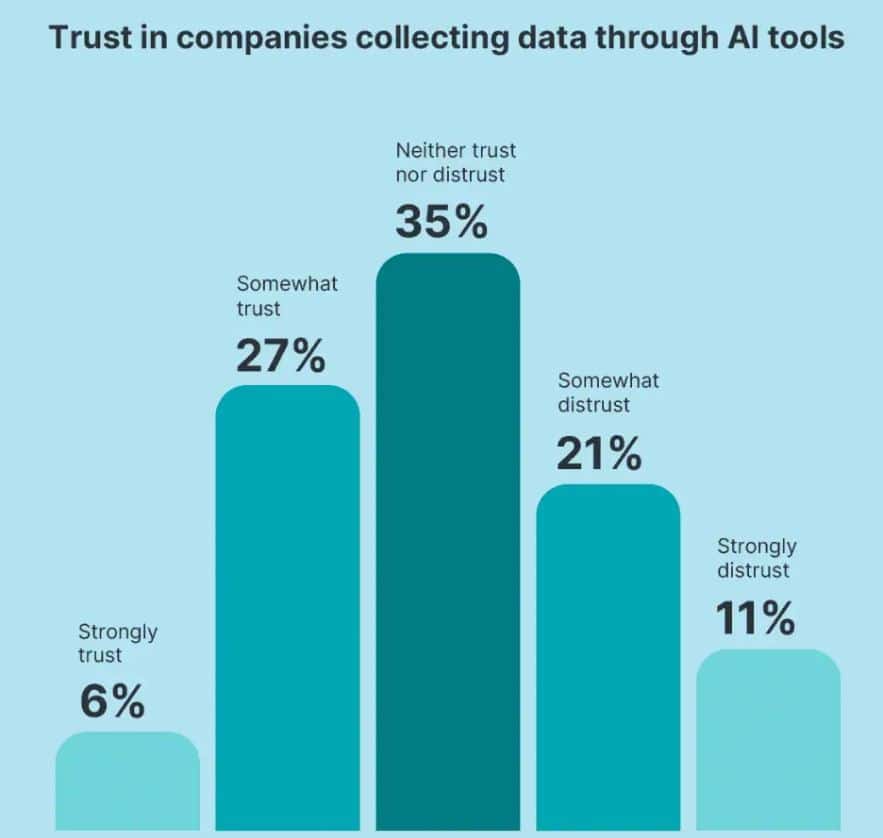
- The statistics indicate that the majority of the population remains very cautious regarding companies that employ AI tools for data collection.
- A small portion of people, roughly 6%, have complete confidence in these corporations, whereas 27% are somewhat comfortable with it.
- The largest group, which is 35%, is neither here nor there—they don’t give it full trust, but they also don’t reject it.
- On the sceptic’s side, 21% are somewhat uncomfortable with AI-based data collection, and another 11% do not trust it at all.
AI Tool Usage By Industry
- The worldwide acceptance of AI has come to almost the same level of non-difference, where 96% of global organizations are incorporating some kind of AI into their daily operations.
- Still, a lot of them are having a hard time getting the full benefit of AI because of the problems caused by the old-fashioned legacy systems, scattered data, and the slow automation resulting from manual workflows.
- Among large corporations, approximately 50% of Fortune 1000 companies have already integrated AI into their systems and products so deeply that it has become a part of their modern drive, proving their commitment to the new technology.
- The usage patterns also change according to the roles in the organization—33% of managers in the U.S. are heavy AI users, while only 16% of the workers on the front line are similar, indicating that access and training are still not equal across the companies’ levels.
- The technology sector leads, with 50% of companies using it; professional services ranks second at 34%, and finance third at 32%. This reflects the degree of digital maturity and the availability of the necessary data infrastructure to support AI integration across sectors.
- Emerging markets are regions where the development of AI is no longer impossible to overlook.
- The Indian scenario, in which 93% of business leaders expect their companies to adopt AI beyond the next 1.5 years, indicates the rapid scale of AI adoption.
- Brazil is another case: In industry, AI was implemented by 16.9% of the medium and large enterprises already in 2022.
- Of the Brazilian companies above, the most frequent use of AI is in clerical work (73.8%); Way behind are the other areas R&D (65.9%), operations (65.1%), production (56.4%), and shipping (48.4%), signifying that the operation of AI moves from the bottom to official and then to core company functions.
AI Integration In Business Operations
- Firms that have incorporated generative AI are reaping hefty financial rewards.
- Collectively, they deliver a 3.7× return on a dollar invested, with financial services the best performers at 4.2×, owing to applications in fraud detection, risk modelling, and automated advisory systems.
- AI is not restricted to a single department anymore—72% of the companies are using AI across different business areas, which is a sign of general acceptance and integration with the already existing functions in the organization.
- Productivity gains are also becoming more prominent, as 47% of American top managers report that AI tools are the driving force behind measurable improvements.
- Governance follows the adoption trail; however, 60% of enterprises have implemented responsible AI policies to ensure the ethical and transparent use of AI across their stakeholders.
- Among those companies whose annual income is in the range of US$1B to US$5B, only 10% have completely brought AI into operations, with the so-called reasons being high costs of implementation, legal pressure, or reluctance within the organization, among others.
- The economic forecast highlights AI’s capacity to alter the landscape fundamentally.
- The generative AI market is projected to grow at a 46% CAGR and reach US$356 billion by 2030.
- In addition, cumulative AI investments could add US$19.9 trillion to the global economy by 2030, equivalent to 3.5% of global GDP.
- This indicates AI’s future role as a primary driver of productivity and growth over the next decade.
Estimated Weekly Time Spent On AI Tools By Age Group
| Age Group | Sessions Per Week | Minutes Per Session |
Total Weekly Minutes
|
| Under 30 | 14 | 18 |
252 (4.2 hours)
|
| 30-44 | 10 | 25 |
250 (4.2 hours)
|
| 45-64 | 6 | 35 |
210 (3.5 hours)
|
| 65+ | 3 | 45 |
135 (2.25 hours)
|
(Source: aboutchromebooks.com)
- When usage patterns are converted into time spent, distinct behavioural differences are observed across age groups.
- People under 30 are the most frequent users of AI tools, averaging approximately 14 sessions per week. However, each session lasts approximately 18 minutes.
- Altogether, this amounts to approximately 252 minutes or 4.2 hours per week.
- The pattern of daily interactions suggests that young adults have incorporated AI into their lives in a way that allows them to use it for quick help with tasks like drafting, searching, or brainstorming during almost every moment of the day.
- Those aged 30 to 44 spend almost the same total time—about 250 minutes per week—but have fewer, longer sessions of approximately 25 minutes each.
- This points to a more deliberate, task-oriented use of AI, often linked to professional duties such as analysis, documentation, or decision-making.
- This group of workers reports real gains: those using AI report saving approximately 5.4% of their working time, which, in turn, leads to an overall 1.1% increase in productivity across the workforce.
Reasons Students Are Not Using AI Agents
(Reference: sqmagazine.co.uk)
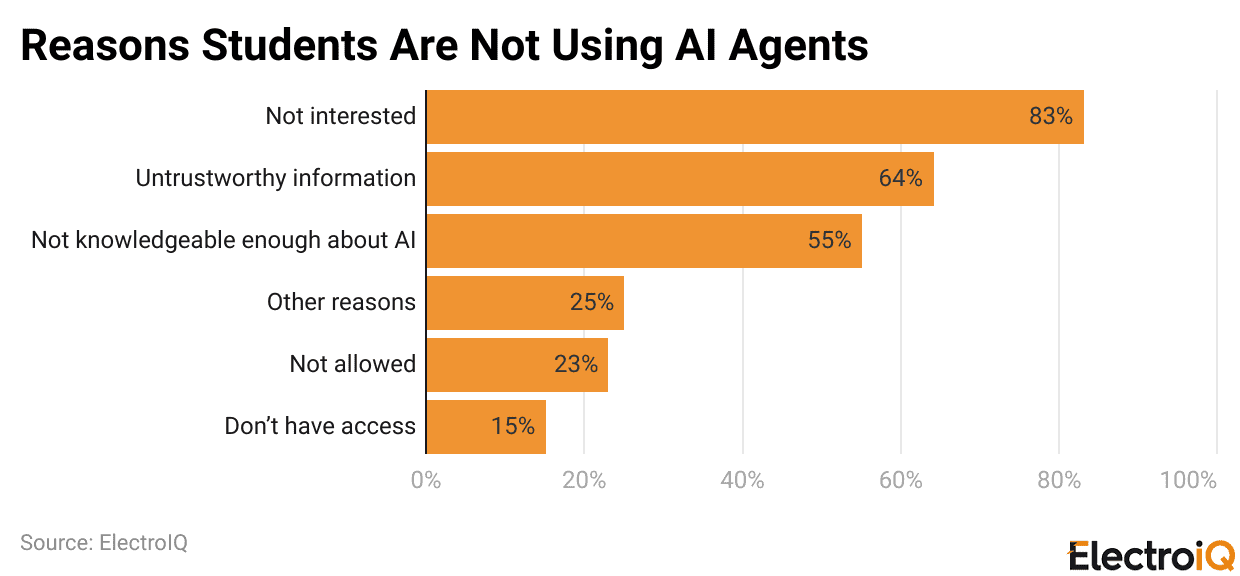
- The majority of the student community is still not inclined to use AI agents, and the statistics reveal a number of factors contributing to this reluctance.
- An overwhelming proportion—83%—simply do not show interest, which implies that AI agents are not yet perceived as necessary or attractive by many, and thus are not included in their academic routines.
- Another major issue is trust: 64% of students refrain from using AI because they believe the information it provides is unreliable, underscoring concerns about accuracy and the risk of misleading responses.
- Approximately 55% of students report that they lack the knowledge or skills required to work effectively with AI.
- This indicates that unfamiliarity and insufficient training are the most important factors contributing to low AI adoption. Also, there are some practical and external limitations.
- Nearly 25% cite other reasons, which may include a preference for traditional study or fear of dependence on technology.
- Approximately 23% report that they are not permitted to use AI tools; these individuals are typically students whose schools have implemented policies aimed at preventing cheating or maintaining academic integrity.
- And the last group, which makes up 15% of the total, includes students who are completely cut off from the AI agents. This suggests that unequal access to technology continues to affect the situation.
Emerging AI Tools And Platforms
- The new AI tools and platforms that are coming into the market are changing the very nature of global innovation and the whole process of development and automation.
- One of the most significant trends that illustrates the deep impact of AI on these areas is the rapid adoption of the new technology by startups.
- The transformation is so pronounced in the case of Y Combinator’s Winter 2025 cohort, where as much as 25% of new firms already depend on AI codebases that are 95% AI-generated.
- Thus, instead of purely human input, the usage of AI-assisted coding is fast becoming a standard practice rather than a rarity.
- To illustrate, the predictive maintenance systems at Siemens have resulted in a 25% reduction of unexpected downtimes and a 65% decrease in the number of calls to the maintenance department.
- On the other hand, LOXM, JPMorgan’s autonomous trading system, is already performing complex market execution operations with very little human participation.
- These cases demonstrate that AI with agency can do jobs that require constant supervision, fast decision-making, and exemplary accuracy.
- Simultaneously, the most popular generative AI tools, including ChatGPT, AlphaCode, and DALL-E 2, are making their presence felt in virtually all sectors – from software engineering and design to customer service and research.
- The organizations are catching up rapidly with these tools: a survey by Gartner shows that in the case of 44% of the interviewed companies, generative AI pilots are already being run, while 10% of the companies have even gone ahead and deployed them in production, which is indeed a substantial increase compared to early 2023, when the adoption rate was considerably lower.
- The industry has recorded an 18.7% growth per annum, and private investments are expected to amount to US$33.9 billion in 2024, which indicates a very strong belief in the commercial potential of AI.
- India is being recognized as one of the most vibrant AI markets. The AI services export from India is predicted to touch US$17 billion by 2027, thanks to the country’s widespread digital population and the growing confluence of the business sector with the automation supply.
- India has turned out to be the number one mobile user market for ChatGPT, signalling a strong customer involvement.
- The hype around this development is further stimulated by the launch of OpenAI Academy in India. The Academy will run teacher training programs for 1 million teachers and provide API credits to 50 Start-ups, thus creating a conducive environment for GenAI’s adoption in education, entrepreneurship, and social work.
- Together, these developments show how emerging AI tools and platforms are not only transforming industries but also reshaping the global innovation landscape.
Most Trusted AI Tools Among Content Marketers
(Reference: sqmagazine.co.uk)
- Content marketers exhibit a very clear preference for a few AI tools, and one platform is really the king among them.
- ChatGPT is the most trustworthy choice, and it has been picked by 77.9% of the marketers, which indicates its multipurpose nature, user-friendliness, and great performance in working with content.
- Claude is the second most trusted tool by marketers and is picked by 27.5% of them, which means that it has started to become accepted, but it is still far behind ChatGPT in the dependency aspect.
- Gemini, which is trusted by 16.3% has a constant but not very rapid acceptance, perhaps because it has been connected to Google’s environment.
- Nearly that, 15.5% of the marketers believe in Perplexity, which has earned a name for quick and research-oriented replies.
- The total trust in all the other AI products amounts to only 10.9% of the marketers, thus indicating the situation that although there are other options available, the majority of content professionals are dependent on a small number of top platforms.
- These figures are pointing at a very tight circle around a few reliable tools, with ChatGPT being in the middle of the content marketing workflows in a very large measure.
Regional Distribution of AI Tool Adoption
- India is now the number one country in the world regarding the use of generative AI in the workplace, where 92% of employees are using it, in comparison to 72% of the global figure.
- In the U.K., the number has increased from 32% to 49% in the workplace AI usage during the year 2024, which means that one-third of the employees are using it without the management’s knowledge.
- In the U.S., AI saw a tremendous investment of US$109.1 billion in 2024, thus taking the lead over both China and the U.K., and out of the total investment, US$33.9 billion went to generative AI.
- The size of the AI services market in India is predicted to be US$17 billion by 2027, due to the factors of a large number of mobile users and new education programs.
- Companies that use AI to generate their code are becoming global; however, the Y Combinator cohort is still predominantly American.
- In Brazil, 16.9% of large industry companies utilize AI, mainly in the areas of admin work, product innovation, and logistics.
- The global music sector foresees a 17.2% rise in revenue derived from AI in the coming year.
AI Tools For Data Analysis
- The Researchers utilize AI to analyze data to help in their ground-breaking research.
- To cite one instance, the GNoME tool from DeepMind has already discovered more than 2 million novel crystal materials along with a very high validation success rate.
- Claude.ai’s analysis indicates that presently, around 36% of occupations have AI as a part of their functionalities, and those AI-included tasks, 57% are meant for management, while 43% are automatic.
- The programmers who are dependent on AI for coding approximately 30% are yielding 2.4% more commits per quarter.
- The Agentic AI is automating financial tasks that are complicated, thus aiding the companies in reducing downtime and speeding up operations.
- AI is leading to faster computer-driven discovery rather than slow lab experiments in the field of materials science.
Impact of AI Tool Usage On Productivity
- The employees who utilize generative AI are sending 25% fewer emails, which translates to a rough saving of 3 hours a week; however, there are no changes in the meeting time.
- The software developers applying 30% of AI-assisted coding are increasing their productivity.
- The U.S. alone is increasing the annual value by US$9.6–US$14.4 billion due to AI adoption in development, and this amount could be much larger if the adoption gets more extensive.
- The AI-assisted coding has been a major factor in start-ups directing their attention towards speed and automation.
- Usage of AI among students has increased from 66% to 92% in education, which has resulted in quicker content creation for them, albeit concerns about the quality still exist.
- The use of generative AI in more than one area is reported by 72% of companies, and almost half (47%) of U.S. executives agree that the productivity improvements are undeniable.
AI Tools Usage In Healthcare
- The healthcare sector could also benefit from AI solutions that automate or predict the results of tasks—it has already enjoyed the benefits of faster diagnoses and more efficient workflows, similar to how the tech has been applied in manufacturing and finance.
- However, precise figures on the adoption of AI in healthcare are still not available to the public.
- The early stages of education and scientific research indicate that similar productivity gains might gradually become apparent in the healthcare sector.
AI Tools For Content Creation
- Claude.ai is getting popularly used for writing in several areas, such as economics, education, and software development, though the degree of usage varies among the different platforms.
- Most AI-assisted academic writing (77%) involves ChatGPT, particularly for rewording and grammar corrections.
- DALL-E, ChatGPT, and AlphaCode have become major tools for companies and professionals in many sectors for generating text, images, and even programming code.
Conclusion
AI Tools Usage Statistics: By 2025, AI adoption will have progressed from trial and error to a widespread application that has changed the dynamics of entire industries, their processes, and even global economies. The AI integration in organizations across departments is being accompanied by evident productivity enhancements, higher return on investment (ROI), and faster innovation.
However, there are still some issues to address—access disparities, scepticism, a lack of a skilled workforce, and discontinuous adoption across functions and industries. AI is becoming a central factor not only in business strategy but also in day-to-day work. Its influence in the near future is expected to be even greater.
Sources
FAQ.
The adoption of AI is almost everywhere—96% of the organizations are using AI in one form or another. Technology is the frontrunner in adoption by 50%, and then come professional services (34%) and finance (32%). Around 50% of Fortune 1000 companies have AI as an integral part of their business operations.
Generative AI users claim an average 3.7× ROI, while the financial sector has even higher returns at 4.2×. These profits are the result of, among others, automation, fraud detection, and boosting the efficiency of different departments.
Trust is still an issue. Only 6% express strong trust towards the companies which apply AI for data collection, while 11% voice strong distrust. The majority of the people (35%) occupy the doubtful and cautious position of neither trusting nor distrusting, thus indicating a widespread caution and uncertainty.
The younger generation (under 30) uses AI a lot but in short time intervals— about 14 times per week, amounting to 4.2 hours. The middle-aged (30-44) do not differ much from the younger in the total time spent, but they do it in longer and more focused sessions. This group claims, however, that there is a measurable increase in productivity, with 5.4% of the working hours saved.
Marketers’ content sources mainly trust ChatGPT, as it was picked by 77.9% of them. Claude is next with 27.5%, Gemini with 16.3% and Perplexity with 15.5%. The rest of the tools together account for a mere 10.9% of the trust placed by marketers.

I hold an MBA in Finance and Marketing, bringing a unique blend of business acumen and creative communication skills. With experience as a content in crafting statistical and research-backed content across multiple domains, including education, technology, product reviews, and company website analytics, I specialize in producing engaging, informative, and SEO-optimized content tailored to diverse audiences. My work bridges technical accuracy with compelling storytelling, helping brands educate, inform, and connect with their target markets.