AI Usage Statistics By Market Analysis, Companies, Usage, Types, Businesses, Trend and Facts (2025)

Updated · Dec 15, 2025


Table of Contents
- Introduction
- Editor’s Choice
- General Statistics
- AI Market Size Statistics
- Companies Using AI Statistics
- Most Common Everyday Uses Of AI
- Businesses Using AI Statistics
- AI Adoption Statistics By Region
- Companies Reported Cost Reduction By Using AI
- Types of AI Tools In Use Statistics
- Predictive Analytics and Machine Learning
- Automation and Robotics
- The Growing Scale of Consumer AI
- Common Use Cases of AI By Consumers
- AI Use Statistics By Age Group/Generations
- United States AI Use Cases Statistics
- AI Usage Statistics By Businesses
- Conclusion
Introduction
AI Usage Statistics: Artificial intelligence is no longer science fiction. It is already part of our daily lives and modern workplaces. We meet AI when we see product suggestions, talk to virtual assistants, or use tools that help doctors and banks make smarter decisions. As more people and companies adopt AI, it is important to understand how frequently it is used, by whom, and for what purposes. AI usage statistics help us see the big picture: which countries and industries are ahead, which tools are most popular, and how habits are changing over time.
This article presents clear, simple figures on AI adoption, user behaviour, and business impact, and explains the main benefits, risks, and future possibilities.
Editor’s Choice
- In 2025, McKinsey further estimated that around 88% of organisations will use AI regularly.
- AI use is expected in 27% of small U.S. firms and 53% of large ones.
- AI helps the average worker save approximately 2.5 hours per day.
- As of 2025, around 54% of consumers would share anonymised data to improve AI.
- Approximately 78% of global companies are expected to use AI, and 90% will be using it or testing it.
- 56% of companies use AI in customer service.
- The top three everyday uses of AI among U.S. adults are writing emails (19%), researching topics of interest (18%), and managing to-do lists (18%).
- By 2025, around 36% of companies will use AI in IT and 36% in marketing and sales.
- In China, 50% of companies have already deployed AI, while another 36% are currently exploring its use.
- As of 2025, around 1.8 billion consumers are currently using AI, with 600 million (daily) and 1.2 billion (weekly or monthly).
- 45% of people use AI for daily tasks, particularly for messages, and 43% for financial questions.
- In the U.S., 61% of adults aged 18-79 use AI, with 19% using it daily.
- 51% of Americans most often use AI to look up answers.
- A report published by Digital Silk stated that 72% of companies worldwide use AI in at least one function in 2025.
- 94% of workers are aware of AI tools, and 62% of global employees generative AI will boost efficiency.
General Statistics
- According to ExplodingTopics’ analysis of 2025 data, AI helps the average worker save approximately 2.5 hours per day.
- About 28% of business leaders also use AI to reduce company costs.
- From 2025 to 2030, the global AI market is projected to grow at an annual rate of 37.3%.
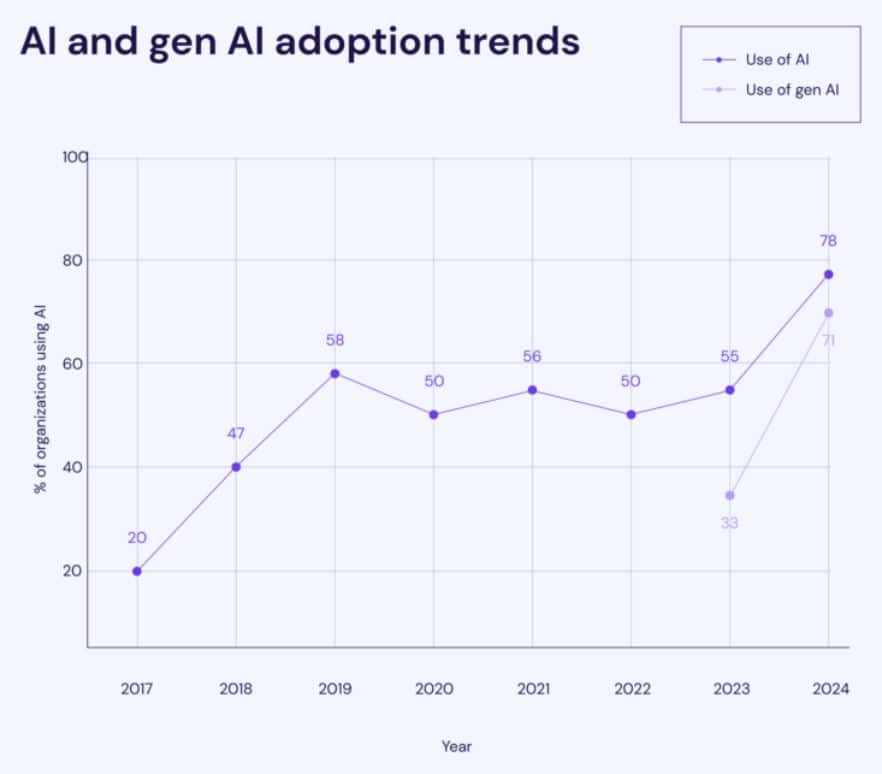
- In 2025, McKinsey reported further estimated that around 88% of organisations will use AI regularly.
(Source: hostinger.com)
- In 2024, 78% of organisations used AI, and 71% of them used generative AI.
- By 2025, AI use is expected in 27% of small U.S. firms and 53% of large ones.
- Menlo Ventures reports 61% of adults have tried AI, while 19% use it daily.
AI Market Size Statistics
(Reference: digitalsilk.com)
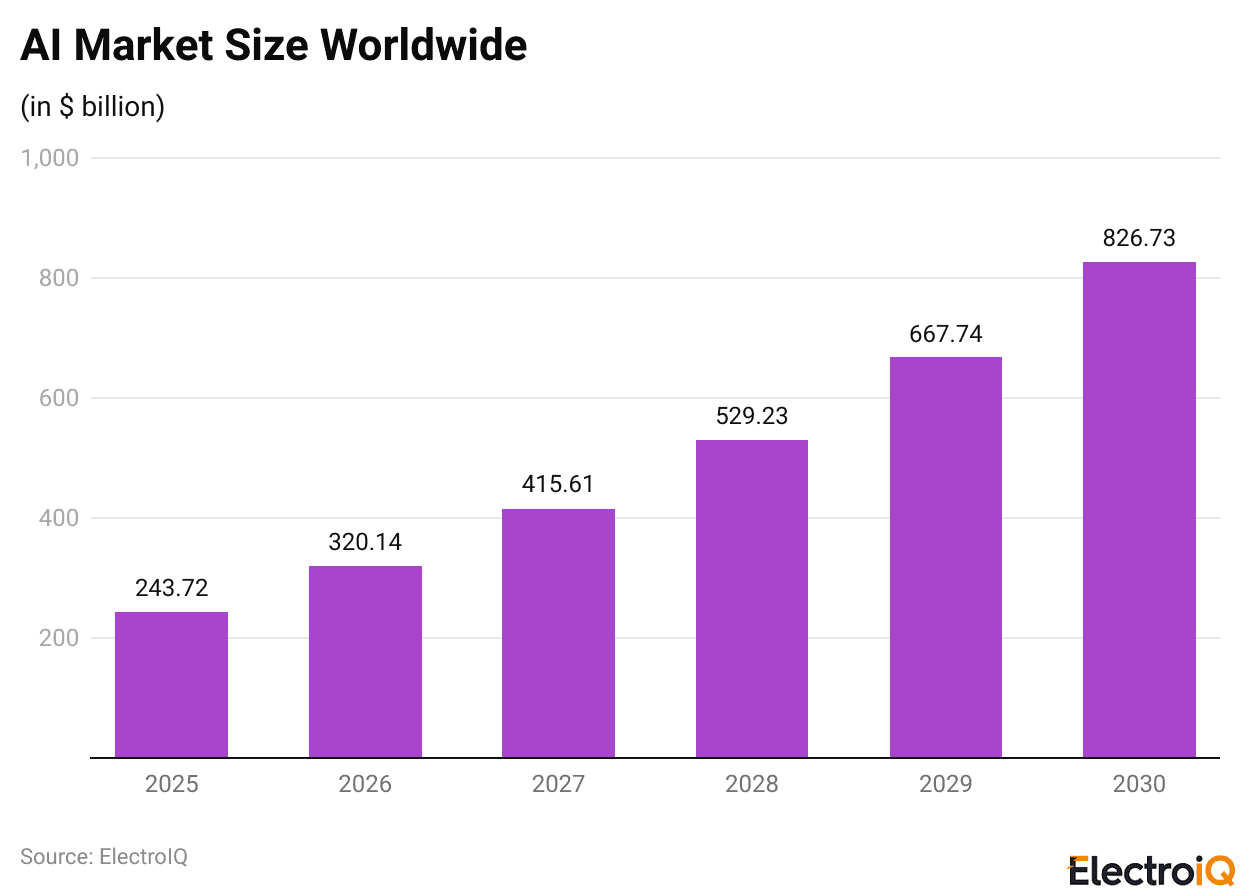
- The AI market size is expected to reach around USD 243.72 billion by 2025.
- Furthermore, the market will grow to around USD 320.14 billion by 2026, USD 415.61 billion by 2027, USD 529.23 billion by 2028, USD 667.74 billion by 2029, and USD 826.73 billion by 2030.
- As of 2025, around 54% of consumers would share anonymised data to improve AI.
- 38% of Americans hold a positive view of AI, and 65% of AI users are Millennials or Gen Z.
Companies Using AI Statistics
(Source: buttercms.com)
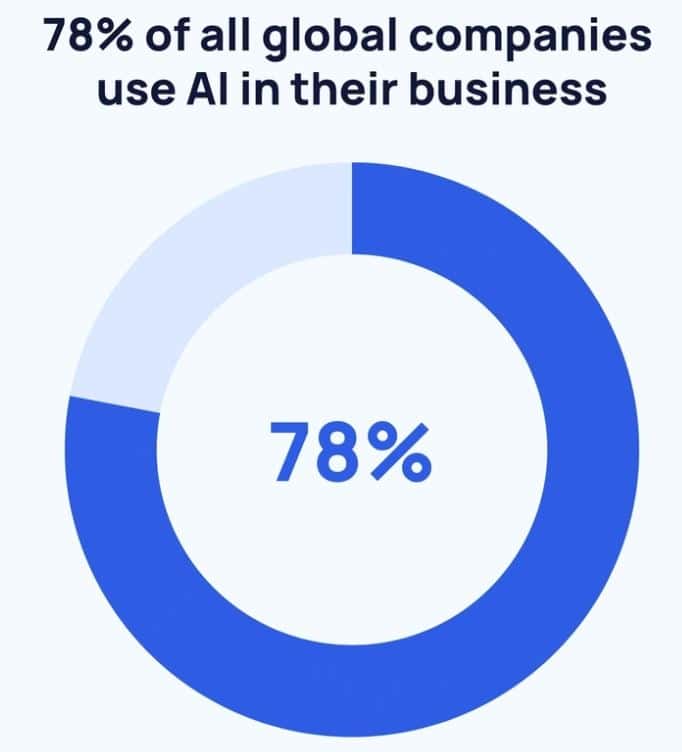
- In 2025, approximately 78% of global companies are expected to use AI, and 90% will be using it or testing it.
- India leads, with AI in about 59% of its companies.
- The global AI market is projected to reach USD 1.85 trillion by 2030.
- Large enterprises are approximately twice as likely to adopt AI as small firms.
- Meanwhile, 50.11% of workers using AI receive little or no formal training.
By the Most Common Ways
(Reference: buttercms.com)
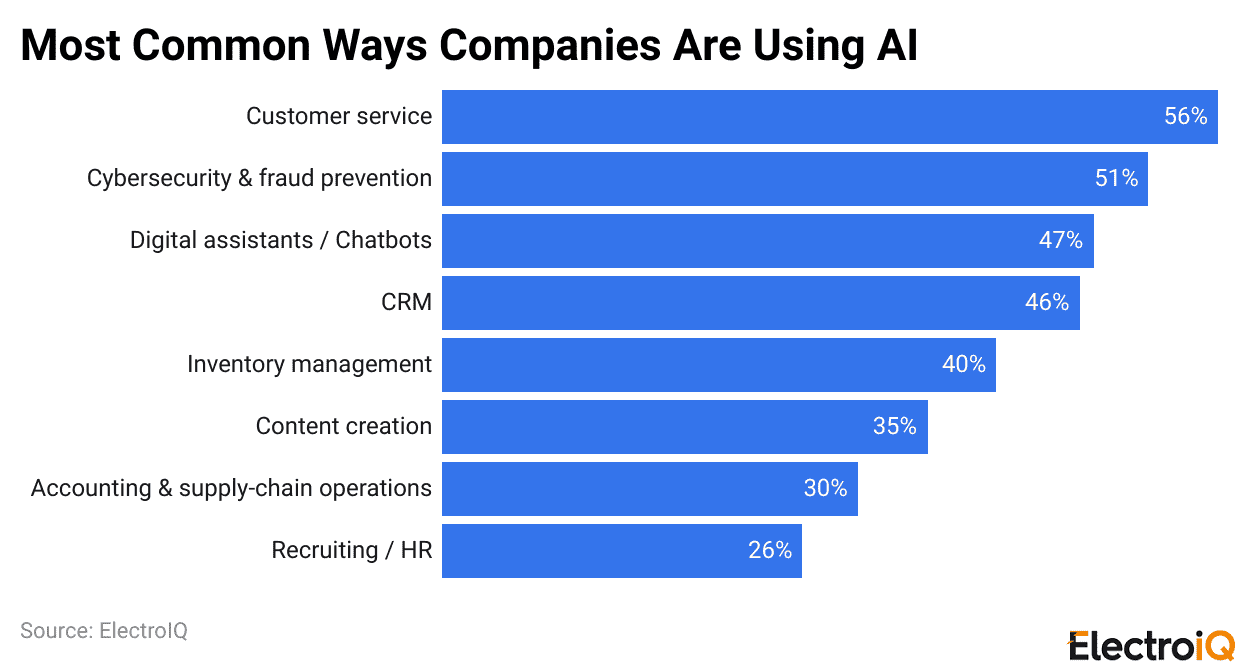
- In 2025, 56% of companies use AI in customer service.
- Meanwhile, 51% in cybersecurity and fraud prevention, and 47% in digital assistants or chatbots.
- Followed by 46% (CRM), 40% (inventory or supply-chain work), 35% (content creation), 30% (accounting and supply-chain operations), and 26% (recruiting or HR).
Most Common Everyday Uses Of AI
- According to menlovc.com, the top three everyday uses of AI among U.S. adults are writing emails (19%), researching topics of interest (18%), and managing to-do lists (18%).
- Moreover, other use cases include writing support (18%), meal planning (16%), managing expenses (15%), taking and organising notes (15%), researching purchases (15%), and researching health questions (14%).
Businesses Using AI Statistics
(Reference: hostinger.com)
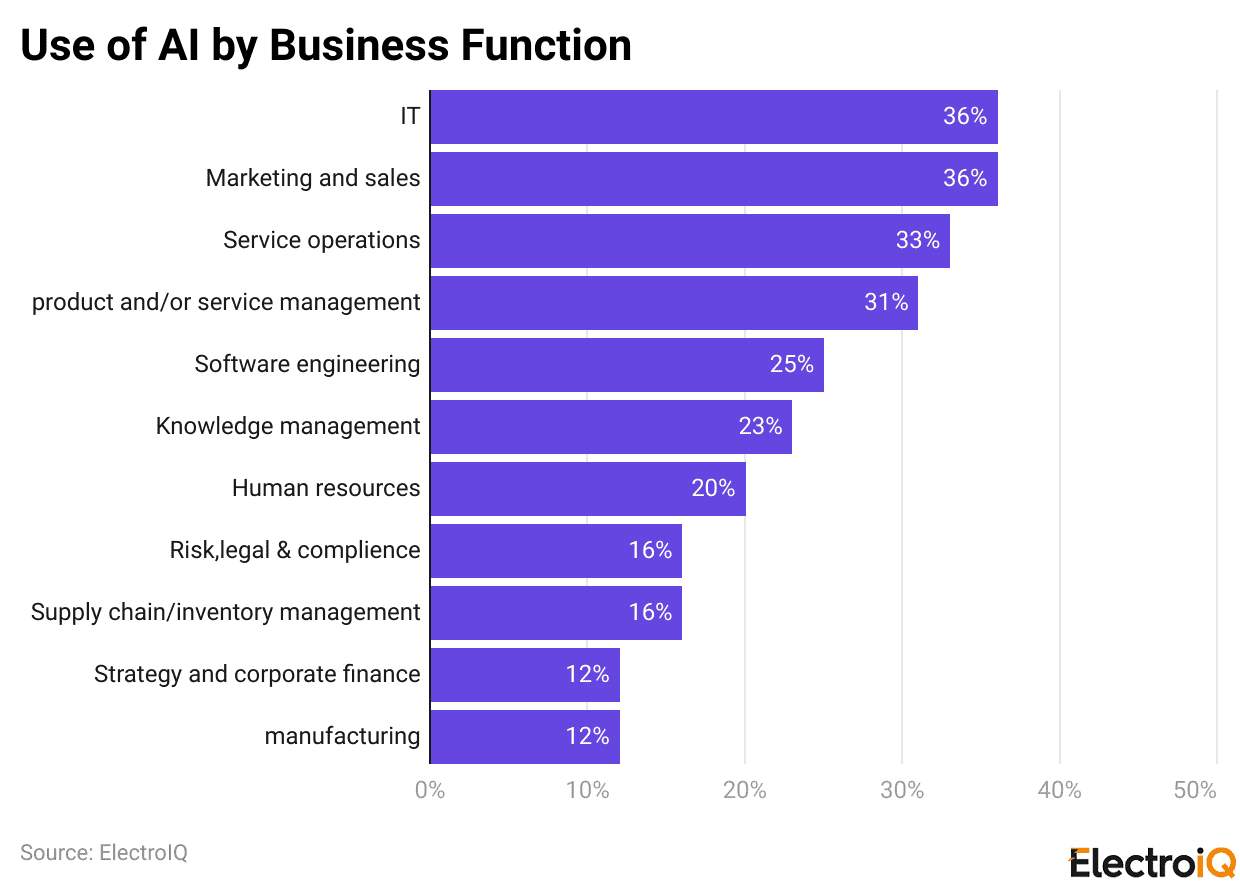
- By 2025, around 36% of companies will use AI in IT and 36% in marketing and sales.
- Meanwhile, other shares of businesses that are using AI are followed by service operations (33%), product or service development (31%), software engineering (25%), knowledge management (23%), human resources (20%), risk, legal & compliance (16%), supply chain or inventory management (16%), strategy and corporate finance (12%) and manufacturing (12%).
AI Adoption Statistics By Region
(Reference: buttercms.com)
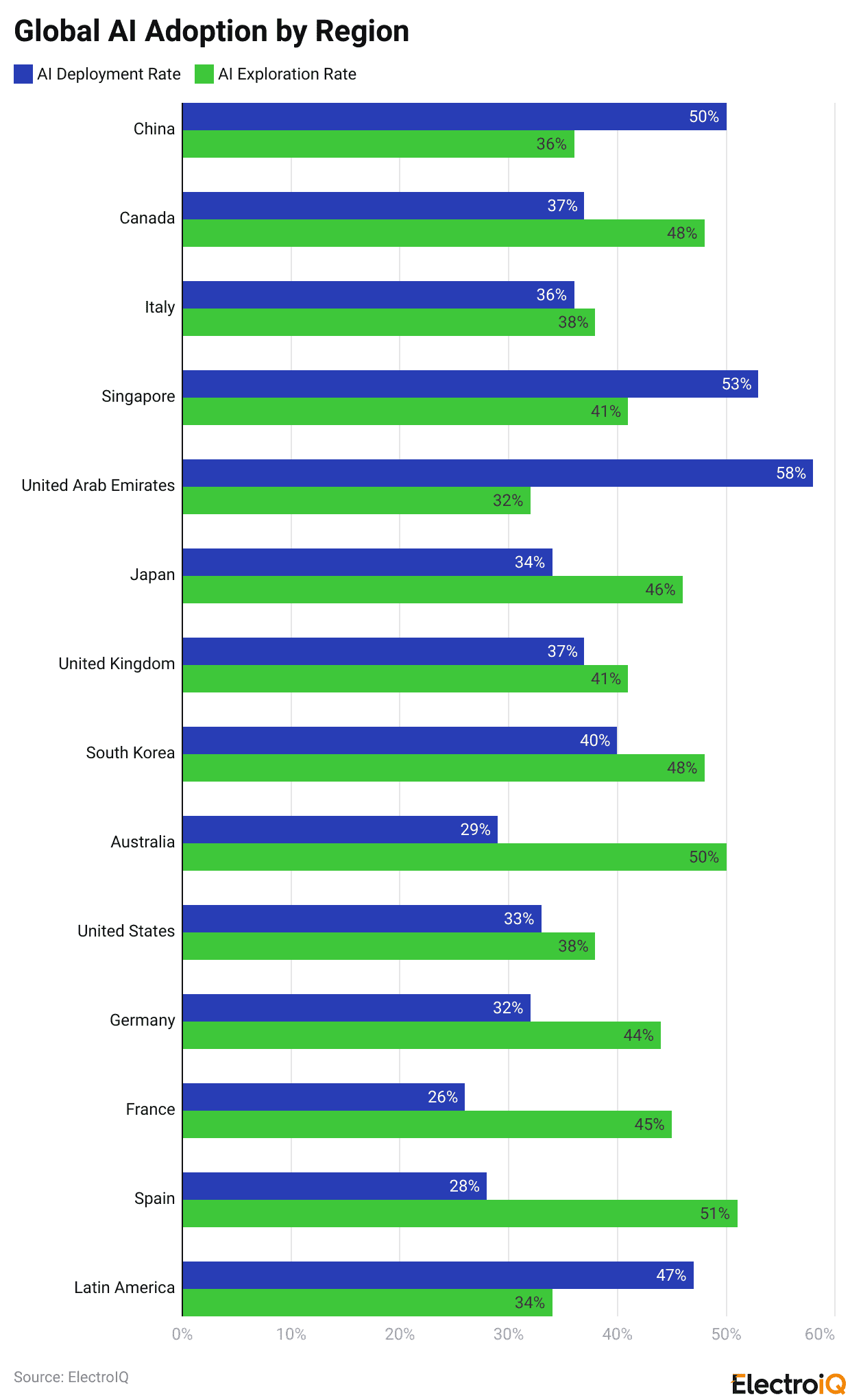
- In China, 50% of companies have already deployed AI, while another 36% are currently exploring its use.
Furthermore, other countries’ AI adoption rates are stated in the table below:
| Country | AI Deployment Rate | AI Exploration Rate |
| India | 59% | 27% |
| Canada | 37% | 48% |
| Italy | 36% | 38% |
| Singapore | 53% | 41% |
| United Arab Emirates | 58% | 32% |
| Germany | 32% | 44% |
| France | 26% | 45% |
| Spain | 28% | 51% |
| United Kingdom | 37% | 41% |
| United States | 33% | 38% |
| Australia | 29% | 50% |
| South Korea | 40% | 48% |
| Japan | 34% | 46% |
Companies Reported Cost Reduction By Using AI
(Reference: hostinger.com)
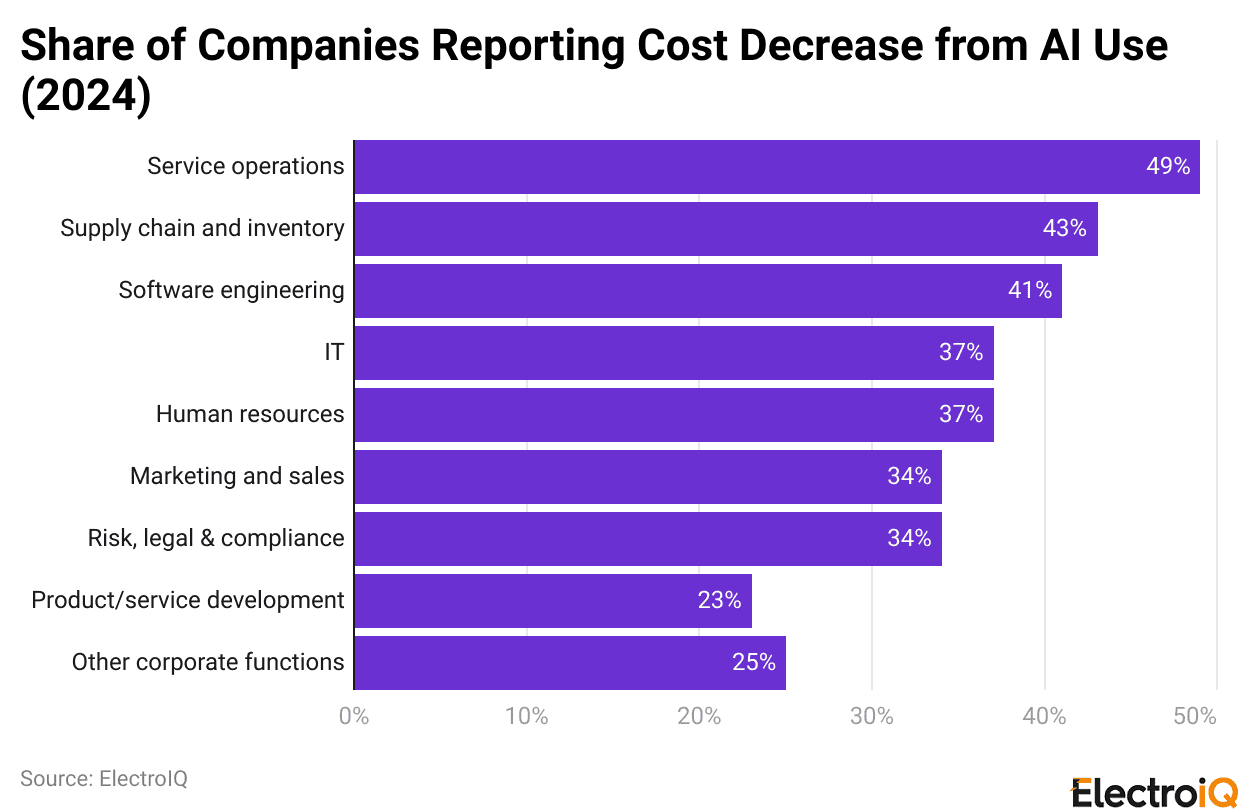
- In 2024, 49% of companies stated that AI reduced costs in service operations, 43% in supply chain and inventory, and 41% in software engineering.
- Other companies are followed by IT (37%), human resources (37%), marketing and sales (34%), risk, legal, and compliance (34%), product or service development (23%), and corporate functions (25%).
Types of AI Tools In Use Statistics
Generative AI
(Reference: precedenceresearch.com)
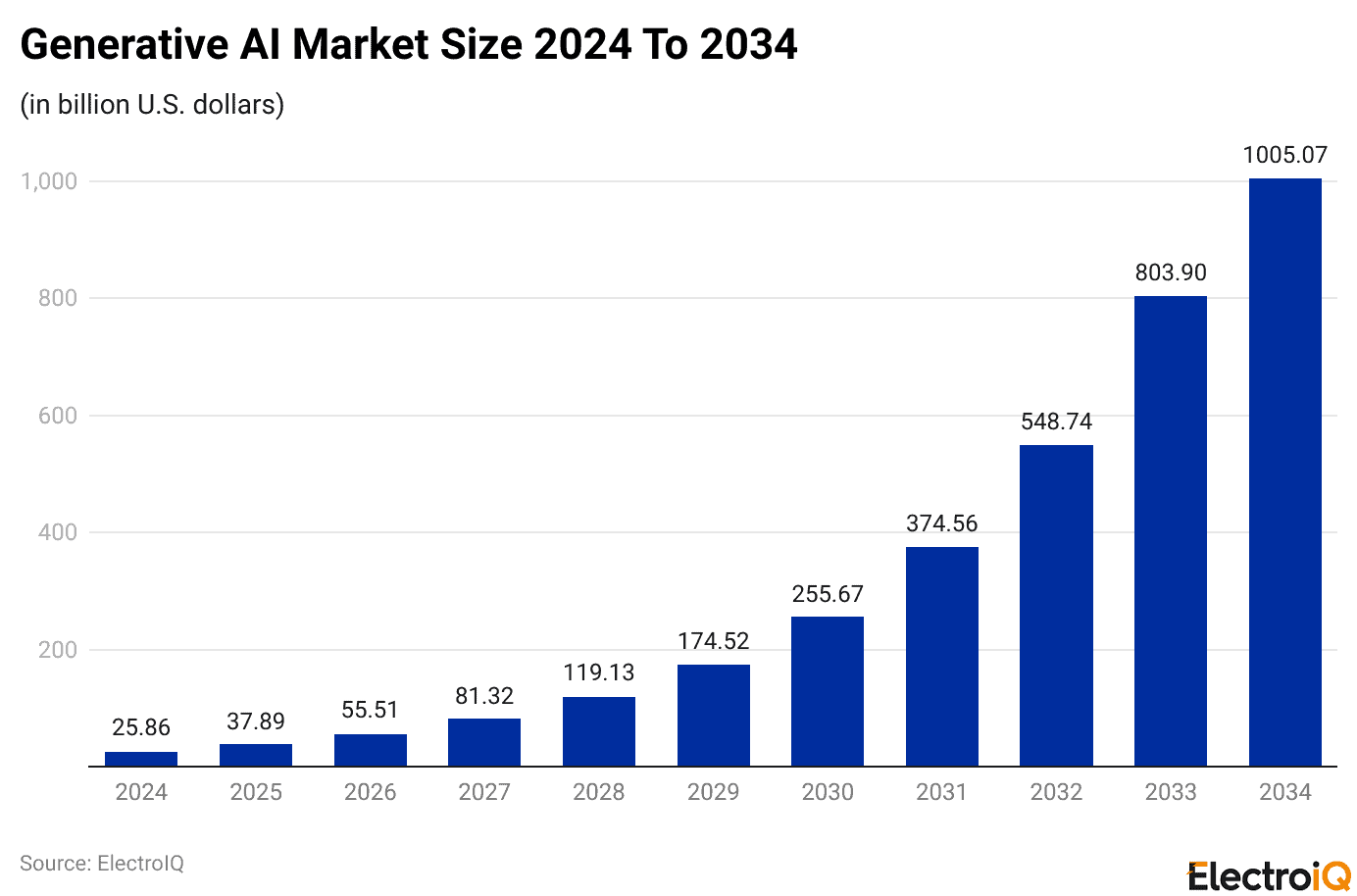
- Precedence Research estimates that by 2025, the generative AI market will reach approximately USD 37.89 billion, with projections reaching USD 1,005.07 billion by 2032, at a global CAGR of 44.20% from 2025 to 2034.
- In 2024, North America accounted for 41% of revenue, followed by the software segment (65.50%) and transformer technology segment (42%).
- Media & entertainment accounted for 34% of sales that year.
- Moreover, the Asia-Pacific region is projected to expand at a 27.6% CAGR from 2025 to 2034.
- The business and financial services segment is projected to grow at a 36.4% CAGR in the generative market.
Predictive Analytics and Machine Learning
(Source: amazonaws.com)
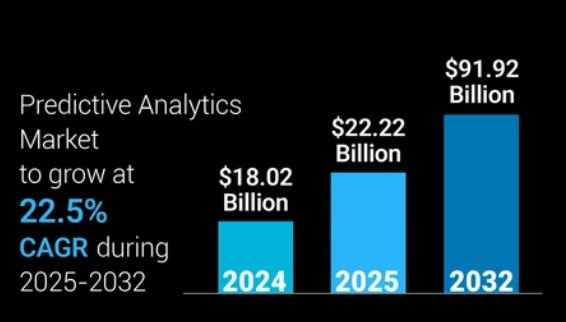
- As of 2024, the predictive analytics market was valued at USD 18.02 billion.
- The market will reach USD 22.22 billion by 2025 and USD 91.92 billion by the end of 2032, with a 22.5% CAGR from 2025 to 2032.
- The North American region accounted for 38.73% of the market.
- The expertcommunity.com further reports that approximately 72% of organisations used predictive analytics in 2024.
- Nearly 45% reported that these tools clearly improved decision accuracy, and 38% reported efficiency gains.
- According to Fortune Business Insights, the global market size for machine learning (ML) is estimated to reach approximately USD 47.99 billion.
- A MindInventory report further stated that more than 15% of companies use or test machine learning.
- Approximately 60% see it as a growth driver, whereas 85% of projects fail due to poor data as the primary issue.
Automation and Robotics
(Source: amazonaws.com)
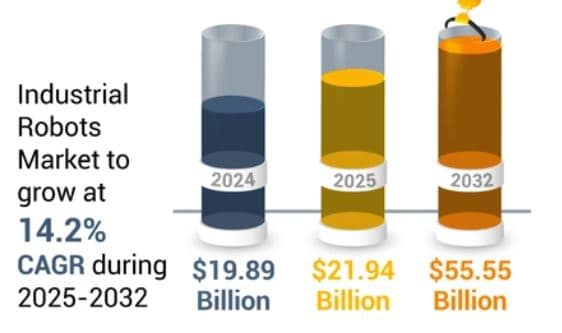
- In 2024, the global market size for industrial robots was USD 19.89 billion.
- It is projected to reach from USD 21.94 billion in 2025 to USD 55.55 billion by 2032, with a 14.19% CAGR.
- As of 2024, the Asia-Pacific region held the largest market share at 48.72%.
- Articulated robots accounted for 40% of the total share.
- In 2025, material-handling uses will account for the largest share at 33%.
The Growing Scale of Consumer AI
(Source: menlovc.com)
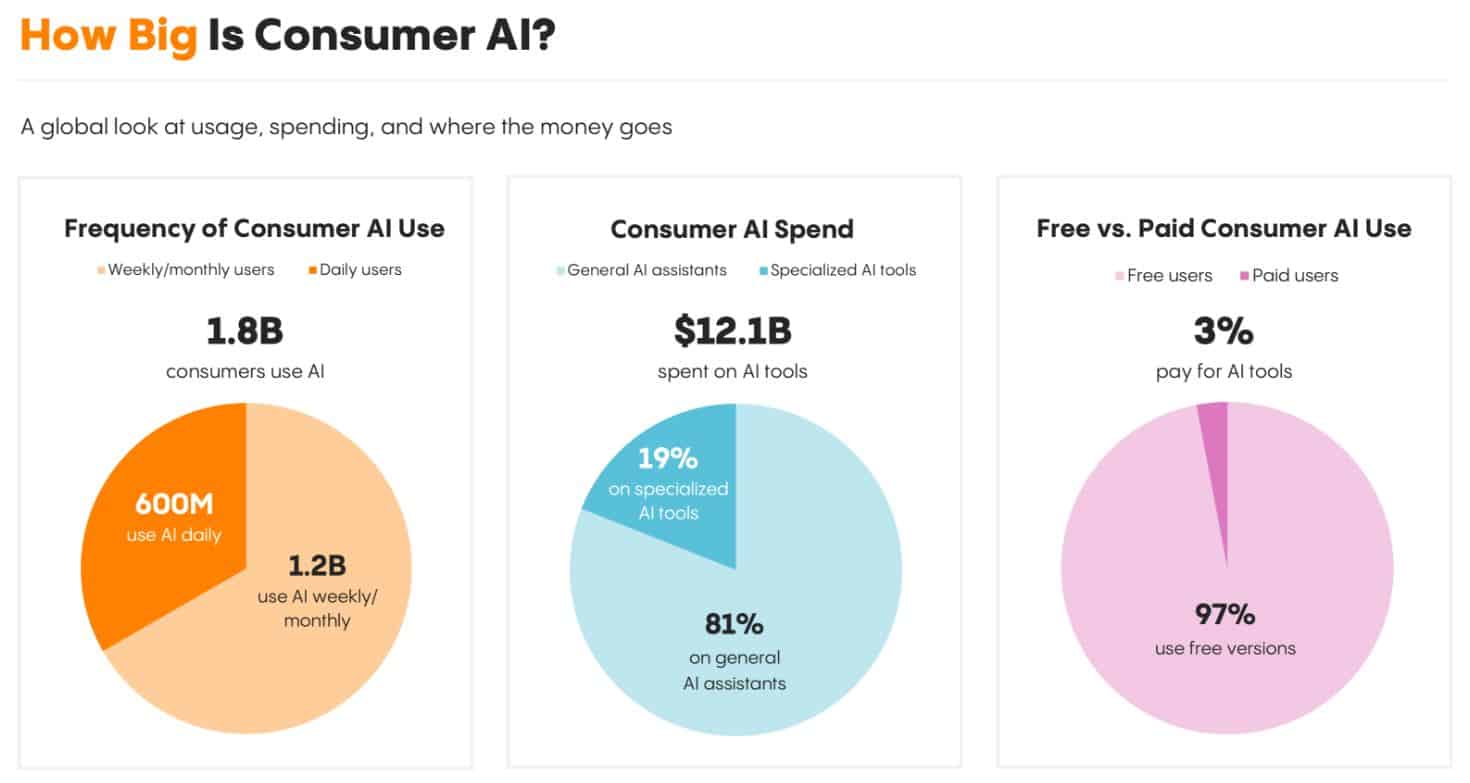
- As of 2025, around 1.8 billion consumers are currently using AI, with 600 million (daily) and 1.2 billion (weekly or monthly).
- Meanwhile, consumers spend USD 12.1 billion on AI tools, with about 81% (general AI assistants) and 19% (specialised AI tools).
- Only 3% of users actually pay for AI tools, while 97% use free versions.
Common Use Cases of AI By Consumers
(Source: aiprm.com)
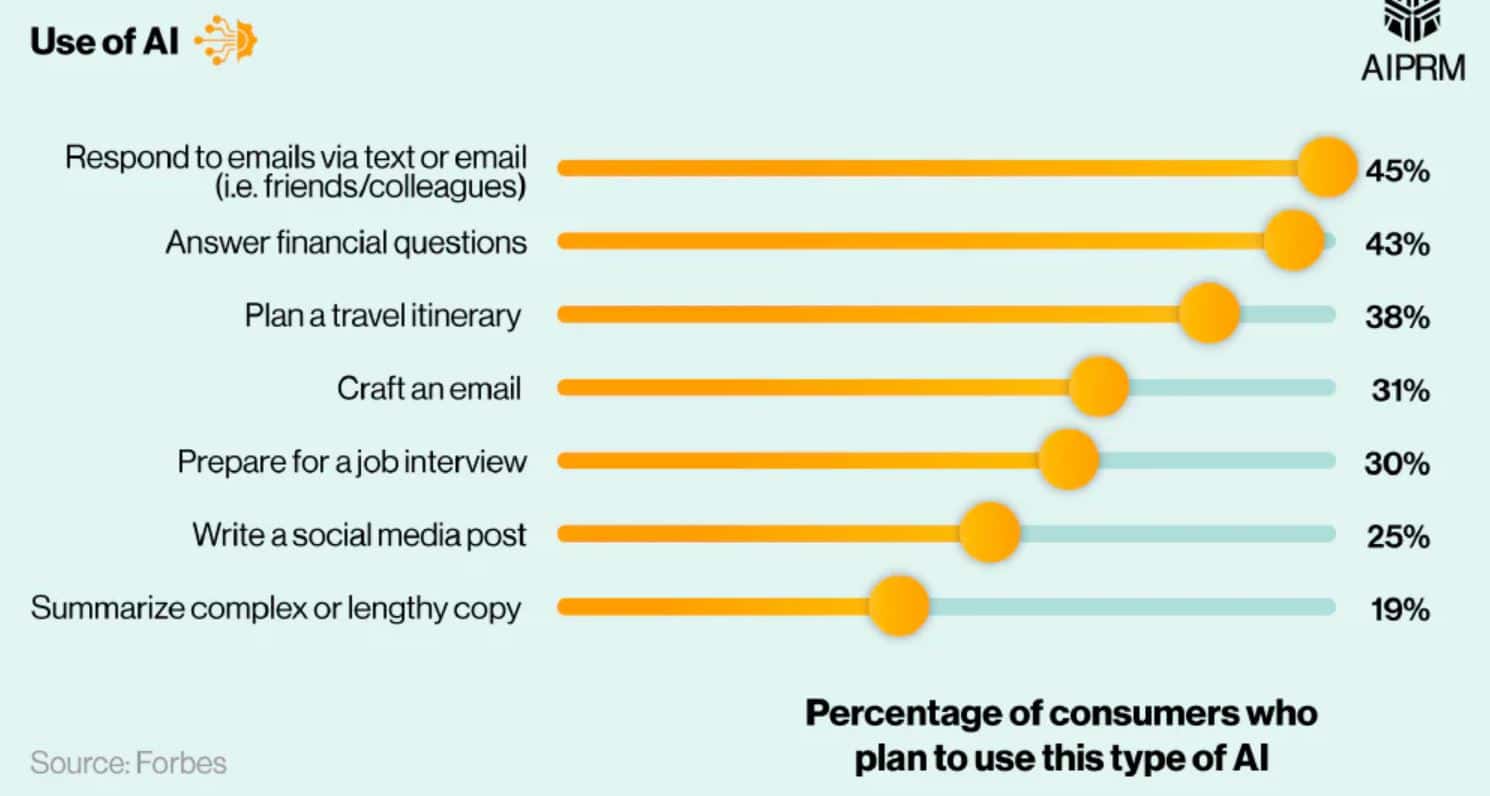
- As of 2025, 45% of people use AI for daily tasks, particularly for messages, and 43% for financial questions.
- Others are followed as planning a travel itinerary (38%), crafting an email (31%), preparing for a job interview (30%), writing a social media post (25%), and summarising complex or lengthy copy (19%).
AI Use Statistics By Age Group/Generations
(Source: menlovc.com)
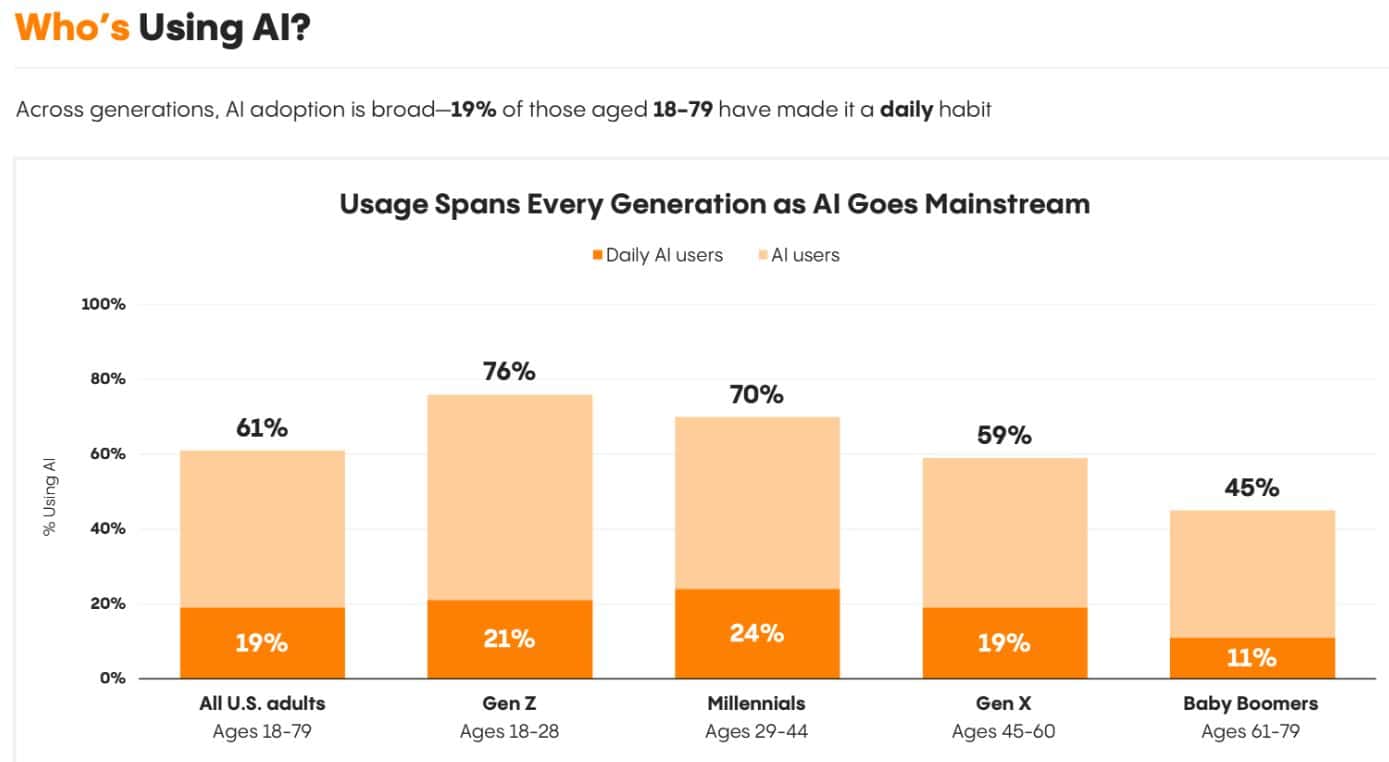
- In the U.S., 61% of adults aged 18-79 use AI, with 19% using it daily.
- Gen Z (18-28 years) exhibits the highest adoption, with 76% using AI and 21% using it daily.
- Millennials (29-44 years) follow, with 70% using AI and 24% using it daily.
- For Gen X (45-60 years), 59% use AI, and 19% use it daily.
- Even Baby Boomers (61-79 years) are involved, with 45% using AI and 11% interacting with it each day.
By Employment Status and Income
| Employment status | Daily AI users share | Income group | Daily AI users share |
| Employed | 26% | Income < USD 50K | 14% |
| Student | 22% | Income USD 50K to 100K | 22% |
| Homemaker | 9% |
Income > USD 100K
|
30%
|
| Retired | 10% | ||
| Unemployed | 14% | ||
| Other | 17% |
United States AI Use Cases Statistics
(Reference: digitalsilk.com)
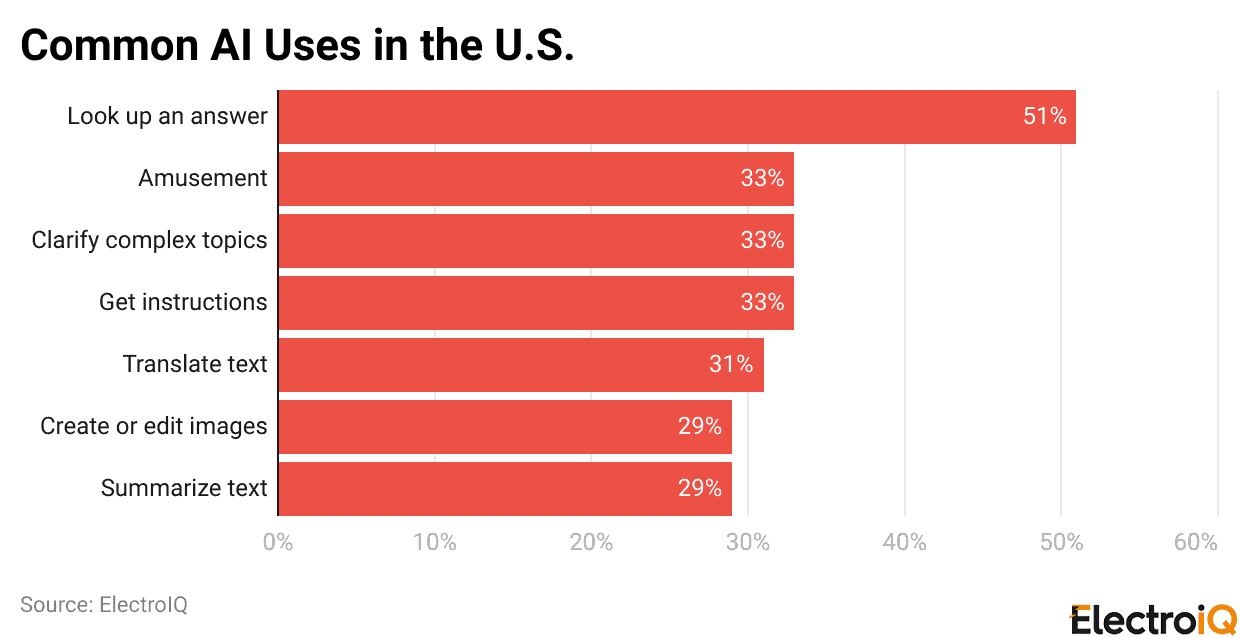
- 51% of Americans most often use AI to look up answers.
- Approximately 33% use it for amusement, to clarify complex topics, and to get instructions.
- Another 31% use AI to translate text, 29% to create or edit images, and 29% to summarise text.
AI Usage Statistics By Businesses
- A report published by Digital Silk stated that 72% of companies worldwide use AI in at least one function in 2025.
- As of 2024, Central and South America lag at 58% adoption.
- In the U.S., 60% use generative AI for content and social media; 79% of leaders report that AI is needed to remain competitive; and 78% expect to increase AI spending.
- 86% of technical leaders and 59% of C-suite leaders favour generative AI.
- Meanwhile, 28% of AI users give the CEO authority over governance, and 29% report that one quarter of staff are trained in AI and generative AI.
- Among small businesses, approximately 57% use AI for marketing, followed by 61% (save time), 52% (content), 83% (improve user experience), 56% (fund conversational AI), and 47% (achieve faster support as the primary benefit).
By Employees
- 94% of workers are aware of AI tools, and 62% of global employees generative AI will boost efficiency.
- Meanwhile, 62% believed it should be used in industry.
- Followed by 90% stated AI saved time, 78% bought their own tools, 52% hide using AI on key tasks, while 63% see job enjoyment, and 55% report improved mental health.
- 90% reported it helped them save time, and 63% reported it improved their enjoyment of their jobs.
- About 78% brought their own AI tools into work, yet 52% were hesitant to admit to using AI for their most important tasks.
- In addition, 55% reported that AI improved their mental health at work and reduced their stress.
(Reference: digitalsilk.com)
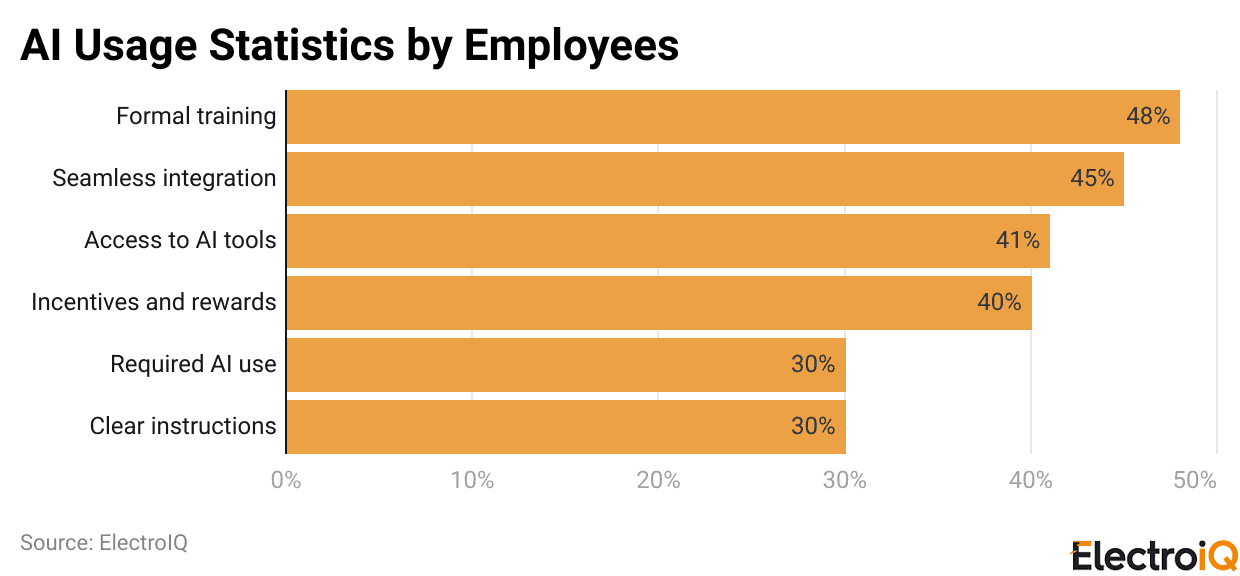
- 48% of employees reported that the most effective way to increase AI use is formal training.
- The most common approaches are seamless integration (45%), access to AI tools (41%), incentives and rewards (40%), AI use required (30%), and clear instructions (30%).
Conclusion
After completing the article, all the above analysis indicates that AI is no longer merely a test tool; it is becoming part of everyday work and life. More people and companies in many countries now use AI to accelerate tasks, support decision-making, and serve customers more effectively. However, the same data also warns of risks such as privacy leaks, biased outputs, and job displacement. For students, workers, and businesses, AI can be a big help if used with care, clear rules, and good digital education. Ultimately, how we guide and control these tools will shape their impact on society.
Sources
FAQ.
Use AI in shopping, navigation, entertainment, learning, health tracking, smart homes, customer support, and work.
AI saves time, automates routine tasks, improves decision-making, analyses large datasets, personalises experiences, and helps create new services.
Use trusted tools, protect personal data, verify important answers, and ask experts for critical decisions.
Businesses use AI for automation, customer support, data insights, personalisation, marketing, and decision-making.
Critical thinking, creativity, problem-solving, communication, data literacy, adaptability, and effective collaboration with AI tools are required today.

Maitrayee Dey has a background in Electrical Engineering and has worked in various technical roles before transitioning to writing. Specializing in technology and Artificial Intelligence, she has served as an Academic Research Analyst and Freelance Writer, particularly focusing on education and healthcare in Australia. Maitrayee's lifelong passions for writing and painting led her to pursue a full-time writing career. She is also the creator of a cooking YouTube channel, where she shares her culinary adventures. At Smartphone Thoughts, Maitrayee brings her expertise in technology to provide in-depth smartphone reviews and app-related statistics, making complex topics easy to understand for all readers.