Digital Comic Statistics and Facts (2025)

Updated · Dec 04, 2025


Table of Contents
- Introduction
- Editor’s Choice
- General Digital Comic Statistics
- Digital Comic Market Size
- Segmental Analysis
- US Digital Comic Market Size
- Digital Comic Book Growth Statistics
- By Geography
- Digital Comic and Webtoon User Demographic Statistics
- Reading Preferences Between Print And Digital Comics
- Digital Comics Preferences
- Conclusion
Introduction
Digital Comic Statistics: Digital comics have changed the way people find, buy, and read stories. Today, most readers use phones, tablets, or e-readers to access thousands of comics anytime, anywhere, from famous superhero series to small indie webtoons. Because of this shift from paper to screens, we now have a lot of information about readers, their spending, and global market growth. Studying these numbers shows who reads digital comics, which apps and sites are most popular, and how different formats keep people interested.
This article shares key data, examines trends across regions, and explains how these patterns shape the future of digital comics and guide important choices for creators and publishers.
Editor’s Choice
- The Digital Comics market is expected to reach around USD 5,806 million in revenue by 2025, up from USD 5,369 million in 2024.
- The digital comic market size in the U.S. will reach around 0.85 billion by 2025, and is estimated to account for USD 1.14 billion by 2025.
- The digital comic book market is projected to grow around 10.9% between 2025 and 2026.
- By gender, 58% are men and 42% are women, with 50 million people worldwide reading digital comics monthly.
- According to Market.Us, manga-style titles accounted for 59.8% in 2024.
- In the 2024 digital comic market, Action leads with 34.4%, followed by Comedy at 21.5% and Romance at 16.4%.
- Meanwhile, digital comic revenue is mostly subscription-based at 73.6%, while ad-based models contribute 26.4%.
- The digital comic market audience is 31.7% kids and 68.3% adults.
- In a 2025 market synthesis, the shop notes that 32% of global digital-comic readers are 18 to 34.
- According to Statista insights, only 25% of respondents chose digital comics as their main reading format.
General Digital Comic Statistics
- Market.Us reports that in 2024, physical comics accounted for 55% of worldwide sales, while digital comics accounted for 45%.
- The Asia-Pacific region is expected to drive 71% of future global market growth.
- Comic readers are varied: 32% are between 18 and 34 years old.
- By gender, 58% are men and 42% are women, with 50 million people worldwide reading monthly.
- Research suggests that AI can cut production costs by over 30%, enabling small studios and independent artists to compete with big publishers.
- Around 44% of webcomic creators use AI to personalise stories.
- Meanwhile, 68% of platforms now add sound effects, animations, or AR to digital comics.
- Nearly 70% focus on localisation, adding multiple languages and culturally relevant stories.
- About 77% of readers mainly enjoy comics on phones.
- Subscription plans also drive growth, with 62% of platforms offering unlimited library access for a single fixed monthly fee.
Digital Comic Market Size
(Source: Market.us)
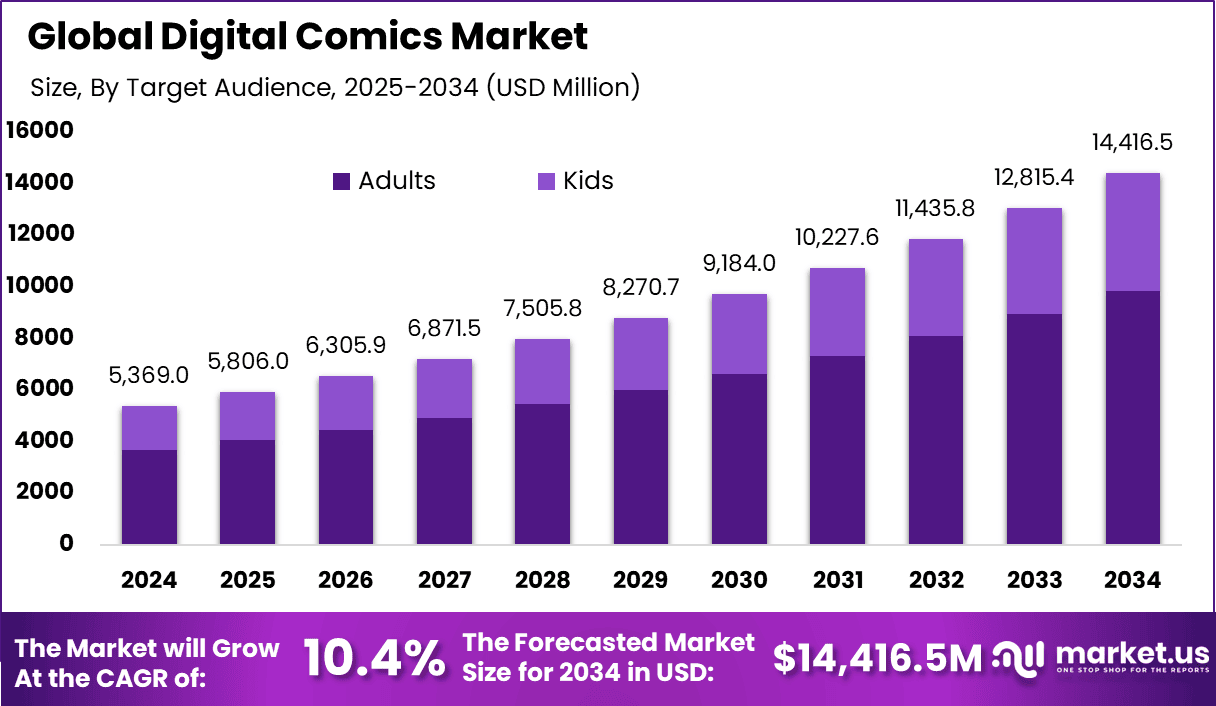
- The Global Digital Comics Market generated USD 5,369 million in 2024 and is expected to grow from USD 5,806 million in 2025 to about USD 14,416.5 million by 2034, recording a 10.4% CAGR.
- The Asia Pacific region held a dominant 77.9% share in 2024, generating USD 4,182 million in revenue, driven by strong mobile usage and the popularity of digital comics there for many years.
- Industry data shows that physical comics accounted for 55% of global sales in 2024, while digital comics accounted for 45%, indicating a clear shift toward online reading.
- The Asia Pacific region is projected to account for 71% of global market growth, underscoring its central role in expanding digital comic consumption.
- Comic readers are diverse, and 32% of them are between 18 and 34 years, showing strong interest from young adults.
- The gender mix indicates that 58% of readers are men and 42% are women, showing broad engagement across both groups.
- Around 50 million people worldwide read comics each month, proving that the medium remains highly popular.
- The Manga type segment accounted for 59.8%, showing a strong global preference for Japanese-style digital comics.
- The Action genre accounted for 34.4% of total engagement, indicating that action stories attract the highest engagement.
- The Adults category accounted for 68.3% of readers, indicating that most digital comic users prefer deeper, more complex themes.
- The Subscription-based model dominated with 73.6%, showing that readers like predictable access and creators benefit from steady monetisation.
- In Japan, the digital comics market reached USD 3,712.7 million in 2024, driven by continued growth in demand for digital manga.
- The market is expanding at a 9.1% CAGR, showing stable long-term growth in digital comic consumption.
Type Analysis
- In 2024, manga holds the largest share of the digital comics market at 59.8%, and its share has inched up from 59.6% in 2020, showing steady and consistent dominance over time.
- This strong position for manga is supported by a long cultural and storytelling tradition that attracts both local and international readers, as well as by serialized stories that keep audiences returning for new chapters.
- Many digital manga platforms now release chapters at the same time worldwide, which helps creators reach global fans faster than print and makes international consumption smoother and more convenient.
- Digital platforms also promote original manga titles, giving independent artists better visibility, new ways to earn money, and a chance to compete alongside established creators.
- Younger readers, who often prefer to read on smartphones and tablets, are a key driver of this growth, as they are more comfortable with mobile apps and continuous digital reading sessions.
- Manga benefits from strong links with anime, games, and films, and this cross media presence keeps characters and stories in front of fans, reinforcing manga as the most influential part of global digital comic consumption.
- While manga leads, other categories such as manhwa at 13.1%, manhua at 7.8%, Western comics at 15.1%, and others at 4.2% in 2024 show smaller but stable roles in the market, and the table tracks these shares in % terms rather than in specific USD revenue figures.
Market Share (%) By Type Analysis, 2020-2024
| Type | 2020 | 2021 | 2022 | 2023 | 2024 |
|---|---|---|---|---|---|
| Manga | 59.6% | 59.6% | 59.7% | 59.7% | 59.8% |
| Manhwa | 12.8% | 12.9% | 13.0% | 13.0% | 13.1% |
| Manhua | 7.3% | 7.4% | 7.5% | 7.7% | 7.8% |
| Western | 15.8% | 15.6% | 15.5% | 15.3% | 15.1% |
| Others | 4.6% | 4.5% | 4.4% | 4.3% | 4.2% |
Genre Analysis
- In 2024, the action genre holds 34.4% of the global digital comics market revenue, which is counted in USD, making it the largest share among all genres.
- Readers are attracted to action comics because of clear stories, strong characters, and vivid artwork that look especially engaging on digital screens.
- The action category performs well in download rankings, as it appeals to both younger readers and long-time fans of digital storytelling.
- Many studios now combine classic comic art with high-resolution visuals and light animation, which makes action scenes feel more immersive on digital platforms.
- Interactive tools, such as panel effects and guided viewing, help action titles feel closer to a movie experience and keep readers engaged for longer.
- From 2020 to 2024, the action share of total digital comics revenue increased from 33.0% to 34.4%, showing steady growth in its importance within the market.
- Over the same period, comedy declined slightly from 21.8% to 21.5%, and sci-fi moved down from 12.9% to 12.1%, which indicates that these genres are losing a small part of their market share to other categories.
- Horror decreased from 6.3% in 2020 to 5.9% in 2024, while romance rose from 15.9% to 16.4%, showing that romantic stories are gaining more space in digital comics.
- The “others” category slipped from 10.1% to 9.7% between 2020 and 2024, which suggests that readers are concentrating more of their spending in the main named genres, especially action and romance.
Market Share (%) By Genre Analysis, 2020-2024
| By Genre | 2020 | 2021 | 2022 | 2023 | 2024 |
|---|---|---|---|---|---|
| Action | 33.0% | 33.3% | 33.7% | 34.0% | 34.4% |
| Comedy | 21.8% | 21.7% | 21.6% | 21.6% | 21.5% |
| Sci-Fi | 12.9% | 12.7% | 12.5% | 12.3% | 12.1% |
| Horror | 6.3% | 6.2% | 6.1% | 6.0% | 5.9% |
| Romance | 15.9% | 16.0% | 16.1% | 16.2% | 16.4% |
| Others | 10.1% | 10.0% | 9.9% | 9.8% | 9.7% |
By Target Audience
Segmental Analysis
- As of 2024, action stories accounted for 34.4% of the Japanese digital comics market.
- In the same period, adults accounted for 68.3% of the audience, and subscription plans accounted for 73.6% of revenue.
- Meanwhile, the Asia Pacific accounted for 77.9% of the global share.
- In Japan, sales reached USD 3,712.7 million in 2024, and the market is projected to grow at a 9.1% CAGR from 2025 to 2034.
US Digital Comic Market Size
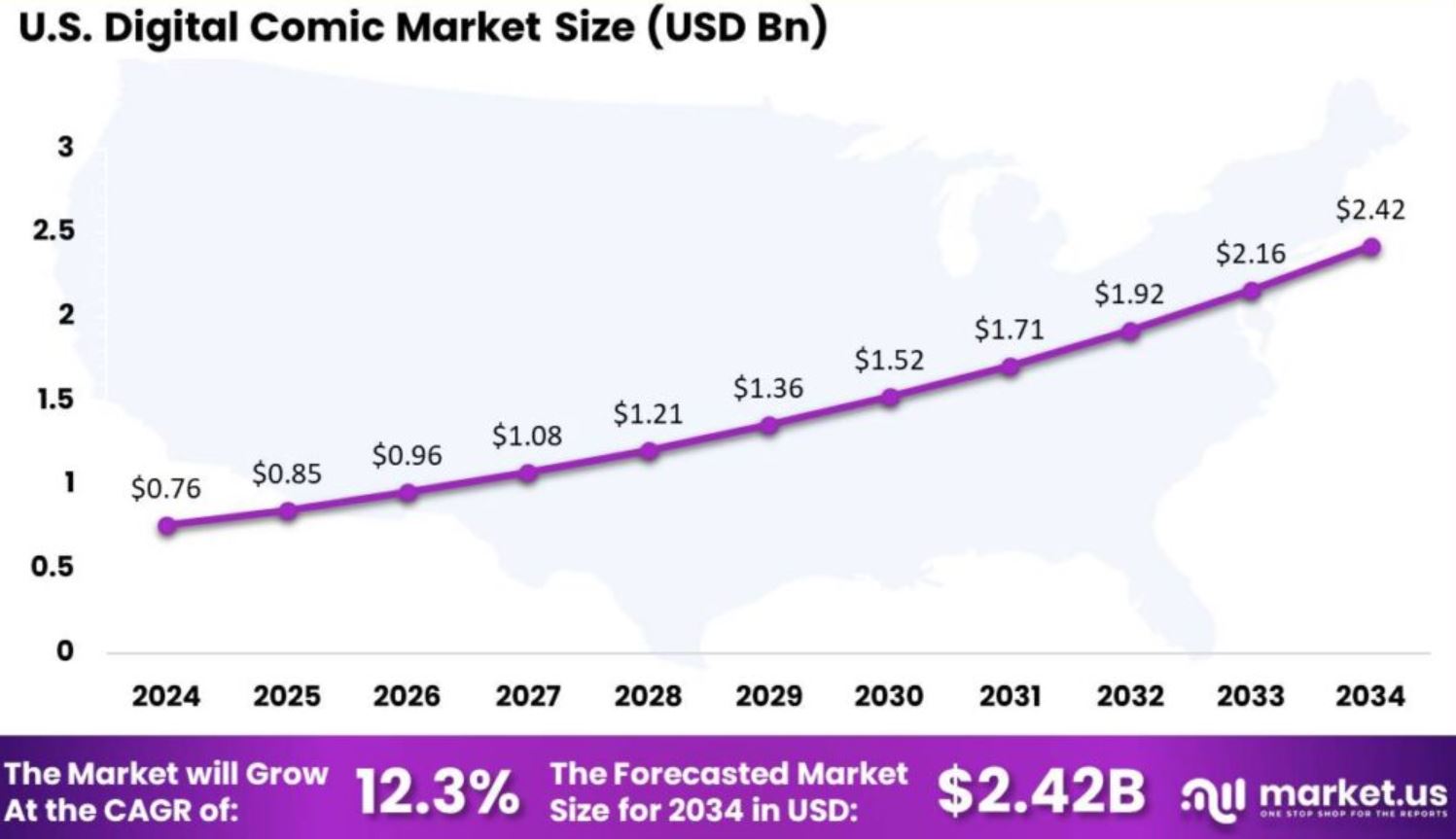
(Source: Market.us)
- The digital comic market in the U.S. is projected to reach approximately USD 0.85 billion by 2025.
- It is estimated to reach approximately USD 0.96 billion (2026), followed by USD 1.08 billion (2027), USD 1.21 billion (2028), USD 1.36 billion (2029), USD 1.52 billion (2030), USD 1.71 billion (2031), USD 1.92 billion (2032), USD 2.16 billion (2033) and USD 2.42 billion (2034).
- The market is growing at a CAGR of 12.4% from 2025 to 2034.
Digital Comic Book Growth Statistics
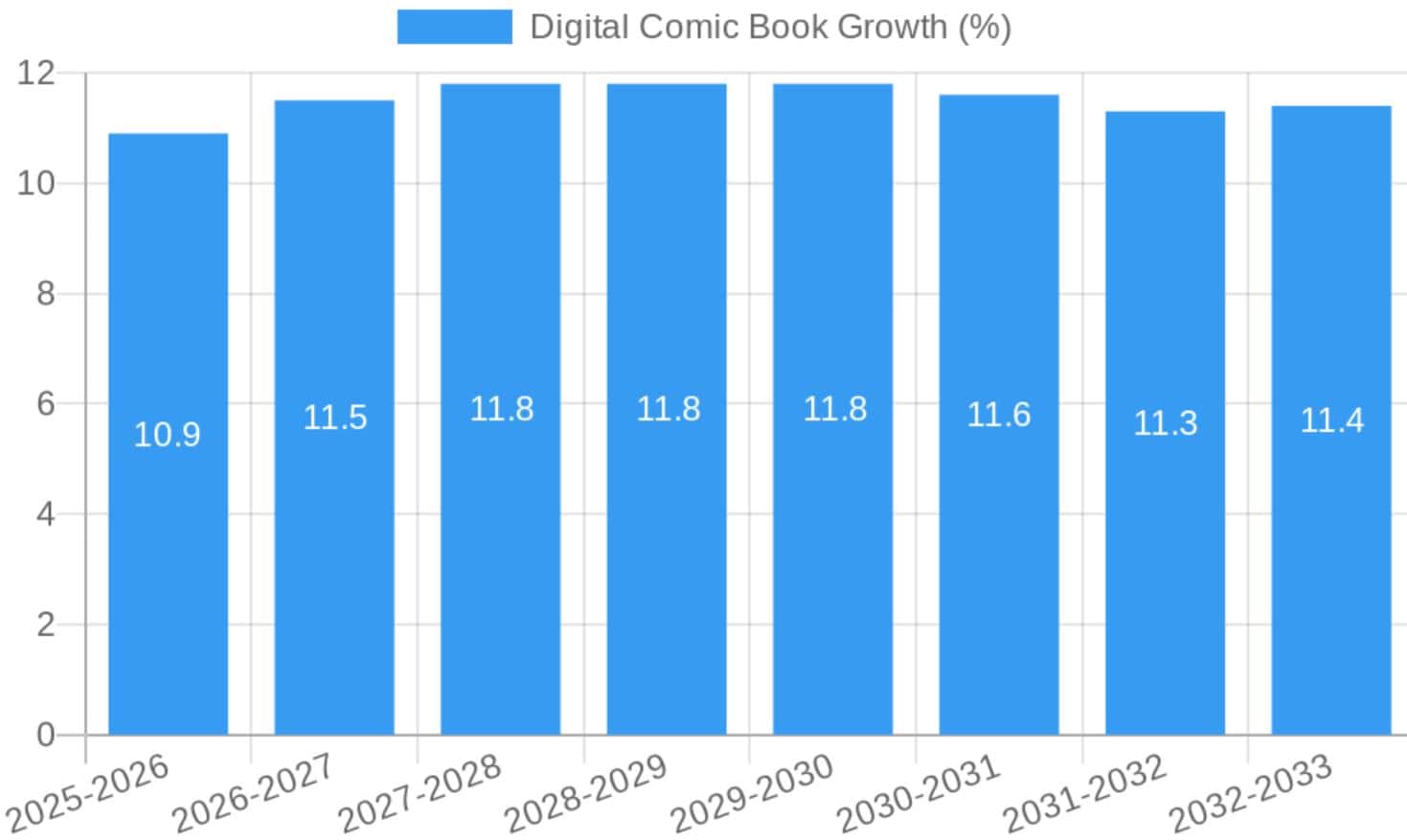
- The digital comic book market is projected to grow by approximately 10.9% in 2025-2026, followed by 11.5% in 2026-2027, and 11.8% in each of the periods from 2027 to 2028 and from 2029 to 2030.
- Growth then slightly eases to 11.6% in 2030 to 2031, 11.3% in 2031 to 2032, and 11.4% in 2032 to 2033.
By Geography
Japan
- According to Animenomics, Japan’s digital manga comics earned about USD 3.3 billion (¥483 billion) in 2023.
- Moreover, 90% of the nation’s ebook/digital publishing market and about 30% of all publishing sales.
- AldusNet, using Wise forex data, estimates the 2019 comics market at approximately USD 3.0 billion (€2.6 billion), with 55% digital.
South Korea
- South Korea’s webtoon industry generated ₩2.189 trillion (around USD 1.5 to 1.6 billion) in 2023, with a 19.7% rise from 2022, according to Welcon/KED Global.
- In 2021, sales reached ₩1.57 trillion (USD 1.23 billion), and webtoons accounted for 76.5% of sector revenue (KOCCA/Korea Times).
- Exports in 2023 skewed toward Japan (40.3%), North America (19.7%), the China region (15.6%), Southeast Asia (12.3%), and Europe (8.2%) (Korea.net, Asia Economy).
North America
- In North America (The U.S.and Canada), the total comics and graphic novel market reached USD 1.28 billion in 2020.
- Of this, USD 160 million (12.5%) came from digital comics, rising to USD 170 million (approximately 8.19% of about USD 2.08 billion) in 2021, according to Publishers Weekly and WordsRated.
- The Aldus/EUDICOM study estimates that, in 2019, the U.S. comics market was worth about USD 1.07 billion (€927 million), around 15% of the global market.
- Besides, digital comics account for only 8.7% of U.S. sales, with the rest in print.
France
- France’s comics market was about USD 637 million (around €550m) in 2019, making up roughly 8% of global comics revenue, with digital comics contributing only 3%, according to Aldus/EUDICOM.
- By 2024, only 2% of French comics readers will have used digital formats.
- Meanwhile, French digital-comics platforms generate around USD 2.5 billion, and are projected to reach USD 5.8 billion by 2033 (with a CAGR of 10.2% from 2026 to 2033).
India
- According to Grand View Research and GlobeNewswire, the comic-book market in India was valued at about USD 687 million in 2024 and is projected to reach roughly USD 1.35 billion by 2030, implying a CAGR of around 12%.
- Digital platforms like Pratilipi Comics and Webtoon are driving consumption.
- Toonsutra, dubbed India’s leading webtoon app, has more than 1 million monthly active users as of 2025, according to MediaBrief and NewsMantra.
Digital Comic and Webtoon User Demographic Statistics
- According to a 2023 survey by WhaTech, 65% of millennials and Gen Z prefer digital comics over print.
- Meanwhile, in 2024, estimates suggest 40% of Webtoon readers are 18 to 24, 35% are 25 to 34 (around 75% aged 18 to 34), and over 90% access via mobile devices.
- In a 2025 market synthesis, the shop notes that 32% of global digital-comic readers are 18 to 34.
- Besides, digital formats account for about 25% to 45% of all comic sales, and around 70% of digital comic reading occurs on mobile devices.
- The same synthesis reports a 36% increase in female digital readership since 2020.
Reading Preferences Between Print And Digital Comics
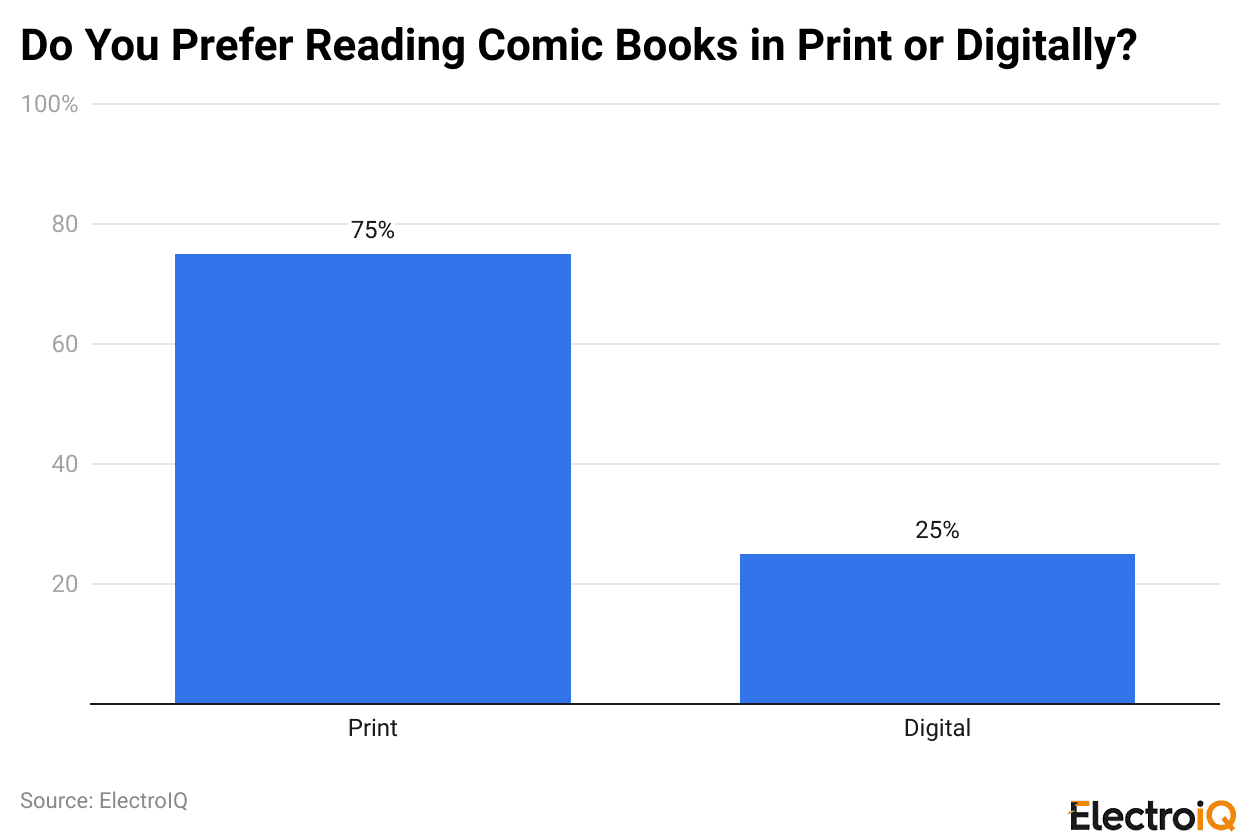
(Reference: statista.com)
- The Statista chart shows that 75% of respondents prefer reading print comics in 2025.
- Only 25% of respondents chose digital comics as their main reading format.
Digital Comics Preferences
- According to pdxscholar.library.pdx.edu, the survey results show that printed comics are still slightly more popular, with 55.9% of readers choosing printed formats compared to 44.1% who prefer digital comics.
- Meanwhile, 88.3% reported reading both printed and digital comics, while only 11.7% said they do not read both.
- Approximately 78.2% reported using a digital comics subscription service, and the remaining 21.8% reported not using one.
Conclusion
Digital comics are growing very fast and changing how people make, share, and read stories. More readers now use phones and tablets, and they enjoy many kinds of comics from all over the world. Numbers like views, subscribers, and how often people finish episodes help creators improve their work and choose how to earn money. Digital comics do not replace printed books; they sit beside them. Together, they create a mixed world of comics where easy access, fun features, and personal choices will keep pushing growth.
FAQ.
Digital comics are commonly read on smartphones, tablets, laptops, desktop computers, and compatible e-reader devices.
Readers use webtoon apps, ebook readers, comic viewer apps, and publisher websites to read comics.
Digital comics commonly use PDF, JPG, PNG, CBR, CBZ, and EPUB formats for viewing online.
Some digital comics are free, but many cost money; it depends on the platform, creator, and series chosen.
Plan story, design characters, draw panels digitally, add text, format pages, export, and publish online.

Maitrayee Dey has a background in Electrical Engineering and has worked in various technical roles before transitioning to writing. Specializing in technology and Artificial Intelligence, she has served as an Academic Research Analyst and Freelance Writer, particularly focusing on education and healthcare in Australia. Maitrayee's lifelong passions for writing and painting led her to pursue a full-time writing career. She is also the creator of a cooking YouTube channel, where she shares her culinary adventures. At Smartphone Thoughts, Maitrayee brings her expertise in technology to provide in-depth smartphone reviews and app-related statistics, making complex topics easy to understand for all readers.