Mercedes-Benz Statistics By Sales, Revenue And Facts (2026)

Updated · Apr 08, 2026


Table of Contents
- Introduction
- Editor’s Choice
- Mercedes-Benz 2025 Sales Performance By Segment
- Mercedes-Benz Sales By Region
- Mercedes-Benz Vans Unit Sales By Segment 2025
- Mercedes-Benz 2025 Revenue Breakdown
- Mercedes-Benz 2025 Financial Performance
- Mercedes-Benz 2025 Cash Flow
- Mercedes-Benz Energy Consumption
- Mercedes-Benz’s Capital Expenditure
- Mercedes-Benz Strategic Investments Review 2025
- Comparative Analysis – Mercedes-Benz vs. BMW and Audi
- Conclusion
Introduction
Mercedes-Benz Statistics: Mercedes-Benz Group is changing the worldwide luxury car market through its new approach, which focuses on electric vehicles, high-end products, and digital transportation solutions. The company faced unstable conditions between 2025 and 2026 because of worldwide political conflicts, import duty restrictions, and rising competition from Chinese electric vehicle companies. Mercedes-Benz achieved more than revenue because it maintained strong revenue streams while concentrating on high-profit luxury vehicles and cost reduction strategies.
The company’s performance shows how it changed from expanding through sales increases to achieving profitable growth through its premium products, electric vehicle development, and research into new technologies.
Editor’s Choice
- Mercedes-Benz Group’s total unit sales declined 9% to 1.80 million in 2025.
- Top-End segment sales fell 5% to 268,026 units, with S-Class down 17% to 105,564 units.
- Core segment volumes dropped 10% to 1.05 million units because of model lifecycle and electric vehicle competition.
- The entry segment experienced a 10% decline because smart brand sales decreased by 99%.
- The sales of electrified vehicles remained unchanged at 368700 units, which accounted for 20.5% of the overall sales mix.
- The sales of BEVs decreased by 9% to 168823 units, whereas PHEV sales increased by 9% to 199877 units.
- The vans division experienced an 11% year-on-year sales drop, which resulted in 359136 unit sales because of reduced logistics needs.
- The sales of electrified vans experienced a 46% increase, which resulted in 28488 unit sales and a mix increase from 48% to 79%.
- Total revenue declined 9% to €132.2 billion because of decreased volume and a return to regular pricing.
- The revenue of Mercedes-Benz Cars decreased by 11%, which resulted in a total revenue of €96.4 billion that made up 73% of all revenue.
- The Asian revenue decreased by 20% while China experienced a 29% decrease, which resulted in the worst performance among all regions.
- The gross profit decreased by 22% to €22.3 billion, which showed that the company experienced major margin reductions.
- The net profit decreased by 49% to €5.3 billion while earnings per share decreased from €10.19 to €5.34.
- The company increased its research and development spending by 9% to €6.1 billion, which demonstrates its commitment to electrification and innovation.
- The industrial free cash flow experienced a 41% decline to €5.4 billion because of decreased operating cash flow and increased investment expenditures.
Mercedes-Benz 2025 Sales Performance By Segment

(Source: group.mercedes-benz.com)
- According to Mercedes-Benz Group Investor Relations (Annual Report 2025), the 2025 unit sales data of Mercedes-Benz shows a strategic transition period, which does not represent a decrease in sales volume.
- The company experienced a unit sales decline of 9%, which resulted in total sales decreasing to 1.80 million units because demand returned to normal after the strong sales of 2024 and current economic conditions.
- The Top-End segment, which serves as a major profitability source, experienced a 5% decrease to 268026 units because S-Class sales decreased by 17% to 105564 units.
- The company experienced weak performance in some areas, yet Mercedes-AMG (+1%) and G-Class (+14%) showed strong results, which proved that consumers still wanted to buy high-performance and exclusive luxury products.
- 6% decline in Mercedes-Maybach sales, which demonstrated that the ultra-luxury market faced reduced demand.
- The Core segment, which produces the highest volume, experienced a 10% decline, which brought total output down to 1.05 million units.
- The E-Class model (-10%) and C-Class model (-8%) experienced challenges because of their current model updates and the rising market presence of competitive electric vehicle products.
- The Entry segment experienced a 10% decline because B-Class (-17%) and A-Class (-5%) failed to meet expectations, and the smart brand experienced a complete market exit with a 99% decline.
- The key accomplishment centers around the electrification strategy, which serves as a core growth driver for upcoming business development.
- The company maintained its electrified vehicle sales at 368700 units while its internal operations experienced complete organizational changes.
- The market for Battery Electric Vehicles (BEVs) experienced a 9% decline, which resulted in 168823 unit sales because certain regions showed decreased electric vehicle (EV) adoption rates.
- The market for Plug-in Hybrid Vehicles (PHEVs) experienced 9% growth, which resulted in 199877 unit sales, showing that consumers prefer to use transitional technologies.
- The share of electrified vehicles increased to 20.5%, which represents a 2% growth from 18.5% in 2024. This increase shows that our organization is making steady progress towards achieving its sustainability targets, even though our production capacity has been restricted.
- The metrics confirm margin-focused growth, portfolio recalibration, and electrification transition as central themes. While short-term sales volumes softened, Mercedes-Benz continues to prioritize high-value segments, premium mix optimization, and hybrid-driven electrification, positioning itself for long-term resilience in the evolving global automotive market.
Mercedes-Benz Sales By Region

(Source: group.mercedes-benz.com)
- The sales data for Mercedes-Benz in 2025 shows that the company is currently implementing a strategic shift because of declining sales and changes in the growth of the electric vehicle market.
- The global automotive markets experienced a demand reduction, while the macroeconomic conditions resulted in a 9% decrease in total unit sales, which reached 1.80 million units.
- The Top-End luxury segment declined 5% to 268,026 units, driven by a sharp 17% drop in S-Class sales, a key flagship model.
- The performance of Mercedes-AMG and G-Class vehicles maintained strong demand for high-performance vehicles and G-Class vehicles, which serve as essential components for maintaining profitable operations.
- The Core segment, which represents more than 58% of total sales, experienced a 10% decline, while E-Class sales decreased by 10% and C-Class sales dropped by 8% because of vehicle lifecycle changes and the increasing competition from electric vehicles.
- The Entry segment experienced a 10% decline, with B-Class sales dropping 17% and smart vehicle sales showing a 99% decrease because of imminent total portfolio changes.
- The sales of electrified vehicles (xEV) reached 368,700 units during the reporting period, while BEV sales decreased by 9% and plug-in hybrid sales grew by 9%, which shows that consumers are starting to move toward a new phase.
- The main themes of the study include premiumization and electrification, product mix optimization, and margin focus, which together create a foundation for Mercedes-Benz to achieve sustainable growth in the future, while current sales conditions create difficulties.
Mercedes-Benz Vans Unit Sales By Segment 2025

(Source: group.mercedes-benz.com)
- The Mercedes-Benz Vans division during 2025 shows two different paths, which include decreased sales and changes brought about by electric vehicle development.
- Total unit sales declined 11% YoY to 359,136 units, which represents decreased demand for logistics and commercial mobility services as the economy returned to its normal state.
- The Commercial Vans segment, which generates more than 83% of total van sales, saw a 13% decrease that brought its sales total to 298,655 units.
- The large vans category, which includes Sprinter and eSprinter, experienced a 14% decline, while the mid-size vans category, which includes Vito and eVito, showed the same 14% decrease because of temporary fleet demand drops and businesses putting off their capital equipment purchases.
- The Small vans category, which includes Citan and eCitan, maintained its position with only a 2% decline, which demonstrates that last-mile delivery solutions have maintained their effectiveness.
- The Private Vans segment experienced a stable performance, which resulted in a 2% decrease that brought its total volume to 60481 units.
- The T-Class and EQT small private vans showed strong growth with a 32% increase, which demonstrates that consumers are becoming more interested in compact mobility solutions that serve their lifestyle needs.
- The main observation from the research shows that the electrification strategy serves as a core initiative that will determine the company’s future expansion.
- The electrified van market experienced a 46% growth, which brought sales to 28488 units, and this increase raised their market share from 48% to 79%.
- The electric vehicle market for commercial vehicles (eVans) shows strong growth because of the current trend toward electric vehicle adoption.
- Mercedes-Benz operates its business through two strategic approaches, which require short-term volume reductions while the company increases its market presence through electric vehicle technology and product variety and premium van products, which help the company adapt to changes in the transportation industry.
Mercedes-Benz 2025 Revenue Breakdown

(Source: group.mercedes-benz.com)
- The revenue performance of Mercedes-Benz in 2025 shows a comprehensive decrease, which results from regional market weaknesses and declines in specific product categories.
- The group experienced a 9% revenue decrease, which brought total revenue down to €132.2 billion because of economic conditions and reduced vehicle sales, and restored pricing levels.
- Mercedes-Benz Cars, which serves as the main revenue source for the company, generated 73% of total revenue, but its revenue declined 11% to €96.4 billion because of decreased unit sales and changes to vehicle models.
- Mercedes-Benz Vans’ revenue dropped 11% to €17.1 billion because of decreased demand from commercial customers.
- Financial Services experienced less decline than other segments because its revenue only decreased 2% to €24.6 billion, as financing and leasing operations maintained their regular level, thus protecting essential profit margins.
- Europe emerged as the dominant market, which generated €57.9 billion (-1%), because it showed economic resilience despite facing international economic challenges.
- The North American market declined 11% to €34.6 billion, while the U.S. market dropped 11% because luxury demand decreased.
- The decrease in premium vehicle demand and rising competition caused Asia (-20%) to experience its most severe decline, which particularly affected China (-29%).
Mercedes-Benz 2025 Financial Performance
- The 2025 financial results of Mercedes-Benz demonstrate traditional margin compression patterns, which show that cost efficiencies and strategic investments have been unsuccessful because of declining revenues and external market conditions.
- The company achieved its cost optimization and operational efficiency goals, yet its profitability metrics experienced severe deterioration.
- Sales expenses dropped to €109.9 billion (6% YoY decrease) because of reduced product sales and improved purchasing and manufacturing efficiency, which formed the core elements of Mercedes-Benz’s cost leadership approach.
- The organization experienced reduced savings because of increased tariff costs and additional financial service provisions and expenditures for the “Next Level Performance” transformation program, which proved to be ongoing restructuring expenses.
- The company experienced cost control problems, which resulted in gross profit declining to €22.3 billion from its previous level of €28.6 billion, which represented a 22% decrease.
- The operating expenses of the company showed a reduction in selling costs, which dropped to €9.7 billion, while general administrative expenses stayed at €2.5 billion, which showed effective management of operational costs.
- The efficiency initiatives achieved their goals by reducing expenses that businesses incurred through their restructuring activities while management maintained its commitment to operational efficiency and protection of profit margins.
- The research and development (R&D) budget reached €6.1 billion, which marked a 9% increase because the company continued its funding of electrification efforts and digitalization projects and its development of innovative technologies, which play vital roles in determining the future of the automotive sector.
- The increase demonstrates that Mercedes-Benz pursues its long-term objective of technological dominance, which results in short-term earnings cost.
- The company experienced a major decrease in other operating income, which fell to €0.5 billion because of one-time costs tied to selling assets in Argentina, while the previous year had a legal provision reversal, which generated higher income.
- The income from equity-method investments stayed constant at €1.1 billion because the joint ventures experienced both asset decline and reduced capital investments.
- The tax system provided businesses with partial financial relief because their effective tax rate decreased to 15.2 percent, which resulted from two factors: their pre-tax income fell, and they benefited from German tax law changes.
- The company experienced a net profit decrease to €5.3 billion, which represented a 49% drop, while the earnings per share (EPS) declined to €5.34 after reaching €10.19, which demonstrated decreased shareholder returns.
- The decrease in average shares outstanding to 962.4 million shares through previous buyback programs protected EPS from falling further while demonstrating that the company will keep investing in its business operations to benefit shareholders.
- The financial reports from Mercedes-Benz show that 2025 operates as a transitional period, which brings together financial difficulties and corporate development, along with operational changes.
- The company faces a short-term earnings decline, yet it builds foundations for future sustainable growth by investing in cost-efficient operations and electric vehicle technologies and optimizing its business portfolio.
Mercedes-Benz 2025 Cash Flow

(Source: group.mercedes-benz.com)
- The cash flow performance of Mercedes-Benz 2025 shows that business operations showed decreased cash flow results because net cash flow from operations dropped, and the company continued to spend money on projects.
- The industrial business experienced a free cash flow (FCF) decrease of 41%, which resulted in €5.4 billion for the current year, compared to €9.2 billion in 2024, which indicates that the company will face short-term financial difficulties.
- The primary driver was a decline in cash flow from operating activities, which fell to €14.8 billion (-15%) because of decreased earnings (EBIT), margin reductions, and working capital requirements.
- The automotive industry experiences profit compression and demand normalization, which reflects overall market trends.
- The company maintained an ongoing negative cash flow from investing activities at -€8.6 billion, which demonstrates its ongoing capital expenditures (CapEx) and its investments in electrification and EV platforms and digital transformation, which serve as vital drivers of its long-term market competitiveness.
- The company faced additional financial challenges because marketable securities showed a decrease of -€275 million compared to the previous year, which produced a total of +€700 million in 2024.
- The right-of-use assets, together with other adjustments, created a total cash flow reduction of more than €500 million.
- Mercedes-Benz decreased its short-term free cash flow capacity, but it still focuses on its strategic investments and cost efficiency methods and long-term value generation, so it can achieve better cash flow results in the changing premium automotive market.
Mercedes-Benz Energy Consumption
(Source: group.mercedes-benz.com)
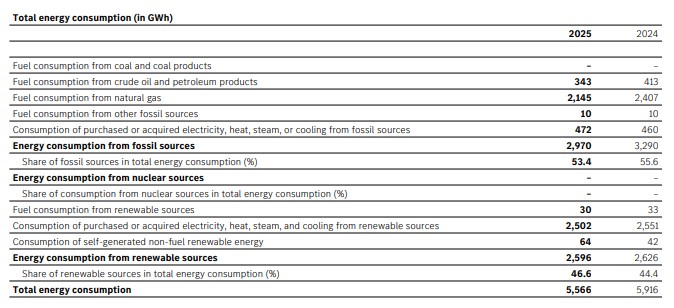
- The newest energy consumption statistics from Mercedes-Benz show that the company is making a gradual yet substantial change to its energy mix approach.
- The company achieved a 5.9% drop in total energy consumption, which decreased from 5,916 GWh in 2024 to 5,566 GWh in 2025, thus showing better energy efficiency and more efficient business operations.
- Fossil fuel usage shows a significant decline according to the analysis. Total fossil-based energy dropped from 3,290 GWh to 2,970 GWh, reducing its share from 55.6% to 53.4%.
- The main energy source, natural gas consumption, decreased by 10.9% from 2,407 GWh to 2,145 GWh, while petroleum-based energy dropped by 17% to demonstrate a specific movement toward using less carbon-heavy energy sources.
- The total renewable energy usage experienced a minor decrease from 2,626 GWh to 2,596 GWh, but the company achieved a higher renewable energy share of 46.6%, which supports its decarbonization efforts.
- The company experienced a significant growth in self-generated renewable energy, which rose by more than 52% from 42 GWh to 64 GWh, showing increased funding for on-site renewable energy facilities.
- The energy patterns of Mercedes-Benz demonstrate that the company uses a sustainable business model, which decreases emissions while preserving operational efficiency, thus establishing itself as an industry standard for environmentally friendly vehicle production.
Mercedes-Benz’s Capital Expenditure

(Source: group.mercedes-benz.com)
- The capital expenditure breakdown of Mercedes-Benz demonstrates its strategic shift towards funding sustainable initiatives while supporting growth that complies with environmental standards.
- The organization increased its total capital expenditure from €23,620 million in 2024 to €25,115 million in 2025, which represents a 6.3% increase from the previous year.
- The organization displays its dedication to developing assets that will bring value throughout the entire period of their useful life.
- The company spent 30.1% of its capital expenditures on taxonomy-compliant projects, but this percentage dropped to 29.4%, which shows that the organization has made only slight progress toward its alignment objectives.
- R&D, digitalization, and innovation efforts receive funding through intangible assets, which represent the organization.
- The highest alignment level is through capitalized development costs, which show 74.7% alignment because the organization seeks to create future mobility solutions.
- The organization reported its property, plant, and equipment assets at €5 482 million, which represents a 35 7% increase because the company expanded both its manufacturing capabilities and its electric vehicle charging network.
- The right-of-use assets exhibit a 17.9% alignment rate, while operating leases show a 6.6% alignment rate, which indicates that these areas provide minimal support to EU Taxonomy objectives.
- The financial metrics show that Mercedes-Benz pursues two goals because the company expands its operations while it develops sustainable practices that help it succeed in the changing green investment market.
Mercedes-Benz Strategic Investments Review 2025
- The 2025 performance evaluation of Mercedes-Benz associated companies proves that equity investments together with strategic partnerships and international joint ventures serve as essential elements for their business development and financial performance over extended time periods.
- Daimler Truck Holding AG operates as a main asset of Mercedes-Benz because it stands among the top three worldwide producers of commercial vehicles.
- Mercedes-Benz values this investment using the equity method, which shows its actual ownership share in the company as demonstrated through both operating profits and changes in asset worth.
- The company experienced a valuation decrease of €120 million in 2024, while its 2025 dividend revenue of €345 million created a major cash flow increase, which improved its financial position. The cash distribution, which resulted in a decrease of asset value amounting to €469 million, demonstrates the common pattern that shows how actual cash earnings affect asset worth on financial statements.
- The partnership between Daimler Truck and Toyota Motor Corporation, which combines their operations of Mitsubishi Fuso and Hino Motors into ARCHION Corporation, represents an important step to achieve worldwide business expansion while developing operational efficiency and a better market position in commercial mobility sectors.
- The partners established a 25% ownership target, which will create long-term value for their alliance, yet the financial advantages of their partnership will start to show results after 2026.
- The importance of Beijing Benz Automotive Co Ltd, BBAC, as a primary component of Mercedes-Benz’s China operations, which targets the world’s biggest automotive market.
- BBAC produced major dividend payouts of €881 million, which created significant cash flow benefits for the company in 2025.
- The distributions decreased the investment value, but they demonstrated strong earnings performance and operational strength of the company in China.
- The technology licensing agreement generated €189 million during 2024, which served as proof of intellectual property revenue streams that had become a vital revenue source.
- The planned €0.1 billion equity contribution further underscores the ongoing commitment to strengthening this partnership.
- The data reveals that the organization prioritizes four main areas of financial performance, which include equity income and dividend cash flows, international partnerships, and platform operational efficiencies.
- The associated companies provide Mercedes-Benz with two benefits, which include improved financial stability and access to different markets while enabling the company to benefit from upcoming transportation trends and international business partnerships.
Comparative Analysis – Mercedes-Benz vs. BMW and Audi
|
Metric (2025) |
Mercedes-Benz | BMW | Audi |
| Total luxury market share (global premium) | Part of ~80% triad share with BMW & Audi | Part of ~80% triad share with Mercedes & Audi |
Part of ~80% triad share with BMW & Mercedes |
|
BEV volumes (units) |
168,800 (‑9% YoY) | 442,072 (+3.6% YoY) | 223,000 (+36% YoY) |
| xEV (BEV + PHEV) volumes (units, approx.) | 537,400 (incl. 368,600 PHEVs) | Higher BEV mix; PHEV data not fully disclosedeqmagpro+1 |
Lower xEV base; strong BEV growth |
|
xEV share of own global sales (approx.) |
~29.8% global; ~40% in Europeelectrive+1 | Target: 25% of sales BEV by 2025 | Growing EV share; exact xEV mix not stated |
| BEV growth vs. 2024 | ‑9% decline | +3.6% growth |
+36% growth |
|
Positioning in the luxury EV space |
Strong xEV mix but PHEV‑heavy | BEV‑centric volume leader |
Rapidly growing challenger |
Conclusion
Mercedes-Benz Statistics: The 2025 performance of Mercedes-Benz Group shows a transitional period, which produces decreasing sales and diminishing profits because of economic challenges and its efforts to develop electric vehicles. The company operates its business with margin-based objectives, which they achieve by targeting high-end luxury markets and maintaining a balanced product line that includes PHEV vehicles. The company faced substantial challenges regarding revenue, profit, and cash flow, but their ongoing R&D investments, EV platform development, and digital transformation efforts demonstrate their commitment to achieving a sustained future growth vision.
The primary worry for the company lies in its current regional performance, which especially concerns the Chinese market. The combination of strong brand equity, premium positioning, and effective cost control strategies enables Mercedes-Benz to rebuild its profit margins while maintaining its dominant position in the changing global luxury auto market.
FAQ.
Mercedes-Benz sold 1.80 million vehicles globally, down 9% year-over-year.
In 2025, 20.5% of all sales came from electrified vehicles, according to the company.
The company experienced profit decreases because of reduced sales volume, increased expenses, tariffs and their rising expenditures for electric vehicle development and research and development.
The Asian market experienced the biggest loss, with revenue decreasing by 20%, and China’s revenue dropping by 29%.
The company raised its research and development budget to €6.1 billion while directing funding toward electrification and digitalization and next-generation automotive technology development

I hold an MBA in Finance and Marketing, bringing a unique blend of business acumen and creative communication skills. With experience as a content in crafting statistical and research-backed content across multiple domains, including education, technology, product reviews, and company website analytics, I specialize in producing engaging, informative, and SEO-optimized content tailored to diverse audiences. My work bridges technical accuracy with compelling storytelling, helping brands educate, inform, and connect with their target markets.