MiniMax AI Statistics And Facts By Model, Revenue, Trends and Rise of Innovation (2026)

Updated · Mar 14, 2026


Table of Contents
- Introduction
- Editor’s Choice
- MiniMax AI Revenue
- MiniMax AI’s IPO Signals Strong Investor Confidence In China’s AI Ambitions
- MiniMax Top-Performing Models
- How MiniMax’s Model Portfolio Balances Scale, Speed, And Cost Efficiency
- MiniMax-M2 Sets A New Performance Bar In Agentic And Developer Benchmarks
- Conclusion
Introduction
MiniMax AI Statistics: 2025 was a watershed year that characterized the tumultuous and fast-moving world of artificial intelligence, not only by the skyrocketing market valuations and mainstream AI adoption but also by the rise of new open-source models that challenged the incumbents. Among them, MiniMax AI was a remarkable story — an AI platform with the origin in China, which was able to combine the performance of state-of-the-art models with the use of an expanding global market, enterprises winning over government and scientific researchers.
From amazing architectural designs to incredible volumes of interactions, MiniMax’s trajectory in 2025 offers one of the most enchanting stories in the AI realm — where the innovation stemming from open-source caught up with real-world impact and economic value that was measurable. Thus, let us proceed to analyze the figures, the scientific side, and the strategic implications of MiniMax AI statistics in 2025.
Editor’s Choice
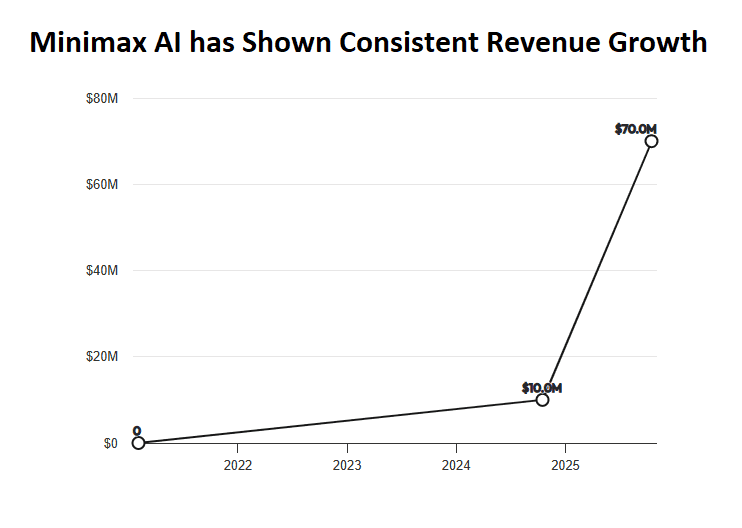
- MiniMax AI’s revenue skyrocketed from $10M in September 2024 to $70M in September 2025, showcasing a sevenfold increase in annual revenue.
- The company had a successful Hong Kong IPO, raising HK$4.82 billion (about $618.6 million) by offering shares at the top end of the range.
- Due to overwhelming investor demand, MiniMax AI decided to increase its IPO from the initially planned 29.2 million shares to 35.2 million.
- The Hong Kong IPO market had a record-breaking year in 2025, raising a total of $36.5 billion through 114 listings, with MiniMax AI being one of the major contributors to their strongest year since 2021.
- MiniMax M2 achieved 87.0% score even with a smaller parameter size of 230B, proving its efficiency in terms of cost and performance.
- MiniMax M1 40K got very close to that with a 96.0% score, which testifies to the consistent high performance across variants.
- On SWE-bench Verified, MiniMax-M2 scored 69.4, coming closer to GPT-5’s 74.9 and proving its near-frontier capability.
- MiniMax M1 80K achieved a leading 96.8% best score, supported by a 456B-parameter architecture.
- MiniMax M2.1 delivered a strong 91.5% score, highlighting efficient scaling across model generations.
MiniMax AI Revenue
(Source: getlatka.com)
- According to GetLatka, MiniMax AI’s financial trajectory follows a typical high-growth curve in the AI sector.
- The company, launched in 2021 and reporting no revenue at the time, was still in the early stages of development, but later experienced rapid growth.
- By September 2024, MiniMax AI was able to generate $10M in revenue, which was considered the company’s first major monetization milestone.
- However, 2025 turned out to be the game-changing year when the company’s revenue skyrocketed to $70M in September, marking a sevenfold increase in just one year.
- A rapid expansion can be attributed to strong product-market fit, growing enterprise adoption, and scalable demand across industries.
- Overall, MiniMax AI’s performance is an indicator of how quickly the right AI platforms can turn innovation into sustained, long-term commercial momentum.
MiniMax AI’s IPO Signals Strong Investor Confidence In China’s AI Ambitions
- MiniMax AI’s IPO in Hong Kong is an indication of the epoch-making turn for China’s home-grown artificial intelligence ecosystem.
- The company not only raised HK$4.82 billion (around $618.6 million) after the share price was set at the upper limit of the range, but also demonstrated strong institutional and market confidence.
- The sale of 29.2 million shares, higher than initially intended, indicates that demand far exceeds supply, a distinguishing feature of a successful listing.
- For MiniMax AI, the IPO is not just a monetary event, but also a recognition of its strategy to advance its technology, as it is one of the first tokenizers in China’s LLM development to go public.
- The larger context makes the event even more important. Currently, the market for IPOs in Hong Kong is being flooded by Chinese companies dealing with AI and chips, which, along with the price stability manifested by their post-listing prices, indicates that the investors are here for a long time and not just for short-term speculation.
- The support of such powerful investors as the Abu Dhabi Investment Authority and Mirae Asset Securities is a further factor making MiniMax AI more credible, and it is a sign of global trust in its long-run pros.
- In Hong Kong, $36.5 billion has been raised across 114 IPOs, the strongest year since 2021, and the company’s listing is not only a success for the company but also for the broader capital flow returning to Asia’s AI-driven growth story.
MiniMax Top-Performing Models
(Source: llm-stats.com)
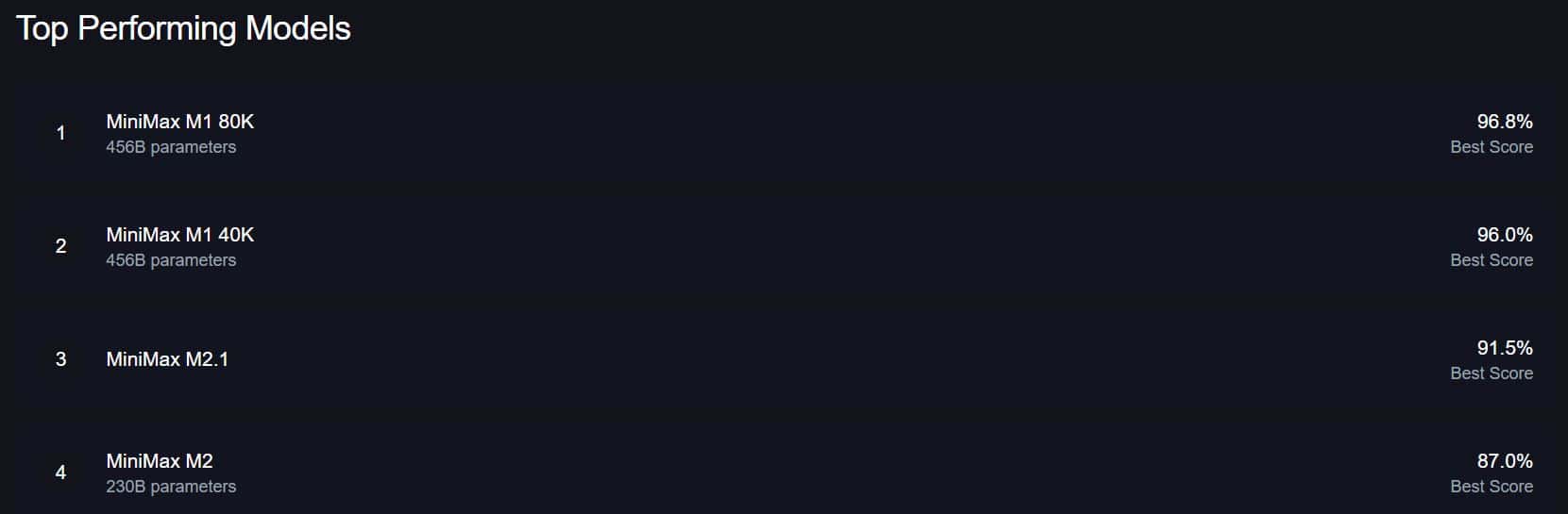
- According to IIm-stats.com, show that it is simple and yet very convincing: MiniMax AI has taken the lead very firmly in all its models.
- The rankings reveal a total domination by MiniMax models, indicating not gradual improvement but rather a deliberate performance optimization throughout.
- The winner is MiniMax M1 80K, which gets a stunning score of 96.8%, best of all, marking the highest point for the large-scale language models with its huge 456B parameter structure.
- Very near is MiniMax M1 40K, which is also based on the same parameters and gets a score of 96.0%, which is almost the same, meaning it is also very consistent and not dependent on a single high-end variant.
- MiniMax M2.1 has a score of 91.5%, and MiniMax M2, despite using a much smaller 230B parameter limit, still scores a strong 87.0%. This performance gradient is indicative of effective scaling, not just compute power. At a minimum, MiniMax AI indicates that it can cater to both premium and budget-sensitive markets.
- The concentration of top places indicates that MiniMax AI is not opportunistically chasing benchmarks but rather, constructing a coherent, high-performing ensemble of models that compete with global leaders while providing various performance levels for real-world adoption.
How MiniMax’s Model Portfolio Balances Scale, Speed, And Cost Efficiency
| Model | Core Positioning | Key Technical Strengths | Release & Access |
| MiniMax M1 (80K / 40K) | Long-context, open-source reasoning powerhouse | Hybrid-attention architecture that supports 1 Million token context and 80K reasoning output; Lightning Attention reduces compute to ~30% of DeepSeek R1; CISPO RL algorithm increases convergence speed by a factor of two; trained on 512 H800 GPUs for 3 weeks | Date of Release: June 16, 2025; M1 80K cost $0.55/M input & $2.20/M output; API through Novita and unified gateway |
| MiniMax M2.1 | Multilingual, production-grade coding model | Top-notch quality in Rust, Java, Golang, C++, Kotlin, JS/TS, high-grade Android and iOS development, better DSDi and fD responses with lesser token usage; interfaces with major coding agents without hiccups | Launch Date: Dec 23, 2025; aked at $0.30/M input & $1.20/M output; via API= MiniMax |
| MiniMax M2 | Agent-centric, open-source workhorse | The best performance in tool usage, reasoning, and search, albeit being in a long-chain tool calling environment (Shell, Browser, Python) ~100 TPS inference speed; at 8% cost of Claude 3.5 Sonnet; ranking among the top five globally on Artificial Analysis | Date of Issue: Oct 27, 2025; charged at $0.30/M input & $1.20/M output; accessible through MiniMax & Novita; weights available on Hugging Face |
(Source: llm-stats.com)
MiniMax-M2 Sets A New Performance Bar In Agentic And Developer Benchmarks
- According to the benchmark results, MiniMax AI is not only one of the best-performing models among open-weight systems-up-and-coming but also a serious competitor to the leading proprietary models.
- The scores of the MiniMax-M2 show a pattern that, more than any one metric, consistency, almost at the frontier, of all possible diverse, real-world workloads.
- On SWE-bench Verified, a score of 69.4 puts it very close to GPT-5’s 74.9, indicating strong software engineering and code reasoning capabilities, which are crucial for production use.
- MiniMax-M2 ArtifactsBench score of 66.8 is higher than that of Claude Sonnet 4.5 and DeepSeek-V3.2, meaning it can better manage structured outputs and tool-oriented tasks.
- The model attains 77.2 on τ²-Bench, very near to GPT-5’s performance, thus highlighting its power in agentic reasoning loops. In GAIA (text-only), MiniMax-M2 beats DeepSeek-V3, thus strengthening its general reasoning depth.
- Most probably, the M2’s forward-looking strategy is the directive BrowComp and FinSearchComp-global. which are on it among the open models. This means that MiniMax-M2 is an enterprise-level agent in terms of strong retrieval, browsing, and financial reasoning capabilities, which are critical to them.
Conclusion
MiniMax AI Statistics: The roadmap for MiniMax AI in 2025 showcases an extraordinary convergence of technical superiority, commercial efficiency, and market timing. The company’s rapid, dramatic revenue growth, an IPO that was very well received, and strong institutional support are more than just hype—they point to lasting demand and an increasing level of trust in its platform. The company’s wide-ranging portfolio of models is the one thing that is equally gripping; it does so by providing a good balance of top-quality performance, cost control, and real-world usability.
While different models and techniques are being tested and compared in benchmarks, MiniMax AI remains approachable and open, positioning itself as a legitimate contender against established alternatives. Simply put, the company’s growth story is the tale of disciplined innovation, turned into a large-scale, worldwide cultivation of AI leadership.
FAQ.
MiniMax AI’s revenue skyrocketed to approximately $70 million by the end of September 2025, rising from $10 million in 2024, which represents a sevenfold increase year-over-year.
MiniMax AI went public in Hong Kong in 2025 and raised HK$4.82 billion (around $618.6 million) through its IPO; this has been considered a sign of strong investor confidence.
Among the institutional investors, Abu Dhabi Investment Authority and Mirae Asset Securities were the major ones that participated, thus confirming MiniMax AI’s international credibility.
MiniMax M1 80K, M1 40K, M2.1, and M2 are the top models of MiniMax, with their scores on the benchmarks ranging from 87.0% to 96.8% and dominating different leaderboards.
MiniMax AI’s capabilities come in handy mostly in the areas of software engineering, enterprise automation, financial analysis, multilingual development, and agent-based workflows.

I hold an MBA in Finance and Marketing, bringing a unique blend of business acumen and creative communication skills. With experience as a content in crafting statistical and research-backed content across multiple domains, including education, technology, product reviews, and company website analytics, I specialize in producing engaging, informative, and SEO-optimized content tailored to diverse audiences. My work bridges technical accuracy with compelling storytelling, helping brands educate, inform, and connect with their target markets.