Volvo Statistics By Insights And Trends (2026)

Updated · Apr 02, 2026


Table of Contents
- Introduction
- Editor’s Choice
- Volvo Group Performance Outlook
- Volvo Group Strategic Financial Targets vs 2025 Performance
- Volvo Group Segment-Wise Revenue Breakdown
- Volvo Group Regional Revenue
- Volvo Group High Investments, Strategic Divestments, and Cash Flow Dynamics
- Volvo Group Trucks Segment 2025
- Volvo Equity and the Number of Shares
- Volvo Workforce Geographic Composition
- Strategic Shift – The “CELLCENTRIC” Hydrogen Joint Venture
- Conclusion
Introduction
Volvo Statistics: The global automotive industry depends on two main components, which include Volvo Group and Volvo Cars, and their combined operations that cover commercial vehicles, electric vehicle technology, and luxury car manufacturing. The period from 2025 to 2026 serves as a transitional stage because the market experiences reduced demand while companies establish their electrification programs and implement cost-saving measures.
Volvo maintains its business strength through service revenue growth and its investment in technology and the development of strategic business alliances, despite facing economic challenges, which include rising inflation, increased tariffs, and changes to electric vehicle incentive programs.
The article presents research-based Volvo statistics that demonstrate Volvo’s financial results, sales performance, and profit evaluation through the use of authentic numerical data and market research.
Editor’s Choice
- Volvo Group reported adjusted operating income of SEK 51.2 billion in 2025, down from SEK 65.7 billion.
- Yearly operating margin decreased from 12.5% to 10.7% because of decreasing demand.
- The company experienced a 9% decrease in net sales, which reached SEK 479.2 billion.
- Service revenue grew 2% to SEK 124.0 billion, which represented 26% of total revenue.
- The service segment achieved a strong 13% CAGR (2021–2025), which exceeded the group CAGR of 7%.
- ROCE reached 25.3% in 2025, while the 5-year ROCE average stood at 30.1%.
- The company showed capital spending through its financial assets decreased from SEK 85.9 billion to SEK 63.0 billion.
- The Trucks segment experienced a 10% revenue decline, which reached SEK 323.5 billion because of reduced freight demand.
- Construction Equipment revenue decreased 8% to 81.6 billion.
- The company delivered 202,911 units of trucks, which represented an 8% decrease from the previous year.
- The market experienced an 18% increase, while fully electric truck deliveries grew 8% to 4,006 units.
- The company experienced a 43% YoY increase in total investments, which reached 26.1 billion because of its electrification efforts.
- Net income fell 31.6% to SEK 34.46 billion, which reduced EPS to SEK 16.94.
- The company experienced a 2.0% decrease in its workforce, which now totals 89,188 employees, because of its efficiency measures.
- Volvo Connect ecosystem enables digital revenue growth through its support of more than 1.2 million connected vehicles.
Volvo Group Performance Outlook
(Source: volvogroup.com)
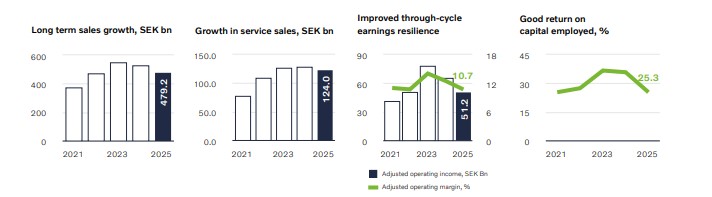
- The Volvo Group started 2025 with a solid financial base, yet experienced a decline in vehicle sales throughout the year, especially in North America and South America, while European sales remained steady.
- The company achieved earnings stability during difficult situations by producing an adjusted operating income of SEK 51.2 billion, which decreased from SEK 65.7 billion in 2024, while showing an operating margin of 10.7% that fell short of the previous 12.5% mark.
- Volvo’s high-margin service business operated as a main stabilizing element because its net sales after currency adjustments increased by 2% to SEK 124.0 billion, which represented 26% of total group revenue.
- The segment demonstrated strong growth between 2021 and 2025 by achieving a 13% compound annual growth rate, which exceeded the group’s overall 7% compound annual growth rate while net sales increased from SEK 372.2 billion to SEK 479.2 billion.
- The company established a strategic path toward recurring revenue streams through its focus on aftermarket services and lifecycle solutions, which currently serve as essential automotive industry terms for profitability assessments.
- Volvo plans to move its capital resources into higher-return projects by selling its 70% stake in SDLG and buying Swecon, which will help the company expand its construction equipment distribution operations.
- Business profitability measures showed minor decreases in 2025, yet they still demonstrate strong performance.
- The company maintained an average operating margin of 11.8% (2021–2025) while Return on Capital Employed (ROCE) stood at 25.3% in 2025, with a five-year average of 30.1%, which showed efficient capital usage and strict control of financial operations.
- Volvo uses its position in long-term growth sectors, which include transport and infrastructure, and construction equipment, to create a business model that enables it to handle market fluctuations.
- The performance metrics that Volvo uses to measure its 2025 results include earnings resilience, service revenue growth, capital allocation strategy, operating margin stability, and ROCE efficiency.
- Volvo Group maintains a strong market position through its strategic flexibility, multiple revenue sources, and effective financial management because market weakness has decreased its business operations.
Volvo Group Strategic Financial Targets vs 2025 Performance
(Source: volvogroup.com)
- Volvo Group demonstrates its commitment to financial discipline through its practice of matching long-term goals with actual industry market trends.
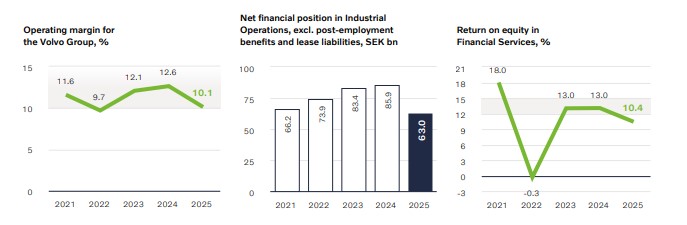
- The company uses its operational margin goal, which requires all business activities to achieve 10% margin capacity throughout the entire business cycle, as its main standard for assessing profitability.
- Volvo achieved an operating margin of 10.1% in 2025, which served as its strategic goal despite being lower than the 12.6% operating margin that the company achieved in 2024.
- The 2021–2025 average operating margin of 11.2% and adjusted average of 11.8% show that margins stay stable while automotive companies practice cost management, which serves as a vital performance metric for their industry.
- Volvo sets its zero net financial indebtedness target as a means to maintain a conservative capital structure approach, which underpins its balance sheet management.
- The company reported its financial asset position at SEK 63.0 billion in 2025, which showed strong liquidity and controlled capital spending, although it decreased from SEK 85.9 billion in 2024.
- The Financial Services operation had a target return on equity (ROE) of 12–15%, which it failed to meet because the actual ROE reached 10.4% in 2025, despite the equity ratio increasing to 10.0%, which surpassed the 8% benchmark because of regulatory changes.
- Between 2021 and 2025, historical ROE performance, except for Russia and Belarus operations, showed higher strength, which averaged 13.2%.
Volvo Group Segment-Wise Revenue Breakdown
(Source: volvogroup.com)
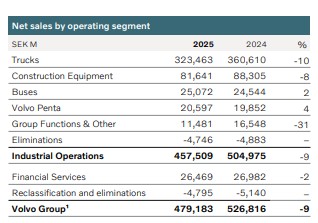
- The revenue performance of Volvo Group in 2025 showed mixed results because of both existing business operations and newly launched market initiatives.
- The total net sales showed a 9% year-on-year decrease, which resulted in SEK 479183 million total revenue because of economic difficulties that affected important markets.
- The Trucks segment, which serves as the main source of income for the company, reported SEK 323463 million in revenues, which marked a 10% decrease from the previous year because of reduced freight demand and the shift back to typical operations after peak business periods.
- The Construction Equipment business experienced an 8% revenue decrease to SEK 81641 million, which indicated a decrease in infrastructure and construction work delivery that serves as a primary benchmark for market demand.
- The Buses segment experienced minimal progress, which resulted in a 2% revenue increase that brought total sales to SEK 25072 million, while Volvo Penta showed a 4% revenue increase that brought total sales to SEK 20597 million, which demonstrates strong market performance in specialized marine and industrial fields.
- Group Functions & Other experienced a 31% revenue decrease, which negatively affected total business results.
- Financial Services operates as a vital success factor because its operations generated SEK 26469 million in revenue, while only showing a 2% revenue decrease, which demonstrates how recurring income and financing solutions protect income stability.
- The Industrial Operations sector showed a revenue decline of 9%, which resulted in total revenue of SEK 457509 million because operational challenges affected company performance, but the company maintained stability through its various business operations.
Volvo Group Regional Revenue
(Source: volvogroup.com)
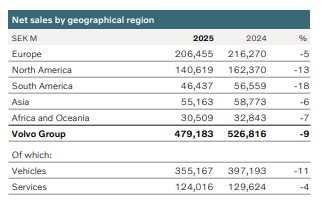
- The 2025 geographical revenue distribution of Volvo Group shows that all worldwide markets experienced a revenue decrease, which resulted in total net sales dropping 9% from the previous year to reach SEK 479183 million.
- The current trend shows how economic factors, together with diminished transportation requirements and seasonal patterns, affect vital geographic areas.
- The European market represents the company’s primary revenue source, which produced SEK 206455 million for the company, although revenue decreased by 5% compared to the previous year.
- The European market has maintained its stable position because infrastructure requirements remain constant and fleet renewal programs continue to operate, which establishes itself as the main indicator of regional stability.
- North America experienced a 13% decrease, which brought total revenue down to SEK 140619 million, as freight operations reduced their activity after the industry experienced its peak period.
- South America experienced its largest revenue decrease of 18%, which resulted in total revenue dropping to SEK 46437 million because of multiple economic fluctuations and declining investment patterns, which represent a major risk for developing markets.
- Asia experienced a 6% revenue decline, which brought total revenue to SEK 55163 million, while both Africa and Oceania showed a 7% revenue decrease, which resulted in total revenue reaching EUR 30509 million.
- The global demand for products from developing countries shows weak performance, as development areas experience decreased market activity.
- The company experienced a 11% drop in vehicle sales, which resulted in total revenue reaching 355167 million, whereas services revenue maintained its strong performance for the company.
- The company needs to focus on aftermarket services and regular income sources because they play a crucial role in sustaining its business operations.
Volvo Group High Investments, Strategic Divestments, and Cash Flow Dynamics

(Source: volvogroup.com)
- Volvo Group executed a capital-intensive growth strategy in 2025, directing SEK 26.1 billion toward electrification and infrastructure development and portfolio expansion.
- The company’s total industrial operations expenditures reached SEK 26.1 billion, which represents a 43 % year-over-year rise from the previous year’s expenditure of SEK 18.3 billion.
- The Trucks segment received the largest share of capital funds through its allocation of SEK 22.5 billion, which made up 86 % of the total investment budget.
- The current investment cycle focuses on three primary key elements, which include battery-electric trucks, production expansion, and product innovation.
- Volvo dedicated its major investment funds to building a new production facility in Mexico, which included electrification initiatives and plant renovations in Sweden.
- Construction Equipment funding decreased to SEK 1.7 billion, which the company used to improve electric machinery and develop new products. Buses spent SEK 0.6 billion, and Volvo Penta invested SEK 1.0 billion to make consistent yet specific product advancements.
- The company lost SEK 2.1 billion through its cash flow operations, which included investing and selling shares, because the company invested capital into its joint ventures.
- The company used its divestment from SDLG to generate a positive cash flow of SEK 0.8 billion, which resulted from its efforts to streamline its business operations.
- The financing operations experienced net borrowings, which rose by SEK 12.3 billion because the financial services credit portfolio expanded, which serves as a vital source of recurring revenue.
- Volvo provided significant shareholder value through its total dividend payments of SEK 37.6 billion, which included both standard and special distributions that supported its policy for returning value to shareholders.
- The company experienced a decrease in cash and cash equivalents, which amounted to SEK 11.8 billion; thus, its total cash position reached SEK 73.4 billion because it made substantial capital investments and paid out dividends.
Volvo Group Trucks Segment 2025
- Volvo Group’s trucks division achieved 2025 results because its profitability remained strong during periods of decreasing sales volume.
- The company reported net sales of SEK 323463 million, which showed a 10% decrease from the previous year and a 5% decrease when adjusted for currency changes because of lower delivery volumes.
- The total truck deliveries dropped to 202911 units, which represented an 8% decrease because of weakened global demand.
- The company achieved a strong adjusted operating margin of 9.8 % despite facing multiple challenges while generating adjusted operating income of SEK 31.73 billion.
- The company shows strong cost control together with pricing discipline and operational efficiency, which have become essential profitability metrics in the commercial vehicle industry, even though its performance dropped to 12.7% from 2024.
- The heavy-duty truck market in Europe experienced a 5% decline because replacement needs and current fleet operations remained constant.
- North America experienced a 15% drop because of weak freight activity and pricing challenges, and EPA 2027 emissions standards regulatory doubts affected the market badly.
- Interest rates in Brazil drove an 11% market contraction while agriculture and mining industries provided some market protection.
- India and China developed into emerging markets because infrastructure financing improvements and government programs created positive growth conditions.
- The market for fully-electric trucks expanded by 18% which reached 3,925 units, while deliveries to customers increased by 8% which reached 4,006 units.
- The company generated service revenues that increased by 3%, which helped to offset a 7% decrease in vehicle sales, showing how crucial aftermarket services and regular revenue streams are for business success.
- The decline in profit because of material expenses, tariffs, and negative currency effects resulted in SEK 3,472 million losses.
- Operating costs dropped while high-quality service delivery created an operational shield for the company.

(Source: volvogroup.com)
- The outstanding shares profile shows that the capital structure remains mostly constant, although it experiences minor internal changes that create significant effects.
- The total shares maintained their level at 2,033,452,084 throughout 2025 and 2024, which resulted in zero net dilution. This metric functions as a crucial component for measuring how effectively investors maintain their ownership stakes and how well the company manages its funds.
- The company maintains a stable operational state, yet it executes a substantial shift in its share class distribution.
- The A-shares experienced a decrease from 444.98 million to 444.29 million, whereas the B-shares showed an increase from 1,588.47 million to 1,589.16 million.
- The conversion of approximately 695,472 A-shares into B-shares created this strategic shift that aims to achieve better liquidity management and voting structure advancement.
- Companies implement equity restructuring to create a balance between their control over operations and the ability to access markets.
- The earnings per share (EPS) data show that the company experienced a decline in its profit. Basic and diluted EPS both dropped to SEK 16.94 in 2025, which represents a 31.6% decrease from the previous year.
- The company experienced a decline in net income, which dropped from SEK 50.39 billion to SEK 34.46 billion, creating a 31.6% drop in earnings.
- The company saw its average shares outstanding remain stable at 2,033 million, yet its earnings drop caused EPS to decrease because of earnings loss instead of dilution effects.
- The average share price of B-shares reached SEK 281.03, which represents a 2.9% increase from SEK 273.02 despite the company achieving lower earnings results. The market shows optimism because it predicts future growth or reacts to signs of economic recovery.
Volvo Workforce Geographic Composition

(Source: volvogroup.com)
- The workforce of AB Volvo operates in various regions around the world while maintaining consistent patterns of gender distribution across different areas.
- The Volvo Group workforce declined slightly to 89,188 employees in 2025, down from 90,995 in 2024, reflecting a -2.0% year-over-year contraction—a signal of operational efficiency measures and possible cost optimization.
- Sweden (subsidiaries) has established itself as the leading talent center, which employs 25,020 employees, who have increased their workforce by 2.8% since the previous year, because it functions as a principal center for innovation and engineering activities.
- The workforce in Western Europe (excluding Sweden) experienced a -3.2% decrease, which reduced its total to 20,487 employees because of ongoing market adjustments in established regions.
- The number of employees in North America decreased to 19,182 employees, which represents a 2.6% reduction, while Asia saw a 4.2% employee decline, which indicates adjustments to its unstable but rapidly expanding markets.
- The group achieved a 23% female representation boost from its previous 22% level, which demonstrates steady advancement toward achieving gender equality throughout its organization.
- The ratio of men to women in South America achieves 21% balance, and Eastern Europe reaches 26% balance, but Western Europe falls behind with a 19% ratio.
- AB Volvo Sweden operates with a total of 328 employees who maintain a balanced workforce because 49% of them are women.
- The organization has adopted a workforce management approach that creates operational efficiencies through its focus on maintaining diverse staff who work across multiple regions. The organization has developed three core values that help foster its long-term sustainability.
Strategic Shift – The “CELLCENTRIC” Hydrogen Joint Venture
|
Parameter |
Status / Figure |
| JV Formation Date |
1 March 2021 (Volvo acquires 50% for ~€0.6 billion) |
|
Shareholders |
Daimler Truck AG + Volvo Group (50/50) |
| Current Fuel Cell System |
BZA150 (in pilot production at Esslingen) |
|
Pilot Production Facility |
Esslingen-Pliensauvorstadt, inaugurated June 2024 |
| NextGen Fuel Cell System |
Up to 375 kW, 20% less fuel, 40% more power density vs BZA150 |
|
KLIMA |
WERK Site (Weilheim/Teck) |
| GenH2 Prototype Mileage |
>225,000 km across 5 customer deployments by Sept 2025 |
|
H2 Consumption (trial average) |
5.6–8.0 kg/100 km (16–34 tonne GCW range) |
| Mercedes-Benz NextGenH2 Truck |
100-unit small series, Wörth plant, customer deployment from the end of 2026 |
|
NextGenH2 Liquid H₂ Tank Capacity |
Up to 85 kg (dual tanks); refuel in 10–15 min via sLH2 standard |
| NextGenH2 Range |
Well beyond 1,000 km per fill |
|
German Government Grant (NextGenH2 programme) |
€226 million (Federal + state governments) |
| Mass Production Target |
Early 2030s (revised from “second half of this decade”) |
|
Required EU H₂ Refuelling Network (by 2030) |
2,000 stations for truck deployment at scale |
| Milence Shareholders |
Traton Group, Daimler Truck, Volvo Group |
|
Milence EU Grant (AFIF/MILES) |
€422 million |
| Milence MCS Points Announced (June 2025) |
284 MCS points at 71 locations, 10 EU countries, by 2027 |
|
Existing EU Truck Charging Points (Aug 2025) |
~1,100 truck-suitable public charge points |
Conclusion
The 2025 performance of Volvo Group shows a transitional period, which results in reduced vehicle demand while the company implements successful strategic changes. The company maintained its business operations despite a 9% decrease in revenue, which caused profit margins to shrink because its service division now generates more than 25% of total income. The company plans future growth by making substantial investments in its electrification projects and digital platforms, which include Volvo Connect, to create recurring income streams while improving operational effectiveness.
The company maintained financial discipline, which resulted in decreased profitability metrics but strong ROCE, together with consistent margins. Volvo maintains a positive long-term outlook, which results from its diverse product range combined with its commitment to sustainability and its growing software-based transportation solutions.
Sources
FAQ.
Volvo Group reported total net sales of SEK 479.2 billion, which represented a 9% decrease from the previous year.
Volvo Connect functions as a digital platform which connects more than 1.2 million vehicles to create recurring revenue through its data-based services.
In 2025, Volvo invested SEK 26.1 billion, which represented a 43% increase that primarily targeted electrification and infrastructure development.
The company delivered 4,006 electric trucks, which represented an 8% increase, while it invested heavily in electric vehicle and hydrogen technology development.
Truck revenue dropped 10% to SEK 323.5 billion because global demand declined, which led to an 8% drop in deliveries.

I hold an MBA in Finance and Marketing, bringing a unique blend of business acumen and creative communication skills. With experience as a content in crafting statistical and research-backed content across multiple domains, including education, technology, product reviews, and company website analytics, I specialize in producing engaging, informative, and SEO-optimized content tailored to diverse audiences. My work bridges technical accuracy with compelling storytelling, helping brands educate, inform, and connect with their target markets.