Video Conferencing Statistics By Market Size, Revenue, Usage, Device Used, Benefits, Trends and Facts (2026)

Updated · Jan 21, 2026



Table of Contents
- Introduction
- Editor’s Choice
- General Video Conferencing Statistics
- Video Conferencing Market Size Analysis
- Video Conferencing Revenue Statistics By Application
- Video Conferencing Market Share Statistics
- Video Conferencing Usage Statistics
- Video Conferencing Statistics By Device Used
- Savings Analysis of Video Conferencing
- Benefits of Video Conferencing
- Conclusion
Introduction
Video Conferencing Statistics: Video conferencing is now a major way people communicate. It lets individuals in different places see and talk to each other quickly and easily. In the past, this kind of meeting needed costly, special equipment, but today anyone can join using a laptop, smartphone, or tablet. Because of this, virtual meetings have become normal in schools, offices, hospitals, government work, and even everyday conversations. Using video calls helps people save travel money, avoid long trips, and work together from anywhere in the world.
Still, there are some problems, such as technical glitches, weak internet connections, and privacy concerns. As new tools such as artificial intelligence and virtual reality improve, video conferencing will likely become smoother, safer, and more interactive than it is now.
Editor’s Choice
- By 2025, the global video conferencing market size is expected to reach around USD 10 billion, up from USD 9 billion in 2024.
- In the same duration, the U.S. video conferencing market is expected to be worth USD 2.94 billion.
- In 2025, video conferencing will generate USD 4.8 billion from consumer applications and USD 5.2 billion from enterprise applications.
- As of 2024, Adobe Systems Incorporated held a strong position in the video conferencing market, capturing a leading 18% share.
- North America held 42% of the video conferencing market share, followed by Europe with 27%.
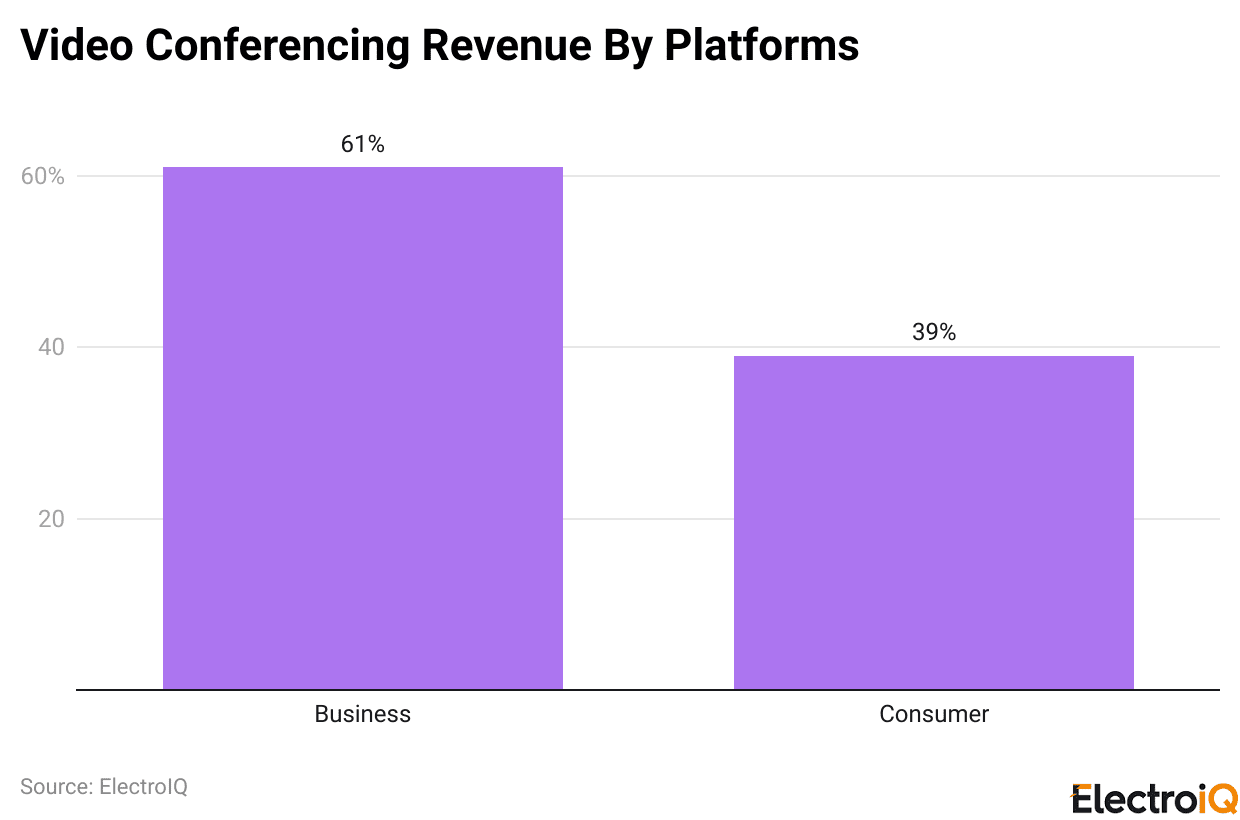
- In 2025, business platforms will generate most of the revenue from video conferencing, accounting for about 61%.
- Zoom dominates the video conferencing market, with a 55.44% share in 2024.
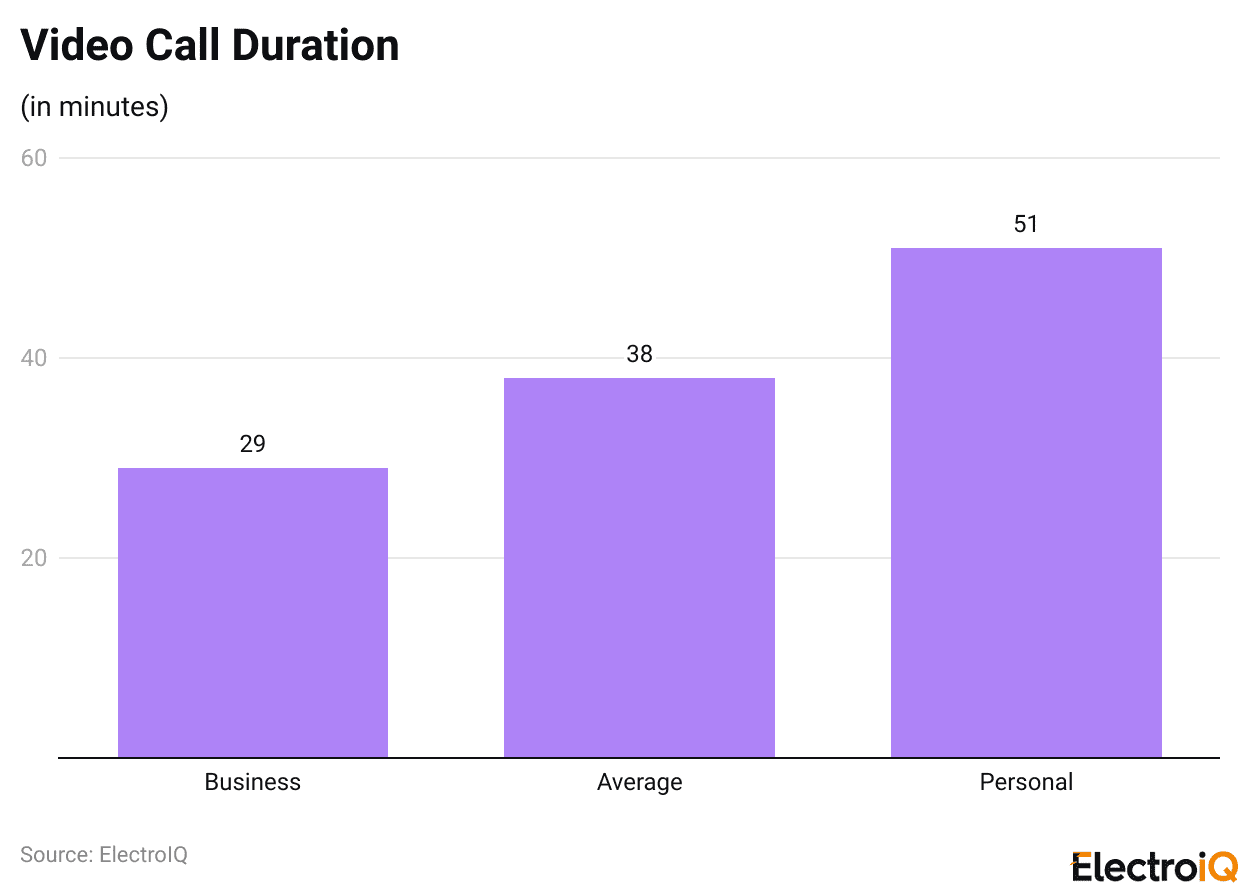
- The average video conference call lasts 38 minutes, with business calls lasting around 29 minutes and personal calls about 51 minutes.
- About 44% worry about unauthorised recording during video calls.
- In recent years, companies saved about USD 11,000 per employee each year by using video meetings.
General Video Conferencing Statistics
- According to scoop.market.us, Zoom surpassed Skype in popularity, reaching about 300 million daily meetings.
- Many companies now rely on video calls for hiring and daily communication, and 94% of HR leaders say remote work makes people more productive.
- As of 2022, video-conferencing software use grew by around 65%.
- Almost 99% of employees worldwide said video meetings improved their communication experience.
- Still, 58% of professionals report that technical or software problems are the biggest issue during calls.
- A report published by Live Webinar states that 45% of teams use video calls daily or weekly, and many employees rely on them for various purposes: 80% for 1:1 talks, 78% for team stand-ups, 77% for large-company meetings, and 62% for customer or partner calls.
- Around 89% of remote workers and 87% of remote teams felt more connected through video meetings.
- Meanwhile, 55% of companies achieved the highest engagement, and 76% of professionals reported productivity gains.
- People joined video calls mostly on computers (77%), phones (31%), or tablets (13%), and companies saved about 30% on travel.
Video Conferencing Market Size Analysis
(Source: market.us)
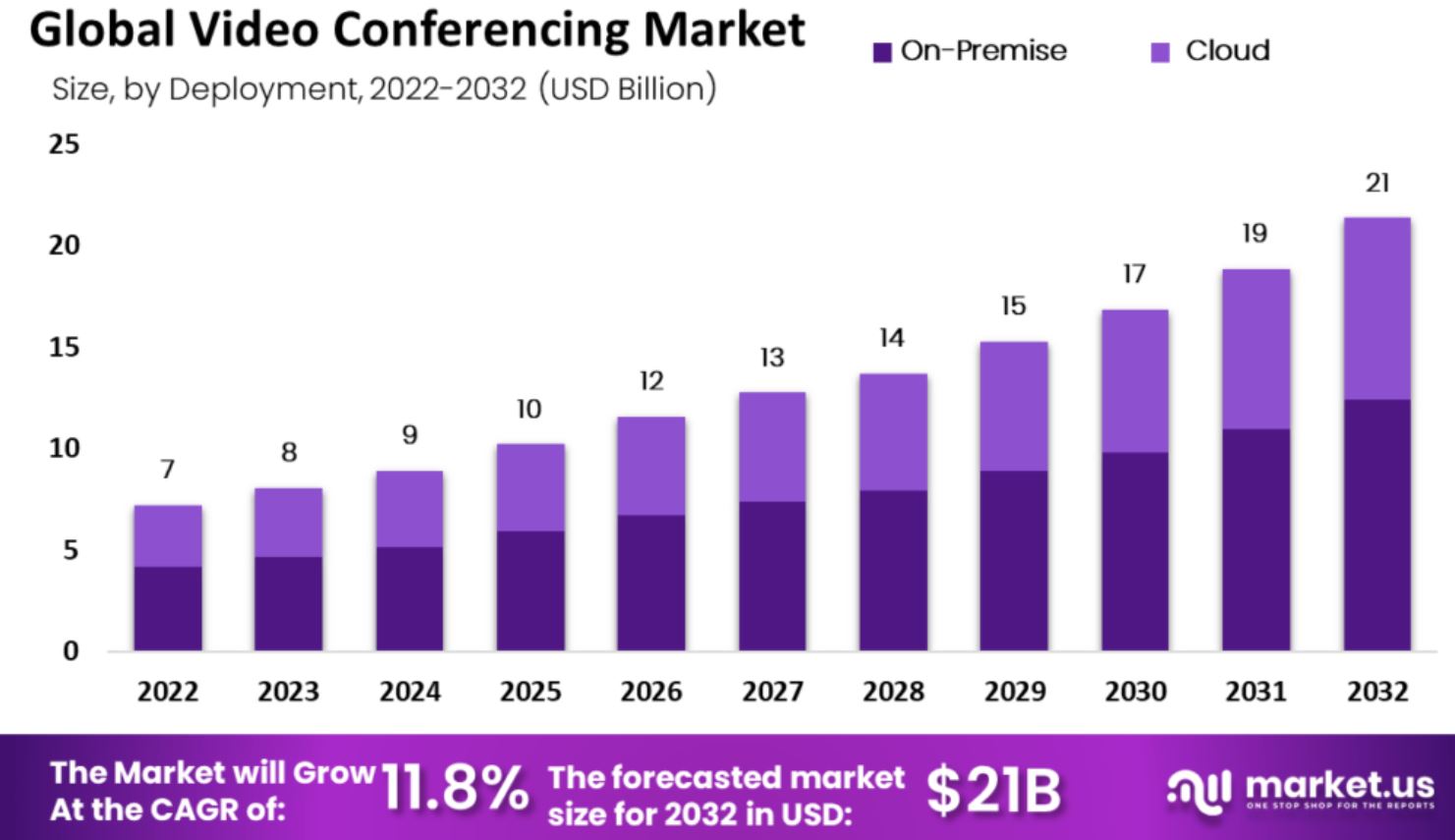
- By 2025, the global video conferencing market size is expected to reach around USD 10 billion, up from USD 9 billion in 2024.
- In the coming year, the market size is estimated to reach around USD 12 billion in 2026, followed by USD 13 billion in 2027, USD 14 billion in 2028, USD 15 billion in 2029, USD 17 billion in 2030, USD 19 billion in 2031, and USD 21 billion in 2032.
- The compound annual growth rate of the market will grow at 11.8% from 2025 to 2032.
- Zebracat’s report says North America leads video conferencing revenue with USD 5.9 billion, followed by Europe with USD 3.1 billion.
- Large companies with more than 1,000 workers now spend about USD 242,000 a year on video-calling tools.
- Cloud services account for 73% of the market, while on-premises systems account for 27%.
- Paid subscriptions have grown significantly since 2020, reaching 89 million in 2025.
- The Asia-Pacific region grew the fastest at 34%, followed by Europe at 21% and North America at 18%.
- In-app purchases and usage-based plans accounted for 19% of annual revenue.
- Government and education together spend USD 2.3 billion, or 16% of global costs.
- Healthcare use jumped 47% from 2023 to 2025, compared with 12% in legal services.
In the United States
(Source: precedenceresearch.com)
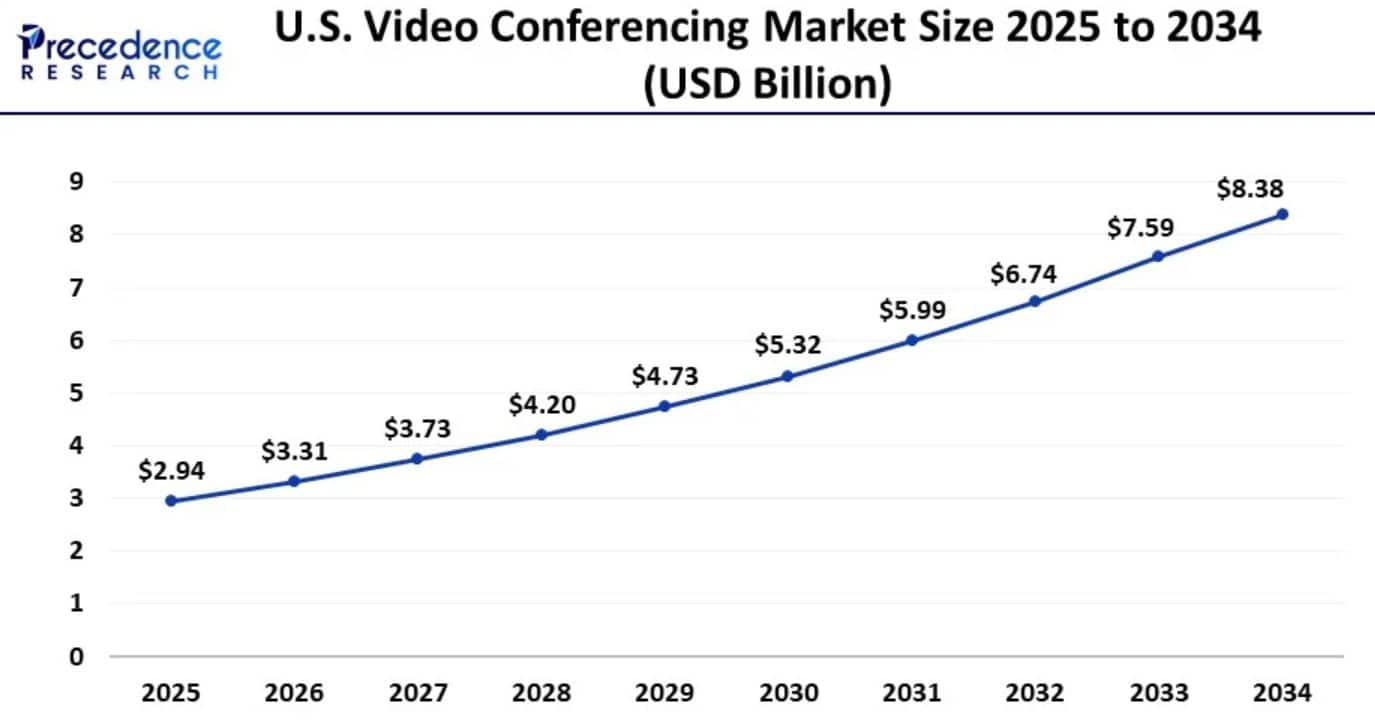
- By 2025, the U.S. video conferencing market is expected to reach USD 2.94 billion.
- It is projected to grow at a 12.35% CAGR from 2024 to 2034, reaching about USD 8.38 billion by 2034.
- The estimated market valuation is the following years is 2026 (USD 3.31 billion), 2027 (USD 3.73 billion), 2028 (USD 4.20 billion), 2029 (USD 4.73 billion), 2030 (USD 5.32 billion), 2031 (USD 5.99 billion), 2032 (USD 6.74 billion), and 2033 (USD 7.59 billion).
Video Conferencing Revenue Statistics By Application
- In 2025, video conferencing will generate USD 4.8 billion from consumer applications and USD 5.2 billion from enterprise applications.
Furthermore, application revenue in the coming years is estimated in the table below:
|
Year
|
Consumer Application | Enterprise Application |
| Revenue (USD billion) | ||
| 2026 | 5.8 | 6.2 |
| 2027 | 6.2 | 6.8 |
| 2028 | 6.7 | 7.3 |
| 2029 | 7.2 | 7.8 |
| 2030 | 8.2 | 8.8 |
| 2031 | 9.1 | 9.9 |
| 2032 | 10.1 | 10.9 |
(Reference: scoop.market.us)
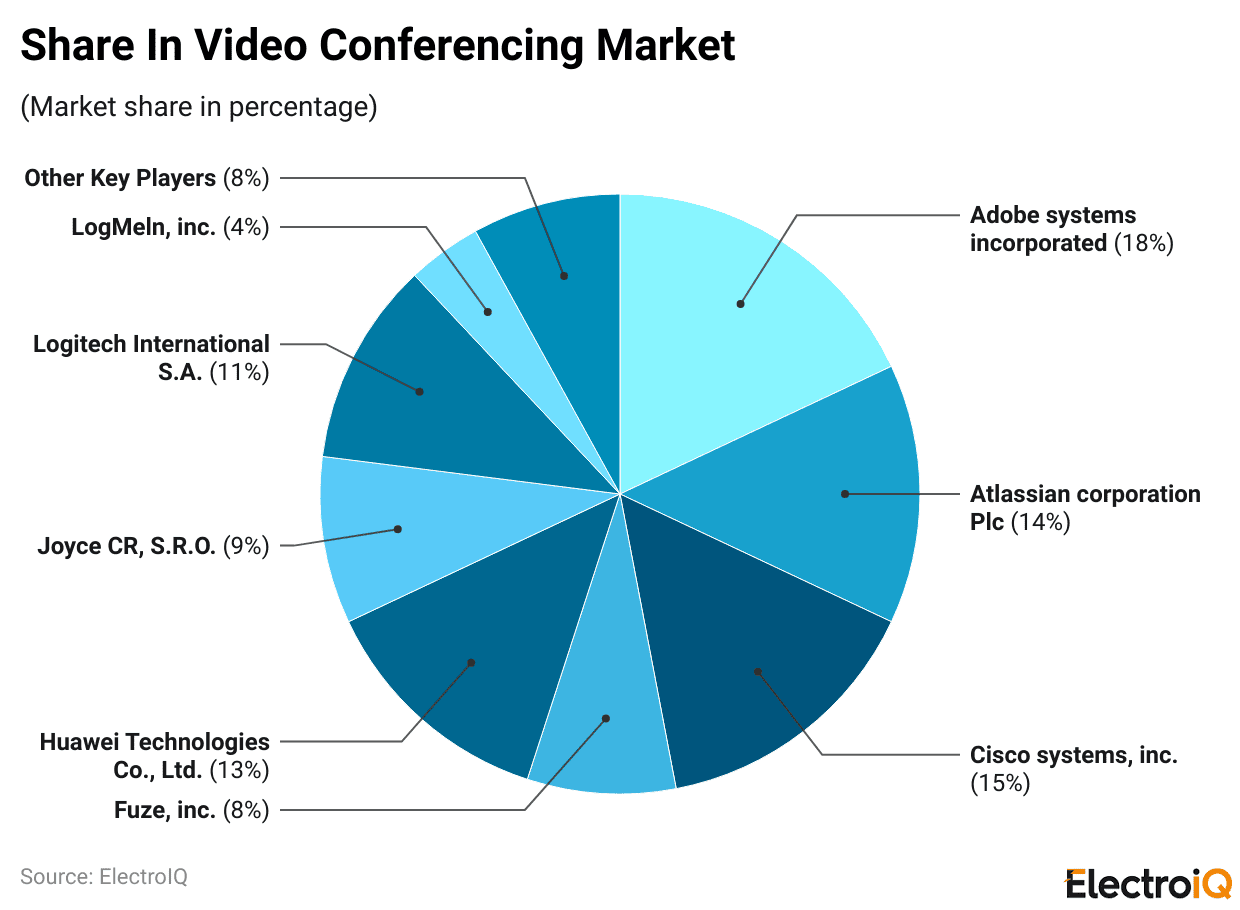
- As of 2024, Adobe Systems Incorporated held a strong position in the video conferencing market, capturing a leading 18% share.
- Followed by Cisco Systems, Inc. (15%), Atlassian Corporation Plc. (14%), Huawei Technologies Co. Ltd. (13%), Logitech International S.A. (11%), JOYCE CR S.R.O. (9%), Fuze, Inc. (8%), and LogMein, Inc. (4%).
- Togetherly, other smaller companies make up the remaining 8% share.
By Region
(Reference: precedenceresearch.com)
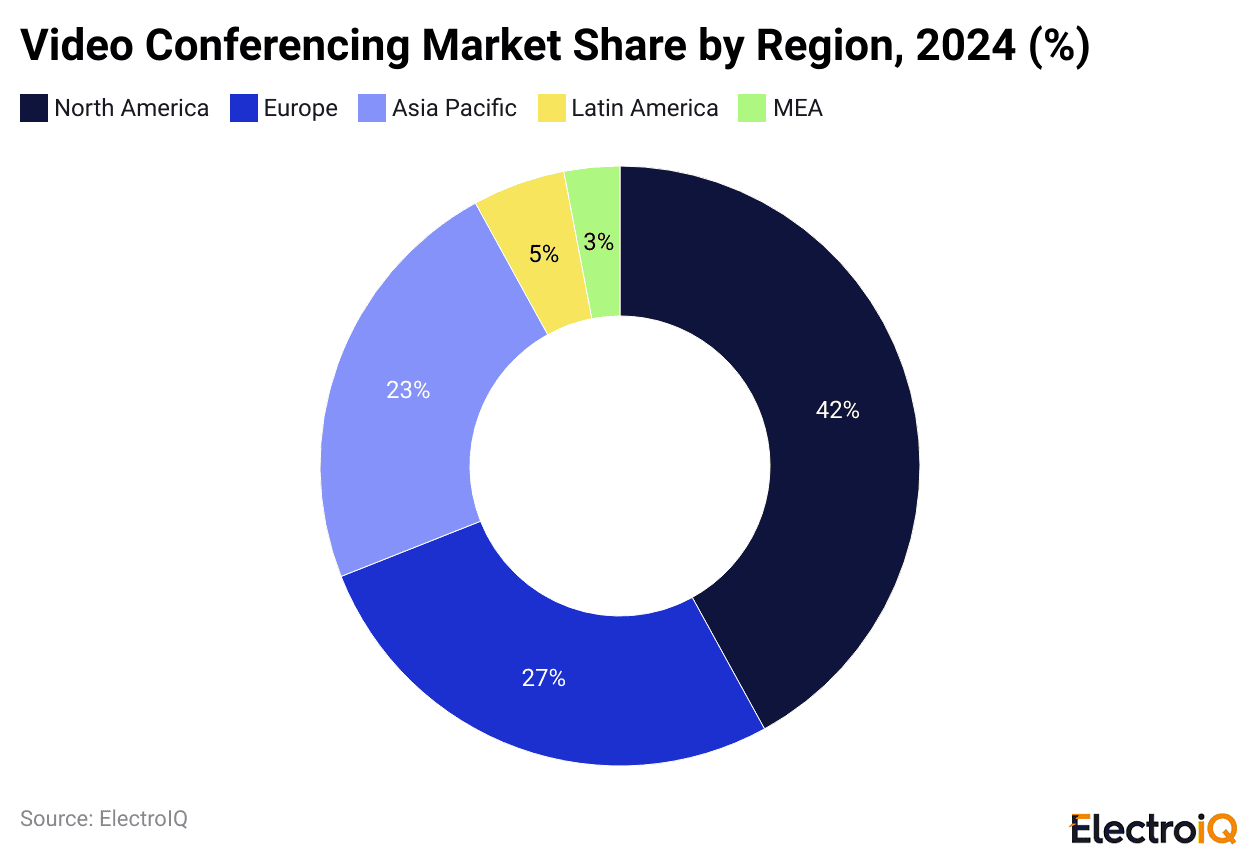
- The North American region accounted for the highest share of 42% in the video conferencing market in 2024, followed by Europe with 27% and Asia Pacific with 23%.
- Following Latin America (5%), the MEA region accounted for the remaining 3%.
By Platforms
(Reference: prod.website-files.com)
- As of 2025, business platforms will generate the highest revenue from video conferencing, with 61%.
- Meanwhile, consumer platforms account for the remaining 39% of revenue.
By Components
(Source: futuremarketinsights.com)
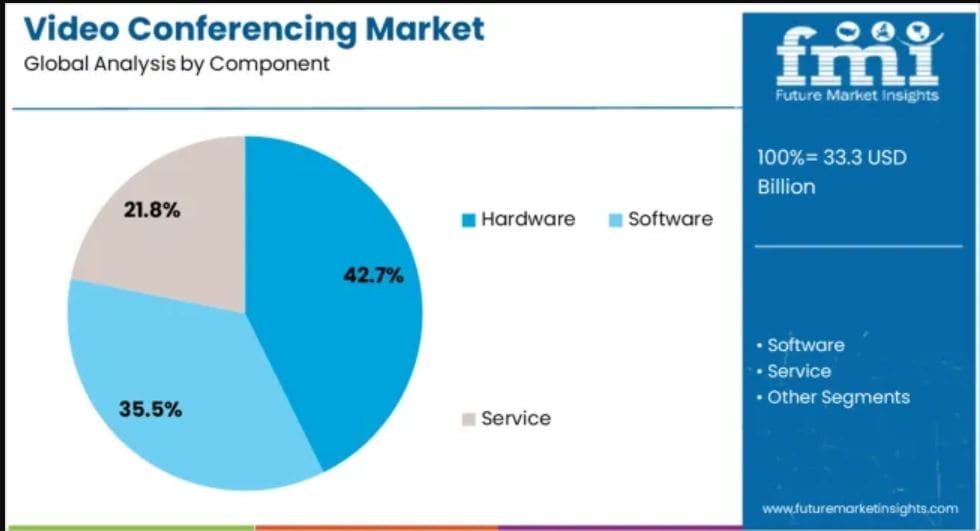
- By 2025, hardware is expected to lead video conferencing components with a 42.7% share.
- Additionally, the software and service segments will account for 35.5% and 21.8% of the market, respectively.
By Leading Companies
- A report published by Market.Us shows that Zoom dominates the video conferencing market, with a 55.44% share in 2024.
- Microsoft Teams holds the second-largest share at 20.93%, followed by GoTo Meeting with 12.80% and WebEx at 9.43%.
- Followed by RingCentral (5.67%), Google Meet (5.32%), FaceTime (3.14%), Skype (2.25%), Facebook Messenger (0.82%), and BlueJeans (0.62%).
Video Conferencing Usage Statistics
- According to zebracat.ai, in 2025, around 86% of remote workers will use video conferencing tools at least once a week.
- Meanwhile, the average person now joins about 5.4 calls per week, up from 3.8 two years ago.
- Mobile devices account for 42% of all video sessions, while 58% still happen on desktops.
- Users aged 18 to 34 prefer video calls (78%), but only 49% of those aged 50 years and above feel the same.
- Around 61% of hybrid-work companies use two or more video platforms.
- The global adoption keeps rising 29% in Latin America, followed by 18% (Europe) and 15% (North America).
- Educational users spend 8.2 hours weekly on video tools, compared with 4.7 hours in finance.
- Meanwhile, about 72% of people have joined a meeting on a smartphone, while 54% took their first video call for personal reasons.
- Smaller companies use video for client talks 67% of the time, compared with 89% in larger firms.
- Only 36% say video meetings make them more productive.
- Lastly, users in Asia join about 6.1 calls per week, compared with 4.9 in Europe and 4.4 in North America.
- Video conferencing sessions are 68% work-related and 32% personal.
- Business use peaks from 10:00 AM to 1:00 PM, while personal calls peak from 6:00 PM to 9:00 PM.
- Users are 2.5 times more likely to use virtual backgrounds in business meetings.
- About 41% use video tools for family events, and companies with more than 500 employees average 11.6 calls weekly, versus 2.3 for personal users.
- Longer video calls (45+ minutes) occur in 37% of personal and 18% of business sessions.
- Also, 24% use video conferencing for gaming or watching parties.
- Business users are four times more likely to use scheduling tools, 83% use video internally, and 62% feel pressure to appear professional.
- Based on mobile preference, 46% personal and 72% business.
- Meanwhile, recurring meetings account for 91% of business and 17% of personal time.
Video Conferencing Statistics By Device Used
- A report from 99 Firms shows that about 77% of people join video calls from a laptop or desktop, while 34% use conference room equipment.
- Additionally, 31% connect through mobile phones and 13% join meetings using tablets.
By Frequency and Duration
(Reference: website-files.com)
- The above graphical presentation shows that the average video call lasts 38 minutes, with business calls lasting around 29 minutes and personal calls about 51 minutes.
- Remote workers join about 7.3 calls a week, while hybrid workers have 4.1, and office workers only 2.6.
- About 65% join at least one call every weekday, and 42% had a meeting over an hour long last month.
- Sales teams often make 3 to 5 video calls a day (57%), but only 23% of marketers do.
- Approximately 33% say their longest call happens on Monday.
- Smaller teams average 2.1 calls per day, while big teams average 4.8.
- Also, 28% of meetings end 7 minutes early.
- Younger adults (18 to 24 years) spend 5.6 hours per week on calls, while older adults (45 years and above) spend 3.2 hours per week.
By Privacy and Security
- As of 2024, about 44% worry about unauthorised recording during video calls.
- Meanwhile, only 32% use default end-to-end encryption, while 68% rely on weaker protections.
- Around 27% of breached users were affected during calls.
- 58% don’t know if meetings are encrypted, and 36% have had unwanted guests join.
- Approximately 39% video calls received phishing invites.
- Finance companies are 3 times more likely than retail to block personal devices.
- Government agencies use closed networks 2.4 times more often.
- Small firms, 22% regularly check video call security, while 64% of enterprises do.
- About 36% also faced unwanted guests.
- Also, 41% of mobile users skip locks, compared with 18% on desktops.
Savings Analysis of Video Conferencing
- According to livewebinar.com, companies saved about USD 11,000 per employee each year by using video meetings.
- Meanwhile, Dell reported saving USD 12 million yearly by needing less office space.
- Working from home for half their time could have saved the U.S. over USD 700 billion and reduced pollution.
- Video tools also cut travel costs by 30% and reduced business trips by 47%.
- Employees saved around USD 2,000 to USD 7,000, and full-time remote work saved 2 to 3 weeks yearly.
Benefits of Video Conferencing
- In 2024, 94% of businesses said video conferencing helped boost productivity, while 90% of users felt it made communication clearer.
- Another 89% of users said it shortened task-completion time, and 89% also reported that it helped them feel more connected.
Conclusion
Video-conferencing numbers show that virtual communication has quickly become part of everyday life. These statistics point to big increases in online classes, remote jobs, and digital teamwork. They also show why video calls are useful, people spend less on travel, meetings happen more quickly, and connecting with others around the world becomes easier.
Despite the technical and security issues discussed in the article, the ongoing trends make it clear that video conferencing will continue to develop as new tools and technologies are introduced.
FAQ.
Users need a device, a camera, a microphone, speakers or headphones, a stable internet connection, and video conferencing software.
Common video conferencing apps include Zoom, Microsoft Teams, Google Meet, Skype, and Webex.
It lets people talk and see each other instantly by sharing video and sound through the internet in real time.
Users must use a strong internet connection, good lighting, updated equipment, close unused apps, and position the camera properly.
The number of people varies on different platforms, ranging from a few to hundreds.

Tajammul Pangarkar is the co-founder of a PR firm and the Chief Technology Officer at Prudour Research Firm. With a Bachelor of Engineering in Information Technology from Shivaji University, Tajammul brings over ten years of expertise in digital marketing to his roles. He excels at gathering and analyzing data, producing detailed statistics on various trending topics that help shape industry perspectives. Tajammul's deep-seated experience in mobile technology and industry research often shines through in his insightful analyses. He is keen on decoding tech trends, examining mobile applications, and enhancing general tech awareness. His writings frequently appear in numerous industry-specific magazines and forums, where he shares his knowledge and insights. When he's not immersed in technology, Tajammul enjoys playing table tennis. This hobby provides him with a refreshing break and allows him to engage in something he loves outside of his professional life. Whether he's analyzing data or serving a fast ball, Tajammul demonstrates dedication and passion in every endeavor.