Mobile Marketing Statistics By Usage, Insight And Trend (2025)

Updated · Dec 14, 2025


Table of Contents
- Introduction
- Editor’s Choice
- General Mobile Marketing Statistics
- Mobile Marketing Market Size Analysis
- Effectiveness of Mobile Marketing Statistics
- Mobile Users Statistics
- Smartphone Subscription Statistics
- Time Spent On Mobile Devices Statistics
- Mobile Usage Statistics
- Mobile Internet and App Usage Statistics
- Mobile Search Statistics
- Mobile Advertising Statistics
- Mobile E-Commerce and Shopping Behaviour Statistics
- SMS and Mobile Messaging Statistics
- Mobile Email Marketing Statistics
- Conclusion
Introduction
Mobile Marketing Statistics: Mobile marketing is now a key channel for businesses to engage people instantly. Most people use their smartphones every day, so brands no longer depend only on computers, TV, or print ads. Many reports indicate that people spend a large share of their online time on mobile, which affects how they search, buy, and connect with companies. Mobile apps are widely used; online shopping on phones is growing fast, and businesses are investing more in mobile ads.
Simple tools such as mobile-friendly websites and text message campaigns can significantly improve customer response rates and sales. These mobile marketing statistics draw on multiple insights to help companies plan more effectively, reach the right people, and succeed in today’s mobile-first world.
Editor’s Choice
- The State of Mobile Marketing report from DigitalSilk indicates that 98% of U.S. adults own a mobile phone.
- A 2025 Vidico report found that almost 72% of global internet traffic comes from mobile devices.
- The global market size for Mobile Marketing was USD 18.9 billion in 2024.
- About 91% of smartphone users report buying or planning to buy after seeing a relevant ad.
- From 2024 to 2025, mobile’s share of digital marketing rose from 65.37% to 66.77%.
- A report from Truelist estimated that the global mobile user base will reach approximately 7.49 billion by 2025.
- Globally, the number of smartphone subscriptions will reach around 7,296 million in the same period.
- In 2025, people usually spend about 4 hours and 37 minutes a day on their phones.
- DataReportal reported that 5.78 billion people, about 70.5% of the global population, used mobile phones.
- In November 2025, the global mobile search engine market was dominated by Google, accounting for 94.35%.
- The mobile advertising market is expected to reach around USD 319.49 billion by 2025, up from about USD 277.7 billion in 2024.
- From 2024 to 2027, global mobile e-commerce expands from USD 2.522 trillion to USD 3.436 trillion.
- The mobile messaging industry is valued at USD 136.2 billion in 2025 and is expected to reach USD 595.8 billion by 2035, growing at a 15.9% CAGR.
- According to mailmodo.com, about 55% of all website visits worldwide come from mobile phones.
General Mobile Marketing Statistics
(Source: digitalsilk.com)
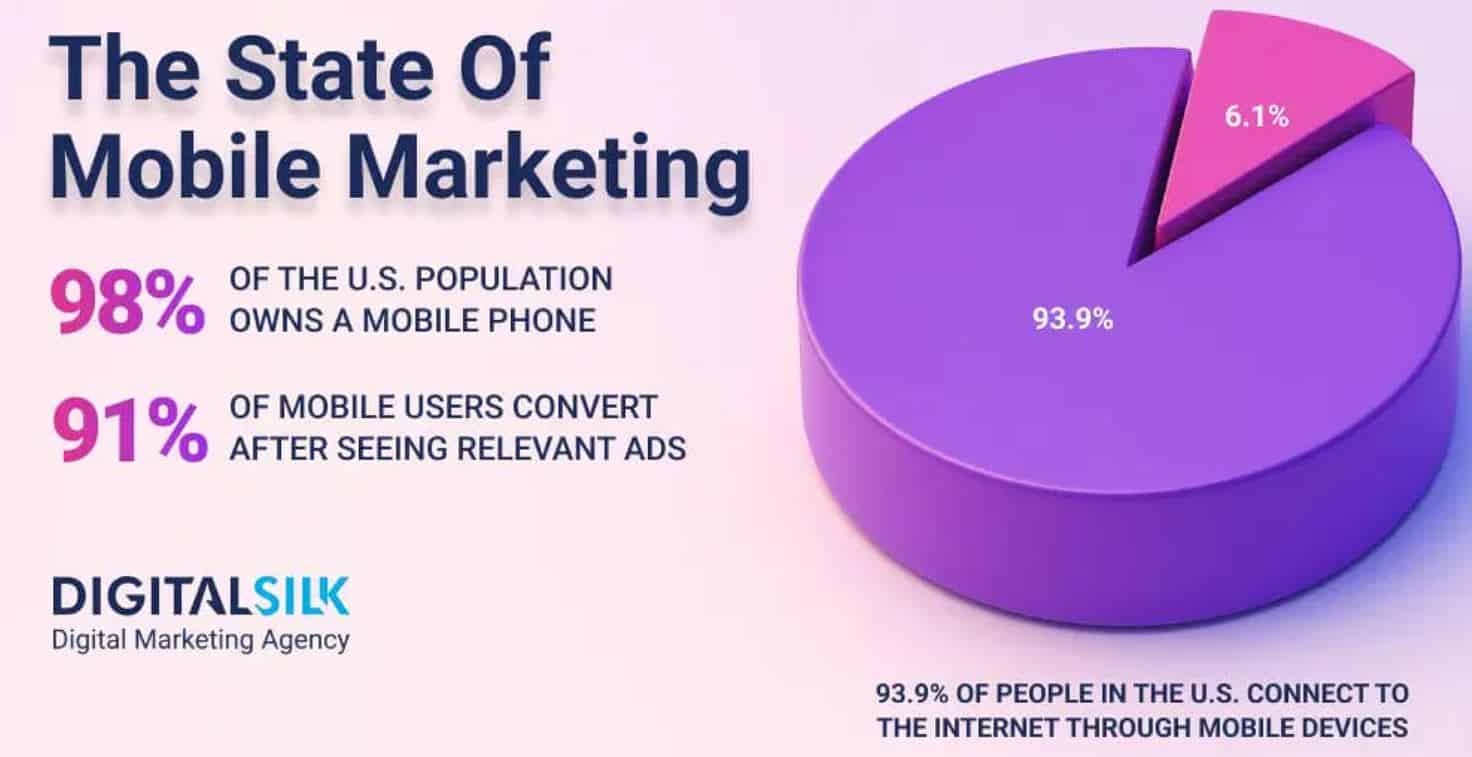
- The State of Mobile Marketing report from DigitalSilk indicates that 98% of U.S. adults own a mobile phone.
- Meanwhile, 91% of mobile users convert after seeing relevant ads.
- A pie chart further indicates that 93.9% of people in the U.S. access the internet via mobile devices, and the remaining 6.1% use other methods.
- Mobile dominates digital advertising, projected to account for 69.61% of total global ad revenue by 2028.
- Nearly 50% of consumers prefer browsing a company’s mobile site to installing an app.
- A 2025 Vidico report found that almost 72% of global internet traffic comes from mobile devices, and the average American spends 5.4 hours a day on their phone, checking it around 205 times daily.
- Platforms like Facebook see 98.5% of users logging in via phone, while YouTube sees 90% of views and most app downloads.
- Shopping habits are also shifting: 72.9% of online sales in 2025 are expected to come from mobile, and 187.5 million U.S. users are expected to make at least one mobile purchase.
- Consumers prefer mobile-friendly experiences: 61% are more likely to have a better opinion of brands with good mobile sites, and 57% avoid recommending brands with poor mobile sites.
- Trends include 5G adoption at 45%, mobile AR reaching 1.7 billion users, and a 42% jump in voice search.
Mobile Marketing Market Size Analysis

(Reference: digitalsilk.com)
- The global market size for Mobile Marketing was USD 18.9 billion in 2024.
- The market is projected to reach approximately USD 81.74 billion by the end of 2030, with a 23.9% CAGR from 2025 to 2030.
- In the United States, CMOs now allocate 23.3% of their marketing budgets to mobile campaigns.
- As of 2025, around 98% of people own a mobile phone.
- In 2024, apps earned USD 69.2 billion from in-app purchases worldwide.
- Moreover, the average person spends about 3.5 hours each day on Android and iOS devices.
Effectiveness of Mobile Marketing Statistics
- According to digitalsilk.com, about 91% of smartphone users report buying or planning to buy after seeing a relevant ad.
- The U.S. remains the largest mobile ad market, with spending expected to reach around USD 233.35 billion in 2025.
- In the same year, mobile ad spending is projected at USD 228.12 billion, including USD 187.78 billion from in-app ads and USD 40.34 billion from web ads.

(Reference: digitalsilk.com)
- From 2024 to 2025, mobile’s share of digital marketing rose from 65.37% to 66.77%, showing clear year-to-year growth.
- Followed by 67.87% in 2026, 68.74% in 2027, and 68.61% in 2028.
- In 2025, U.S. mobile search ads account for USD 97.7 billion, and by 2029, they reach USD 147.63 billion, accounting for a dominant share of U.S. market spend.
- In 2025, social media will be the top digital ad touchpoint in the U.S., reaching 50% of people.
- 59% of U.S. digital media experts claimed that it is the easiest place for ad fraud.
- Only 25% of U.S. mobile users stated that mobile game ads annoy them most.
- Around 8% of adult mobile users use ad blockers or anti-tracking tools.
Mobile Users Statistics
(Source: truelist.co)
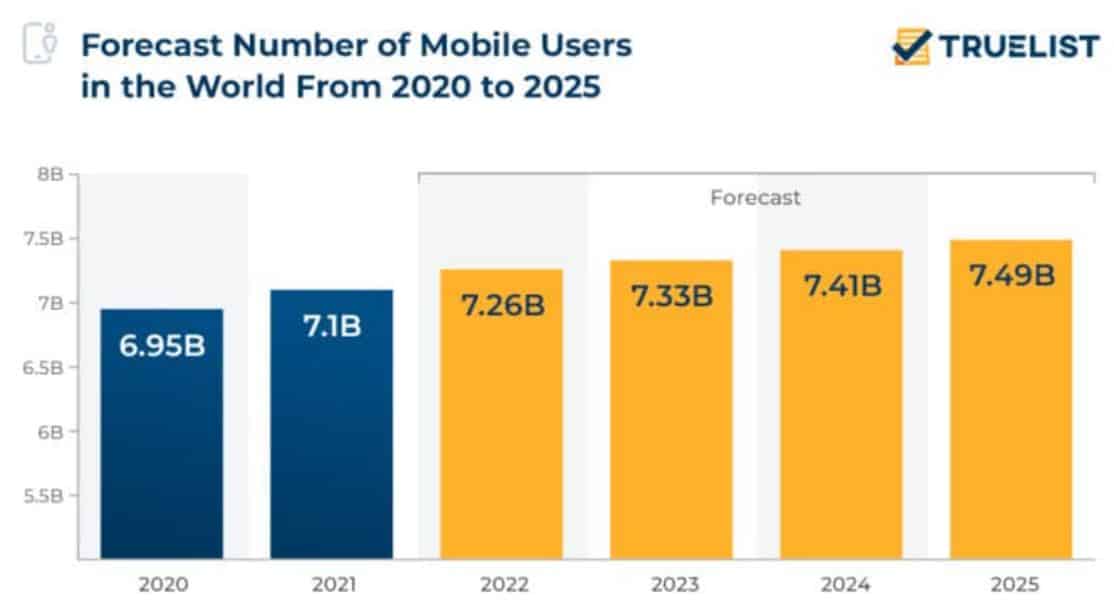
- A report from Truelist estimated that by 2025, the global mobile user base will reach approximately 7.49 billion, up from 7.41 billion in 2024.
- Moreover, in 2023, mobile users were 7.33 billion; in 2022 (7.26 billion), 2021 (7.1 billion), and 2020 (6.95 billion).
Smartphone Subscription Statistics

(Source: truelist.co)
- Globally, the number of smartphone subscriptions will reach around 7,296 million by 2025, up from 7.074 million in 2024.
- In the coming years, subscription counts are projected to be 2026 (7,514 million) and 2027 (7,690 million).
Time Spent On Mobile Devices Statistics

(Source: buttercms.com)
- In 2025, people will usually spend about 4 hours and 37 minutes a day on their phones.
- They pick up their phones around 58 times daily, and about 30 of those checks happen while they are working.
- Many sessions start quickly: nearly half of phone use begins within 3 minutes of the last call in a typical busy day.
- People check their phones about 40 times a day, and 69% of all pickups last under 2 minutes.
- Approximately 15 checks per day, accounting for 26%, take 2 to 10 minutes, and only 3 pickups (5%) exceed 10 minutes.
- Baby Boomers show 51.6% using phones more than they want and 31.3% trying to cut back.
- Gen X reports 66.7% overuse and 40.7% reducing it.
- Millennials reach 67.3%, and 30.5% of Gen Z, while Gen Z is highest at 76.3%, with 41% taking steps to limit screen time in their daily phone habits.
Mobile Usage Statistics
- In 2025, DataReportal reported that 5.78 billion people, about 70.5% of the global population, used mobile phones.
- Electro IQ noted that smartphones made up 87% of all mobile handsets, with an estimated 7.43 billion active smartphones worldwide.
- According to the ITU, global internet users reached 6 billion (approximately 74%).
- Meanwhile, the GSMA highlighted the economic impact of mobile technologies, which contribute 5.8% of global GDP, or roughly USD 6.5 trillion.
Mobile Internet and App Usage Statistics
- In 2025, almost 6billion people worldwide, about three-quarters of humanity, use the internet.
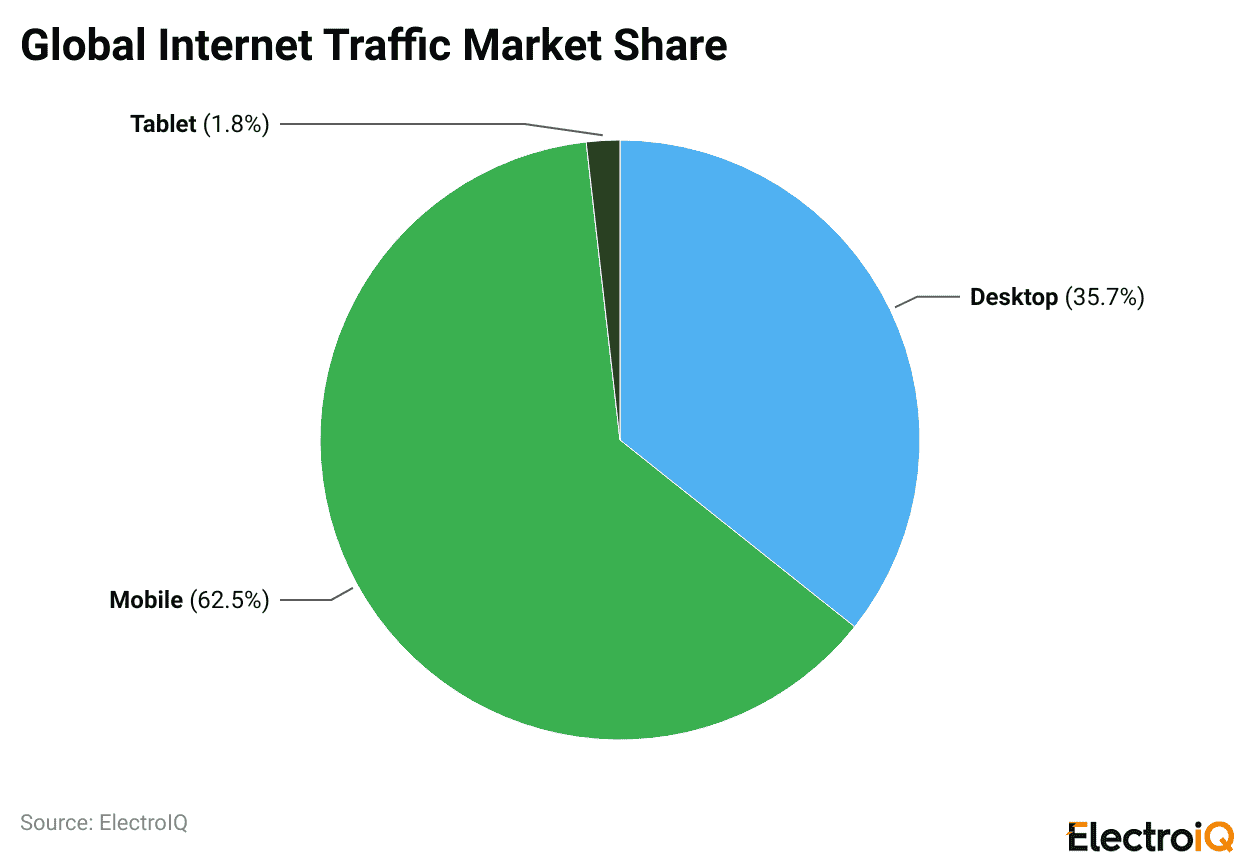
(Reference: website-files.com)
- The above pie chart shows that global internet traffic in 2025 is dominated by mobile at 62.5%, followed by desktop at 35.7%, while tablets account for only 1.8%.
- In 2025, people are expected to download about 299 billion mobile apps, which works out to around 819 million downloads every day.
- Nearly 49% of people open apps 11 or more times a day.
- Most smartphone users use about 10 apps daily and around 30 monthly.
Mobile Search Statistics
- As of April 2025, mobile devices account for about 59.7% of global website traffic.
(Source: statcounter.com)
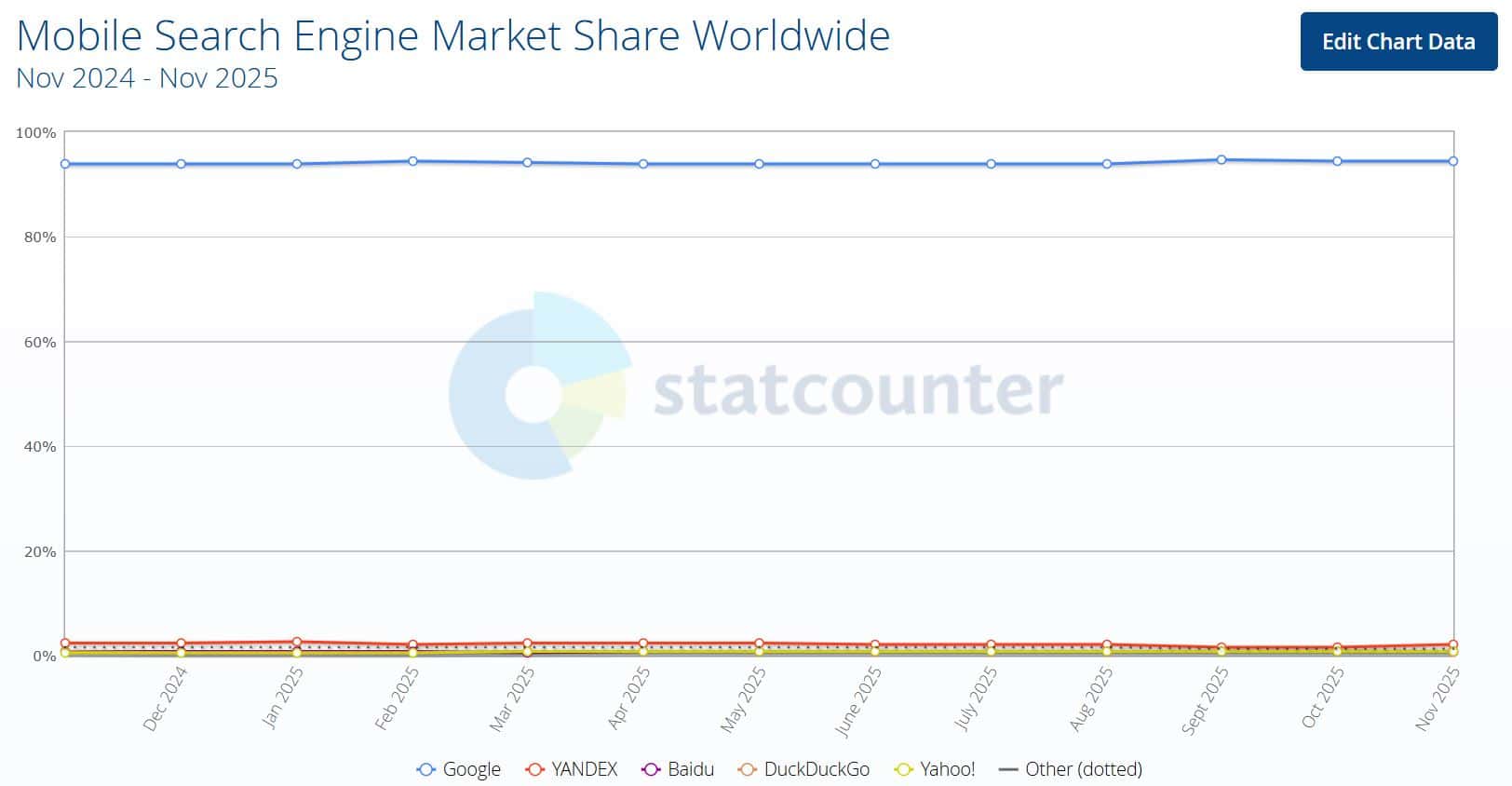
- In November 2025, Google dominated the global mobile search market with a 94.35% share.
- Other search engines were followed by Yandex (2.03%), Baidu (0.83%), DuckDuckGo (0.79%), Yahoo! (0.71%), and Bing (0.61%).
Mobile Advertising Statistics
(Source: thebusinessresearchcompany.com)
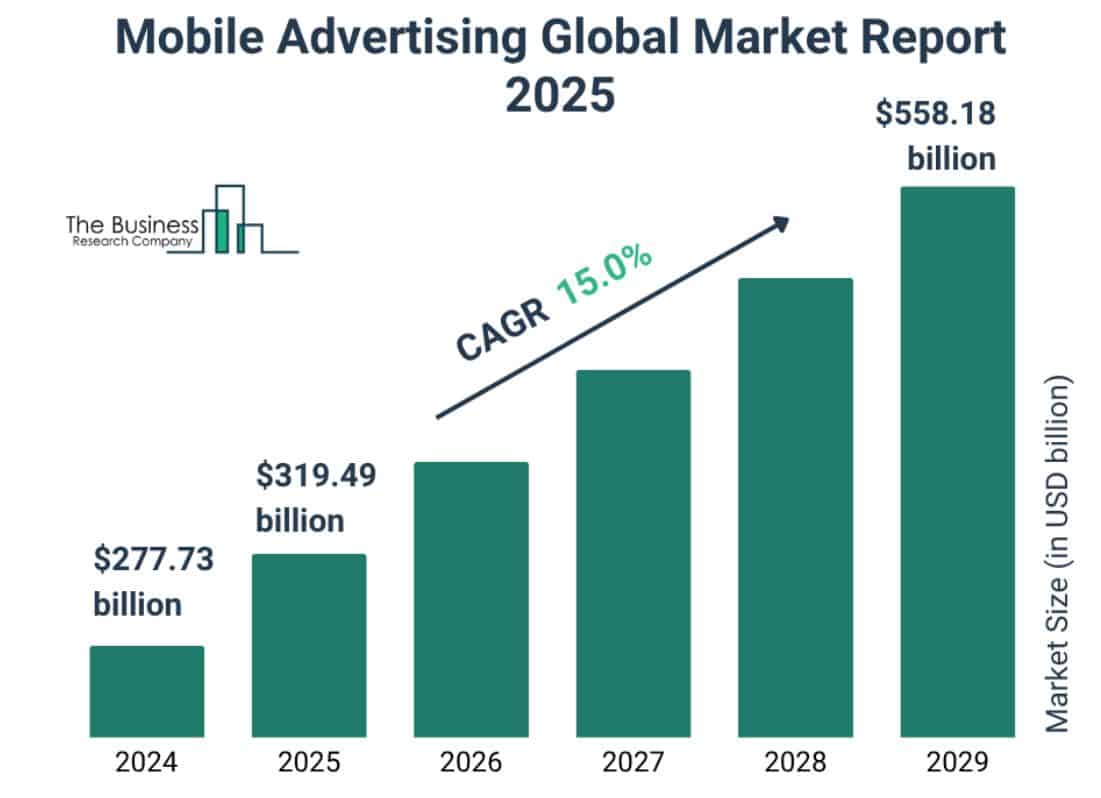
- The mobile advertising market is expected to reach around USD 319.49 billion by 2025, up from about USD 277.7 billion in 2024.
- The market will grow to approximately USD 558.18 billion by 2029, with a 15% CAGR from 2026 to 2029.
- According to sqmagazine.co.uk, mobile will account for approximately 56% of global digital ad spend in 2025, with over 72% of digital ad dollars directed to mobile platforms.
- The United States mobile ad spend reached $202.59 billion in 2024, rising roughly 14.4% year over year.
- In-app advertising remains dominant, with global in-app ad spend projected at about USD 390 billion in 2025.
- Regionally, the Asia-Pacific leads with approximately USD 231 billion, ahead of North America at USD 164 billion.
- Social and in-app placements combined are expected to account for about 60% of mobile spend.
Mobile E-Commerce and Shopping Behaviour Statistics
(Source: website-files.com)
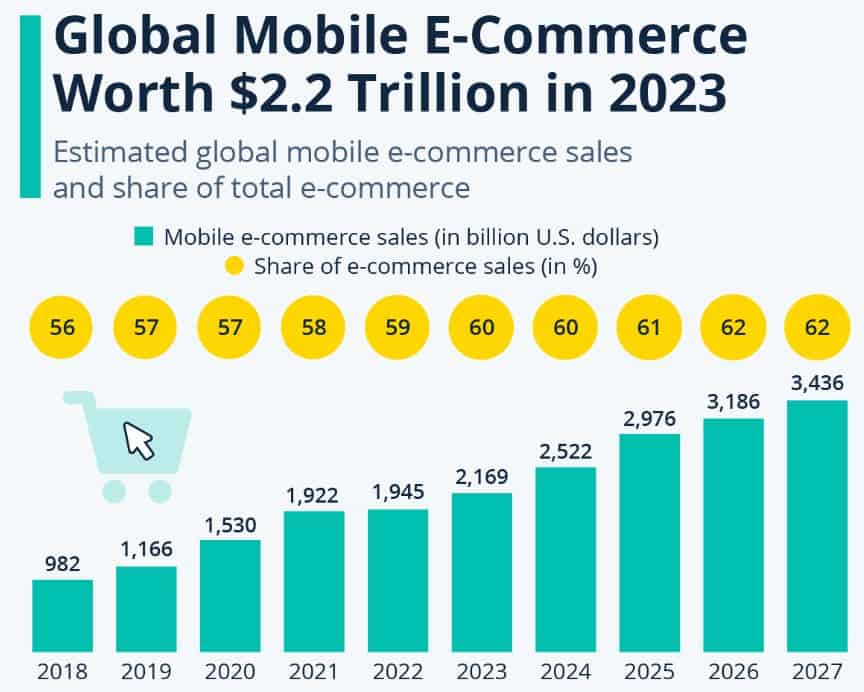
- From 2024 to 2027, global mobile e-commerce expands from USD 2.522 trillion to USD 3.436 trillion, while its share of total online retail gradually increases from 60% in 2024 to 62% by 2027.
- This period reflects steady year-over-year growth, with 2025 reaching USD 2.976 trillion (61% sales share) and 2026 reaching USD 3.186 trillion (62%).
- In 2025, Sellers Commerce reports that about 30% of the digital population (1.65 billion people) will shop via mobile phones.
- Marketing LTB notes that early-year data show mobile devices account for 65.9% of B2C e-commerce purchases, compared with 34.1% on desktop.
- OuterBox reports that 76% of U.S. adults shop online on smartphones, while mobile will account for 44.2% of U.S. retail e-commerce sales.
- Additionally, sellerrocket. in stated that the voice-enabled commerce market will reach USD 151.39 billion in 2025, with 22% of consumers making purchases via voice assistants.
SMS and Mobile Messaging Statistics

(Source: futuremarketinsights.com)
- The mobile messaging industry is valued at USD 136.2 billion in 2025 and is expected to reach USD 595.8 billion by 2035, growing at a 15.9% CAGR.
- In 2025, the hardware segment accounts for the largest share of the market at 57.3%, followed by the software segment (42.7%).
- By application, the OMEs segment will account for the largest share at 58.5%, followed by the aftermarket at 41.5%.
- By component and platform, the A2P Service will account for 55.9% and 44.1%, respectively.
- In 2025, WhatsApp had 3.3 billion monthly users and 2.3 billion daily users, and users sent around 150 billion messages per day.
- SMS marketing also remains strong, with a 98% open rate.
- About 84% of consumers prefer to receive business texts, and 51% find these SMS messages useful.
Mobile Email Marketing Statistics
- According to mailmodo.com, about 55% of all website visits worldwide come from mobile phones.
- Many smartphone owners prefer email for business communication, with 46% choosing it over other channels.
- Moreover, Gmail remains the most widely used email service, with more than 1.5 billion users.
- Email behaviour varies: mobile clients generate 41.6% of opens, webmail 40.6%, and desktops 16.2%.
- Depending on the audience or message type, mobile open rates range from 26% to 78%.
- Nearly one in five campaigns still needs mobile optimisation, even though responsive designs can boost unique mobile clicks by 15%.
- Personal emails are checked more often on phones, as work messages are 40% less likely to be viewed on mobile.
- People respond 54% faster on phones, and iPhones account for 28.4% of mobile opens.
- B2C brands see 47.8% more mobile opens than B2B brands, and Leisure and Sports lead mobile readership at 60%.
- Notably, 75% of Americans delete emails that are not mobile-friendly.
Conclusion
Mobile marketing data show that people spend significant time on their phones. Most of their time online, the apps they open, and much of their shopping now happen on mobile screens. That means brands can’t treat mobile as an extra add-on. Marketers need to plan for phones first: clear pages, big buttons, and sites that load quickly. Messages should feel personal while protecting privacy.
When SMS, apps, and social media work together, brands stay in touch often. Today, to capture people’s attention, you must be on their phones.
FAQ.
SMS, MMS, mobile web, apps, in-app ads, push notifications, location-based services, QR campaigns, and email marketing.
Mobile marketing targets personal devices, enabling real-time, location-based, highly interactive communication everywhere.
Define goals, optimise a mobile-friendly website, build an SMS list, run targeted social ads, and regularly analyse performance.
Carefully track installs, in-app actions, retention, revenue, ROAS, and cohort performance over time.
Avoid neglecting rest, overcommitting, ignoring feedback, procrastinating, multitasking, and negative self-talk habits.

Maitrayee Dey has a background in Electrical Engineering and has worked in various technical roles before transitioning to writing. Specializing in technology and Artificial Intelligence, she has served as an Academic Research Analyst and Freelance Writer, particularly focusing on education and healthcare in Australia. Maitrayee's lifelong passions for writing and painting led her to pursue a full-time writing career. She is also the creator of a cooking YouTube channel, where she shares her culinary adventures. At Smartphone Thoughts, Maitrayee brings her expertise in technology to provide in-depth smartphone reviews and app-related statistics, making complex topics easy to understand for all readers.