Know Your Customer (KYC) Statistics By Market Analysis, Trends And Facts (2026)

Updated · Mar 29, 2026



Table of Contents
- Introduction
- Editor’s Choice
- Know Your Customer (KYC) Market Size
- Know Your Customer (KYC) Software Market Size
- Digital KYC Adoption Reshaping Banking Efficiency
- Global Enforcement Actions Redefine KYC Risk Exposure
- AI-Driven KYC Transformation
- Methodology Behind Identifying Leading KYC Software Development Firms
- The Shift From Periodic To Perpetual KYC (pKYC)
- Crypto Compliance Crackdown
- Conclusion
Introduction
Know Your Customer (KYC) Statistics: The financial system of today operates as a digitally interconnected system, which requires financial institutions to use Know Your Customer (KYC) protocols as an essential trust-building element that helps manage risks and improve their operational processes. The year 2025 marked a turning point for KYC systems, with their first major advancement driven by digital transformation across banking, fintech, crypto platforms, and identity systems worldwide. Organizations that include both international banks and cryptocurrency exchanges must now manage their compliance requirements while delivering exceptional customer service and implementing advanced technological solutions, as these factors will determine their success in the market.
The article presents current Know Your Customer (KYC) statistics for 2025, supported by research, to demonstrate the industry’s progress since then, and uses numerical data to project future industry developments.
Editor’s Choice
- The e-KYC market reached USD 805.8 million in 2024 and is projected to hit USD 3.56 billion by 2033 (17.7% CAGR).
- The broader KYC market is valued at USD 6.73 billion in 2025, forecasted to reach USD 14.39 billion by 2030 (16.4% CAGR).
- The global identity verification market touched USD 13.8 billion in 2024.
- The KYC software market generated USD 4.8 billion in 2024 and is expected to grow to USD 43.5 billion by 2034 (24.8% CAGR).
- North America held 35.8% market share in 2024, generating USD 1.7 billion in KYC software revenue.
- Over 70% of banks in developed markets are replacing legacy KYC systems with digital platforms.
- More than 70% of onboarding processes are expected to be automated in 2025.
- Biometric authentication accounts for 45.4% of digital verification methods.
- KYC automation reduces operational costs by 40–70% and cuts fraud losses by up to 50%.
- Biometric eKYC lowers identity fraud by approximately 85%.
- Global financial penalties totalled USD 4.6 billion in 2024, with 94% originating in North America.
- The global economy incurred penalties exceeding USD 3.3 billion due to transaction-monitoring failures.
- The total expenditure for AML and KYC data and services reached USD 2.9 billion in 2025 and is projected to grow at a 22% compound annual growth rate over the next five years.
- The use of AI technology in AML and KYC operations increased from 42% to over 82% across the industry, with Singapore reporting the highest adoption rate at 92%.
- The U.S. digital-asset industry accounted for 43% of all U.S. regulatory penalties in 2025, totaling USD 728 million in fines, while worldwide AML penalties increased to USD 1.23 billion, representing 417% YoY growth.
Know Your Customer (KYC) Market Size
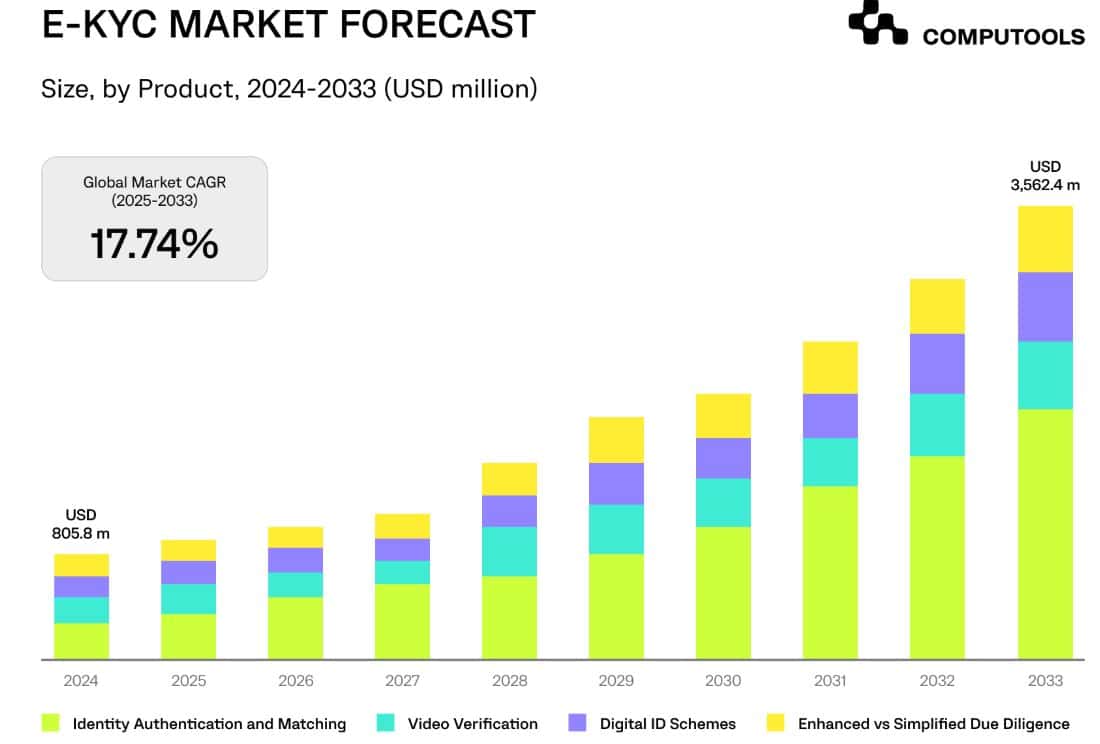
(Source: computools.com)
- The digital identity ecosystem is experiencing rapid growth due to compliance requirements and fintech development.
- Recent KYC statistics show the e-KYC segment reaching USD 805.8 million in 2024, projected to climb to USD 3.56 billion by 2033 at a 17.7% CAGR.
- The broader KYC market, valued at USD 6.73 billion in 2025, was expected to reach USD 14.39 billion by 2030, with annual growth of 16.4%.
- The global identity verification market reached USD 13.8 billion in 2024, driven by companies’ increased spending on fraud prevention measures.
- The KYC statistics demonstrate that regulatory technology has become essential for building digital finance systems.
Know Your Customer (KYC) Software Market Size
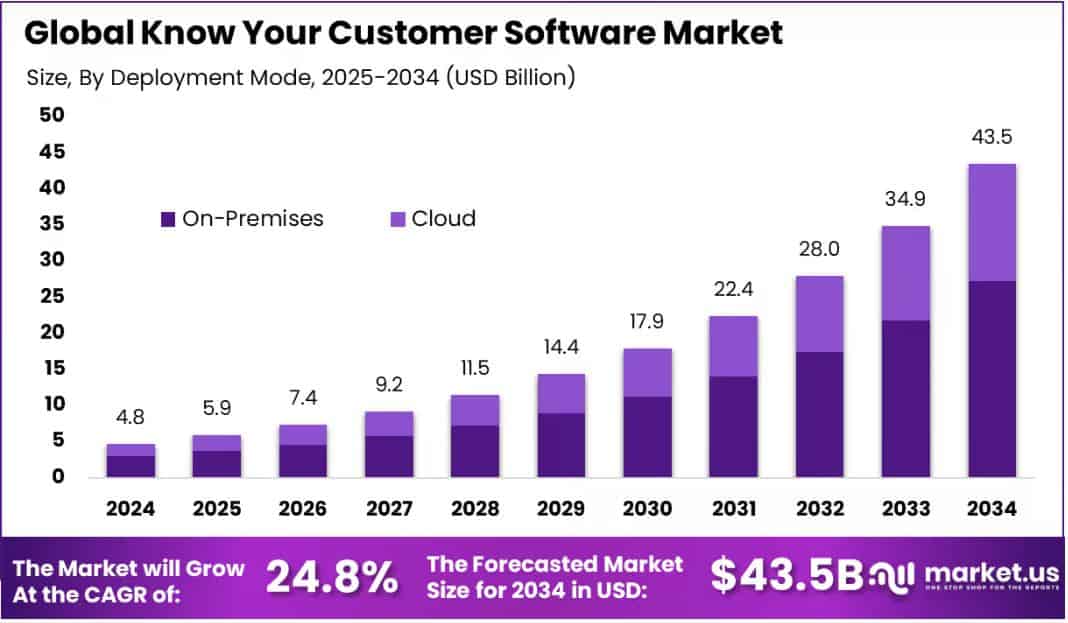
(Source: market.us)
- The KYC software market is entering a hyper-growth decade driven by regulatory digitization and rising financial crime risks.
- The market generated USD 4.8 billion in 2024 and is projected to surge from USD 5.9 billion in 2025 to an impressive USD 43.5 billion by 2034, expanding at a robust 24.8% CAGR.
- Recent KYC statistics highlight North America’s leadership, with a 35.8% market share in 2024 and USD 1.7 billion in revenue.
- The KYC statistics demonstrate that compliance automation, together with AI-based verification and international fintech growth, are enabling organizations to use identity governance as a mechanism for business expansion.
Digital KYC Adoption Reshaping Banking Efficiency
- The latest KYC statistics indicate that global banking institutions are moving toward automated systems for their operations.
- Over 70% of banks in developed markets are replacing legacy systems with digital KYC platforms, and more than 70% of onboarding processes are expected to be fully automated in 2025.
- Biometric authentication now represents 45.4% of verification methods, led by facial recognition and fingerprint scanning.
- The automation process reduces onboarding time from several days to just minutes while decreasing operational expenses by 40% to 70%.
- The combination of biometric eKYC and other security measures results in a 50% decrease in fraud losses, while identity fraud drops by 85% this process establishes new standards for compliance effectiveness.
Global Enforcement Actions Redefine KYC Risk Exposure
- The latest KYC statistics demonstrate that the regulatory environment has become more stringent than ever before.
- In 2024, total global financial penalties reached USD 4.6 billion, spanning traditional banks, digital asset platforms, and gaming operators.
- North America accounted for 94% of these fines, indicating that the region conducts its supervisory activities with a high degree of forcefulness.
- The compliance bar continues to rise, shown by the historic USD 4.3 billion penalty which the major crypto platform received during the Binance 2023 crypto fine.
- The UK regulatory body imposed a £107 million fine on Santander UK because of extended periods during which the bank failed to meet KYC and CDD control standards.
- Weak onboarding systems created the basis for transaction-monitoring violations, resulting in global penalties exceeding USD 3.3 billion.
- Bank fines rose by 522%, bringing total fines to USD 3.65 billion in a single year.
- The KYC statistics demonstrate that organizations fail to verify customer identities, creating significant risks of financial loss and reputational damage.
AI-Driven KYC Transformation
- The implementation of AI for KYC processes has led to substantial reductions in operational costs and improvements in efficiency.
- The latest KYC data shows that organizations need to fundamentally change their compliance practices because current methods will no longer work.
- Digital-first institutions like NeoBank are targeting up to 50% cost reductions across the KYC value chain through AI deployment.
- Automation solutions have achieved a 70% reduction in manual labor costs, while leading case studies show that their onboarding process now takes 87% shorter time to complete.
- AI systems now deliver customer risk assessments within 60 seconds, which complies with security standards, while physical verification processes take 18 minutes, and corporate assessments require 95 days.
- The industry shows strong adoption trends as organizations have increased their use of AI for AML and KYC tasks from 42% to more than 82%, with Singapore businesses leading the way at 92% usage.
- The machine learning tools enable organizations to decrease false positive rates by 50%, which results in better productivity for analysts.
- The KYC statistics prove that AI technology brings new possibilities for organizations to handle compliance work at larger scales while achieving better risk assessment outcomes.
Methodology Behind Identifying Leading KYC Software Development Firms
- The process of finding the best KYC software development companies requires using specific methods to determine their strongest abilities, which should match the requirements of increasing regulatory compliance demands.
- Our evaluation framework prioritized firms with 8+ years of fintech engineering experience, reflecting operational maturity in delivering identity verification, e-KYC, KYB, and AML automation platforms.
- The need for in-depth knowledge about regulatory systems, which include PSD2, GDPR, SOC 2 and ISO standards and international data protection regulations, became essential because KYC compliance costs show double-digit growth every year.
- AI/ML-driven verification, biometric authentication (now representing 45%+ of digital onboarding tools), OCR, risk-scoring engines, and cloud-native architectures.
- Vendors with 150+ engineers ranked higher, showing scalability for enterprise deployments.
- The top companies established integration depth by creating direct connections between their systems and core banking systems, AML tools, fraud detection modules, CRMs and onboarding pipelines.
- The companies with 4.9/5 client ratings, verified audits, and strong security certifications achieved a special status.
- The KYC statistics-based selection criteria allow the shortlisted partners to create secure platforms which undergo audits and are designed for rapid development in fintech environments.
The Shift From Periodic To Perpetual KYC (pKYC)
| Dimension | Legacy periodic KYC model (circa 2015–2023) | Perpetual KYC (pKYC) model (circa 2025–2026) |
| Review frequency | Fixed 1‑, 2‑, or 3‑year calendar‑based refresh cycles, regardless of whether customer risk has changed. | Continuous monitoring with event‑based triggers (for example, sanctions hits, beneficial‑ownership changes, unusual activity), initiating reviews as needed |
| Cost and effort | KYC costs about 3% of bank operating expenses; up to two‑thirds of AML budget is spent on people; periodic reviews can take 61–150 days and cost ≈2,200 dollars per case. | PwC and Capgemini report 60–80% reductions in KYC effort and 40–60% cuts in turnaround time when pKYC and straight‑through processing are deployed at scale. |
| Risk coverage | Long blind spots between reviews; issues may go undetected until the next cycle, leaving institutions reactive rather than proactive. | Real‑time sanctions and adverse‑media screening plus dynamic risk profiling enable faster detection of emerging threats and materially stronger ongoing due diligence. |
Crypto Compliance Crackdown
- Digital-asset platforms now represent the most investigated area of financial compliance, which has become the primary focus of global enforcement activities in 2025.
- According to a study by Fenergo, U.S. digital-asset firms accounted for 43% of all U.S. financial regulatory penalties, accumulating USD 728 million in fines, which represents a higher burden than the USD 511 million penalty that traditional banks received.
- The data demonstrates to analysts that enforcement techniques now focus on different priorities, which regulators use to try to create compliance standards that match crypto platforms with traditional financial institutions.
- The research established a connection between cryptocurrency requirements and KYC research methods, which generated a better understanding of customer verification needs.
- Additional research by ComplyAdvantage shows that cryptocurrency firms became the largest target of global AML enforcement in 2025, with enforcement activities that issued more than USD 927 million in penalties during the first half of the year, which included a USD 504 million penalty against a major exchange because it failed to operate an effective AML program.
- The current time period experienced a 417% increase in global AML fines, which reached USD 1.23 billion, because investigators concentrated their efforts on fast blockchain trades and organizations with deficient customer verification procedures.
- The Financial Action Task Force requires virtual-asset service providers to establish compliance systems that meet banking standards and include risk-based customer due diligence as well as transaction monitoring and suspicious-activity reporting requirements.
- The Financial Crimes Enforcement Network designates many crypto exchanges as money-services businesses according to Bank Secrecy Act regulations, which require them to implement complete AML programs that mirror bank security practices.
Conclusion
The 2025 Know Your Customer (KYC) statistics demonstrate that compliance has developed into a strategic growth engine that organizations now view as more important than their regulatory duties. The global KYC market will exceed USD 43 billion by 2034, and AML/KYC data spending will reach USD 2.9 billion. More than 80% of leading institutions use AI technology, driving major changes in the industry. Businesses achieve up to 87% faster customer onboarding through automation, biometric verification, and continuous KYC systems, which reduce operational expenses by 60% or more.
The increasing number of global enforcement actions and penalties against the cryptocurrency sector demonstrates how the costs of non-compliance keep rising. Organizations now treat KYC processes as essential business operations that help them establish customer trust, drive business growth, and enhance financial stability.
FAQ.
The KYC software market is valued at USD 5.9 billion in 2025 and is projected to reach USD 43.5 billion by 2034, growing at a 24.8% CAGR.
Over 70% of banks in developed markets have transitioned from legacy systems to automated digital KYC platforms.
AI-driven KYC automation can reduce operational costs by 40–70% and decrease false positives by up to 50%.
Global financial penalties reached USD 4.6 billion in 2024, while AML fines surged 417% year-over-year to USD 1.23 billion in 2025.
In 2025, U.S. digital-asset firms accounted for 43% of regulatory penalties, reflecting stricter enforcement and expectations for bank-grade AML and KYC controls.

Tajammul Pangarkar is the co-founder of a PR firm and the Chief Technology Officer at Prudour Research Firm. With a Bachelor of Engineering in Information Technology from Shivaji University, Tajammul brings over ten years of expertise in digital marketing to his roles. He excels at gathering and analyzing data, producing detailed statistics on various trending topics that help shape industry perspectives. Tajammul's deep-seated experience in mobile technology and industry research often shines through in his insightful analyses. He is keen on decoding tech trends, examining mobile applications, and enhancing general tech awareness. His writings frequently appear in numerous industry-specific magazines and forums, where he shares his knowledge and insights. When he's not immersed in technology, Tajammul enjoys playing table tennis. This hobby provides him with a refreshing break and allows him to engage in something he loves outside of his professional life. Whether he's analyzing data or serving a fast ball, Tajammul demonstrates dedication and passion in every endeavor.