Understanding Bitcoin’s 4 Phases in Market Cycles

Updated · Jul 15, 2026


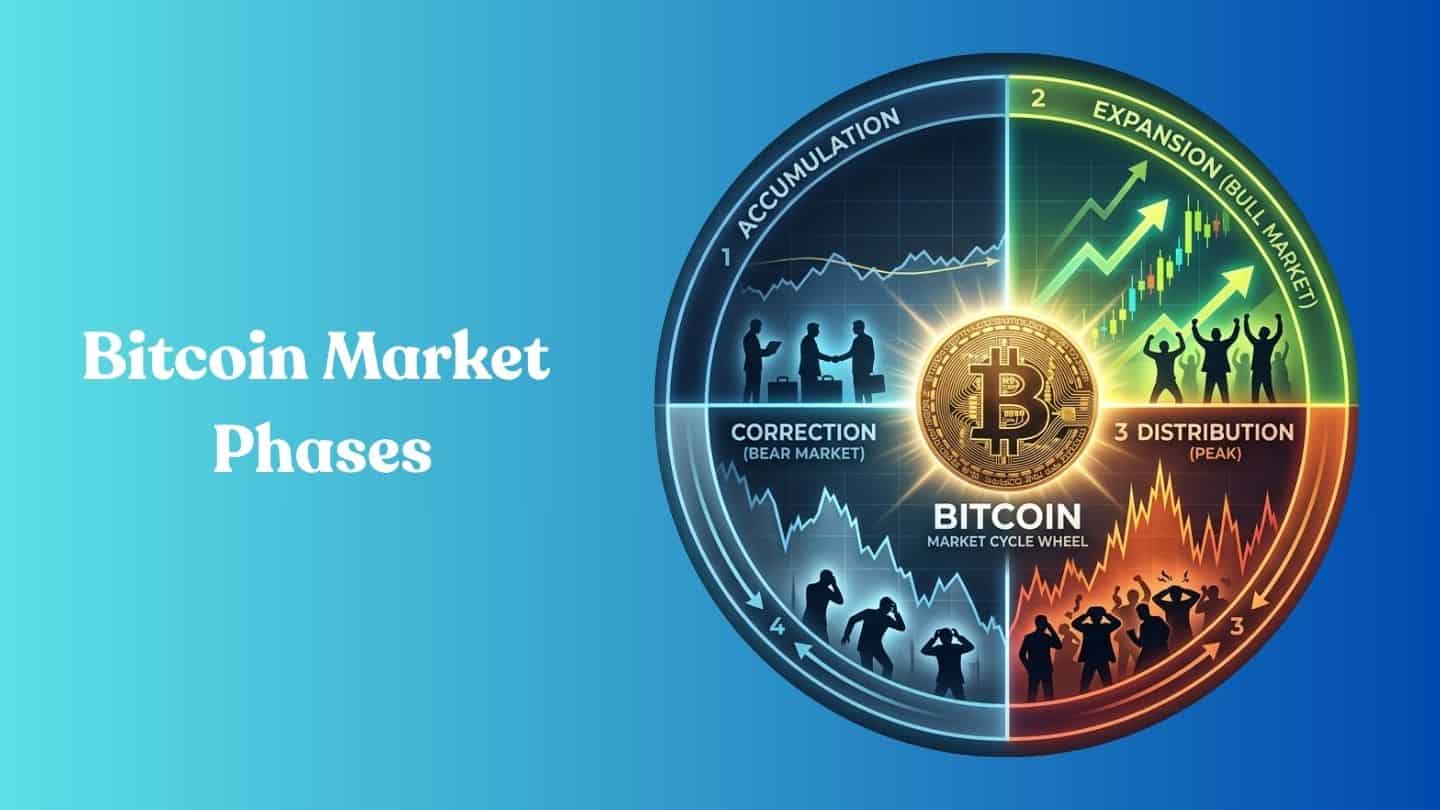
Table of Contents
People often think of the cryptocurrency market as a crazy digital wilderness that changes a lot, but in fact, there is a regular rhythmic pattern underneath the price fluctuations. Investors have been applying bitcoin cycle analysis for years to try to figure out the market, dividing its behavior into four phases. These cycles have been closely linked to the Bitcoin halving events that occur every four years, thus serving as a guide for capital increase from the phase of low, key accumulation to that of euphoric expansion, then comes distribution, leading to correction.
In 2026, the market will be more mature and influenced to a great extent by institutional ETFs as well as changing global liquidity; however, the underlying psychology of the cycle will remain the same. If you are planning to explore Bitcoin payment processing solutions or start a digital asset portfolio, understanding these alterations is very important because different stages mean different levels of risk and reward.
1. Accumulation Phase
The accumulation phase is probably the hardest phase to spot for casual observers, as it coincides with market sentiment hitting rock bottom. After a major downtrend, the prices stabilize and move within a narrow range. At that point, “weak hands” are, in large part, out of the market, and long-term investors, sometimes called “smart money,” start quietly accumulating their positions.
The accumulation phase is when the price of an asset barely moves, and the volume is low. The asset becomes “boring” to most people as prices stabilize and the volatility disappears. However, on-chain data often says a completely different story: it is a gradual movement of coins from exchanges to private cold storage. So, it is about waiting for the right time and being patient when the market is scared or not interested.
2. Expansion Phase
This phase of the market, which is often referred to as the “bull market” or the expansion phase, occurs after Bitcoin has broken through the resistance levels that have held it down for a long time, leading to an inflow of demand. When the price of Bitcoin goes up, the general public’s perception goes through various stages. Initially, they don’t believe it, then they get hopeful, and finally, after seeing everyone else doing it, they experience FOMO (Fear Of Missing Out). This phase is characterized by an increased influx of money and participation of various investors in the market, not only retail but also institutional.
Capital is on the move at a greater speed during the expansion. With Bitcoin price reaching new highs and new lows, this pattern gets more and more support from social media and traditional financial news that is becoming more mainstream. Thus, this period witnesses the highest level of speculative leverage. Once investors get bored with the old, same old trend, they start taking their money from Bitcoin to “altcoins” in search of higher returns, which is basically the start of the market cycle’s finish.
3. Distribution Phase
The distribution phase is the opposite of accumulation. If accumulation is the valley at the bottom of a cycle, then distribution is the plateau at the top of a cycle. Here, price action gets quite volatile, but new large gains fail to be made. Long-term holders, who bought during the accumulation phase period, start to sell their holdings to late-arriving investors at this point.
Sentiment is still bullish, but the real market structure is starting to deteriorate. You will frequently notice “double tops” or “head and shoulders” patterns in price charts. One of the most important metrics to keep an eye on is Bitcoin dominance, which often goes through extreme fluctuations as capital is shifted from BTC to the rest of the market. Extreme price fluctuations during the distribution phase generally indicate that the market is having trouble finding new buyers to support the existing price levels, and hence, a change in the trend comes.
4. Correction Phase
The correction phase, or bear market, is a tough resetting phase. This is when people get scared of risk; there is no money to be had, and the bubble from the expansion phase finally bursts. During this period, the market may experience a rapid decline, and sometimes the market value may be down from the peak of the cycle in just a few months.
Correction aims at bringing the market back to a stable situation, it gets rid of excessive leverage and takes the asset back to a “fair value” reflecting fundamental utility rather than excitement. Consequently, the first drop can be very brisk and intense. Nonetheless, the final part of a correction is a slow “grind” down, which ultimately leads to the selling pressure being exhausted and the transition into the new accumulation phase. Thus, for the disciplined investor, the correction is less about the loss and more about discovering where the new floor is being set.
Which Bitcoin Market Phase Comes Next in 2026?
The market seems to be going through a challenging transition as 2026 gets underway. After the 2025 bull run, several charts predict that we might be in a Correction/Consolidation phase. This time around, the crash has not been a steep, sharp drop; it looks more like a well-planned withdrawal, mainly because institutional spot ETFs have had a calming effect on the market.
The table given below shows a comparison of 2026 indicators with the traditional four-phase model:
Phase Indicator Comparison (Early 2026 Context)
| Indicator | Accumulation | Expansion | Distribution | Current (2026) |
| Price Trend | Sideways/Flat | Strong Uptrend | Volatile/Flat | Neutral/Slight Down |
| Sentiment | Fear/Boredom | Euphoria/FOMO | Greed/Hype | Cautious/Uncertain |
| Liquidity | Low/Dry | High/Rising | Peak/Turning | Moderate/Stable |
| BTC Dominance | Rising | Falling | Fluctuating | Rising (Flight to Safety) |
Most agree that 2026 won’t really have the dramatic “Golden Cycle” expansion that some fans were expecting; however, it is considered to be a fundamental year. The trend is probably moving away from speculative fluctuations to a “development phase,” in which Bitcoin will be seen more as a digital commodity (gold) rather than a tech stock with high growth potential.
Final Thoughts
The four-phase model is still an effective perspective through which we can understand Bitcoin, even though the market keeps changing. The impact of the halving on supply, shock, might be less than it was ten years ago, but fear and greed, which are human emotions, still dictate these cycles. Investors who figure out the current phase can more easily keep their emotions in check and not get caught up in the irrational trades typical of emotional moments.
Explore How Crypto Is Used in Practice
Cryptocurrency is used for more than trading and long-term holding. The guides below explore how different coins work as payment methods on platforms that accept direct wallet deposits and withdrawals.

Jeeva Shanmugam is passionate about turning raw numbers into real stories. With a knack for breaking down complex stats into simple, engaging insights, he helps readers see the world through the lens of data—without ever feeling overwhelmed. From trends that shape industries to everyday patterns we overlook, Jeeva’s writing bridges the gap between data and people. His mission? To prove that statistics aren’t just about numbers, they’re about understanding life a little better, one data point at a time.