BMW Statistics By Sales Trends And Revenue Insights (2026)

Updated · Apr 01, 2026


Table of Contents
- Introduction
- Editor’s Choice
- BMW Financial Performance
- BMW Stock Performance and Shareholder Value Trends
- BMW Production
- BMW Regional Distribution of BMW Group Purchasing Volume
- Global Vehicle Deliveries Performance by Region and Market
- BMW’s Carbon Footprint Dynamics
- BMW Group’s Sustainability Metrics 2025
- BMW Workforce Regional Shifts
- BMW Workforce Age Structure
- BMW vs. Mercedes-Benz vs. Tesla
- Conclusion
Introduction
BMW Statistics: The BMW Group maintains its status as a top global brand in premium automobiles while adapting to challenges created by electric vehicle adoption, changing customer preferences, and worldwide economic conditions. The period from 2025 to 2026 marks a transitional stage for BMW as the company seeks to balance its revenue goals with its intensive spending on electric vehicle development, digital transformation, and sustainable practices. The company achieved stable worldwide sales and high revenue results despite facing challenges from decreasing demand in China and increasing costs.
BMW remains an important force in developing future luxury transportation through its expanding electric vehicle market share and continuous product innovation. The article presents essential BMW statistics and its financial data from 2025, which gives investors, revenue, and technology fans a complete understanding of its financial situation.
Editor’s Choice
- The revenue for BMW Group dropped 6.3% compared to the previous year, resulting in total revenue of €133.45 billion for 2025 because of declining customer demand and pricing challenges.
- The automotive segment experienced a revenue decline of 5.9%, which resulted in total revenue of €117.56 billion, showing fundamental business operational difficulties.
- The financial services sector achieved a 3.2% revenue growth, resulting in total revenue of €39.81 billion, which helped maintain earnings consistency.
- The EBIT figure decreased by 11.5% to €10.19 billion, indicating declining profit margins.
- The automotive sector experienced a 20.7% decline in EBIT because of higher costs and the company’s decision to invest in electric vehicles.
- The net profit dropped 3.0% to €7.45 billion, which demonstrated that the company maintained stable profit margins despite facing financial challenges.
- The total vehicle production for 2025 decreased by 2.3%, resulting in a production total of 2.46 million units.
- The Spartanburg production facility increased its output by 4.2%, which resulted in 412,799 units produced, showing strong demand from the United States.
- The output from China’s Dadong plant decreased by 40.2%, which indicated a decrease in demand throughout the region.
- European delivery numbers increased by 7.2%, which resulted in 1.02 million units delivered, helping to balance out the delivery drop in Asia.
- The Asian market experienced an 18.5% decline in deliveries, which included a 12.5% decrease in deliveries from China, because of increased competition.
- The total procurement spending reached €79.5 billion, with Germany contributing 31.3%.
- 5% reduction in CO₂ emissions, which resulted in total emissions of 128.35 million tCO₂e, advancing their ESG initiatives.
- 9% workforce reduction, which led to a total employee count of 155,497 because of operational efficiency enhancements through restructuring.
BMW Financial Performance
(Source: bmwgroup.com)
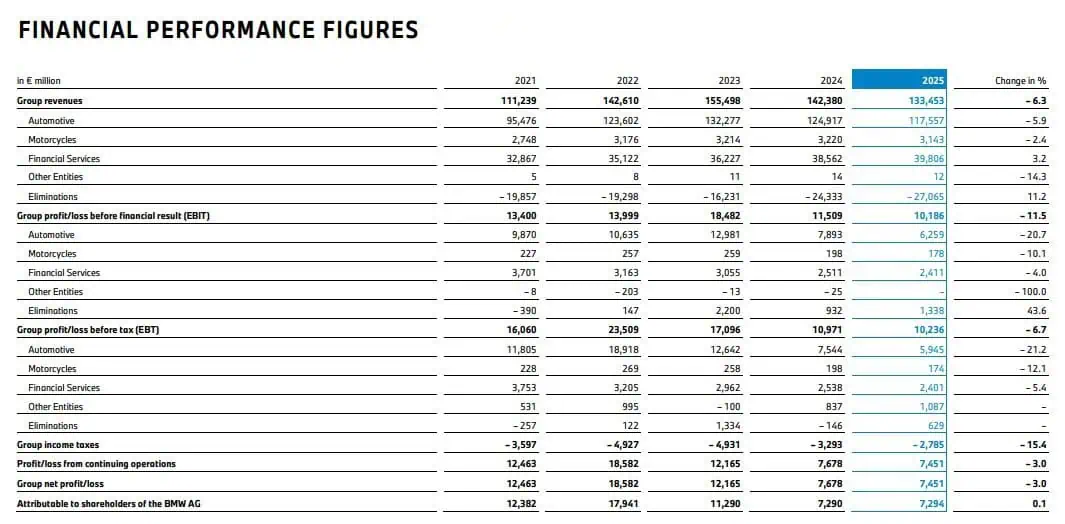
- The newest financial results from BMW AG show that their financial performance has developed through three main factors, which include market fluctuations, rising expenses, and their upcoming business plans.
- The group received revenues of €133,453 million in 2025, which represents a decline of 6.3 % when compared to 2024.
- The revenue decline results mainly from the automotive business, which serves as the primary income source for BMW, because it decreased by 5.9 % to 117557 million euros.
- The motorcycle division experienced a minor reduction of 2.4 %, which demonstrates that niche mobility markets maintain their ability to withstand challenges.
- Financial services for automotive businesses experienced a remarkable performance, which increased by 3.2 % to reach 39806 million euros. This achievement shows that financial services have become vital for sustaining business operations during periods of automotive market fluctuations.
- The company showed an increased rate of intra-group financial adjustments, which resulted in consolidation accounting errors that led to more significant elimination expenses.
- The company reported a decline in its EBIT figure after it dropped by 11.5 % to reach 10186 million euros, while automotive EBIT experienced a more severe decrease of 20.7 % because of rising production expenses and electrification costs.
- EBT figure decreased to 10236 million euros because of operational problems that continued to exist even after financial services provided their assistance.
- As per the BMW Group Report 2025 reported a net profit of 7451 million euros, which represents a 3.0 % decrease compared to the previous year.
- The net profit for shareholders increased by 0.1 %, which demonstrates the company’s dedication to managing capital resources while developing strategies that benefit shareholders.
- The company reduced its income tax burden by 15.4 %, which helped to balance out the decrease in profits.
- The financial data of BMW shows a transitional period according to trend analysis methods. The dataset contains essential automotive industry terms, which include electric vehicle (EV) investment and cost optimization, revenue diversification, and margin pressure.
- Financial services business shows growth potential while its net profit decline remains manageable, and this demonstrates that the company can withstand market challenges.
- The financial results of BMW from 2025 demonstrate how the company must achieve both operational transformation and profitability maintenance, while its future growth depends on its ability to expand electric vehicle production, improve operational productivity, and maintain customer demand in international markets.
(Source: bmwgroup.com)
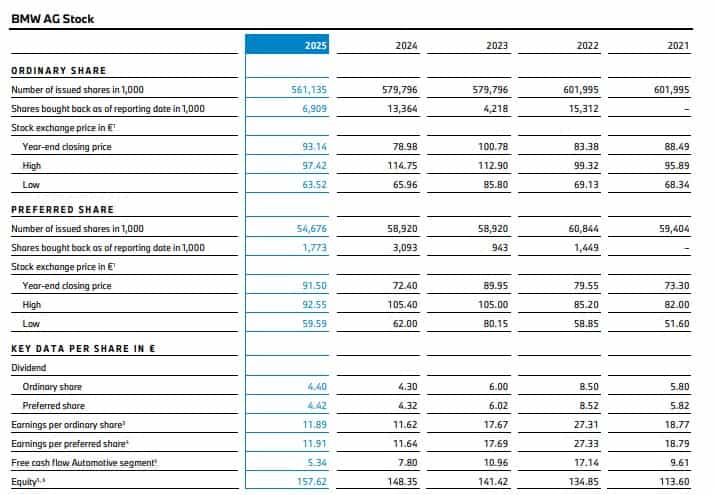
- The period from 2021 to 2025 shows how BMW AG’s movement developed because of its capital adjustments and market fluctuations, and its changing shareholder distribution.
- The total number of ordinary shares outstanding decreased to 561.1 million shares in 2025, which represented a decline from 579.8 million shares in 2024 because of ongoing share buyback programs that repurchased 6.9 million shares.
- The company intends to accomplish two goals, which demonstrate its commitment to capital management and EPS growth, which serve as essential elements for equity valuation.
- The stock price analysis shows that BMW’s closing price for 2025 reached €93.14, which represented a significant increase from its 2024 price of €78.98.
- The company needs to monitor its share price movements because the stock price shows ongoing ocean market trends and macroeconomic factors that affect investor decision-making.
- The preferred shares experience the same price pattern as the shares reached a closing price of €91.50 after rising from €72.40 in 2024.
- The company reduced its share buybacks to 1.77 million shares, which shows that the company now practices a more careful approach to deciding where to spend its money.
- The ordinary shares displayed a slight earnings growth, which brought EPS to €11.89, but this value stayed far below the 2022 peak of €27.31 because of margin difficulties and normal earnings patterns. Free cash flow per share decreased to €5.34, which represented a major drop from its 2022 value of €17.14 because the company spent heavily on electrification and innovation projects.
- The company achieved dividend stability through its decision to pay ordinary shareholders €4.40, which demonstrates BMW’s dedication to returning cash to shareholders while maintaining an appealing dividend yield.
- The company saw an increase in equity per share to €157.62, which shows that the company’s balance sheet financial strength has improved.
BMW Production
(Source: bmwgroup.com)
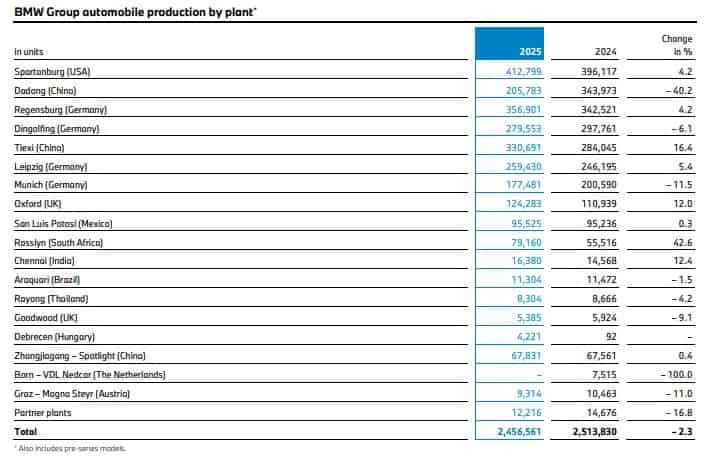
- The production data from BMW Group indicates that worldwide manufacturing operates through regional strengths that connect to the company’s strategic recovery program.
- The total production shows a minor decrease of 2.3 %, which results in 2456561 units for 2025 compared to the 2513830 units of 2024, although the output shows two different production patterns at the plant level.
- Spartanburg, USA, operates as BMW’s biggest manufacturing site, which produces 412799 units after experiencing a 4.2 % production increase.
- The automotive industry establishes SUV demand as a critical element that demonstrates the USA market value. Regensburg, Germany, delivered 356901 units to establish Germany as a vital production center.
- The greatest production total volume reduction occurs in Dadong, China, which experienced a 40.2% output drop to reach 205783 units.
- The automotive industry in China faces market shifts that result in this substantial decline as competitive domestic manufacturers emerge and electric vehicle preferences develop.
- The production output at Tiexi China increased by 16.4 %, which indicates that the site is adjusting its production schedule instead of suspending operations.
- The results from European plants show various levels of success. The Leipzig, Germany, facility experienced a production increase of 5.4 % while the Munich, Germany, facility observed an 11.5 % decrease, which indicates that the facility underwent either restructuring activities or changes in its operational models.
- The Oxford, UK plant increased production by 12.0 % because of strong demand for MINI vehicles, while Goodwood, UK experienced a 9.1 % decline, which stemmed from fluctuations in ultra-luxury customers.
- Rosslyn, South Africa, achieved a 42.6 % increase, which became the top growth achievement, while Chennai, India, recorded a 12.4 % expansion, which demonstrates that emerging markets drive BMW’s automotive expansion strategy in emerging markets.
- The smaller facilities of Araquari, Brazil, and Rayong, Thailand, experienced minor production declines.
- The Netherlands location of Born experienced a complete production halt, which resulted in a 100% production decline. This development marked a major change in BMW’s worldwide production strategy.
- BMW’s 2025 production showed the effects of regional manufacturing optimization, together with electric vehicle transition demands and changing customer needs.
- The company achieved better performance through its main production facilities and new markets because these areas showed strong development, which allowed the company to adapt its operations in response to changes in the worldwide automotive market.
BMW Regional Distribution of BMW Group Purchasing Volume
(Source: bmwgroup.com)
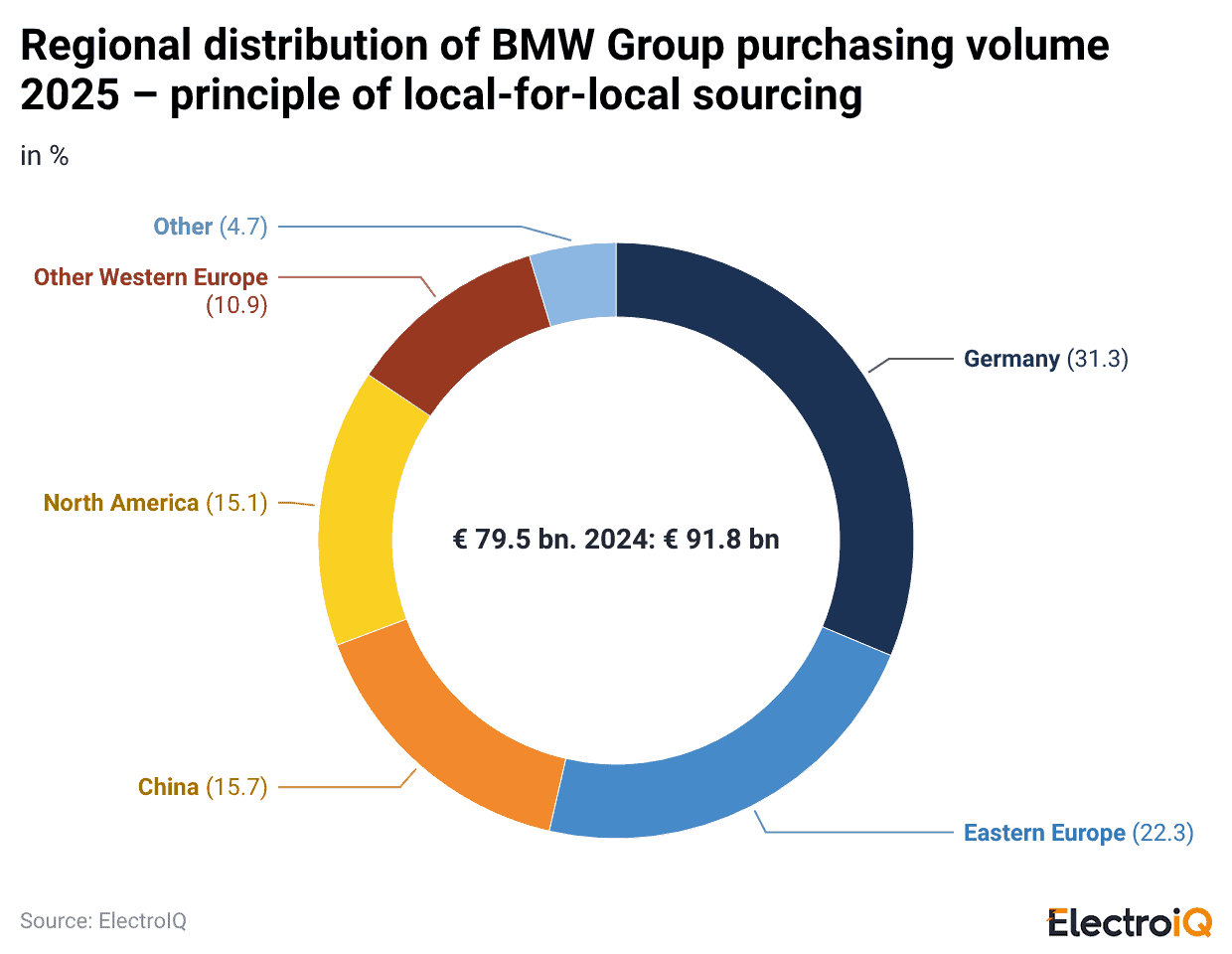
- The procurement landscape of BMW Group in 2025 highlights a well-calibrated local-for-local sourcing strategy with total purchasing volume reaching €79.5 billion.
- The regional distribution of resources demonstrates BMW’s dedication to achieving supply chain efficiency and economic savings while protecting itself against various market threats that arise in international business.
- Germany maintains its position as the main hub for BMW’s automotive supply chain and engineering operations with a market share of 31.3%.
- The domestic supply chain base provides essential support for manufacturing operations that require high-value components and advanced research capabilities.
- Eastern Europe now accounts for 22.3% of market share because it has become a key manufacturing base that offers affordable production costs and extensive supplier connections.
- Asia maintains its critical position in the market because China accounts for 15.7% of total procurement activities. This agreement supports BMW’s strategy to establish connections with the Chinese automotive market through developing production facilities in that country.
- North America maintains a 15.1% stake, which matches the company’s sourcing strategy to its strong operational capabilities that exist particularly in the United States.
- Western Europe outside its main regions provides 10.9% of total contributions, which enables companies to enter new markets while existing markets maintain their stable development.
- The company uses the “Other” category to display its global sourcing activities when acquiring special parts, which make up 4.7% of its total components.
- The distribution shows how BMW maintains strength through worldwide supply chain challenges, geopolitical changes, and current electric vehicle (EV) development.
- By procuring materials closer to its production facilities, BMW improves its operational efficiency while decreasing transportation expenses and protecting itself from international economic fluctuations.
Global Vehicle Deliveries Performance by Region and Market
(Source: bmwgroup.com)
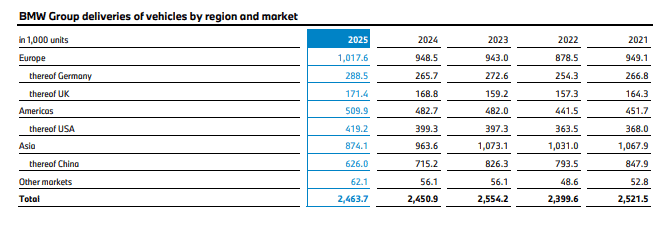
- The dataset demonstrates how worldwide automotive demand has transformed itself through total vehicle deliveries, which will increase to 2.46 million units in 2025 from 2.45 million in 2024, showing a slight growth of approximately 0.1 % year-over-year (YoY).
- The automotive market has reached a stable phase, which shows established patterns of consumer behavior.
- Europe remains a core growth pillar, which will increase its market size to 1.02 million units in 2025 through a 7.2 % year-over-year (YoY) growth rate that German markets (288.5k units) and the United Kingdom (171.4k units) benefit from.
- The Americas experience strong growth as their market reaches 509.9k units, which shows a 5.6 % year-over-year (YoY) increase because the USA market controls 82 % of regional sales, while people show strong interest in buying, and the economy stays strong.
- The area achieved total deliveries of 874.1k units, yet it decreased from its 2023 delivery peak of 1.07 million units because all Asian markets experienced 18.5 % loss, which happened mainly because China shipments dropped to 626k units, which marked a 12.5 % year-over-year (YoY) decline.
- The situation shows how competition and international economic challenges have intensified in the most important Asian markets. Other markets remain niche but stable at 62.1k units.
- The automotive industry worldwide faces three main forces, which combine regional market distribution with consumer demand restoration and market competition, according to European and American markets, which balance out the Asian market decline.
- The automotive industry worldwide faces three main forces, which combine regional market distribution with consumer demand restoration and market competition, according to European and American markets, which balance out the Asian market decline.
BMW’s Carbon Footprint Dynamics
(Source: bmwgroup.com)
- The CO₂ emissions path of BMW Group demonstrates its two operational difficulties and its dedication to sustainable development initiatives.
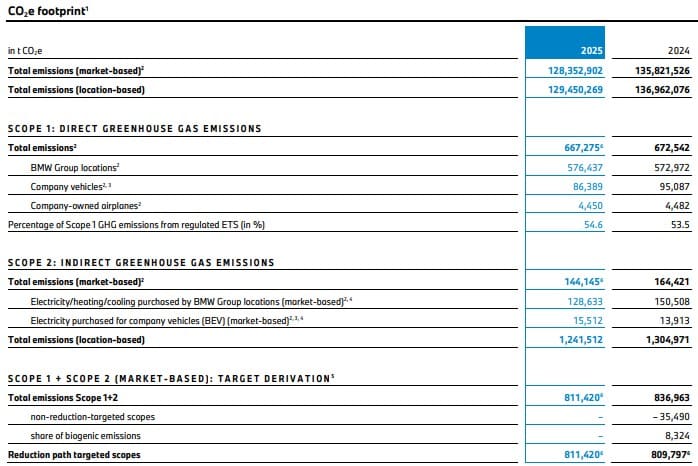
- The 2025 market-based total emissions reached 128.35 million t CO₂e, which represented a 5.5% decrease from the 135.82 million t CO₂e emissions of 2024.
- The location-based emissions decreased to 129.45 million t CO₂e, which demonstrates BMW’s achievement of its carbon neutrality and ESG objectives.
- The examination of Scope 1 emissions (direct greenhouse gas emissions) demonstrates that emissions have improved because they decreased from 672,542 t CO₂e in 2024 to 667,275 t CO₂e in 2025.
- The company achieved this result because company vehicle emissions dropped by approximately 9.2% while BMW Group locations maintained their emission levels.
- The regulated ETS coverage increased to 54.6%, which demonstrates that organizations are now following emissions trading frameworks more closely.
- The market-based Scope 2 emissions at BMW experienced a significant decrease because the company reduced its electricity-related emissions from 164,421 t CO₂e to 144,145 t CO₂e, which resulted in a 12.3% reduction that stemmed from increased use of renewable energy sources.
- The location-based Scope 2 emissions continue to exceed 1.24 million t CO₂e because the regional energy mix limits production.
- The total emissions of Scope 1 and 2 decreased to 811,420 t CO₂e, which supports BMW’s decarbonization plan and sustainable transportation goals and its commitment to achieve net-zero emissions by 2050.
BMW Group’s Sustainability Metrics 2025
- The 2025 energy performance of BMW Group shows a sustainable development path that maintains equal energy use while increasing renewable energy sources, yet faces challenges from production-related efficiency impacts.
- The company achieved total energy consumption of 6.18 million MWh, which decreased by 0.4% compared to the previous year, demonstrating effective energy control despite complicated operational conditions.
- Renewable energy now provides 49.4% of BMW’s energy needs, which represents a growth from 48.5% that existed in 2024, thus demonstrating BMW’s dedication to both decarbonization and its environmental, social, and governance objectives and sustainable production methods.
- The power needed to produce each vehicle increased to 2.00 MWh, representing a 3.1% rise, which resulted from decreased production capacity combined with production volume changes that typically occur during electric vehicle development processes and factory layout changes.
- The company’s main power generation system produced 551,077 MWh of energy as its combined heat and power systems operated, which resulted in self-sustaining energy production and cost savings, while only 0.2% of total electricity needs came from external sources, showing that the company maintained strong control over its energy use.
- The company experienced rising energy costs because its revenue dipped, together with cost pressures, producing higher expenses than the efficiency improvements.
- The operating margins and sustainability benchmarks of the organization depend on this particular metric.
BMW Workforce Regional Shifts
(Source: bmwgroup.com)
- BMW Group introduces a precise but crucial method to improve its employee operations in worldwide markets in 2025.
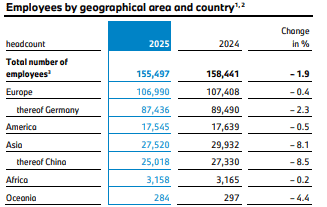
- The total number of employees declined to 155,497, down from 158,441 in 2024, representing a -1.9% contraction—a signal of increased focus on operational efficiency, automation, and cost optimization.
- Regionally, Europe remains BMW’s employment backbone with 106,990 employees, though slightly reduced by -0.4%.
- Notably, Germany, the company’s core hub, saw a sharper decline of -2.3%, dropping to 87,436 employees, reflecting industrial restructuring and gradual shifts toward digital manufacturing.
- The Americas experienced a small decrease in headcount, which dropped by -0.5% to 17,545 employees, showing that the company maintains its current size while proceeding with cautious recruitment.
- However, the most significant contraction occurred in Asia, where employee numbers fell by -8.1% to 27,520.
- The Chinese market, which serves as a vital growth area, experienced an -8.5% decline because market conditions changed and geopolitical conflicts emerged, and supply chain operations transformed.
- Africa reported a slight growth of +0.2%, while Oceania faced a small decrease of -4.4%.
- Overall, BMW’s workforce data shows a movement toward operational efficiency, which includes shifting staff locations and matching its sustainability objectives with digital transformation initiatives.
(Source: bmwgroup.com)
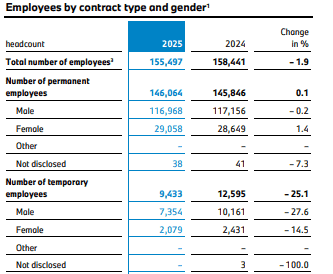
- The study of BMW Group workforce composition shows that the company developed its plan for 2025, which focuses on three main goals: sustaining employee job security, maintaining employee skills, and growing business operations.
- The total workforce decreased by 1.9%, bringing the number of employees to 155497 as the company implemented cost-cutting measures and increased its use of automated systems.
- The main feature of the study shows that permanent employee numbers reached 146064 after a slight increase of 0.1%.
- BMW uses permanent employee relationships to develop plans for its future workforce needs.
- The not disclosed category declined by -7.3%, which shows that organizations now present their data with greater accuracy.
- The company experienced a 25.1% drop in temporary employment, which resulted in 9433 employees working in that category.
- The company experienced a stronger drop in temporary male workers who left at a rate of 27.6% compared to temporary female workers who left at a rate of 14.5%.
- The company made this transition because it wanted to establish permanent employment positions instead of using temporary employees.
BMW Workforce Age Structure
(Source: bmwgroup.com)
- The 2025 workforce data of BMW Group shows that the company has made an intentional demographic change, which matches current industry patterns of employee reallocation and automation with new skill requirements.
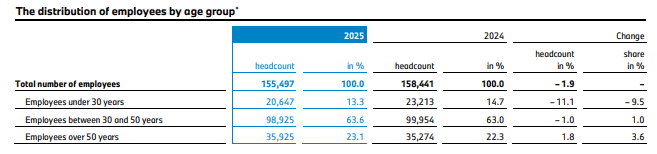
- The total employee count decreased to 155497, which represents a 1.9 % decrease from the previous year because the company implemented cost-saving measures through its workforce efficiency planning.
- The examination of age distribution patterns demonstrates how human capital resources of the organization have developed over time.
- The number of employees under 30 years decreased by 11.1%, which resulted in 20647 employees who now represent 13.3 % of the total workforce.
- The decline indicates that companies have decreased their entry-level recruitment activities or they have extended their hiring processes because of economic uncertainty and digital transformation advancements.
- The core workforce between 30 and 50 years old maintains its status as the largest group, which makes up 63.6 % of employees (98,925 employees) who demonstrate only a 1.0 % decrease. This segment drives operational productivity while providing engineering skills and leadership development, which supports the company’s electrification and innovation initiatives.
- The number of employees who are 50 years old or older grew by 1.8% to 35,925, which brought their total to 23.1% of the workforce.
- The workforce has become older, which demonstrates the companies’ need to keep experienced workers, but it creates challenges for future leadership development as the industry shifts to electric vehicle technologies.
BMW vs. Mercedes-Benz vs. Tesla
|
Company / Segment |
Latest Reported Margin Metric | 2023–2024 Level | Stated / Implied Target Corridor | Notes |
| BMW Automotive | EBIT margin (segment) | 8.6% HY1 2024; 9.6% excl. | 8–10% medium‑term |
Maintaining the target band through the BEV ramp and Neue Klasse capex. |
|
Mercedes‑Benz Cars |
Adjusted Return on Sales (RoS) | 12.6% in 2023 | 10–12% guided for 2024 | Margin‑over‑volume focus, more ICE/PHEV mix, slower BEV than the initial plan. |
| Mercedes‑Benz Vans | Adjusted RoS | 15.1% in 2023; 14.6% in 2024 | 12–14% guided for 2024 |
Exceptionally high van profitability; key earnings pillar. |
|
Tesla (Group) |
Operating margin | 9.2% in 2023; 7.2% in 2024 | No explicit % band; management prioritises growth + cost leadership |
Margins compressed by global price cuts; still above mass‑market ICE peers but now similar to BMW band. |
Conclusion
The performance of BMW Group during the period from 2025 to 2026 shows a transitional phase that emerges from three main factors. The company showed resilience because its global deliveries remained stable while its financial services and capital management practices maintained their strength. The company maintained growth stability through its operations in Europe and the Americas, which compensated for its Chinese market challenges and its production and workforce improvements that led to better operational results.
BMW established itself as a competitor for future electric mobility markets through its strong investment in electric vehicle development through the Neue Klasse platform. The company uses short-term profit reduction to fund its strategic initiatives, which help it maintain its position as a leader in the premium automotive and electric vehicle markets.
Sources
FAQ.
BMW achieved revenues of €133.45 billion in 2025 which represented a 6.3% decrease from the previous year.
The company experienced profitability losses because of two main factors which were increased investments into electric vehicles, rising expenses for production and decreased demand from the Chinese market.
The company delivered approximately 2.46 million vehicles worldwide which represented a stable growth rate of 0.1%.
The company achieved its highest delivery results from Europe which saw an increase of 7.2% compared to the previous year.
Neue Klasse is BMW’s next-generation EV platform, which aims to achieve 50% electric vehicle sales by 2030 through enhanced range capabilities and charging speed, plus reduced cost.

I hold an MBA in Finance and Marketing, bringing a unique blend of business acumen and creative communication skills. With experience as a content in crafting statistical and research-backed content across multiple domains, including education, technology, product reviews, and company website analytics, I specialize in producing engaging, informative, and SEO-optimized content tailored to diverse audiences. My work bridges technical accuracy with compelling storytelling, helping brands educate, inform, and connect with their target markets.