Conversion Rate Optimization Statistics By Spending, Budgeting and Facts (2026)

Updated · Jan 12, 2026


Table of Contents
- Introduction
- Editor’s Choice
- Average Conversion Rate By Industry
- Conversion Rate Optimization Statistics – Marketing Strategies
- Conversion Rate Optimisation Statistics By Spending and Budgeting
- Landing Page Optimization CRO Statistics
- CRO Statistics – A/B Testing And Conversion Optimization
- Recent Developments
- Conclusion
Introduction
Conversion Rate Optimization Statistics: In the current digital economy, attracting visitors to your site is only part of the whole picture. Winning over that traffic through customers, leads, or subscribers is the actual reward. Conversion Rate Optimization (CRO) in 2026 is a mandatory practice rather than a mere appealing term. As user behaviours change and AI tool adoption accelerates, competition for every click intensifies. A small improvement in conversion rate can generate millions of dollars in additional revenue for high-traffic platforms. It can also bring thousands for new companies.
This article will focus on the cutting-edge Conversion Rate Optimization statistics for 2026. It will include market benchmarks, AI, and UX trends.
Editor’s Choice
- Different industries have their own average conversion rates, with Food & Beverage having the highest at 8.98%, and the other extreme is complex B2B sectors like computer product manufacturing, with an average as low as 1.1%.
- Legal services are the strongest in B2B conversions with 7.4%, while companies with longer sales cycles typically experience lower rates.
- The dollar value of small businesses not utilizing the proven impact of CRO is equal to about 68% of the total small business market, thus presenting a big opportunity waiting to be unlocked.
- The global eCommerce conversion rate currently stands at 3.76%, and 75% of B2B marketers consider it to be a key performance metric.
- Bounce rates between 26% and 70% have a direct and significant effect on conversions, with the lower rates showing higher engagement and vice versa.
- Organic search traffic is very strong, accounting for more than 90% of total web traffic and a 53% conversion rate, which is much higher than paid leads at 2.35%.
- In the case of Facebook Ads, the average conversion rate is 8.24%, and particularly strong performance is observed in the paid sector across fitness, employment, and healthcare.
- Considering factors like speedy loading, uncluttered CTAs, customization, and easy-to-use layouts, website UX influentially can magnify conversions by more than 200%.
- Less than 5% of businesses’ total budgets is allocated to CRO; however, 55% plan to increase investment given the strong ROI potential.
- Landing page optimization methods, including single CTAs, videos, testimonials, and personalization, can convert visitors into customers to the extent of even 371%.
- A/B testing is reported to drive up to a 49% increase in conversions, yet only 44% of companies currently employ it.
- The market is being driven by CRO solutions, AI-based testing, and personalized marketing; thus, the CRO software value is expected to get close to 1.93 billion dollars.
Average Conversion Rate By Industry
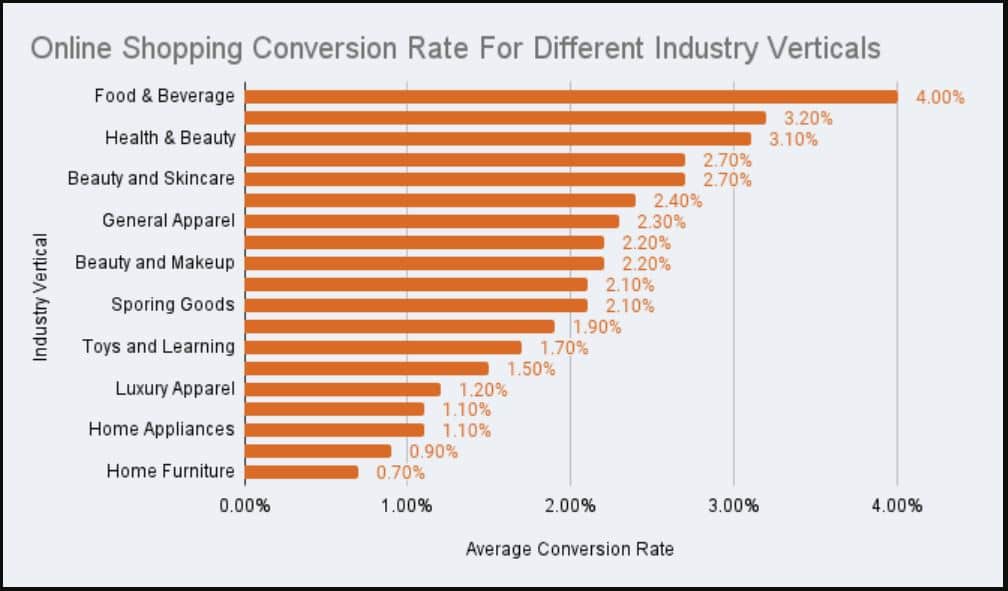
(Source: meetanshi.com)
- The statistics point out that conversion rate is specific for each sector and each business model; thus, custom-tailored conversion rate optimization (CRO) strategies are crucial.
- In 2024, the Food and Beverage industry had a conversion rate of 8.98%, making it the strongest performer in eCommerce.
- Legal services average a 7.4% conversion rate; POS services are in the 2%-5% range on average.
- Other sectors, such as Commercial Real Estate (2.70%), Rehabilitation & Recovery (2.1%), and Investment & Health Management (1.9%), have conversion rates that are generally moderate.
- The computer product manufacturing sector has the lowest average B2B conversion rate at 1.1%, likely due to slow sales processes and complex purchase decisions.
- Despite the obvious effect of CRO on performance, its use remains quite limited.
- Small companies make up about 68% of the total number, which have either not looked into CRO or have not spent money on the process of optimization strategy development.
- This gap is a significant opportunity, especially since global eCommerce conversion rates average 3.76%.
- The necessity for optimization is commonly acknowledged among business professionals, 75% of whom have categorized the conversion rate as one of the key performance indicators for judging the success of a landing page and the entire marketing campaign.
Conversion Rate Optimization Statistics – Marketing Strategies
- Various marketing factors and optimization tactics have a direct impact on conversion rates across industries and channels.
- Bounce rate is a major factor as it indicates the percentage of website visitors who exit the site after visiting only one page.
- The majority of websites’ bounce rates range from 26% to 70%, and sites with higher bounce rates typically have lower conversion potential because users do not interact further with the site.
- The average B2B conversion rate is approximately 2.1%, while for professional services it is 4.6%.
- The finance sector is experiencing conversion rates of around 3.1%, the travel industry is averaging 2.4%, and the higher education and colleges sectors are slightly above 2.8%.
- The arts and crafts sector, however, has an average conversion rate of 3.84%-4.07%, indicating strong buyer intent and engagement among its niche audience.
- Across industries, Facebook Ads have the highest average conversion rate at 8.24%, yet there is a wide range of benchmark values.
- The fitness industry leads in conversion rates, reaching up to 14.29%, followed by the employment and jobs sector at 11.73%.
- Healthcare has an average of 3.20%, while education records the lowest with 2.78%. The differences among these figures highlight the need to compare results against industry-specific benchmarks rather than overall averages.
- From a marketing strategy perspective, lead conversion is the primary focus, with 74% of marketing specialists ranking it as the top priority.
- The performance of organic leads is overwhelming: they account for more than 90% of website traffic, and the conversion rate is 53%, which is far higher than that of paid leads. As a result, the conversion rate is about 2.35%.
- The conversions driven by SEO are averaging 2.1% in B2B and 2.6% in B2C, thus emphasizing the long-run benefit of organic search.
- Designing a website, aligning content structure with users, and enhancing the overall experience can have a significant impact on conversion results.
- For instance, placing a call to action just before the fold can increase conversions by 317%, while questions in the titles can drive 15% more clicks.
- Blog entries with clickable CTAs can see a 121% increase in conversion rate, and user-generated content contributes to a 3.2% lift in trust and authenticity.
- Speed and performance are equally important. B2C websites whose loading time is one second can achieve conversion rates that are 2.5 times higher compared to those whose loading time is longer than that, and every second that is taken for load time in eCommerce reduces the rate of conversions by 0.3%.
- Texts that are around 3,000 words long are very likely to produce double the conversions of shorter texts and receive 24% more social shares.
- Posts with headings between 40 and 50 characters have an 8.5x higher click-through rate, making them highly effective at attracting and converting readers.
- In general, the conversion rate from a blog visit to a lead ranges from 1% to 3%, indicating that small optimisations can deliver meaningful performance improvements.
Conversion Rate Optimisation Statistics By Spending and Budgeting
- There is a significant gap between the importance of conversion rate optimization and the actual amount of money businesses spend on it.
- Fewer than 5% of companies allocate to CRO, which is not a large share given its direct impact on revenue and lead generation.
- This under-investment implies that a lot of companies still care more about getting traffic than about maximizing the value of the visitors that are already there.
- Almost 55% of the companies intend to raise their CRO budgets, which is a sign of a change in the way businesses think about performance; that is, the focus is slowly transitioning from acquisition to optimization.
- One of the factors that contributes to this change is that firms increasingly invest in CRO tools, and the average cost of the support for A/B testing, user behavior tracking, and landing page optimization is around US$2,000.
- In 2018, the global conversion rate optimization software market was worth about US$771 million and is predicted to continue its growth at a rate of 10% per year, reaching close to US$1.93 billion by 2026.
- Demand for data-driven tools that help businesses systematically improve conversions has been steadily rising, as reflected in the growth indicated.
- Adding live chat is the most effective, potentially increasing revenue by up to 40% and conversion by up to 48% by providing immediate assistance and reducing friction during decision-making.
- Likewise, exit pop-ups deliver measurable gains, with websites seeing conversion rates increase by 2% to 5% by capturing user attention before they leave.
- The combination of these insights indicates that even minimal spending on CRO tools and strategies can yield disproportionately large profits when applied effectively.
Landing Page Optimization CRO Statistics
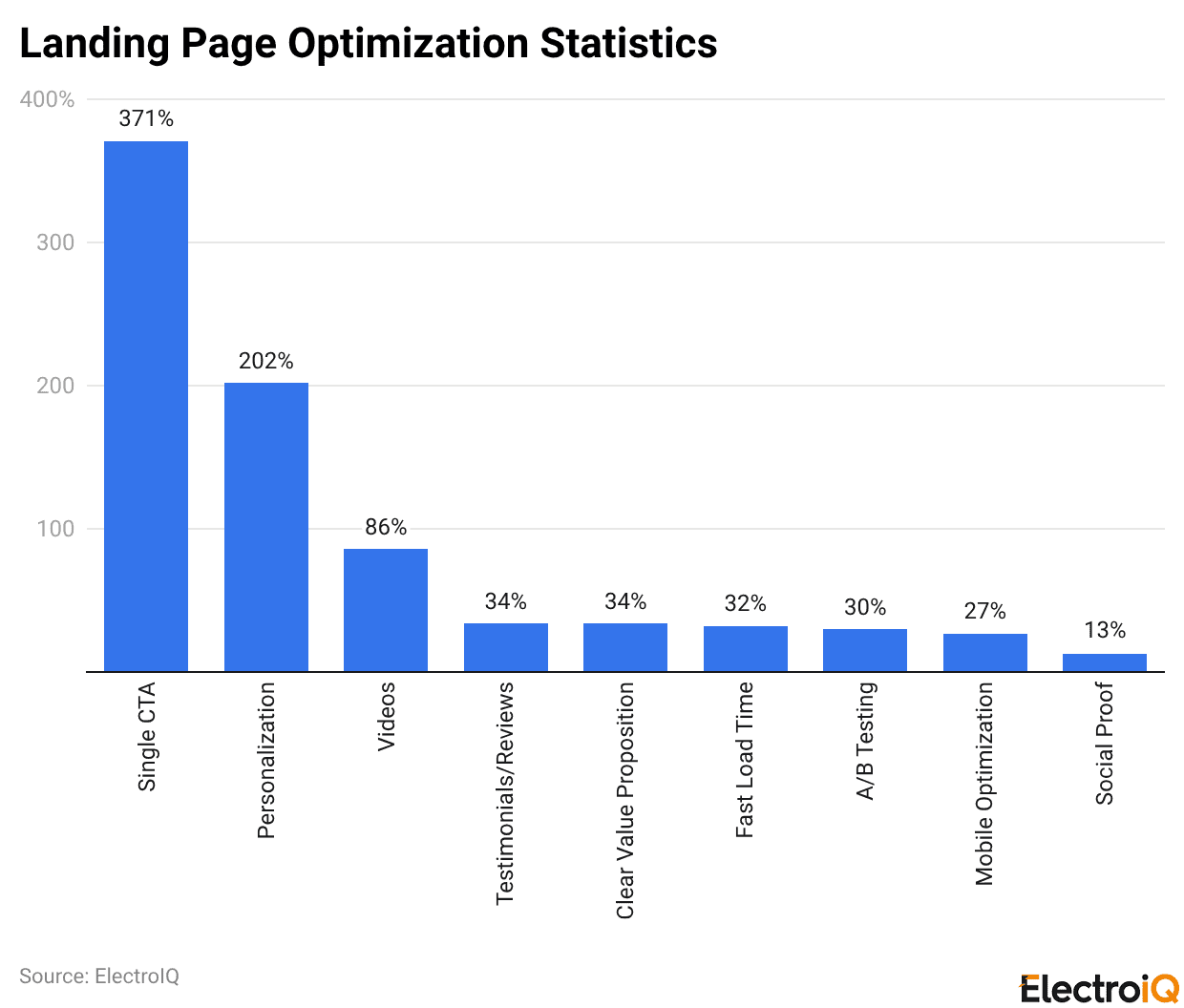
(Reference: scoop.market.us)
- The data reveals that the average conversion rate of landing pages is rather low at 2.35% across various industries, but still, there lies a great potential to enhance performance through optimization that is limited to a lesser degree.
- One of the most significant aspects is simplicity: just the opposite of the landing pages with multiple and confusing calls-to-action, a single and clear call-to-action can increase conversions by up to 371% as it minimizes distraction and directs users to perform one specific action.
- For instance, the landing page the business adds video to can convert 86% more visitors, because it is more effective in explaining the product, and the visitors are also more likely to stick around.
- Moreover, customer reviews or endorsements lead to a 34% increase in conversions, as social proof provides reassurance and builds trust.
- The sites that comprehensively and quickly convey their value proposition to the customer reap increased conversion rates of 34% since users swiftly grasp what they will receive as their benefit.
- Landing pages that are optimized for mobile devices can see a 27% increase in conversion rates, which is quite a reflection of the mobile traffic’s rising share.
- A further 12.5% lift is achieved through social proof, which is visible to the public, such as the number of customers or subscribers.
- The largest increase in conversion rates comes from personalization, where the practice of modifying landing pages for particular audience groups can result in conversion rates being up to 202% higher, thus emphasizing the importance of relevance and targeted messaging in CRO.
CRO Statistics – A/B Testing And Conversion Optimization
- A/B Testing in Conversion Performance Improvement has a Strong Impact, and it is also revealing that many companies are still underutilizing it.
- The average A/B test conversion rate can be increased by approximately 49%, and companies that conduct on-site testing as part of their strategy see an overall increase of about 14% in conversion rates.
- Nevertheless, only 44% of firms consistently apply A/B testing to make data-driven decisions, indicating a considerable gap between established efficiency and actual use of this method.
- Nearly 71% of companies conduct less than five A/B tests monthly, and thus slows down their learning and optimization process.
- Testing call-to-action buttons can increase clicks by 49%, while A/B testing email campaigns may yield a similar increase in click-through rates.
- A/B testing specifically aimed at mobile devices is considered to be very useful because it can increase conversion rates by as much as 27%, which suggests that mobile users’ consideration is a must when it comes to optimizations.
- On the one hand, A/B tests typically take two to four weeks to show a statistically significant result, depending on traffic volume and conversion rates.
- It is best to test during peak traffic, and at least 1,000 visitors per variation are required to ensure the results are reliable.
- On the other hand, A/B testing is a valuable tool for companies of all sizes. Small businesses can generally improve their average conversion rate by 23%, while larger companies see a 16% increase.
Recent Developments
- Recent happenings in the clinical research sector indicate strong momentum towards consolidation, innovation, and collaboration.
- IQVIA cemented its position in medical device research by acquiring MedTech, a biotech company, in a US$500 million deal that not only strengthened its capabilities but also expanded its healthcare services portfolio.
- Similarly, PAREXEL introduced a cutting-edge real-world evidence platform that enables the pharmaceutical industry to derive insights from vast amounts of patient data, thereby aiding decision-making in drug development and market access.
- Digital innovation investment is also on the rise, as the clinical research start-up CliniOps raised US$20 million in Series C funding, led by Sequoia Capital, to scale operations and enhance trial management and patient engagement software.
- CROs are progressively incorporating digital health solutions like wearables, remote monitoring systems, and electronic data capture systems, which allow conducting trials in a decentralized manner, collecting data instantly, and having data of better quality.
- Furthermore, the trend of strategic outsourcing partnerships between CROs and biopharma firms is on the rise, as these partnerships not only accelerate therapy development but also enhance clinical research efficiency through the combination of expertise and resources.
Conclusion
Conversion Rate Optimisation Statistics: In 2025, conversion rate optimisation became a central growth strategy. It is no longer just a mere supporting tactic. The data unambiguously illustrates that CRO provides measurable gains in all sectors. It does so through improved user experience, personalisation, speed optimisation, and data-driven testing. Although conversion rates vary widely across sectors, even small improvements can have a significant revenue impact. However, many businesses still underinvest in CRO. They thus miss out on significant growth opportunities.
As competition gets stiffer and acquisition costs go up, brands turn to the optimization, experimentation, and AI tools. They aim to maximize existing traffic, enhance marketing efficiency, and secure sustainable long-term performance gains.
FAQ.
The average conversion rates are very different according to the industry. The global average for eCommerce conversion rates is approximately 3.76% and it varies a lot; however, the Food and Beverage almost leads the pack with about 9%. B2B industries usually lie somewhere between 1% and 7.4%, which depends on the complexity of sales and the buyer’s intent.
The high-impact CRO strategies are to enhance the page’s loading time, make landing pages easier, put CTAs above the fold, personalize the content, display social proof, and conduct A/B testing. These methods can increase sales by 30% to as high as 200%.
Organic traffic significantly surpasses paid traffic, with a conversion rate of approximately 53% versus just 2.35% for paid leads. SEO is responsible for 2.1% B2B and 2.6% B2C conversions, thus making organic search a long-lasting CRO asset.
More than Half of the companies spend below 5% of their budget on CRO, but at the same time 55% have the intention to increase their investment. Companies pay US$2,000 on average for CRO tools, while the worldwide CRO software market is projected to be close to US$1.93 billion by 2026.
A/B testing aids in pinpointing the most attractive features for users, and thereby it can yield up to a 49% increase in conversion rates. Only 44% of companies, however, rely on it even though it is efficient, while both small and large enterprises benefit from frequent testing.

Maitrayee Dey has a background in Electrical Engineering and has worked in various technical roles before transitioning to writing. Specializing in technology and Artificial Intelligence, she has served as an Academic Research Analyst and Freelance Writer, particularly focusing on education and healthcare in Australia. Maitrayee's lifelong passions for writing and painting led her to pursue a full-time writing career. She is also the creator of a cooking YouTube channel, where she shares her culinary adventures. At Smartphone Thoughts, Maitrayee brings her expertise in technology to provide in-depth smartphone reviews and app-related statistics, making complex topics easy to understand for all readers.