Costco Wholesale Statistics By Revenue, Merchandise Category, Employees, Properties, Investments, Key Challenges And Facts (2026)

Updated · Mar 14, 2026


Table of Contents
- Introduction
- Editor’s Choice
- Costco Wholesale Revenue
- Costco Wholesale Gross Merchandise Value (GMV)
- Costco Wholesale Membership Worldwide
- Costco Wholesale Net Sales By Merchandise Category
- Costco’s Brand Strength And Global Customer Loyalty
- Total Number of Costco Wholesale Employees
- Costco’s Premium Valuation
- Costco Wholesale Properties
- Costco Wholesale Comparison Of 5-Year Cumulative Total Returns
- Costco Wholesale Gross Margin
- Costco Wholesale Cashflow Activities
- Costco Wholesale Investments
- Costco’s Equity Incentives
- Costco’s U.S. Warehouse Footprint
- Costco’s Operating Model Delivers Industry-Leading Productivity
- Costco Stock Driven By Growth Tailwinds And Structural Risks
- Costco E-commerce Sales
- Costco Wholesale Net Sales Growth And Global Strength
- Costco Wholesale EBIT
- Costco Wholesale Earnings Per Share
- Key Challenges
- Conclusion
Introduction
Costco Wholesale Statistics: Costco Wholesale Corporation, trading under the ticker COST, serves as more than just a warehouse club because it operates as a retail system that creates value for customers who shop in the 21st century. Costco established itself as a permanent shopping destination for North American customers who value product discounts through its membership system that delivers bulk products and operational efficiency, together with customer loyalty programs.
The company shows strong financial results and a growing customer base and international business expansion during 2025 because its retail operations withstand economic challenges, which include rising prices and supply chain problems. Costco maintains strong business growth while traditional big box stores experience declining sales because the company achieves record sales and develops new markets through its dedication to creating customer value.
The article provides an analysis of the Costco Wholesale statistics, which determine its performance outcomes for the year 2025.
Editor’s Choice
- Costco Wholesale revenue grew from USD 237.7B in 2023 to USD 269.9B in 2025, a USD 32B+ increase in two years.
- The company saw a 8% net sales increase for FY2025, which exceeded the performance of most international big-box retailers.
- The United States experienced the highest sales growth at 9%, while Canada showed 6% growth, and other international markets achieved 8% growth.
- The shopping frequency increased by 5% while customers spent approximately 1% more on their purchases.
- The adjusted comparable sales reached 8% because fuel and FX impacts did not affect the calculation.
- Costco Wholesale opened 24 net new warehouses since the end of 2024.
- Core merchandise sales climbed 10%, reflecting broad category strength.
- Food and Sundries generated USD 109.5B, accounting for over 40% of total sales.
- The total number of paid memberships reached about 76 million in 2024, while customers renewed their memberships at a rate above 90%.
- Gold Star memberships grew 7.2% YoY to 68.3M in 2025.
- Membership fee income rose 10.4% YoY to USD 1.24B, operating at near- 100% margin.
- The company expects to increase EBIT from the 2023 value of USD 8.1B to the 2027 projection of USD 12.8B.
- The gross margin reached 11.12% in FY2025 after increasing 20 basis points from the previous year.
- The operating cash flow for 2025 reached USD 13.3B, up from USD 11.3 B the previous year.
- The capital expenditures for 2025 reached USD 5.5B, which enabled controlled growth of storage space.
- The average U.S. warehouse generates annual sales of approximately USD 269 million.
- Costco Wholesale stock delivered higher five-year cumulative returns than the S&P 500 and retail indices.
Costco Wholesale Revenue
(Reference: substack.com)
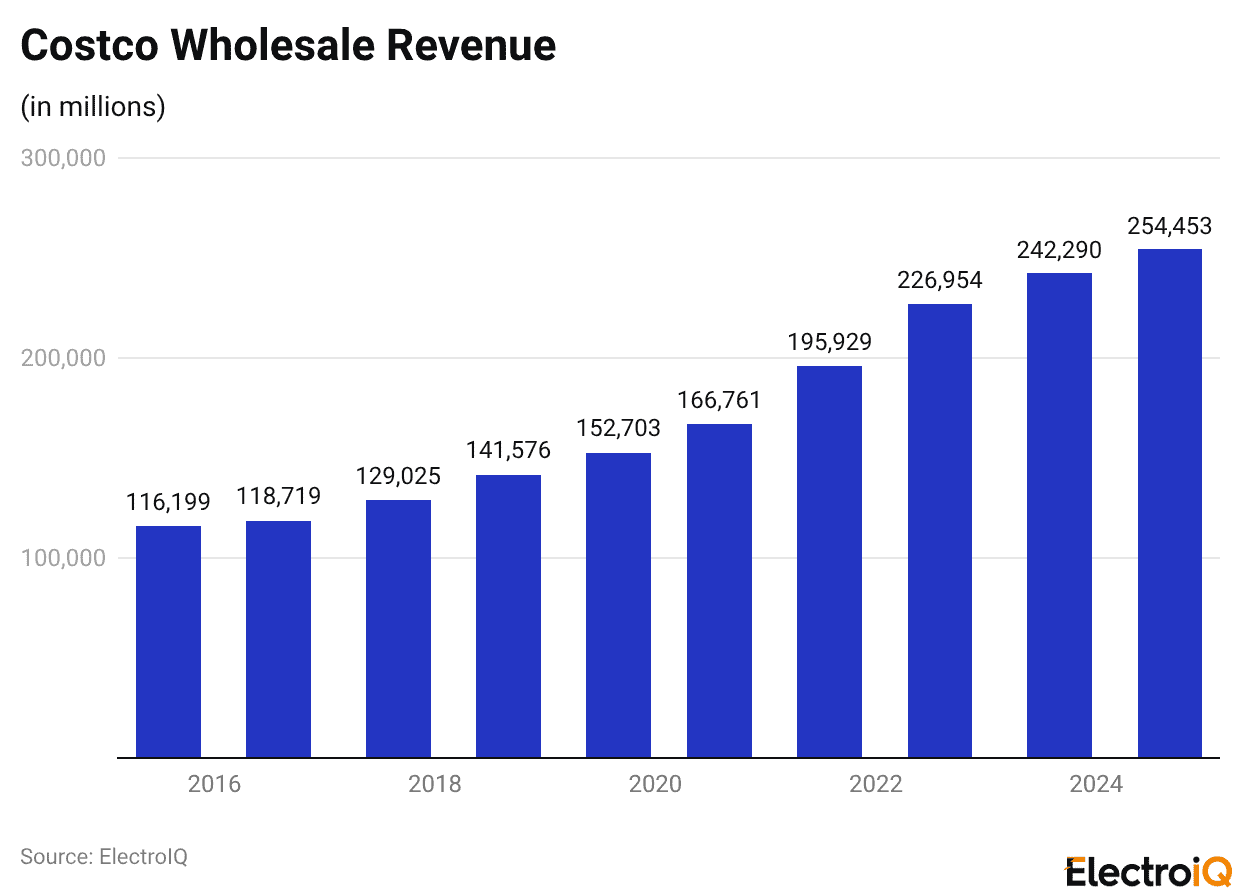
- The above chart, given by Substack, demonstrates that Costco Wholesale maintains constant revenue growth for ten years, which confirms the effectiveness of its membership-based business model.
- Annual revenues climbed from roughly USD 116.2 billion in 2015 to about USD 254.5 billion in 2024, representing a total increase of nearly 119% and a solid compound annual growth rate (CAGR) of around 9.1%.
- The trajectory of this growth path extends beyond its complete size because its development maintains steady progress throughout different economic situations, inflation surges, and supply chain interruptions.
- The revenue increased from USD 166.8 billion in 2020 to USD 226.9 billion in 2022 because of pandemic demand, which led to bigger purchases and customers who continued buying.
- The company’s revenue growth persisted throughout 2023 and 2024 as it reached USD 242 billion and then USD 254 billion, showing that the company established permanent growth paths.
- Costco Wholesale utilizes its minimal SKU management, which enables product pricing control via its private labels and generates constant membership revenue to secure operational margins.
- The data shows that Costco Wholesale operates as a defensive-growth retailer that achieves business expansion while maintaining customer loyalty and predictable future revenue streams.
Costco Wholesale Gross Merchandise Value (GMV)
(Reference: statista.com)
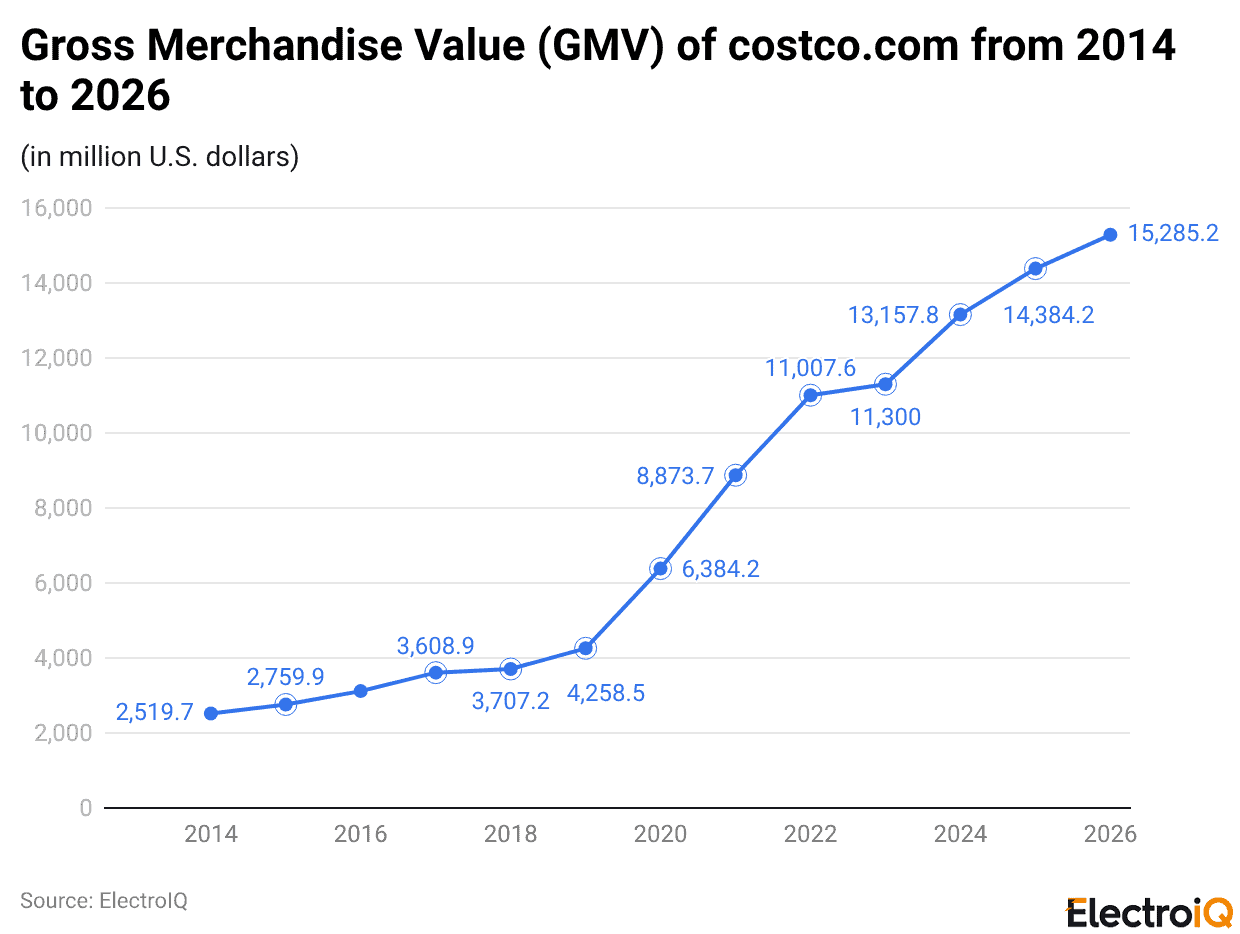
- The chart from Statista displays a strong long-term growth pattern, which shows that Costco.com has increased its gross merchandise value (GMV) from 2014 to the present day.
- The GMV increased from approximately USD 2.5 billion in 2014 to more than USD 6.3 billion by 2020 because of Costco’s strategic approach to eCommerce which matched its traditional business practices.
- The true turning point occurred after 2020, when GMV reached almost USD 8.9 billion in 2021 and advanced past USD 11 billion in 2022 because of changing consumer habits during the pandemic and increased online shopping cart values.
- The forecast period shows continued momentum, which allows GMV to achieve about USD 13.2 billion in 2024, while it will surpass USD 15.2 billion by 2026, showing more than three years of growth that exceeds typical rates for physical store development.
- The growth path demonstrates that Costco Wholesale successfully profits from its devoted online customers while maintaining its business system, which depends on low-margin products that sell at high volumes.
- Digital expansion helps warehouse operations because it adds value to the business without creating competition.
- The data shows that Costco Wholesale operates as an e-commerce retailer that expands its online business while maintaining profitability, customer trust, and building value for the future.
Costco Wholesale Membership Worldwide
(Reference: statista.com)
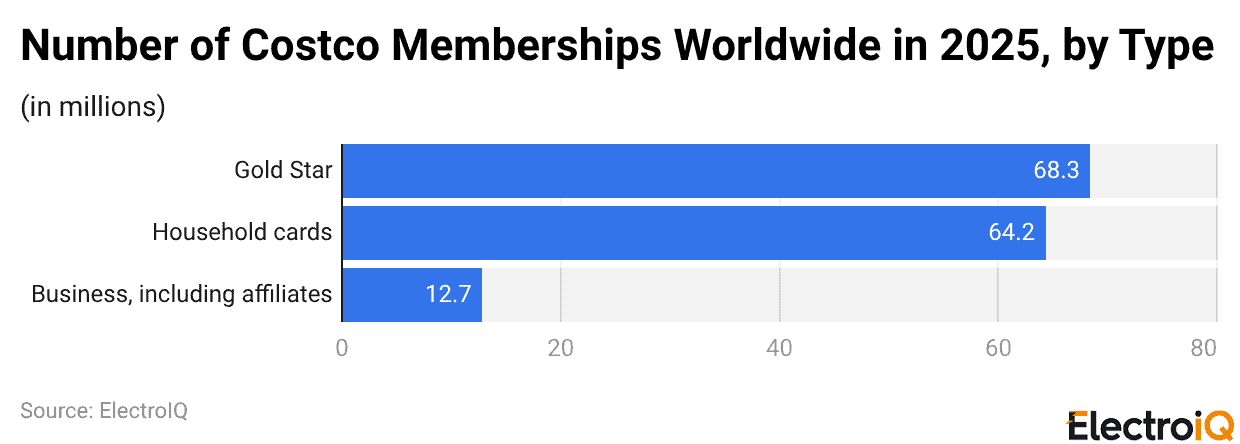
- The increase in Costco Gold Star membership from 63.7 million members in 2024 to 68.3 million members in 2025 demonstrates that customers remain loyal to the brand while they perceive constant value from the company.
- The membership growth of 7.2% from the previous year creates a predictable cash flow system, which supports Costco Wholesale as its primary financial asset.
- The combination of membership fees and high renewal rates, which exceed 90% most of the time, creates a stable earnings base that most retailers cannot achieve.
- The company generated net sales of almost USD 270 billion in 2025, which demonstrates how Costco’s business model operates through its high-volume and low-margin approach.
- The combination of growing memberships and record sales proves that Costco Wholesale uses customer loyalty to create sustainable financial success for its business.
Costco Wholesale Net Sales By Merchandise Category
(Reference: statista.com)
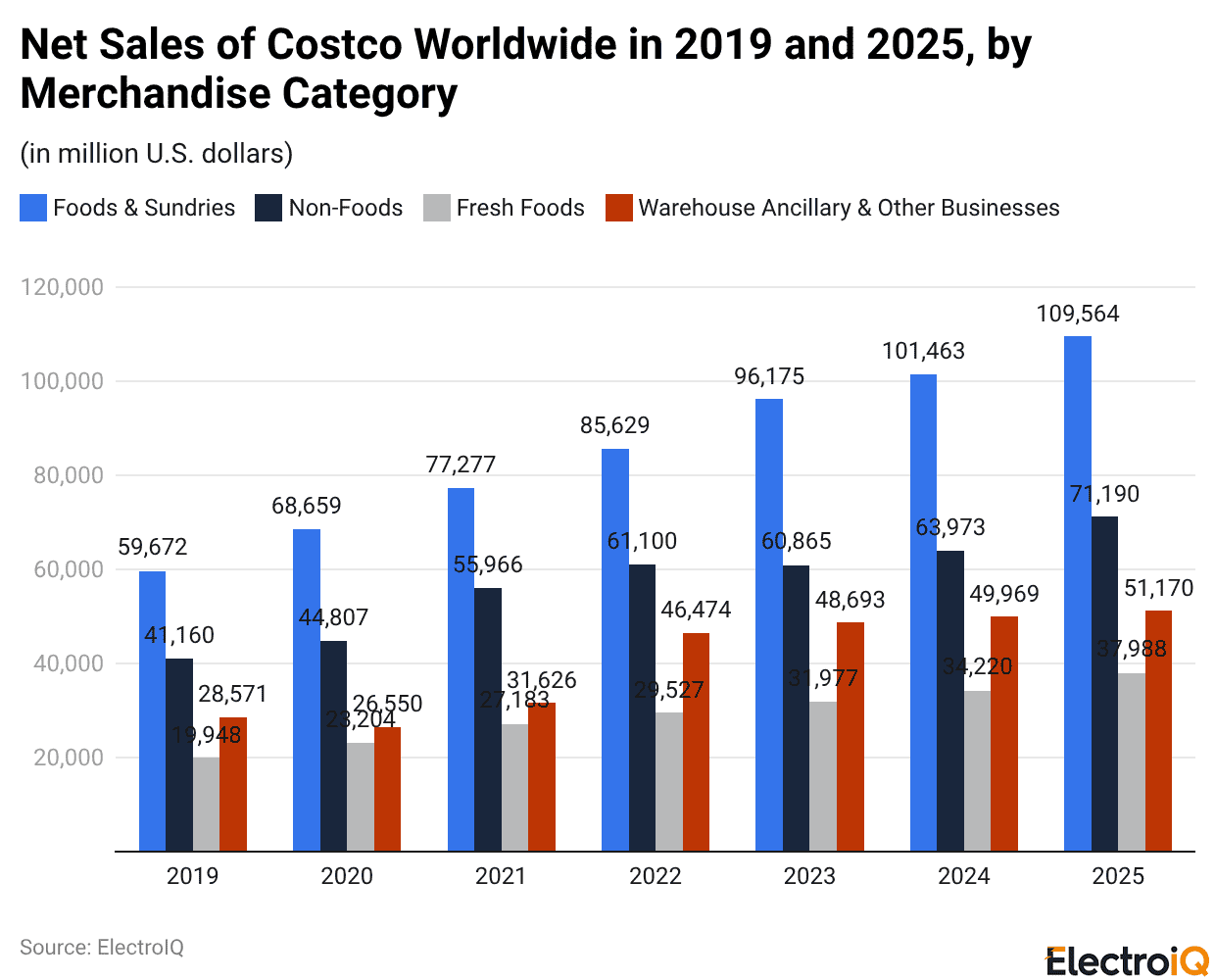
- Food and Sundries generated USD 109.5 billion in revenue, which constituted more than 40% of total revenue because global net sales reached almost USD 270 billion.
- The primary products that customers frequently purchase at Costco wholesale remain vital because they create economic growth for the company through increased customer traffic and larger purchase amounts, and they maintain steady customer demand during periods of inflation.
- The company uses its limited-SKU approach with aggressive pricing to establish its value proposition, which enables it to achieve cost-saving benefits through higher product sales.
Costco’s Brand Strength And Global Customer Loyalty
- The brand metrics provide additional proof of this business strength. The U.S. market shows 83% brand recognition and more than 80% customers who plan to buy from the brand again, which demonstrates strong customer loyalty to the brand.
- Costco demonstrates strong performance capabilities, which depend on vital customer spending patterns, according to loyalty metrics that showed diminished media attention during the 2023 holiday season.
- In the UK, brand awareness is at 75,% but only 16% of grocery shoppers show active interest in the brand, which shows that there exists potential to develop emotional connections with customers despite strong existing customer loyalty.
- The gap between these two areas indicates that businesses need to develop untapped markets that exist without essential elements to function properly.
- Costco’s worldwide operations continue to operate under its mission, which strives to deliver top-quality products at the most affordable prices.
- In 2024, the company reported approximately 76 million paying members, which showed consistent growth from the previous year and validated the strength of its membership-based business model.
- Costco Wholesale uses its membership system together with its high customer renewal rates and its core product offerings to create a competitive advantage, which helps the company grow its international operations while dealing with market competition and economic challenges.
Membership Fee
- Costco’s membership structure is one of the most powerful profit engines in global retail.
- The annual membership fee—restricted to members only—operates at near-100% margin, which enables the company to maintain its low-price strategy across all product categories.
- Costco Wholesale focuses on gaining new members, but its main goal involves converting existing members into Executive Memberships, which provide 2% cashback and result in increased spending by each household.
- The membership fee increase that Costco implemented during 2024 marked its first increase in seven years while it established stronger pricing authority, which did not significantly affect customer retention.
- Membership fee income reached USD 1.24 billion, which represents a 10.4% increase from the previous year, while the recent price increase accounted for 4.6% of quarterly revenue growth.
- At the end of Q3, U.S. and Canada renewal rates stood at 92.7% while global renewals reached 90.2%, which remained consistent with historical trends that exceed 90%.
- The acquisition method controls short-term fluctuations that occur because of Groupon promotions and increased online registration.
Total Number of Costco Wholesale Employees
(Source: q4cdn.com)
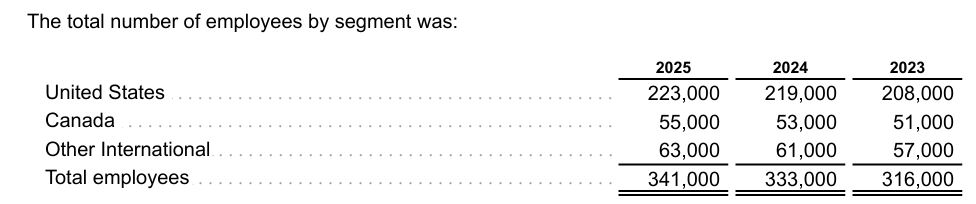
- Costco’s employee growth rate matches its consistent business expansion. The total headcount of the company increased from 316000 in 2023 to 341000 in 2025, which represents a 79% growth during the two years.
- The United States operates as the primary support base for organizations that employ 223000 workers in 2025, who experienced a rise from 208000 employees in 2023.
- Canada experienced a similar growth patterns which resulted in a workforce increase to 55000 employees, while other international markets reached 63000 employees to demonstrate Costco’s selective approach to global expansion.
- Costco Wholesale focuses on expanding its operations while maintaining high productivity and service standards.
- Costco Wholesale maintains its workforce expansion at controlled levels, which enables the company to achieve cost efficiency while maintaining operational reliability and stable profit margins.
Costco’s Premium Valuation
- The market has assigned Costco a high market value because of its strong business performance.
- The core investor conflict with Costco Wholesale arises from the process of valuing the company instead of the execution of its business operations.
- The company has gained its reputation for stability because it maintains consistent pricing practices while generating dependable cash flow streams during economic downturns.
- The market continues to evaluate Costco as a high-growth stock, although the company exhibits a moderate growth pattern throughout its operational lifespan.
- Costco has a current market valuation that stands at 5120 times forward earnings that exceeds its five-year average valuation by 28%.
- NVIDIA operates in a fast-growing sector, yet its business valuation shows a PEG ratio that is nearly five times lower than this valuation. Investors demonstrate a willingness to pay high prices for forecasted results that will not lead to business growth.
- The stock will experience significant value loss because its high trading multiples offer no protection if renewal rates decrease.
- Historical performance provides reassurance because Costco’s maximum drawdowns during the last five years remained under 20 %, even with extreme market volatility occurring.
- Current market prices exist at such high levels that investors must pay high costs for this reliable information.
Costco Wholesale Properties
(Source: q4cdn.com)
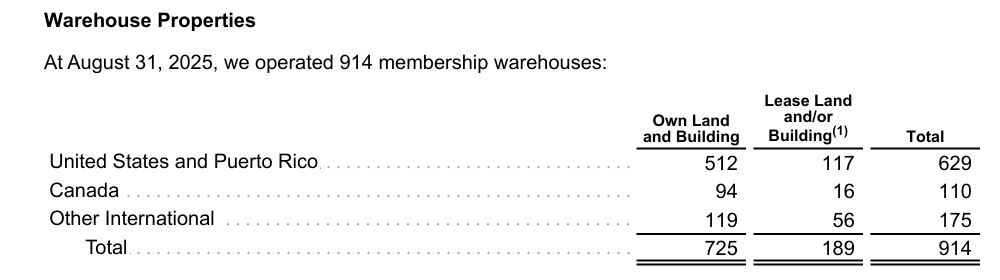
- Costco maintains its warehouse portfolio through an intentional asset acquisition approach, which helps the company maintain its profit margins and operational management.
- Costco Wholesale operated 914 membership warehouses worldwide as of August 31 2025, which included 725 owned locations and 189 leased sites, because the company maintained control over 79 % of its facilities.
- Costco operates 629 warehouses throughout the United States and Puerto Rico, which helps the company maintain its market leadership position.
- The company operates 110 warehouses in Canada, but its international operations maintain 175 locations, which demonstrate its controlled approach to global business growth.
- The company displays exceptional operational capabilities through its extensive physical infrastructure.
- The total operating floor area reached 134.7 million square feet, which included 93.6 million square feet of space in the United States, to demonstrate operational effectiveness through their high volume.
- The company added 32.2 million square feet of space for distribution and logistics purposes to enhance its ability to manage supply chain operations.
- The Costco wholesale data illustrates how the company operates a vertically integrated business model, which combines its ownership of assets and logistics operations and private-label production to achieve cost savings and higher pricing power.
Costco Wholesale Comparison Of 5-Year Cumulative Total Returns
(Source: q4cdn.com)
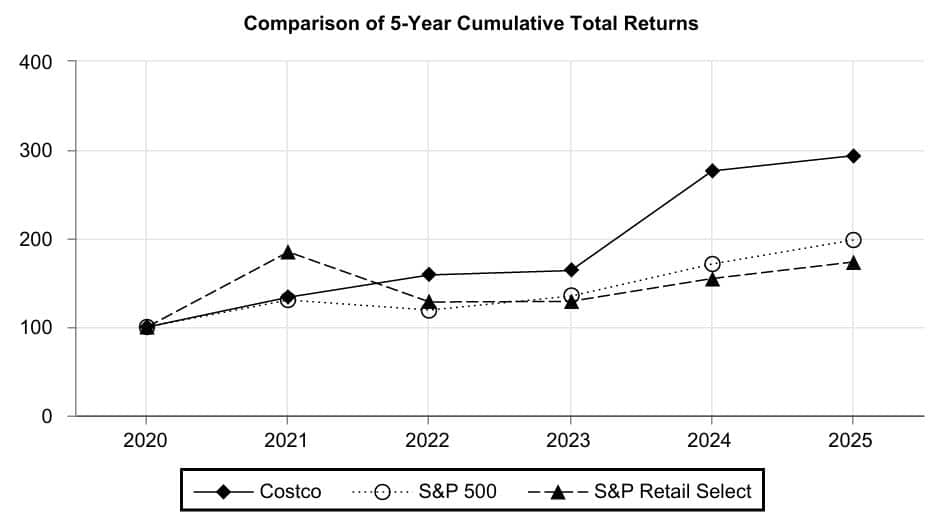
- The five-year cumulative return comparison shows Costco Wholesale as the best performer among long-term companies.
- Assuming dividends were reinvested, a USD 100 investment in Costco stock from August 2020 to August 2025 delivered materially higher total shareholder returns than both the S&P 500 and the S&P Retail Select Index.
- The retail index, which includes apparel, food, drug, and broadline retailers, experienced outperformance because these segments face recurring margin pressure.
- Costco Wholesale maintained shareholder rewards through its steady earnings performance,e which generated cash flow from memberships and its controlled spending of company funds.
- The retail sector experienced drawdown difficulties during inflation periods and rate changes, but Costco Wholesale demonstrated better performance because it maintained consistent operations while achieving superior total returns, which established the company as a safe and valuable retail investment.
Costco Wholesale Gross Margin
(Source: q4cdn.com)
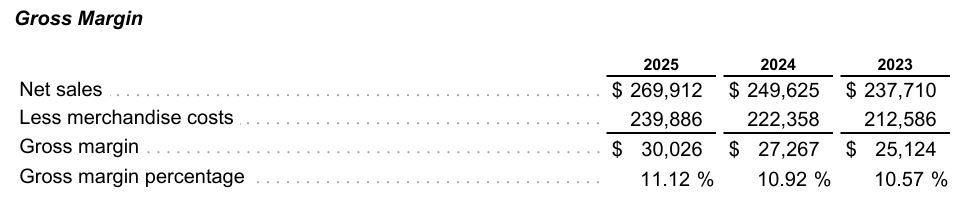
- The current gross margin results demonstrate that Costco Wholesale maintains its profit protection capacity while its revenue growth continues.
- The total net sales reached USD 269.9 billion in FY2025, which represented an 8.1% increase from the previous year’s total of USD 249.6 billion.
- The company achieved a gross margin increase of USD 30.0 billion. The gross margin percentage reached 11.12%, which increased by 20 basis points from the previous year while maintaining an upward trend that started with 10.57% in 2023.
- The core operations of the business, which exclude gasoline price deflation, showed a margin increase of 11 basis points to 11.03%, which demonstrates that core operations drive better performance than fuel price fluctuations.
- The highest contribution came from core merchandise, which produced 19 basis points through the success of higher-margin fresh foods and the increasing revenue from the co-branded credit card program.
- The company experienced gains, which faced partial reduction from cost pressures that included a seven-basis-point LIFO charge because of increased merchandise expenses and a slight impact from warehouse ancillary businesses.
- Costco Wholesale demonstrates its capability to maintain its low-price strategy while effectively controlling operational costs, which results in gradual profit margin improvements.
- The retail industry, which operates with extremely low profit margins, shows how Costco Wholesale achieves steady profitability through its operational scale, product selection, and financial service offerings.
Costco Wholesale Cashflow Activities
- The cash flow profile for 2025 demonstrates that Costco Wholesale maintains financial stability while managing its capital resources.
- The operating cash flow reached USD 13.3 billion in 2025 after increasing from USD 11.3 billion, which had been recorded in 2024 because of increased net sales together with persistent high-margin membership fee revenue.
- The company received sufficient cash inflows to meet its essential operational requirements, which included supplier payments, employee wages and their benefits, taxes, and card processing expenses.
- The efficiency of working capital management depends on inventory control because it determines how fast products are sold and how vendors are paid.
- The company expects to spend between USD 6.0 billion and USD 6.5 billion for its capital projects in fiscal 2026, which indicates its confidence in future demand.
- The company maintains its warehouse growth at a moderate pace because it opened 27 new facilities in 2025 and plans to open 35 more facilities in 2026, which enables operational expansion without financial burden.
- The company is working to return its financing activities to their normal state after it made large shareholder payments during 2024.
- The financial operations consumed net cash of USD 3.8 billion, which showed a dramatic decrease from the previous year’s total of USD 10.8 billion because special dividend payments in 2024 reached USD 15 per share.
- The company distributed regular dividends amounting to USD 2.18 billion in 2025, which equated to USD 4.92 per share while also increasing its quarterly dividend payment to USD 1.30.
- The company executed share buybacks at a controlled pace, which resulted in USD 903 million being spent to repurchase 943000 shares, while USD 2.0 billion remained available for repurchase under existing agreements.
- Debt activity was minimal, with just USD 103 million in repayments and no new long-term issuance, underscoring balance-sheet strength.
- Overall, these figures show Costco’s wholesale funding growth organically while returning capital responsibly.
- From a cash-flow lens, Costco Wholesale continues to balance expansion, efficiency, and shareholder rewards with precision.
Costco Wholesale Investments
(Source: q4cdn.com)
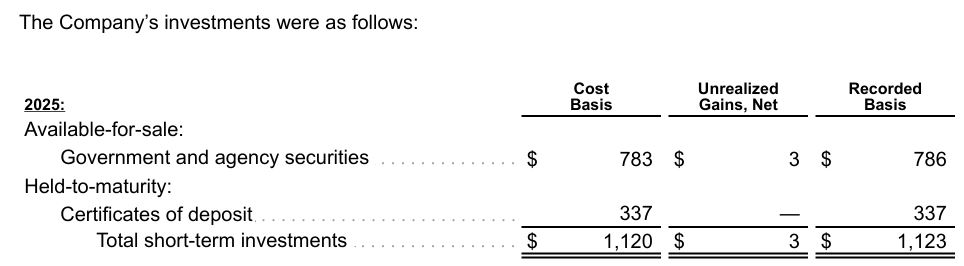
- Costco Wholesale demonstrates an investment strategy that emphasizes the protection of its members’ assets through its 2025 operations.
- The company owned USD 1.12 billion in short-term investments, which showed a recorded value of USD 1.123 billion, but this amount included only USD 3 million of unrealised gains.
- The portfolio consists mostly of low-risk assets, which include USD 786 million in government and agency securities that organizations treat as available-for-sale and USD 337 million in certificates of deposit, which the organization will hold until their maturity date.
- The structure of this system operates at its highest level of efficiency because it protects capital assets from potential losses while it generates investment returns.
- The investment choices made by Costco Wholesale match its financial strategy, which aims to minimize risk while maintaining enough funds for operational needs, capital projects, and shareholder distributions.
- The information shows that Costco Wholesale uses its extra cash reserves for disciplined spending instead of pursuing yield-based investments.
Costco’s Equity Incentives
- Costco Wholesale maintains its practice of stock-based compensation as a structured approach that helps employees and executives pursue their shared obligation to create shareholder value over the long term.
- The company can distribute 15.9 million restricted stock units (RSUs) through the 2019 Incentive Plan, which enables performance-based rewards while reducing dilution.
- The organisation has 6.28 million RSUs available for future grants until 2025, which demonstrates its strategic approach to compensation and its commitment to future growth.
- The outstanding awards had a primary focus on maintaining stability while keeping employees with the company.
- The company will grant approximately 2.19 million time-based RSUs to employees who continue their service, which helps maintain workforce stability in a company that employs more than 340000 people worldwide.
- Costco Wholesale uses incentive-driven equity at a conservative level because its performance-based RSUs represent only 121000 shares.
- The group includes 70000 RSUs, which executives will receive after they achieve their performance goals for 2025, which will result in partial accelerated vesting because they reached most of their targets.
- Vested RSUs use newly issued shares for settlement after deducting tax withholdings, which establishes clear guidelines for equity distribution.
- Costco Wholesale allocates its time-based and performance-based awards because the company wants to achieve stable results instead of taking high-stakes risks, which could endanger its business operations.
- The structure represents a compensation system that prioritizes employee loyalty and accountable behavior while supporting sustainable business growth instead of extreme equity dilution.
Costco’s U.S. Warehouse Footprint
- The U.S. real estate strategy that Costco Wholesale will implement in 2025 demonstrates controlled expansion according to established business methods.
- Costco operates 629 warehouses throughout the United States and Puerto Rico, which establishes an operational network that operates efficiently without extending its reach.
- The total operating space of these warehouses exceeds 90 million square feet, which results in an average location size of approximately 147,000 square feet that exceeds the dimensions of standard big-box stores.
- The facility dimensions permit businesses to handle substantial product volumes while maintaining a small number of product options, which results in exceptional sales performance throughout the facility.
- The Costco wholesale model displays its main feature through its concentration of operations in specific regions.
- About 143 warehouses operate in California, which represents approximately 23% of all U.S. warehouse sites. This shows that Costco operates in high-density suburban areas with high-income residents.
- Texas operates 44 warehouses, while Washington,n Florida, Illinois, New Jersey, and Arizona serve as secondary warehouse locations.
- Costco serves 47 states, along with D.C. and Puerto Rico,o while avoiding markets that lack population because they would not provide sufficient size benefits.
- Costco builds its infrastructure through two major components, ts which include retail space and logistics systems.
- The company operates distribution and fulfillment centers, which create a global logistics network that spans approximately 32 million square feet.
- The suburban site selection process enables organizations to achieve affordable land acquisition while establishing efficient transportation links through highways and creating space for extensive parking areas and additional facilities like fuel stations and pharmacies.
Costco’s Operating Model Delivers Industry-Leading Productivity
- Costco Wholesale demonstrates an exceptional case because its business model combines three elements that create operational efficiency that can be measured.
- The company requires about 219000 workers in the United States to operate its extensive network of warehouses, which results in one employee for every 416 square feet of retail space.
- The company maintains a staffing ratio of two employees for every 1000 square feet, which establishes a new standard because it operates its stores with basic pallet-based inventory systems during a 70-hour weekly schedule.
- The average U.S. Costco warehouse generates approximately USD 269 million in annual sales.
- Labor efficiency further reinforces the story. Each U.S. employee at Costco Wholesale supports more than USD 850000 in annual revenue, which exceeds the industry standard of about USD 348000 per employee.
- Costco maintains low labor expenses as a percentage of sales because it processes high transaction volumes in each warehouse using only basic staffing requirements, even though it pays its workers above-average wages.
- The market share efficiency of Costco provides the most important evidence about the company.
- The company operates only 8% of U.S. warehouse clubs and users, yet it controls approximately 25% of total sales within this market segment.
- The average Costco wholesale store generates three to four times more revenue than a typical competing store.
- The metrics show an operational system that operates at high volume because of its precise design.
- Competitors find it hard to duplicate these operations, which create a long-lasting competitive edge through their efficient business processes.
Costco Stock Driven By Growth Tailwinds And Structural Risks
- The long-term outlook for CostcoWholesalee through 2030 and beyond shows sustainable growth potential because of its enduring expansion drivers and its controllable operational hazards.
- The company benefits from international market expansion, which functions as its main growth engine.
- Costco can add millions of new members because it expands into emerging markets, which include India and China.
- International operations will generate an estimated 30 to 35 % of total revenue by 2030, which will decrease U.S. market dependence and enhance international market presence.
- The Kirkland Signature brand delivers better value and quality than national brands, which results in increased profit margins and customer loyalty.
- Analysts estimate that private-label products will reach 35 to 40% of total sales by 2030, which will protect Costco Wholesale from supplier price increases while maintaining financial strength during periods of inflation.
- The company plans to achieve digital sales growth through its logistics improvements, speedier deliveries and better platform usability, which will help it reach 15 to 20 % of total revenue by 2030.
- Costco’s online presence falls short of dedicated e-commerce competitors, yet its omnichannel strategy boosts warehouse operations while maintaining member loyalty.
- The company faces a risk because it relies heavily on membership fees, which creates operational vulnerabilities.
- Membership income serves as the primary source of operating profit for the company, which means any decrease in renewal rates will have a significant impact on earnings.
- The company faces competitive challenges because its digital technology adoption rate is slower than that of more advanced technological competitors.
- The company will experience expansion delays because of regulatory requirements in international markets.
Costco E-commerce Sales
(Source: digitalcommerce360.com)
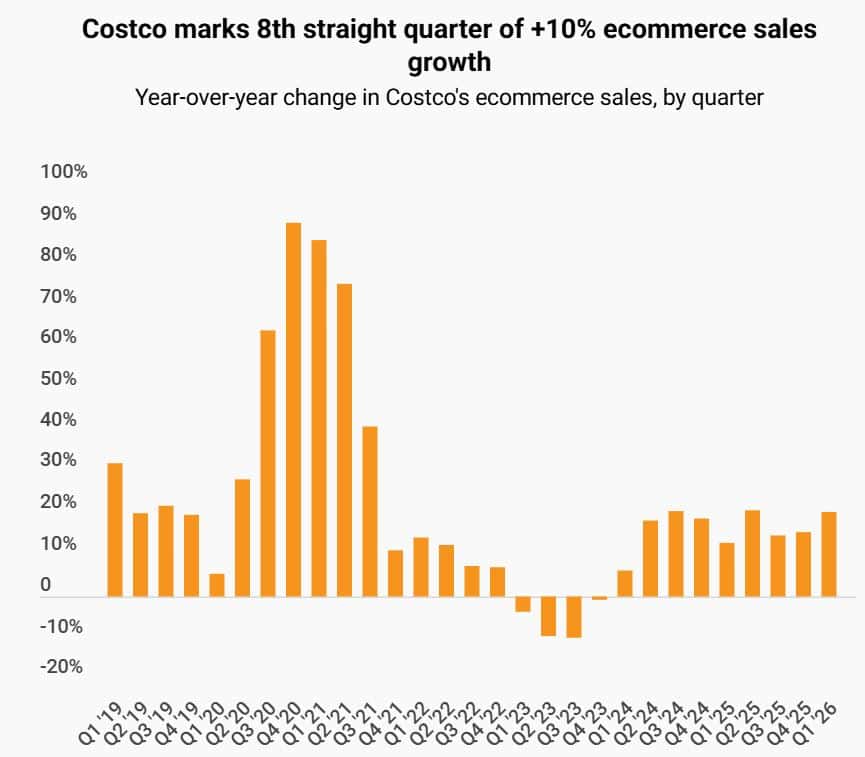
- According to Digital Commerce 360, Costco Wholesale has experienced a complete shift in its e-commerce performance during the past seven years, according to the data results.
- The 2019 data shows initial growth patterns that exhibit both moderate yet unpredictable development because the company experienced quarterly growth rates that fluctuated between 19% and 32%.
- The pandemic period brought increased fluctuations because online demand reached its highest point during that time,e which resulted in digital demand experiencing 90.6% year-over-year growth during Q4 2020 and staying at above 75% for most of 2021.
- The company achieved these extraordinary results through temporary lockdown measures instead of any permanent business transformation.
- The period after the pandemic ended brought a return to regular operations, which led to double-digit declines that reached mid-teen levels.
- From Q1 2025 through Q1 2026, CostcoWholesalee recorded five consecutive quarters of double-digit e-commerce growth, ranging from 13% to 20.9%, culminating in a strong 20.5% increase in Q1 2026.
- The digital revenue growth between 10% and 20% maintains itself at above 10% growth level, which shows that the company handles its digital operations at a mature level.
- The combination of better personalization, increased app usage, and new same-day delivery services drives customers to return for more business.
- The pattern shows that e-commerce development has established a permanent growth system for Costco wholesale which works together with its high-volume warehouse operations to build enduring omnichannel strength instead of short-term digital fluctuations.
Costco Wholesale Net Sales Growth And Global Strength
(Source: q4cdn.com)
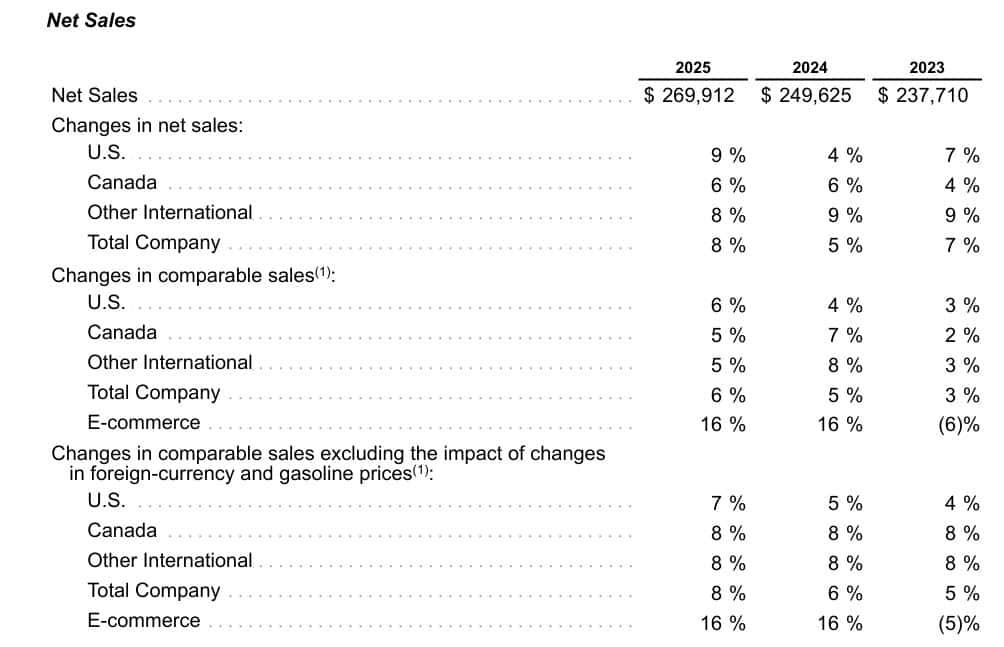
- Costco Wholesale demonstrates its steady business growth through its sales results, which show consistent operational performance.
- In fiscal 2025, net sales reached USD 269.9 billion, up 8% year over year, building on USD 249.6 billion in 2024 and USD 237.7 billion in 2023.
- The two-year period shows a total increase that exceeds USD 32 billion, which demonstrates ongoing progress throughout various areas.
- The U.S. market experienced the highest growth rate at 9%, while Canadian and international markets achieved solid growth with 6% and 8% increases, respectively, which showed equal business performance throughout different geographic areas.
- Total company comps rose 6% in 2025, driven by a 5% increase in shopping frequency and a 1% lift in average ticket size.
- The adjusted comparable sales rose to 8% after excluding the effects of foreign currency and gasoline price changes, which demonstrates strong customer demand.
- E-commerce maintained its strong performance, achieving 16% comparable growth for the second straight year, which demonstrates Costco’s ability to operate multiple sales channels.
- The opening of 24 new warehouses during the period since 2024 brought additional income, which supported revenue growth in existing facilities.
- Core merchandise sales climbed 10%, reflecting broad-based strength across all categories, while ancillary businesses added a modest 2% increase.
- The company lost USD 2.3 billion in sales because of lower gasoline prices and USD 1.9 billion due to unfavorable foreign exchange rate changes.
- Costco Wholesale achieved strong revenue growth despite these challenges because of its effective pricing strategy, high customer retention, and strong market demand.
Costco Wholesale EBIT
(Source: substack.com)
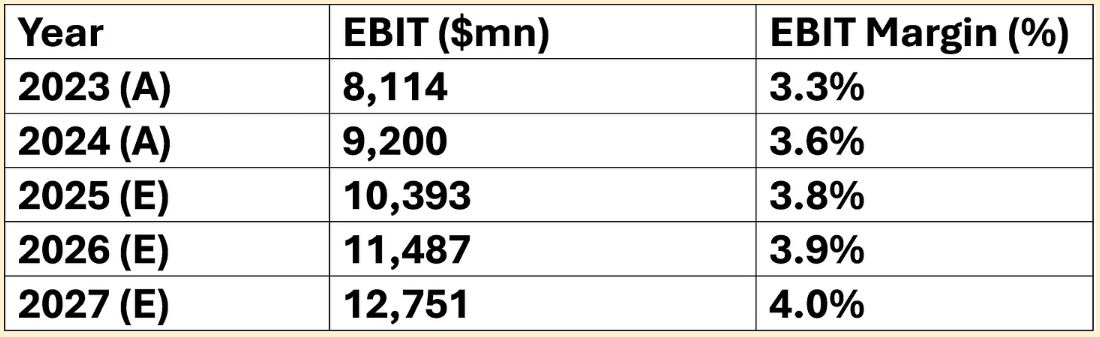
- The data presented above proves that Costco Wholesale operates its business through effective methods, which lead to profitable growth that can be expanded.
- The company shows a consistent increase in EBIT, which starts from 2023 actual earnings of USD 8.1 billion and reaches USD 12.8 billion in 2027 through five years of cumulative growth that amounts to 57 %.
- The company achieved margin growth from 3.3 % to 4.0 % because of its ability to manage expenses and implement successful pricing strategies while benefiting from its operational advantages during times of rising inflation.
- Costco generates additional earnings worth billions through its gradual margin growth, which creates a significant financial impact because of its enormous revenue scale.
- Costco Wholesale maintains strong business foundations through its effective methods for handling inventory and its strategy of generating high sales with low profit margins, which leads to continuous sustainable value creation.
(Source: tradingeconomics.com)
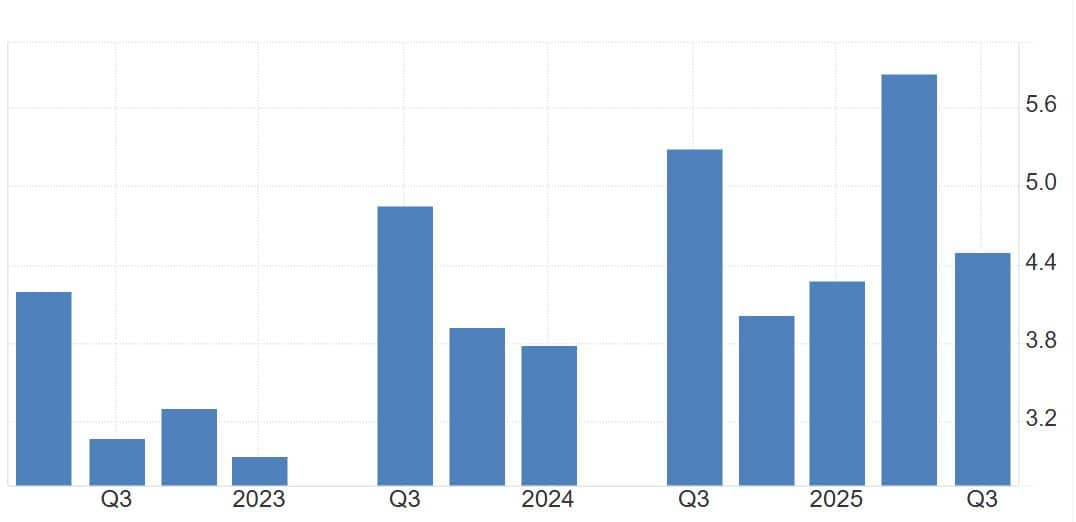
- The EPS data shows that Costco Wholesale can achieve continuous earnings improvement while it outperforms market predictions by a significant margin.
- The fiscal quarter that ended in September 2025 reported EPS of USD 4.50, which showed an 11% increase compared to the same quarter of the previous year.
- The company announced that its 2025 Q4 EPS reached USD 5.87, which increased from its previous value of USD 5.29 because of high membership renewal rates and strong demand from consumers.
- Costco exceeded market expectations in four of its last five quarters because its earnings results surpassed predictions by a range from 1 % to 6 %, demonstrating its consistent business performance.
- The company showed sustained annual revenue growth, even when it missed earnings targets by a small margin during specific quarters.
- The company demonstrates its ability to control pricing while managing expenses effectively and maintaining strong profit margins through its private-label products, which operate at higher profit margins.
- The EPS trajectory shows that investors can trust Costco to maintain its earnings growth pattern, which provides strong financial protection, yet drives overall business expansion.
Key Challenges
- Despite its strong financial and operational performance, Costco continues to operate in a challenging external environment.
- Persistent inflation has increased input, transportation, and labor costs, which can place pressure on operating margins if not carefully managed.
- In addition, ongoing uncertainty around global trade policies, including potential U.S. tariffs, poses risks to international sourcing and pricing stability.
- The competitive landscape is also intensifying, as major retailers such as Walmart and Target increase promotional spending and invest heavily in store modernization.
- Even so, Costco’s disciplined pricing strategy and membership-based revenue model provide a strong buffer against these pressures.
Conclusion
Costco Wholesale Statistics: Costco Wholesale stands out as one of the most structurally resilient retailers in global commerce. Its ability to compound revenue, expand margins incrementally, and generate predictable cash flows is anchored in a rare combination of scale, membership economics, and operational discipline. Despite macro headwinds such as inflation, FX volatility, and fuel price pressure, Costco continues to grow organically while protecting profitability.
Strong comparable sales, accelerating e-commerce maturity, and disciplined warehouse expansion reinforce long-term visibility. While valuation remains elevated, the company’s consistency, loyalty-driven demand, and downside resilience justify its premium status. Overall, Costco Wholesale remains a benchmark for sustainable, high-quality retail growth.
FAQ.
Costco reported net sales of approximately USD 269.9 billion in fiscal 2025.
Revenue has grown at roughly a 9% CAGR over the past decade.
Costco operated 914 warehouses worldwide as of August 2025.
Costco had approximately 76 million paid members in 2024.
An average U.S. Costco warehouse generates about USD 269 million in annual sales.
Yes, Costco has delivered higher five-year cumulative returns than the S&P 500 and retail indices.

I hold an MBA in Finance and Marketing, bringing a unique blend of business acumen and creative communication skills. With experience as a content in crafting statistical and research-backed content across multiple domains, including education, technology, product reviews, and company website analytics, I specialize in producing engaging, informative, and SEO-optimized content tailored to diverse audiences. My work bridges technical accuracy with compelling storytelling, helping brands educate, inform, and connect with their target markets.