Digital Currency Statistics By Investors, Demographics and Facts (2025)

Updated · Dec 02, 2025


Table of Contents
- Introduction
- Editor’s Choice
- Digital Currency Market Share Breakdown
- Digital Currency Market Share By Type
- Cryptocurrency Rapid Growth
- The Global Trend of Cryptocurrency
- Cryptocurrency Statistics: Investors And Demographics
- The Influence Of Economic Conditions On Cryptocurrency Adoption
- Technological Innovations In Digital Currencies
- Recent Developments
- Conclusion
Introduction
Digital Currency Statistics: Digital currencies — encompassing cryptocurrencies such as Bitcoin and Ethereum, stablecoins, and central bank digital currencies (CBDCs) — went from a niche tech experiment to mainstream finance in 2024. The year marked a transition with large price and market-value gains, the number of people holding crypto increasing, the growth of stablecoins accelerating, and government work on CBDCs remaining steady.
This article presents the latest digital currency statistics and their market growth.
Editor’s Choice
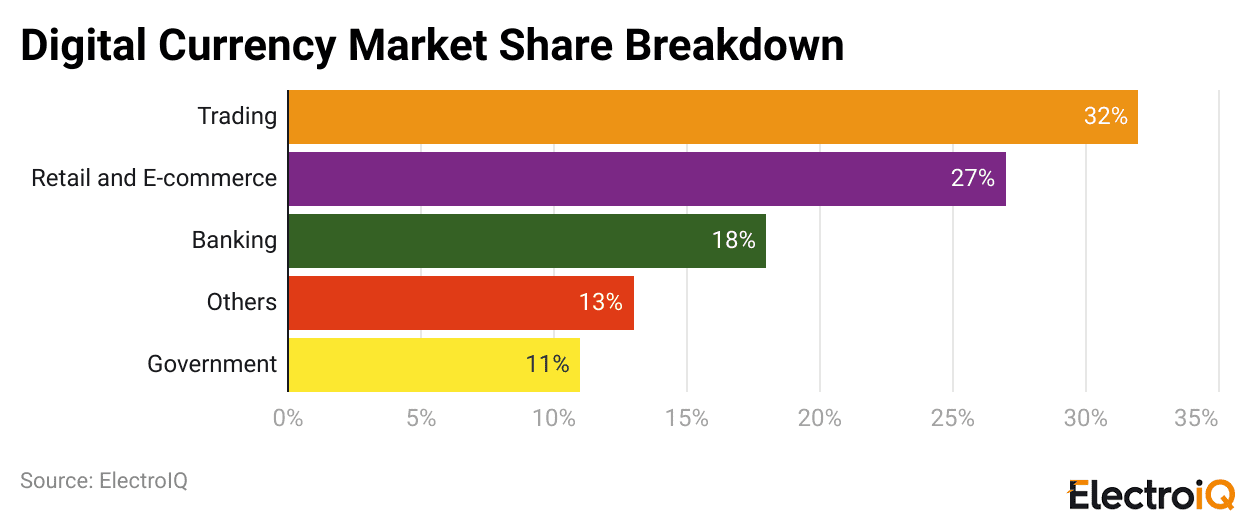
- Trading emerges as the primary use of digital currencies, accounting for 32%, followed by retail and e-commerce (27%), banking (18%), other applications such as gaming and remittances (13%), and government/CBDC domains (11%).
- The market’s revenue is expected to surge to US$31.2 billion in 2024, US$36 billion in 2025, and finally, US$76.9 billion by 2032.
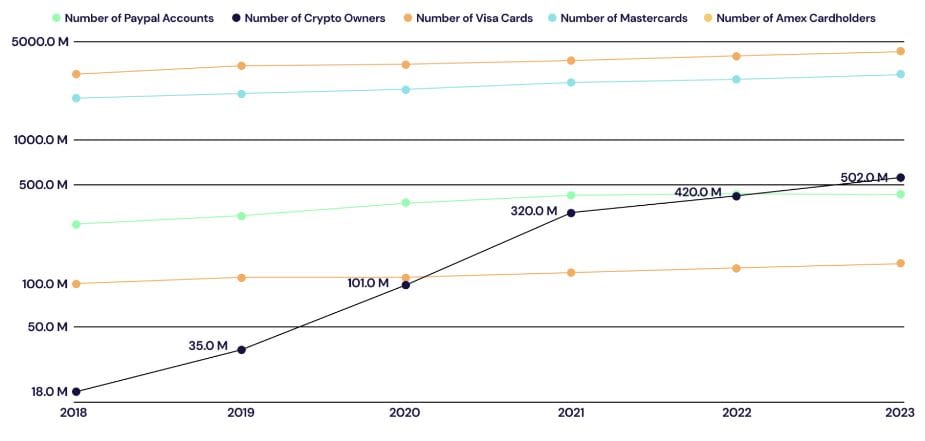
- The number of cryptocurrency owners accelerated at a startling 99% compound annual growth rate (CAGR) during 2018-2023, exceeding the roughly 8% annual growth rate of traditional payment methods.
- Among the fastest-growing regions for cryptocurrency adoption are Latin America (15.2% of the total market) and Africa (19.4% growth in user numbers).
- Now, institutional investors account for 16.5% of global cryptocurrency market volume, while retail investors continue to account for approximately 60%.
- In the United States, 65% of people who own cryptocurrency belong to the Millennial or Gen Z generations, with women now making up 32% of this group.
- On the African continent, 70% of cryptocurrency users are under 30, and they use it mainly to protect their money against inflation and to make international transfers.
- The acceptance of cryptocurrency payments is a global trend, with El Salvador (82%), Japan (31,000 retailers), and the US, Brazil, the UAE, and the Philippines continuing to adopt it and increasing their use of it, at the forefront of the trend.
- Late in 2025, one-fourth of the central banks that had previously planned to launch their digital currencies paused their CBDC projects, though 50% plan to resume them within 3-5 years.
- Cryptocurrency thefts totalled US$2.6 billion in 2025, and the majority (61%) were attributed to North Korean actors.
- Crypto payments in the US increased by 43% in 2025 and are forecast to grow by 88% by the end of 2026.
- As of May 2025, Bitcoin accounted for 24-hour trading volume, surpassing all other cryptocurrencies.
- The number of global crypto owners exceeded 590 million in 2025, driven largely by South America and Southeast Asia.
(Reference: coinlaw.io)
- According to the data, the largest part of the market, 32%, is made up of the trading of digital currencies, hence it is the main use case.
- This indicates that cryptocurrencies are heavily dependent on trading activity across different platforms open to both individual and institutional investors.
- Next, retail and e-commerce at 27%, which is a clear sign that online shoppers are gradually accepting digital currencies and are being used more often for online purchases and payments.
- More and more merchants and platforms are allowing crypto payments, thereby becoming part of the digital commerce system.
- The banking sector accounts for 18% of the market. This reflects traditional financial institutions’ acceptance of digital assets and, perhaps, their integration into advisory services.
- This could mean offering crypto-related products, blockchain-based solutions for faster payments, and digital asset custody services.
- The “other” category, which accounts for 13%, includes uses of digital currencies for gaming, international remittances, and peer-to-peer money transfers.
- This showcases the capacity of digital currencies to support a variety of non-traditional financial activities.
- Finally, government usage captured 11% of the market share, indicating the growing popularity of Central Bank Digital Currencies and the practical application of blockchain technology in the public sector.
- This implies that the government is venturing into the use of digital currencies for regulatory purposes, auditing, and for fast, secure public-sector financial systems.
- The data illustrates the digital currency market, comprising a few major cryptocurrencies, with Bitcoin leading in revenue.
- The total market for the year 2022 was approximately USD 25.2 billion, and Bitcoin was the largest contributor with USD 10 billion, which is more than one-third of the total market.
- Ethereum was next with USD 6 billion, followed by Litecoin and Ripple with USD 4 billion and USD 3 billion, respectively.
- The remaining list of cryptocurrencies amounted to about USD 3 billion, suggesting that, though there are many digital currencies, a few powerful ones are ruling the revenue battle.
- Bitcoin is expected to retain its primary role throughout this growth period, thanks to strong brand recognition, widespread acceptance, and its status as the first and most significant cryptocurrency.
- Ethereum, Litecoin, Ripple, and other cryptocurrencies are also expected to play a major role in the overall market, supported by their distinct applications, such as smart contracts, faster transactions, and cross-border payments.
- The digital currency market is expected to be worth around USD 76.9 billion by the year 2032. This massive growth is driven by the global acceptance, continuous technological advancements, and the broadening spectrum of cryptocurrencies.
- Such factors are rapidly transforming the financial landscape, with digital currencies increasingly recognised and influential in shaping the world’s economy.
Cryptocurrency Rapid Growth
(Source: triple-a.io)
- Ownership of this high-tech asset has risen rapidly and steeply, especially recently.
- The numbers from 2018 to 2023 showed an astronomical 99% CAGR, meaning that, on average, the number of crypto holders nearly doubled each year.
- These increases in the number of users have been far greater than those experienced with standard payment methods, which increased annually at approximately 8% during the same period.
- This implies that while the rates of crypto adoption have increased faster than and more than, say, credit card usage or conventional tools like American Express, those have also slowly gained users over time.
- It indicates that the world is not only adopting digital assets for speculation but also for various payment and financial access purposes at a much faster pace.
The Global Trend of Cryptocurrency
- The adoption of this crypto asset was still going strong in 2025, with already 12.4% of the global population being reported as holders of at least one type of digital stake.
- The Asia-Pacific region captivated the world in this regard, as 60% of the countries with the highest adoption rates belong to it.
- In the Netherlands, clearer governmental regulations and traditional financial institutions becoming more involved were the reasons behind the increase in adoption to 8.9%.
- Latin America experienced an extremely rapid increase and an average national adoption rate of 15.2%, largely driven by people’s intention to mitigate inflation and the use of crypto as a more stable currency in local markets.
- Africa, on the other hand, was the continent with the fastest increase in crypto users worldwide.
- However, the 19.4% increase in the number of crypto users in Africa was the whole continent’s share of the international market’s very rapid relative growth during the year.
- Nigerian, Kenyan, and South African economies were the main actors in this development, underscoring the importance of cryptocurrency in advancing financial inclusion in regions where banks and similar institutions do not exist.
- The Middle East also had considerable acceptance; thus, it accounted for 11.3% of the region’s digital asset holders.
- The share of institutional investors in global crypto transaction volumes grew rapidly and reached 16.5% by 2025.
- The proportion of stablecoins (digital currencies linked to traditional assets such as the U.S. dollar) in total transaction volume was 33.2%, indicating that the investment climate was becoming more stable and that investors were seeking less volatile tokens and utilities.
- More than one-third of the world’s total remittances were processed by blockchain solutions, which, along with their 9.6% share in remittance flows, were already significant intermediaries in the international financial market, providing fast and inexpensive cross-border payments.
- Moreover, crypto accounted for 5.4% of global B2B trade settlements, indicating it is gradually assimilating into the world’s commercial and financial landscapes as a functional channel.
Cryptocurrency Statistics: Investors And Demographics
- The younger generations are more noticeable in crypto adoption, and Millennials and Gen Z make up about 65% of the USA’s cryptocurrency holders; most are aged 18 to 34.
- The participation of females in the crypto market is also increasing, as reflected in data showing that women’s share of U.S. crypto holders has grown from 26% in 2020 to 32% now.
- However, at the same time, an increased participation of institutional investors is being witnessed, with the likes of BlackRock and Fidelity, among others, providing crypto exposure through retirement and investment products.
- Retail investors worldwide remain the main players in the crypto market, accounting for about 60% of total market value, while institutional interest is growing, particularly through Bitcoin ETFs in Canada and Europe.
- The youth in Africa are taking the lead in the adoption of digital currencies, with nearly 70% of crypto users under 30 using them to protect their money from inflation and for cross-border transactions.
- The major part of the users is from the urban areas, where technology and the availability of financial services are conducive to adoption.
- Moreover, affluent people are also entering the market; for instance, 35% of U.S. crypto owners, according to a survey, earn more than US$100,000 per year, indicating a wider, more diverse investor population.
The Influence Of Economic Conditions On Cryptocurrency Adoption
- Worldwide economic instability was another reason for the fast adoption of cryptocurrencies.
- People in countries facing 20% inflation are, on average, 2.7 times more likely than those in economically stable countries to buy digital assets.
- Argentina is one such clear instance, where, after suffering 85% inflation in 2025, around 29.4% of the population turned to crypto as a hedge for their savings.
- Around 16.3% of Venezuelan families are using crypto, particularly USDT and Bitcoin, to purchase daily needs, owing to the local currency’s eroding value.
- The depreciation of the Lira has, in fact, triggered a 31.5% year-on-year rise in crypto trading volume in Turkey.
- All in all, Egypt will see a 42.8% rise in crypto activity in 2025, primarily driven by the currency’s higher devaluation and restrictions on moving money abroad.
- The informal crypto-economy in Zimbabwe is very active, and unofficial estimates of digital transaction volumes are equivalent to 6.2% of the country’s GDP, making it the world’s largest per capita market.
- In the US, crypto ownership increased during the mild 2025 recession, with approximately 15.2 million new wallet activations as investors sought another option.
- Due to the banking crisis in Lebanon, nearly 19.8% of the population has turned to cryptocurrencies as the safest method to store their money outside the banking system.
- The crypto market in Pakistan has been performing quite well, and the volume of remittances in cryptocurrency has reached 18.7%, mainly via Binance P2P, as people try to avoid the impact of the rupee’s volatility.
- Ukraine is a country where cryptocurrency is almost providing its support to mankind, the humanitarian aid through crypto is estimated at USUS$2.1 billion, and DAOs are facilitating financing for both defence and local relief projects.
Technological Innovations In Digital Currencies
- Transaction speeds are improving, and fees are being lowered, enabling blockchain networks to be more scalable and efficient through the adoption of layer 2 solutions like Bitcoin’s Lightning Network and Ethereum’s Optimism. ZK-rollups.
- These are part of zero-knowledge proofs, which facilitate privacy by allowing transactions to be validated without revealing any private information; hence, the confidentiality and security properties of the applications remain intact.
- Cross-chain interoperability technologies – example projects like Polkadot and Cosmos at the forefront – make it possible for separate blockchain networks to interact, thus providing a larger playing field for digital assets in terms of their use cases and paving the way for more complex scenarios.
- Ethereum 2.0 is one of the major upgrades that has been affecting smart contracts.
- Performance, security, and energy efficiency are the areas in which Ethereum has enhanced its capabilities, enabling the deployment of more advanced applications in finance, supply chain, and real estate.
- Uniswap, PancakeSwap, and other decentralized exchanges have become popular, thus increasing the market for direct trading between users and gradually diminishing the use of centralized exchanges.
- Besides, NFT marketplaces are increasingly integrating their operations with the Metaverse, enabling users not only to trade but also to showcase their digital assets in platforms like Decentraland and The Sandbox.
- Moreover, blockchain-based identity systems are becoming more and more important, especially in the so-called developing world, where decentralized digital IDs can effectively secure and verify the identity of people otherwise cut off from the traditional banking system.
Recent Developments
- A major development in central banks’ digital currency projects in 2025 is that most are changing their strategies.
- Nearly a quarter of them (27%) have opted to temporarily halt their Central Bank Digital Currency (CBDC) initiatives. But this certainly does not mean that the concept is being entirely abandoned.
- Approx. 50% of those who have put their plans on hold still plan to launch a CBDC in three to five years, indicating a more careful, research-oriented approach rather than a complete withdrawal.
- In 2025, the incidence of crimes involving cryptocurrencies has grown as well.
- The sum total of the perished digital assets reached nearly US$2.6 billion, which is an 18% increase relative to the preceding year.
- The bulk of this theft, which is about 61% or US$1.58 billion, has been traced back to North Korean-affiliated parties. This once again emphasises that organised, state-sponsored cybercrime is becoming a significant risk in the crypto world.
- At the same time, there has been an immense surge in the adoption of cryptocurrencies as a means of payment in the United States.
- In 2025 alone, the figure grew by 43%, and if the current trend continues, the upswing could reach 88% in 2026. This indicates that more retailers and customers are increasingly considering crypto not just as an investment but also as a viable payment option.
- Bitcoin still leads in market activity. It is the only cryptocurrency with the highest 24-hour trading volume in May 2025.
- It implies that throughout a single trading day, a larger number of people are engaging in the buying and selling of Bitcoin compared to Ethereum or other crypto assets that are widely accepted, like Tether, thereby further confirming Bitcoin’s stronghold as the most traded and recognized digital currency.
Conclusion
Digital Currency Statistics: It is now obvious that digital currencies have moved from the status of experimental technology to a powerful global financial force. The rapid uptake, particularly in less developed parts of the world, the dramatic increase in market capitalization, and the growing presence of institutional investors are all indicators that crypto is changing the ways of storing value, transferring money, and making payments.
The coin that keeps winning is Bitcoin, while stablecoins and blockchain-based applications are widening the scope of trade, remittances, and daily transactions. On the other hand, the growing prevalence of cybercrime and central banks’ wait-and-see approach to CBDCs make it clear that stronger regulation and security measures are necessary.
Sources
FAQ.
The growing adoption of cryptocurrencies can be attributed to their functioning as a hedging option against unstable fiat currencies, their facilitation in connecting to the global financial system, and their ability to process international payments quickly and at a lower cost. Moreover, the inflationary pressure in countries like Argentina, Venezuela, and Turkey has made the populace inclined towards digital assets for both elections and storing value purposes.
Obviously, the continents of Africa and Latin America are the ones that followed the least regarding the usage of crypto. Africa’s user base grew by 19.4% mainly because of young people opting for the currency due to remittances and inflation protection. Latin America’s adoption rate hit 15.2%, primarily as a result of people employing cryptocurrencies to protect themselves from depreciating national currencies.
Institutional investors are now responsible for approximately 16.5% of the total volume of crypto transactions worldwide, with leading investment companies like BlackRock and Fidelity providing access to crypto products. On the other hand, governments are tentatively investigating the possibility of issuing Central Bank Digital Currency (CBDC), but 27% of central banks that were planning CBDC for 2025 have now stopped the project in order to carry out a risk and regulation reassessment.
The usage of cryptocurrencies for real-life transactions is on the rise. El Salvador, as it were, is the frontrunner, as 82% of merchants are willing to accept payment in Bitcoin. Besides, Japan, the Philippines, the UAE and Brazil could not remain unaffected and are witnessing strong adoption as well. In the United States, nearly 17.4% of small and medium businesses now accept cryptocurrencies, particularly stablecoins, due to their price stability property, as we can see in the case of other countries.
The largest risks involve cybersecurity and fluctuations in the market. In 2025, the total amount of stolen cryptocurrencies was US$2.6 billion, and 61% of these cases were attributed to North Korean criminals.

I hold an MBA in Finance and Marketing, bringing a unique blend of business acumen and creative communication skills. With experience as a content in crafting statistical and research-backed content across multiple domains, including education, technology, product reviews, and company website analytics, I specialize in producing engaging, informative, and SEO-optimized content tailored to diverse audiences. My work bridges technical accuracy with compelling storytelling, helping brands educate, inform, and connect with their target markets.