Emirates Airlines Statistics And Facts, By Financial Highlights, Connectivity, Brand, Performance and Insights (2026)

Updated · Mar 14, 2026


Table of Contents
- Introduction
- Editor’s Choice
- Emirates Airlines Financial Highlights
- Emirates Airlines Global Network And Connectivity Strength
- Partnerships And Fleet Investments
- Customer Experience And Retail Strategy
- Sustainability And Brand Investments
- Operational Performance Shows Balanced Growth
- Cargo And Ancillary Businesses
- Emirates Airlines Capacity By Region
- Emirates Awards
- Conclusion
Introduction
Emirates Airlines Statistics: Emirates Airlines operates as a successful business that combines its ability to bounce back from challenges with its capacity to introduce new solutions and its continuous business development. Emirates, which functions as one of the most famous international airlines, es has managed to navigate through economic difficulties and industry disruptions to achieve record-breaking financial results while expanding its routes and operational capacity during the year 2025.
Through this complete study, we present the up-to-date airline statistics together with financial outcomes, operational results, and strategic research findings, which show Emirates performance for 2025 and explain how this airline maintains its position as a leading force in international aviation.
Editor’s Choice
- Emirates Airlines generated AED 65.6 billion (USD 17.9 billion) in revenue in FY2025, representing 6% year-on-year growth.
- The company reported a 17% increase in profit, bringing pre-tax profit to AED 11.4 billion.
- The EBITDA amount reached AED 19.7 billion, which demonstrates operating cash flow strength, although fuel, labor, and maintenance expenses increased.
- The airline experienced a 4% increase in passenger traffic.
- Transported 27.8 million passengers who travelled at a 79.5% seat occupancy rate, while the airline’s ASKM increased by 5% to 185.9 billion.
- Cargo volumes increased by 4% to 1.25 million tonnes amid worldwide supply chain disruptions.
- Emirates Airlines operates a network serving 153 airports across 81 countries.
- The fleet size reached 265 aircraft after the company received new A350 aircraft and completed 23 widebody upgrades under its USD 5 billion retrofit program.
- North America showed the strongest recovery, with 7.5% capacity growth versus 2019, highlighting sustained premium and business travel demand.
Emirates Airlines Financial Highlights
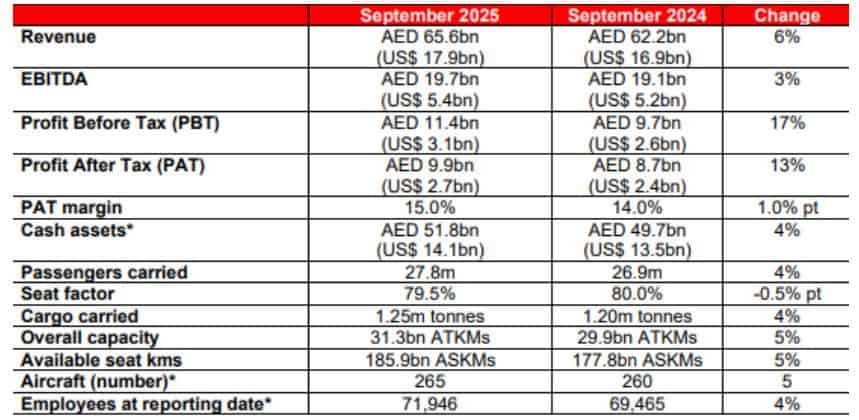
(Source: emirates.com)
- Emirates Airlines’ financial highlights for the year ending September 2025 demonstrate successful corporate growth, as the airline manages both high operational demands and price-sensitive requirements in the aviation industry.
- The company achieved revenue of AED 65.6 billion (USD 17.9 billion), representing 6% year-on-year growth.
- The company experienced top-line growth as international travel demand increased; it expanded its routes through a controlled approach and successfully managed revenue across both premium and economy segments.
- The company reported a 17% increase in profit before tax to AED 11.4 billion, while profit after tax rose 13% to AED 9.9 billion.
- The PAT margin reached 15.0% because Emirates Airlines translated demand growth into actual earnings growth, thereby offsetting the effects of rising fuel costs, labour expenses, and maintenance charges.
- The company demonstrated strong operating cash flow, with EBITDA increasing by 3% to AED 19.7 billion.
- The airline achieved operational success by transporting 27.8 million passengers, a 4% increase over the previous year.
- The seat factor decreased from 80.0% to 79.5% because the airline increased its seat inventory, which operated under current demand conditions.
- The airline achieved a 5% growth in available seat kilometers, which reached 185.9 billion through a total capacity increase of 5% and a fleet expansion that brought its aircraft count to 265.
- The airline has developed its operational capacity to handle international passenger traffic from Asia, Europe, and the Middle East through its international travel operations.
- The company experienced a 4% increase in cargo volumes, which reached 1.25 million tonnes, because total cargo capacity grew by 5% to 31.3 billion ATKMs.
- The balance sheet showed improvement because cash assets increased by 4% to reach AED 51.8 billion, which created enough liquid assets to fund fleet purchases, technology improvements, and employee recruitment.
- The company experienced a 4% increase in employee numbers, which brought the total to approximately 72,000 workers who will stay with the company for future development.
Emirates Airlines Global Network And Connectivity Strength
- Emirates Airlines shows a clear strategic direction by developing its worldwide network through its Dubai operational center.
- The airline established new flight paths to Danang and Siem Reap, Shenzhen, and Hangzhou during the first half of FY2025–26 to strengthen its position in rapidly developing Asian markets.
- The airline operated its network to 153 airports in 81 countries and territories by 30 September, which demonstrated its outstanding long-distance travel capabilities.
- The airline introduced 28 extra weekly flights to major destinations like Johannesburg, Rome, Riyadh, and Taipei, which increased both flight schedule options and operational network strength.
Partnerships And Fleet Investments
- Emirates Airlines established better flight connections through its new codeshare and interline partnerships with Air Seychelles, Condor, and Aurigny, which allowed passengers to reach various secondary and leisure destinations.
- The airline received five new Airbus A350 aircraft, which increased its premium cabin capacity, while 23 widebody aircraft completed the USUSD5 billion retrofit program with brand new interior designs.
- The extensive interior renovation program enabled Emirates to provide Premium Economy service between Dubai and 61 different cities, which strengthened its high-end service delivery across multiple markets.
Customer Experience And Retail Strategy
- The ground experience serves as the main element that distinguishes our service from all competing services.
- The establishment of “Emirates First” at Dubai International Airport provided First Class passengers and Platinum Skywards members with an exclusive, luxurious check-in service.
- Emirates introduced its worldwide retail expansion plan through the establishment of travel concept stores in eight important cities, which included Singapore, Seoul, and Geneva.
- The organization makes these changes to establish multiple customer contact points, which will enhance product recognition through retail locations that extend beyond airport facilities.
Sustainability And Brand Investments
- The world makes slow environmental progress, which still brings substantial results.
- Emirates used sustainable aviation fuel at 37 airports while it joined the Aviation Circularity Consortium to show its dedication to building circular supply chains and creating pathways for decarbonization.
- Emirates Airlines dedicated significant funding to worldwide sports sponsorships, which resulted in partnerships with FC Bayern Munich, Real Madrid, Basketball EPCR Rugby, and an extended ATP Tour partnership that lasts until 2030.
- The contracts create deep emotional connections between the brand and consumers throughout Europe and international sports markets.
Operational Performance Shows Balanced Growth
- The organization demonstrates stable progress through its operational metrics, which indicate controlled expansion without any attempts to exceed operational limits.
- The total capacity of the system reached 31.3 billion ATKM, which includes a 5% increase in capacity and a 5% increase in ASKM.
- The airline observed a 4% increase in passenger traffic, which measures RPKM, while its passenger seat factor reached a satisfactory 79.5% level.
- The airline transported 27.8 million passengers during the period, which showed strong customer demand despite the airline’s increased capacity.
- The organization achieves balanced results through its revenue management system, which controls income while maintaining efficiency instead of using load factor as a growth strategy.
Cargo And Ancillary Businesses
- The operating results for Emirates SkyCargo show a 4 % increase in freight volume to 1.25 million tonnes, which the company achieved through its three new Boeing 777 freighters and its Emirates Courier Express service.
- The company experienced a 6 % decline in cargo yields because of decreased market demand and ongoing tariff disputes between countries, but its shipment volume remained constant.
- The ancillary business units generated strong results, as Emirates Flight Catering increased its external revenue to AED 555 million, which represented a 13 % growth, through its provision of services to 116 airlines.
- Through its complete acquisition of Air Ventures LLC, Emirates has acquired additional resources, which will enhance its ability to generate income from non-essential business activities.
Emirates Airlines Capacity By Region
| Region | 2024 | Growth v 2019 | Share of Total in 2024 |
Change in Share v 2019
|
| Africa | 4,320,219 | 6.0% | -0.1% | |
| Asia | 12,272,449 | -4.5% | 17.1% | 0.1% |
| Europe | 12,258,212 | -1.0% | 17.1% | 0.7% |
| Latin America | 579,484 | 1.1% | 0.8% | 0.1% |
| North America | 2,516,240 | 7.5% | 3.5% | 0.4% |
| Middle East | 37,637,194 | -7.1% | 52.5% | -1.0% |
| Southwest Pacific | 2,167,304 | -11.9% | 3.0% | -0.2% |
| Total | 71,751,102 | -5.3% |
(Source: oag.com)
- Emirates Airlines uses its capacity distribution patterns to establish its global business strategy, which focuses on expanding operations through increased connectivity while optimizing selected areas of its operations.
- Total capacity for 2024 reached 71.75 million units despite a 5.3 % decrease from 2019 due to post-pandemic system restoration and network system streamlining.
- The Middle East functions as the primary operational center, which accounts for 37.6 million units that represent 52.5 % of the overall operational capacity.
- The figure shows a 7.1 % reduction from 2019, which resulted in a 1.0 percentage point drop of total market share, yet the data shows that Dubai functions as the primary international hub and transit center of the airline.
- Asia recorded 12.27 million units (17.1% share), while Europe followed closely with 12.26 million units (also 17.1%).
- The European market has shown an increase of 0.7 %age points, which demonstrates its ability to maintain operations and its strong demand for international flights, despite operating with slightly reduced capacity when compared to 2019.
- The automotive sector in North America experienced its strongest recovery with 2.52 million units sold, which showed 7.5% growth compared to 2019, and the region increased its market share to 3.5% because of ongoing demand for premium and business travel services.
- The share of Africa maintains its 6.0% stability, while the Latin American and Southwest Pacific regions function as niche markets that hold strategic importance for businesses.
Emirates Awards
- The 2024–25 awards season recognized Emirates Airlines through multiple major industry awards, which covered airline performance, onboard experience, customer loyalty programs, and technological advancements.
- The International Loyalty Awards named Emirates as the best International Loyalty Programme of the Year for 2024 in the Middle East region.
- At the 2024 World Travel Awards, Emirates received three awards, which included the title of Middle East’s Leading Airline, Leading Airline First Class, and Leading Airline Rewards Programme.
- Pax International Magazine Awards recognized Emirates with the Best In-Flight Entertainment and Connectivity award for the Middle East region.
- The Times and Sunday Times Travel Awards 2024 named Emirates the Best Airline.
- The ULTRAs 2024 Awards named Emirates the World’s Best Airline.
- Emirates received three awards at the 2024 World Travel Awards, which included World’s Leading Airline awards, Inflight Entertainment awards, Rewards Programme awards, and brand awards.
- Emirates achieved five awards at the 2024 Business Traveller Middle East Awards, which included Best Airline Worldwide, Best Premium Economy, Best First Class, Best Airport Lounge – Middle East, and Best Frequent Flyer Programme.
- Emirates received several AirlineRatings.com Airline Excellence Awards for Best In-Flight Entertainment and Best Premium Economy.
- Forbes Travel Guide’s Air Travel Awards in 2025 added honours such as Best International Airline, Best First Class, Best Culinary Programme, and Best International Airline Lounge (First Class Lounge, Dubai).
- Emirates’ inflight entertainment system, ice, received recognition at the 2025 APEXIFSA Awards because it won the best global entertainment award.
- Emirates achieved successful results in both expos and culinary competitions by winning multiple gold, silver, bronze, and merit awards at ExpoCulinaire 2024.
Conclusion
Emirates Airlines 2025 performance shows that the airline has reached a point beyond recovery and now practices structured expansion based on value. The airline demonstrates monetization of scale through its strong revenue growth and increasing profit margins, and substantial cash reserves. The airline maintains its long-haul business through its network expansion in Asia, its strong demand in Europe and North America, and the permanent status of Dubai as a hub. The company achieves revenue stability through its strategic fleet upgrades and premium cabin investments, and ancillary business operations, while it maintains capacity growth to ensure yield protection.
The volume of cargo remains strong even though cargo prices have decreased. Emirates Airlines shows that it achieves sustainable competitive advantage through operational discipline and brand strength, and its leadership in connectivity.
FAQ.
The company generated AED 65.6 billion, which converts to USD 17.9 billion in revenue, that shows a 6 % revenue increase when compared to the previous year.
27.8 million passengers who travelled with the airline in 2025 represent an annual growth rate of 4 %.
The airline operates its services from 153 airports, which serve 81 different countries and territories.
The company operates a fleet of 265 aircraft, which includes all new Airbus A350 deliveries.
The Middle East region represents 52.5 % of the total capacity operated by the airline.
The company invests in premium travel through its delivery of A350 aircraft, which include cabin upgrades and new Premium Economy route expansion.

I hold an MBA in Finance and Marketing, bringing a unique blend of business acumen and creative communication skills. With experience as a content in crafting statistical and research-backed content across multiple domains, including education, technology, product reviews, and company website analytics, I specialize in producing engaging, informative, and SEO-optimized content tailored to diverse audiences. My work bridges technical accuracy with compelling storytelling, helping brands educate, inform, and connect with their target markets.