Foldable Smartphone Statistics By Market Size, Region, Forecast, Operating System, Demographics, Trend And Facts (2026)

Updated · Mar 14, 2026


Table of Contents
- Introduction
- Editor’s Choice
- Foldable Smartphone Market Size
- Global Foldable Smartphone Shipment Share
- Global Foldable Market Share By Region
- SellCell’s Late-2025 Depreciation Report
- Foldable Market Share Forecast By Operating System
- Durability and Consumer Trust Metrics
- Foldable Smartphone Demographics
- The Rise Of Tri-Fold Technology (2025–2026)
- Apple’s Anticipated Entry In The Foldable Market Dynamics
- Foldable Smartphone Pricing Comparison (2026)
- AI Integration in Foldable Smartphones
- Battery Technology Advancements in Foldables
- Future Outlook
- Conclusion
Introduction
Foldable Smartphone Statistics: The field of mobile technology has advanced to create foldable smartphones, which have become the most important new development during the past five years. The foldable smartphone market has grown from its initial design phase to become a fundamental part of high-end smartphone products that people use every day.
The category has evolved from an emerging trend into a data-driven market segment, reshaping consumer expectations around screen technology, multitasking, and device innovation. This article analyzes shipment volumes, revenue figures, market share shifts, and consumer research shaping the foldable smartphone market as of 2025.
Editor’s Choice
- The worldwide foldable smartphone market is expected to expand from USD 26 billion (2023) to USD 188.4 billion (2033) with a compound annual growth rate of 21.9%.
- Flip models account for 67% of foldable ownership, while book-type devices hold 33%.
- Q3 2025 foldable shipments increased 14% YoY compared to Q3 2024.
- Samsung expanded its market share from 56% (Q3 2024) to 64% (Q3 2025).
- Vivo recorded the strongest growth among challengers at +67% YoY, while Xiaomi declined -54% YoY.
- Greater China leads regional foldable adoption at 3.2% market share, ahead of North America at 1.2%.
- Foldable devices account for approximately 2.5% of global smartphone shipments.
- Foldable devices experience a value decrease of 62.3% after six months, while traditional flagship devices experience a value decrease of 49.8%.
- Samsung foldables experience a 63.7% decline in value during six months, while Galaxy S models experience a 48.3% decline.
- Within the foldable smartphone segment, Android’s OS share is projected to decline from 89% (2025) to 52% (2029).
- iOS is projected to rise from 0% (2025) to 34% (2029) in the foldable market share.
- Book-type foldables are forecast to reach 65% shipment share by 2026, up from 35% in 2020.
- According to IDC, the growth in the foldable phones category is predicted to reach the 20.6 million units units with 10% YoY growth in 2025.
- In the U.S., 46% of consumers prefer Samsung foldables due to its strong brand loyalty within the premium segment.
Foldable Smartphone Market Size
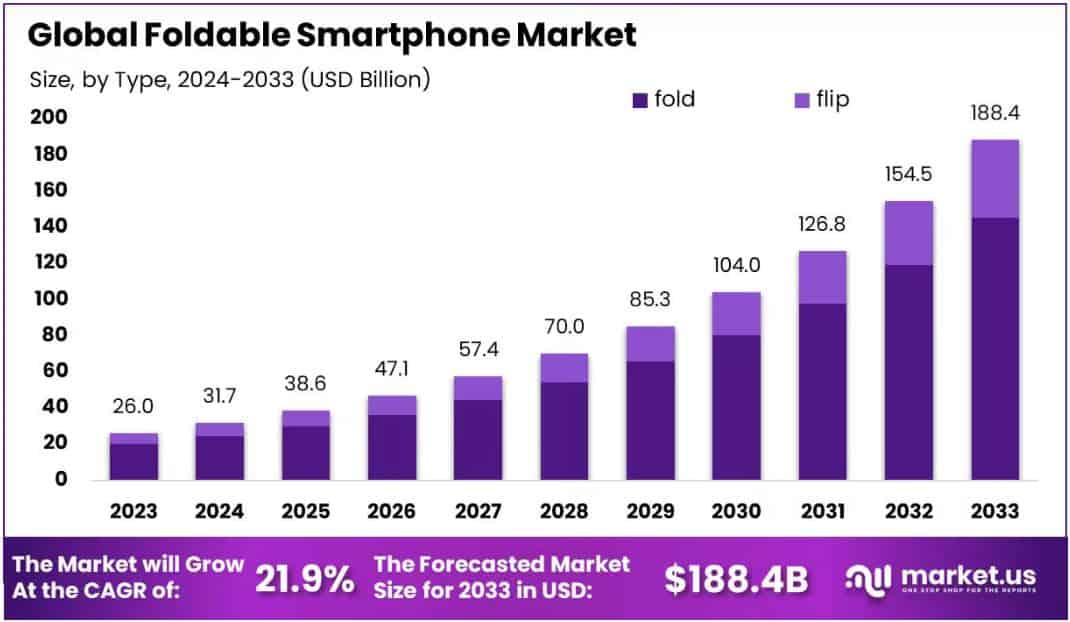
(Source: market.us)
- The global market is expected to grow from USD 26 billion in 2023 to USD 188.4 billion by 2033 through a 21.9% CAGR, which represents an outstanding growth rate.
- Flip Devices, which fold in half to offer a smaller external display when closed, represent 67% of all foldable smartphones owned.
- The remaining 33% of the market consists of Fold Devices, which use inward folding displays to create larger tablet-sized screens.
- North America reached 328 million smartphone subscribers by 2025, according to GSMA projections, which will result in 86% mobile penetration and 80% internet penetration.
- Europe will achieve digital maturity by 2025 when 88% of the population used smartphones and 82% of people access the internet.
- The online platform segment captured 58.3% market share in 2023, driven by convenience and promotional incentives.
- The aggregate statistics about foldable smartphones demonstrate that innovation accelerates while more consumers adopt the technology, and global markets maintain their growth until 2033.
| Brand | Market Share Q3 2024 (%) | Market Share Q3 2025 (%) | YoY Change in Shipments (%) |
| Samsung | 56% | 64% | 0.32 |
| Huawei | 15% | 15% | 0.1 |
| Motorola | 7% | 7% | 0.16 |
| HONOR | 10% | 6% | -31% |
| Vivo | 3% | 4% | 0.67 |
| Xiaomi | 6% | 2% | -54% |
| Others | 3% | 2% | -39% |
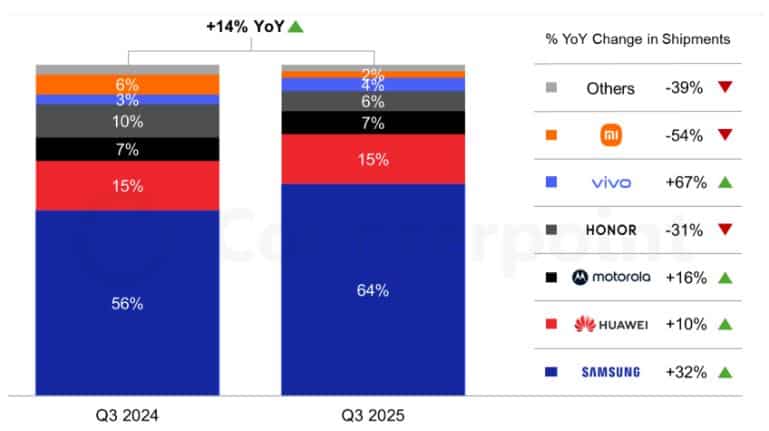
- Q3 2025 signals a decisive market reshuffle, with overall shipments rising 14% YoY from Q3 2024.
- The standout performer is Samsung, expanding its share from 56% to 64%, reflecting a robust +32% YoY growth. Vivo also delivered an impressive +67% growth, strengthening its competitive footing, while Huawei and Motorola posted steady gains of +10% and +16%, respectively.
- In contrast, Xiaomi (-54%), HONOR (-31%), and the “Others” category (-39%) faced significant contractions, underscoring intensifying brand polarization.
- The data suggests consolidation at the top, where innovation-driven brands are capitalizing on favorable foldable smartphone statistics.
(Source: market.us)
| Region | Market Share (%) |
| Greater China | 3.2% |
| North America | 1.2% |
| Europe | 0.6% |
| Latin America | 0.4% |
| APAC* | 0.3% |
| MEA | 0.2% |
- The H1 2025 regional breakdown highlights how concentrated the foldable opportunity remains.
- Greater China leads at 3.2%, nearly three times ahead of North America (1.2%), which indicates that reflecting stronger consumer adoption and a more mature ecosystem.
- Europe follows at 0.6%, while Latin America (0.4%), APAC excluding key markets (0.3%), and MEA (0.2%) are still in early adoption phases.
- These numbers reinforce broader foldable smartphone statistics, which show that global penetration remains under 5% thus creating substantial growth potential for the market.
- The disparity exists because customers respond differently to product prices while distribution channels reach various stages of development, and brands introduce new products through their unique innovation processes.
- Current foldable smartphone statistics suggest that premium positioning is resonating more in innovation-driven markets like China.
SellCell’s Late-2025 Depreciation Report
- The current foldable smartphone statistics demonstrate that companies must choose between developing new technology and maintaining product value through resale.
- Foldable devices lose their value at a rate that surpasses traditional flagship smartphones, which experience a 15.4% higher value reduction during their first six months of market presence.
- Foldable devices experience a 62.3% value loss within six months, whereas standard flagship devices experience a 49.8% value loss, which resulting in a 12.5-percentage-point gap between the two categories in short-term value retention.
- Foldable devices have experienced a 71.1% decline after 18 months, while non-foldable devices have only dropped 60.7%, which establishes a 10.4% greater value depreciation distinction between both product categories.
- Samsung’s foldable devices experience their highest value loss through a 63.7% depreciation within six months, while the Galaxy S series faces a 48.3% depreciation, which creates the greatest performance difference between different manufacturers.
- The Google Pixel Fold experiences a 58.1% value loss during the first six months, which represents a 2% increase compared to the Pixel Pro, which loses 56.1% of its value, but the value difference between both products decreases to 1.7% after one year.
- The OnePlus Open experiences a 55.2% value drop over six months, while the OnePlus 11 shows a 51.0% value decline, resulting in a 4.2% difference between the two devices.
- The two models exhibit identical depreciation patterns after 18 months, which establishes the Open as the top-performing foldable device in this study.

(Reference: informa.com)
| Year | iOS | Android | HarmonyOS |
| 2025 | 0% | 89% | 11% |
| 2026 | 22% | 61% | 17% |
| 2027 | 30% | 55% | 15% |
| 2028 | 32% | 53% | 15% |
| 2029 | 34% | 52% | 14% |
- The market share of Android stood at 89% in 2025 but is projected to decline its position to 52% by 2029, resulting in a 37% drop.
- The iOS platform shows strong growth, with its market share increasing from 0% to 34%, indicating that more users are adopting its ecosystem and entering its premium market.
- HarmonyOS is forecast to reach its highest usage rate of 17% in 2026 and then maintains a usage range of 14% to 15%.
- The foldable smartphone statistics demonstrate that their market share shows a pattern of increasing diversification.
- Android maintains its status as the leading operating system, but its market share decreases because users prefer to link different devices through their operating systems.
- The iOS platform gained approximately 8.5 percentage points per year on average from 2025 to 2029.

(Source: counterpointresearch.com)
| Year | Book-Type Share of Foldable Shipments | Leading Brand |
| 2020 | 35% | Samsung |
| 2021 | 39% | Samsung |
| 2022 | 42% | Samsung |
| 2023 | 47% | Samsung |
| 2024 | 51% | Huawei |
| 2025 | 52.0% | Samsung |
| 2026 F | 65% (Forecast) | TBD |
- The trajectory of book-style foldables reveals a compelling shift in consumer preference and competitive dynamics.
- In 2020, book-type models accounted for just 35% of total shipments, but by 2026, projections indicate a commanding 65% share—an impressive 30-%age-point surge in six years.
- From a brand standpoint, Samsung maintained leadership from 2020 through 2023, before Huawei briefly captured the top spot in 2024.
- The competitive reshuffle underscores intensifying innovation cycles within the premium segment. These foldable smartphone statistics signal that consumers increasingly favor productivity-oriented designs over compact clamshell alternatives.
- As economies of scale reduce production costs and ecosystem integration strengthens, foldable smartphone statistics suggest book-type devices are evolving from niche premium gadgets into mainstream flagship contenders by 2026.
Durability and Consumer Trust Metrics
| Vice category | Example models | Key display type | Typical out‑of‑warranty inner/main screen repair cost (parts only, approx.) | Illustrative sources |
| Large book‑style foldable (latest generation) | Galaxy Z Fold 7 | Inner flexible OLED panel | 761 euros (about 76,395 rupees or roughly 800 dollars), excluding labor | Hindustan Times, Moneycontrol (citing SamMobile supplier data) |
| Large book‑style foldable (recent generation) | Galaxy Z Fold 4, Z Fold 3 | Inner flexible OLED panel | 479–499 dollars for the inner screen module | Android Authority (Samsung official repair pricing) |
| Flip‑style foldable | Galaxy Z Flip 7 | Inner flexible OLED panel | 342 euros (about 34,343 rupees), excluding labor | Hindustan Times, Moneycontrol |
| Conventional flagship slab phone | iPhone 15 Pro Max, Galaxy S24 Ultra, Pixel 8 Pro | Rigid OLED or AMOLED panel | Roughly 290–329 dollars at official service centers, often 200–300 dollars via third‑party repair shops | Salvation Repair compiled a repair‑cost guide. |
Foldable Smartphone Demographics
| Segment | Typical age bracket | Preferred foldable form factor | Primary use cases and motivations | Key supporting insight |
| Gen Z consumers | 18–24 years | Flip‑style foldables | The elements of aesthetics, cool factor, compactness, selfie flexibility, short-form video creation, and social media posting on platforms TikTok and Instagram create a complete aesthetic. | YouGov finds 83% of 18–29‑year‑olds are interested in foldables, with younger adults emphasizing design and novelty. |
| Younger Millennials | 25–34 years | Flip‑style (for lifestyle) and some book‑style (for hybrid work) | The combination of style and practical functionality, along with creative camera functions, allows users to multitask among three application types: messaging, productivity, and entertainment. | Kantar reports flip devices account for 67% of foldables owned, indicating a strong tilt toward lifestyle‑oriented buyers. |
| Older Millennials and Gen X professionals | 30–49 years | Book‑style foldables | The user needs to perform heavy multitasking activities, which include document review together with email and calendar management, and on-device presentations while using their phone instead of carrying both phone and tablet. | Samsung notes B2B foldable shipments more than doubled, with book‑style devices deployed to knowledge‑worker and field‑worker roles for productivity. |
| Enterprise and B2B buyers | 30–60 years (IT and business decision‑makers) | Primarily book‑style foldables | The system enables secure mobile operations that display business applications through a split-screen view and show operational dashboards and client demonstrations that work with MDM and corporate productivity software. | ResearchAndMarkets and Samsung case studies highlight accelerating enterprise adoption, driven by multitasking and document‑focused use cases. |
| Cautious mainstream users | 45+ years | Mostly conventional slab phones, with limited foldable uptake | Many people find foldable devices unappealing because they prioritize dependable performance and basic design, which costs less than new features, while most users believe foldable devices do not provide enough benefits to warrant their expense and product fragility. | YouGov and Kantar show lower interest levels among older adults, and a significant share of foldable owners reverting to traditional smartphones. |
The Rise Of Tri-Fold Technology (2025–2026)
- The shift toward tri-fold smartphones is defined by ultra-premium pricing, low volumes, and strategic experimentation.
- Huawei launched the Mate XT in China at 19,999–23,999 yuan (≈USD 2,800–USD 3,370), while its international version reached €3,499 (≈USD 3,660), positioning it firmly in the luxury tier.
- DSCC reports that foldable display demand is stagnating at around 22 million units annually in 2024–2025, after previously expanding at 40%+ yearly growth.
- Panel orders for Huawei’s tri-fold were revised down by over 20%, reflecting softer-than-expected demand.
- Samsung Electronics entered the market with the Galaxy Z TriFold 5G, priced at USD 2,899 and featuring a 10-inch main display, a 6.5-inch cover screen, and 16 GB of RAM and up to 1 TB of storage.
- Forecasts suggest foldables could return to 30% growth in 2026, which will stabilize at 20% growth for the upcoming years.
Apple’s Anticipated Entry In The Foldable Market Dynamics
- The upcoming foldable iPhone from Apple, which is expected to launch in late 2026, will create a major shift in the smartphone market, according to IDC.
- When Apple enters a new market segment, the company has historically driven consumer adoption rates to rise more quickly than before, and current data on foldable smartphone usage shows a similar pattern.
- IDC predicts that in its first year of operation, Apple will capture 22% of the worldwide foldable device market while obtaining 34% of total market revenue, indicating that Apple’s revenue share will exceed its unit share, reflecting its premium pricing strategy.
- Apple plans to enter the ultra-premium market segment at around USD 2400, which will help the company establish value-based market divisions while building customer confidence in this product category.
- The validation effect will lead developers to focus on software development, which will solve existing problems that restrict user experience.
- The upcoming Galaxy Z Trifold from Samsung, which will debut in 2026, and the strategic plans of Huawei to increase their foldable shipments demonstrate how both companies are preparing for Apple’s upcoming market entry.
- The current foldable smartphone statistics show that innovation will accelerate, product pricing will become more diverse, and the market will achieve mainstream maturity by 2026.
Foldable Smartphone Pricing Comparison (2026)
| Device | Type | Price (USD) | Launch Year |
| Samsung Galaxy Z Flip 7 FE | Clamshell | ~$900 | 2025 |
| Samsung Galaxy Z Flip 7 | Clamshell | ~$1,200 | 2025 |
| Samsung Galaxy Z Fold 7 | Book-style | ~$2,000 | 2025 |
| Samsung Galaxy Z TriFold | Tri-fold | $2,899 | 2026 |
| Google Pixel 10 Pro Fold | Book-style | ~$1,800 | 2025 |
| Huawei Mate X7 | Book-style | ~$1,800 | 2025 |
| Huawei Mate XT (International) | Tri-fold | €3,499 (~$3,660) | 2025 |
| Apple iPhone Fold (Expected) | Book-style | ~$2,400 | Late 2026 |
| Motorola Razr Fold | Book-style | ~$1,500 | 2026 |
| HONOR Magic V6 | Book-style | TBD | 2026 |
AI Integration in Foldable Smartphones
- AI-powered multitasking optimisation for split-screen workflows on foldable displays
- Samsung Galaxy AI features tailored for Z Fold 7 and Z TriFold (e.g., interpreter mode, sketch-to-image across the larger canvas)
- Google Gemini integration on Pixel Fold for contextual assistance across panels
- HONOR’s “Robot Phone” concept and AI-enhanced productivity on Magic V6
- IDC forecasts that 370+ million GenAI smartphones will be shipped in 2025, with foldables positioned as the premium AI-first form factor.
Battery Technology Advancements in Foldables
- Shift from lithium-ion to silicon-carbon batteries enabling slimmer foldables with higher capacity.
- HONOR Magic V6: 6,660 mAh silicon-carbon battery with 25% silicon content — an industry-first in foldables.
- Samsung using silicon-carbon battery in Galaxy Z TriFold prototype.
- Industry trend: single-cell capacity expected to hit 8,500–9,000 mAh by 2026–2027.
- Comparison with traditional foldables: Galaxy Z Fold 7 still has a 4,400 mAh lithium-ion battery.
Future Outlook
- The statistics for future foldable smartphones indicate that the industry will experience major growth.
- Business experts predict that global foldable device shipments will reach 100 million units by 2027, representing a major increase from current levels.
- The combination of pricing stabilization and more original equipment manufacturer (OEM) companies entering the market will create easier access for users, while Apple plans to enter the market in 2026, which will boost demand.
- The combination of hardware improvements and software development will enable users to achieve higher productivity levels in their work tasks.
- Foldable smartphone statistics show that this technology has moved from an exclusive, high-end product to a fast-growing market segment now present across the entire smartphone market.
Conclusion
Foldable smartphones established themselves as a desirable yet rapidly evolving technology in 2025. The foldable market demonstrated its enduring nature with 20.6 million unit sales, generating multiple billions in revenue at premium price points and drawing interest from both consumers and manufacturers.
Although they hold a minor portion of the worldwide smartphone market, approximately 2.5 %, their adoption will grow because companies have started to develop more devices and continue to innovate, while Apple plans to enter the market. Users will experience a new way of using digital content because display technology will improve and price barriers will decrease, enabling them to carry everything in their hands.
Sources
FAQ.
In 2025, global foldable smartphone shipments rose +14% YoY from Q3 2024 figures, with the total market size projected to grow from USD 26 billion in 2023 to USD 188.4 billion by 2033 at a 21.9% CAGR.
U.S. adoption remains early: foldables represent roughly 1–2.5% of total smartphones owned across key markets (including the U.S.), and 46% of U.S. consumers state a preference for Samsung foldables.
Regionally, Greater China leads with 3.2% market share, North America holds 1.2%, Europe 0.6%, Latin America 0.4%, APAC (excl. major markets) 0.3%, and MEA 0.2%.
Foldable devices comprise an estimated ~2.5% of the global smartphone market in 2025, with increasing shipment volumes and gradual mainstream growth.
Global shipments reached approximately 27.6 million units in 2025, representing a 25% year-over-year increase from prior volumes.

Tajammul Pangarkar is the co-founder of a PR firm and the Chief Technology Officer at Prudour Research Firm. With a Bachelor of Engineering in Information Technology from Shivaji University, Tajammul brings over ten years of expertise in digital marketing to his roles. He excels at gathering and analyzing data, producing detailed statistics on various trending topics that help shape industry perspectives. Tajammul's deep-seated experience in mobile technology and industry research often shines through in his insightful analyses. He is keen on decoding tech trends, examining mobile applications, and enhancing general tech awareness. His writings frequently appear in numerous industry-specific magazines and forums, where he shares his knowledge and insights. When he's not immersed in technology, Tajammul enjoys playing table tennis. This hobby provides him with a refreshing break and allows him to engage in something he loves outside of his professional life. Whether he's analyzing data or serving a fast ball, Tajammul demonstrates dedication and passion in every endeavor.