Internet Statistics and Facts 2026: Global Users, Demographics & Usage Data

Updated · Mar 14, 2026


Table of Contents
- Introduction
- Editor’s Choice
- Number Of Internet Users Worldwide
- Most Popular Reasons For Using The Internet Worldwide
- Global Fixed Broadband Speed Rankings 2025
- Global Internet Access Rate By Market Maturity
- Global Internet Penetration Leaders And Regional Digital Dynamics
- Number Of Internet Users Worldwide By Subregion
- Global Longest-Running Internet Censorship Cases
- Global Internet Freedom Rankings 2025
- Unconnected Global Population 2025, By Region
- Countries With The Most People Lacking Internet Connection
- Daily Time Spent Online By Internet Users Worldwide
- Mobile Internet Statistics
- Median global mobile and fixed broadband download and upload speed worldwide
- Internet Demographics Statistics
- Global Internet Access Challenges
- The Impact Of AI On Global Internet Traffic
- Conclusion
Introduction
Internet Statistics: The year 2025 stood as a defining milestone in the evolution of the internet, marking an era when digital connectivity is no longer a privilege but a pervasive dimension of modern life. The internet now serves as a communication tool that billions of people across the world use from both major cities and distant areas, accessing its services for work, education, healthcare, commerce, and social networking.
The expansion of this system has grown rapidly, yet it remains unequal because different regions experience different levels of development, and their residents experience different income levels, and their areas have different levels of infrastructure development. The 2025 internet statistics reveal that the world now enjoys greater internet connectivity, yet essential connectivity voids remain, which will influence upcoming investment and policy decisions for several years.
Editor’s Choice
- The number of internet users worldwide reached 6 billion in 2025, which represents 74% of the total global population.
- Eastern Asia (1.34 billion) and Southern Asia (1.1+ billion) hold the largest regional user bases.
- Northern Europe shows the highest internet usage rate, with 97.7% who exceed the worldwide average of 73.2%.
- The Small Island Developing States (65%) almost match the worldwide internet access rate, while LDCs (35%) fall far behind.
- The year 2025 saw 700 million people in Southern Asia who do not have internet access.
- The largest number of offline people in the world exists in India (440 million) and Pakistan (139 million).
- People worldwide spend 6 hours 38 minutes online each day, according to Q3 2024 data, which shows an increase of 19 minutes since 2015.
- South Africa leads the average daily internet usage, with South Africans spending 9 hours and 27 minutes online, whereas Japanese people spend 3 hours and 57 minutes.
- In 2025, mobile devices generated ~64% of all web traffic worldwide.
- The UAE holds the top position for worldwide mobile internet speed, with a speed of 652.87 Mbps.
- Singapore maintains the highest fixed broadband speed, which reaches 372.02 Mbps.
- Mobile internet speed reached 90.64 Mbps while fixed internet speed reached 98.31 Mbps in March 2025.
- The internet was used by 79% of global youth aged 15 to 24, while 99% of high-income youth use the internet.
- Global internet traffic reached 33 exabytes per day in 2024, while AI technology will increase data center power requirements from 30 GW in 2025 to 90 GW in 2030 at a 22% compound annual growth rate.
Number Of Internet Users Worldwide
(Reference: statista.com)
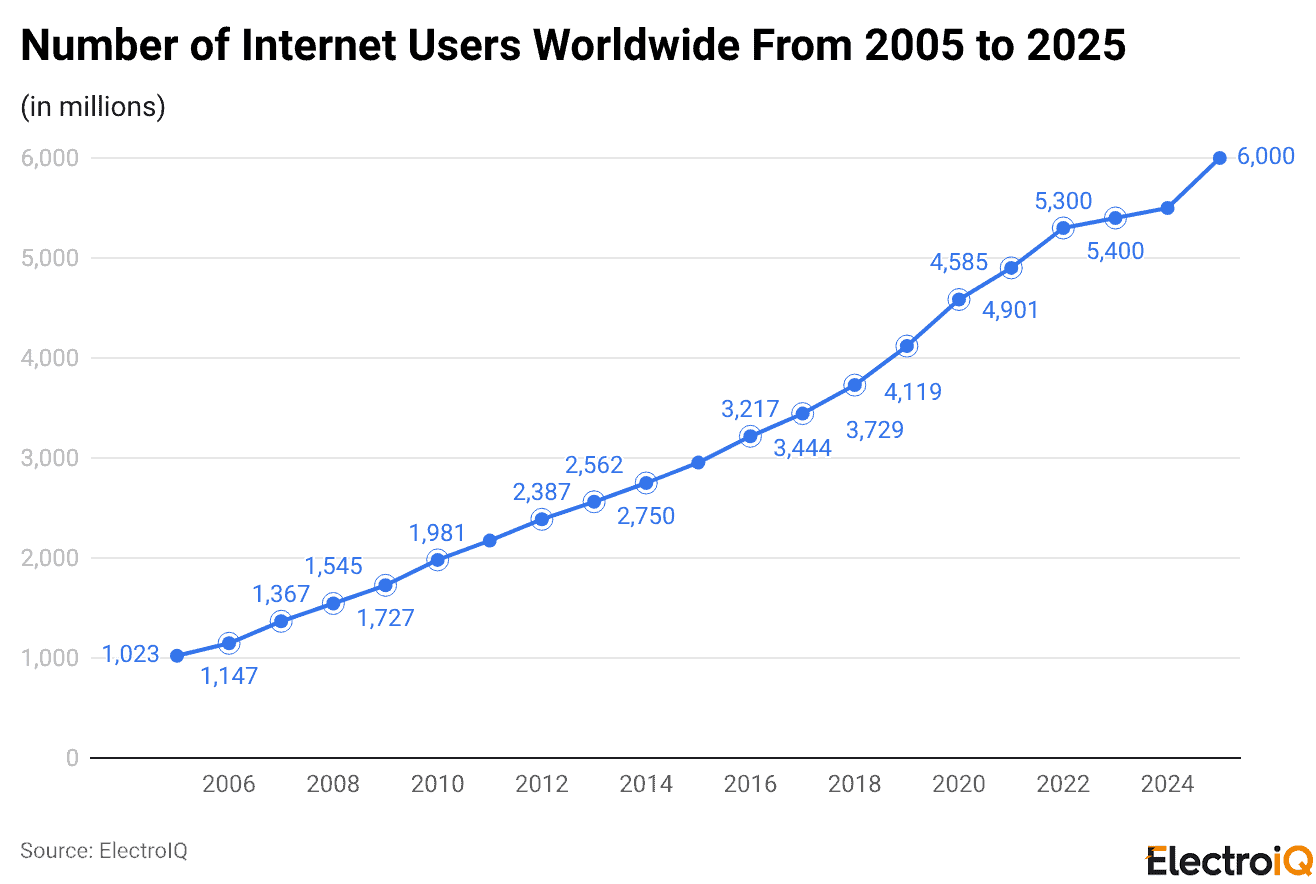
- The number of worldwide internet users reached 6 billion in 2025, which exceeded the previous total of 5.8 billion users from 2024, because 74% of people worldwide now access the internet.
- The analyst observes that the digital transformation process accelerated because broadband networks extend their reach and people increasingly use smartphones as their main method to access the internet.
- Emerging Asian economies experience the fastest internet growth rates because they now possess the largest digital user base in the world, while the United States stands as the third largest digital user base.
- Facebook holds the top position as the most active social networking platform, which users access from various locations throughout the globe. India held the largest Facebook audience as of October 2025.
- People use the internet mainly to connect with their family and friends, to share their opinions and entertainment content, and to shop online.
Most Popular Reasons For Using The Internet Worldwide
(Reference: statista.com)
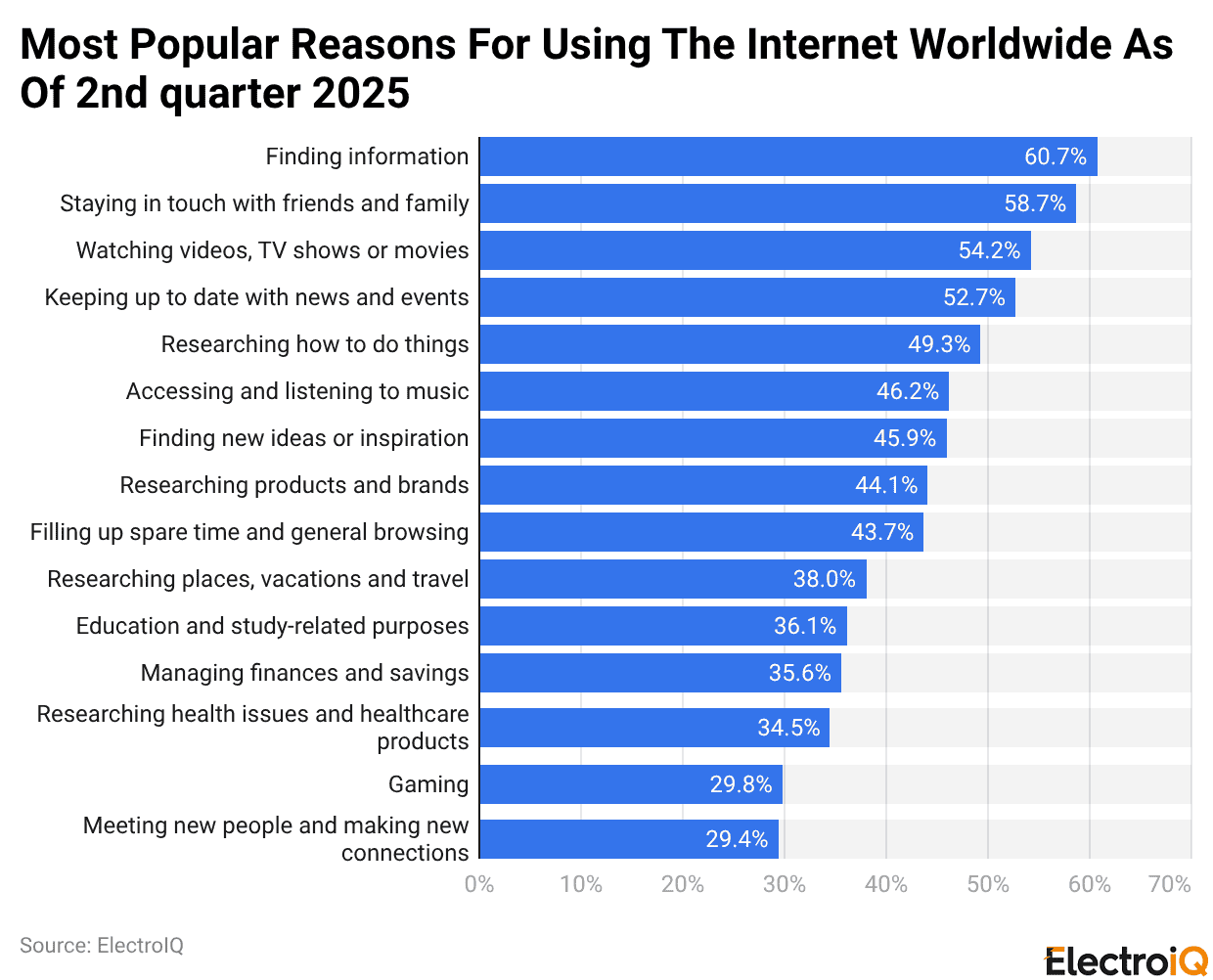
- The research shows that 62.8% of internet users worldwide say finding information is a main reason for going online; the 60.7% figure applies specifically to internet users aged 16 to 24, not to all users.
- Search and knowledge discovery remained the primary driver of digital platform usage worldwide.
- The second most common internet activity worldwide shows that people need to maintain contact with their friends and family who live far away.
- Data indicates that people use the internet for both practical purposes and social interaction, which affects their online behavior.
- The mobile revolution continues to redefine access patterns. By Q2 2024, 96.2% of users accessed the web via mobile devices, while smartphones generated 60% of global web page views by January 2024.
- The online time population spends 57% of their time online through mobile devices, while 43% of their time online occurs through desktop computers, which shows that mobile internet usage has become the primary way people access the internet in 2025.
- The platforms TikTok and Instagram served as the main sources for social video viewing during the initial quarter of 2024.
- TikTok reached the status of one of the most downloaded mobile applications worldwide during 2024, while it achieved the highest video views across all account sizes, which indicates a definite transition towards short content that social media platforms recommend through their algorithms in the online environment.
Global Fixed Broadband Speed Rankings 2025
(Reference: statista.com)
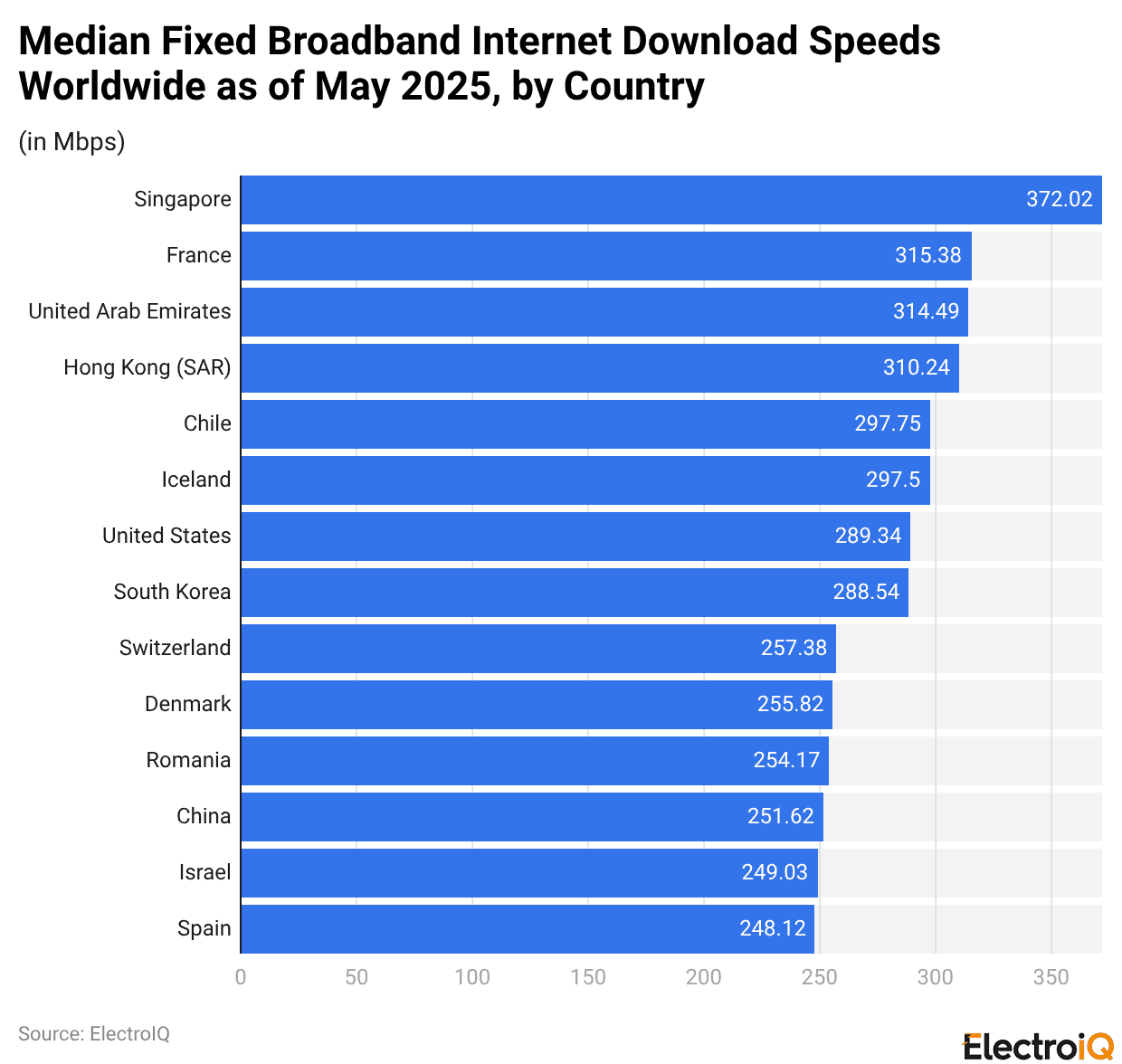
- As of May 2025, Singapore led global fixed broadband speed rankings with a remarkable median download speed of 372.02 Mbps, which establishes the standard for high-speed internet connections.
- France follows at 315.38 Mbps, while the United Arab Emirates secures third place, which demonstrates its commitment to developing its network infrastructure.
- These broadband speed statistics show how fibre-optic networks have become the dominant technology, because they deliver better performance with their dependable service and quick data transfer rates.
- Fixed broadband performance drives digital competitiveness and economic innovation in all regions, which will continue to expand as fibre networks reach more locations.
Global Internet Access Rate By Market Maturity
(Reference: statista.com)
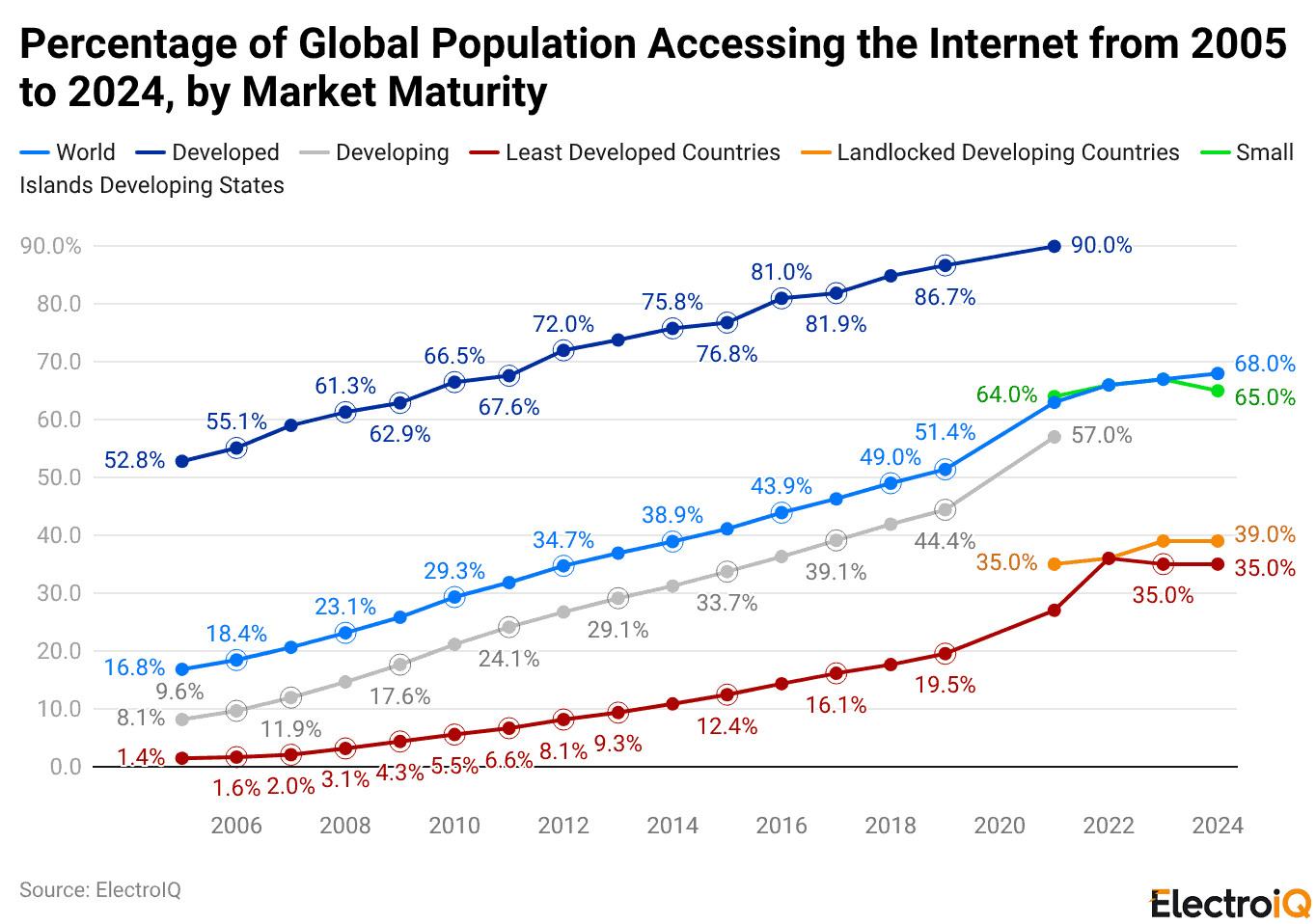
- The world achieved 68% internet access in 2023, but developing regions still show major differences in internet availability.
- Small Island Developing States (SIDS) recorded a relatively strong 65% online access rate, closely aligning with the global average.
- Least Developed Countries (LDCs) showed a 35% internet access rate, while Landlocked Developing Countries (LLDCs) reached 39% internet access.
- The internet access statistics demonstrate to analysts how geographic factors and infrastructure funding, together with economic development, affect digital access in different regions.
- The limited internet access in LDCs and LLDCs leads to reduced economic development and educational opportunities while blocking access to the worldwide digital market, which results in increased digital inequality.
Global Internet Penetration Leaders And Regional Digital Dynamics
(Reference: statista.com)
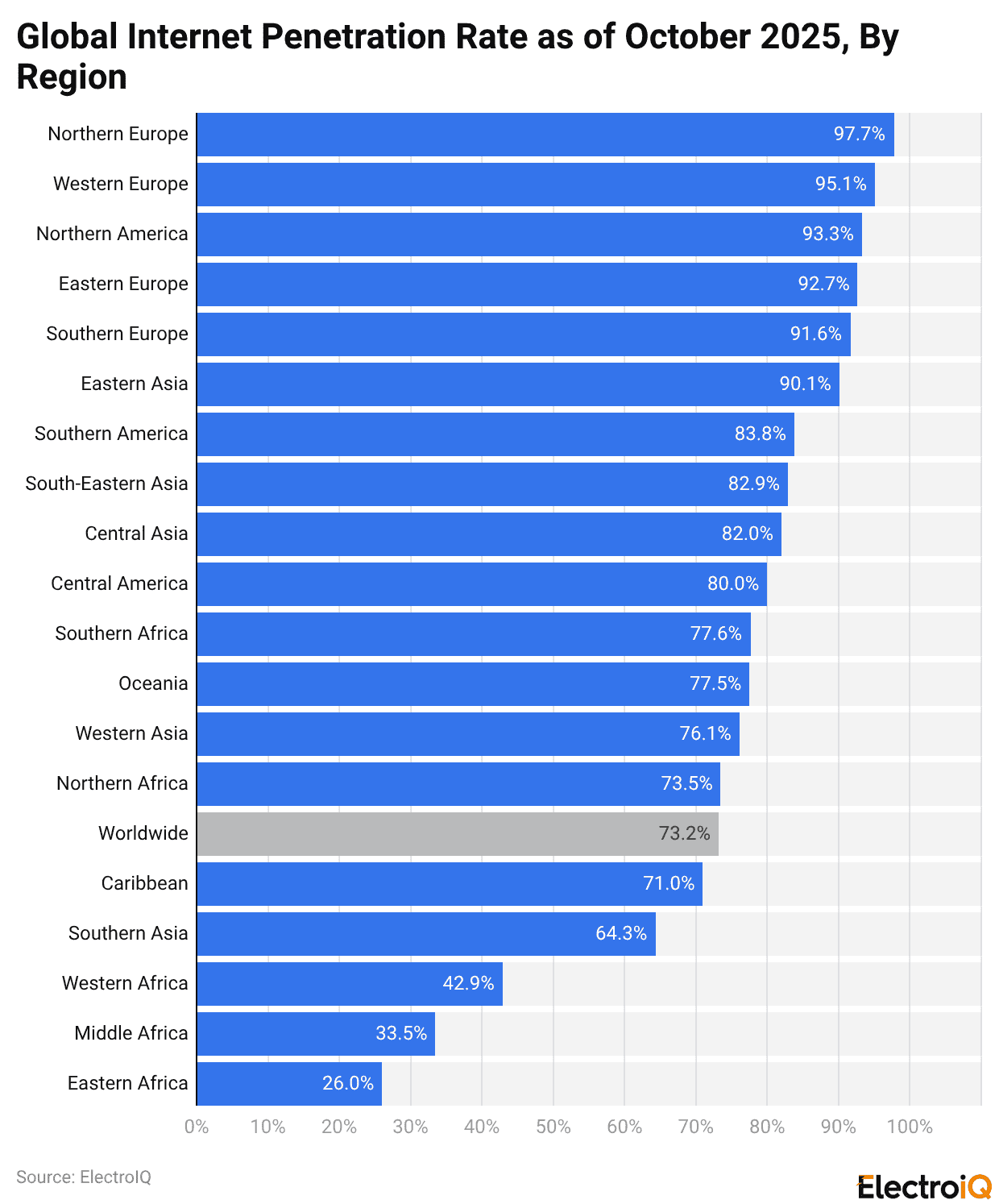
- Internet penetration in Northern Europe reached 97.7% on October 2025, which made it the highest worldwide internet usage rate.
- Western Europe achieved a 95.1% internet usage rate exceeded the global average of 73.2%.
- The internet statistics show that advanced economies possess developed telecom systems, high digital literacy, and extensive broadband availability.
- The world achieved 5.45 billion internet users by July 2024 because of better mobile internet access and improved network systems.
- Google Chrome holds the largest browser market share at 65.2%, while Safari follows with an almost 19% share, which shows how web platforms concentrate their user base.
- Asia contains the biggest digital population, which exceeds 2.9 billion users and shows its strongest presence in East Asia.
- The internet adoption rate in Eastern Asia reached 75.3% during 2023 because of the high number of users who did not achieve the highest level of internet access.
Number Of Internet Users Worldwide By Subregion
(Reference: statista.com)
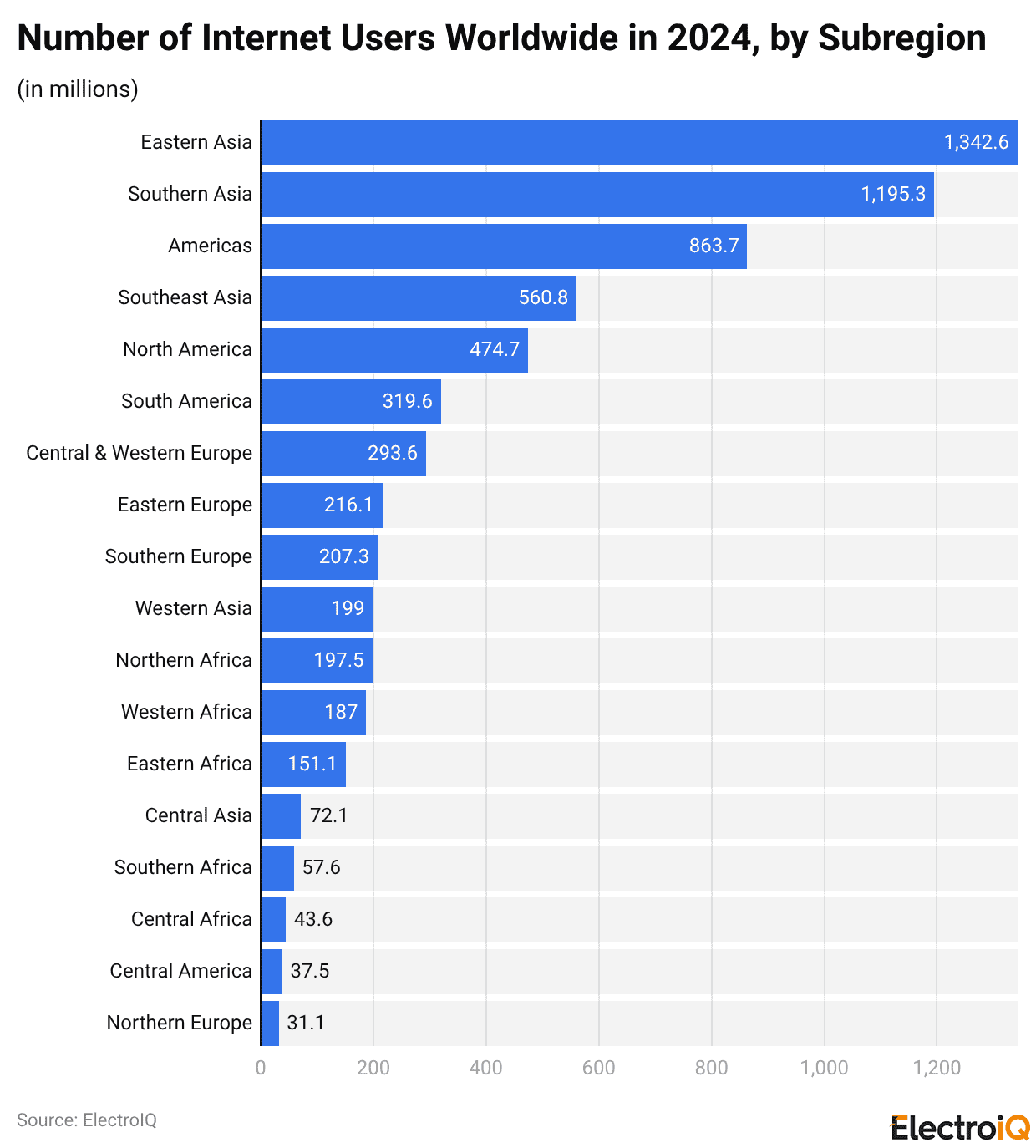
- In 2024, Eastern Asia represented the largest share of the global internet user base, accounting for approximately 1.34 billion users, while Southern Asia followed closely with over 1.1 billion users.
- The internet statistics demonstrate that Asia remains the leading force that drives the global digital economy, according to Statista.
- The worldwide digital population reached 5.16 billion in January 2023, according to DataReportal, while the 5.5 billion figure corresponds to ITU’s 2024 estimate; this growth reflects Asia’s large population base, rapid smartphone adoption, and continued broadband infrastructure development.
- The internet usage patterns of different regions show that high user volume does not guarantee the highest internet penetration rates because digital development gaps between those areas continue to exist.
Global Longest-Running Internet Censorship Cases
| Characteristic | Restriction |
| Feb 2009 | VoIP was banned in Oman* |
| May 2009 | Facebook and X (formerly Twitter) were blocked in Iran |
| Jun 2009 | Iran’s leading mobile phone network was cut in Tehran, and Facebook and YouTube were restricted |
| Jul 2009 | Twitter, Facebook, and YouTube were banned in China (to date) |
| Dec 2009 | YouTube was blocked in Turkmenistan |
(Source: statista.com)
- The year 2009 exists as the most severe period of internet censorship, together with digital restrictions which reached their peak in the year 2025.
- The Telecom Regulatory Authority lifted some VoIP service bans that Oman had implemented in February 2020, although the country still prohibits WhatsApp Calling.
- Iran enforced extensive internet shutdowns during May and June, which included complete access denial to Facebook and YouTube, together with mobile network interruptions throughout Tehran.
- China established permanent access blocks to Twitter, Facebook, and YouTube by July 2024, which remain in effect until today.
- Turkmenistan has maintained a YouTube ban, which has continued for many years, because the country maintains its worldwide internet censorship practices.
Global Internet Freedom Rankings 2025
(Reference: statista.com)
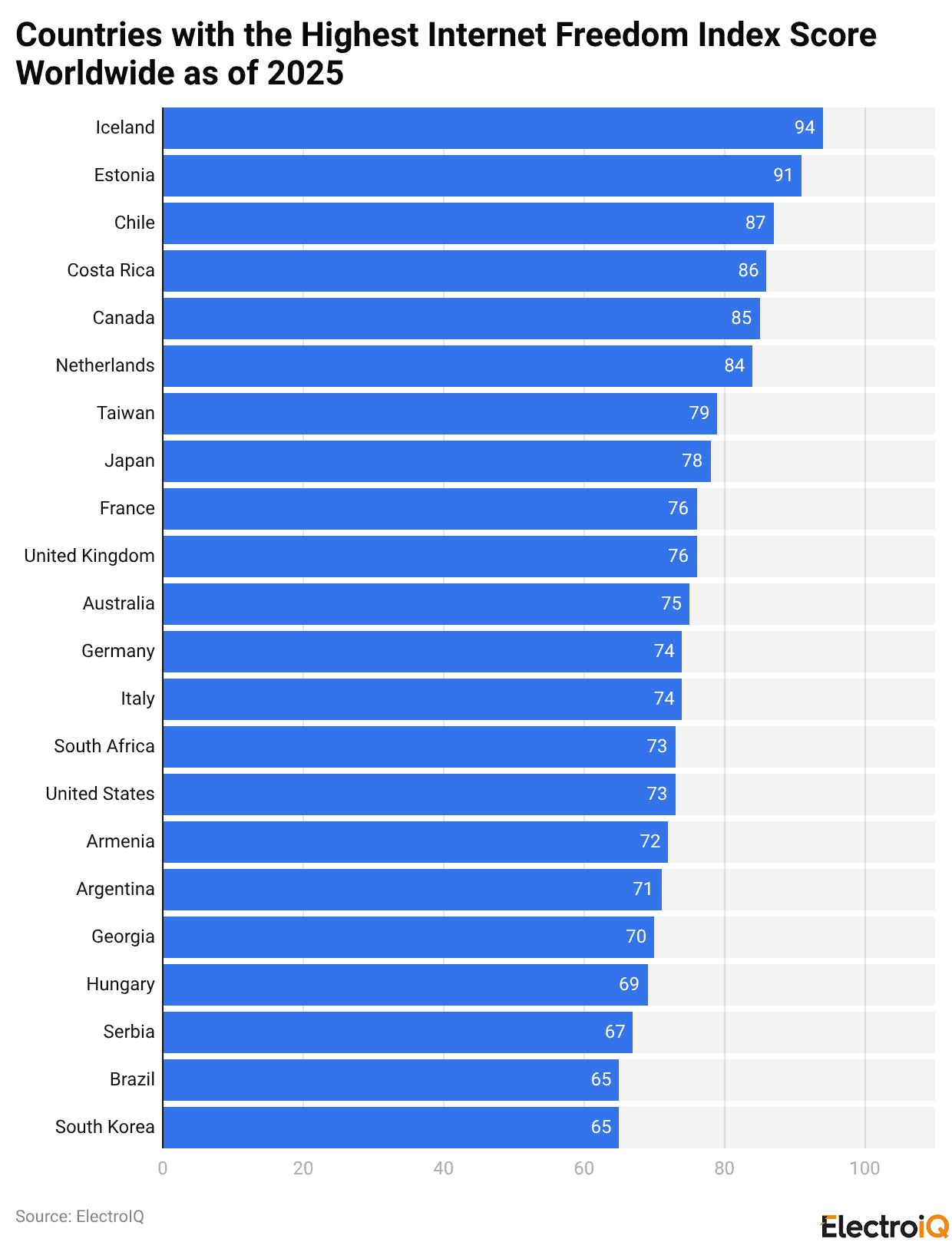
- The 2025 Internet Freedom Rankings show that open online ecosystems and restricted online environments have created a widening digital gap.
- Iceland achieved a perfect score of 94 out of 100 on the Freedom House Index, according to the latest Freedom House report, which established Iceland as the international standard for digital rights and online transparency.
- Estonia achieved a score of 91 points while Chile reached 87 points because both countries established effective regulatory systems that safeguard user privacy and their right to digital communication.
Unconnected Global Population 2025, By Region
(Reference: statista.com)
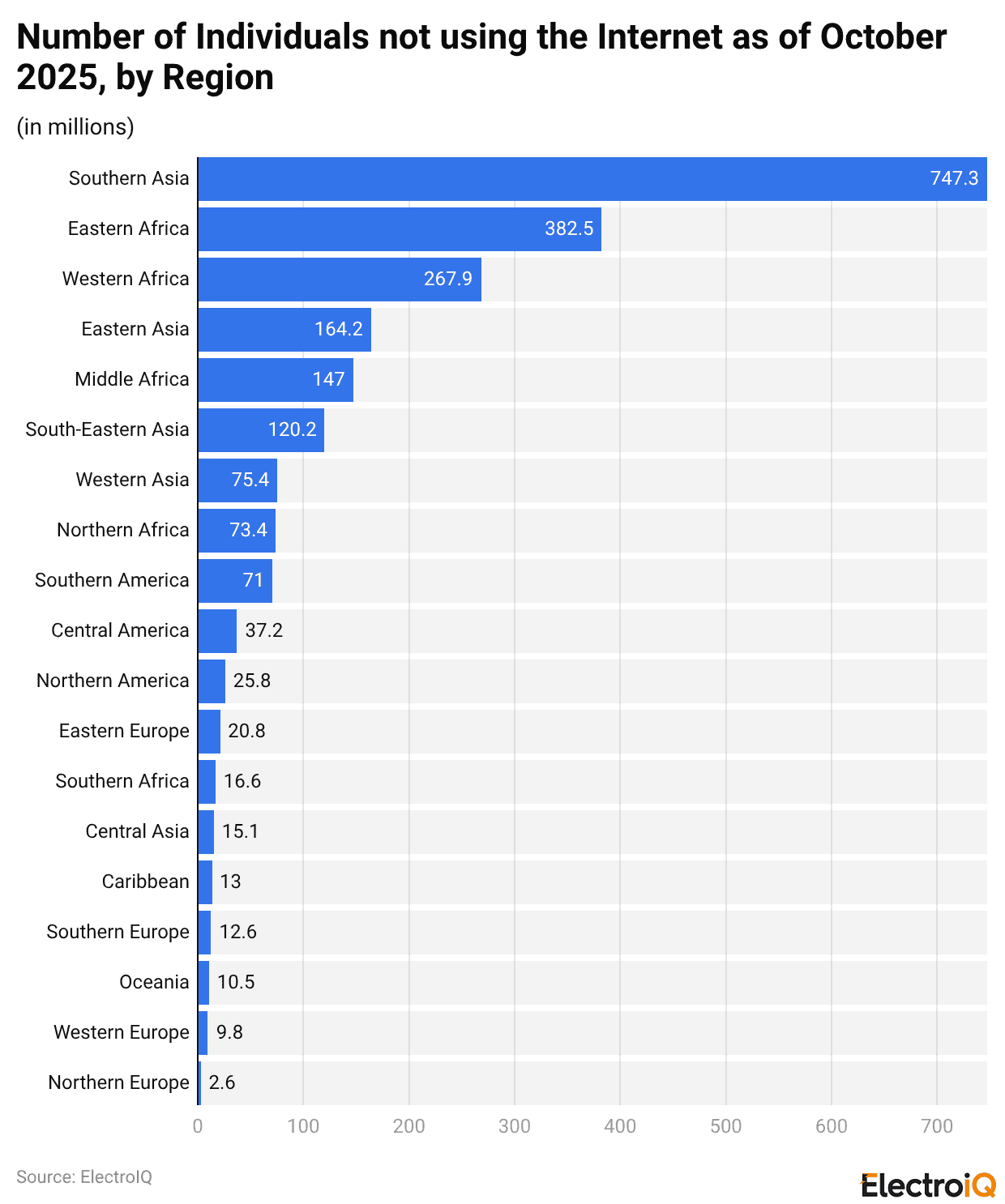
- The 2025 digital inclusion landscape highlights persistent structural disparities in global connectivity.
- Internet penetration data shows that ~958.8 million people in Southern Asia remain offline, representing one of the largest unconnected populations worldwide.
- Eastern Africa follows with almost 400 million people who lack internet access because of insufficient infrastructure and high connection costs.
- The Western African region has about 268 million people who do not use the internet.
- The internet access statistics show a growing digital divide because economic limitations in specific regions, together with insufficient rural internet service and a lack of broadband funding, prevent worldwide internet access from increasing.
Countries With The Most People Lacking Internet Connection
(Source: statista.com)
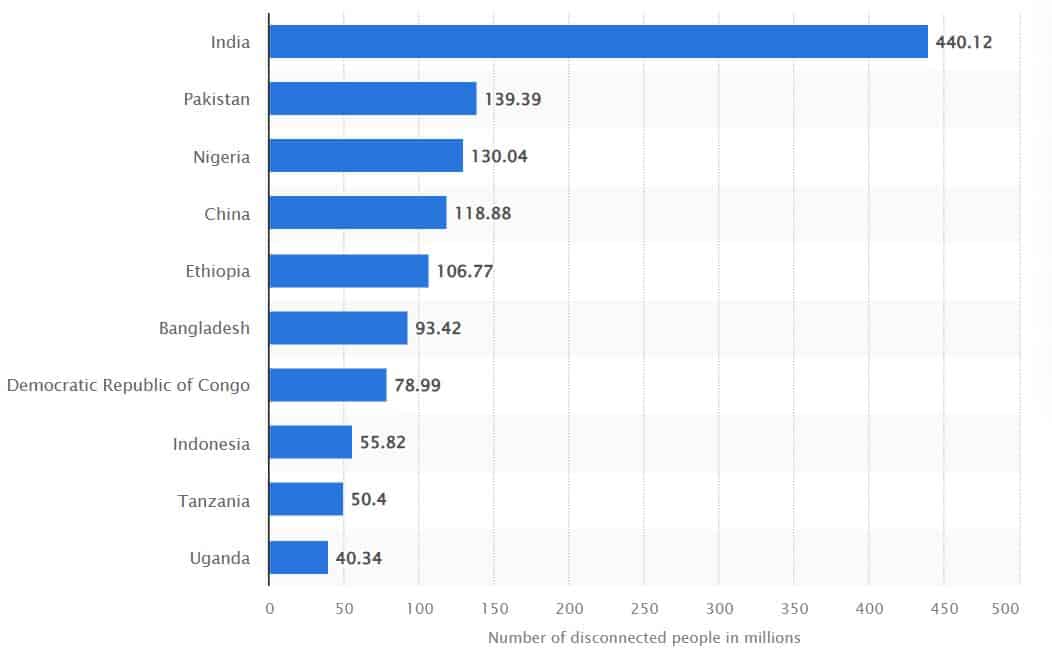
- The 2025 global internet access report shows a major connectivity paradox across the world.
- India has more than 440 million people without internet access, while Pakistan has nearly 139 million citizens who remain unconnected.
- Both countries maintain their status as major internet user markets because they have large populations.
- In 2023, internet access across Africa reached 37%, while in Europe achieved 91%.
- The forecasts show Africa will reach a penetration rate of 48.15 % by 2028, which indicates that digital transformation will proceed through infrastructure development.
Daily Time Spent Online By Internet Users Worldwide
(Source: statista.com)
- 2024 internet usage statistics demonstrate that people now combine digital activities with their daily routines.
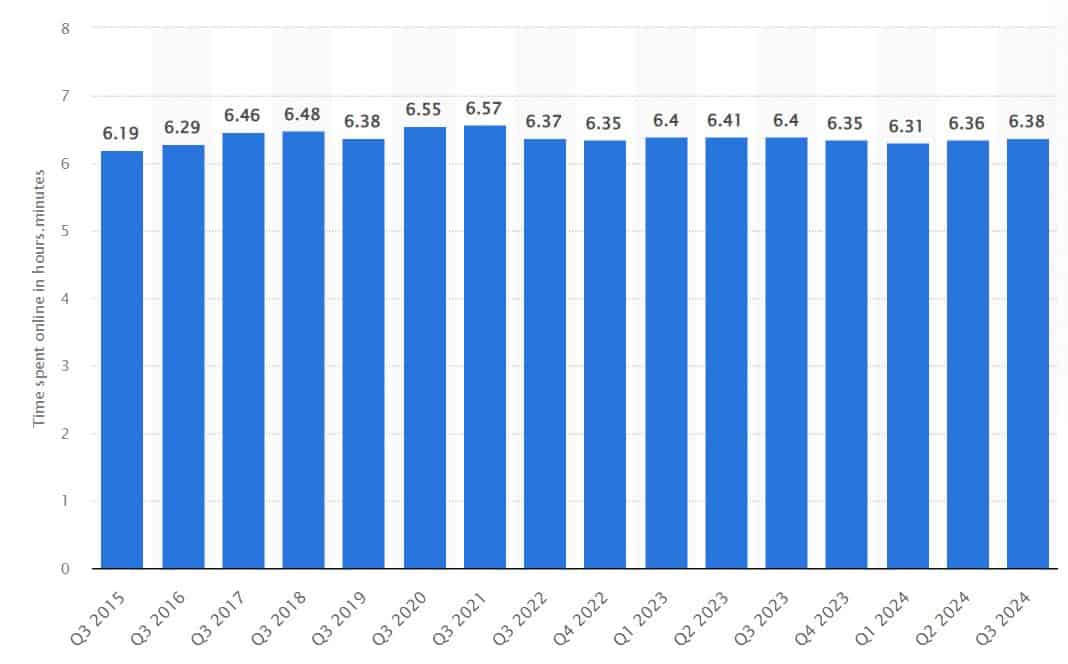
- Global users spent an average of 6 hours and 38 minutes online during Q3 2024, which represents a slight increase from the previous quarter and shows a 19-minute rise from Q3 2015.
- The digital growth indicator shows minor progress because it demonstrates ongoing digital development that has continued for almost ten years.
- The data shows major differences between various countries. South Africa leads with an impressive 9 hours and 27 minutes of daily screen time among users aged 16–64, followed closely by Brazil and the Philippines.
- Japanese people spend only 3 hours and 57 minutes online each day, while Danish people spend about five hours per day.
- The online behavior patterns demonstrate that cultural factors, infrastructure systems and digital ecosystems determine how people use the internet throughout the world.
Mobile Internet Statistics
Countries with the fastest average mobile internet speed
(Reference: statista.com)
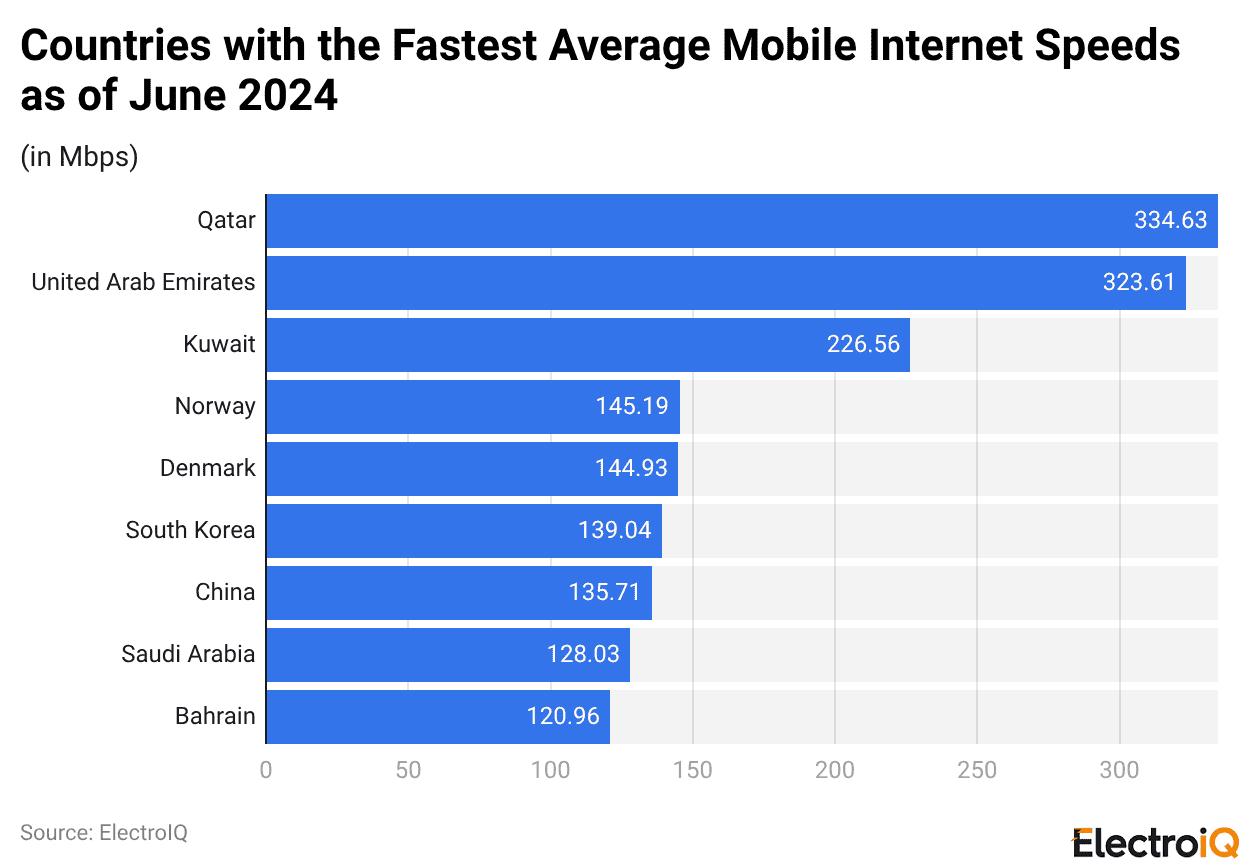
- Mobile internet speed rankings from June 2024 show Gulf nations as the primary leaders in digital infrastructure investment.
- UAE leads the world with its mobile download speed, which reaches an average of 652.87 Mbps, while Qatar follows at 515.23 Mbps.
- Kuwait ranks third with 226.56 Mbps, which establishes a major speed difference when compared to European markets that include Norway at 145.19 Mbps and Denmark at 144.93 Mbps.
- The statistics for mobile internet speeds demonstrate how the rapid expansion of 5G networks and telecom investments has created new global standards for internet connectivity.
Median global mobile and fixed broadband download and upload speed worldwide
(Reference: statista.com)
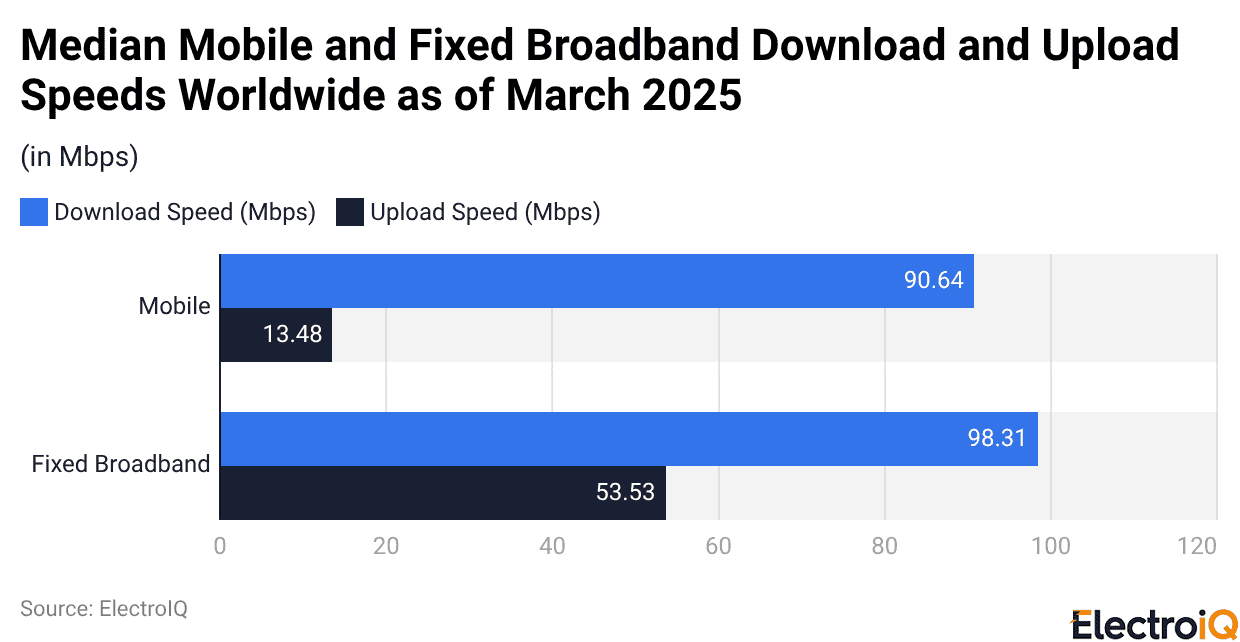
- The 2025 broadband performance tests show that download speeds have become more equal between different networks, yet their upload capacities show ongoing performance differences.
- The March 2025 median mobile download speed reached 90.64 Mbps, which is almost equal to the fixed broadband speed of 98.31 Mbps, according to the results, which indicate that both technologies have similar performance for streaming and browsing activities.
- The speed comparison data between broadband networks demonstrates that fixed broadband services provide substantially better upload speeds than mobile network systems.
- The ability to upload data at high speeds plays a vital role in supporting data-heavy tasks, which include multiplayer gaming, cloud collaboration, and 4K content creation, making fixed network systems essential for powering high-demand digital environments.
Internet Demographics Statistics
(Reference: statista.com)
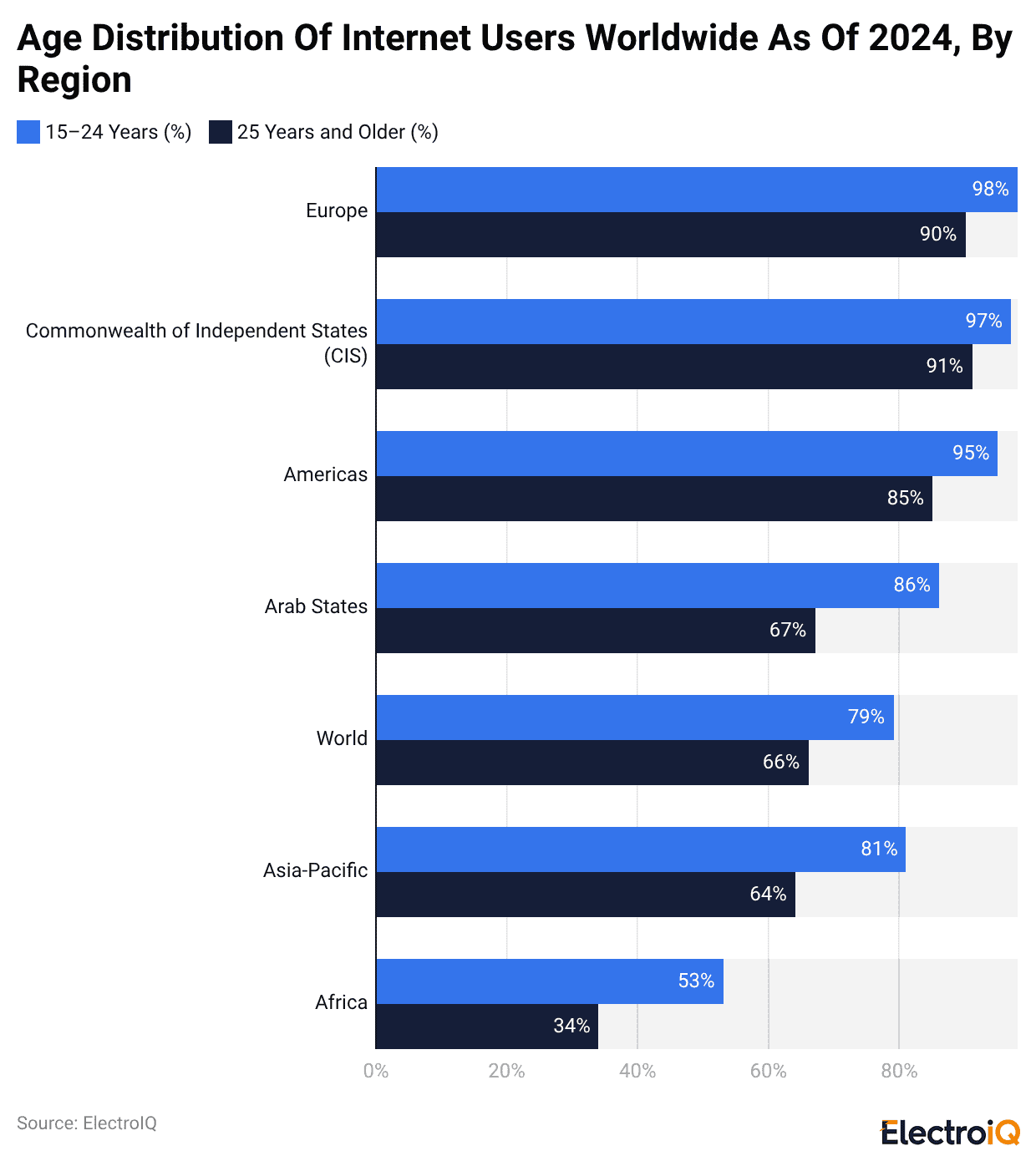
- The 2024 youth internet penetration shows that developed regions have reached almost full digital access through their youth population.
- Europe leads global internet usage, with 98% of people aged 15 to 24 accessing the internet, and the Commonwealth of Independent States follows with 97% usage.
- The Americas rank third with 95% of young users accessing the internet. Africa has 53% internet access, which demonstrates the need to develop both infrastructure systems and make services affordable.
- 79% of people aged 15 to 24 worldwide access the internet shows strong internet usage among young people, but revealing ongoing disparities in internet access between different areas.
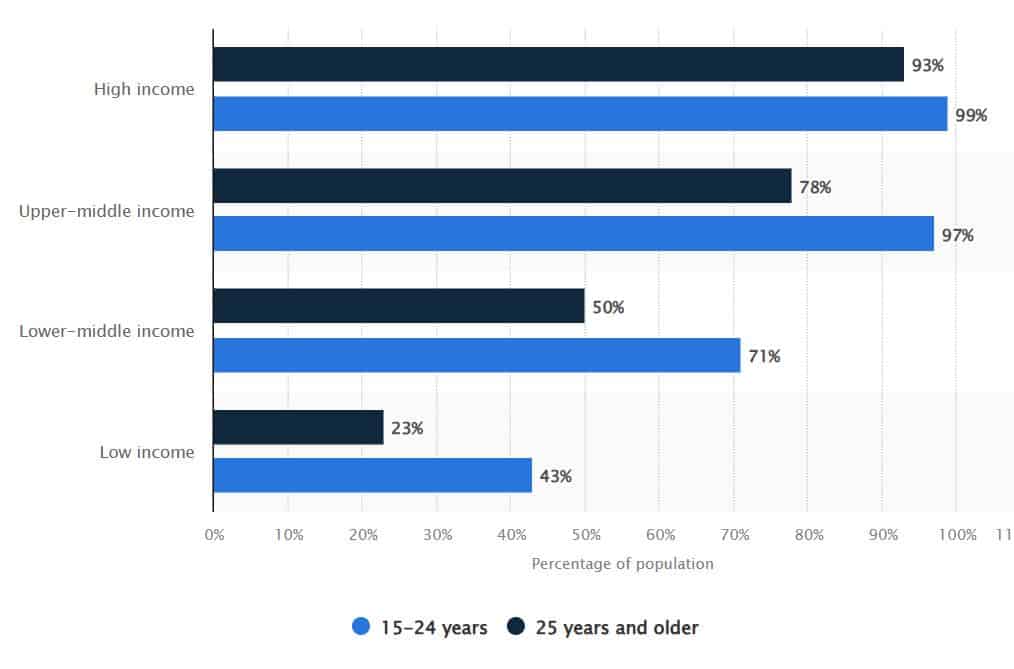
Global age distribution of internet users by country income level
(Source: statista.com)
- The 2024 internet penetration statistics demonstrate that income levels create a significant digital divide between different population groups.
- Young people between 15 and 24 years in high-income economies use the internet at a rate of 99%, while the general population achieves a 93% usage rate, indicating near-total youth internet usage.
- Youth attendance at online services reaches 97% in upper-middle-income markets.
- The contrast between the two groups becomes more pronounced because only 43% of 15 to 24-year-olds in low-income nations use the internet.
- The digital divide statistics demonstrate that economic capabilities determine infrastructure development and service costs and user accessibility, which creates an income-based pattern for youth internet usage across different regions of the world.
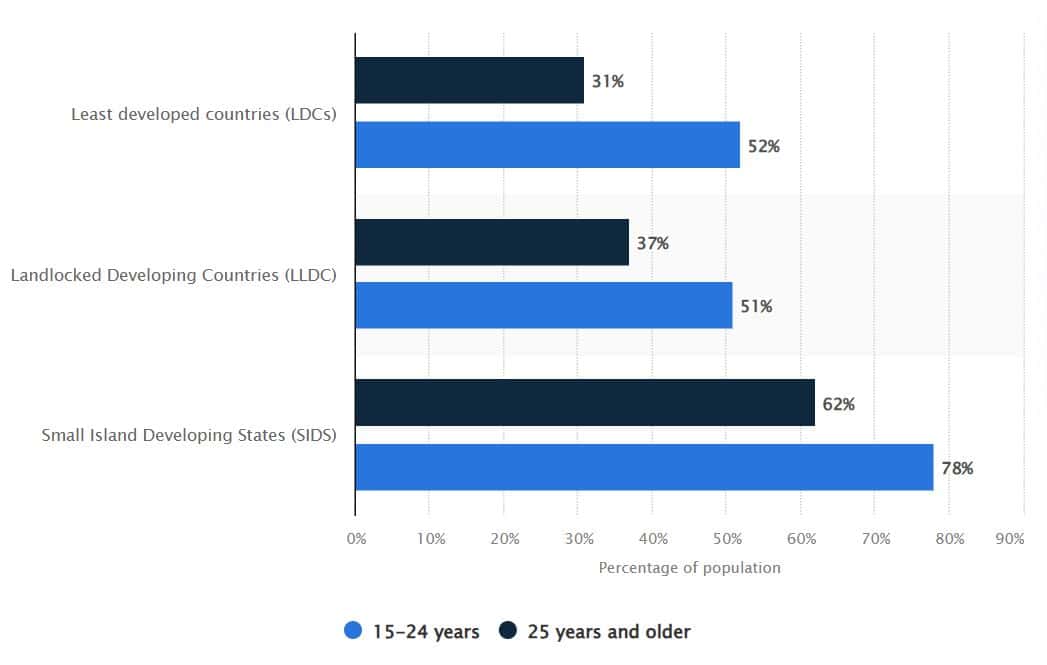
Global age distribution of internet users in the least developed and developing states
(Reference: statista.com)
- The 2024 youth internet usage statistics show that economically vulnerable countries lead among all nations for internet access.
- Small Island Developing States (SIDS) achieved the highest youth internet connectivity rate at 78%, which surpassed all other developing regions.
- The Least Developed Countries (LDCs) achieved a 52% connectivity rate while the Landlocked Developing Countries (LLDCs) experienced a slightly lower rate of 51%.
- The digital divide research shows that geographic isolation affects youth internet access differently, yet infrastructure limitations still hinder internet use in developing regions.
Global Internet Access Challenges
- The various structural dangers to worldwide internet access points have been increasing throughout the year.
- The period from 2015 until the middle of 2023 saw 172 internet shutdowns that occurred in response to protests, which showed how political unrest directly impacts digital networks.
- The 2023 Internet Freedom Report shows that 40 % of internet users worldwide faced limitations to their fundamental online rights.
- The year 2023 saw the implementation of 76 new internet usage restrictions, which had a worldwide impact, while Asia recorded approximately 55 restrictions.
- The internet access difficulties demonstrate how government actions, civil disturbances and digital governance practices together determine worldwide internet accessibility patterns.
- The 2022 decline in digital freedom was heavily influenced by geopolitical tensions, particularly following the invasion of Ukraine by Russia.
- Russian authorities imposed restrictions on major US-based platforms, which included X, Facebook and Instagram.
- The action resulted in 7000 hours of service interruption, which affected 113 million users.
- The 2022 protests in Iran, which occurred after Mahsa Amini died, resulted in 11 different internet shutdowns throughout that year.
- The region of Jammu and Kashmir imposed twice as many restrictions as Iran, which shows that local rules can lead to major digital access interruptions.
The Impact Of AI On Global Internet Traffic
- The current period has begun an AI-driven phase. Sandvine estimates worldwide traffic reached 33 exabytes per day in 2024—about 4.2 GB per subscriber daily—marking a structural shift beyond traditional video streaming.
- Cisco describes AI as a “new traffic type,” warning that agentic AI could double enterprise traffic as persistent assistants replace sporadic chatbot sessions.
- Almost 40% of Americans use AI tools every month, while more than 15 million people depend on generative AI as their main search tool.
- McKinsey & Company estimates that AI data-center power requirements will increase from 30 GW in 2025 to 90 GW by 2030, with a compound annual growth rate of 22%, while inference workloads will experience even more rapid growth.
Conclusion
Internet Statistics: The year 2025 marked a monumental phase in global connectivity. The internet creates economic value through its role in global economic activity, social interactions, and information distribution, and its ability to drive digital development, which supports international electronic commerce that has reached trillions of dollars, and through mobile network systems that shape daily human activities. Yet significant inequalities remain. The situation shows that billions of people remain without internet access, while different regions have different internet accessibility rates, and the need for digital literacy and affordable solutions continues to create obstacles for policymakers and all other involved groups.
At this point, the internet has evolved from its original purpose to exist as the main tool that drives human development and economic growth, while it determines all current methods people use to interact, work, and create new ideas, which exist in the 21st century.
FAQ.
Around 6 billion people, representing 74% of the global population.
Northern Europe, with a 97.7% penetration rate in 2025.
India has more than 440 million people offline.
Global users spend an average of 6 hours and 38 minutes per day online.
AI has pushed global traffic to 33 exabytes per day, and data-center power demand is projected to triple from 30 GW in 2025 to 90 GW by 2030.

I hold an MBA in Finance and Marketing, bringing a unique blend of business acumen and creative communication skills. With experience as a content in crafting statistical and research-backed content across multiple domains, including education, technology, product reviews, and company website analytics, I specialize in producing engaging, informative, and SEO-optimized content tailored to diverse audiences. My work bridges technical accuracy with compelling storytelling, helping brands educate, inform, and connect with their target markets.