Satellite Internet Statistics and Facts, By Types, Market Share, Region, Providers And Trend (2025)

Updated · Dec 06, 2025


Table of Contents
- Introduction
- Editor’s Choice
- General Statistics
- Types of Satellite Internet
- Advantages And Disadvantages Of Satellite Internet
- Satellite Internet Market Size
- Satellite Internet Market Share Statistics By Region
- Satellite Internet Market Breakdown
- United States Satellite Internet Market Statistics
- Cost Of Satellite Internet Statistics
- Usage Across Countries
- Comparison of Top Satellite Internet Providers
- Top Satellite Internet Providers Statistics By Plans And Prices
- Market Drivers For Satellite Internet
- Planned Satellite Launches By Major Internet Providers
- Conclusion
Introduction
Satellite Internet Statistics: Satellite internet delivers fast wireless service by sending broadband signals from satellites. It is useful for people in remote or rural areas and allows access to calls, videos, and online information almost anywhere. Although the technology has existed for years, it is gaining renewed attention due to Starlink’s rapid expansion, OneWeb’s revival, and major companies’ proposals for large satellite constellations. SpaceX’s Starlink, OneWeb, and Viasat are rapidly expanding their satellite networks and transforming the industry.
Growing online needs, heavier digital use, and new government programs are also influencing how people adopt satellite internet. These statistics help explain key areas such as costs, availability, demand, and user behaviour, giving readers a clearer picture of how this fast-growing technology is improving global connectivity.
Editor’s Choice
- The global market size for satellite internet is expected to reach approximately USD 11.93 billion by 2025, with a CAGR of 13.90% from 2025 to 2034.
- As of 2024, the North American region accounted for the largest share of the Satellite Internet market at 34%, followed by Europe at 29%.
- A report published by FactMR estimates that the United States is a strong market for satellite internet, valued at USD 900 million in 2024.
- The U.S. Satellite Internet market is estimated to reach USD 3.24 billion by 2025.
- As of 2024, the average monthly satellite internet cost is USD 121, totalling USD 1,452 per year, with users paying about USD 1.58 per Mbps.
- According to Statista, in 2024, satellite internet use was 7% in Canada and 6% in the United States.
- Starlink leads with 29,988 satellites, followed by the China Satellite Network with 12,992.
- In recent years, only 6.7% of Americans use satellite internet.
General Statistics
- According to Wikipedia, as of 2024, several companies offer satellite home internet in the United States, including ViaSat’s Exede service, EchoStar’s HughesNet, Starlink, and Amazon’s Project Kuiper.
- In the European Union, the IRIS² satellite program is scheduled to begin in the late 2020s.
- China is developing a state-owned satellite internet network led by ChinaSat.
- In India, OneWeb and JioSpaceFiber are the primary providers, while licenses for Starlink and Project Kuiper were still under consideration in 2023.
(Reference: ey.com)
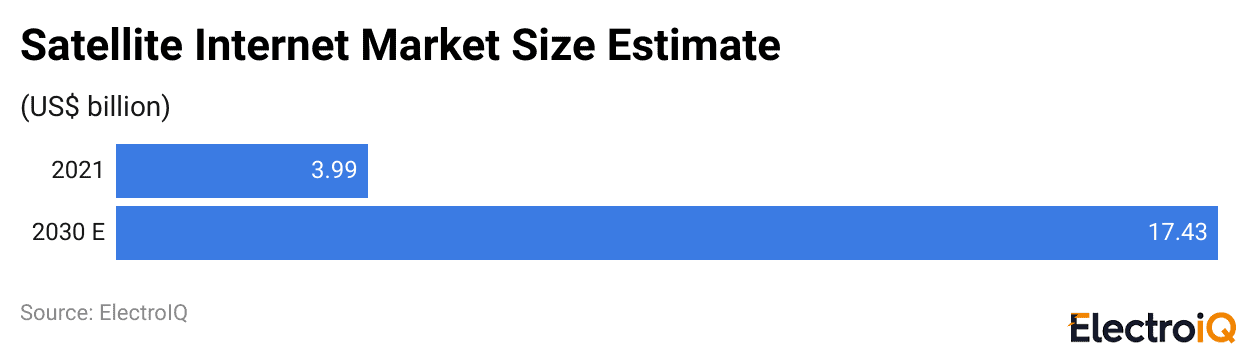
- The above image estimates that the satellite internet market could grow from USD 3.99 billion in 2021 to more than USD 17.43 billion by 2030.
- The UN data shows that about 63% of people worldwide use the internet.
(Source: satelliteinternet.com)
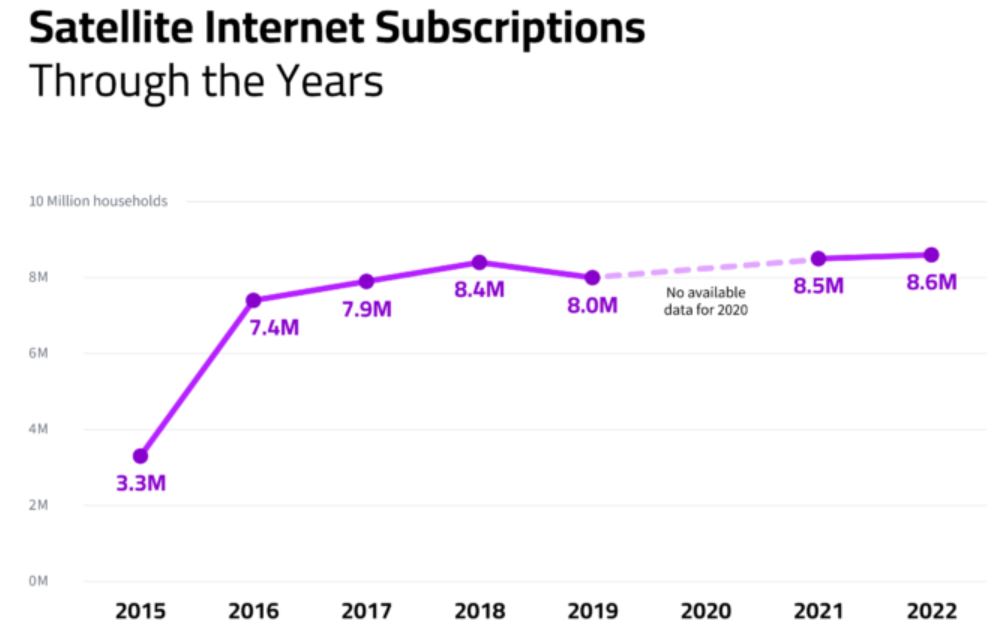
- In 2022, satellite internet subscriptions reached approximately 8.6 million households.
- At the same time, approximately 91.2% of Americans used the internet, even though 95.7% of households had a computer.
- In recent years, only 6.7% of Americans use satellite internet.
Types of Satellite Internet
| Type of Satellite Internet | Orbit Height | Latency (ms) |
Speed Range (Mbps) |
Key Features |
| Geostationary Earth Orbit (GEO) | 35,786 km above Earth | 600 to 700 | 12 to 150 | Wide coverage, stable signal, higher delay due to distance |
| Medium Earth Orbit (MEO) | 2,000 to 20,000 km | 100 to 150 | 50 to 200 | Lower latency than GEO, moderate coverage area |
| Low Earth Orbit (LEO) | 500 to 2,000 km | 20 to 50 | 50 to 250 | Very low latency, faster speeds, requires large satellite constellations |
| Highly Elliptical Orbit (HEO) | 1,000 to 40,000 km | 300 to 600 | 25 to 150 | Strong coverage in high-latitude regions |
Advantages And Disadvantages Of Satellite Internet
| Orbit Type | Advantage | Disadvantage |
| Geostationary Earth Orbit (HEO) | Satellite internet can cover very large areas, so fewer satellites are needed to serve many users. | Satellite signals take time to travel; the delay is too high for real-time applications such as gaming or live calls. |
| Medium Earth Orbit (MEO) | Its latency is lower than that of GEO systems, helping videos and online services run more smoothly. | Setting up a working system often needs many satellites, which makes deployment very expensive. |
| Low Earth Orbit (LEO) | It also provides high-speed internet access in remote or rural areas where deploying other networks is difficult. | Each satellite covers only a small area, so creating full coverage requires thousands of satellites in orbit. |
Satellite Internet Market Size
(Reference: precedenceresearch.com)
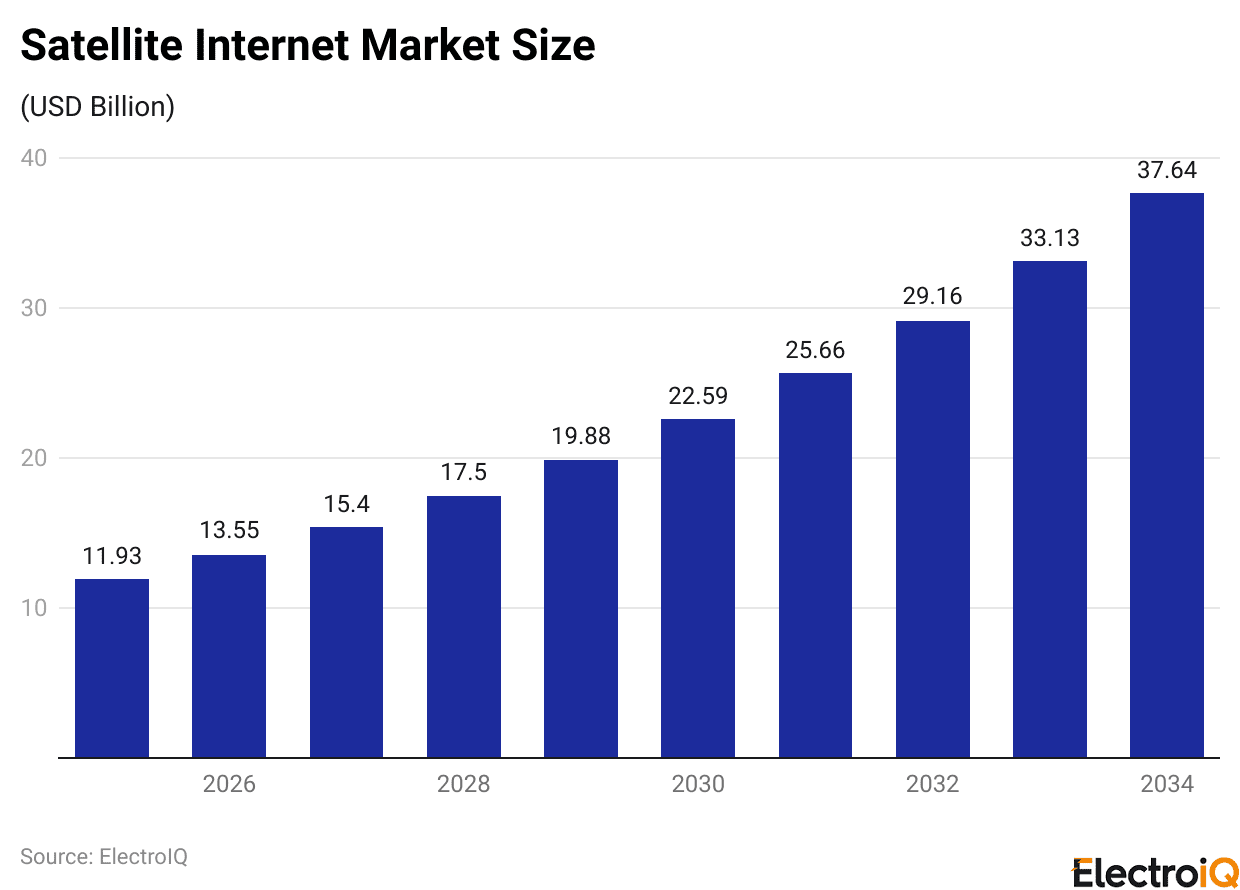
- The global market size for satellite internet is expected to reach approximately USD 11.93 billion by 2025, with a CAGR of 13.90% from 2025 to 2034.
- In the coming years, the market size is followed by USD 13.55 billion (2026), USD 15.40 billion (2027), USD 17.50 billion (2028), USD 19.88 billion (2029), USD 22.59 billion (2030), USD 25.06 billion (2031), USD 29.16 billion (2032), USD 33.13 billion (2033) and USD 37.64 billion (2034).
(Reference: precedenceresearch.com)
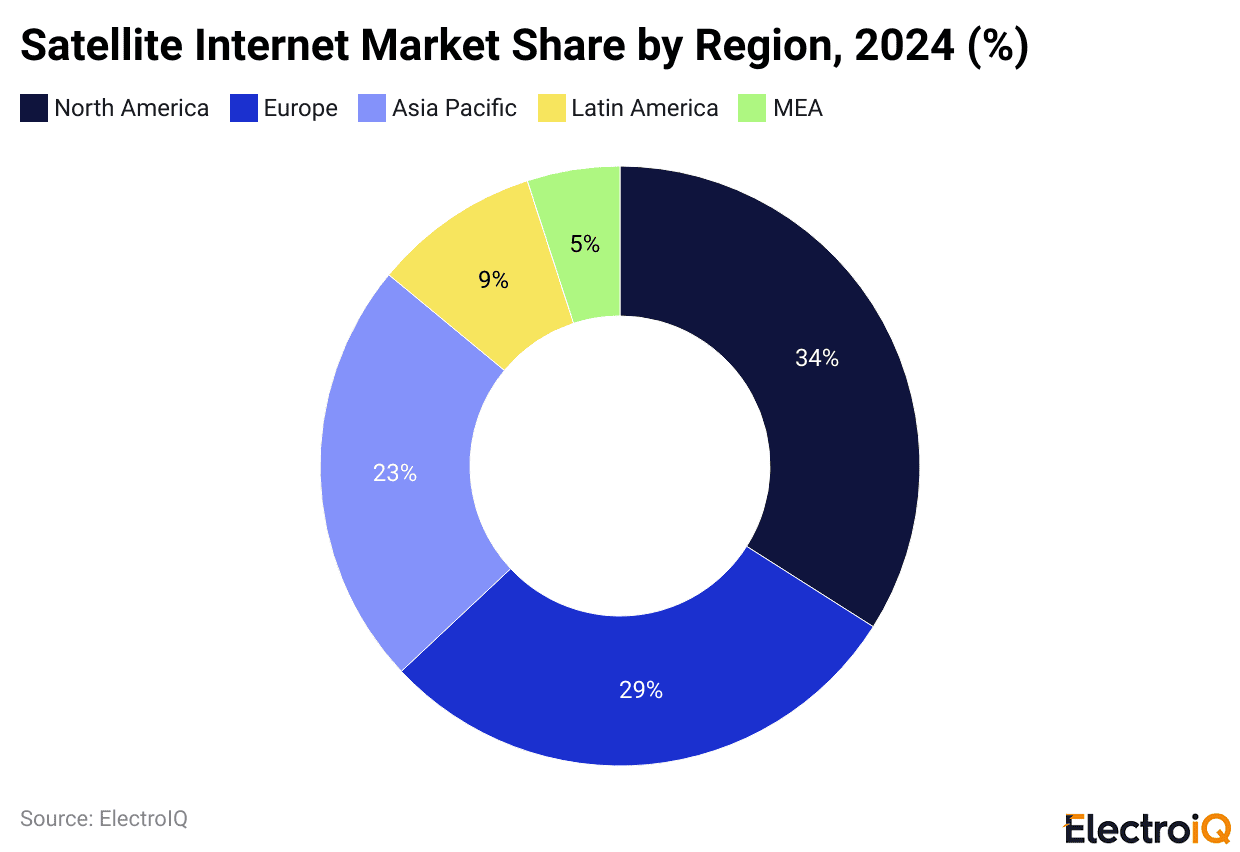
- In 2024, the satellite internet market in the North American region accounted for the largest share at 34%, followed by Europe at 29%.
- Asia Pacific accounted for 23%, and the remaining 5% was split between Latin America and MEA.
Satellite Internet Market Breakdown
- A report published by FactMR estimates that the United States is a strong market for satellite internet, valued at USD 900 million in 2024 and estimated to reach USD 3.3 billion by 2034, with a 14% CAGR from 2025 to 2034.
- In Japan, satellite internet is projected to increase from USD 500 million to USD 2 billion at a 14% CAGR over the same forecast period.
- Military use is also high, expanding from USD 2.3 billion to USD 7.7 billion at a 12.7% CAGR.
- LEO satellites (600-1200 km) are growing rapidly, increasing from USD 5.4 billion to USD 18.4 billion at a 13% CAGR.
- According to Mordor Intelligence in 2024, Ka-Band accounted for 31.80% of revenue and is expected to grow at a 18.6% CAGR from 2025 to 2030.
- Two-way connectivity accounted for 51.60% of the market and is projected to grow at a 17.8% CAGR.
- Commercial and enterprise users accounted for 54.30% of demand, while the residential segment is projected to achieve an 18.4% CAGR, the fastest among categories.
- LEO systems accounted for 42.80% of deployments and are projected to grow at a 18.2% CAGR.
- Backhaul and rural cell-site links accounted for 38.50% of applications, and mobility use cases are projected to grow at an 18.8% CAGR.
- Regionally, North America led with a 34.80% share, while the Asia-Pacific region is expected to post the highest CAGR of 18.8% through 2030.
United States Satellite Internet Market Statistics
(Source: precedenceresearch.com)
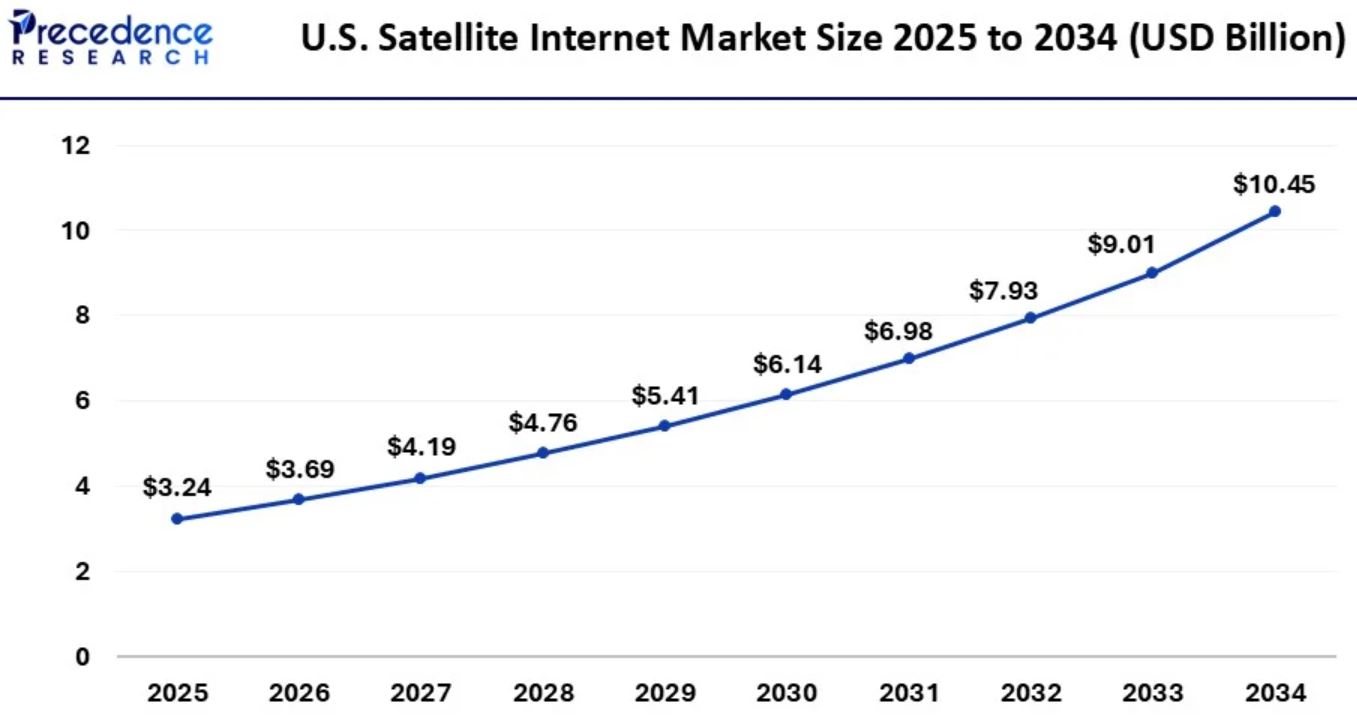
- The U.S. Satellite Internet market is estimated to reach USD 3.24 billion by 2025.
- The market is projected to grow at a CAGR of 13.90% from 2025 to 2034.
- In the coming years, the market size is expected to reach USD 3.69 billion (2026), USD 4.19 billion (2027), USD 4.76 billion (2028), USD 5.41 billion (2029), USD 6.14 billion (2030), USD 6.98 billion (2031), USD 7.93 billion (2032), USD 9.01 billion (2033) and USD 10.45 billion (2034).
Cost Of Satellite Internet Statistics

(Source: satelliteinternet.com)
- In 2024, the average monthly cost of satellite internet was USD 121, followed by USD 1,452 per year.
- Besides, users pay about USD 1.58 per Mbps.
- Census data indicate that 24.7% of individuals earning less than USD 20,000 annually lack internet access.
- Meanwhile, rural Americans have a median income of USD 49,895, making satellite internet unaffordable.
- Although Americans pay an average of USD 81 per month for internet, rural users relying on satellite services typically pay 37% more.
- Provider prices vary: HughesNet averages USD 64.99 per month, Viasat averages USD 109.99, and Starlink averages USD 165.
- Equipment expenses for Starlink hardware cost from USD 200 to USD 250, with a maximum of USD 2,500.
Usage Across Countries
(Source: statista.com)
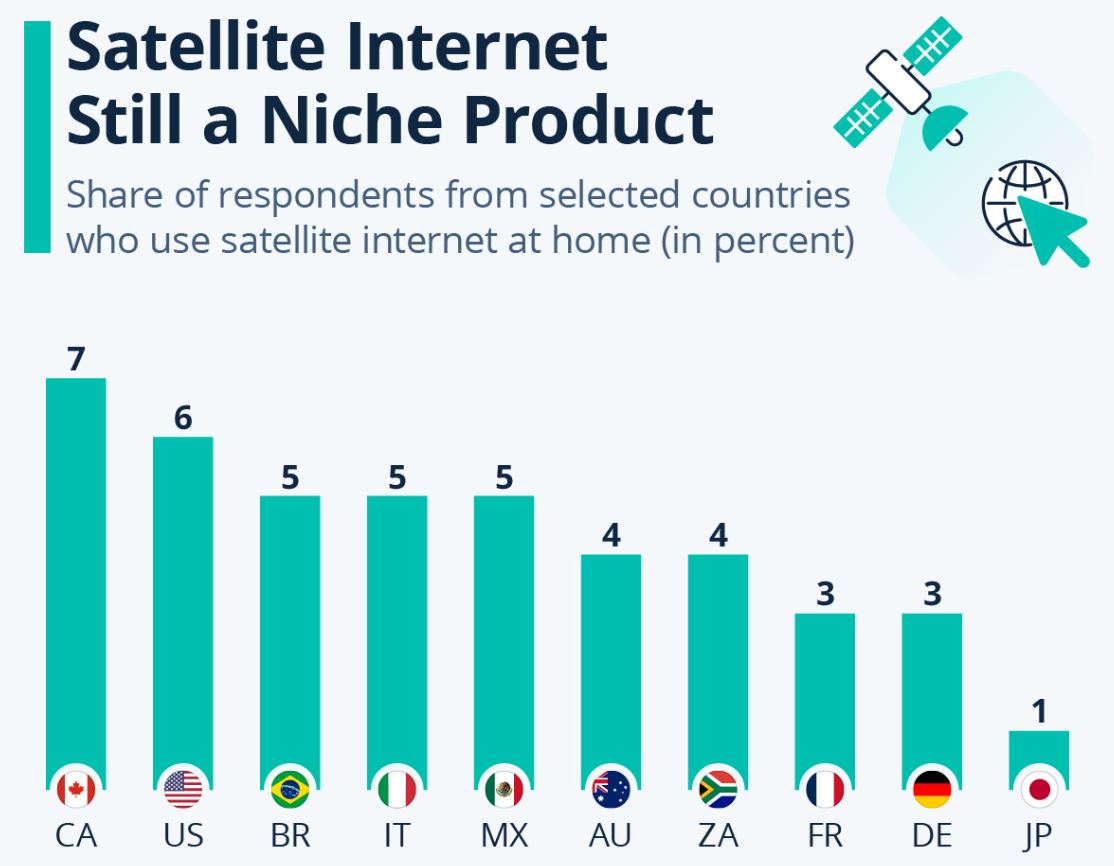
- In 2024, satellite internet use was 7% in Canada, 6% in the United States.
- Separately 5% usage share in Brazil, Italy, and Mexico.
- Usage was slightly lower in Australia and South Africa, at 4% each.
- France and Germany each reached 3%, while Japan reported the lowest share at just 1%.
Comparison of Top Satellite Internet Providers
| Category | Starlink | Viasat | HughesNet |
| Satellite Type | LEO satellites | GEO (Geostationary Orbit) | GEO (Geostationary) |
| Monthly Price | USD 110 (Residential) | USD 85 to USD 400 per month | USD 65 to USD 150 after a six-month discount period |
| Hardware Cost | USD 599 one-time | USD 13 per month or USD 299 one-time | USD 15/month or USD 450 one-time |
| RV Plan Price | USD 135 per month | – | – |
| Data Cap | 1TB per month | 40GB to 300GB, depending on plan | 15GB to 100GB, with optional data tokens |
| Download Speeds | 50 to 250 Mbps (typical 80 to 90 Mbps) | 12 to150 Mbps | 25 Mbps |
| Upload Speeds | 10 Mbps | 3 Mbps | 3 Mbps |
| Latency | 50 ms | High latency is common with GEO satellites | Very high due to the GEO orbit |
| Availability | Still expanding; not available everywhere | Wide U.S. coverage with two plan types (Unlimited & New Choice) | Coverage in almost all U.S. regions, plus 50GB bonus data from 2 a.m. to 8 a.m. |
Top Satellite Internet Providers Statistics By Plans And Prices
Starlink
| Plan | Monthly Price (USD) |
Max Download Speed (Mbps) |
Max Upload Speed (Mbps) | Upfront Equipment Fee (USD) |
Priority Data (GB) |
| Residential Lite | 80 | 25-100 | 5-20 |
349
|
–
|
| Residential | 120 | 40-220 | 8-25 | ||
| Local Priority | 65 |
100-350
|
5-25 | 1999 (Performance) / 349 (Standard) |
50+
|
| Global Priority | 250 | 8-25 | 1999 (Performance) / 999 (Previous Performance) |
Viasat
| Plan | Monthly Price (USD) |
Max Speeds (Mbps) |
Fees & Service Details |
| Viasat Essentials | 70 |
150 (download, 3 (upload)
|
150 GB soft cap, USD 15 equipment monthly or USD 250 upfront |
| Viasat Unleashed | 100-150 | 850 GB soft cap, USD15 equipment monthly or USD 250 upfront |
HughesNet
| Plan | Monthly Price (USD) |
Max Speeds (Mbps) |
Fees & Contract |
| Lite Plan | 40 (50 after 12 months) | 25 (download), 3 (upload) | 10 monthly equipment or 300 upfront, 2-year contract, 100 GB soft cap |
| Select Plan | 50 (75 after 12 months) | 50 (download), 5 (upload) | 15 monthly equipment or 300 upfront, 2-year contract, 100 GB soft cap |
| Elite Plan | 65 (90 after 12 months) |
100 ( download), 5 (upload)
|
15 monthly equipment or 300 upfront, 2-year contract, 200 GB soft cap |
| Fusion Plan | 95 (120 after 12 months) | 20 monthly equipment or 450 upfront, 2-year contract, 200 GB soft cap |
Market Drivers For Satellite Internet
- Satellite providers are primarily motivated to serve rural markets ahead of competitors, driven by limited internet access in these areas and rising smartphone penetration.
- The a high demand for real-time communication between governments and healthcare institutions, particularly during the COVID-19 pandemic.
- Advancements in global communications and cutting-edge satellite technologies, including AI, ML, and cloud computing, also propel growth.
- Additionally, increasing government incentives and subsidies encourages greater use of satellite broadband.
- The future of smart cities and connected vehicles is expected to enhance demand, making these factors the major growth drivers for satellite internet.
Planned Satellite Launches By Major Internet Providers
(Source: tii.imgix.net)
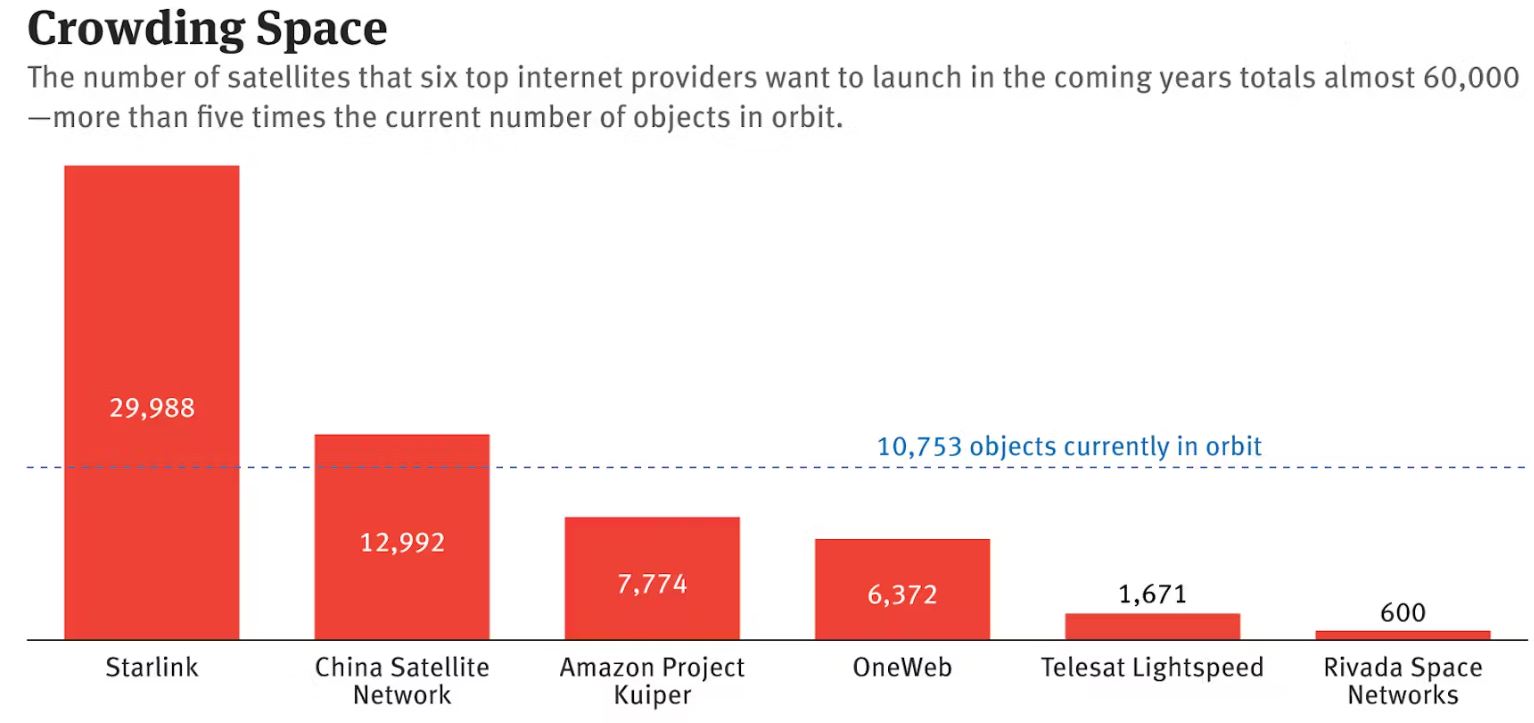
- The above image shows that six major internet providers plan to launch nearly 60,000 satellites in the coming years, far exceeding the 10,753 objects currently in orbit.
- Starlink leads with 29,988 satellites, followed by the China Satellite Network with 12,992.
- Amazon’s Project Kuiper aims to deploy 7,774 satellites, whereas OneWeb plans to deploy 6,372.
- Telesat Lightspeed intends to add 1,671 satellites, and Rivada Space Networks plans a smaller fleet of 600.
Conclusion
Satellite internet statistics highlight how important this service has become for people living in areas where wired internet is limited or unavailable. As more daily tasks, from working to learning and staying in touch, depend on being online, satellite networks are helping reduce the digital gap. Many companies are expanding rapidly, underscoring how quickly the industry is changing.
Many households still struggle with the cost of satellite internet. Still, improvements in speed, broader coverage, supportive government programs, and efforts to help more people choose this option have been observed. As a result, satellite internet is steadily becoming an important source of reliable online access worldwide.
Sources
FAQ.
Satellite internet sends signals between a user’s dish and orbiting satellites, which are connected to ground stations.
Satellite internet is primarily used in rural, remote, and underserved areas that lack traditional wired connections.
Major satellite internet providers include Starlink, HughesNet, Viasat, and OneWeb, which serve users worldwide.
Yes, users require a satellite dish, a modem, and a router to access satellite internet services.
Sometimes, bad weather, heavy rainfal, snowfall, or storms, can weaken satellite signals and degrade service quality.

Tajammul Pangarkar is the co-founder of a PR firm and the Chief Technology Officer at Prudour Research Firm. With a Bachelor of Engineering in Information Technology from Shivaji University, Tajammul brings over ten years of expertise in digital marketing to his roles. He excels at gathering and analyzing data, producing detailed statistics on various trending topics that help shape industry perspectives. Tajammul's deep-seated experience in mobile technology and industry research often shines through in his insightful analyses. He is keen on decoding tech trends, examining mobile applications, and enhancing general tech awareness. His writings frequently appear in numerous industry-specific magazines and forums, where he shares his knowledge and insights. When he's not immersed in technology, Tajammul enjoys playing table tennis. This hobby provides him with a refreshing break and allows him to engage in something he loves outside of his professional life. Whether he's analyzing data or serving a fast ball, Tajammul demonstrates dedication and passion in every endeavor.