Apple Sales Statistics and Facts By Revenue, Product, Region, Emerging Markets, Workforce And Diversity, Trends (2025)

Updated · Dec 17, 2025



Table of Contents
- Introduction
- Editor’s Choice
- Apple Revenue
- Apple Revenue By Product
- Apple Revenue By Region
- Apple’s Financial Performance: Revenue Growth from 2011 to 2025
- Statistics On Apple Product Performance
- Regional Breakdown of Apple Product Sales
- Apple Sales Comparison With Competitors
- Sales Growth In Emerging Markets
- The Environmental And Sustainability Impact On Sales
- Apple Workforce And Diversity Statistics
- Apple Consumer Loyalty Statistics
- Apple R&D Statistics
- Conclusion
Introduction
Apple Sales Statistics: Consider a business that transforms stylish hardware, an app store, and a subscription bundle into a consumer ecosystem that is almost half a trillion dollars a year. This is Apple in 2025: matured, continuously optimized, and surprisingly still growing. An account is taken of Apple’s 2025 sales performance using solid figures, research-supported background, and market trends, so that one can track the company’s momentum and the risks it still faces.
Editor’s Choice
- Apple’s strongest revenue source was the iPhone, which is projected to sell 250 million units a year and capture 60% of the premium smartphone market.
- For the quarter ending September 30, 2025, Apple reported revenue of $102.466 billion, representing a 7.94% year-over-year increase.
- For the twelve months ending on the same date, revenue totaled $416.161 billion, marking a 6.43% increase compared to the prior year.
- Continuing the trend, the Services segment accounted for about 20% of total revenue and had the fastest sales growth compared to the main competitors.
- Marketable devices, led by the Apple Watch with a 40% market share, drove significant sales growth, surpassing 55 million units annually.
- Mac and iPad sales remained strong, with Mac sales up 15% annually and iPad accounting for 30% of the global tablet market.
- The Americas accounted for the highest regional revenue share (46.3%), while Europe and China also provided a significant global sales base for Apple.
- Affordable models and the expansion of retail presence in India, Brazil, Vietnam, and parts of Africa drove double-digit growth in these emerging markets.
- Apple held a very strong position: it was #2 in global smartphones, #1 in US laptops, #1 in tablets, and it continued to lead in wearables and in-store payments.
- Customer loyalty was outstanding: the iPhone retention rate was 92%, engagement with the ecosystem was strong, and annual R&D investment of about US$30B to support future innovations in AI, AR, and health tech was sustaining that loyalty.
Apple Revenue
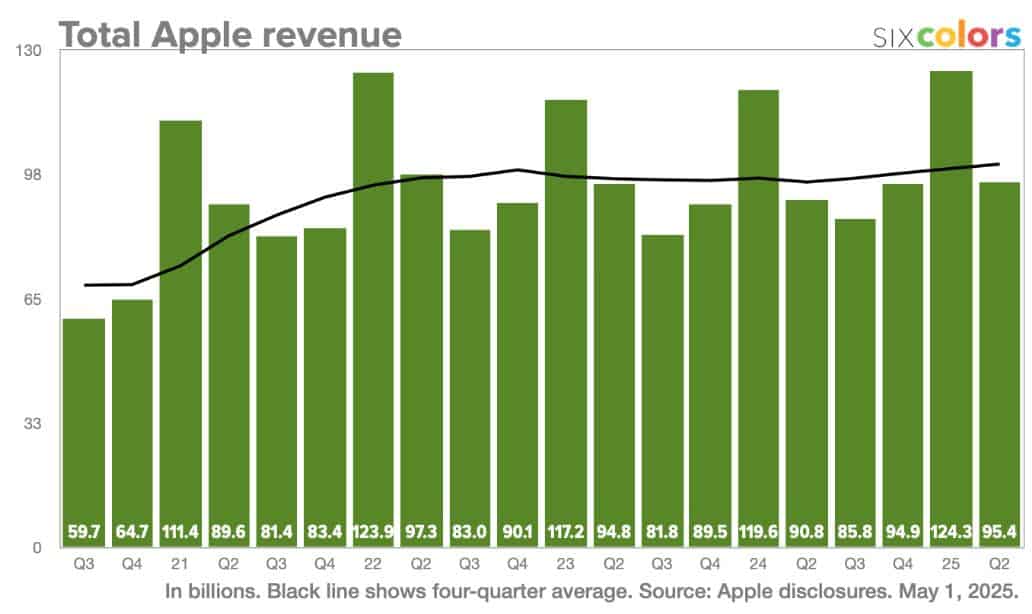
(Source: sixcolors.com)
- The graph shows Apple’s quarterly revenue in billions of dollars for the period.
- Each green bar indicates quarterly revenue, while the black line represents the four-quarter moving average, which helps smooth out seasonal fluctuations.
- Quarterly revenue is shown at the bottom of each bar.
- For instance, the earlier quarters in the timeline present Apple’s revenues of US$59.7B and US$64.7B, which then rise to even higher points of US$111.4 billion and US$123.9 billion, typical for Apple’s practice, where Q1, the holiday season, is significantly higher than other quarters.
- This seasonal trend is evident throughout the chart; the tall bars appear roughly every fourth position, reflecting peak holiday revenues.
- Despite annual revenue fluctuations, the overall level remained high and somewhat stable, typically in the US$80B to US$125B range per quarter.
- The four-quarter average line quietly moves from the left to the center of the chart, revealing improved overall performance, then levels off ever so slightly, indicating more stable revenues in recent years without major swings up or down.
- The last few quarters on the right show revenues like US$88.9B, US$94.9B, US$124.3B, and US$95.4B, again demonstrating the holiday spike and normalization afterwards.
- Overall, the image illustrates that while Apple’s quarterly revenue varies with predictable seasonal cycles, the company maintains a consistently strong revenue base with modest long-term growth reflected in the trend line.
Apple Revenue By Product
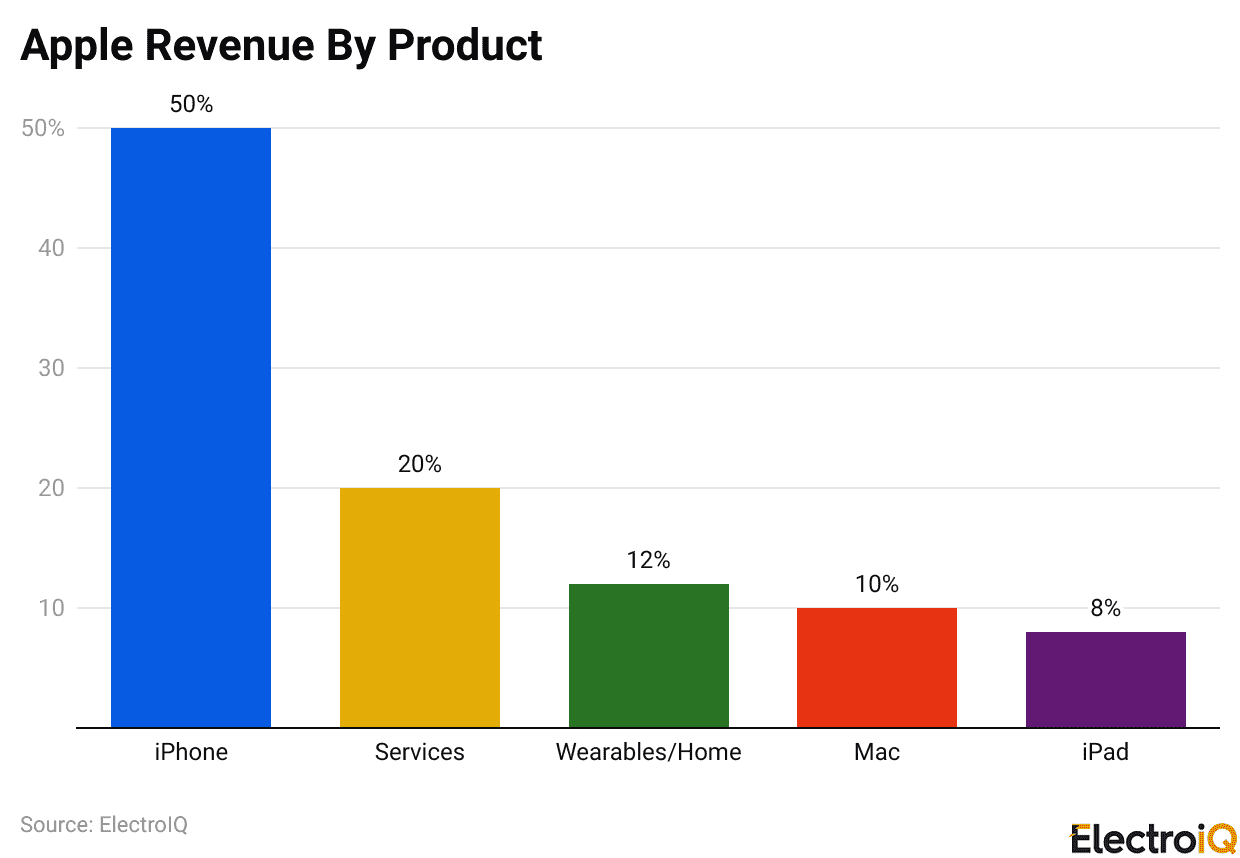
(Reference: maestra.ai)
- Apple’s sales come from several main product categories, with each contributing differently to overall earnings.
- iPhone has been the largest contributor to Apple’s revenue, accounting for roughly half of the company’s total sales, underscoring the phone’s importance to Apple’s business.
- Services such as Apple Music, iCloud, the App Store, and Apple TV+ account for about 20%, indicating the sector is growing rapidly as more subscribers adopt Apple’s digital offerings.
- Wearables and home products such as the Apple Watch, AirPods, and HomePod account for about 12%, underscoring continued demand for personal tech accessories.
- Mac computers’ share is 10%, further strengthened by the availability of Apple’s range of laptops and desktops that are powered by its chips. iPads account for the last 8%, with the device still serving both casual users and professionals.
- Thus, the overall mix indicates that the iPhone remains Apple’s primary revenue driver, while the growing strength of services and accessories is diversifying the company’s revenue.
Apple Revenue By Region
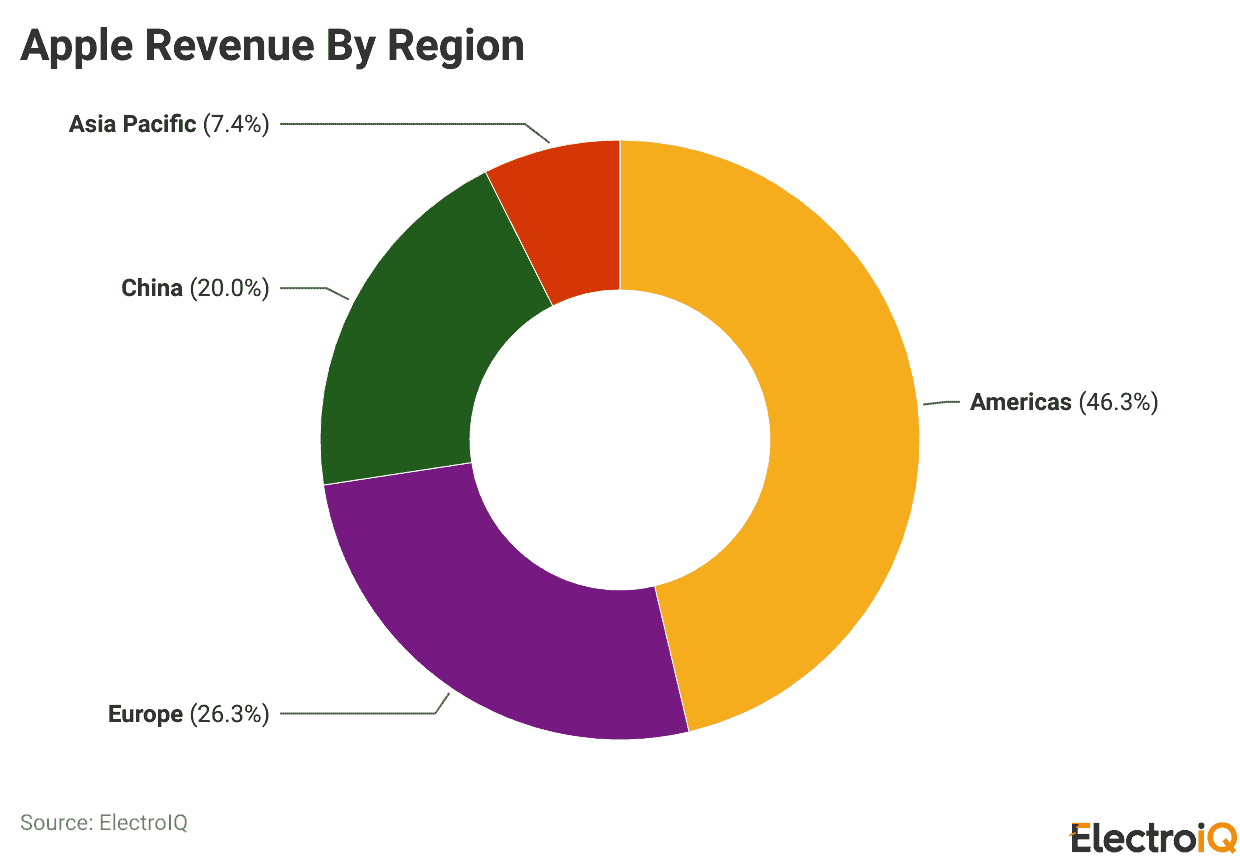
(Reference: sqmagazine.co.uk)
- Apple’s largest market is the Americas, which alone accounts for almost half of the company’s total revenue – 46.3% – indicating the very good performance of Apple products in the U.S., Canada, and Latin America.
- Europe’s contribution is 26.3%, which also reflects strong demand in key markets such as the UK, Germany, and France.
- China remains one of Apple’s priority markets, accounting for 20% of global revenue, driven by consumer demand for high-end devices and the company’s strong brand loyalty.
- The Asia Pacific region’s contribution is 7.4% pointing out the company’s steady progress in already existing fast-growing markets where it continues to take its presence.
- The numbers collectively reflect Apple’s vast global market and the need for strong performance across regions to capitalise on it.
Apple’s Financial Performance: Revenue Growth from 2011 to 2025
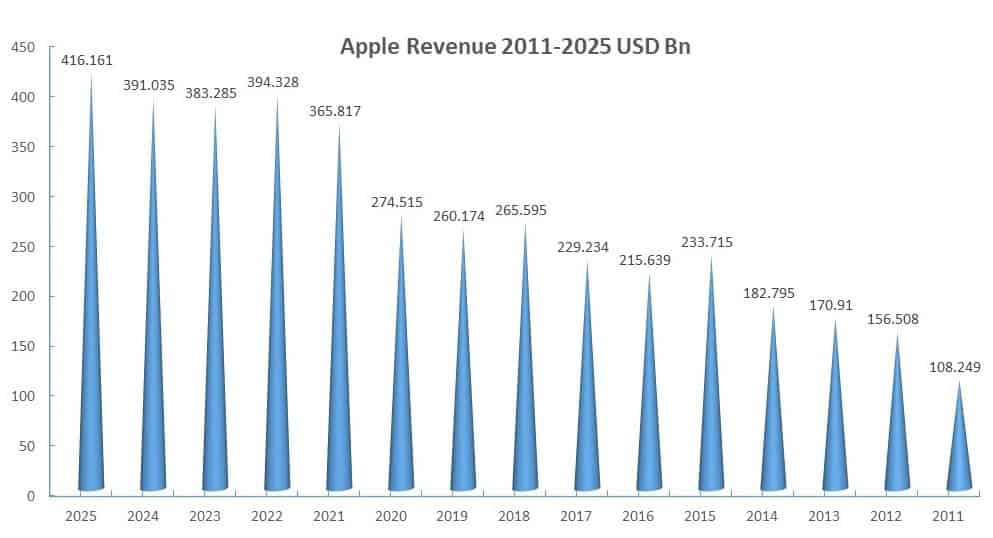
According to MacroTrends, for the quarter ending September 30, 2025, Apple’s revenue was $102.466 billion, up 7.94% year over year.
For the twelve months ending September 30, 2025, Apple reported revenue of $416.161 billion, marking a 6.43% increase compared to the previous year.
Apple’s annual revenue shows long-term growth with periodic fluctuations. Revenue reached $416.161 in 2025 (+6.43% YoY), up from $391.035 in 2024 (+2.02%), $383.285 in 2023 (–2.8%), and $394.328 in 2022.
Earlier, Apple generated $365.817 in 2021, $274.515 in 2020, $260.174 in 2019, and $265.595 in 2018, following steady expansion from $229.234 in 2017 and $215.639 in 2016. Revenue totaled $233.715B in 2015, $182.795B in 2014, $170.910B in 2013, $156.508B in 2012, and $108.249B in 2011, highlighting Apple’s significant scale-up over the past decade.
Statistics On Apple Product Performance
1. iPhone
- In the middle of all Apple’s products, the iPhone actually has its place to be the most important one.
- It is projected that S250 million of them will be sold annually, indicating considerable global demand.
- Furthermore, it holds the largest share in the premium smartphone category (60%), indicating that most high-end smartphone buyers choose the iPhone.
- By the way, the expansion of Apple’s presence in India and Brazil has helped the company to gain a stronger foothold in the premium segment, as the market there is gradually shifting to high-end devices.
2. Apple Watch and Wearables
- The Apple Watch continues to be the market leader in the smartwatch segment worldwide, accounting for about 40% of it.
- The wearables category of Apple is booming, with the sales volume forecasted to exceed US$55 million units per year.
- The advanced health and safety features of the watch, such as ECG monitoring and crash detection, are among the most important factors for its broad acceptance.
3. Mac and iPad
- Mac prices increased 15% year-on-year, driven primarily by demand for Apple’s M-series chips, which are known for their performance and power efficiency—these are the main reasons professionals, students, and creators appreciate them.
- iPad continues to hold 30% of the global tablet market share and remains the most preferred device for users who want one that is equally good for work and play.
Regional Breakdown of Apple Product Sales
- Apple’s product sales followed the same regional pattern as in the previous year. In the U.S., revenue was US$46.3 billion in the 1st quarter of 2025, making it Apple’s largest market.
- It was only a slight increase of 2.9% over the previous year. Greater China had a recovery, bringing in US$24.1 billion in Q1 2025, and bounced back from a slowdown in the last months of 2024.
- India remained Apple’s fastest-growing market, with year-on-year growth of 18.2%, driven by local manufacturing and competitive pricing.
- In addition to the UK, Germany, and France, which are the main markets, Apple had US$29.7 billion in Europe during the first half of 2025.
- Japan’s sales went down slightly by 2.3%, mostly due to the currency situation and inflation.
- The Latin American market performed well, with 11.6% YoY growth, driven primarily by iPhone and wearable device sales.
- In Canada, sales were relatively stable, up 0.8% year over year, but iPad demand declined.
- In the first two quarters of 2025, the Middle East and Africa region experienced 9.5% YoY sales growth, with Dubai and South Africa being the major contributors to this growth.
- Vietnam and the Philippines together recorded a 14% YoY rise, driven by increasing adoption of e-commerce and digital payments.
- Overall, Australia and New Zealand’s performance remained stable, but Mac sales grew by 6.2% thanks to purchases from universities and government institutions.
Apple Sales Comparison With Competitors
- In the smartphone market worldwide, Apple ranked 2nd in Q1 2025 with a 22.8% market share, while Samsung led with 24.1%.
- The US laptop market saw Apple overtake Dell to capture the top sales spot in Q1 2025, setting a record high for MacBook Air M3 sales.
- With a share of 36%, the iPad led the tablet market and eclipsed Samsung at 19% and Huawei at 12%.
- Apple’s services income rose by 9.1%, which was quicker than Google Play’s growth rate within the same time frame.
- Apple’s smartphone ASP remained well above the market average, at US$988 versus US$410 for Xiaomi and Oppo, indicating it still targets a premium segment.
- Apple led the wearables category, with Apple Watch accounting for 31% of the global market, outpacing Garmin and Fitbit.
- Apple TV+ boasted 42 million subscribers in early 2025, even though Netflix and Disney+ are still much larger.
- Apple Pay has become more popular than Google Pay in the US, as 54% of iPhone users use it for in-store payments.
- Samsung’s Galaxy A25 launch intensified competition in Asia, but Apple still saw a 3.5% increase in sales in this region.
- In the global PC market, Apple ranked fourth by unit sales in Q1 2025, behind Lenovo, HP, and Dell; however, it posted the fastest year-over-year growth among the top manufacturers.
Sales Growth In Emerging Markets
- Apple achieved strong sales in the newborn markets in 2025, with India becoming the company’s fastest-growing major market, posting 18.2% year-on-year growth in the first quarter.
- Three new Apple Stores, opened at the beginning of 2025, attracted and converted 12% more customers, thereby strengthening Apple’s retail presence.
- Brazilian sales rose 7.6% YoY, driven primarily by the affordable iPhone SE and older iPhones now available in Tier 2 cities, which attract young buyers.
- Vietnam’s opening of import restrictions and a rising number of authorized resellers created a favourable environment, which led to a 13% increase in iPhone shipments.
- Apple’s partnerships with educational institutions resulted in a 26% increase in iPad sales in Indonesia.
- In Africa, by overcoming the economic and infrastructural challenges, Nigeria and Kenya collectively posted 9.3% growth.
- Through the expansion of retail locations and securing carrier agreements, Apple’s market share in Mexico rose above 17%.
- In Thailand, Apple Watch sales jumped 14% as young consumers became increasingly fond of the product.
- In the case of the emerging markets, the mid-range Apple products, namely iPhone 13 and iPhone SE, comprised 35% of the total unit sales, indicating the significance of the fairly priced devices.
- The localization activities, including upgraded Hindi and Vietnamese language support, played a role in helping Apple to become more engaged in the Asia-Pacific markets.
The Environmental And Sustainability Impact On Sales
- Towards the end of 2025, sustainability remained a key driver of Apple’s unstoppable sales.
- A considerable proportion of the global operations, 78%, powered by renewable energy, is a big step toward the company’s overall climate goal.
- The road to making all Apple products carbon-neutral by 2030 remains on track, with half of the current product range already meeting the requirements.
- The Apple Watch Series X became Apple’s first carbon-neutral product, achieved entirely through the use of recycled aluminium and rare-earth materials.
- In 2024, Apple reported recycling more than 44,000 metric tons of e-waste, in line with the company’s goal of a 9.2% annual increase, and is forecasting even higher recycling volumes in 2025.
- The number of devices incorporating recycled rare earth elements has crossed 310 million, up 17% from the previous year.
- Apple’s trade-in program has also increased by 13%, helping retain customers and benefit the environment.
- Additionally, Apple reduced its environmental footprint by eliminating plastic from the iPhone 15 packaging, with the entire phone line now made of fibre.
- The Supplier Clean Energy Program has eliminated 16.8 million metric tons of CO₂e in 2024, with further reductions expected in 2025.
- The Apple Renew recycling project has expanded to 28 new countries, making responsible electronics disposal and trade-ins easier for consumers around the globe.
- 73% of the U.S. Apple buyers in early 2025 surveys indicated that environmental responsibility is a fundamental factor in the selection of Apple products.
Apple Workforce And Diversity Statistics
- Apple has a worldwide workforce of approximately 164,000 people, demonstrating its large global footprint across its corporate offices, retail outlets, and supply chain hubs.
- Employee morale is very high, and 80% of the employees think that they are involved and appreciated in their jobs.
- The company’s diversity programs are also showing positive results: the proportion of employees from underrepresented groups in the tech industry has reached 47%.
- The proportion of women among top executives has increased by 29% since 2018, indicating a gradual yet consistent shift toward more inclusive leadership.
- Moreover, Apple has significant economic influence worldwide. It creates jobs for over 2 million people globally through its manufacturing partners, app ecosystem, and retail operations.
- Apple’s retail network of over 500 stores has a substantial impact on the economic development of the areas where they are located by creating jobs, increasing sales for nearby businesses, and providing consumers with better access to technologically advanced services.
Apple Consumer Loyalty Statistics
- Apple customer loyalty remains excellent, and its ecosystem is a major factor.
- In fact, over 92% of iPhone users choose to buy another iPhone when upgrading, reflecting the strong bond between consumers and Apple’s product experience.
- The ecosystem is the primary driver of retention: 80% of iPhone users also use at least one other Apple product, such as a Mac, iPad, or Apple Watch.
- Furthermore, 40% of new Apple accounts cite the main reason for choosing Apple products as the seamless integration with other Apple devices.
- Apple Pay is widely accepted, and in developed countries, 75% of iPhone users use it regularly for both in-store and online purchases.
- Customer satisfaction remains very high, and Apple typically achieves 90% or more. This rating is especially typical for its iPhone and Apple Watch product lines.
Apple R&D Statistics
- Apple’s investment in research and development underscores the company’s commitment to delivering future innovations that are remarkable.
- The firm planned to spend US$30 billion on R&D in 2024 and expects to spend at least that amount in 2025.
- AI and machine learning, which underpin Siri, camera processing, and predictive device features, are the primary focus of the research investment.
- The company also plans to deliver breakthroughs in augmented reality through products like the Apple Vision Pro, which industry experts predict could generate US$10 billion in annual revenue by 2026.
- Health tech remains another area of focus, with the company developing advanced Apple Watch sensors, including non-invasive blood glucose monitoring and enhanced ECG capabilities, which will help it further strengthen its position in the consumer health tech market.
Conclusion
Apple Sales Statistics: The sales performance of Apple in 2025 is a reflection of a strong, varied, and forward-thinking company. The iPhone is, of course, the mainstay of revenue, but services, wearables, and Macs are the areas that East and West add stability and future growth. The giant company’s presence is growing not just in developed markets but primarily in emerging ones, where it has opened doors through thoughtful pricing, retail, and advertising. Commitment to working with nature, customer satisfaction, and innovation that consistently outpace the competition are among the factors that positively influence the company’s market position.
Apple remains the leader in several product categories despite intense competition and is the top spender on technologies such as AI, AR, and health, while others are using them primarily for research and development. To sum up, Apple is well-positioned for the next phase of growth, with its strong position, loyal clientele, and a clear view of the future.
Sources
FAQ.
The iPhone kept being the biggest source of income for Apple in 2025, providing about 50% of total sales. The total number of iPhones sold each year was predicted to be 250 million, and Apple was still the leader in the high-end smartphone market with a 60% share.
Services and wearables had the most significant growth. Services made up around 20% of turnover and experienced rapid growth, while wearables—the Apple Watch in particular— surpassed 55 million sales per year and accounted for 40% of the world’s market demand.
The Americas were the biggest contributor with 46.3% of Apple’s total revenue, Europe was next with 26.3% and China was third with 20%. The Asia-Pacific region’s share was 7.4%, which is an indicator of the necessity that is growing necessity in the emerging markets.
With a global smartphone market share of 22.8%, Apple was very close to Samsung. It took the first position in the U.S. laptop sales, the first position in the global tablet market with a 36% share, and the 31% share in the wearables market. Furthermore, Apple surpassed Google in U.S. mobile payment usage.
The company’s sustainability measures—like 78% renewable-energy operations and the first carbon-neutral Apple Watch—were among the main factors influencing consumers’ choice towards Apple. The environmental factor was mentioned by 73% of U.S. Apple buyers in 2025 as the main reason for selecting Apple products, thus increasing brand loyalty and customer trust.

I hold an MBA in Finance and Marketing, bringing a unique blend of business acumen and creative communication skills. With experience as a content in crafting statistical and research-backed content across multiple domains, including education, technology, product reviews, and company website analytics, I specialize in producing engaging, informative, and SEO-optimized content tailored to diverse audiences. My work bridges technical accuracy with compelling storytelling, helping brands educate, inform, and connect with their target markets.