Astrology App Statistics, Insights, and Facts (2026)

Updated · Mar 14, 2026


Table of Contents
- Editor’s Choice: Key Astrology App Stats (2026)
- Market Size And Growth: The App Layer Riding A Larger Wave
- Who Uses Astrology Apps: Demographics, Motivations, and Spike Moments
- What The Apps Actually Offer In 2026: Features That Drive Habit
- Monetisation: How Astrology Apps Turn Insight Into Revenue
- Billionaires By Zodiac: Why This Content Format Works So Well
- Nebula In The Ecosystem: Why Brand Trust Matters In Spiritual Apps
- Conclusion: What The 2026 Numbers Actually Say
Digital astrology has grown up. What used to live in newspaper columns and late-night conversations now sits inside polished mobile products with onboarding flows, push notifications, subscriptions, and retention problems to solve.
The category looks niche until you zoom out: the wider astrology market (across products and services) was estimated at $12.8B in 2021 and projected to reach $22.8B by 2031 in a major market-research forecast.
This article breaks down what’s happening in astrology apps in 2026: who uses them, what the leading products actually ship, how monetisation tends to work, and why the “billionaire zodiac” content format travels so well online.
If you’re building, investing, or writing about this space, you’ll see the same pattern everywhere: people pay for tools that make their lives feel more readable.
Editor’s Choice: Key Astrology App Stats (2026)
- The “astrology economy” is bigger than most people assume. A widely cited market forecast puts the overall astrology market at $12.8B (2021) with a projection of $22.8B by 2031.
- Astrology-related behaviours are mainstream enough to support recurring subscriptions. In a Pew Research Center survey cited by AP, about 3 in 10 U.S. adults said they engage in at least one activity, such as astrology, tarot, or fortune-telling, at least once a year.
- People mostly treat it as light-touch meaning-making. The same reporting notes that many say they do it “just for fun,” while smaller shares say it offers “helpful insights,” and only a very small fraction report heavy reliance for major decisions.
- Most of the business model looks familiar. Apps like Nebula, for example, typically give away chart basics, then charge for depth: longer reports, compatibility overlays, and premium timing alerts. (Where pricing is public, subscriptions often sit in the “streaming-service” range rather than a one-off purchase.)
Market Size And Growth: The App Layer Riding A Larger Wave
| Market by size | USD 22.8 billion |
| Growth Rate | CAGR of 5.7% |
| Forecast period | 2021-2031 |
| Report Pages | 250 |
| By Type | Natal Astrology
Medical Astrology Horary Astrology Electional Astrology Uranian Astrology Love Astrology Vedic Astrology |
| By Mode | Online (Apps and websites)
Offline |
| By User Generation | Gen Z
Millennials Boomers |
Source: alliedmarketresearch.com
- The cleanest way to understand astrology apps is as a “mobile interface” for spiritual curiosity. The market’s growth isn’t only about belief; it’s also about habit. People check these products the way they check the weather, calendars, or steps: quickly, repeatedly, and easily to share.
- Demand doesn’t require literal certainty. Pew data (as reported by AP) suggests a large segment engages occasionally without treating it as a decision engine. That’s an important distinction for app economics: casual users still create ad inventory, social proof, and the top-of-funnel for subscriptions.
- The broader market forecast gives context for why so many apps exist. A category projected to move from $12.8B (2021) to $22.8B (2031) invites competition, copycats, and heavy marketing.
- The app part benefits from distribution changes. Smartphones didn’t just digitise astrology; they changed how it feels. Notifications, daily cards, compatibility tools, and “timing” language turn a symbolic system into a product experience.
Who Uses Astrology Apps: Demographics, Motivations, and Spike Moments
Source: devtechnosys.ae
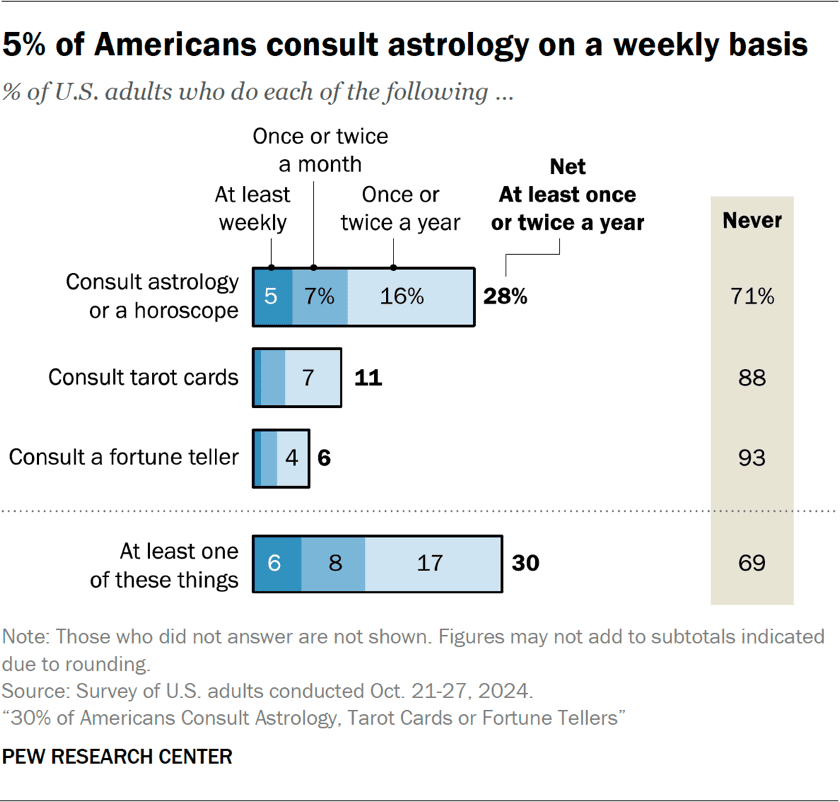
- Engagement is broad; intensity is narrow. Many people check astrology apps occasionally, but a smaller group uses them for “helpful insights,” and only a tiny share treats it as a real decision input. Pew’s 2024 survey found 30% of U.S. adults consult astrology/horoscopes, tarot, or a fortune teller at least once a year, while about 5% do so weekly.
source: Pew Research Center
- The core demographic skews young and female. Age and gender gaps are large: younger adults, especially younger women, are much more likely to believe in astrology and consult it. In Pew’s data, 43% of women 18-49 say they believe in astrology, compared with notably lower shares among men and older adults.
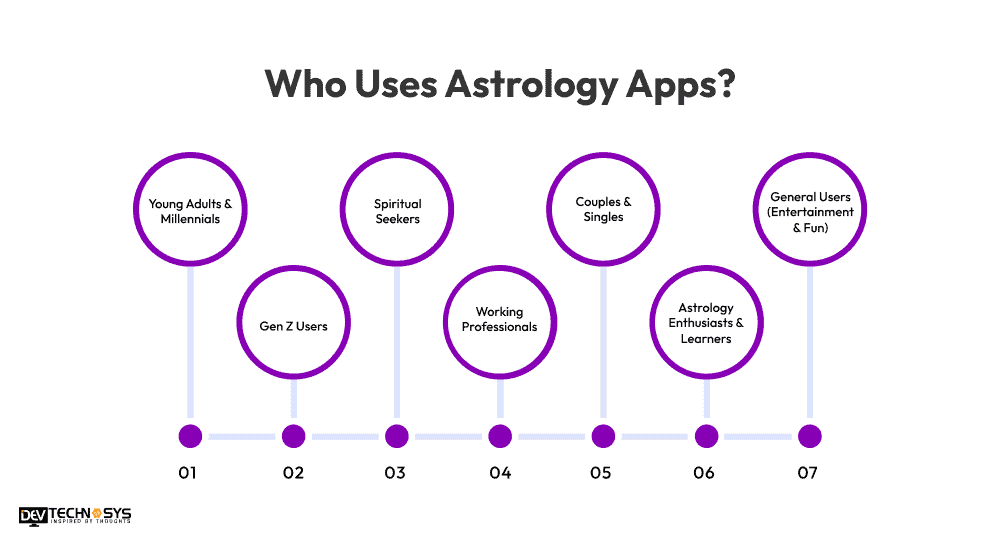
- Motivations differ by cohort:
– Millennials / young adults: daily guidance on love, career, relationships; preference for modern, personalised reads.
– Gen Z: self-expression and social sharing; compatibility checks; interactive, AI-style, gamified tools.
– Spiritual seekers: mix astrology with meditation, chakras, numerology, tarot, or Vedic approaches.
– Working professionals: use it as a “thinking framework” for career moves, money stress, and decision fatigue.
– Couples & singles: relationship/compatibility features; conversation starters and reassurance.
– Astrology learners: people actively studying Western/Vedic/Chinese astrology.
– Casual users: entertainment-first (daily horoscopes, tarot pulls, quick reads).
What The Apps Actually Offer In 2026: Features That Drive Habit
- Onboarding that feels like identity. The “birth data down to the minute” flow works because it creates a sense of precision, even before the user reads a single interpretation.
- Daily content that behaves like a feed. Most leading apps have moved beyond one horoscope line. They ship multiple tiles: mood, timing, relationships, and “watch-outs,” so users can skim and still feel they got something.
- Push notifications that create a reason to return. “Venus enters X,” “new moon in your sign,” “retrograde starts today” – the value is partly informational and partly behavioural. The phone pings, the user opens, the habit strengthens.
- Compatibility as a viral loop. Synastry overlays and “friend charts” turn a private reading into social content. The product becomes something you discuss, not just consume.
- Community layers that create social proof. Once users can compare notes, the framework validates itself socially. If twenty people say Mercury retrograde wrecked their inbox, the thread itself becomes the evidence.
Monetisation: How Astrology Apps Turn Insight Into Revenue
- Freemium is the default. Basic charts and daily content pull people in; premium sits behind a paywall: deeper reports, compatibility breakdowns, longer forecasts, and consult access.
- Subscriptions win because the product stays “alive.” The value proposition doesn’t expire. Transits continue, cycles repeat, and users keep returning for interpretation at the exact times they feel uncertain.
- Premium pricing often mirrors entertainment subscriptions. For example, the Nebula app’s subscription pricing is publicly visible via app store listings (and commonly sits in the “monthly subscription” bracket rather than a single purchase).
- Consults and add-ons create a second revenue stream. Many apps sell one-off readings, written reports, or specialist add-ons on top of monthly plans, which raises average revenue per paying user without forcing a price hike for everyone.
- Churn tends to be lower than you’d expect. Users who subscribe during stressful periods often keep paying out of habit. That behaviour looks closer to “self-care subscriptions” than to a utility app people cancel once they’ve solved a problem.
Billionaires By Zodiac: Why This Content Format Works So Well
Source: Bloomberg Billionaires Index
Astrology apps don’t only sell readings. They also sell stories people enjoy sharing because they’re easy to understand, mildly provocative, and low-risk socially. “Billionaires by zodiac sign” sits perfectly in that lane: it combines a familiar symbolic system with modern, numbers-forward framing.
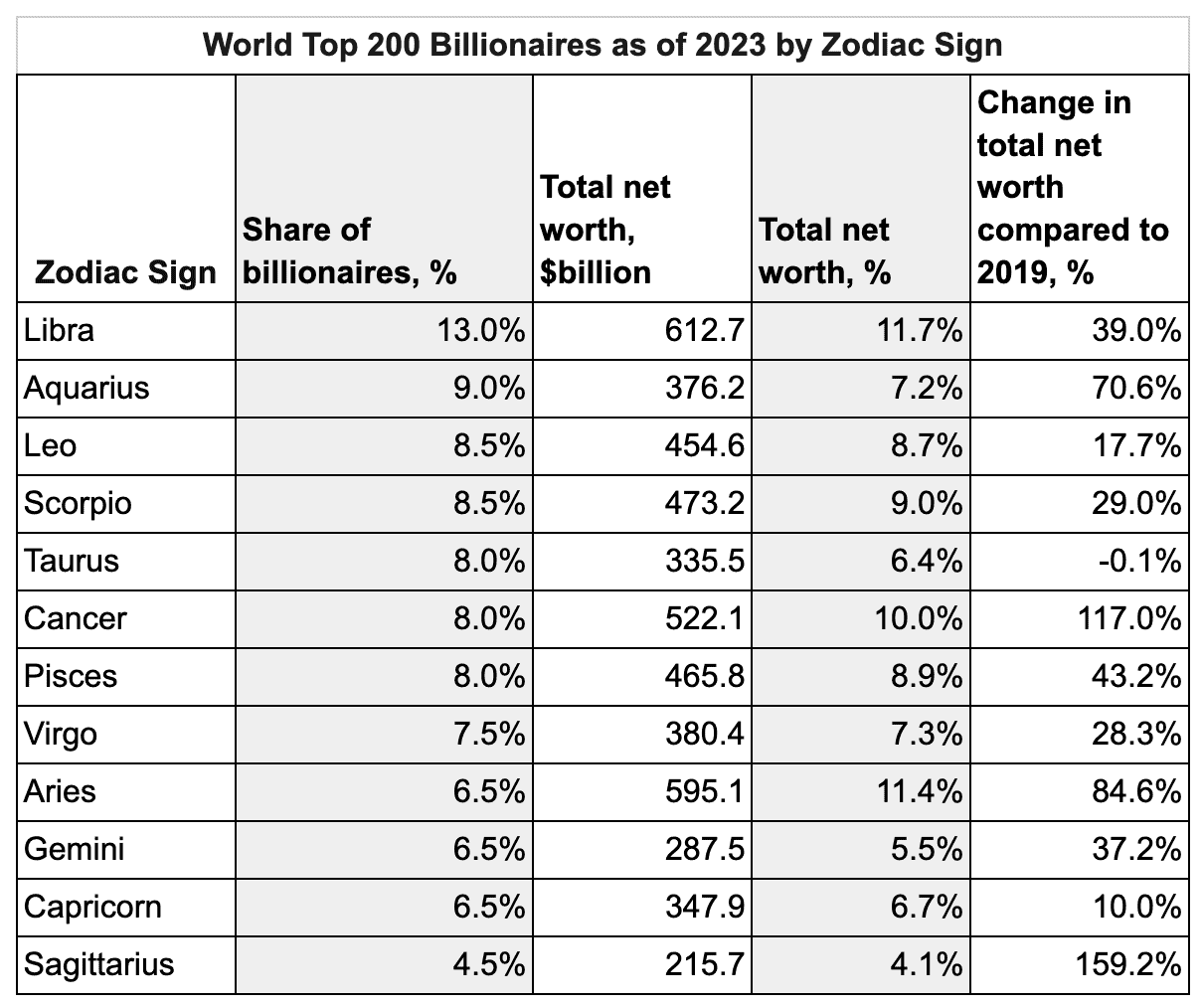
Below is a structured snapshot from the Nebula astrology advisors’ analysis of the Top 200 billionaires in the Bloomberg Billionaires Index (as of 2023), including change vs. 2019 (dataset provided in your spreadsheet and table):
- Most common billionaire zodiac sign: Libra (13%), with $612.7B combined net worth (about 11.7% of the Top 200 total).
- Second most common: Aquarius (9%), with $376.2B combined net worth.
- Third place (tied): Leo (8.5%) and Scorpio (8.5%).
- Fourth place group: Taurus, Cancer, Pisces at 8% each.
- Least common: Sagittarius (4.5%), yet it shows the largest total wealth growth from 2019–2023 (+159.2%).
What makes this format durable:
- Every sign gets a “win.” If your sign isn’t common, you can still share the growth story (Sagittarius). If your sign isn’t high-growth, you can share the concentration story (Libra).
- It feels empirical without being falsifiable. The numbers look concrete; the interpretations stay flexible.
- It’s culturally legible. People can repost it in one screenshot. That matters more than accuracy debates in social media distribution.
Nebula In The Ecosystem: Why Brand Trust Matters In Spiritual Apps
If astrology apps were only entertainment, branding wouldn’t matter as much. In practice, people bring real emotions to these products. That makes trust a competitive advantage: clarity of claims, careful wording, and consistent user experience all affect retention.
- The strongest products avoid overpromising. They frame astrology as guidance, timing, and reflection, instead of deterministic prophecy. That tone keeps users engaged without triggering the “this is nonsense” backlash.
- They also build brand identity outside the app. Sharing-friendly research, explainers, and “cultural astrology” pieces create a distribution moat. The billionaire-zodiac analysis is one example of that content style.
- Nebula’s positioning is built around guidance and advisors. If you want to see how the brand frames its offering, start with the main product hub.
Conclusion: What The 2026 Numbers Actually Say
The most useful conclusion for 2026 isn’t just suitable forthe simplified narrative that astrology is true or fake. The numbers point somewhere else.
- People return to tools that help them narrate their lives. When uncertainty rises, demand rises. Apps that give users language and structure, without demanding strict belief, fit modern habits.
- The business works when the product behaves like a routine. Push timing alerts, daily feeds, compatibility loops, and community discussion all support retention.
- Market growth invites competition, and competition forces polish. If the broader astrology economy is moving toward $22.8B by 2031 (per one major forecast), we should expect better UX, tighter claims, and more product differentiation, not fewer apps.
- The numbers-forward astrology format is a growth lever. The billionaire-zodiac analysis shows why: it’s concrete enough to share, interpretive enough to fit any sign, and culturally familiar enough to spread.

I hold an MBA in Finance and Marketing, bringing a unique blend of business acumen and creative communication skills. With experience as a content in crafting statistical and research-backed content across multiple domains, including education, technology, product reviews, and company website analytics, I specialize in producing engaging, informative, and SEO-optimized content tailored to diverse audiences. My work bridges technical accuracy with compelling storytelling, helping brands educate, inform, and connect with their target markets.