Cybersecurity Job Statistics By Salary, Countries and Facts (2026)

Updated · Feb 23, 2026



Table of Contents
- Introduction
- Editor’s Choice
- General Cybersecurity Job Statistics
- Cybersecurity Workforce Analyses
- Global Cybersecurity Job Statistics By Region
- Salary Structure Of Cybersecurity Jobs
- Indian Cybersecurity Job Market Statistics
- Top U.S. Cities For Cybersecurity Job Statistics By Salaries
- Top 10 Countries For Cybersecurity Jobs Statistics
- Reason For Choosing Cybersecurity Careers Analysis
- Conclusion
Introduction
Cybersecurity Job Statistics: Cybersecurity is no longer only an IT job. Today, it is important for every business. Online attacks are occurring more frequently, and they can cause significant losses. As a result, companies across many fields are hiring more security personnel. They require personnel to protect computer systems, cloud services, applications, and sensitive data. However, there are still insufficiently skilled professionals, so many positions remain open. This skills gap is affecting how companies recruit and train employees.
In this article, you will learn the latest facts and numbers about cybersecurity careers. We will look at job growth, popular roles, pay trends, and the value of certifications. We will also explain how the cloud works, remote jobs, and new rules are changing hiring needs and opportunities.
Editor’s Choice
- According to Destcert.com, there were approximately 457,398 cybersecurity job openings nationwide in 2025.
- A report from the ISC² study finds that the Asia-Pacific region faces the largest shortage, with about 2.14 million workers missing.
- As of 2024, the global cybersecurity workforce stood at approximately 5,457,173, up 0.1% from last year.
- According to onlinedegrees.sandiego.edu, the highest average salary was earned by a cybersecurity architect, at USD 129,000.
- India’s cybersecurity job market could reach 280 billion rupees by 2025, growing about 18.33% each year.
- A report published by careerbdjobs.com states that Washington, D.C., offers strong federal security jobs, high contract demand, and average cybersecurity salaries of more than USD 140,000.
- Get GIS report further stated that cybersecurity is a smart career choice because it offers steady hiring, strong salaries, and many paths for growth.
General Cybersecurity Job Statistics
- According to Destcert.com, there were approximately 457,398 cybersecurity job openings nationwide in 2025.
- Even without actively seeking employment, 46% of cybersecurity workers receive weekly contact from recruiters, according to a report published by onlinedegrees.sandiego.edu.
- Another 18% receive daily outreach from recruiters despite not searching.
- Nevertheless, 79% report feeling happy working in cybersecurity.
- In 2024, job ads increased for 40% of the top 25 cybersecurity roles.
- A report published on imd.org stated that the global cybersecurity job market has 3.5 million unfilled positions.
- Based on BLS estimates, entry-level cybersecurity roles typically pay between USD 70,000 and USD 105,000.
Cybersecurity Workforce Analyses
- A report from the ISC² study finds that the Asia-Pacific region faces the largest shortage, with about 2.14 million workers missing.
- North America follows with a gap of 498,000.
- Staffing within firms is also tight, with 63% of respondents reporting their organisation lacks sufficient IT staff dedicated to cybersecurity.
- As a result, 59% believe their company faces a moderate to extreme risk of cyberattacks.
- Meanwhile, hiring plans appear promising, but only 48% expect to add cybersecurity staff over the next 12 months.
- Lastly, 68% reported being very or somewhat satisfied with their current job role due to excessive pressure.
Global Cybersecurity Job Statistics By Region
(Source: sitecorecloud.io)
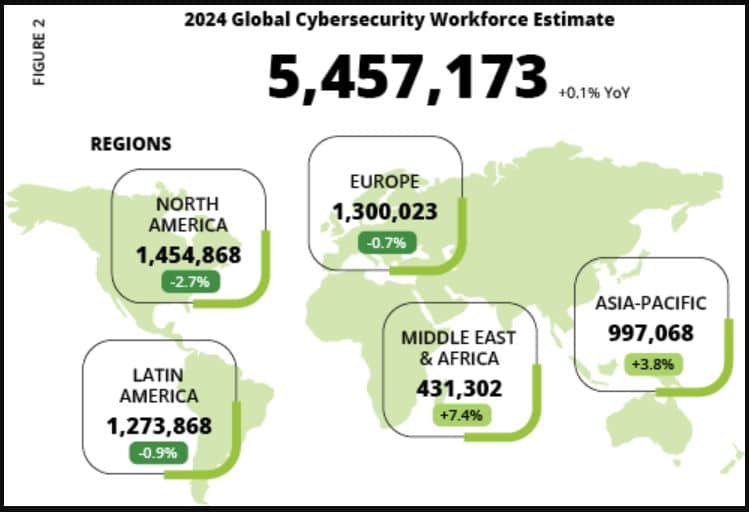
- As of 2024, the global cybersecurity workforce stood at approximately 5,457,173, up 0.1% from last year.
- At the same time, the North American region accounted for 1,454,868 employees, with 2.7% down from last year.
Other regional analyses in 2024 are stated in the table below:
|
Region |
Workforce |
Change Rate (YoY) |
|
Latin America |
1,273,868 | -0.9% |
| Europe | 1,300,023 |
-0.7% |
|
Middle East & Africa |
431,302 | +7.4% |
| Asia-Pacific | 997,068 |
+3.8% |
- North America employed 1,454,868 cybersecurity professionals in 2024, while the workforce declined by 2.7% YoY, suggesting hiring moderation and workforce consolidation across mature markets.
- Latin America recorded a cybersecurity workforce of 1,273,868 professionals, with a 0.9% YoY decline, showing mild contraction linked to budget constraints and delayed enterprise hiring.
- Europe accounted for 1,300,023 cybersecurity professionals in 2024, representing a 0.7% YoY decrease, reflecting cautious hiring amid regulatory and economic pressures.
- The Middle East and Africa employed 431,302 cybersecurity professionals, posting a strong 7.4% YoY increase, driven by national cyber resilience programs and rising digital infrastructure investments.
- The Asia Pacific region reached 997,068 cybersecurity professionals in 2024, with a 3.8% YoY increase, supported by expanding digital economies and increased demand for cloud and data security expertise.
Entry and Junior Cybersecurity Hiring Trends Statistics
| Metrics | Description |
| Preference for IT experience (2025, ISACA) | 90% would hire candidates with only past IT experience. |
| Preference for entry-level certification | 89% would accept candidates with only an entry-level cybersecurity certificate. |
| Internships as a talent source | 55% of managers say internships help find new talent. |
| Apprenticeships as a talent source | 46% say apprenticeships are helpful. |
| Hiring plans (Dec 2024-2025) | 75% planned to hire more in 2025. |
| Current openings | Nearly 90% still had vacancies. |
| Top hiring channels | Job ads 57%; recruiting firms 57%. |
| Attrition concern | 58% worry about losing new staff. |
| Budget for training | 75% report funding for training. |
| Ability to hire enough staff | 73% feel they can hire enough people. |
| Hiring through education programs | 55% use education programs. |
| Talent found outside the cybersecurity fields | 25% find good talent beyond cybersecurity. |
| Cloud tasks handled by entry-level | Only 18% rely on entry-level workers. |
| Cloud tasks need junior-level skills | 46% prefer junior-level skills. |
Salary Structure Of Cybersecurity Jobs
- According to onlinedegrees.sandiego.edu, the highest average salary was earned by a cybersecurity architect, at USD 129,000.
Furthermore, other jobs’ average salary structures are stated in the table below:
| Jobs Name | Average Salary (USD) |
| Cybersecurity manager/administrator | 115,000 |
| Cybersecurity engineer | 108,000 |
| Penetration & vulnerability tester | 102,000 |
| Cybersecurity consultant | 100,000 |
| Cybersecurity analyst | 85,000 |
- A cybersecurity architect earns the highest average salary at USD 129,000, which reflects the strategic nature of the role and its focus on designing secure enterprise systems.
- A cybersecurity manager or administrator receives an average salary of USD 115,000, driven by responsibility for overseeing security operations, policies, and teams.
- A cybersecurity engineer earns around USD 108,000, supported by strong demand for professionals who build and maintain secure networks and infrastructure.
- A penetration and vulnerability tester records an average salary of USD 102,000, as organizations increasingly invest in proactive testing to reduce cyber risk exposure.
- A cybersecurity consultant earns close to USD 100,000, reflecting demand for expert advisory services across compliance, risk assessment, and security strategy.
- A cybersecurity analyst earns an average salary of USD 85,000, which aligns with the role’s focus on monitoring threats, analyzing incidents, and supporting security operations.
In the United States, 2025
| Level | Role | Average Salary (USD) |
|
Entry-level
|
Cybersecurity Analyst | 78,000-114,000 |
| Junior Penetration Tester | 70,000-96,000 | |
| IT Security Specialist | 75,000-92,000 | |
|
Mid-level
(3-7 years) |
Network Security Engineer | 94,000-135,000 |
| Cybersecurity Consultant | 99,500-159,000 | |
| Incident Response Analyst | 90,000-130,000 | |
|
Senior/Executive
(8+ years) |
Chief Information Security Officer (CISO) | 200,000-585,000 |
| Security Architect | 150,000-225,000 | |
| Cybersecurity Engineer | 162,000 |
- In the United States in 2025, an entry level Cybersecurity Analyst typically earns between USD 78,000 and USD 114,000, reflecting strong demand for professionals who monitor threats and protect systems.
- A Junior Penetration Tester at the early career stage usually receives an annual salary ranging from USD 70,000 to USD 96,000, as organizations invest in testing and improving system security.
- An IT Security Specialist with limited experience earns around USD 75,000 to USD 92,000, driven by the need to manage access controls and security tools.
- A Network Security Engineer with approximately 3 to 7 years of experience earns between USD 94,000 and USD 135,000, as enterprises focus on securing complex network environments.
- A Cybersecurity Consultant at the mid career level typically earns from USD 99,500 to USD 159,000, supported by rising demand for advisory and risk management services.
- An Incident Response Analyst with several years of experience earns about USD 90,000 to USD 130,000, reflecting the growing importance of rapid breach detection and recovery.
- A Chief Information Security Officer with over 8 years of experience earns between USD 200,000 and USD 585,000, as companies prioritize executive leadership in cybersecurity strategy.
- A Security Architect at the senior level earns roughly USD 150,000 to USD 225,000, driven by responsibility for designing secure enterprise systems.
- A senior Cybersecurity Engineer earns an average salary of around USD 162,000, reflecting advanced technical expertise and responsibility for securing critical infrastructure.
Indian Cybersecurity Job Market Statistics
- According to Nucamp.Co, India’s cybersecurity market could reach 280 billion rupees by 2025, growing about 18.33% each year.
- Approximately 93% of Indian companies are increasing their cybersecurity budgets, and 17% plan to increase them by 15% or more.
- The market is expected to rise from nearly 140 billion rupees now to almost double by 2025.
- Bengaluru leads hiring, making up about 10% of cybersecurity job listings.
- Hiring demand has grown by over 200% in data analytics and cybersecurity roles.
- Entry-level salaries are strong, with penetration testers starting at around ₹11.8 LPA and analysts at around ₹6.9 LPA.
- Cyber threats affect healthcare at 21.82% and hospitality at 19.57%, which keeps cybersecurity demand high.
Top U.S. Cities For Cybersecurity Job Statistics By Salaries
- A report published by careerbdjobs.com states that Washington, D.C., offers strong federal security jobs, high contract demand, and average cybersecurity salaries of more than USD 140,000.
Furthermore, other top cities’ salary scales are stated in the table below:
| City | Average salary (USD) |
| New York, NY | 147,500 |
| San Francisco / San Jose, CA | 135,000 to 143,500 |
| Baltimore, MD | 130,000+ |
| Atlanta, GA | 120,000 |
- Washington, D.C. stands out as a leading U.S. city for cybersecurity jobs, supported by strong federal security programs and high government contract demand, with average salaries exceeding USD 140,000 according to careerbdjobs.com.
- New York, NY offers the highest average cybersecurity pay among major cities, where professionals earn around USD 147,500, driven by demand from financial services, media, and large enterprises.
- San Francisco and San Jose, CA together form a major cybersecurity employment hub, with average salaries ranging between USD 135,000 and USD 143,500, supported by technology firms and cloud service providers.
- Baltimore, MD provides stable cybersecurity career opportunities linked to defense and public sector organizations, with average salaries above USD 130,000.
- Atlanta, GA remains an emerging cybersecurity job market, where growing corporate adoption of security solutions supports average salaries of around USD 120,000.
Top 10 Countries For Cybersecurity Jobs Statistics
| Country | Job market/market size | Top employers | Average salary | Work hours | Visa requirements |
| United States | 3.5 million openings | CrowdStrike, Fortinet, Palo Alto Networks. | USD 122,000 annually | 350 hours in a year | An H-1B visa is required for individuals in a specified professional/academic field. |
| Canada | 100,000 new roles | Deloitte, Accenture, Atlantis IT Group. | USD 88,788 CAD per year | 40-hour workweek | Job offer supported by LMIA, proof of funds, a clean medical record, and documents. |
| Australia | USD 5.8 billion | Eleks, Internut, Genentech Solutions. | AUD 120,000 (approx. $84,533 USD) | Less than 38 hours/week | Score 65 Points for the General Skilled Migrant Program. |
| Germany | 106,000 unfilled positions by 2026. | ABB, Kostal Gruppe, Landwirtschaftliche Rentenbank. | €63,000 annually | 36-40 hours | Completed application form, cover letter, and health insurance |
| United Kingdom | £13.2 billion revenue in 2025 | Ernst & Young, BAE Systems, Sophos. | USD 72,961 | 8 hours/day or 40 hours/week | Skilled Worker visa needs a certificate of sponsorship (CoS) |
| Singapore | USD 4.82 billion by 2029 | Marina Bay Sands, ST Engineering, and Deloitte. | SGD 70,000 (Approximately USD 52,000) | 5 days or less/week | Original passport; must be 18+; for Indians, the maximum age limit is 50 years |
| Austria | 1,300 job openings | Avanade Österreich, PwC Österreich, ÖBB-Konzern. | USD 64,809 | 35.5-hour work week | Birth certificate, proof of accommodation, and proof of funds. |
| Switzerland | 83% growth rate | UBS, KPMG, Kudelski Security. | CHF 100,000 to CHF 190,000 | 45-50 hours/week | National Visa D form, university degree, and work experience. |
| Netherlands | 4500 job openings | Breachlock Inc., Websafety Ninja, Websec. | USD 102,413 | 36-40 hours/week | Master’s degree (or equivalent) with 5 years of experience. |
| Sweden | 60% growth | H&M, Telia Company, and Here Technologies. | USD 80,000 | 40 hours/week | Valid passport; must have an employment contract. |
Top Causes of Skills Gaps vs. Staff Shortages of Cybersecurity Job Statistics
| Skills-gap cause | Share | Staff-shortage cause | Share |
| Not enough budget to hire | 33% | Not enough budget | 39% |
| Can’t find people with the needed skills | 30% | Can’t find enough qualified talent | 35% |
| Hard to keep in-demand talent | 27% | Pay isn’t competitive | 28% |
| Gaps in emerging tech areas | 27% | High turnover/attrition | 23% |
| New tech, but not enough security expertise | 26% | Limited growth/promotion options | 22% |
Reason For Choosing Cybersecurity Careers Analysis
- A report by Get GIS states that cybersecurity is a smart career choice because it offers steady hiring, strong salaries, and many paths for growth.
- In the U.S., the cybersecurity market is projected to grow by 33% from 2023 to 2030.
- As of 2025, the Cybersecurity Workforce Study highlights a global talent gap, with approximately 3.4 million open cybersecurity roles.
- Pay is also competitive: many U.S. cybersecurity roles pay a median of USD 81,000 to USD 99,000 per year, often exceeding those for other IT roles.
Conclusion
Overall, cybersecurity job openings are increasing faster than the number of qualified professionals available. This industry also offers cybersecurity roles like cloud security, access control, application security, threat detection, and compliance. In recent years, companies have continued to hire because of increased cyberattacks, data breaches, and new regulations. For job seekers, this creates strong and stable career opportunities. Those who understand basic networking and scripting and have practical skills in SIEM, IAM, and incident response will have a better chance of success.
Sources
FAQ.
A cybersecurity job protects systems, networks, and data from hacking, threats, breaches, and cyber attacks.
Yes, this career demand remained very high in 2025, and offered strong pay and meaningful work, and requires continuous learning and resilience.
Security analyst, SOC analyst, junior penetration tester, incident response trainee, IT support specialist, and cybersecurity technician.
Critical thinking, communication, adaptability, emotional intelligence, problem-solving, collaboration, time management, digital literacy, creativity, resilience, and continuous learning.
Linux, Python, Bash, Wireshark, Nmap, Burp Suite, Metasploit, SIEM, and Git.

Maitrayee Dey has a background in Electrical Engineering and has worked in various technical roles before transitioning to writing. Specializing in technology and Artificial Intelligence, she has served as an Academic Research Analyst and Freelance Writer, particularly focusing on education and healthcare in Australia. Maitrayee's lifelong passions for writing and painting led her to pursue a full-time writing career. She is also the creator of a cooking YouTube channel, where she shares her culinary adventures. At Smartphone Thoughts, Maitrayee brings her expertise in technology to provide in-depth smartphone reviews and app-related statistics, making complex topics easy to understand for all readers.