OpenAI Vs. Anthropic Statistics By Company Analysis, Features, Products, Revenue, Business Model, Partnership And Collaborations, Use Cases, Trends and Facts 2026

Updated · Feb 11, 2026


Table of Contents
- Introduction
- Editor’s Choice
- Company Analysis of OpenAI Vs. Anthropic Statistics
- Key Features of OpenAI Vs. Anthropic
- Key Products of OpenAI Vs. Anthropic Analyses
- OpenAI Vs. Anthropic Revenue Statistics, 2025
- OpenAI Vs. Anthropic Statistics By Business Model Components
- By Partnership And Collaborations
- Model’s Adoption Rate Statistics By OpenAI Vs. Anthropic
- Business Penetration Statistics
- Top Funded LLM Developers
- OpenAI Vs. Anthropic Statistics By Strategy Split And Investor
- OpenAI Vs. Anthropic Joint Safety Evaluation
- Red-Teaming Comparison Between OpenAI (GPT-5) Vs. Anthropic (Claude Opus 4.5)
- Technical Comparison Between OpenAI (GPT-4) Vs. Anthropic (Claude+)
- Pros And Cons Analysis Of OpenAI Vs. Anthropic
- Use Cases Comparison Between OpenAI vs. Anthropic
- Controversies And Challenges Analysis
- Recent Developments
- Conclusion
Introduction
OpenAI Vs. Anthropic Statistics: OpenAI and Anthropic are widely viewed as the two main independent AI labs to watch. They both create powerful, general-purpose language models and make them available through apps and developer APIs. Because of this, their public metrics, such as users, business clients, revenue, and funding that help readers see how the competition is evolving.
OpenAI is known for its extensive reach, driven by ChatGPT and its growing adoption in workplace tools. Anthropic is growing differently, with strong traction among companies and fast business-focused expansion. Comparing key stats such as adoption, revenue run rate, and valuation shows how each lab is building its own path to lead.
This article presents several statistics from various sources, covering key analyses of the race, users, revenue, overall valuations, growth rates, and also provides a clear comparison between consumer reach and enterprise push, among other metrics.
Editor’s Choice
- OpenAI was founded in December 2015 as a nonprofit research lab, while Anthropic was founded in 2021 by former OpenAI staff to develop AI that is safer and more responsible.
- According to builtin.com, in 2025, ChatGPT reportedly reached 800 million weekly active users, while Anthropic’s Claude had about 18.9 million monthly active users by January 2025.
- OpenAI has an annualised revenue of approximately USD 12 billion, and Anthropic has a lower total revenue, with annualised revenue of approximately USD 5 billion.
- OpenAI’s position in enterprise LLMs has weakened, declining from approximately 50% market share to approximately 25%.
- Anthropic has increased its enterprise market share to approximately 32%.
- ChatGPT Pro costs USD 200/month and provides “unlimited” access to GPT-5 Pro and extended model usage, whereas Claude Pro starts at USD 17/month on an annual plan or USD 20/month on a monthly plan, with access to Sonnet 4 and moderate usage.
- A report published by SQ Magazine stated that OpenAI has expanded compute by adding Google Cloud TPUs, reducing reliance on Azure and Nvidia GPUs.
- Meanwhile, Anthropic’s Claude Opus 4 is described as a state-of-the-art coding model, scoring 72.5% on SWE-Bench.
- By Q2 2025, OpenAI reported more than 120 enterprise and government partnerships.
- Anthropic partnered with the University of Chicago’s Becker Friedman Institute to use Claude Enterprise to study AI’s labour-market effects.
- By July 2025, OpenAI is ahead with 36.5%, while Anthropic is rising quickly at 12.1%, and total business adoption stands at 44.5%.
- OpenAI leads with approximately USD 19.1 billion in total equity funding, while Anthropic has approximately USD 16.0 billion.
- OpenAI and Anthropic shared safety test findings on their top AI models, highlighting what each system does well and where it struggles.
Company Analysis of OpenAI Vs. Anthropic Statistics
| Topic | OpenAI | Anthropic |
| Launched in | December 2015 as a nonprofit AI research lab | 2021 by former OpenAI staff |
| Founded by | Elon Musk and Sam Altman | Former DeepMind co-founder Demis Hassabis |
| Headquarter | San Francisco; Registered office: 1455 3rd St, San Francisco, CA 94158 |
San Francisco; HQ listed as 500 Howard St, San Francisco, CA 94105 |
| Mission | Ensure that artificial general intelligence benefits all of humanity | AI safety and research to build reliable, interpretable, and steerable systems |
| Structure/governance | Nonprofit control; commercial arm moving from LLC to Public Benefit Corporation (PBC) while nonprofit remains in control (reported May 2025) | A Public Benefit Corporation with governance features like the Long-Term Benefit Trust |
| Flagship products | ChatGPT (introduced 30 Nov 2022) and the OpenAI API for model access. | Claude + Claude Code (developer/coding focus). |
| Key partnerships | Microsoft: USD 1 billion investment (Jul 2019) and Azure compute partnership | Amazon: up to USD 4 billion (Sep 2023) / total USD 8 billion (Nov 2024); Google: up to USD 2 billion (Oct 2023) |
| Focus | Cutting-edge technology | Safety and ethics |
| Ideal For | Developers and startups | High-stakes industries |
| Accessibility | API-based and flexible integration | Custom solutions |
| Pricing | Pay-as-you-go | Tailored packages |
Key Features of OpenAI Vs. Anthropic
| OpenAI | Anthropic |
|
|
Key Products of OpenAI Vs. Anthropic Analyses
- ChatGPT, powered by GPT-5, is reported to have reached 800 million weekly active users and is used by both consumers and businesses.
- OpenAI also added Deep Research, an agent that browses the web and analyzes data to create reports quickly.
- OpenAI made GPT-oss models open-source to provide developers with more options, and it acquired the hardware startup io for USD 6.5 billion.
- Anthropic’s Claude AI, including Sonnet, Opus, and Claude 4/4.1, supports its API and enterprise products.
- Use of the Claude Code increased after Claude 4, but revenue multiples aren’t publicly available.
- Anthropic also promotes API integrations, Databricks connectors, and a files API.
- Both offer enterprise licensing, APIs, and subscriptions.
OpenAI Vs. Anthropic Revenue Statistics, 2025
(Source: substackcdn.com)
OpenAI:
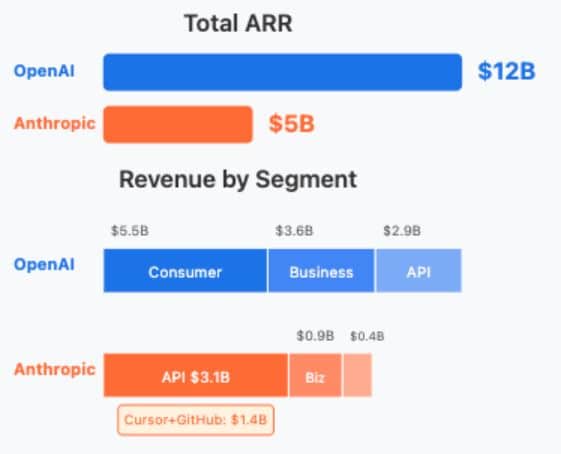
- OpenAI has an annualised revenue of approximately USD 12 billion.
- Revenue breakdown by segment is followed by Consumer (USD 5.5 billion), Business (USD 3.6 billion), and API (USD 2.9 billion).
- In enterprise adoption, OpenAI is estimated to have around 25% market share, down from 50% in 2023.
- Meanwhile, its valuation is approximately USD 300 billion.
Anthropic:
- Anthropic has lower total revenue, with annualised revenue of approximately USD 5 billion.
- Revenue breakdown includes the API segment at USD 3.1 billion, the Biz segment at USD 0.9 billion, and a smaller segment at USD 0.4 billion.
- However, its API revenue is slightly higher than OpenAI’s at about USD 3.1 billion.
- In the enterprise market, Anthropic held a 32% market share, with the note that it is growing rapidly.
- Its valuation is approximately USD 61.5 billion, and it is approaching USD 170 billion in new rounds.
OpenAI Vs. Anthropic Statistics By Business Model Components
(Source: substackcdn.com)
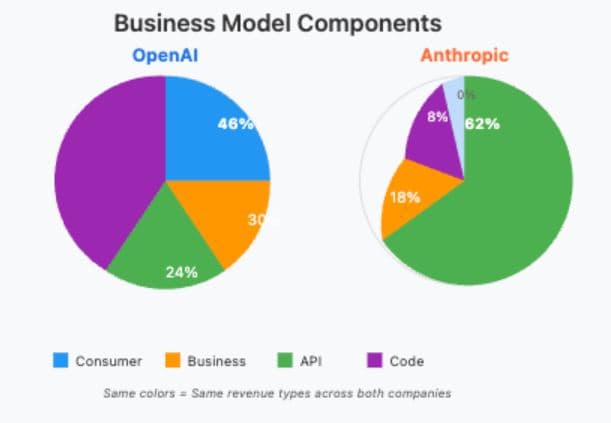
- For OpenAI, the pie chart above shows that 46% comes from Consumer, 30% from Business, and 24% from API.
- For Anthropic, 62% came from the API, followed by 18% from Business, and 8% from Code.
By Market Growth Analyses
- According tobuiltin.com, in 2025, ChatGPT reportedly reached 800 million weekly active users, up from 400 million in February.
- It is reported to process more than 1 billion queries per day, with approximately 190.6 million people using it daily, with 2,200 visits per second.
- For business customers, OpenAI reports 3 million paying users, and ChatGPT Enterprise is priced at approximately USD 60 per seat per month.
- Anthropic’s Claude had about 18.9 million monthly active users by January 2025 and around 769.6 million app downloads.
- Following the launch of Claude 4, Claude Code revenue reportedly increased by 5.5 times.
- OpenAI’s API traffic exceeded 2.2 billion daily calls in 2025, up from 1.3 billion in 2024, with more than 2.1 million developers.
- Additionally, 70% of new API signups in 2025 originated outside the U.S.
By Enterprise LLM Share and Usage Trends
- OpenAI’s position in enterprise LLMs has weakened, declining from approximately 50% market share to approximately 25%.
- Even so, its enterprise API activity, like coding and agent use, more than doubled, and reasoning -based use cases grew eightfold.
- Anthropic has increased its enterprise market share to approximately 32%, up from approximately 15% two years ago.
- Claude Code is used more by startups (32.9%) than by enterprises (23.8%), and its revenue reportedly increased 5.5-fold after the Claude 4 launch.
- Claude Opus 4.1 is available through AWS Bedrock, Vertex AI, and GitHub Copilot.
By Pricing Comparison
| OpenAI | Anthropic |
|
|
By Model’s Performance and Capabilities
- A report published by SQ Magazine stated that OpenAI has expanded compute by adding Google Cloud TPUs, reducing reliance on Azure and Nvidia GPUs.
- OpenAI also introduced the Model Context Protocol (MCP) across ChatGPT, the Agents SDK, and other APIs to enable tools to work together.
- Meanwhile, Anthropic’s Claude Opus 4 is described as a state-of-the-art coding model, scoring 72.5% on SWE-Bench and 43.2% on Terminal-Bench, and it can continue working on complex tasks for multiple hours with consistent code reasoning.
- OpenAI’s GPT Store contains 3 million custom GPTs built with GPT Builder.
- Anthropic provides developer tools, like code execution, an MCP connector, and a Files API.
- Claude 4.1 connects with Google Cloud Vertex AI and AWS Bedrock, and is previewed in GitHub Copilot.
By Partnership And Collaborations
OpenAI:
- By Q2 2025, OpenAI reported more than 120 enterprise and government partnerships.
- It partnered with The Washington Post (April 2025), Guardian Media Group (Feb 2025), and Schibsted Media Group to bring journalism into ChatGPT search.
- It is building Stargate Norway with Nscale Global and Aker, with 100,000 Nvidia GPUs by the end of 2026.
- In the U.S., Stargate with SoftBank, Oracle, and MGX targets a USD 500 billion buildout over four years.
- It signed a USD 12 billion compute deal with CoreWeave in 2025 and took a USD 350 million equity stake, in addition to its Azure investment.
- Its defense contract was USD 200 million from the U.S. Department of Defense, launching OpenAI for Government.
Anthropic:
- Anthropic partnered with the University of Chicago’s Becker Friedman Institute to use Claude Enterprise to study AI’s labour-market effects.
- Using MCP, it integrated S&P Global data into Claude for finance and worked with Wiley via MCP on responsible AI in scholarly research.
- It has been established that the U.S. Security and Public Sector Advisory Council partners with the U.S.
- GSA to provide Claude access across federal agencies, and expanded outreach through Northeastern University, LSE, and Champlain College.
Model’s Adoption Rate Statistics By OpenAI Vs. Anthropic

(Source: econlab.substack.com)
- By July 2025, OpenAI is ahead with 36.5%, while Anthropic is rising quickly at 12.1%, and total business adoption stands at 44.5%.
- Others’ adoption rates are followed by xAI (1.5%), Google (1%), and DeepSeek (<1%).
- The overall adoption has increased to 44.5%.
- saastr.com reports further estimated that Anthropic will reach 20-25% spending by 2026, will OpenAI will reach up to 40-45% as more users shift to enterprise contracts.
- Overall, card-based adoption may reach 70-80% by 2027.
Business Penetration Statistics

(Source: saastr.com)
- In the second quarter of 2025, OpenAI accounted for the highest business penetration at 37.2%, while Anthropic reached 14.5%.
- Additionally, the penetration rates for other providers are xAI (1.8%) and Google (1.1%).
- By 2026, OpenAI’s penetration rate is expected to reach 42% (+5.5%), whereas Anthropic’s is projected to be 22% (+9.9%).
Top Funded LLM Developers
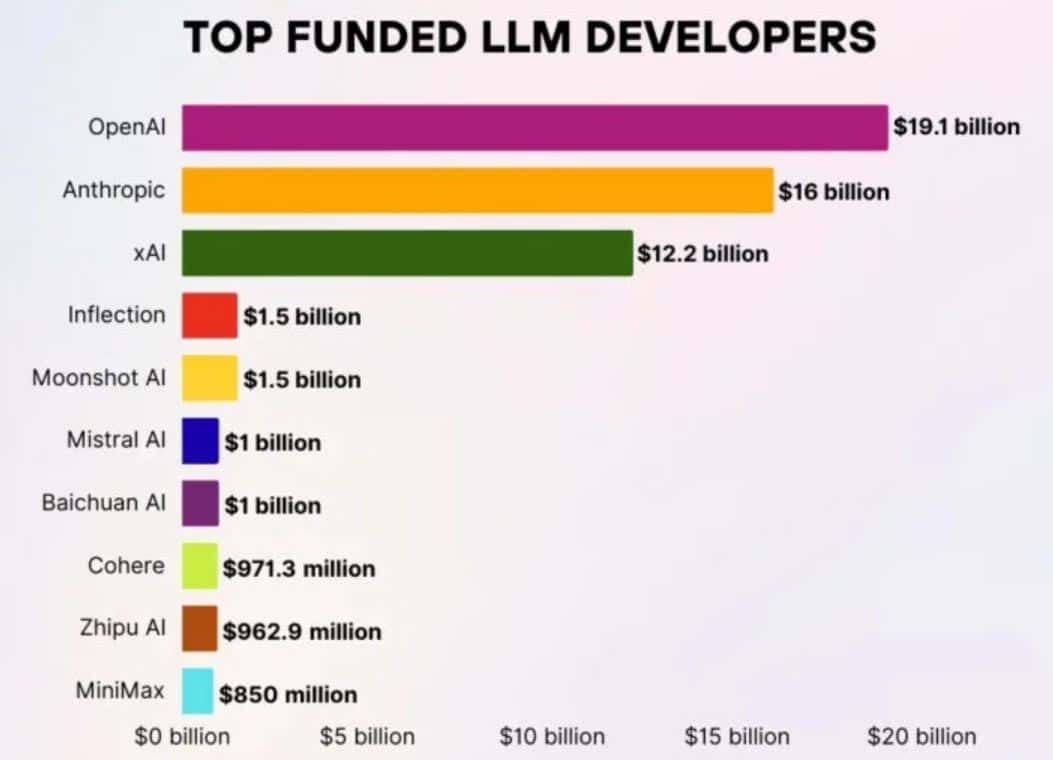
- OpenAI leads with approximately USD 19.1 billion in total equity funding, while Anthropic has approximately USD 16.0 billion.
- Elon Musk’s xAI has raised USD 12.2 billion, followed by Inflection and Moonshot AI (USD 1.5 billion each), Mistral AI and Baichuan AI (USD 1 billion each), Cohere (USD 971.3 million), Zhipu AI (USD 962.9 million), and MiniMax (USD 850 million).
OpenAI Vs. Anthropic Statistics By Strategy Split And Investor
| Metrics | OpenAI | Anthropic |
| Core strategy | Consumer-first, broad access, and ecosystem-driven growth. | Enterprise-first, compliance-led approach with deep integrations. |
| Target market | Around USD 1.2 trillion across enterprise software and consumer apps. | The enterprise AI market is expected to be approximately USD 550 billion by 2035. |
| Monetization | ChatGPT Plus at USD 20/month, plus scaling API usage based on volume. | Long-term institutional contracts with higher per-seat value in regulated sectors. |
| Growth profile | Faster, high-velocity top-line growth supported by scale and distribution. | More predictable compounding from steady enterprise adoption. |
| Defensibility | Network effects, product ecosystem, user data, and integrations. | Trust/compliance credibility, infrastructure stickiness, and alignment/safety positioning. |
| Investment appeal | Higher-growth upside, but potentially more volatile outcomes. | More durable, defensive profile with regulatory tailwinds. |
| Investor takeaway | It can suit investors seeking faster growth and greater volatility. | It can fit investors seeking steadier returns and stronger downside protection. |
OpenAI Vs. Anthropic Joint Safety Evaluation
- OpenAI and Anthropic shared safety test findings on their top AI models, highlighting what each system does well and where it struggles.
- In their first coordinated evaluation, each company applied its own internal safety checks to the other’s models.
- OpenAI tested Anthropic’s Claude Opus 4 and Claude Sonnet 4, while Anthropic assessed OpenAI’s GPT-4o, GPT-4.1, o3, and o4-mini.
- To run the trials, they temporarily relaxed certain external protections, a common practice when probing potentially dangerous capabilities.
- The work examined four areas: instruction hierarchy, jailbreak resistance, reducing hallucinations, and detecting scheming behaviour.
Red-Teaming Comparison Between OpenAI (GPT-5) Vs. Anthropic (Claude Opus 4.5)
| Dimension | GPT-5 | Claude Opus 4.5 |
| System card length | 55 pages | 153 pages |
| Attack methodology | Single-attempt + iterative patching | 200-attempt RL campaigns |
| ASR @ one attempt (coding) | 89% raw (pre-patch) | 4.70% |
| Prompt injection defense | 20% ASR | 96% blocked; 99.4% w/ safeguards |
| Interpretability | CoT monitoring | 10 million neural features tracked |
| Deception detection | 2.1% CoT flagged | Internal feature activation |
| Evaluation awareness | Identifies exact eval (METR) | <10% |
| CBRN risk | Medium | Below ASL-4 |
| Governance | SAG + Preparedness v2 | FRT-AST-RSO/CEO |
| External partners | UK AISI, US AISI, METR, Apollo | Gray Swan, UK AISI, US CAISI, METR |
| Reward hacking | Yes (METR) | Yes (impossible tasks) |
Technical Comparison Between OpenAI (GPT-4) Vs. Anthropic (Claude+)
| Features | GPT-4 | Claude+ |
| Model Size | 175 billion parameters | More than 100 billion parameters |
| Training Data | Diverse internet corpora + curated data | Similar data + safety-focused corpora |
| Multimodal Capabilities | Yes (text & images) | Primarily text-focused |
| Safety Techniques | RLHF + human moderation | Constitutional AI + interpretability |
| API Accessibility | Extensive via Azure & OpenAI APIs | Available via cloud partnerships |
| Fine-tuning Flexibility | High | Moderate |
Pros And Cons Analysis Of OpenAI Vs. Anthropic
| AI Platform | Pros | Cons |
| OpenAI |
|
|
| Anthropic |
|
|
Use Cases Comparison Between OpenAI vs. Anthropic
| Scenario | OpenAI fits better when | Anthropic fits better when |
| Best match | It worked best for product-led teams that built widely used apps. | It suited high-trust enterprise work needing safer, structured outputs. |
| Speed & integration | The team sought flexible APIs for rapid prototyping and seamless product integration. | The team needed very steerable models with predictable behaviour. |
| Tooling & platforms | The team relied on widely supported tools across platforms and SDKs. | The team prioritised safer outputs for customer-facing or compliance-heavy tasks. |
| Capabilities | The team required multimodal features, including vision, code, and audio. | The team processed lengthy legal or technical documents with extensive context requirements. |
| Agents & workflows | The team used advanced agents for autonomous task handling and a general assistant with a large plugin ecosystem. | The team depended on strong guardrails, enterprise alignment, and human review/approval loops. |
| Reliability | The team required scalable infrastructure and uptime guarantees for production applications. | The team focused on controlled enterprise workflows and risk reduction. |
Controversies And Challenges Analysis
Open AI:
- Some reports describe friction between research and product teams, with concerns that product delivery may be taking priority over safety work.
- The company has also seen notable departures of researchers and senior leaders.
- In addition, OpenAI has been criticised for enforcing strict offboarding agreements that some argue discourage former staff from speaking openly.
Anthropic:
- Anthropic faced a copyright lawsuit from Universal Music Publishing Group, alleging improper use of song lyrics.
- Some users also complain about Claude’s pricing and what they see as heavy filtering or censorship in answers.
- Anthropic’s own research notes how hard it is to evaluate AI systems and keep them harmless, which adds to these concerns.
- Finally, investors such as Amazon and Google could exert pressure on how models are built and released.
Recent Developments
- According to SQ Magazine, OpenAI’s restructure may slip into 2026 as Microsoft talks drag on over IP rights and Azure exclusivity.
- CPO Julia Villagra is leaving for creative work, and interim leaders will take over.
- Users have raised concerns about the GPT-5 rollout, but Sam Altman has issued no formal statement confirming problems or changes to the GPT-4 paywall.
- OpenAI is also reported to be exploring alternatives to Azure for compute, with no confirmed partnerships with Google or Amazon. Anthropic is preparing a USD 3-5 billion Iconiq-led round that could value it at USD 170 billion.
- Meanwhile, Amazon’s USD 8 billion investment supports cloud work, though AWS revenue figures aren’t public.
- Claude 4 was launched in 2025, but model names and dates remain unverified.
Conclusion
After completing the article, it is now clear that both OpenAI and Anthropic are growing rapidly, but their growth trajectories differ on paper. OpenAI accounted for the higher reach, with huge user numbers and strong adoption across consumer and work products. Anthropic stands out for its business-first approach, attracting many enterprise clients and demonstrating rapid revenue growth.
This article includes a comparison of users, customers, revenue run rate, valuation, model performance, and distribution and customer retention. In the long run, the teams that move fast while staying safe and earning trust will be the ones that win.
FAQ.
They are U.S. AI companies that develop large language models and make them available via apps and APIs.
OpenAI is best known for ChatGPT and its developer API, while Anthropic is known for Claude and its API.
OpenAI has a wide audience and reaches many everyday users. Anthropic is often chosen by businesses and developers who want a more work-focused tool.
OpenAI’s models are from the GPT series, while Anthropic’s models are from the Claude series.
There is no single winner. One may excel at writing, another at coding, math, or complex tasks.
Both can help with coding, but the best option depends on your tools, budget, and the kind of code you write.
Both can handle long text, but the limit varies by model and plan.

Tajammul Pangarkar is the co-founder of a PR firm and the Chief Technology Officer at Prudour Research Firm. With a Bachelor of Engineering in Information Technology from Shivaji University, Tajammul brings over ten years of expertise in digital marketing to his roles. He excels at gathering and analyzing data, producing detailed statistics on various trending topics that help shape industry perspectives. Tajammul's deep-seated experience in mobile technology and industry research often shines through in his insightful analyses. He is keen on decoding tech trends, examining mobile applications, and enhancing general tech awareness. His writings frequently appear in numerous industry-specific magazines and forums, where he shares his knowledge and insights. When he's not immersed in technology, Tajammul enjoys playing table tennis. This hobby provides him with a refreshing break and allows him to engage in something he loves outside of his professional life. Whether he's analyzing data or serving a fast ball, Tajammul demonstrates dedication and passion in every endeavor.