Ram Trucks Statistics By Market Share And Sales (2026)

Updated · May 20, 2026


Table of Contents
Introduction
Ram Trucks Statistics: Ram Trucks stepped into the 2025–2026 stretch, dealing with one of the bigger crossroads in its newer story. A big leadership shuffle at Stellantis happened, and then, well, the company officially backed away from its prior stance and re-homologated the 5.7L HEMI V8 with eTorque for the 2026 model year. Ram stayed, basically, one of North America’s biggest pickup builders, pulling in billions of dollars each year thanks to its very lucrative full-size lineup. Then the redesigned 2025 Ram 1500 showed up, the Hurricane inline-six powertrains started expanding, and all the groundwork for Ramcharger electrified models helped set the stage for growth over the long haul.
On top of that, better retail share, pricier transactions, and loyal buyers just kept pushing Ram into a pretty key role within Stellantis across 2025–2026.
Editor’s Choice
- Ram’s total Q1 2025 sales only slid 2% year-over-year, even though a lot of shoppers were worried about the HEMI V8 being removed.
- Rental fleet sales basically fell off a cliff, 98%, dropping from around 10,900 units to about 300 units in Q1 2025.
- Ram’s retail truck sales jumped, more than 15%, moving from nearly 65,300 units to 75,700 units in Q1 2025.
- Ram’s retail market share in Q1 2025 rose from 16.6% to 17.2%, so it gained ground despite all the noise.
- In Q1 2026, Ram brand sales leaped 20% year-over-year, which points to real rebound energy.
- Ram 1500 sales grew 27%, reaching 59,828 units in Q1 2026.
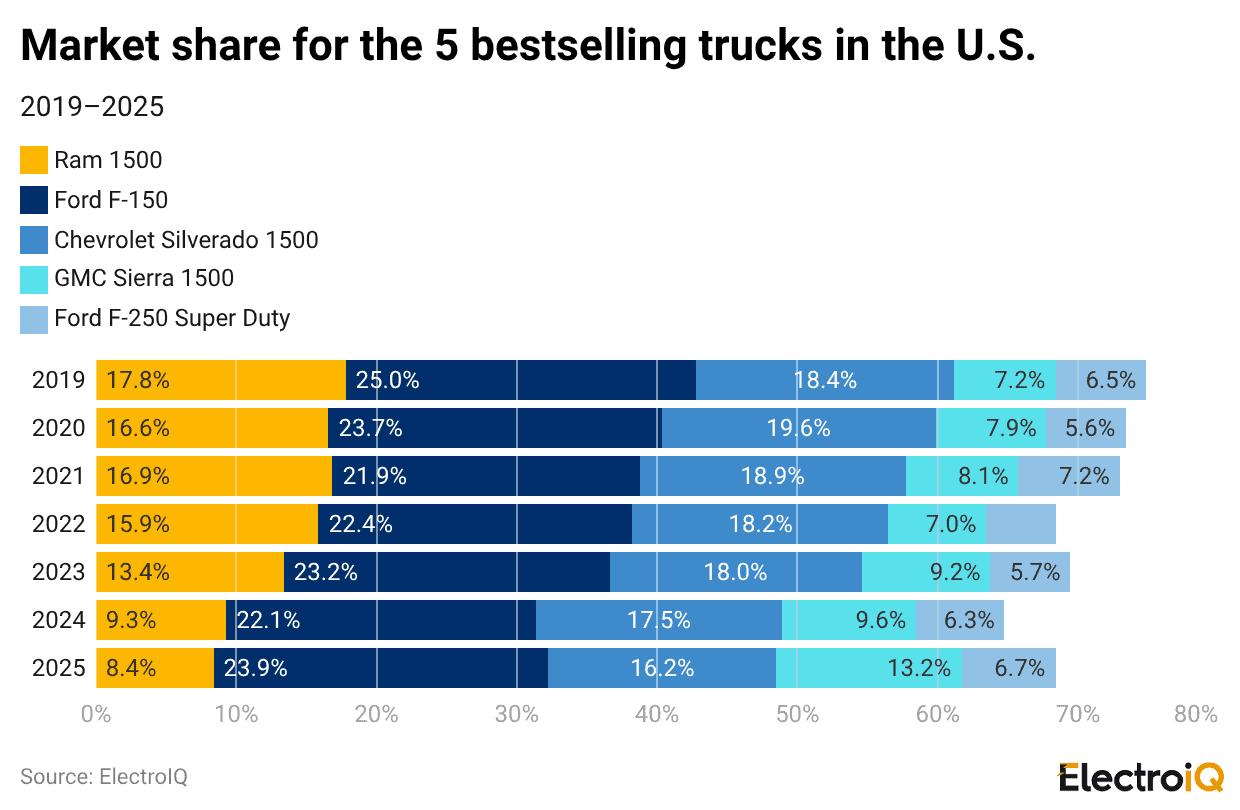
- Still, Ram 1500 market share fell from 17.8% back in 2019 to 8.4% in 2025, and that reads like a major six-year slide.
- Ram’s overall market share also eased sharply from 15.9% in 2022 to 13.4% in 2023.
- Ram’s full-size pickup section dropped a pretty aggressive 41% since 2019, or at least that’s what the numbers say.
- Nearly 10,000 HEMI-powered Ram 1500 orders were reportedly logged in the first 24 hours after the V8 comeback announcement, which is kinda wild when you think about it.
- HEMI-powered trucks are expected to make up around 35% of Ram sales mix once 2026 production calms down a bit, while the HEMI engine output is projected to go past 100,000 units every year.
Ram Trucks’ Sales Statistics
- Ram Trucks might seem like they are stumbling at first glance, but if you dig into the figures, it kinda says something else.
- During the Hemi comeback and NASCAR Truck Series announcement, Stellantis presented figures showing Ram’s total Q1 2025 sales slipped just 2% year-over-year versus Q1 2024.
- The drop was basically all driven by a brutal 98% collapse in rental fleet sales, which fell from around 10,900 units to about 300 units.
- At the same time, retail activity moved in the other direction. Ram’s retail truck sales rose from roughly 65,300 units in Q1 2024 to nearly 75,700 units in Q1 2025, that’s growth of more than 15% overall.
- The retail market share climbed too, from 16.6% up to 17.2%, suggesting steadier demand from everyday buyers, despite the still-debated shift away from the Hemi-powered lineup.
- Ram’s manufacturing facilities reportedly ran into volume constraints, so the company kinda had to decide between doing low-profit rental trucks or going after higher-margin retail models, like the 2025 Ram 1500 RHO and even the pricier premium trims. Ram really seemed to pick profitability over mass volume, if that makes sense.
- Total unit sales dipped a little, but Ram likely pulled in better revenue per truck, since retail buyers usually go for more optioned-up vehicles with meaningfully larger profit margins compared to fleet operators.
- Then, Q1 2026 sales numbers from FCA US LLC come out, showing an explosive 20% year-over-year sales surge for the Ram brand, with the light-duty Ram 1500 climbing 27% to 59,828 units for the quarter.
(Reference: cnbc.com)
- The chart sort of shows a pretty dramatic shift in the U.S. full-size pickup truck market from 2019 to 2025, and Ram Trucks seem to get hit harder than most.
- Basically, the numbers say Ram 1500 market share went from 17.8% in 2019 down to 8.4% in 2025, so that’s a drop of more than 9 points over just six years.
- It’s more like a mix of production problems, a few controversial product calls, aggressive price moves, and also stronger pressure from competitors such as the Ford F-150 and the GMC Sierra 1500.
- Ford stayed out front the whole time, holding market share above 21% in every year, and then actually climbing back to 23.9% in 2025.
- On the other hand, the Chevrolet Silverado 1500 drifted down more slowly, moving from 18.4% in 2019 to 16.2% in 2025. That suggests, at least for now, steadier customer commitment even with all the broader industry ups and downs.
- GMC nearly doubled its share from 7.2% in 2019 to 13.2% in 2025, which points to growing interest in premium pickups, you know, those trucks with a more upscale feel and typically better profit per unit.
- Market share fell from 15.9% to 13.4% in 2023, then dropped again to 9.3% in 2024. Analysts often connect this downturn to delayed product rollouts, tight inventory levels, and the backlash tied to removing the Hemi V-8 engine.
Ram’s High-Risk Comeback Strategy
- Ram Trucks is moving into 2025–2026 with a pretty dramatic turnaround kind of plan, steered again by returning CEO Tim Kuniskis.
- According to CNBC and Stellantis, Ram sales are down by almost 38% from their 2019 high. And the full-size pickup segment, which is basically crucial for the brand, slid about 41% even more, putting a lot of strain on one of Stellantis’ most profitable lines.
- Kuniskis has brought back the legendary Hemi V-8 engine, reactivated Ram’s presence in the NASCAR Craftsman Truck Series, and pushed aggressive marketing that leans into “Symbol of Protest” style branding, mechanical bull rides, and public events that are high energy, a bit loud too, like on purpose.
- Full-size truck buyers in the U.S. keep ranking towing capability, that unmistakable engine sound, strong performance, and some kind of emotional connection as top priorities.
- Even with electrification showing up everywhere, V-8 power still has weight because it fits the vibe people want.
- Pricing problems, slower-than-expected product rollouts, and production complications linked to the redesigned Ram 1500 all chipped away at momentum over the past two years.
- The operational headaches apparently meant less inventory on lots, and that weakened how competitive Ram could be against rivals like Ford and Chevrolet.
- Ram is embracing bold branding, high-performance heritage, and emotional marketing to reconnect with truck buyers. Whether this aggressive comeback works will likely determine Stellantis’ long-term strength in the highly profitable North American pickup market.
Stellantis’ 2026 Powertrain Gamble: Why the HEMI V8 Is Roaring Back
- Stellantis’ 2026 truck plan is starting to look less like a total stop to electrification and more like this multi-engine balancing act, you know. Not a full retreat, more like they’re trying to keep everything moving.
- Stellantis, Ram, and a bunch of industry analysts say the company is basically holding on to three main powertrain routes at the same time: the Hurricane twin turbo inline-six, the coming back 5.7-liter HEMI V8 with eTorque, and then the EV and hybrid directions that are still in the mix too.
- People close to Ram, plus automotive media reports, suggest that almost 10,000 HEMI-equipped Ram 1500 orders landed inside the first 24 hours after the “HEMI is back” announcement.
- That returning 5.7-liter HEMI V8 is rated at 395 horsepower and 410 lb-ft of torque.
- Then there’s the 48-volt eTorque mild-hybrid system, which can add as much as 130 lb-ft of extra torque during acceleration, so it feels punchier when you need it.
- Ram and Stellantis engineering briefings, plus related sources, also point out that the mild hybrid arrangement helps launch response, improves fuel economy, and can reduce emissions, but without wiping out the classic V8 kind of driving feel.
- On the tech side, eTorque runs with a belt-driven motor generator and a smaller 0.4–0.6 kWh lithium-ion battery pack. That makes it lighter, and honestly simpler, than a plug-in hybrid setup where you’d think more about charging routines and extra hardware.
- As per dealer feedback plus various automotive reports, a lot of truck owners still treat the HEMI’s 20-year legacy like a steady, safer long-term bet.
- Looking ahead, Stellantis says the HEMI V8 could reach something like 35% of the Ram truck sales mix once production levels off in 2026.
- Finally, to keep up with demand, the Saltillo Engine Plant in Mexico is ramping up HEMI production heavily, with output expected to top 100,000 engines every year, which is more than triple the 2025 estimates.
- The company’s strategy recognizes that the U.S. truck market remains deeply divided between efficiency-focused buyers, EV adopters, and traditional V8 loyalists.
Conclusion
Ram Trucks basically had a big strategic reset, like rebuilding market share, getting the brand identity back on track, and trying to keep electrification in the mix while still satisfying that real-world craving for traditional V8 muscle. Even though total sales and market share took a hit for a bit, Ram still showed serious retail momentum, lifting profitability by leaning more on higher-margin consumer sales instead of that low-profit fleet stuff.
The HEMI V8 coming back, plus a pretty aggressive branding push, and also expanded production capacity, all point to Stellantis leaning in again, hard, into the North American pickup segment, where everyone is fighting constantly. Going forward, Ram’s performance will depend on how well it can balance that emotional, “feels fast” appeal, new powertrain directions, pricing discipline, and the fact that Ford and General Motors keep tightening the screws.
Sources
FAQ.
Ram brought the HEMI V8 back because customers kept asking for it, market share was sliding, and there was still that emotional loyalty people have toward the older school V8 trucks.
Ram brand sales went up 20% year over year. At the same time, Ram 1500 sales climbed 27% to 59,828 units.
It mostly came down to a 98% drop in rental fleet sales, not because retail demand suddenly got weak.
Some reports claim nearly 10,000 HEMI-equipped Ram 1500 orders were put in within the first 24 hours, so yeah, pretty quick
Stellantis is running three lanes at once: HEMI V8, Hurricane inline-six engines, and future EV hybrid systems.

I hold an MBA in Finance and Marketing, bringing a unique blend of business acumen and creative communication skills. With experience as a content in crafting statistical and research-backed content across multiple domains, including education, technology, product reviews, and company website analytics, I specialize in producing engaging, informative, and SEO-optimized content tailored to diverse audiences. My work bridges technical accuracy with compelling storytelling, helping brands educate, inform, and connect with their target markets.