Mobile Apps Statistics By Market Size, Segments, Usage, Performance, Industry, Trends ands Facts (2026)

Updated · Mar 14, 2026



Table of Contents
- Introduction
- Editor’s Choice
- Key Takeaways
- Number Of Apps On Major App Stores
- Mobile App Market Statistics
- Mobile App Downloads By Segments
- Consumer Spending Statistics of Mobile Apps
- Mobile App Usage Statistics
- Mobile App Performance Comparison By Brand
- Mobile App Retention Rate Statistics
- Day 30 Mobile App Retention Rates By Industry
- Most Popular Mobile Apps
- Mobile App Penetration Rate Statistics By Google Play Store
- Conclusion
Introduction
Mobile Apps Statistics: Mobile apps are now a daily necessity, helping people stay connected, manage work, shop online, learn new skills, and enjoy entertainment anytime, anywhere. As smartphones and internet access continue to grow, mobile applications provide quick, simple, and personalised solutions for users worldwide. Whether it is chatting on social media, paying bills, tracking fitness goals, or studying online, apps make everyday tasks easier and more convenient.
With constant technological advancements, mobile applications are improving the user experience, encouraging innovation, and shaping the future of digital living.
Editor’s Choice
- According to Scribd, global mobile app (non-game) downloads will rise to approximately 190.8 billion in 2026.
- Global app installs via Google Play are projected to total roughly 143 billion downloads.
- By 2026, the Google Play Store is projected to host more than 4 million apps.
- In 2026, gaming apps are projected to account for the largest share of downloads, at approximately 30%.
- India recorded about 75 billion app downloads in 2025, and this figure is expected to reach more than 80 billion in 2026.
- In 2026, daily app downloads are projected to average roughly 860 million worldwide
- Approximately 40% of daily app downloads take place during the evening peak period, from 7 PM to 10 PM.
- In 2026, total global consumer spending on mobile apps and games reaches about USD 223.1 billion.
- On average, smartphone users spend about 3 hours and 10 minutes each day using mobile apps.
- Global people spend an average of 4 hours and 37 minutes per day on their smartphone apps, about 19% of the day.
- Users aged 18-24 years spend the most time on mobile apps, averaging 112.6 hours per month.
- In 2026, only about 26% of mobile app users return to an app within 1 day of installing it.
- Facebook is the world’s largest social network, with approximately 3.2 billion monthly active users (MAU).
Key Takeaways
- According to Appinventiv, in 2025, mobile app downloads reached 300 billion.
- In 2025, people spent 4.2 trillion hours using apps, and app spending reached USD 150 billion, according to a Sensor Tower report.
- On average, iPhone users spend USD 12.77 per app and USD 1.07 on in-app purchases, far more than Android users.
- Android leads with over 70% of app downloads due to its massive user base, while iOS generates 65% of total app revenue despite fewer downloads.
- An average person spends about 4 hours and 37 minutes daily on mobile, which equals nearly 70 days (approximately 19%) of a year on screen time.
- Moreover, 90% of total mobile usage happens inside apps, while only 10% is spent on mobile web browsing.
- Only 25% of users return to an app after the first day.
- Users actively use about 9-10 apps daily, representing around 30% of the nearly 30 apps they use regularly each month.
Number Of Apps On Major App Stores
(Source: appverticals.com)
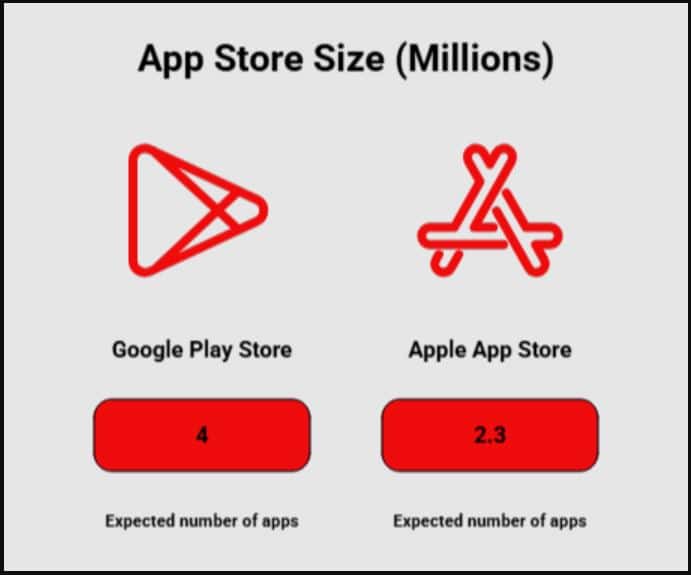
- The Google Play Store is expected to exceed 4 million apps by 2026, securing its position as the largest mobile app marketplace.
- In comparison, the Apple App Store is projected to reach 2.3 million apps.
Mobile App Market Statistics
(Source: aleaitsolutions.com)
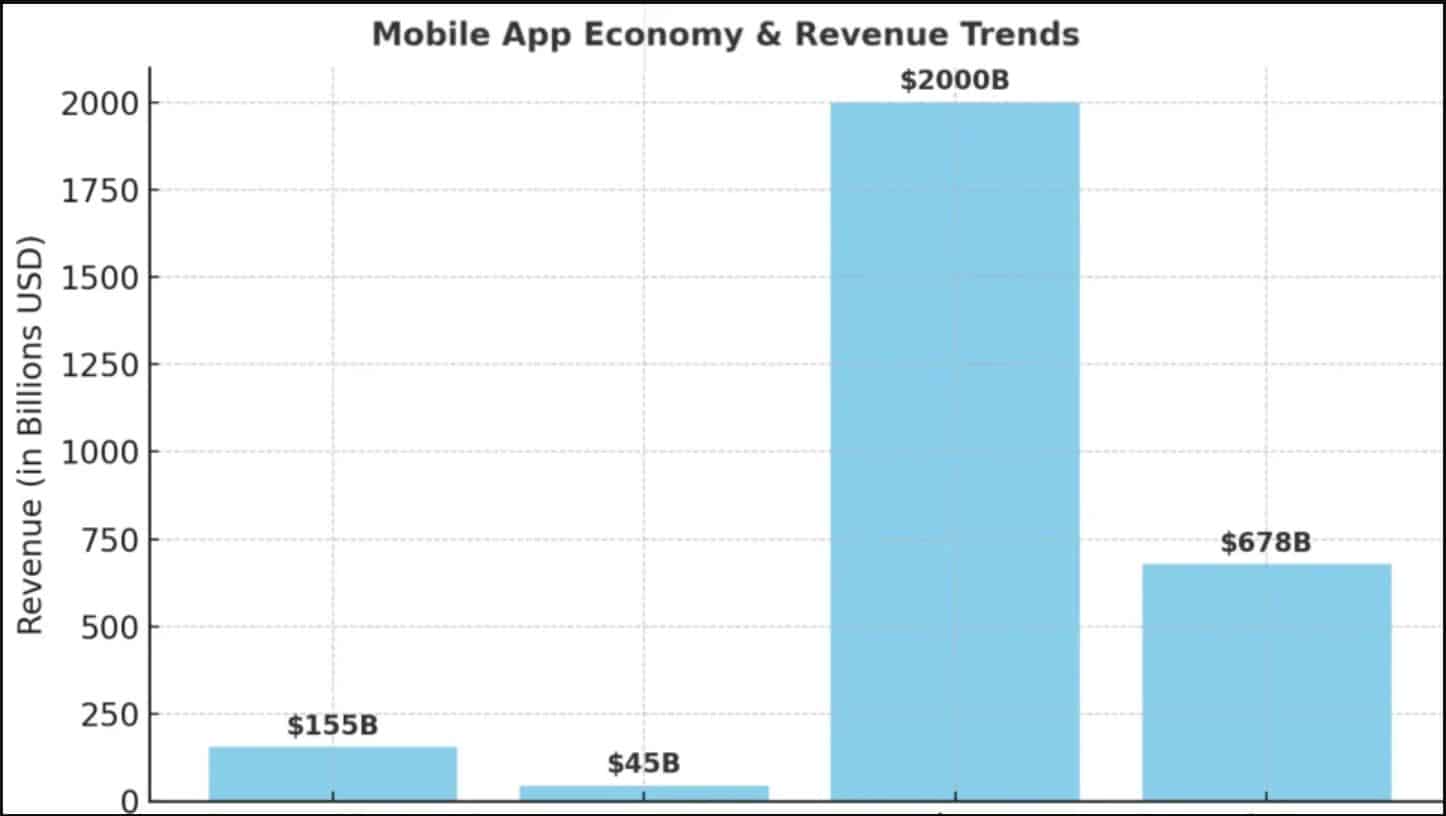
- As of 2025, Gaming apps are the biggest contributor, producing approximately USD 2,000 billion in revenue.
- Non-gaming apps, subscription and utility services, generated USD 678 billion in revenue.
- At the same time, mobile advertising accounted for USD 155 billion, followed by app store fees (USD 45 billion).
- Alea Research 2025 reports that Android holds about 75% of the global smartphone market.
- By 2025, most app revenue worldwide is expected to come from mobile advertising, accounting for around 75% of the total, with Google and Meta controlling nearly 90% of mobile ad spending.
- The total number of app downloads worldwide is forecast to exceed 320 billion per year by 2026.
Mobile App Downloads By Segments
- According to Scribd, global mobile app (non-game) downloads are expected to reach about 190.8 billion in 2026.
- Mobile apps account for approximately 45.3% of total downloads.
- From 2025 to 2030, the mobile apps record a CAGR of 4.6%.
- By 2030, global mobile app downloads are projected to increase further to around 229.9 billion downloads.
- Mobile apps are expected to maintain a 45.5% share of total downloads.
By Platforms
(Source: buildfire.com)
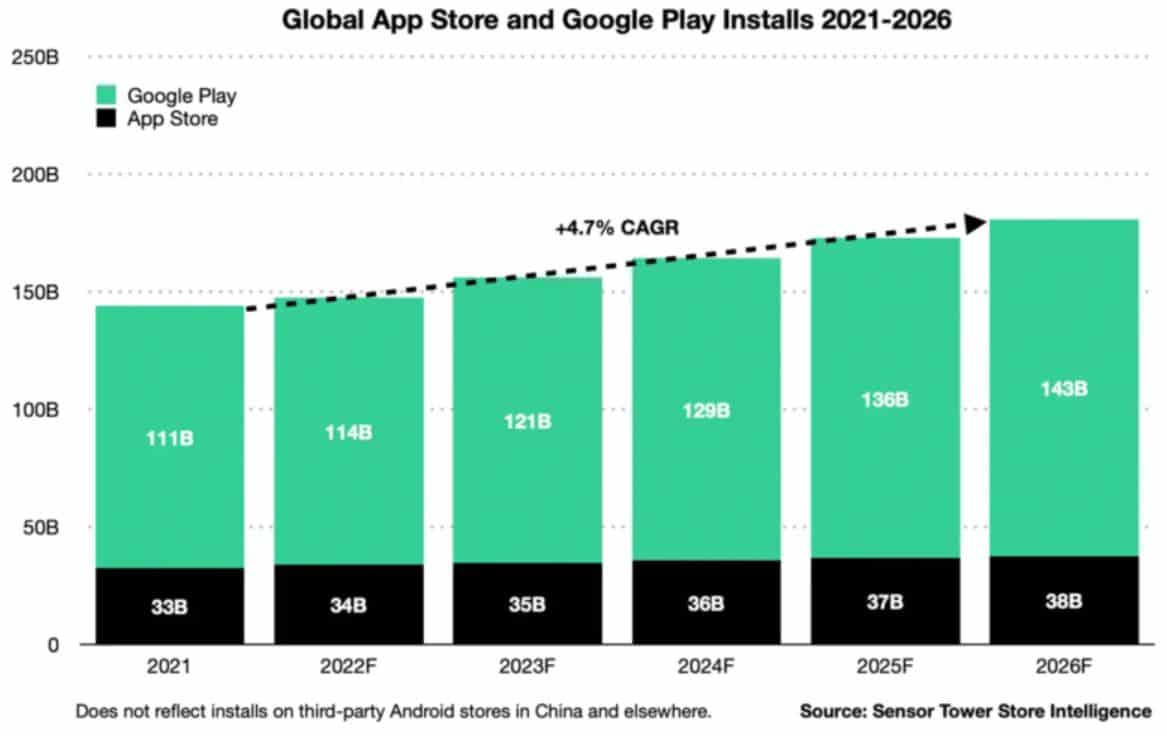
- By 2026, global app installations on Google Play will reach around 143 billion downloads.
- Meanwhile, the Apple App Store is expected to record around 38 billion downloads worldwide.
- From 2021 to 2026, the combined app market is expected to grow at a CAGR of more than 4.7%.
By Category
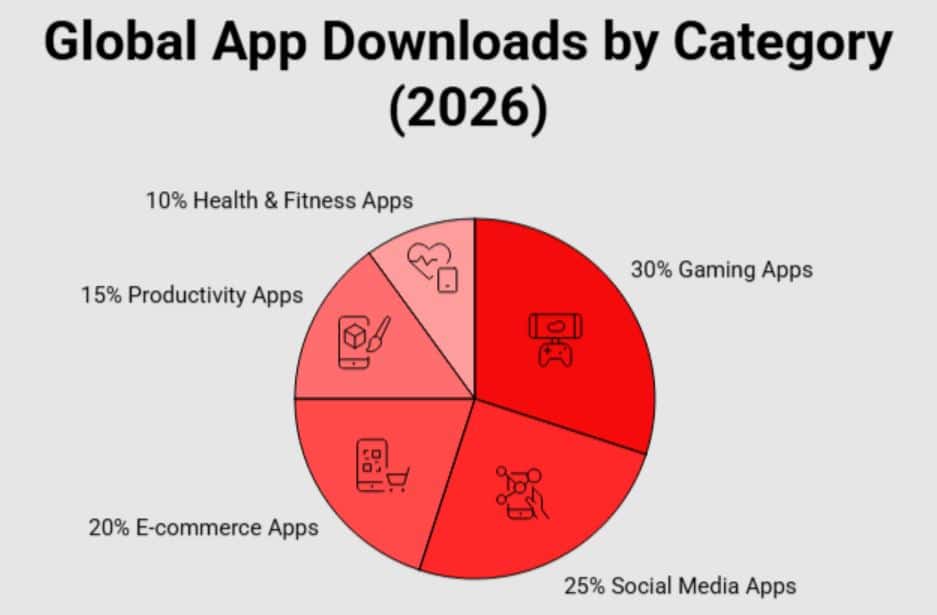
(Source: appverticals.com)
- In 2026, gaming apps are expected to account for the highest app downloads, at about 30%.
- Social media apps will remain highly popular, contributing nearly 25% of total global downloads.
- Furthermore, other mobile app download shares in 2026 are estimated to be E-commerce apps (20%), Productivity apps (15%), and Health and fitness apps (10%).
By Country
| Country | App Downloads (2025) | Expected App Downloads (2026) |
| India | 75 billion | 80+ billion |
| China | 62 billion | 68 billion |
| United States | 35 billion | 37 billion |
| Brazil | 28 billion | 32 billion |
| Indonesia | 21 billion | 24 billion |
By Events
- In 2026, average daily app downloads are expected to reach about 860 million, according to AppVerticals.
- On Black Friday, app downloads are projected to spike to around 1.6 billion.
- On Christmas Day, downloads will reach approximately 1.4 billion.
- During Prime Day and Singles’ Day, app downloads are forecast to increase by about 60% compared to the daily average.
- Major mobile game launches in 2026 will see downloads reach nearly 1.2 billion on peak launch days.
By Patterns
- In 2026, most app downloads are expected to happen in the evening.
- Between 7 PM and 10 PM, around 40% of daily downloads occur.
- During lunch hours, from 12 PM to 2 PM, about 18% of downloads are likely to occur.
- In the morning, from 7 AM to 9 AM, roughly 15% of users will download the app.
- Late at night, between 10 PM and 1 AM, downloads account for nearly 12% of the day’s total.
- Additionally, weekends are expected to see about 25% more downloads than weekdays.
Consumer Spending Statistics of Mobile Apps
- Scribd report further states that in 2026, total global consumer spending on mobile apps and games reaches about USD 223.1 billion.
- Apps (non-game) generate approximately USD 89.8 billion in consumer spending.
- Apps account for roughly 40.3% of the market share.
- From 2026 to 2030, apps show stronger growth momentum, with a 11.1% CAGR.
- By 2030, global consumer spending on mobile apps and games is expected to reach around USD 314.6 billion.
By Genre
- By 2030, entertainment apps are expected to generate the highest consumer spending at USD 42.7 billion, growing at a CAGR of 11.9% (2025 to 2030).
- Meanwhile, social media apps are projected to reach USD 20.6 billion, with a 12.2% CAGR.
- In comparison, utility & productivity apps are forecast to record USD 13.0 billion in spending with a 12.8% CAGR, followed by books & reference apps USD 9.6 billion at 12.5% CAGR, health & fitness apps USD 6.9 billion at 12.6% CAGR, and photo & video apps USD 5.2 billion, but with the highest growth rate of 13.0%.
By Region
| Region | Consumer Spending 2030 (USD Billion) |
CAGR (2025 to 2030) |
| Asia | 125 | 5.5% |
| North America | 90 | 9.4% |
| Europe | 40 | 10.3% |
| Middle East | 7 | 10.7% |
| South America | 6 | 10.9% |
| Oceania | 5 | 9.8% |
| Africa | 3 | 10.8% |
| Central America | 2 | 12.0% |
Mobile App Usage Statistics
- According to BuildFire, the average smartphone user spends 3 hours and 10 minutes per day in their apps.
- Approximately 2 hours and 51 minutes are spent using apps, which is about 90% of total smartphone usage.
- On average, a smartphone has over 80 apps installed, but users do not use all of them regularly.
- The average person uses 9 apps per day and 30 apps per month.
- More than 62% of installed apps are not used in a given month. Only 25% of apps are used once after download and never again.
By Time Spent

(Source: buttercms.com)
- According to Exploding Topics, people worldwide spend an average of 4 hours and 37 minutes per day on their smartphone apps, about 19% of the day.
- Moreover, individuals check their phones around 58 times per day.
- In the United States, average daily phone use has reached 5 hours and 16 minutes, up 14% year over year.
- In Ghana, users spend the most time on their phones, while in Japan, they spend less than 50% of the global average time on mobile apps.
- Around 75% of Gen Z users believe they spend too much time on their smartphones.
- TechKV reported that Social media apps maintained a 72% retention rate, nearly matching their 2025 download levels.
- In countries like Indonesia, app usage can account for up to 82% of total device time in 2025.
- The average 30-day retention is low: 3.8% on iOS and 3.2% on Android.
- Push notifications increase the daily usage by 88%, but overuse causes a 43% spike in uninstalls.
- In the first week, mobile games retained 31% of users, and reduced by 7% in the next two weeks.
- Paid apps maintained a 15% retention rate after 90 days.
- Fitness and social apps reached more than 70% in week one, then fell to 25% by week two.
Age Group
(Reference: techkv.com)
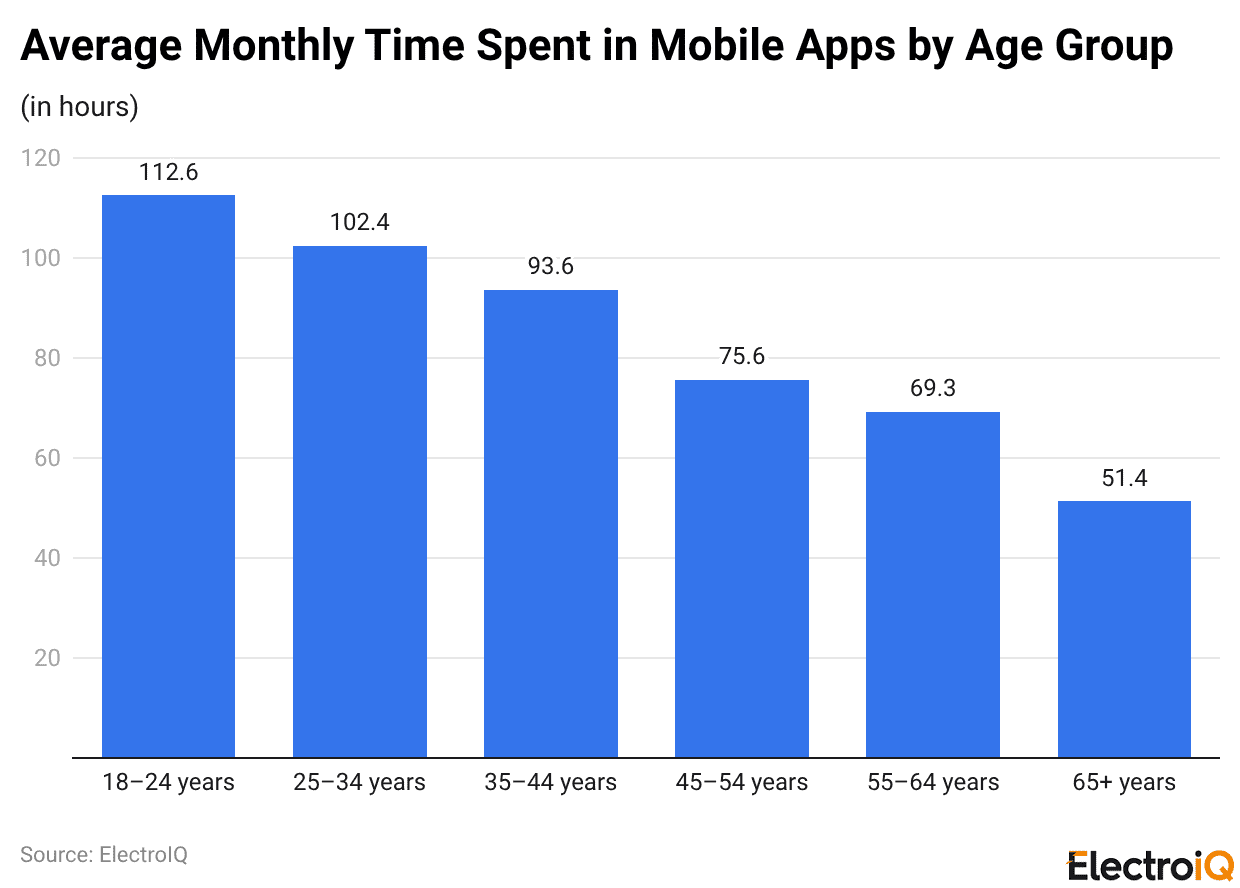
- Adults aged 18 to 24 spend the most time on mobile apps, averaging 112.6 hours per month.
- The 25-34 age group follows with 102.4 hours, while 35-44-year-olds average 93.6 hours, showing a gradual decline.
- Additionally, 45-54-year-olds spend 75.6 hours, 55-64-year-olds average 69.3 hours, and 65+ users spend the least at 51.4 hours.
By Duration and Frequency
| Usage Duration | Average Daily Checks | Share of Daily Pick-Ups |
| Under 2 Minutes | 40 | 69% |
| Between 2 and 10 Minutes | 15 | 26% |
| More Than 10 Minutes | 3 | 5% |
Mobile App Performance Comparison By Brand
Brand A (Wellness):
- Only 16% of all customers used the app.
- These app users accounted for 62% of total revenue.
- Each user opened the app 4.7 times per month, spending an average of 6 minutes and 41 seconds per session.
- Automated cart recovery brought in more than USD 14,000 per month.
- The app generated USD 2,070,000 in revenue on a USD 4,500 investment per quarter, for a 459 times return on investment (ROI).
Brand B (Fashion):
- Only 7% of the website traffic came from app users.
- These users accounted for 20% of total revenue.
- Each user opened the app 3.1 times per month, spending an average of 6 minutes and 28 seconds per session.
- Cart recovery generated USD 5,700 monthly.
- The app generated USD 194,000 in revenue at a quarterly cost of USD 1,800, resulting in a 108 times ROI.
Brand C (Cosmetics):
- 10% of all customers used the app.
- These app users contributed 15% of total sales.
- Each user opened the app 2.1 times per month, spending an average of 4 minutes and 58 seconds per session.
- Automated cart recovery generated USD 4,600 per month.
- The app generated USD 1,820,000 in revenue, with quarterly costs of USD 6,000, yielding a 303 times ROI.
Mobile App Retention Rate Statistics
- Growth-onomics indicates that in 2026, roughly 26% of mobile app users revisit an app within the first day after installation.
- After one week, active usage drops to nearly 13%, and by the 30th day, just around 7% of users are still engaging with the app.
- Retention levels also differ by industry, and some categories perform better than others, with news apps standing out at roughly 11.3% Day-30 retention.
Day 30 Mobile App Retention Rates By Industry
| Industry | Retention Rate |
| News | 11.3% |
| Business | 5.1% |
| Shopping | 5.0% |
| Finance | 4.6% |
| Food & Drink | 3.7% |
| Health & Fitness | 3.7% |
| Productivity | 3.2% |
| Entertainment | 3.0% |
| Travel | 3.0% |
| Social | 2.8% |
| Utilities | 2.6% |
| Gaming | 2.4% |
| Education | 2.1% |
Most Popular Mobile Apps
- A report published by Bipaustin states that Facebook is the world’s largest social network, with approximately 3.2 billion monthly active users (MAU) in 2026.
Furthermore, other popular apps’ monthly active users (MAU) in the same period are estimated in the table below:
| App | MAU |
| YouTube | 2.7 billion |
| 2.5 billion | |
| 2.1 billion | |
| TikTok | 1.8 billion |
| Google Maps | 1.1 billion |
| Telegram | 950 million |
| ChatGPT (OpenAI) | 600 million |
Mobile App Penetration Rate Statistics By Google Play Store
| App Category | Penetration Rate |
| Communication | 99.93% |
| Tools | 99.81% |
| Business Apps | 99.33% |
| Video Players & Editors | 96.63% |
| Travel & Local | 95.70% |
| Social Media Apps | 95.02% |
| Productivity | 91.67% |
| Music & Audio | 88.38% |
| Entertainment | 83.85% |
| News & Magazines | 81.11% |
| Photography | 75.77% |
| Books & Reference | 70.74% |
| Lifestyle | 65.67% |
| Personalization | 61.62% |
| Games (Casual) | 58.86% |
| Games (Puzzle) | 56.50% |
| Games (Arcade) | 55.08% |
| Shopping | 35.79% |
| Games (Action) | 34.19% |
| Weather | 32.46% |
By iOS App Store
| App Category | Penetration Rate |
| Games | 12.68% |
| Business | 10.35% |
| Education | 9.79% |
| Utilities | 9.22% |
| Lifestyle | 7.93% |
| Food & Drink | 6.58% |
| Shopping | 5,26% |
| Health & Fitness | 5.08% |
| Productivity | 4.84% |
| Finance | 4.16% |
| Entertainment | 3.92% |
| Travel | 3.26% |
| Sports | 2.37% |
| Social Networking | 2.16% |
| Music | 1.93% |
| News | 1.66% |
| Photography | 1.61% |
| Reference | 1.41% |
| Navigation | 1.60% |
| Books | 0.97% |
Conclusion
To sum up, mobile app data shows how important apps have become in daily life. The increase in downloads, users, and app usage proves their value for people of all ages and industries. These numbers help companies understand users better and improve their apps. As technology advances, app usage will continue to rise, making statistics essential for future growth and innovation.
FAQ.
Mobile apps make everyday tasks easier and faster. They let people communicate, shop, learn, do banking, enjoy entertainment, and handle many other activities right from their phones.
There are three main types of apps: native, web, and hybrid. Each type works differently, depending on its design and how users interact with it.
Apps allow businesses to connect with more customers, keep users engaged, boost sales, and provide better support and services.

Tajammul Pangarkar is the co-founder of a PR firm and the Chief Technology Officer at Prudour Research Firm. With a Bachelor of Engineering in Information Technology from Shivaji University, Tajammul brings over ten years of expertise in digital marketing to his roles. He excels at gathering and analyzing data, producing detailed statistics on various trending topics that help shape industry perspectives. Tajammul's deep-seated experience in mobile technology and industry research often shines through in his insightful analyses. He is keen on decoding tech trends, examining mobile applications, and enhancing general tech awareness. His writings frequently appear in numerous industry-specific magazines and forums, where he shares his knowledge and insights. When he's not immersed in technology, Tajammul enjoys playing table tennis. This hobby provides him with a refreshing break and allows him to engage in something he loves outside of his professional life. Whether he's analyzing data or serving a fast ball, Tajammul demonstrates dedication and passion in every endeavor.