Connected TV Statistics By Users, Advertising, Benefits, Trends And Insights (2026)

Updated · Mar 14, 2026


Table of Contents
- Introduction
- Editor’s Choice
- Connected TV Users In The U.S
- Connected TV Users by Generation
- Daily Time Spent On Connected TV
- Connected TV Advertising
- Connected TV Advertising Becomes Essential In Modern Media Plans
- Audience Perception of Connected TV
- Connected TV Advanced Targeting And Measurement
- Benefits of Connected TV
- Future Outlook
- Conclusion
Introduction
Connected TV Statistics: In 2025, Connected TV (CTV)—the technology that delivers streaming content through internet-enabled devices like smart TVs, set-top boxes, gaming consoles, and streaming sticks—has become an integral part of entertainment and advertising worldwide. The technology has transformed into a standard component of international entertainment and advertising practices.
The growing popularity of CTV among viewers who prefer to watch shows on their own terms, instead of watching scheduled programming, has led to worldwide changes in how people consume media and spend money on advertising, and develop their content delivery systems.
This detailed article presents essential Connected TV statistics for 2025, which include market size and user adoption rates, advertising revenue, and ROI.
Editor’s Choice
- Connected TV now captures 76% of all U.S. digital video ad views, far exceeding mobile’s 13%.
- More than 75% of U.S. CTV users will watch Smart TVs by 2027, surpassing all other streaming devices.
- By 2028, smart TV users will exceed Roku users by more than 53 million, signaling a device shift.
- Roku has experienced its slowest growth since 2010, with a current expansion rate of 2.7%.
- The fast growth of Gen Z CTV users between 2022 and 2025 will reach 6.5 million, which represents the highest rate of expansion among all user groups.
- The stable user base of millennials will reach 62.6 million monthly CTV users by 2025.
- Daily CTV content consumption reaches 62% among adults aged 18 to 34, while only 24% of adults aged 55 and older watch CTV content.
- U.S. adults watch Connected TV videos for a daily average of 1 hour 6 minutes.
- The CTV advertising market is expected to reach USD 30.1 billion, with an annual growth rate of 22.4%.
- The CTV advertising market will increase to approximately one-third of all video advertising expenses, which represents a significant increase from its previous share of below 10% five years ago.
- Retail media CTV ad spend is surging 86.6% to USD 4.19 billion, accelerating commerce-driven ads.
- Personalized CTV ads are 50% more likely to influence purchase intent than generic ads.
- Addressable advertising now covers 80% of U.S. CTV inventory, enabling precise targeting.
- By 2030, CTV is forecast to command 75% of global TV ad spend, redefining television economics.
Connected TV Users In The U.S
(Source: kortx.io)
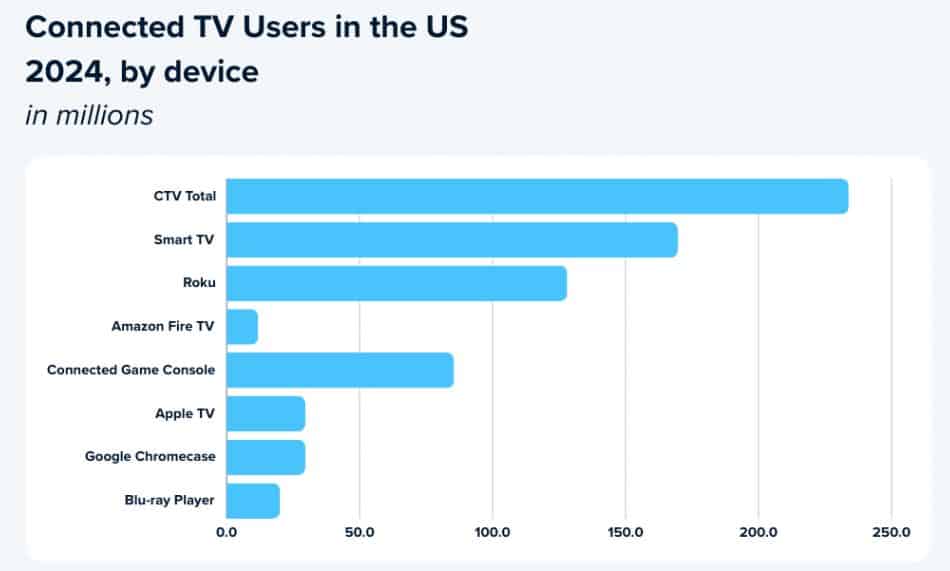
- The most recent Connected TV statistics show that U.S. households now stream content through different methods than they did in the past.
- The market leader, Roku, shows declining growth because the company expects to achieve only 2.7% growth this year, which stands as its lowest expansion rate since 2010.
- The streaming device market shows no growth because smart TV operating systems now offer built-in streaming capabilities that eliminate the need for separate streaming devices.
- Smart TVs have become the main driver of growth for the entire ecosystem. According to Connected TV statistics, more than 75% of U.S.
- CTV users are expected to rely on smart TVs by 2027, driven by manufacturers such as Samsung, Sony, and Amazon Fire TV.
- By 2028, smart TV users are projected to exceed Roku users by over 53 million, signalling a structural shift in device preference.
- Advertising trends reinforce this transition. In H1 2023, connected TV captured 76% of all digital video ad views, far surpassing mobile’s 13%.
Connected TV Users by Generation
(Reference: eskimi.com)
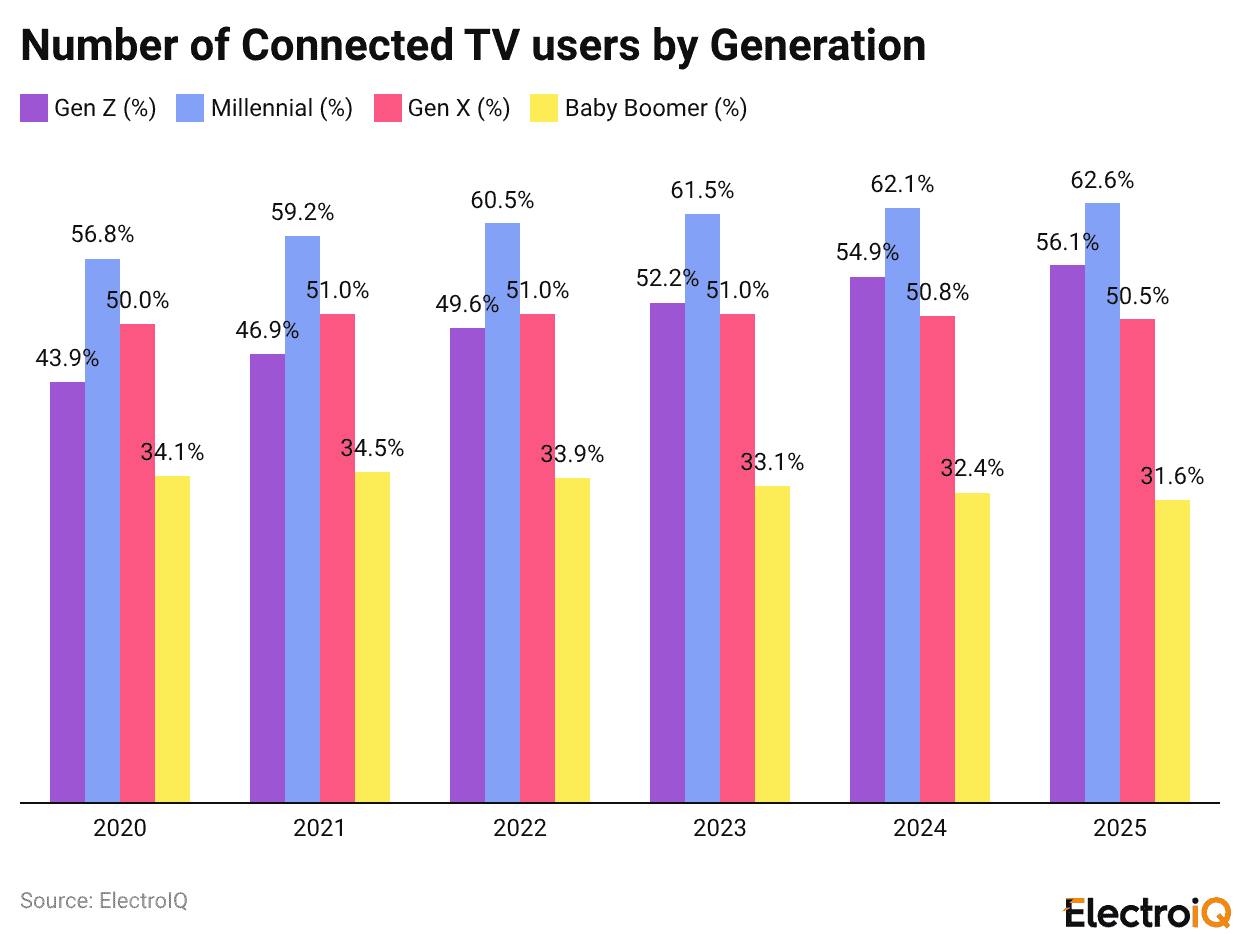
- The most recent Connected TV statistics prove that younger generations drive CTV growth in the United States, while Gen X and baby boomers show low adoption rates.
- The user base of millennials remains large and stable, which leads to an increase in monthly connected TV users from 60.5 million in 2022 to an estimated 62.6 million by 2025, which represents a user increase of 2.1 million.
- The Connected TV statistics show Gen Z users will grow from 49.6 million in 2022 to 56.1 million by 2025, which results in a user increase of 6.5 million users within three years.
- The research from Leichtman Research Group indicates that 62% of adults aged 18 to 34 watch videos daily on connected devices through television.
- The rate of video watching among adults aged 35 to 54 stands at 54%, while only 24% of people aged 55 and above watch videos through connected devices.
- Connected TV usage demonstrates a generational divide, which requires advertisers and platforms to develop strategic solutions.
Daily Time Spent On Connected TV
(Source: kortx.io)
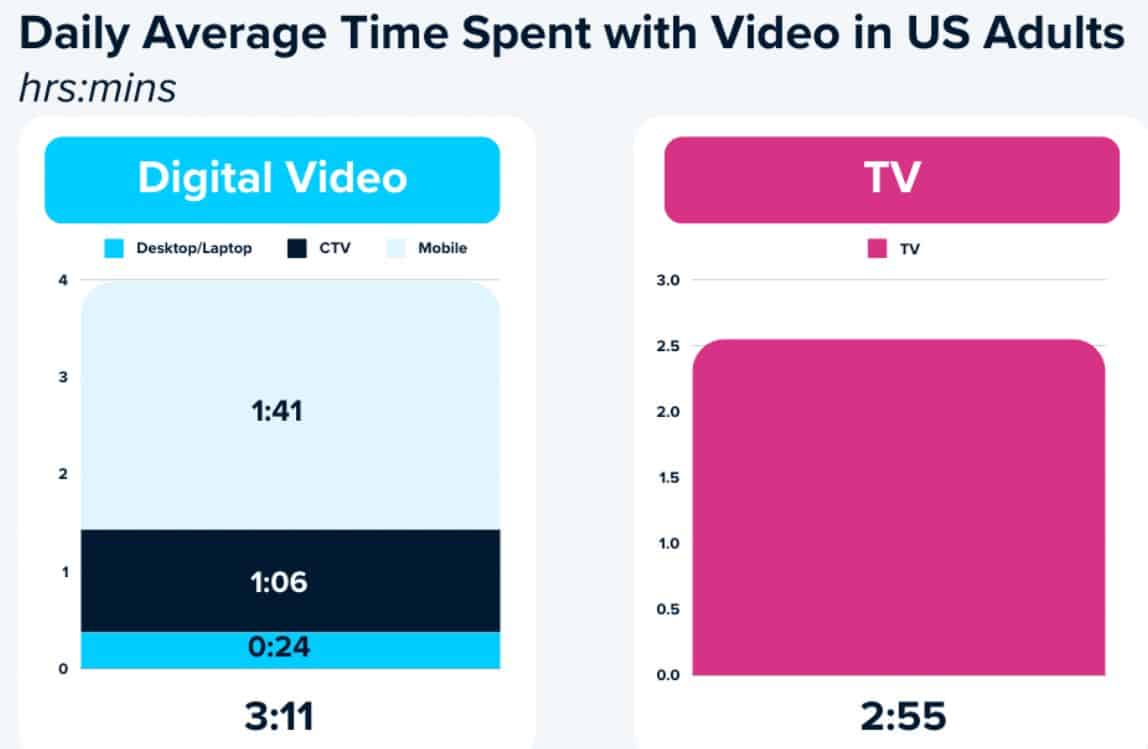
- The above chart illustrates how US adults divide their daily video watching time between different platforms which Connected TV (CTV) serving as their main viewing method.
- People spend 3 hours and 11 minutes each day watching digital video content because they use mobile devices for 1 hour and 41 minutes, Connected TV for 1 hour and 6 minutes, and desktop/laptop for 24 minutes.
- Traditional TV viewing time remains strong at 2 hours and 55 minutes for users who prefer watching extended programs through traditional TV.
- The Connected TV statistics demonstrate how CTV enables users to experience digital content with the same level of engagement found in traditional TV programming.
- According to industry data, more than 85% of US households currently possess at least one CTV device, while CTV advertising expenses increase more than 20% each year.
Connected TV Advertising
- The new Connected TV data confirms from an analyst viewpoint that CTV has become the fastest-expanding major advertising platform within the US market.
- The advertising expenditure will increase by 22.4% in 2024 to reach USD 30.10 billion because brands are reallocating their funds toward data-centric, high-quality video platforms.
- CTV used to account for under 10% of overall video advertising expenditures five years ago, but by 2024, it will achieve almost one-third market share, which results in fundamental changes to advertising budget distribution.
- The CTV market will reach USD 13.84 billion in upfront spending for 2024, which represents a 43.5% increase from the previous year, while advertisers spend an average of USD 0.14 for each hour of viewing time.
- The 2024 Olympics will bring momentary benefits to linear TV programming, but Connected TV data shows that advertisers will reduce their linear ad expenditures by 13.3% until 2025.
- The retail media industry drives this pattern forward while CTV retail advertisements experience an 86.6% growth to reach a total of USD 4.19 billion.
Connected TV Advertising Becomes Essential In Modern Media Plans
- Modern media plans require Connected TV advertising as their essential component.
- The latest Connected TV statistics show that CTV advertising has transformed from an experimental advertising channel into a main advertising channel that businesses use for their media buying process.
- The current video marketers use CTV as a necessary advertising component because 65% of them consider it essential, whereas only 38% of national broadcast and cable TV advertising remains vital.
- The rapid changes in viewing habits create a significant gap between current advertiser needs and their future requirements.
- Ad-supported streaming services are experiencing rapid growth, which creates continuous momentum for this trend.
- Disney+ achieved a tenfold growth in advertisers after introducing its ad-supported tier in 2022, while Peacock experienced a 40% year-over-year increase in advertiser activity.
- These trends demonstrate that brands possess strong market trust while they continue to transfer their financial resources from linear television.
- Total advertising inventory for linear TV and CTV will decrease at 6.6% each year until 2027 because consumers choose ad-free options and programs with fewer advertisements, which creates more competition for premium advertising spaces.
- The strategic elements that drive increases in CTV advertising expenditure show particular patterns.
- Advanced audience targeting demonstrates its value when 47% of marketers identify it as their primary reason for increased spending, while 39% of marketers aim to reach viewers who shift away from traditional linear television.
- Detailed measurement reporting and performance insights gain 30% of users who consider them essential, while another 30% of users view CTV as a budget-friendly alternative to standard television programming that delivers effective results.
- A total of 38% of respondents consider brand awareness, together with conversion goals, to be the main advantages of their search engine optimization endeavors.
- The 36% of marketers who face macroeconomic challenges and the 31% who experience cost increases remain active in their work.
- The 85% figure represents the percentage of people who show concern about advertising fraud.
Audience Perception of Connected TV
- The latest Connected TV statistics show a distinct change in audience attitudes towards advertising on streaming platforms.
- Viewers increasingly find CTV ads to be appropriate because 63% of them see the ads as relevant content, and 54% consider the ads to be less disruptive than mobile advertisements.
- The direct relationship between better perception and improved performance shows a direct relationship.
- About 49% of viewers enjoy interactive CTV ad formats, and 42% say they pay more attention to CTV ads than social media ads.
- The trust element, which affects advertising performance, leads to 62% of users trusting streaming TV advertisement brands.
- The signal is even stronger among younger audiences because 71% of Gen Z viewers choose ad-supported streaming platforms as their first choice.
- The frequency management of advertising content proves essential for creating successful advertising campaigns.
- The results from Connected TV research show that heavy streamers who encounter too many repeated ads will decrease their brand preference by 14%.
- The combination of personalized CTV ads with their optimal viewing schedule presents a modern advertising method that delivers 50% higher purchasing power than other advertising methods.
Connected TV Advanced Targeting And Measurement
- The latest Connected TV statistics show that advertisers need to know which audience segments they want to reach through their campaigns.
- Today, 80% of U.S. CTV inventory allows addressable advertising, which permits brands to decide which viewers will receive their advertisements.
- The research shows that 70% of marketers believe exact audience targeting stands as the main benefit of CTV, while 65% of marketers use first-party data to create personalized experiences.
- The performance data establishes evidence for this operational transformation. CTV audience segmentation methods deliver 27% better campaign ROI results while geotargeted CTV advertising reaches 18% more viewers.
- The advertising industry now requires frequency capping because it prevents viewers from experiencing ad fatigue while safeguarding brand image.
- The CTV measurement tools market saw a 35% growth between the previous year and the current year, while 45% of advertisers now use incrementality measurement to comprehend authentic audience growth.
- The cross-platform attribution method remains challenging for 61% of marketers to execute.
- The optimization process, which derives from artificial intelligence technology, enables campaign performance to increase by 30% through efficiency improvements.
- The advanced Connected TV statistics demonstrate a developing advertising ecosystem, which uses intelligent data analytics to create superior advertising results.
Benefits of Connected TV
(Reference: eskimi.com)
- Advertisers view CTV as a highly effective advertising platform because current statistics prove that Connected TV represents more than a standard video distribution system.
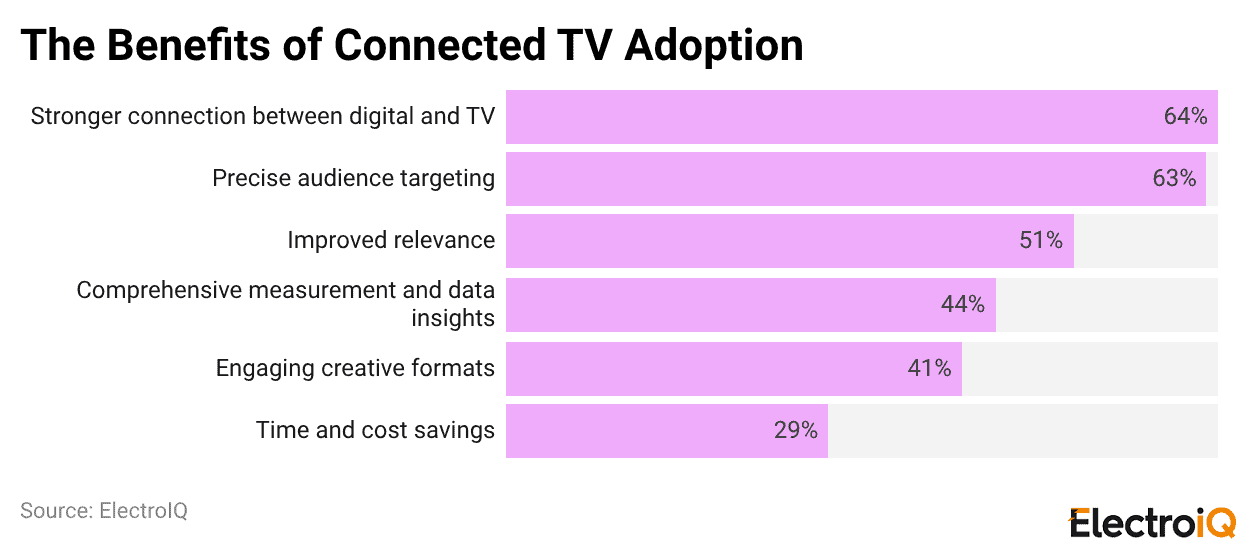
- The Innovid-Digiday report shows that 64% of marketers anticipate CTV will establish better links between digital platforms and traditional TV, which enables advertisers to combine broad branding techniques with precise data-driven methods.
- The current media planning process needs to establish unified cross-screen solutions that create synergy between digital and traditional media components.
- The primary benefits of this system include improved audience targeting capabilities and enhanced advertising relevance.
- The CTV system improves audience targeting accuracy according to 63% of respondents, while 51% of them state that it provides better ad relevance than traditional linear advertising methods.
- The survey results show that 44% of respondents want better measurement and data insights, while 41% of them seek more interactive creative options, and 29% of them expect to save both time and money.
- CTV advertising provides brands with a flexible advertising medium, which enables them to measure results while telling their brand stories, which helps create the future of TV advertising.
Future Outlook
- The latest Connected TV statistics show that viewing habits have advanced from traditional TV watching to modern interactive experiences, which use data for their functioning.
- The 55% annual growth rate of FAST platforms demonstrates that ad-supported content has become a common choice for viewers who want free, organized material instead of paid subscriptions.
- Sports streaming services now provide 25% of total CTV viewing time, which shows that live programming attracts audiences who want to watch premium content.
- Innovation is accelerating across formats. Shoppable and interactive ads are projected to make up 10% of all CTV ads by 2026, while CTV gaming ads are expected to grow 60% by the same year.
- AI-driven personalization will dominate, powering nearly 80% of CTV ads by 2027 and enabling smarter dynamic creative optimization, with DCO adoption set to double.
- The Connected TV statistics demonstrate both operational advantages and operational challenges that need to be addressed by the network.
- Marketers now identify cross-device attribution as their main challenge, while fraud detection remains active at under 4 % of impressions.
- The advertising field considers CTV to be essential because it will generate 75 % of worldwide TV advertising revenue by 2030.
Conclusion
Connected TV has reached a new status, which now establishes it as the primary method through which people view video content, and advertisers promote their products. The latest Connected TV statistics show a fundamental change in audience viewing patterns, which affects advertiser budget distribution and data-driven television implementation at large scale. CTV has evolved into a platform that unites the extensive viewership of television with the exactness of digital advertising due to smart TV adoption, increased usage by younger viewers, and the rising popularity of ad-supported streaming.
The ecosystem becomes more robust through the development of AI-powered personalization tools and addressable advertising solutions, and improved measurement technologies, which help to address existing problems in cross-device attribution and inventory management. The current statistics from Connected TV demonstrate that CTV has achieved its status as the present form of television, which will continue.
Sources
FAQ.
More than 85 % of U.S. households possess at least one Connected TV device.
The CTV advertising market will increase to USD 30.1 billion by 2023, which represents a yearly growth rate of over 22 %.
U.S. adults spend approximately 66 minutes each day watching Connected TV.
Smart TVs will drive CTV adoption because they will become the primary device which 75% of U.S. CTV users will choose by 2027.
By 2030, CTV is expected to account for 75% of global TV ad spend, driven by AI, interactivity, and ad-supported streaming.

I hold an MBA in Finance and Marketing, bringing a unique blend of business acumen and creative communication skills. With experience as a content in crafting statistical and research-backed content across multiple domains, including education, technology, product reviews, and company website analytics, I specialize in producing engaging, informative, and SEO-optimized content tailored to diverse audiences. My work bridges technical accuracy with compelling storytelling, helping brands educate, inform, and connect with their target markets.