Pagani Statistics By Revenue, Sales And Market Insights (2026)

Updated · Apr 28, 2026


Table of Contents
Introduction
Pagani Statistics: Pagani Automobili stands as the highest achievement in automotive engineering through its creation of vehicles that combine rare features with exceptional craftsmanship and extraordinarily high costs. Between 2025 and 2026, Pagani will implement a business strategy that restricts product availability to maintain its brand value and protect its asset value.
Pagani produces 50 to 70 vehicles each year, which it sells to ultra-high-net-worth individuals who make up its target market. Pagani develops its business model through high-margin products, which have low production rates and custom-made offerings that provide enduring value to collectors.
In this article, we will present the Pagani statistics, which include the revenue, automobile model pricing power, and market performance.
Editor’s Choice
- Pagani operates at an extremely low industrial scale because it produces about 50 to 70 cars each year.
- Pagani operates in the highest ultra-luxury market segment because its vehicles have an average price that surpasses 2 million dollars.
- The company generates between 80 million and 120 million dollars in annual revenue from its products, which exclude custom work.
- The Zonda HP Barchetta is limited to just 3 units globally.
- The company plans to produce only 30 Piëce Huayra R units for distribution throughout the globe.
- The company will produce only 99 Pagani Utopia Coupe units, which have already sold out before their official release.
- Utopia Roadster production is expected at ~130 units, which will continue until deliveries finish in 2027 through 2028.
- The Pagani factory can manufacture only 4 to 5 vehicles each month.
- Utopia Coupe pricing starts at ~USD 2.19 million while Roadster pricing rises to ~USD 3.4 million (+55%).
- Customers who want Utopia models need to wait more than three years because the company limits production to maintain its supply control approach.
- The secondary market shows strong residual value because unit prices exceed 200000 dollars above the original cost.
- Huayra R delivers 850 hp at up to 9,000 rpm, which demonstrates its design for racing engineering.
- Utopia Roadster delivers 864 hp and 1,100 Nm torque with a total weight of approximately 1,280 kg.
- Rinascimento restoration projects cost USD 500,000 to USD 1 million+ with margins exceeding 40%.
Pagani at Rétromobile 2026
- The Pagani Automobili exhibition at Salon Rétromobile 2026 focuses on building brand value, demonstrating technological expertise, and showcasing ultra-luxury products.
- The company displays four hypercars, which include the Pagani Utopia Roadster, Pagani Huayra R, Pagani Huayra Roadster, and Pagani Zonda HP Barchetta, to demonstrate its complete product philosophy, which includes road and track, heritage, and future innovation.
- The company produces fewer than 40 vehicles each year, but those vehicles generate annual revenues between USD 80 million and USD 120 million because their individual sales prices exceed USD 2 million to USD 3 million before customizations.
- The Zonda HP Barchetta demonstrates how exclusive ownership of three units creates value through its rarity, which drives prices to exceed typical market rates.
- The Utopia Roadster generates 864 horsepower while producing 1,100 Nm of torque and weighing approximately 1,280 kilograms through its use of more than 40 composite materials.
- The Huayra R reaches 850 horsepower at its maximum engine speed of 9,000 rpm, making it one of the most powerful track-only hypercars in existence because the company produced only 30 units.
- The data demonstrates that Pagani has developed a hypercar system that achieves high power output through its specialized low-power consumption design.
- The Utopia Roadster uses the Pirelli Cyber™ Tyre system for its smart performance ecosystems, which use real-time data to improve safety and driving performance.
- Pagani develops its main vehicle models according to an “analog-first” approach, which helps it attract customers who value traditional driving experiences because this segment brings high revenue.
- Pagani maintains its business model through three main components, which involve producing limited quantities of products that achieve exceptionally high profit margins while delivering outstanding customer service.
- The company generates additional revenue through its custom design services and track driving experiences, which also help to build customer loyalty to the brand.
- Pagani exclusively targets a small market segment, which it leads through its exceptional craftsmanship, rare products, and superior engineering capabilities that create products with high market value.
(Sources: Pagani Automobili official release, Salon Rétromobile materials, Pirelli technology briefings, industry hypercar market analysis)
Pagani Subscriber Stability with Gradual Monetisation
(Source: vidiq.com)
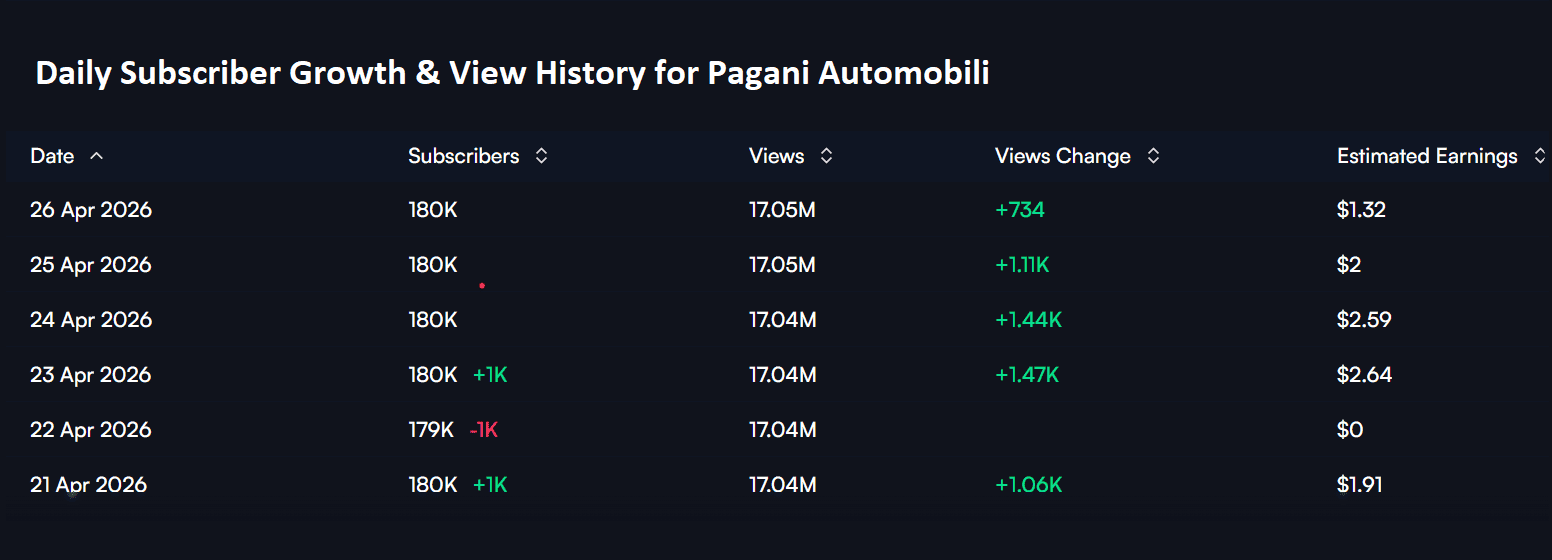
- The dataset shows stable digital channel performance, which increases at a slow rate because it depends on creator platforms that include YouTube analytics.
- The numbers show a consistent subscriber base of ~180K, which indicates that the channel has reached its maturity phase, through which its viewer base will increase at a slow pace.
- Between 21 April and 26 April 2026, subscriber movement remains relatively flat because it moves within a narrow band between 179K and 180K.
- The only notable dip occurs on 22 April (-1K), which is quickly recovered the next day with a +1K gain, suggesting normal churn rather than structural decline.
- The period shows low net subscriber growth, which supports the concept that the audience base depends on retention.
- The total views for engagement purposes stay between 17.04M and 17.05M because they increase at a slow rate throughout each day.
- The “Views Change” metric ranges between +734 to +1.47K per day, which results in daily new views of approximately 1.2K, while the total views show a daily growth rate of 0.007%, which demonstrates that the channel depends on its existing content rather than achieving viral success.
- Estimated daily earnings show a range between USD 0 and USD 2.64, which operates at an active daily range of approximately USD 1.75.
- The highest earnings of USD 2.64 on 23 April connect with the highest view growth of +1.47K, which demonstrates how engagement spikes directly affect revenue at both macro and micro levels.
- The channel operates at a steady state because it has a strong historical base of 17 million views and maintains a stable audience of 180000 subscribers, while its recent growth remains limited.
- The channel needs new content strategies and higher upload frequency and algorithm-friendly formats to reach its next level of growth.
Pagani Utopia – Scarcity, Pricing Power, and the Economics of a 3-Year Waitlist
- The Utopia program from Pagani Automobili shows how businesses can achieve price control and long-term brand value through their practice of making products available in extremely limited quantities.
- Pagani Utopia Coupe production will reach its limit of 99 cars after all units have already been assigned, and the official launch and delivery process will start in late 2023.
- The factory operates at a maximum capacity of 50 to 60 cars every year, which means that the production process will continue for multiple years instead of happening in a short time period.
- The assembly of 99 Coupes will take between 18 to 24 months because production of other models will need to occur simultaneously with this process.
- The Pagani Utopia Roadster follows a precise development path that leads to its final product.
- The Roadster will operate within its production limits, which allows it to reach a maximum capacity of approximately 130 units and then continue its operations until 2027 through 2028 while maintaining a delivery timeline that exceeds three years.
- Ultra-luxury hypercars require customers to wait between three and five years before receiving their vehicles, which follows the standard practices of the industry.
- Pagani maintains its status of limited supply because it can deliver only four to five cars every month at its maximum production capacity.
- The Coupe launched with a price of approximately USD 2.19 million, while the Roadster starts at around €3.1 million, which converts to approximately USD 3.4 million, thus showing a price increase of about 55%.
- The premium price requires the company to spend more on engineering because it needs to redesign the carbon monocoque, which will preserve its original weight of 1,280 kg, but needs to remove the roof structure.
- The precise engineering process increases both material expenses and production duration for each product, which results in higher product prices.
- The complete sale of both Coupe and Roadster vehicles establishes revenue projections that will remain locked until the complete sales period concludes.
- The secondary market shows this with early Utopia units, which have achieved resale values of more than USD 200000 because of their high residual worth and anticipated buyer interest.
- The resale strength of assets develops buyer trust while establishing Pagani as a manufacturer of vehicles that function as investment-grade automotive assets.
- Customers who purchase hypercars between USD 2 million and USD 5 million choose to prioritize exclusive designs and superior craftsmanship instead of receiving their products immediately.
- Pagani uses its build-to-order system, which requires customers to personalize their vehicles through the atelier process to create longer wait times and boost the company’s revenue per product.
- The Coupe-to-Roadster transition process operates as a sequenced production method that leads to the development of new products.
- The final Coupe production phase occurs simultaneously with the start of Roadster manufacturing to create an unbroken production flow, which maintains the existing order system.
- Pagani continues to follow its established business model, which combines limited product releases with high profit margins and ongoing product development through its Grandi Complicazioni program, which limits projects to 10 units.
- Pagani develops financial and brand value through strategic product scarcity, which enables the company to use its car deliveries as instruments that enhance both financial success and brand value.
(Sources: Car and Driver, Motor Authority, Autocar India, Miller Motorcars, Pagani Automobili Press Room, Yahoo Autos, McKinsey automotive luxury analysis)
Pagani ‘Rinascimento’ and ‘Arte in Pista’ Revenue
- Pagani Automobili is currently developing new methods for ultra-luxury car manufacturers to earn money.
- The company developed a successful lifecycle monetisation system through its Rinascimento restoration programme and Arte in Pista track experiences, which operate as two high-margin business lines that generate lasting revenue from their global fleet of under 500 vehicles.
- The Rinascimento programme, which started in 2017, aims to bring back historical models such as the Pagani Zonda and Pagani Huayra to their original factory specifications. These projects require extensive work for several months because they need complete mechanical updates, carbon-fibre restoration, and interior rebuilding.
- Industry estimates indicate that restoration expenses for each vehicle range between USD 500,000 and USD 1 million, while severe instances can lead to costs exceeding multiple million dollars.
- According to McKinsey and Company insights, custom services generate gross margins that exceed 40%, which enables Rinascimento to match or exceed the profitability of new car sales per individual project.
- Rinascimento provides Pagani with strategic advantages because it maintains control over secondary market activities that occur within Pagani’s operational framework.
- The brand safeguards vehicle ownership history and future value through factory-approved restorations, which maintain vehicle documentation accuracy.
- The process of restoration functions as a new sales opportunity, which results in extended revenue generation for each automobile throughout its entire existence.
- The Arte in Pista programme establishes a worldwide racing track system that tracks users who own Pagani Huayra R vehicles.
- The races take place at top racing venues, which include Monza and Spa, where participants experience complete racing services that cover engineering support, training, operational assistance, and guest services.
- The program will expand its operations to 12 international events, which will take place each year in 2026, because participants will pay premium fees for exclusive access to these events.
- Pagani generates ongoing revenue streams from each customer through multiple services, which include vehicle restoration and track participation, instead of earning revenue from their single USD 2-3 million vehicle sale.
- The result creates a business model that delivers constant high-profit earnings while building customer loyalty through exclusive service offerings.
- Pagani establishes a revenue stream through ownership, which allows customers to experience its rare vehicles throughout their entire ownership period.
(Sources: Pagani Official Press Releases, Motor Authority, McKinsey & Company Reports, Pagani Arte in Pista Programme Details, Industry Analyst Estimates)
Conclusion
Pagani Automobili exemplifies a pure scarcity-driven luxury model that generates exceptional financial efficiency through its combination of limited production runs, high-end pricing, and custom-made products. Pagani maintains its ability to charge premium prices because the company restricts its annual production to below 70 vehicles while creating extended waiting lists that last multiple years.
The company generates continuous income streams through its high-profit restoration services and premium customer experience offerings, which attract wealthy clients who make up a small section of its customer base. Pagani functions as an investment-grade luxury brand because its hypercars cost over USD 2 million, and their secondary market prices reach extremely high levels while the company develops products through its distinctive engineering strengths and continuous customer relationship maintenance.
FAQ.
Pagani produces around 50–70 cars per year with some estimates below 40 units.
The Utopia Coupe starts at approximately USD 2.19 million while the Roadster reaches approximately USD 3.4 million.
The Utopia Coupe production limit reaches 99 units while special editions can be produced in quantities as small as 3 units.
The combination of extreme scarcity with handcrafted production and high-performance engineering and customization options leads to prices that exceed USD 2-3 million.
Yes the company creates recurring high-margin revenue streams through restoration programs which cost between USD 500K and USD 1M plus track experiences

Pramod Pawar brings over a decade of SEO expertise to his role as the co-founder of 11Press and Prudour Market Research firm. A B.E. IT graduate from Shivaji University, Pramod has honed his skills in analyzing and writing about statistics pertinent to technology and science. His deep understanding of digital strategies enhances the impactful insights he provides through his work. Outside of his professional endeavors, Pramod enjoys playing cricket and delving into books across various genres, enriching his knowledge and staying inspired. His diverse experiences and interests fuel his innovative approach to statistical research and content creation.