Best AI Trading Bots in 2026: 8 Platforms Compared

Updated · May 20, 2026



Table of Contents
- At a Glance: 8 Best AI Trading Bots in 2026
- How We Picked These Trading Bots
- 1. 3Commas
- 2. Cryptohopper
- 3. Pionex (PionexGPT)
- 4. TradeSanta
- 5. MetaTrader 5 Expert Advisors
- 6. Capitalise.ai
- 7. TrendSpider
- 8. HaasOnline
- How to Choose Between True AI Bots and Rule-Based Bots
- Red Flags When Picking an AI Trading Bot
- Bottom Line
The global algorithmic trading market is forecast to grow from roughly $18.7 billion in 2025 to over $28 billion by 2030, and retail investors now account for around 43% of total algo trading activity (Spencer Logic). What used to require a quant team and a Bloomberg terminal now runs on a $30-a-month subscription and a laptop.

The global algorithmic trading market is forecast to grow from roughly $18.7 billion in 2025 to over $28 billion by 2030, and retail investors now account for around 43% of total algo trading activity (Spencer Logic). What used to require a quant team and a Bloomberg terminal now runs on a $30-a-month subscription and a laptop.
The label “AI trading bot” gets stretched a long way. Some automated trading platforms are genuine machine learning systems that train on price data. Others are rule-based automation tools that the marketing department decided to rebrand as AI. Both types of crypto bots and forex robots can be useful, but they solve different problems, and choosing the wrong one is an expensive mistake.
This guide compares eight of the most-used AI trading bots heading into 2026 across three categories. Crypto-native bots, multi-asset platforms covering stocks, forex and futures, and AI-augmented research tools that drive automated execution. We focused on platforms with verifiable user numbers, transparent pricing, and broker or exchange integrations that actually work in production.
At a Glance: 8 Best AI Trading Bots in 2026
| # | Platform | Asset Class | Type | Starting Price |
| 1 | 3Commas | Crypto | Rule-based + AI assistant | Free / $14/mo |
| 2 | Cryptohopper | Crypto | Rule-based + marketplace | Free / $16/mo |
| 3 | Pionex (PionexGPT) | Crypto | Exchange-native bots | Free (0.05% fee) |
| 4 | TradeSanta | Crypto | Rule-based | Free / $14/mo |
| 5 | MetaTrader 5 Expert Advisors | Forex / CFDs | Code-based (MQL5) | Free (broker spread) |
| 6 | Capitalise.ai | Multi-asset | Natural-language automation | Free / $59/mo |
| 7 | TrendSpider | Stocks / Crypto | AI research + bots | $33/mo+ |
| 8 | HaasOnline | Crypto | Code-based + visual editor | $9/mo+ |
How We Picked These Trading Bots
We assessed each automated trading platform against five criteria.
What “AI” actually means in the product. True machine learning, large-language-model integration, or marketing for rule-based automation.
Broker and exchange integrations. Does the bot actually connect to the venues a real trader uses, or just a handful of crypto exchanges?
Backtesting and paper trading. Can you test a strategy on historical price data before risking capital?
Cost structure. Flat subscription, percentage of profit, or both? Free tiers that work, or free tiers that do not?
Regulatory posture. Does the platform operate transparently, or hide behind offshore licensing? Regulators including the SEC, CFTC, and EU authorities under MiCA are paying increasing attention to AI-driven trading tools (Aurum Law).
1. 3Commas
Best for: crypto traders who want a polished interface and broad exchange support.
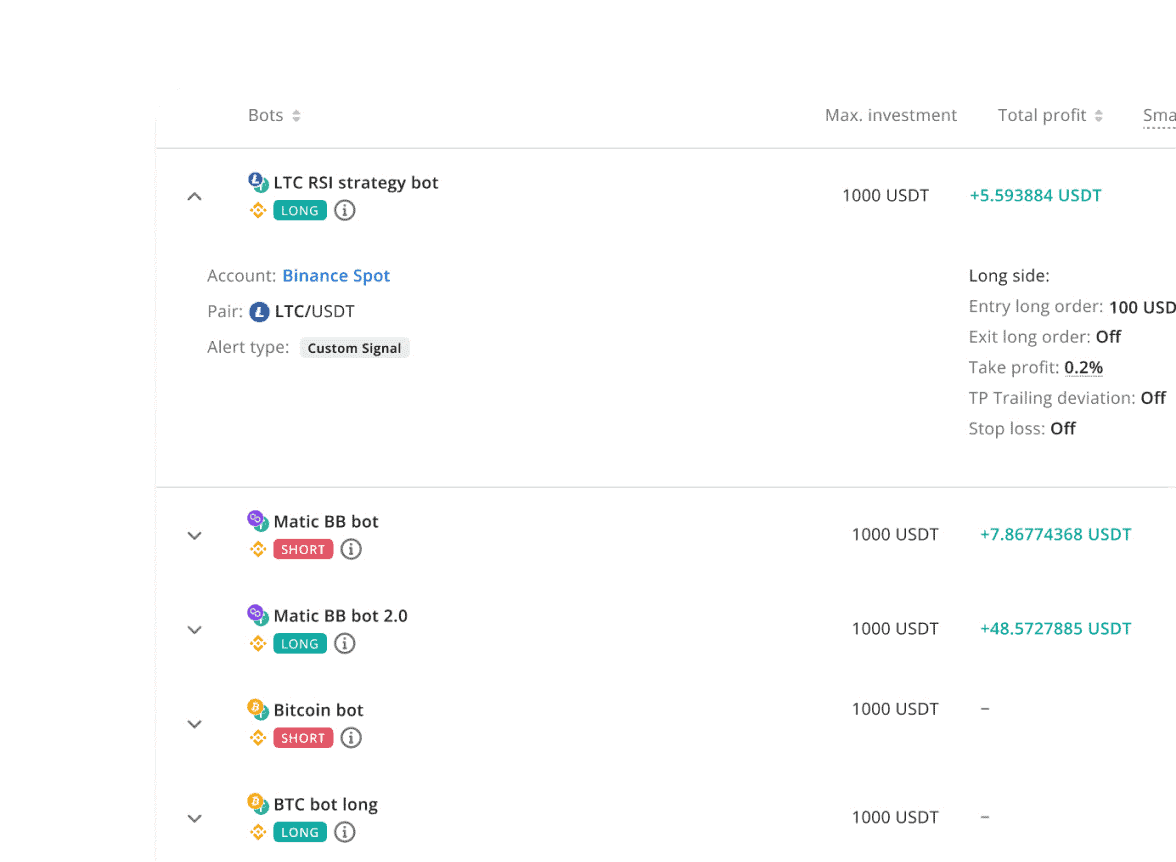
3Commas is one of the longest-running crypto trading bots on the market, supporting major exchanges including Binance, Coinbase, Kraken, KuCoin, and OKX. The platform offers DCA bots, grid bots, options bots, and a “SmartTrade” terminal that lets you set up multi-target take-profit and trailing stop-loss orders manually. An AI assistant feature provides natural-language strategy suggestions and trade ideas.
3Commas leans toward rule-based automation rather than true machine learning, but the rule engine is genuinely sophisticated, and the marketplace lets you copy strategies from successful users.
Pricing: Free tier available; paid plans start at $14 per month.
2. Cryptohopper
Best for: traders who want a strategy marketplace and copy trading.
Cryptohopper offers four account tiers. A free limited “Pioneer” package, then “Explorer” at $16 per month, “Adventure” at $41, and “Hero” at $83 (Coin Bureau). Higher tiers unlock more concurrent positions, more exchanges, and additional bot types.
The standout feature is the Marketplace, where users buy pre-built crypto trading bots, technical indicators, and trade signals from other traders. Paper trading is supported across all tiers, and the platform includes candlestick pattern recognition and customisable indicators. Like 3Commas, Cryptohopper’s “AI” branding is closer to a rule engine than machine learning.
Pricing: Free tier; paid plans from $16 to $83 per month.
3. Pionex (PionexGPT)
Best for: beginners who want bots built directly into the exchange.
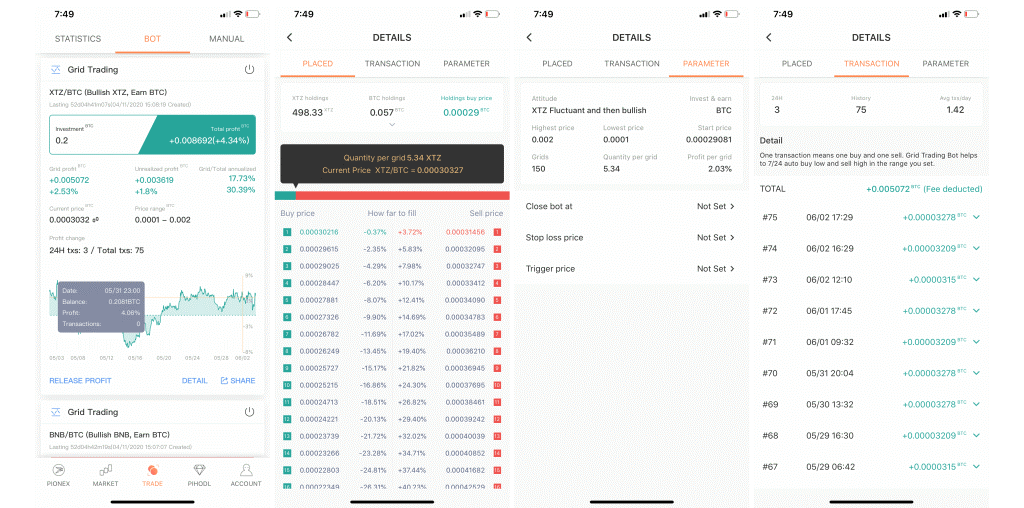
Pionex is a crypto exchange that ships with 16 built-in trading bots out of the box, including grid bots, DCA bots, arbitrage bots, and spot-futures arbitrage. There is no separate subscription. You trade on Pionex itself, and the bots are part of the platform. Spot trading fees are 0.05% per order for both makers and takers (Pionex Review).
The “PionexGPT” feature, currently in beta, is an LLM-based assistant that suggests strategies and explains market conditions in natural language. It is not autonomous trading. It is research and strategy generation that you then deploy via the standard bots.
Pricing: Free; 0.05% per trade.
4. TradeSanta
Best for: traders who want a simple, affordable entry point into crypto trading bots.
TradeSanta keeps the feature set tighter than 3Commas or Cryptohopper, which is part of its appeal. Long bots and short bots with DCA logic, configurable take-profit and stop-loss, and integrations with the major exchanges. Three subscription tiers (Basic, Advanced, Maximum) scale up the number of active bots and additional features.
It is a rule-based platform with no true machine learning component. For traders who know they want a grid or DCA strategy and do not need a marketplace or social layer, it is one of the cheaper options.
Pricing: Free tier; paid plans from $14 per month.
5. MetaTrader 5 Expert Advisors
Best for: forex and CFD traders who want full code-level control.
MetaTrader 5 is the dominant retail forex and CFD platform globally, and its Expert Advisor (EA) system has been the standard for algorithmic forex trading for more than a decade. EAs are written in MQL5, MetaQuotes’ proprietary language, and run inside the MT5 terminal connected to your broker account.
You can build your own EAs, buy them from the MQL5 Market, or hire developers via the MQL5 freelance section. MT5 supports proper backtesting against historical tick data, a feature most crypto bot platforms still do not match. The “AI” angle here is open-ended. It is the platform where serious quantitative forex traders deploy neural networks, but it is also the platform where moving-average crossover EAs get sold as “AI trading bots.”
Pricing: Free with most regulated forex brokers; you only pay the broker’s spread.
6. Capitalise.ai
Best for: traders who want to write strategies in plain English.
Capitalise.ai’s pitch is automated trading without code. You describe a strategy in natural English (for example, “if Bitcoin breaks above $70k on the 4-hour chart, buy and set a 2% trailing stop”) and the platform parses and executes it (Trustpilot). It integrates with major brokers including eToro, Interactive Brokers, and several crypto exchanges.
The natural-language layer is the genuine differentiator. It lowers the barrier for traders who have a clear strategy but do not want to learn MQL5 or Pine Script. Backtesting and paper trading are supported.
Pricing: Free tier; paid plans start around $59 per month.
7. TrendSpider
Best for: stock and crypto traders who want AI-driven research alongside their bots.
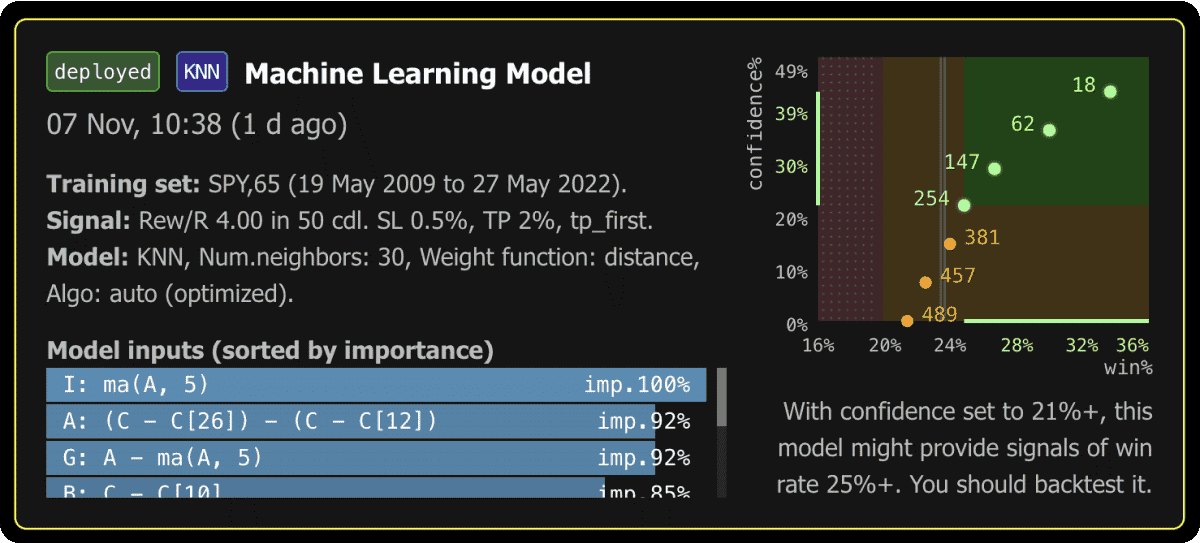
TrendSpider is a multi-asset technical-analysis platform with an AI layer that is more substantive than most. The platform’s AI Strategy Lab lets you train custom machine learning models on your own data and trading goals, defining training data, model type, and inputs to generate probabilistic strategies. Its Sidekick chatbot can read your charts and explain setups in natural language.
Beyond the AI features, TrendSpider includes automated pattern recognition, 200+ indicators, multi-timeframe analysis, and strategy bots that automate execution across 52+ asset types. It is heavier on research than pure automation, which makes it a good fit for discretionary traders who want AI-assisted analysis rather than fully hands-off bots.
Pricing: Plans start at $33 per month (Essential); higher tiers unlock more features.
8. HaasOnline
Best for: advanced crypto traders who want deep customisation and 26+ exchange integrations.
HaasOnline is one of the oldest crypto bot platforms (founded 2014) and is squarely aimed at advanced users. It offers a broad catalog of bots including Accumulation, Crypto Index, Flash Crash, Market Making, Ping Pong, Scalper, Trend Lines, and Zone Recovery, plus a Composite Bot that runs strategies across multiple pairs (CoinSpot.io). HaasOnline connects with 26+ exchanges including Binance, Kraken, Coinbase, Bitfinex, and BitMEX.
Strategies are built with HaasScript (the platform’s scripting language) or a visual editor. There is also a TradingView-alert-driven bot for traders who already have setups on TradingView. The trade-off is complexity. Beginners will find 3Commas or Pionex easier to start with.
Pricing: Plans start at $9 per month (Beginner); higher tiers unlock more bots and exchanges.
How to Choose Between True AI Bots and Rule-Based Bots
The marketing for both categories has converged, but the products are genuinely different.
Rule-based bots (3Commas, Cryptohopper, TradeSanta, Pionex’s standard bots) execute strategies you define in advance. If X happens, do Y. They are reliable, easy to backtest, and predictable. The “AI” branding usually refers to a chat layer that helps you configure the bot, not autonomous decision-making.
True AI trading bots (TrendSpider’s AI Strategy Lab, some custom MT5 EAs) train machine learning models on historical data and generate signals that do not map to fixed rules. They are more powerful in principle and harder to interpret in practice. When the model decides not to take a trade, you often cannot say exactly why.
For most retail traders, a well-tuned rule-based bot will outperform a poorly trained ML model. The question is whether you understand the strategy you are automating well enough to write the rules. If you do not, no bot, AI or otherwise, will save you.
Red Flags When Picking an AI Trading Bot
Guaranteed returns or “passive income” claims. Trading bots automate execution. They do not manufacture alpha. A platform promising 5% to 10% monthly returns is selling a fantasy, not a tool.
Opaque pricing. Any automated trading platform that hides its subscription cost behind a sales call is, statistically, expensive.
No backtesting or paper-trading mode. If you cannot test a strategy without risking real capital, walk away.
Mandatory deposit at a specific broker or exchange. Reputable trading bots let you connect to multiple venues via API. Bots that only work with one (usually unregulated) broker are affiliate-funnel front-ends.
No clear regulatory disclosure. AI-driven trading is increasingly on regulators’ radar. The SEC, CFTC, and EU under MiCA have all signalled that bots used to manage third-party assets may require licensing (Aurum Law). Platforms that operate transparently disclose their regulatory posture; those that do not are taking the risk for you.
Bottom Line
For pure crypto trading bots, 3Commas and Cryptohopper lead on features and ecosystem. Pionex wins on simplicity and zero-subscription cost. HaasOnline wins on depth. For forex and CFDs, MetaTrader 5 EAs remain the standard. For multi-asset automation with a natural-language layer, Capitalise.ai is the most accessible option. And for traders who want genuine machine learning research with execution, TrendSpider’s AI Strategy Lab is the most substantive of the AI-branded platforms on this list.
Pick the platform that matches the strategy you already understand. The AI trading bot does not generate the edge. Your strategy does.
This article is for informational purposes only and does not constitute investment advice. Trading and automated trading carry significant risk of loss. Past performance does not guarantee future results.
Sources
FAQ.
Bots execute strategies. They do not create them. A bot running a profitable strategy will make money. A bot running a losing strategy will lose money faster than you would manually. The biggest gains from automation usually come from emotional discipline (the bot does not panic-sell) rather than superior signals.
Most crypto trading bots have low minimums. You can run a grid bot on Pionex with under $500. Forex EAs on MT5 typically assume $1,000 or more for sensible position sizing. Multi-asset platforms vary by broker. As a rule, you want enough capital that transaction costs and minimum lot sizes do not dominate your returns.
In most jurisdictions, yes, but the legal status depends on use. Trading your own account is generally unregulated. Operating a bot to trade for third parties usually triggers investment-adviser or asset-management regulations under the SEC (US), FCA (UK), MiCA (EU), and similar frameworks elsewhere.
Yes, and many serious algo traders do. The most common stack for stocks and crypto is Python with broker APIs (Alpaca, Interactive Brokers, Binance), pandas for data, and a strategy framework like Backtrader or Zipline. For forex, MQL5 on MetaTrader 5 is the established path. The build-vs-buy question usually comes down to whether you are comfortable maintaining your own code in production.
A bot executes a defined strategy. A copy-trading platform (eToro, ZuluTrade) mirrors the trades of another human in real time. Bots are predictable and auditable; copy-trading puts your returns in the hands of someone else’s discipline.

Joseph D'Souza founded ElectroIQ in 2010 as a personal project to share his insights and experiences with tech gadgets. Over time, it has grown into a well-regarded tech blog, known for its in-depth technology trends, smartphone reviews and app-related statistics.