AliPay Vs. WeChat Pay Statistics You Must Need To Know (2025)

Updated · Dec 10, 2025


Table of Contents
- Introduction
- Editor’s Choice
- Share Of Chinese Payment Customers Who Choose The Following Apps
- Reasons To Choose Mobile Payments
- Demographic and Regional Penetration (Including Rural vs Urban Usage)
- Mobile Payment Penetration In China
- Key Differences of AliPay Vs WeChat Pay
- Cross-Border And Overseas Usage
- Supported Currencies And Devices
- Technological Innovations
- Regulatory And Policy Impact
- Recent Developments
- Conclusion
Introduction
AliPay Vs. WeChat Pay Statistics: Consider a scenario in which you purchase your morning coffee, take the bus, and purchase groceries without handling any coins. This is achieved through one of the two apps that together handle nearly all daily payments in China. By 2025, Alipay and WeChat Pay will remain prominent, but not merely as payment apps; they have indirectly become an economy’s backbone—billions of users, trillions of dollars in annual transactions, and a constant struggle for customer access, ecosystem support, and global expansion.
The author presents the piece clearly by using the most recent 2024-2025 AliPay vs. WeChat Pay Statistics, the conclusions of new research, and the perspectives of merchants and fintech observers, who derive the most practical implications.
Editor’s Choice
- Approximately 90% of online payment users in China rely on Alipay or WeChat Pay, which have been key players in the digital payment ecosystem.
- Alipay leads with a higher total market share (54.5%), whereas WooCommerce Pay has a larger customer base and higher penetration (84.3%).
- UnionPay is the third option, used by approximately 45% of the survey participants.
- Apple Pay and PayPal have expanded their market share among Chinese online payment users, with usage rates of 22% and 11%, respectively.
- Mobile payments have become an integral part of daily life in China—almost 70% of the population use them regularly.
- The two main reasons for adopting mobile payments are convenience (44%) and speed (40%).
- Mobile payments are used by many people to evade credit card fees (36.8%) and to access low processing costs.
- Approximately 19% of consumers adopt mobile wallets because they can be easily integrated into existing online payment practices.
- Security is a factor for about 16% of users, whereas discounts and promotions are the primary reasons for about 14%.
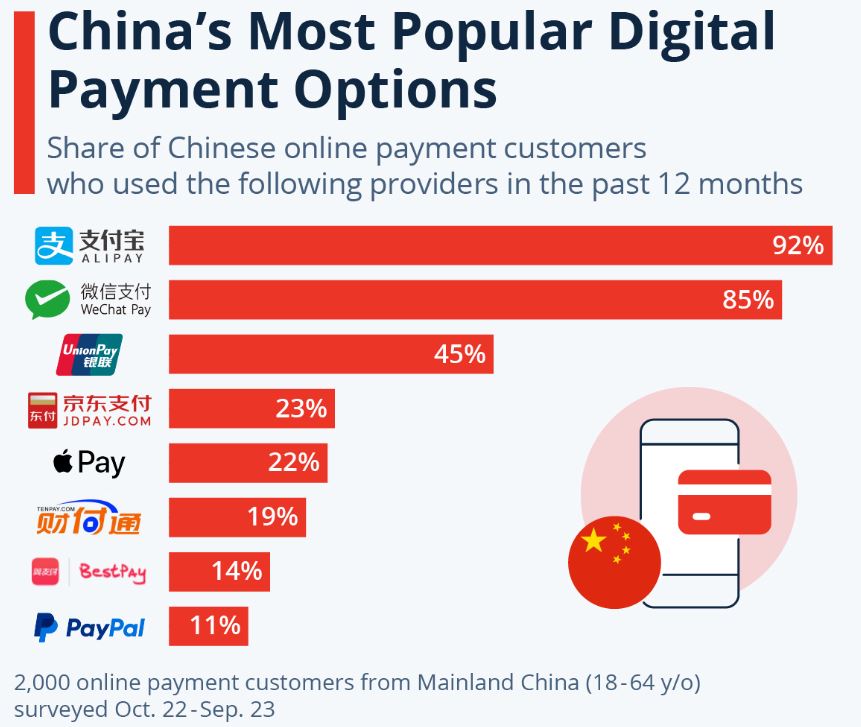
- By the middle of 2024, 92% of surveyed users reported using Alipay, while 85% reported using WeChat Pay.
- The number of mobile payment users in China reached an estimated 968.9 million.
- Usage in rural areas is increasing rapidly, with a projected 65% by 2025.
- The 18-35 age group has nearly 100% adoption of modern payment methods, with QR code usage exceeding 95%.
- The majority of mobile payments, over 90%, are done through QR codes.
- Alipay’s 27 currencies make it easy and affordable to withdraw large amounts, as withdrawals are only processed after RMB 20,000, with no fee charged.
- With WeChat Pay, you can withdraw in 13 currencies, but the fee starts at RMB 1,000 with a 0.1% charge on top of that.
- Alipay is available on almost all devices, whereas WeChat Pay is restricted to devices with the WeChat application installed.
- Alipay is available in more than 220 countries and regions, and WeChat Pay is available in more than 20.
- Alipay Tour Pass and WeChat Overseas Wallet are features that support global tourism on both platforms.
- In April 2025, Ant Group reinforced Alipay’s position by purchasing a Hong Kong securities firm for US$362 million.
- Alipay now offers more than 50 currency options and continues to develop its financial services ecosystem.
(Source: statista.com)
- Digital payments have become a part of everyday life in China. Statista Consumer Insights recently reported that Alipay and WeChat Pay are the leading payment methods in the country, with approximately 90% of Chinese online payment users reporting that they have used these two platforms at least once in the past year.
- UnionPay, which is connected to the big state-run bank card network in China, is the second-most popular choice but very distant at about 45% of those who voted.
- The same study reports that mobile payments have become an integral part of everyday life in China, with nearly 70% of respondents reporting using them.
- Although Alipay and WeChat Pay are the largest, several other payment service providers, including JD.com, Tencent’s wallet services, Huawei Pay, and Bestpay from China Telecom, have successfully launched their own payment services in the market.
- As a matter of fact, two companies that are not Chinese also made it to the top tier, one of them being Apple Pay, which reached a 22% user rate (an increase from 19% the year before), and the other being PayPal, which made its way into the top 8 with an 11% user rate among online payment customers.
Reasons To Choose Mobile Payments
(Reference: coinlaw.io)
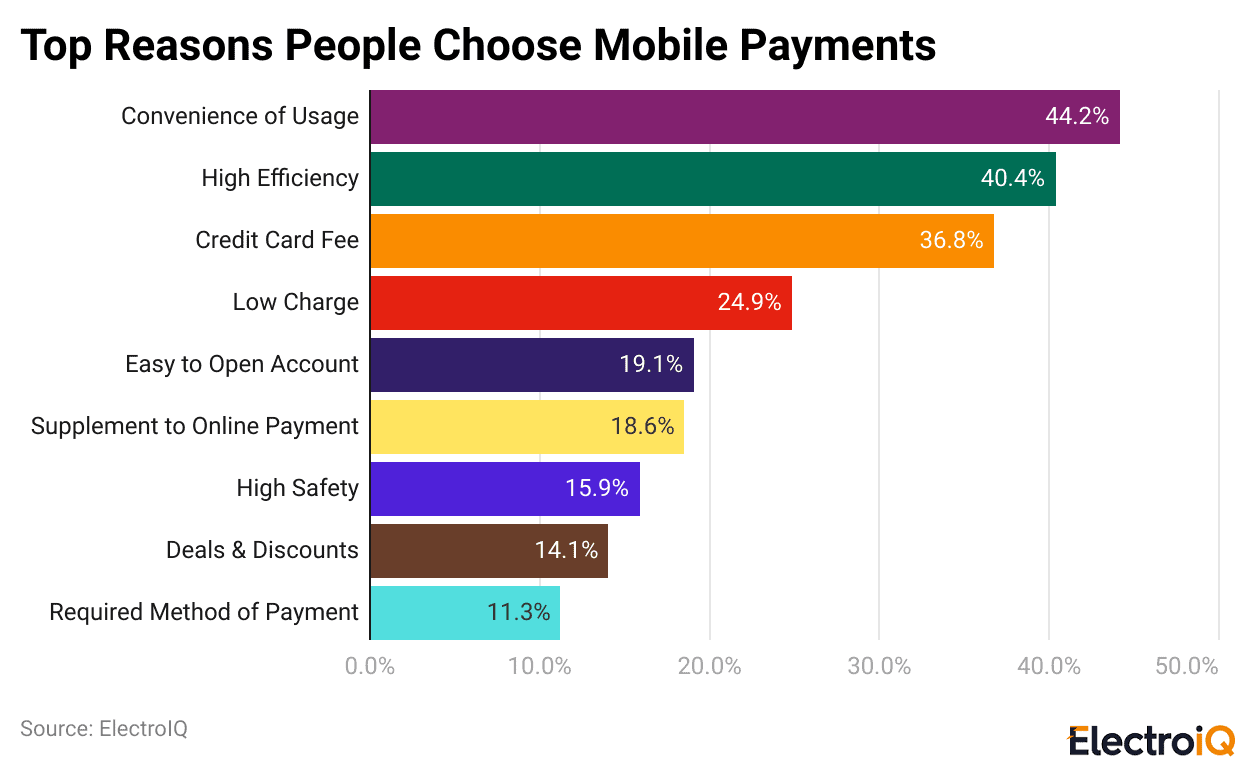
- Consumers choose mobile payments for a multitude of reasons, both practical and financial, with convenience being the primary factor.
- According to surveys, approximately 44% of users prefer mobile payments because of their user-friendliness.
- Speed is another important factor, with approximately 40% of users completing transactions quickly.
- A mobile payment method is used by about 36.8% of users to avoid credit card fees, while the relatively low charges on mobile wallet transactions are a factor considered by nearly one-fourth of users.
- Most mobile payment platforms require a straightforward account opening, which influences approximately 19% of users.
- Adopters of mobile payments believe that the new method integrates easily with their existing online payment practices; nearly 19% consider it an additional payment method that does not require adjusting their digital habits.
- Security is also a factor: approximately 16% of people using mobile wallets are attracted to their safety features.
- Wallets 14% are driven by the availability of deals, discounts, and promotional offers.
- Lastly, for approximately 11%, mobile payments are not merely a matter of choice; in some situations, they are required, leading to adoption even if the user would not otherwise have chosen the method.
Demographic and Regional Penetration (Including Rural vs Urban Usage)
By the middle of 2024, mobile payment usage in China had reached ironclad levels. Nearly 92% of Chinese users surveyed reported using Alipay, while 85% reported using WeChat Pay. In terms of magnitude, approximately 968.9 million individuals nationwide used mobile payments, estimated to constitute about 38% of the total population when children and less tech-savvy individuals are included. Users in cities tend to prefer Alipay, as its strong relationship with major online shopping platforms, such as Taobao and Tmall, makes it highly preferred for online shopping.
The opposite is the case in rural where the adoption is increasing rapidly due to better mobile infrastructure and more digitization programs that will lead to higher digital literacy. In the smaller tier 3 and tier-4 cities, WeChat Pay is especially popular because it’s part of the WeChat social ecosystem, which allows users to chat, shop, and make payments within one app.
Mobile Payment Penetration In China
Among the top global penetration rates, China’s mobile payment penetration is the highest, with more than 85% of urban residents using mobile payment methods for transactions. The penetration in rural areas is also increasing, and it i,s expected to be around 65% in 2025 as a result of the growing smartphone access and government-backed digitization initiatives. The young consumers between 18 and 35 are the most, practically, universally adopters due to the factors like app interface simplification and accessibility to the old as well as the government hearing the seniors’ side and thus giving in to their digital payments requesttal wallets are, nowadays, the most widely accepted payment method for daily expenses in more than two-thirds of households in the country.
QR codes enable contactless payments; they account for more than 90% of all mobile transactions, thus they dominate the landscape. Integration of platforms and services is another factor that is rapidly increasing adoption in smaller and mid-sized cities, creating a more uniform digital payment environment nationwide.
Key Differences of AliPay Vs WeChat Pay
| WeChat Pay | Alipay | |
| Share of China’s mobile payment market | 39.5% | 54.5% |
| Market penetration rate | 84.3% | 62.6% |
| Number of supported currencies | 13 | 27 |
| User Fees | 0.1% for withdrawals over RMB 1,000 |
0.1% for withdrawals over RMB 20,000
|
| Supported devices | Devices that support WeChat |
All phones, tablets, and PCs
|
(Source: ltl-beijing.com)
- The data highlight several key differences between WeChat Pay and Alipay in market share, usage, fees, and flexibility.
- Alipay is the largest mobile payment service in China, holding 54.5% of the market share while We, Chat Pay occupies the remaining 39.5%.
- On the other hand, the penetration rate of WeChat Pay is higher, reaching 84.3% of the population, whereas Alipay reaches only 62.6%. Alipay is the market leader, as it supports 27 currencies compared with 13 supported by WeChat Pay. This gives Alipay a stronger position among world travellers and merchants who want to use multiple currencies.
- When comparing fees, both companies have the same rate of 0.1% for withdrawals.
- However, the fee for Alipay users applies only when their withdrawal amount exceeds RMB 20,000, whereas WeChat Pay starts to charge after a limit of RMB 1,000; thus, Alipay is the more user-friendly option for those who frequently withdraw large amounts.
- Also, there are differences in device support. WeChat Pay is restricted to users of the WeChat app on their devices, whereas Alipay is more versatile and can operate on almost all types of smartphones, tablets, and even PCs, giving it a wider range of users across platforms and devices.
- The mobile payments sector has almost entirely supplanted cash in most Chinese industries.
- In light of this, it is estimated that in retail, especially in tier-1 cities, there is a ratio of more than 85% of the in-store purchases that are made through mobile wallets.
- This tendency is also evident in the online travel industry, where more than 80% of bookings are paid for using Alipay or WeChat Pay.
- The case is similar to that of the food and drink industry, which is the most mobile payment-intensive sector, with some quick-service restaurants reporting that up to 90% of their sales are made through mobile payment apps.
- Digital methods for utility payments have largely supplanted traditional channels, and payments via Alipay and WeChat Pay have grown by over 20% year on year.
- Most younger users make peer-to-peer transfers via mobile wallets, which have thus become the primary means of transferring money to friends or family.
- Education payments—ranging from school tuition to online courses—have become easier through the adoption of mobile payments as the primary channel.
- Not surprisingly, entertainment spending follows the same trend: over 75% of payments for cinema tickets, streaming services, and other channels are channelled through these two mobile platforms.
Cross-Border And Overseas Usage
- Alipay has developed a vast international infrastructure and is now recognized in over 220 nations and regions, offering over 50 currencies through direct partnerships.
- WeChat Pay is also expanding its reach internationally and in the Asia-Pacific region, where it receives significant Chinese tourist traffic; it remains strong, whereas other countries are not well covered at all.
- Across all countries, both payment solutions are available to foreign travellers.
- Japan, Thailand, and Singapore are among the countries with strong co-functioning of Chinese mobile payment systems.
- Foreign merchants targeting Chinese customers are likely to use both Alipay and WeChat Pay to simplify sales and provide a payment experience that is not dissimilar to that in the customer’s home country.
- Support from international payment gateways has facilitated merchants’ acceptance of cross-border QR code payments.
- With the lifting of travel restrictions, the number of Chinese tourists abroad has increased substantially.
- The service’s “Tour Pass” and WeChat Pay’s “Overseas Wallet” facilitate foreign spending by travellers, allowing them to pay at local shops without a local bank account.
Supported Currencies And Devices
- Alipay has a very generous list of supported currencies for payments, with more than 50. It includes a convenient real-time exchange rate conversion, making international purchasing straightforward.
- WeChat Pay is not left behind and provides the same currency-conversion treatment by debiting and crediting via international cards.
- Both services are compatible with almost any mobile device, whether it is an inexpensive Android or an iPhone of the highest category.
- Wearables, such as smartwatches and fitness bands, now include a tap-to-pay function that enables fast, easy contactless payments.
- Although QR code scanning remains the primary channel for mobile payments, in some markets, digital payments are slowly but surely making their way to the top.
- Payment functionalities have extended to tablets and some interactive TV systems via apps, enabling in-app purchases.
- The companies are also actively exploring new features, such as voice-activated payments through smart home devices, as part of their ongoing development of technology ecosystems.
Technological Innovations
- In China, QR codes remain the most widely used method for mobile payments, serving as the primary channel for most transactions.
- The installation of facial recognition payment terminals is becoming common in many shops and subway stations, allowing patrons to pay simply by looking at the display.
- AI systems operate in the background, tracking transactions to identify and alert on any suspicious or potentially fraudulent activity in real time.
- Smart speaker technology is gradually incorporating features such as voice-activated payments, enabling consumers to complete payments with a spoken command.
- NFC technology, which enables tap-to-pay transactions, is gradually being integrated alongside QR payments to expedite checkout.
- In addition, Alipay and WeChat Pay are exploring more sophisticated biometric technologies, such as fingerprint scanning and palm vein recognition, to enhance security and user-friendliness.
- Users can use offline payment methods, which allow them to complete transactions without an internet connection, ensuring uninterrupted processing regardless of the circumstances.
Regulatory And Policy Impact
- The Chinese government has imposed stringent regulations on the fintech industry, with the most stringent measures enacted in 2021 and thereafter.
- The People’s Bank of China has intensified supervision, and a new regulation set to take effect in 2025 will further tighten lending restrictions for non-bank platforms.
- Data protection laws require that user data be encrypted and stored solely in China, so companies must implement the required security measures.
- Additionally, companies will have to comply with strict anti-money-laundering and identity-verification protocols.
- Cross-border payments are subjected to additional monitoring and must comply with currency conversion regulations.
- Some high-risk financial products have been put on hold, or their marketing has been restricted due to increased supervisory oversight.
- As regulations become more complex, it becomes more expensive for companies to comply, which in turn affects their pace of innovation and expansion.
Recent Developments
- In April 2025, Ant Group took a step toward broadening its financial horizons by purchasing a controlling interest in a Hong Kong-based securities firm for approximately US$362 million, thereby enhancing Alipay’s role in the financial services sector.
- In addition to being available as a payment method in more than 220 countries, Alipay provides customers access to more than 50 global currencies.
- WeChat Pay has also expanded globally, operating in more than 20 countries, primarily to serve Chinese travellers in Chinese communities.
- Ant Group has invested over 21 billion yuan (approximately US$2.9 billion) in AI-related areas, R&D, and AI innovation in 2023, and this trend is expected to continue through 2025.
- Alipay has further integrated into the financial ecosystem, thereby enabling users to access more lending, investment, and insurance options.
- On the other hand, WeChat has broadened its mini apps and improved its AI-fueled services for the purpose of increasing participation in both social and commercial activities.
- Control of the authorities has become more stringent in 2025 with us, er data, broader areas of fintech operations, and among others being the major areas of concern to the authorities, thus, influencing the two platforms’ evolution in terms of their reactiveness.
Conclusion
AliPay vs. WeChat Pay Statistics: Alipay and WeChat Pay have been the main pillars of China’s digital economy, transforming the way hundreds of millions of people conduct daily transactions. Their power not only depends on their speed and convenience but also on their extended collaboration with social, commercial, and cross-border ecosystems. The winner of the competition between the two has surely been Alipay, since it has the largest reach and financial services, whereas WeChat Pay has almost the same number of users through its social networks. The rapid adoption of these devices in rural areas, the application of technologies such as facial recognition, and the presence of strict regulations largely dictate the platforms’ evolution.
These two payment methods together indicate China’s transition to a fully digital, interconnected payment system that not only changes but also sets global fintech trends and user expectations.
Sources
FAQ.
Alipay and WeChat Pay’s domination is due to their scopes of operation in daily life—online shopping, in-store payments, utility bills, transport, and peer-to-peer exchanges. Their ecosystems provide the users with unmatched convenience, and of the same quality security and speed, hence, about 90% of the online payment users in China are dependent on at least one of them.
Mainly the users’ ability to make payments by avoiding credit card fees, low service charges, simple account setup, and seamless integration with online shopping. Besides this, the security aspect, discounts, and limited cases of mobile payments also play a major role in influencing the adoption.
Alipay is the market leader with a share of 54.5%, while WeChat Pay has a better user penetration at 84.3%. Alipay supports 27 currencies, while WeChat Pay supports only 1; thus, Alipay has the advantage for international travel. The withdrawal fees are the same at 0.1; however, the limit for Alipay is much higher at RMB 20,000 compared to RMB 1,000 for WeChat Pay, hence cheaper for large withdrawals. In addition, Alipay can be used on more device types, including PCs.
Mobile payments have taken over all the major industries almost completely. Most of the tier-1 retail transactions (more than 85%), online travel payments (around 80%), and more than 90% of quick-service restaurant purchases are done through mobile wallets.
Among the innovations are facial recognition payments, AI fraud detection, offline payment modes, biometrics, NFC support, and voice-activated payments, which all contribute to the growth of capabilities. On the other hand, China has been strict in the regulation of fintech lending, data protection, and anti-money laundering compliance, which has resulted in tighter controls.

I hold an MBA in Finance and Marketing, bringing a unique blend of business acumen and creative communication skills. With experience as a content in crafting statistical and research-backed content across multiple domains, including education, technology, product reviews, and company website analytics, I specialize in producing engaging, informative, and SEO-optimized content tailored to diverse audiences. My work bridges technical accuracy with compelling storytelling, helping brands educate, inform, and connect with their target markets.