LinkedIn Advertising Statistics By Revenue and Facts (2025)

Updated · Dec 08, 2025


Table of Contents
Introduction
LinkedIn Advertising Statistics: The LinkedIn advertising ecosystem is no longer a secluded part of B2B marketing — it has reached approximately 1.2 billion users and is expected to earn around US$8.2 billion in ad revenue, making it one of the most rapidly developing and profitable platforms for marketers in the B2B sector.
The combination of widening ad reach, increased video usage, and sophisticated AI tools provides the platform with high-quality targeting options, which are major drivers and a must-have channel for today’s B2B growth. This article will reflect the LinkedIn statistics and their trends.
Editor’s Choices
- In 2025, LinkedIn’s ad reach hit 1.2 billion users, adding 300 million users in two years.
- LinkedIn is expected to generate US$8.2B in ad revenue in 2025, rising to US$11.3B by 2027.
- Video content is rising sharply: +36% video uploads and +100% video creation YoY after new AI and livestream features.
- LinkedIn ads currently reach about 350M active users monthly, indicating a disparity between total users and those reachable by ads.
- The average CPC on LinkedIn in the U.S. is US$8–US$10, while the global CPC is around US$6–US$7.
- Global CTR ranges from 0.44% to 0.65%, with video ads at 0.44% and single-image ads at 0.56%.
- CPM is between US$50–US$100 in the U.S. and US$40–US$80 globally.
- CPL is very diverse: US$20–US$350, with North America being the highest (~US$230).
- Video ads are the most engaging, with an engagement rate of almost 1.6%.
- LinkedIn has the largest share of B2B advertising budgets among single platforms, while Google Search, Display, and YouTube cannot attract similar budgets individually.
- LinkedIn is the B2B platform with the highest ROAS (113%), surpassing both Meta and Google.
- The average time of B2B buying journeys is 211 days, and deals with enterprises take 49% longer.
- The MQL → SQL step has the longest delay, on average 107 days, which calls for nurturing.
- LinkedIn’s leading industries in ad spending are Business/Industrial, Tech/Electronics, and Government/Nonprofit; the retail sector accounts for only 2%.
- LinkedIn demographics: 57% male, 43% female; majority aged 25–34.
Quarterly Ad Spending On LinkedIn
(Source: amazonaws.com)
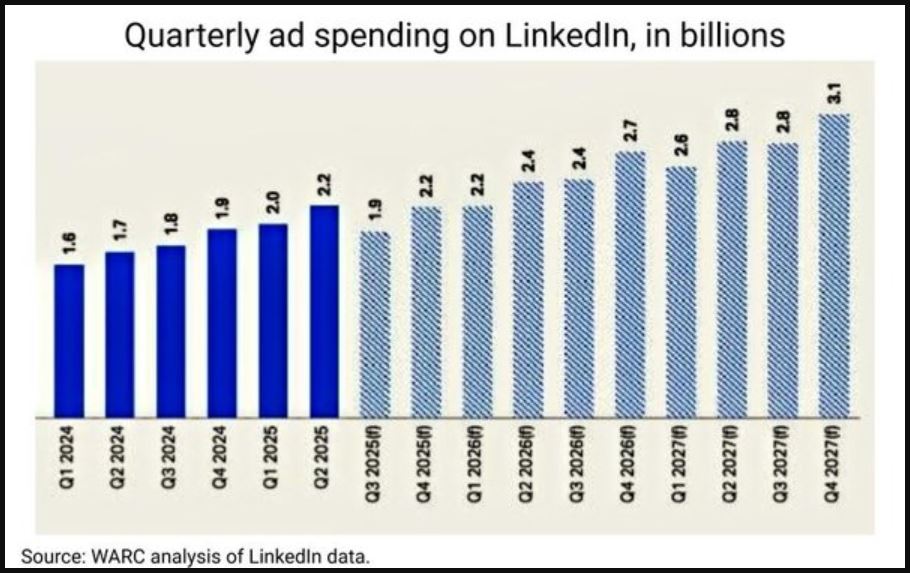
- LinkedIn is fortifying its position as a primary advertising platform at a rapid pace, with video content, artificial intelligence tools, and connected TV as the main drivers.
- The World Advertising Research (WARC) has just released new forecasts predicting that LinkedIn will see steady increases in ad revenue over the next few years.
- The company’s ad revenue in 2025 is US$8.2 billion, which is an 18.3% year-over-year increase, followed by US$9.7 billion in 2026 and US$11.3 billion in 2027—continuing the upward trend.
- Even though the advertising side of LinkedIn accounts for a mere fraction of Microsoft’s overall business, it is still the case that the ad growth of LinkedIn is higher than that of the other mid-sized platforms.
- WARC’s analysis indicates that by 2027, Snapchat’s ad revenue is anticipated to hit US$6 billion, US$4.2 billion for Pinterest, and Reddit will have US$2.2 billion — all below LinkedIn’s path.
- A premium subscription rise and the B2B creators, video formats, and connected TV campaigns that are pushing the platform are identified as significant factors contributing to LinkedIn’s success.
- Moreover, the report provides insights into the sectors that spend the most on the platform.
- The business and industrial sectors are on top, followed by technology and electronics, with government and non-profit organizations coming in third. Retail is the least contributor, accounting for just 2% of overall LinkedIn ad revenue.
- On top of this, companies that deal with generative AI are also among the heavy investors on LinkedIn, allocating 12% of their digital ad budget to the platform, which is significantly higher than the 3% average across other sectors, as reported by Sensor Tower.
LinkedIn Ad Benchmark
- Keeping track of LinkedIn ad benchmarks is crucial for assessing your campaigns’ performance relative to competitors in your sector.
- The click-through rate (CTR) is one of the most important metrics, as it is directly related to Sponsored Content in most cases.
- Generally, you are charged for each click; however, the CTR is calculated based on impressions. The worldwide average CTR is between 0.44% and 0.65%.
- The average for single-image ads is close to 0.56%, while for video ads it is around 0.44%, and for carousel ads it is about 0.40%. A lower CTR often indicates that your advertisement’s creative or message is not appealing enough. Marketing specialists recommend a 0.7% to 1% CTR as a target when launching advertising campaigns, since a higher CTR positively impacts the Quality Score, which may result in a lower cost per click (CPC).
- CPC is the term for the price you pay per ad click on LinkedIn. The latest figures say that the CPC in the U.S. is US$8 to US$10, and the global average is about US$6 to US$7.
- The figures keep climbing due to competition and the introduction of more precise targeting options.
- By targeting the right audience, the Quality Score can be improved, and CPC reduced through better-performing ads.
- Cost per impression (CPM) shows whether the amount you spend on ads is worth it, based on the number of impressions and their impact.
- CPM indicates the cost for every 1,000 impressions. U.S. average CPMs range from US$50 to US$100, while global CPMs are approximately US$40 to US$80.
- The use of this metric is central for campaigns aiming at creating awareness of a brand, and such activities as improving targeting by demographics and testing different ad variations are very likely to help in optimizing CPM.
- CPL, or cost per lead, is an indicator of how much it costs you to generate one lead. CPL on LinkedIn may differ greatly from US$20 to as much as US$350, depending on the region or industry.
- The CPL for Latin America is the lowest at about US$60, whereas the average for North America is around US$230.
- Actually, offering useful things like checklists, guides, or cheat sheets usually results in much better lead-generation performance.
- The engagement rate indicates how well the audience interacts with the ad, measured by both paid and organic clicks.
- The average engagement rate for single-image and carousel ads is about 0.5%, while video ads do much better, with an engagement rate of around 1.6% due to their greater visual appeal.
- The engagement rate can be calculated by dividing the total number of clicks by the total number of impressions.
- These benchmarks collectively help advertisers assess performance and make the right decisions for their LinkedIn campaigns.
Significance of LinkedIn Advertising In B2B Marketing
- Looking at 2024 statistics, it’s clear that LinkedIn is becoming the first choice for B2B marketing professionals.
- The annual survey revealed that the share of marketing budgets earmarked for LinkedIn Ads increased from 31% to 39%, indicating that an increasing number of companies are ready to invest significantly in the platform.
- If one resorts to comparing LinkedIn with Google’s individual networks—like Search, Display, or YouTube—LinkedIn now claims the top spot as the largest single-platform recipient of ad spend in B2B marketing.
- This turn of events indicates a gradual increase in confidence in the platform’s power to provide positive results.
- Lars Grønnegaard, the Chief Executive Officer of Dreamdata, has mentioned that one of the issues that bothers many marketers is whether their budget for LinkedIn is being utilized effectively.
- However, the recent study has put their worries to rest by asserting that LinkedIn remains a bottleneck for B2B companies in terms of growth.
- The ability to directly reach decision-makers and the unique firmographic targeting are the two major factors that really distinguish LinkedIn from other social networks.
- To put it another way, advertisers can target by job title, seniority, company size, and industry with unmatched precision, available only on LinkedIn.
- Despite Google’s advertising ecosystem still accounting for 48% of total ad spending, LinkedIn’s swift growth has proven it is a strong contender in the B2B marketing game.
- More and more marketers are supporting the platform because it enables targeting very specific professional audiences, ensuring that the money they spend on ads is actually going to people who can influence business decisions.
LinkedIn Ads Performance – ROAS And Cost Benchmarks
- LinkedIn Ads may look pricey compared to Meta or Google, but after digging into them, they are the ones that deliver the strongest financial return for B2B marketers.
- Now, LinkedIn is offering a 113% ROAS (return on ad spend), making it the only major platform consistently delivering B2B advertising with a positive ROI.
- Meta might attract cheaper clicks, yet it does not bring in the same level of high-value decision-making audiences.
- Google Search shows strong intent, but its overall ROAS is still not up to LinkedIn’s level.
- Another factor that contributes to LinkedIn’s great performance is its ability to reach the right companies at the right moment in the buying cycle.
- It has the lowest cost per company influenced; thus, it is very useful for account-based marketing, where getting to the specific organizations, not just individuals, is very important.
- The statistics also reveal how long a typical B2B customer journey lasts: approximately 211 days from first contact to deal closure.
- Large corporations take 49% longer than small ones because they go through more steps and involve more people in their decision-making process.
- One of the most significant delays happens between MQL (marketing-qualified lead) and SQL (sales-qualified lead) stages, where the average time is 107 days.
LinkedIn Advertising Audience Reach
(Source: snov.io)
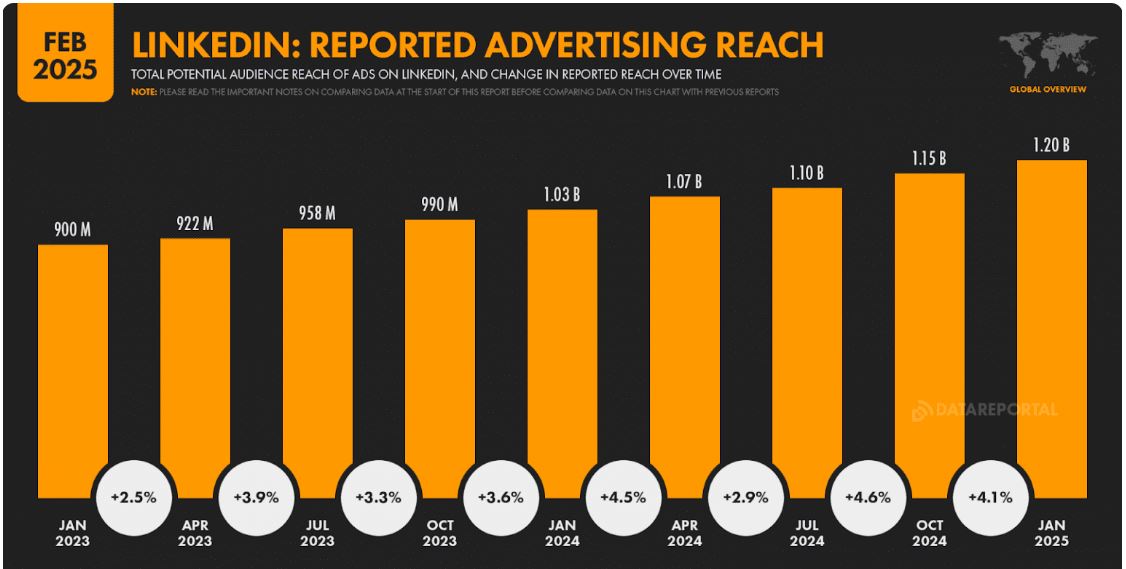
- LinkedIn’s advertising reach has been consistently increasing from January 2023 to January 2025.
- Back in January 2023, it was estimated that around 900 million people could be reached through LinkedIn ads.
- This number increased to 922 million by April 2023, a rise of 2.5%.
- The number continued to grow, reaching 958 million in July 2023, a 3.9% increase, and then 990 million in October 2023, a 3.3% rise.
- The year 2024 started with LinkedIn’s ad reach surpassing the one-billion mark, and in January, it was 1.03 billion with a growth rate of 3.6%.
- The positive trend didn’t stop there; it continued up to 1.07 billion in April 2024 (+4.5%) and then to 1.10 billion in July 2024 (+2.9%). The ads reached 1.15 billion by October 2024, a 4.6% increase.
- Ultimately, by January 2025, LinkedIn’s ad reach reached 1.20 billion users, a 4.1% increase over the previous period.
- All in all, the data clearly indicates that LinkedIn’s potential advertising audience consistently and significantly grew during the two-year period in which the platform added 300 million users to its ad reach.
LinkedIn User Demographics
- The United States tops the chart of countries with the most LinkedIn accounts, with more than 234 million users, making it the most important area for recruiting, networking, and B2B sales engagement.
- On the other hand, the Asia-Pacific region leads the world in total users, with more than 326 million accounts, due to rapid economic development, increasing digital adoption, and support for multiple regional languages, which make the platform more user-friendly.
- The global gender distribution on LinkedIn is 57% men and 43% women.
- Though the difference is not large, studies indicate that women are more likely to be passive in showcasing their skills online, which can, in turn, negatively affect their visibility and professional opportunities.
- According to age distribution, men aged 25 to 34 are the largest demographic group, comprising 26.8%, while the corresponding group of women comes second, and just a tiny fraction of users—2.2% of men and 1.1% of women—are aged 55 or above.
- The detection of these tendencies underscores the need for targeted B2B segmentation that aligns with audience behaviours and interests.
- The statistics reveal that more than a fifth of the global population has opened a LinkedIn account, indicating the platform’s massive reach for networking, career development, and business.
- Of the users, 61 million are categorized as senior-level influencers, and around 40 million possess decision-making capabilities, which means that advertisers and businesses are allowed to target the very individuals that can make or break the company’s future.
- The professional services sector is the main driver of LinkedIn’s user growth, accounting for 233 million members, or more than 20% of the total user population.
- This is a big win for the service industry, as they can now have a direct line to their potential clients.
- LinkedIn members in the U.S. are also highly educated—one-third hold a bachelor’s degree and 18% have a master’s or equivalent degree—therefore, the platform continues to be regarded as a professional, skills-centric ecosystem that cultivates talent.
- To wrap it up, LinkedIn is available in 36 languages, a sign of its dedication to inclusivity worldwide and to helping people from all walks of life benefit from the platform’s features and services.
Conclusion
LinkedIn Advertising statistics: The escalating ad growth, increased global presence, and impressive performance indicators are unmistakable signs that it is the most efficient platform for B2B advertising in 2025. The precision in targeting the right decision-makers, together with increased video engagement and the use of AI tools, are the main factors that help brands win higher-quality leads and stronger ROI than on other platforms.
Even though the platform charges a higher CPC, it guarantees better ROAS, wider influence within accounts, and access to a large and fast-growing professional audience. The longer and more complicated B2B buying journeys create a dilemma for marketers who rely on LinkedIn’s firmographic targeting and creator-focused ecosystem as their only channel for continuous business impact.
Sources
FAQ.
With its precise targeting abilities, large professional user base, and excellent ROI, LinkedIn has developed into the most important advertising platform for B2B marketers. It reached an ad audience of 1.2 billion users in 2025, earning US$8.2B in revenue. Decision-makers are directly reached through LinkedIn, which is why it is preferred by marketers—there are over 40 million users in influential positions—and its B2B ROAS is highest at 113%, surpassing that of Meta and Google.
The global CTR for LinkedIn is between 0.44% and 0.65%, and single-image ads have better CTR than video ads. CPC is US$8–US$10 in the U.S. and US$6–US$7 globally, and the reason for this is its premium targeting environment. CPM can be anywhere between US$40 and US$100, according to the area, while CPL can be as low as US$20 or go up to US$350, depending on the industry.
The reach of LinkedIn ads was all of a sudden in January 2023 and January 2025 went straight up from 900 million users to 1.20 billion, representing a 300 million increase in a mere two years. With the first one being the lowest quarter, Gained between 2.5% and 4.6% steady quarterly growth, the highest one being the most, there was no stopping the growth.
Over the years, the business and industry sectors have taken the lead in spending on LinkedIn ads, followed by the technology/electronics and the government/nonprofits sectors. On the other hand, retail sales do not have much of a contribution to LinkedIn’s total ad revenue, only 2% which has been the case since the platform is more efficient for B2B communication and the sales cycle takes longer.
Men constitute the major part (57%) of LinkedIn’s user group, and young people between the ages of 25 and 34 are the most represented segment, forming also the largest group. Member count in the U.S. is 234 million, while Asia-Pacific has an overall lead with 326 million. Also, there are 61 million top company executives and 40 million decision-makers on the platform, which is why it is so good for B2B targeting. Operating in 36 languages, LinkedIn is hugely diversified and caters to the professional audience across the globe.

I hold an MBA in Finance and Marketing, bringing a unique blend of business acumen and creative communication skills. With experience as a content in crafting statistical and research-backed content across multiple domains, including education, technology, product reviews, and company website analytics, I specialize in producing engaging, informative, and SEO-optimized content tailored to diverse audiences. My work bridges technical accuracy with compelling storytelling, helping brands educate, inform, and connect with their target markets.