TikTok Engagement Statistics By Region, User Insight and Facts (2025)

Updated · Dec 09, 2025


Table of Contents
- Introduction
- Editor’s Choice
- General TikTok Engagement Statistics
- TikTok Average Rate
- TikTok Average Engagement Based On TikTok Profiles
- TikTok Engagement By Region
- TikTok Influencer Average Engagement Rates
- TikTok Engagement Trends And User Insights
- Time Spent On TikTok
- Adoption Rate
- Engagement Rate For Brands
- Conclusion
Introduction
TikTok Engagement Statistics: By 2025, TikTok had transformed from a platform known primarily for its dances and memes into a comprehensive ecosystem for advertising, commerce, and attention. The social media app’s metrics showed a clear picture: attention was concentrated, engagement was strong, and money was following the eyes. TikTok was not only breaking sales records on Black Friday but also attracting advertisers with budget increases and users with more daily per-capita minutes than most other platforms combined.
In this article, we present the latest 2025 TikTok engagement statistics and provide research-based insights for marketers.
Editor’s Choice
- The highest engagement rates are among the smallest TikTok creators, with accounts below the 100k follower mark averaging 7.50%.
- As follower counts increase, engagement rates decline, reaching 5.10% for the 100k-500k Group and 4.48% for the 500k-1M Group.
- Big creators (1M-5M followers) have an average engagement of 3.76%, while the audience of 10M+ subscribers is more diverse but less consistently active, resulting in 2.88% engagement.
- A post from major creators (1 million-5 million followers) would yield 817,000+ likes and nearly 8.9M views, indicating strong audience engagement.
- The top accounts (10 million+) garner more than 7.1 million likes and approximately 80M views per post, indicating viral-level reach.
- The Asia-Pacific area remains TikTok’s biggest and fastest-growing market, with its user base increasing from 250M in 2020 to 500M by 2025.
- The average time spent on TikTok has climbed to 58 minutes per day, driven primarily by effective AI-powered content recommendations and captivating formats.
- The platform has also seen strong user interest in long-form content, with the average engagement rate for TikTok videos over 54 seconds rising to 6.7%.
- Younger audiences still make up a large share of the TikTok user base, with 55% under 30.
- Users spend an average of almost 24 hours per month on TikTok, more than the total time spent on platforms like Facebook and Instagram.
- TikTok’s ad reach grew by 31.2 million users in early 2025, marking a 2% year-over-year increase.
- Brands achieve average engagement rates of 3–5% on TikTok, far higher than Facebook or Instagram.
General TikTok Engagement Statistics
- Global adoption is expected to rise sharply as TikTok’s monthly active users are projected to reach 1.6 billion in 2025, compared with 1 billion recorded in 2023, indicating sustained global momentum.
- In the United States, the platform is expected to reach 117.9 million monthly active users in 2025, which represents 32.9% of the national population and reinforces its strong foothold in major digital markets.
- Average daily activity remains high because users spend nearly 58 minutes per day on the platform, reflecting substantial engagement with short form video content.
- An average engagement rate of 2.5% by follower count positions TikTok ahead of other major social platforms, demonstrating its ability to drive more interactions relative to audience size.
- Engagement performance has remained steady even as the overall rate eased from 2.65% in 2023 to 2.5% in 2024, marking a 5.6% year over year decline that suggests maturing user behavior.
- Micro influencers with fewer than 15,000 followers continue to show notable strength by generating an average engagement rate of 17.96%, significantly outperforming larger creator accounts.
- Longer videos have shown higher interaction levels as content exceeding 54 seconds recorded an average engagement rate of 6.7% between March and August 2023.
- In 2024, the platform’s average engagement rate for general content declined from 5.77% in 2023 to 4.64%, indicating a shift in user consumption patterns as the platform expands.
- A youthful demographic continues to define the platform because 55% of users are under 30, including 25% aged 18 to 24 and 35% aged 25 to 34, highlighting its appeal among younger audiences across countries such as the United States, India, and the United Kingdom.
- Gender distribution remains slightly female-leaning, with 54.8% of the user base identifying as female and 45.2% as male across global markets.
- Shopping decisions are strongly shaped by the platform, as 39% of purchases are influenced by TikTok content, demonstrating its growing importance in social commerce.
- Digital reach expanded further when TikTok ads reached 1.59 billion people in January 2025, amounting to 19.4% of the global population and reinforcing its role as a major advertising channel.
- The overall average engagement rate reportedly fell by 40% year over year in 2024, reaching 3.30%, reflecting broader shifts in user interaction intensity.
- Despite experiencing a 35% decrease in overall engagement during the past year, TikTok still maintained the highest engagement rate among social platforms at 2.65%, underscoring the relative strength of its user activity.
- The United States continued to be a major growth market as the user base increased from 150 million in February 2023 to 170 million by January 2024, confirming strong national adoption.
- TikTok ranks as the world’s second most downloaded application with nearly 4.1 billion total downloads, illustrating its long term global appeal.
- Regional distribution shows that the Asia Pacific region accounts for 28.62% of monthly active users, followed by the Middle East and Africa with 22.55%, supporting its widespread reach across emerging markets.
- Global monthly time spent grew significantly between 2020 and 2022, rising to 23 hours and 30 minutes, reflecting increased content consumption worldwide.
- Advertising adoption accelerated in January 2025 as TikTok’s ad reach added 31.2 million new users compared with January 2024, representing a 2% year over year increase.
- Brand engagement remains comparatively strong because companies on TikTok recorded average interaction levels of 3% to 5% during 2024, which is notably higher than the typical 1% to 2% observed on competing platforms.
TikTok Average Rate
(Source: theinfluencermarketingfactory.com)
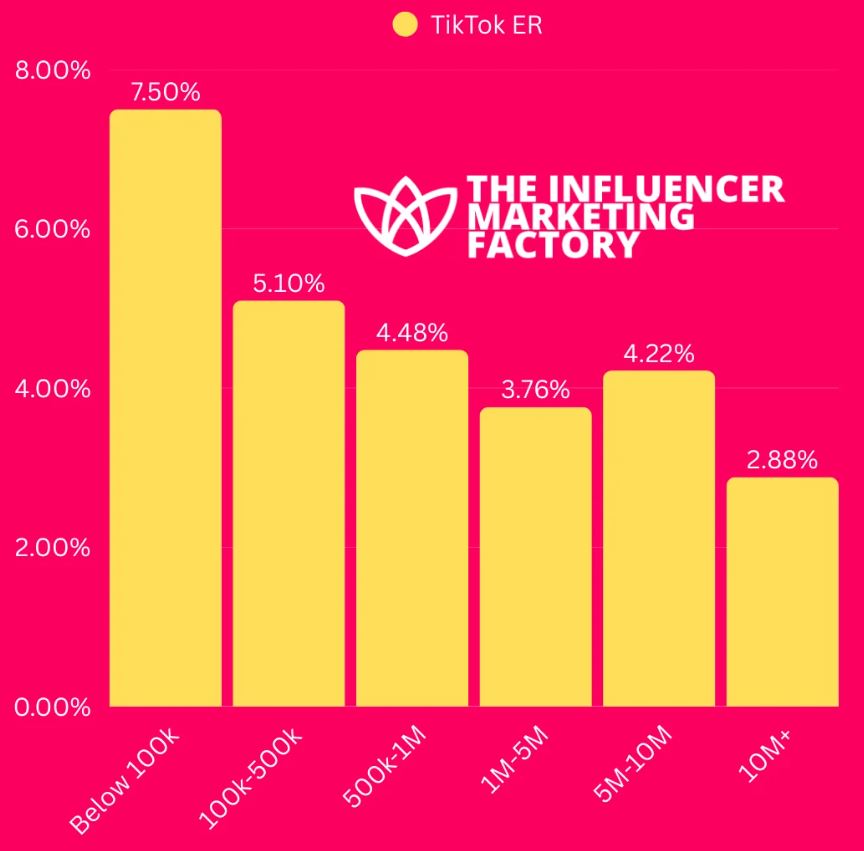
- The above-average engagement rates of creators with less than 100k followers, who are the ones actually at the most significant disadvantage, and the digital pattern that the influencers’ very own telling about all the smaller accounts usually having the higher percentages of engagement, are the major factors for the change in TikTok engagement rates.
- The highest engagement rate for creators with less than 100k followers is 7.50%. It means that the audience is very close to them and is even more likely to react to every single post.
- Engagement rate is inversely related to follower count.
- The percentage is lowest in the 100k–500k group at 5.10%, then it declines again in the 500k–1M group to 4.48%.
- This is because larger audiences are more diverse and their engagement is less uniformly distributed.
- Engagement for the 1M–5M audience group drops further to 3.76%. The total number of engagements increases during this period, but the follower growth rate declines.
- The 5M–10M bracket shows a notable rise to 4.22%, which may indicate that some of the very large influencers are winning their audience’s loyalty, or that they are creating highly viral content that even the most pessimistic interact with more than usual.
- The ones at the top are idols with over 10 million followers, and they have an average engagement rate of 2.88%.
- Although this is the lowest percentage, the engagement of these accounts, measured in absolute terms, is still quite high given their extremely large audiences.
TikTok Average Engagement Based On TikTok Profiles
(Source: theinfluencermarketingfactory.com)
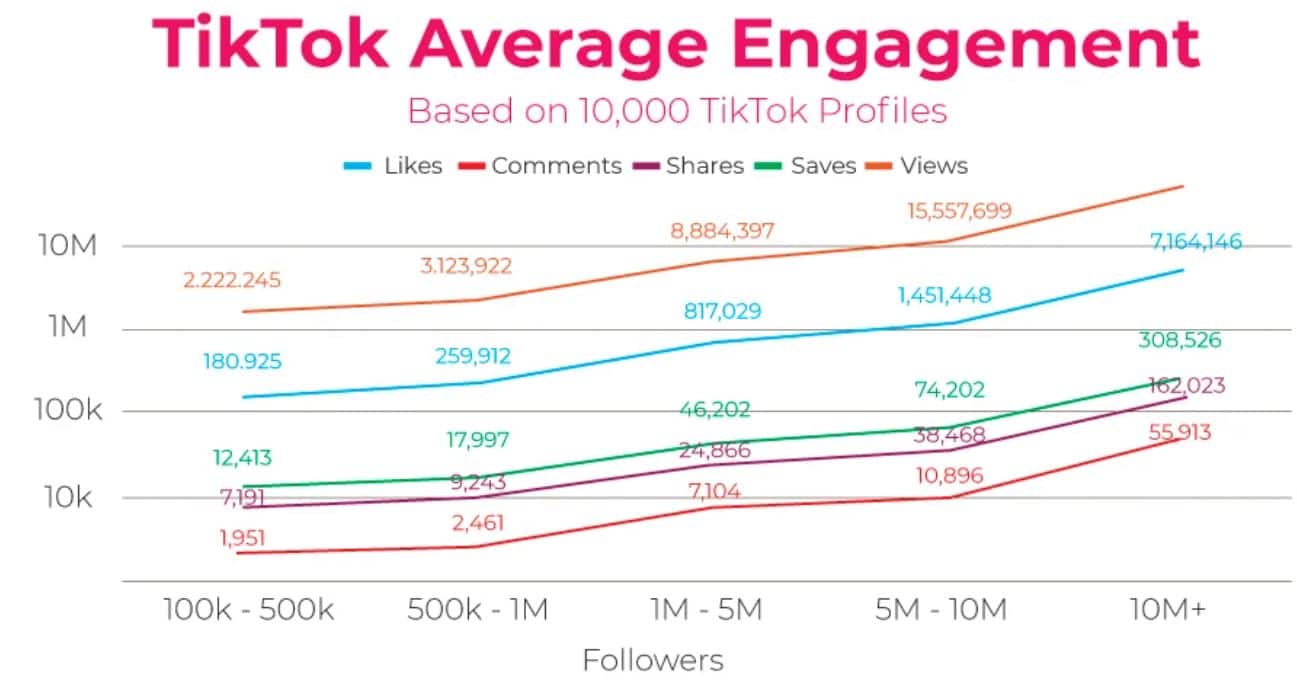
- The chart illustrates diversity in creator engagement on TikTok. It highlights a clear, consistent trend: the major engagement metrics—likes, comments, shares, saves, and views—rise in proportion to follower count.
- Creators in the 100k–500k range average 180,925 likes and more than 2.2 million views.
- This indicates that even mid-tier creators can generate significant visibility, with views often exceeding followers by several times.
- The interaction metrics for comments, shares, and saves look good, which is a strong indication of the strong bond between creators and their audiences.
- The moment creators reach 500k–1M followers, their visibility and engagement increase significantly.
- The average number of likes increases to 259,912, and views exceed 3.1 million. The increase in comments, shares, and saves indicates greater active participation from the new, larger audience.
- The engagement of creators with 1M–5M followers increases abruptly. They gain almost twice as many likes as 100k–500k, and their views are close to 8.9 million.
- The increase in comments and shares, along with the significant rise in likes, indicates that large creators not only reach a wider audience but also actively engage with it.
- There is also a significant increase in the 5M–10M category, with an average of over 1.45 million likes and more than 15.5 million views per post.
- Shares and saves increase significantly, indicating that the content produced by these creators is not just highly entertaining or worth sharing; it is also regarded as highly valuable by viewers.
- The engagement for the topmost tier—creators with over 10 million followers—shifts enormously.
- The posts on these accounts average more than 7.1 million likes and almost 80 million views.
TikTok Engagement By Region
(Source: amraandelma.com)
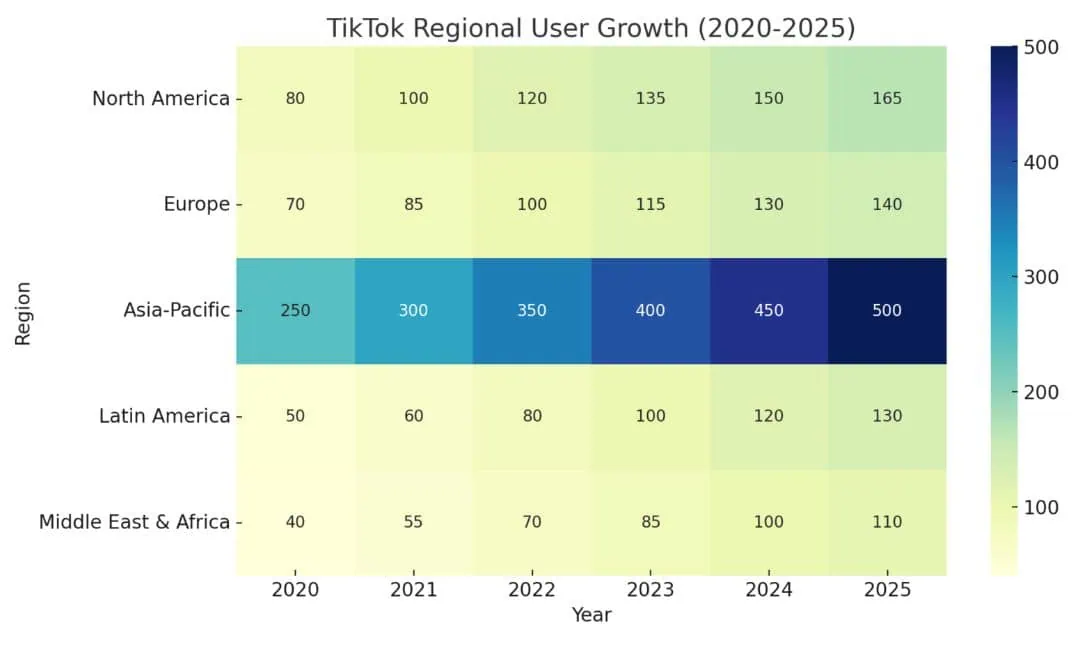
- From 2020 to 2025, TikTok’s user base grew across many regions, with significant differences in user counts and growth rates.
- In the early years, with 250 million users, the Asia-Pacific region was strong and steady, reaching 500 million users by 2025.
- Year by year figures are 300 million in 2021, 350 million in 2022, 400 million in 2023, 450 million in 2024, and finally 500 million in 2025.
- The consistent uptrend reflects the strongest market for TikTok, where consumers have accepted the product quickly and it remains strong.
- North America shows good growth. It started with 80 million users in 2020, and the user base grew each year, reaching 165 million by 2025.
- Europe is following a similar trajectory, rising from 70 million in 2020 to 140 million in 2025, suggesting strong but slow-moving expansion across Western markets.
- On the other hand, Latin America is experiencing slow but steady penetration of the tech market, with user base growing from 50 million in 2020 to about 130 million in 2025. The growth rate is very low but still indicates an expanding digital market.
- The Middle East and Africa start with the lowest number of users, which is 40 million in 2020, but the number of users gradually increases to 110 million in 2025.
- Although overall numbers remain lower than in other regions, the upward trend suggests adoption of the technology is becoming more widespread, with a fast-growing audience.
TikTok Influencer Average Engagement Rates
(Source: phlanx.com)
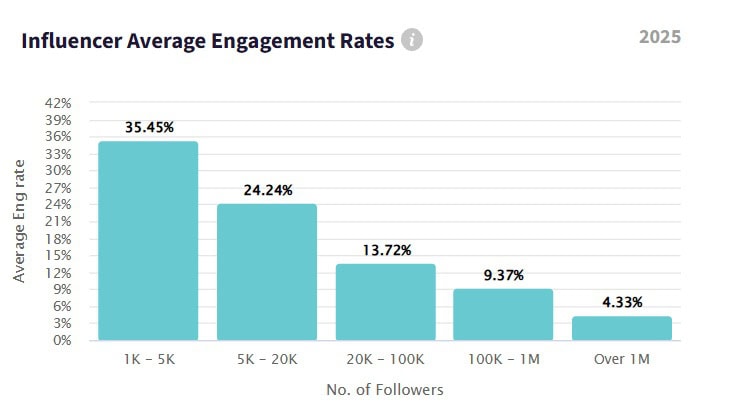
- In 2025, influencers with 1,000 to 5,000 followers recorded the highest average engagement rate at 35.45%, a level commonly seen among nano creators in leading digital markets such as the United States, the United Kingdom, and India where small communities interact very actively with posts.
- Accounts in the 5,000 to 20,000 follower range achieved an average engagement rate of 24.24%, showing that micro influencers in developed economies still keep relatively close relationships with their audiences even as their reach expands.
- For mid-tier creators holding 20,000 to 100,000 followers, the average engagement rate declined to 13.72%, which indicates a gradual move from community-style conversations to more one-way communication that is typical in mature social media markets.
- Influencers with 100,000 to 1 million followers showed an average engagement rate of 9.37%, while very large accounts with over 1 million followers registered only 4.33%, a pattern also observed in high-growth social media countries such as Brazil, Indonesia, and Mexico where celebrity-style profiles attract large but less interactive audiences.
- The comparison reveals that nano influencers with 1,000 to 5,000 followers generate more than eight times the engagement of mega influencers with over 1 million followers, with 35.45% versus 4.33%, which strongly influences how brands allocate influencer marketing budgets that already reach several billion USD globally each year.
TikTok Engagement Trends And User Insights
- TikTok remains the number one platform for user attention in 2025, with an average daily usage of 58 minutes.
- The average engagement rate for TikTok videos over 54 seconds is already 6.7%, suggesting viewers are increasingly open to long-form storytelling.
- Rapid-fire, short videos remain in demand, but creators who teach through narrative or drive engagement through storytelling can reach their audience with higher engagement quality.
- The winning formula is strong retention, power editing, and storytelling that hooks the audience until the very end.
- Overall engagement has declined: the average engagement rate for the content was 5.77% in 2023 and 4.64% in 2024.
- Companies need to elevate their creative strategies through storytelling that aligns with trends, interactive formats, and influencer collaborations to be noticed.
- TikTok Shop, live streams, and AR effects are now among the tools that every brand must have to increase its engagement.
- The analysis of user data indicates that TikTok is particularly popular among younger users, with about 55% of its users under 30.
- These 30% consist of 25% in the 18-24 age group and 35% in the 25-34 age group.
- Therefore, TikTok is an excellent channel for brands targeting young adults in Gen Z and Millennials.
- The male-to-female ratio is similar, with females at 54.8% and males at 45.2%, allowing each segment of the industry to run marketing campaigns targeting the opposite sex.
- Understanding the above demographic data enables brands to develop content strategies that are not only suitable for their target audience but also compelling.
Time Spent On TikTok
- TikTok users now spend almost 24 hours on the app per month, more than on Facebook and Instagram.
- This demonstrates the effectiveness of TikTok in retaining the user’s attention through the very personalized, AI-powered content.
- The prolonged engagement creates enormous opportunities for brands to tell their stories, partner with influencers, and conduct interactive campaigns.
- Additionally, higher screen time can lead to content fatigue; therefore, brands must continuously innovate.
- TikTok’s move to live streaming and longer videos is an effort to engage users in different ways, enabling brands to create more immersive experiences through challenges, filters, and gamified content.
- Given consistent high usage, TikTok is likely to be an important player in the digital entertainment and marketing sectors.
Adoption Rate
- TikTok’s advertising reach expanded by 31.2 million users at the beginning of 2025, indicating a gradual 2% annual increase, which has been the trend for the past years.
- As more brands put their money on it, differentiation will require adopting the most creative strategies, such as shoppable ads and branded hashtag challenges.
- The improvement in AI-powered targeting is also enabling more personalised advertising, but increased demand could lead to a higher cost per thousand impressions (CPM).
- Brands that create content organically and promote it through paid campaigns will reap the greatest benefits from TikTok’s expanding advertising ecosystem.
Engagement Rate For Brands
- The highest brand engagement rates still come from TikTok, averaging 3-5%, which is well above Facebook and Instagram.
- The platform’s dedication to authenticity and entertainment facilitates the seamless integration of branded content with user posts.
- Brands will need to rely on storytelling, trends, and relatable content to sustain strong engagement, rather than resorting to overt promotion.
- As e-commerce tools such as live selling and in-app shopping become more widespread, TikTok presents a new method for businesses to reach their audiences.
- Companies that do not hesitate to invest in interactive and informative content will still compete to some extent, as user preferences and formats of the content change.
Conclusion
TikTok Engagement Statistics: TikTok’s 2025 engagement ecosystem outlines a landscape where attention capture, shifts in creator roles, and the digital marketing sector are being completely redefined. User time spent has increased, the platform is reaching more people worldwide, and the types of content viewed have a very high engagement rate; all of this makes TikTok unbeatable at attracting users.
Brands and creators who are open to change and use trends to tell their story will take the upper hand as competition intensifies. Engagement on TikTok has not been completely stable; it has declined slightly due to excess content. Nevertheless, TikTok remains relevant and powerful due to innovations such as longer videos, AI-driven recommendations, live shopping, and in-app commerce. By 2025 and beyond, TikTok will remain a major platform that drives visibility, growth, and strong audience engagement.
FAQ.
Creators with smaller audiences (under 100k followers) have the highest engagement rate of 7.50% because their followers are very much connected, active, and loyal. When a creator grows, his/her audience becomes more mixed, which naturally results in lower engagement rates. However, large accounts—especially those over 10M followers—are still able to attract a lot of engagement overall, but the corresponding engagement rate drops to 2.88%.
The upward trend of every major engagement metric—likes, comments, shares, saves, and views—corresponds to the ascending curve of follower count. For instance, creators with 1M–5M followers garner on average 817,000+ likes and 8.9M views, whereas top-tier creators boasting more than 10M followers collect 7.1M+ likes and nearly 80M views per post. The engagement rate may fall, but the visibility is multiplied eventually.
TikTok considers the Asia-Pacific as its prime market, which is projected to increase from 250M users in 2020 to 500M in 2025. Other regions like North America, Europe, Latin America, and the Middle East & Africa are also climbing the user number ladder and set to reach 165M users in North America, 140M in Europe, 130M in Latin America, and 110M in MEA by 2025.
Users are said to spend almost 24 hours a month on TikTok—more than on Facebook or Instagram—and the daily average is about 58 minutes. This high frequency of usage opens up numerous avenues for brands to connect with the audience through methods such as storytelling, interactive features, live shopping, and longer video formats. It also means that brands must be creative and consistently take the lead in order not to be considered boring and thereby lose their audience.
The trends to watch include the significant increase in longer videos resulting in a 6.7% engagement rate, brands getting engaged at a high rate of 3–5%, and the rapid acceptance of interactive formats like live shopping, AR effects, and trend-based storytelling. The ad reach of TikTok also grew by 31.2 million users in early 2025, highlighting that organic content combined with paid campaigns is the key to overcoming this challenge.

I hold an MBA in Finance and Marketing, bringing a unique blend of business acumen and creative communication skills. With experience as a content in crafting statistical and research-backed content across multiple domains, including education, technology, product reviews, and company website analytics, I specialize in producing engaging, informative, and SEO-optimized content tailored to diverse audiences. My work bridges technical accuracy with compelling storytelling, helping brands educate, inform, and connect with their target markets.