Walmart Statistics By Market Share, Division, Country, Revenue, Recent Developments and Facts (2026)

Updated · Mar 14, 2026


Table of Contents
- Introduction
- Editor’s Choice
- Walmart Market Share
- Type of Walmart Store In U.S And Retail Strength
- Walmart Online Sales Division
- Walmart International Net Sales By Country
- Walmart International Store By Type
- Total Revenue
- Walmart’s Profitability And Operating Income Show Clear Margin Strength
- Marketplace And Retail Media Drive Walmart’s Margin Expansion
- Speed Monetization Strengthens Walmart’s Digital Margins
- Automation Drives Lower Fulfillment Costs At Walmart
- Walmart Grocery Revenue
- Walmart’s State-Level Economic Footprint Across the U.S.
- Walmart Employee Statistics
- Walmart Return On Investment
- Walmart Customers
- Sam’s Club Stores
- Walmart’s Net Income
- Walmart Theft Statistics
- Recent Developments And Future Outlook
- Conclusion
Introduction
Walmart Statistics: The retail system operates through Walmart Inc., which holds the title of the largest physical retail business in the world and stands as one of the most powerful companies in existence. Walmart achieved multibillion-dollar growth through its successful handling of continuous inflation and its various supply chain difficulties, which led to the establishment of new sales channels and its expansion into digital and healthcare sectors, according to its fiscal performance for 2025. The 2025 statistics of Walmart demonstrate how retail will operate in the future through its extensive data collection system and its various business operations and digital technologies.
The article examines the Walmart statistics while providing contextual information through research insights to explain their implications for customers, stores, revenue, and the global economy.
Editor’s Choice
- Walmart serves 270 million customers weekly in 2025, up 30 million from 2023, reaffirming its unmatched global retail traffic.
- The fiscal year 2025 total revenue reached USD 681.0 billion because the company experienced 5.1% revenue increase compared to the previous year despite ongoing economic difficulties.
- The company generates its main revenue stream from Walmart U.S., which accounts for close to 69% of its net sales.
- The company achieved global eCommerce sales of approximately USD 121 billion in fiscal year 2025, which marked a fivefold increase from the 2019 total.
- Walmart U.S. online sales alone reached USD 79.3 billion, accounting for about 65% of total eCommerce revenue.
- The company operates 4605 stores in the United States while maintaining 11150 locations worldwide, which enables it to achieve advantages from its omnichannel business operations.
- Operating income for FY2025 increased from the FY2024 amount of USD 27.0 billion to reach USD 29.3 billion.
- The gross margin for FY2025 reached 24.1%, which shows the company maintains its operational efficiency while improving its product mix.
- The company achieved revenue growth of 24% in Q4 FY25 and 31% in Q1 FY26 through its retail media business, which resulted in improved structural margins.
- The basket size of U.S. online shoppers increased by 25% after 30% of them adopted express delivery services.
- The grocery sector generated USD 276.0 billion in revenue during FY2025, which represents a 50% increase since FY2019.
- Walmart operates as the largest private employer worldwide with 2.1 million employees, which includes 1.6 million workers in the United States.
- The return on investment reached 15.5% for FY2025, which represented a 50 basis point increase from the previous year.
- Retail theft costs reached USD 6.1 billion in 2022, which will increase to USD 6.5 billion according to projections, thus creating margin pressure on businesses.
- Sam’s Club operates approximately 600 U.S. locations while focusing on maintaining productivity and generating profit through its membership base.
(Source: market.us)
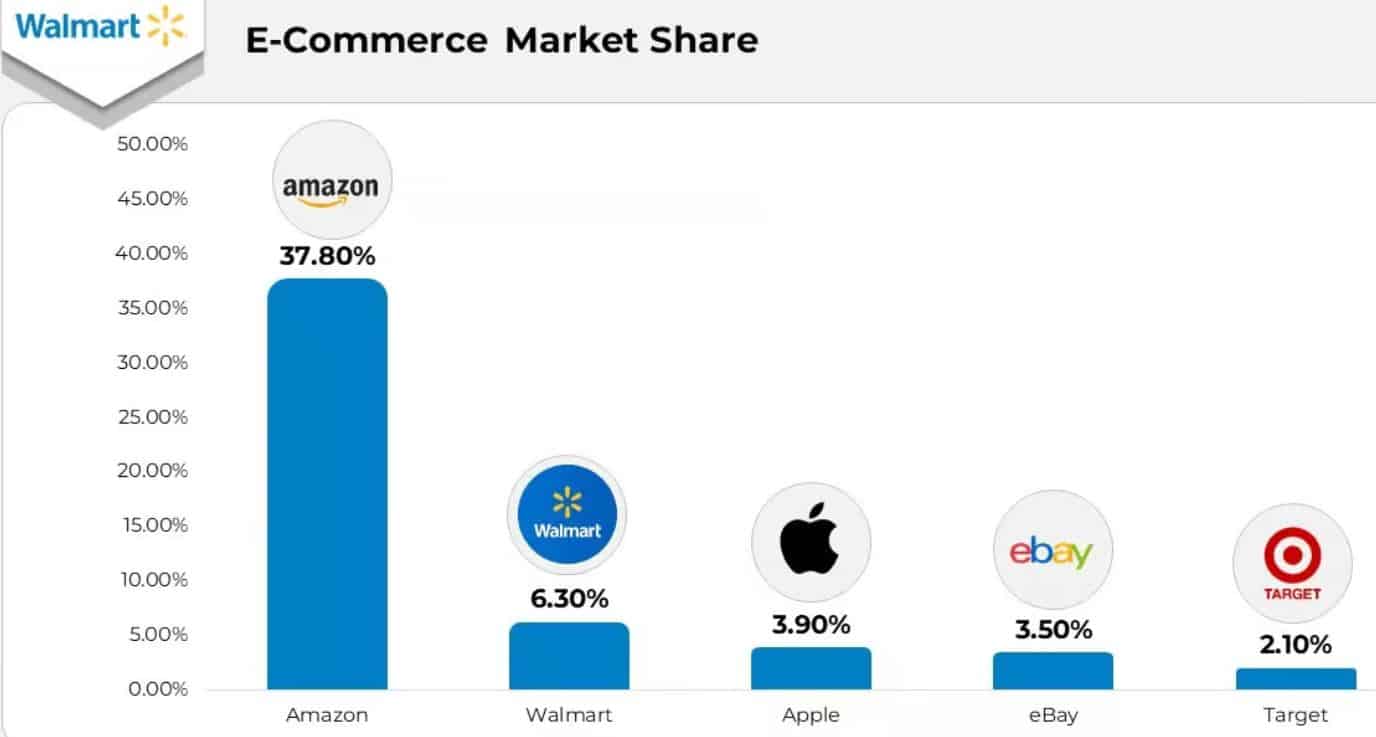
- According to Market.us, the above chart shows that the U.S. e-commerce market has a high concentration level which Amazon dominating according to market share.
- Amazon has established itself as the dominant market player because it controls 37.8% of the market, which exceeds the combined shares of its four closest competitors through its logistics operations, Prime membership system and extensive marketplace operations.
- Walmart statistics show that the company operates a successful omnichannel retail because its large network of physical stores enables online customer pick-up and same-day delivery and grocery-led e-commerce services.
- Apple generates 3.9% of the market share because its business model focuses on high-value commerce through devices and services instead of traditional retail.
- eBay maintains a stable market share of 3.5%, which shows limited growth potential while competing in a marketplace-centric business area.
- Target achieves a 2.1% market share through its specialized product selection and dedication to its private label products, yet its online operations encounter limitations.
- Walmart’s digital performance data demonstrates continuous online growth while its delivery operations become more efficient, yet Amazon retains a nearly 31-point edge whichmakes it extremely difficult for Walmart to compete with Amazon.
Type of Walmart Store In U.S And Retail Strength
(Reference: statista.com)
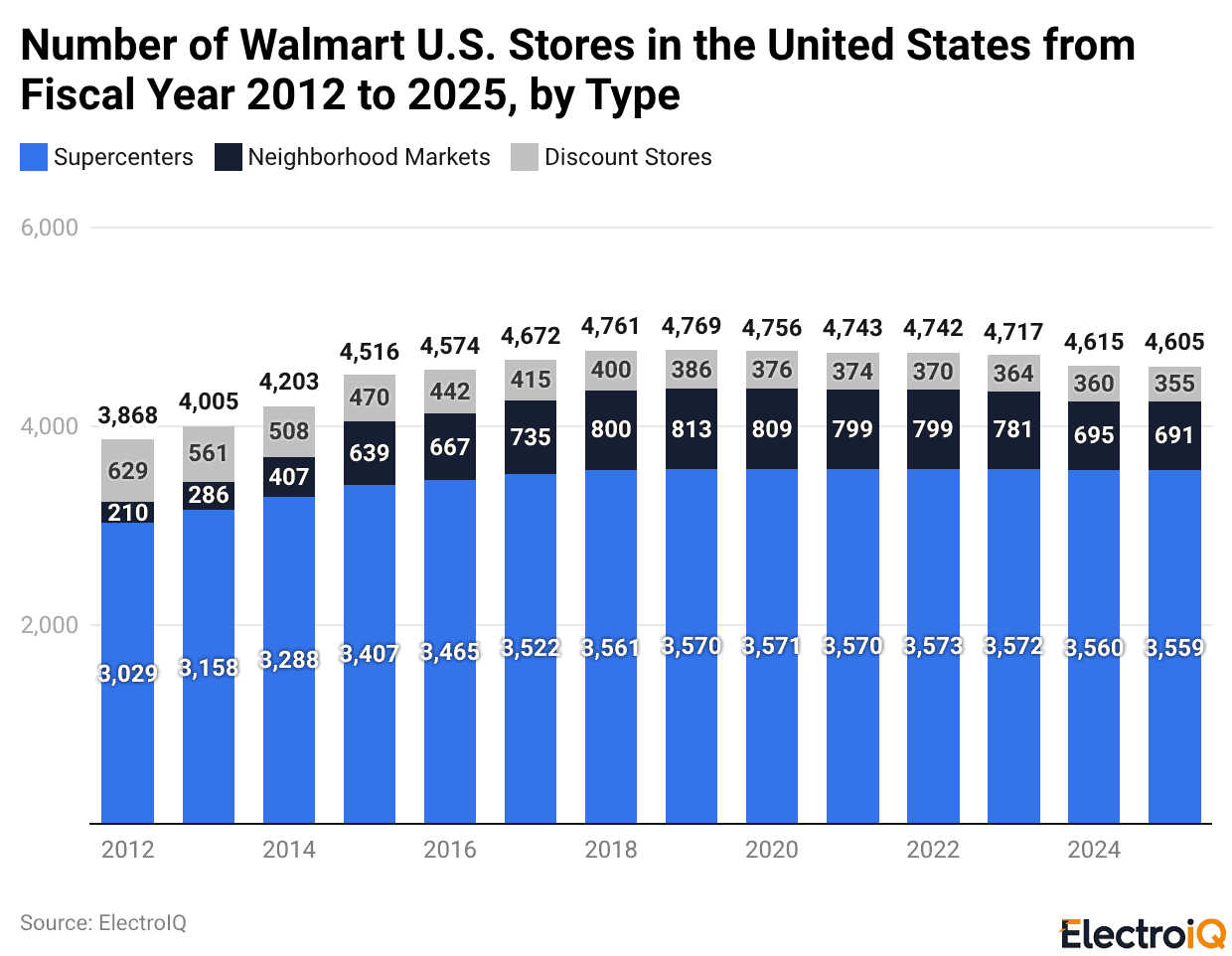
- Walmart operates extensive U.S. store locations, which demonstrate its extensive operational capacity throughout the United States.
- As of January 31, 2025, Walmart operated 4,605 stores in the United States, including 3,559 supercenters and 691 neighbourhood markets, which demonstrates its leadership in both large retail formats and small community stores.
- The Walmart statistics demonstrate how the company achieves nationwide distribution through its multiple stores, which offer local shopping options that most retailers cannot maintain across their entire operations.
- Walmart operates 11150 total properties worldwide, which include 10771 retail locations across the globe.
- The business model of Walmart has developed from a single U.S. store into the largest global retailer through its strategies of generating high sales volume while maintaining competitive prices and efficient supply chain operations.
- Walmart statistics show that scale directly enhances financial strength since the Walmart U.S. segment generated approximately 69% of total company net sales in 2024, which made it the most important source of income for the company.
- Walmart operates three main business units, which include Walmart U.S., Walmart International and Sam’s Club, to generate various income streams through its retail, wholesale and online business activities.
- The U.S. division, supported by Walmart.com, serves as the main component of this system, which combines physical retail locations with online delivery operations.
- Overall, Walmart’s statistics confirm that the company’s expansive store network remains a critical competitive advantage in both domestic and global retail markets.
Walmart Online Sales Division
(Reference: statista.com)
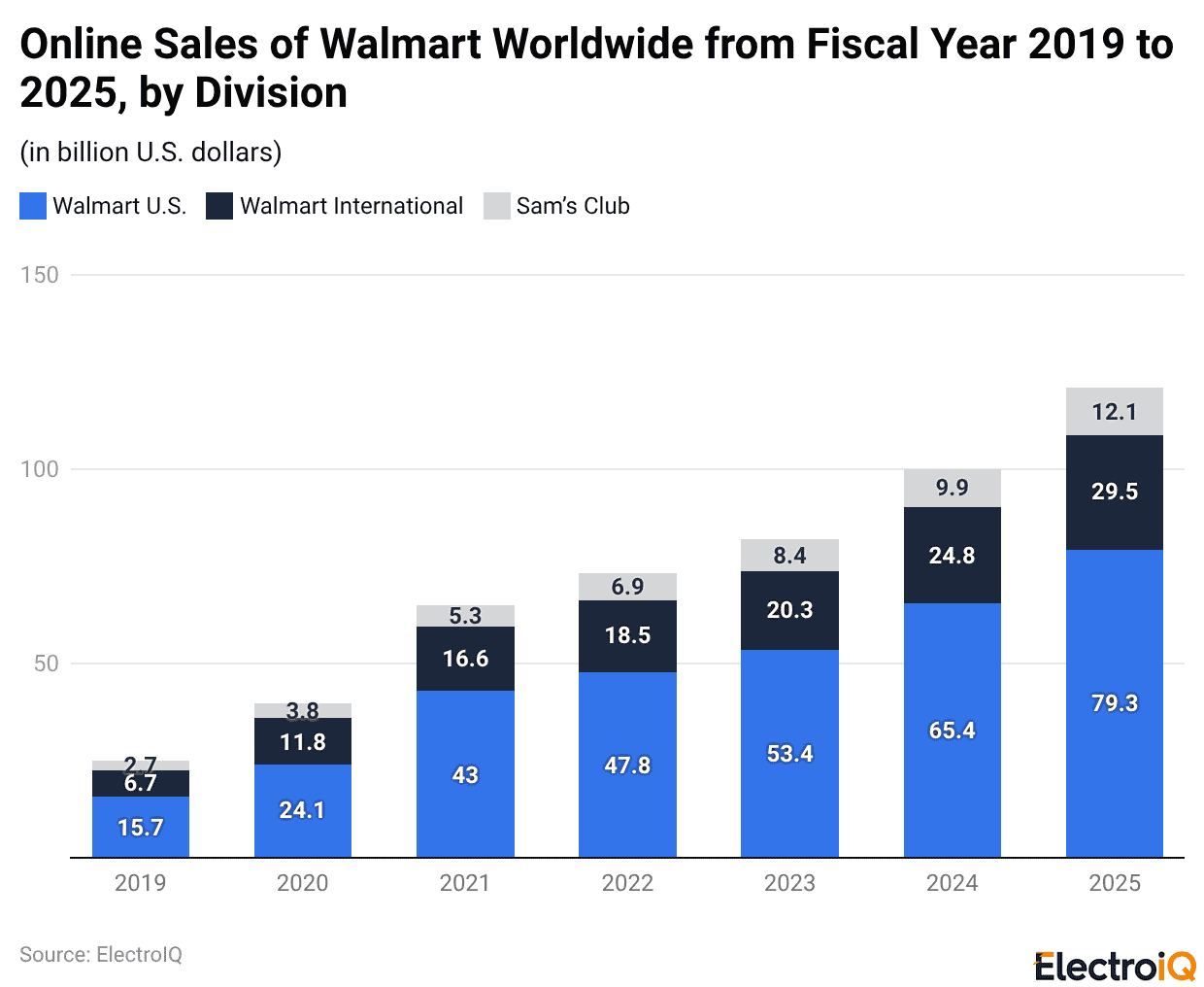
- According to a Statista report, Walmart’s online sales growth demonstrates its effective digital transformation program, which successfully builds scalable online sales capacity.
- The chart shows worldwide eCommerce sales rising from roughly USD 25 billion in 2019 to about USD 121 billion by fiscal year 2025, marking nearly a 5x increase in six years.
- The Walmart data shows that the company uses digital commerce as its main growth engine, which drives its business operations.
- The U.S. segment remains the dominant contributor, growing from USD 15.7 billion in 2019 to approximately USD 79.3 billion in 2025, accounting for nearly 65% of total online sales. This achievement demonstrates how Walmart U.S. uses its extensive store network to handle its delivery operations through three methods, which include product fulfillment, curbside pickup, and last-mile delivery services.
- Walmart International has shown steady momentum, expanding from USD 6.7 billion to nearly USD 29.5 billion, signaling the successful localization of e-commerce models across global markets.
- The online sales of Sam’s Club increased from USD 2.7 billion to USD 12.1 billion, which shows that more members now prefer to shop through digital channels.
- The sustained upward trend indicates that Walmart’s investment in omnichannel infrastructure and supply-chain technology is translating directly into measurable, long-term revenue expansion.
Walmart International Net Sales By Country
(Reference: statista.com)
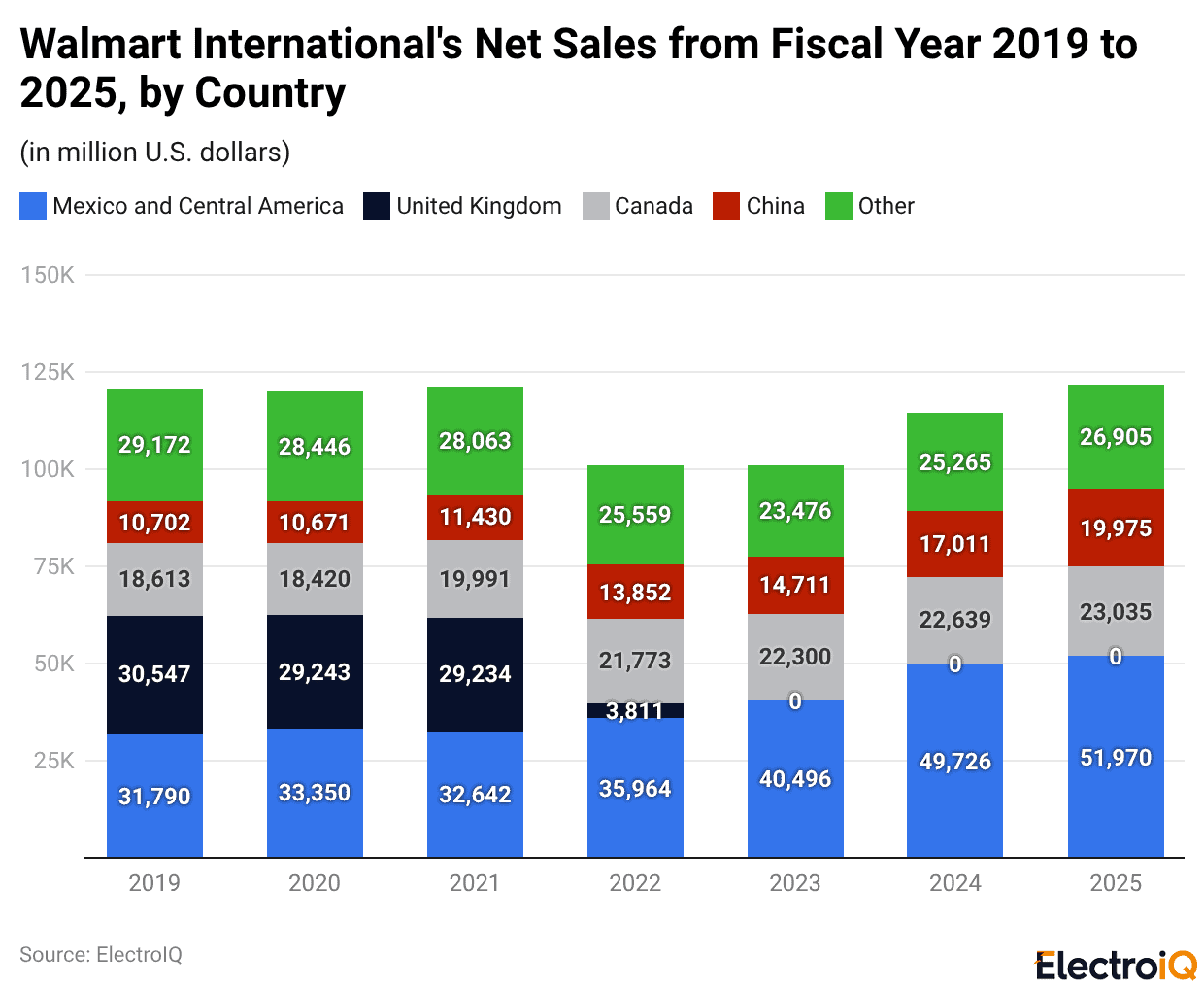
- Walmart’s international performance in fiscal year 2025 reflects a clear concentration of growth in high-potential markets.
- Mexico and Central America led the portfolio with approximately $52 billion in net sales, accounting for over 42% of Walmart International revenue, underscoring the region’s scale, price sensitivity, and store density advantages.
- China followed with nearly $20 billion in sales, rising from $17 billion year over year—an impressive ~18% growth rate driven by digital grocery and omni-channel adoption.
- In total, Walmart International generated $122 billion in net sales, reinforcing Walmart’s statistics that show emerging markets as the primary engine of global expansion and long-term revenue resilience.
Walmart International Store By Type
(Reference: statista.com)
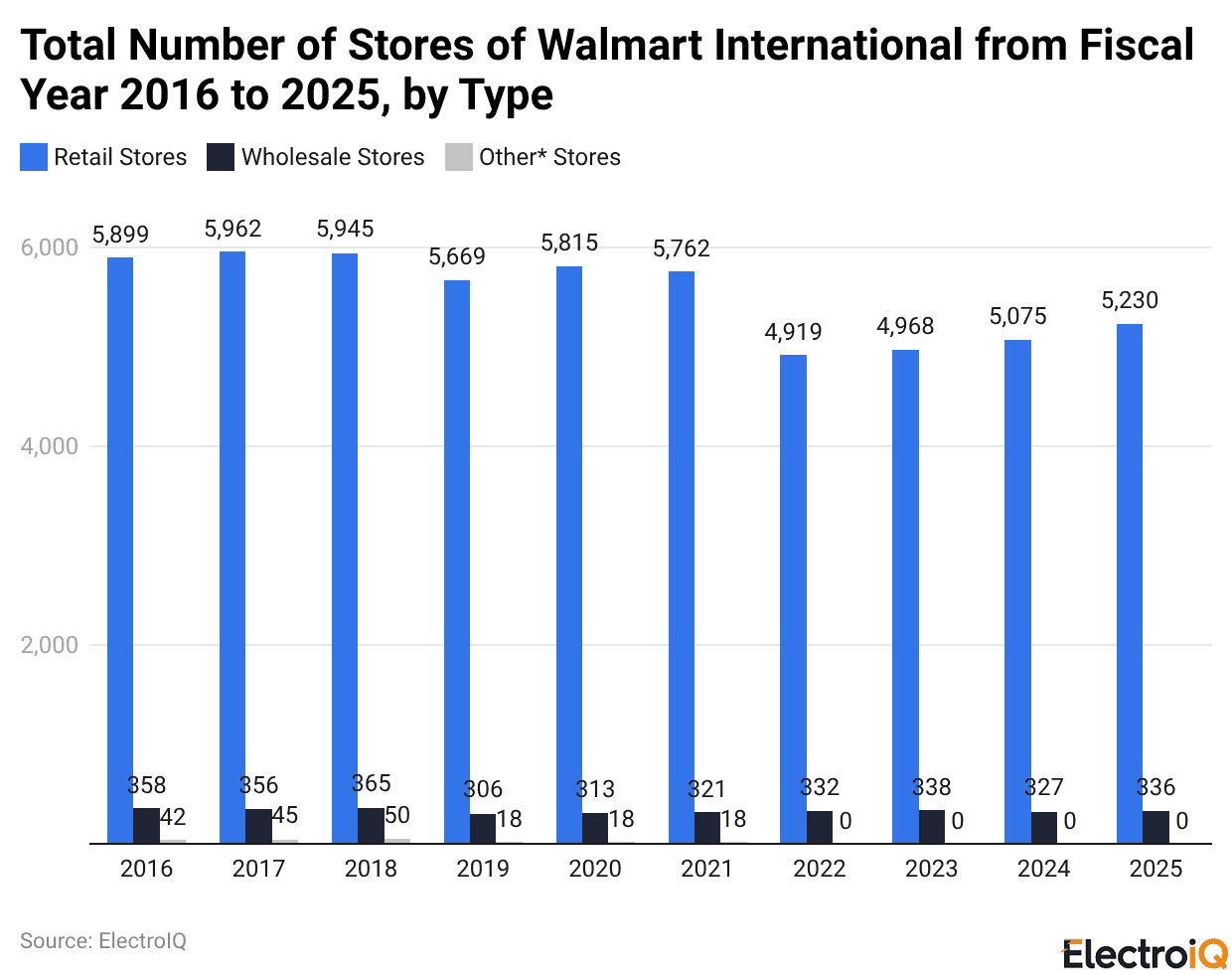
- Walmart International uses its store locations to create a specific combination of business size and focused operational approach.
- The company maintained 5230 active stores for international retail operations on January 31, 2025, while its total store count reached 5566, which established its status as a leading international retailer.
- Walmart facts demonstrate that the company primarily operates in high-growth areas, which include Mexico, Central America, China, India, and Africa, because these regions show increasing consumer demand with rising population numbers.
- The African continent contains more than twelve countries that use South Africa as their main operational center.
- Walmart exited its Japanese and British markets during 2022 because the company wanted to improve its business operations through better portfolio management.
- The Walmart statistics demonstrate that the company now uses better geographic distribution methods, which target developing markets that show potential for generating future income.
Total Revenue
(Source: walmart.com)
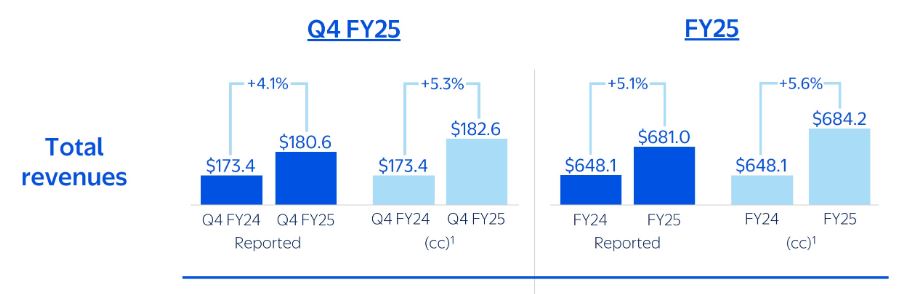
- According to stock.walmart.com, Walmart uses its revenue growth for the fiscal year 2025 to demonstrate how its business strategies create sustainable development through company size advantages.
- Walmart generated USD 1806 billion in Q4 fiscal year 2025, which represented a 41% increase from the USD 1734 billion of Q4 fiscal year 2024.
- The Q4 revenue reached USD 1826 billion when using constant currency because it showed a 53% increase, which proved strong market demand across all regions.
- The full-year results showed that fiscal year 2025 revenue reached USD 6810 billion, which represented a 51 % increase from the USD 6481 billion revenue of fiscal year 2024.
- The revenue increased to USD 6842 billion after currency adjustments, which resulted in a stronger 56 % growth rate.
- The Walmart statistics show that the company maintains steady business growth through its grocery business leadership, increasing eCommerce sales, and effective cost management.
- The retailer generates consistent revenue through its three business segments, which include U.S. stores and international markets, and digital channels.
Walmart’s Profitability And Operating Income Show Clear Margin Strength
(Source: walmart.com)
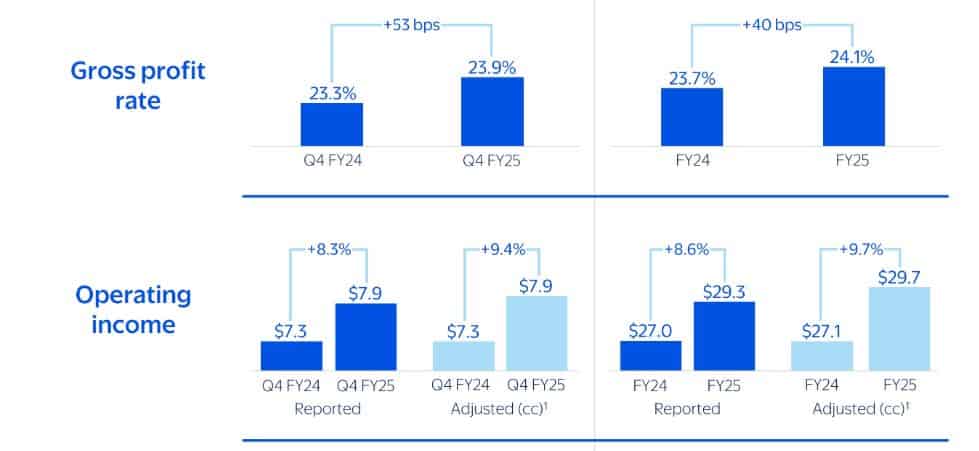
- Walmart has achieved better operational results through its current profitability performance.
- The gross profit rate expanded meaningfully in both the quarter and the full year. In Q4 FY25, the company achieved a gross margin increase to 23.9%, which represented a 53 basis point improvement from the 23.3% figure of Q4 FY24.
- The company achieved a full-year gross profit of 24.1% for FY25, which represents a 40 basis point increase from the previous year’s 23.7% gross profit.
- The Walmart statistics show that management maintains its ability to sustain profit margins in essential product categories.
- The operating income for Q4 FY25 reached USD 7.9 billion, which represents an 8.3% increase from USD 7.3 billion in the previous year.
- The organization achieved constant currency growth of 9.4%, which showed its operational strength beyond foreign exchange impacts.
- The full-year operating income for FY25 increased to USD 29.3 billion, which marked a rise from USD 27.0 billion the previous year, and the adjusted figure showed a 9.7% growth to USD 29.7 billion.
Marketplace And Retail Media Drive Walmart’s Margin Expansion
- According to Grocery Doppio, the marketplace–retail media flywheel system has become a primary profit source, according to analysts who examine Walmart’s business metrics.
- Walmart Connect enables the company to conduct high-margin advertising operations, which it uses to support its 160000 U.S. marketplace sellers.
- Retail media sales surged 24% in Q4 FY25 and accelerated to 31% in Q1 FY26 (ex-VIZIO) because advertisers showed strong demand.
- Marketplace GMV has now grown over 30% year over year for four consecutive quarters, expanding the ad inventory base.
- The company earns revenue from advertisements, which helps cover its fulfilment expenses, while paid Express fees generate nearly full profit.
- The Walmart data demonstrates that structural margin improvements have happened, which match industry predictions about retail media funding digital grocery profitability until 2025.
Speed Monetization Strengthens Walmart’s Digital Margins
- The Walmart system improves its profit margins by implementing a charging process that links urgent delivery needs to shipping costs, according to an analysis of Walmart performance metrics.
- The company generates revenue through its Express delivery service,e which provides customers with three-hour delivery options that cover almost all of the United States.
- Customers increase their spending following their initial Express order because they spend 12% more after their first order and 25% more after their fourth order, according to research.
- The solution directly targets the problems that exist within the industry because 86% of grocers experience dissatisfaction with their digital profitability, and 89% of them identify fulfilment as the primary factor that drives their business operations (Incisiv 2023).
- The Walmart data demonstrates that speed pricing transforms fulfilment operations into a sustained profit source for the company.
Automation Drives Lower Fulfillment Costs At Walmart
- Walmart’s fulfilment automation strategy is an operation that decreases costs by using Walmart’s performance metrics to prove its effectiveness.
- Walmart has established four operational next-generation fulfilment centres, which enable it to automate half of its processing capacity through its automated system.
- The advanced designs, which include AI bin sequencing and autonomous shuttles and a three-level mezzanines enable facilities to achieve double their normal output while decreasing unit handling expenses by approximately 20 %. This setup enables Walmart to exceed market expectations, which forecasted that micro-fulfilment would only handle 3.6 % of grocery electronic orders by 2025.
- The leaders expect inbound automation to produce more than double operational efficiency, which proves Walmart’s statistics that show automation provides businesses with permanent advantages in operational efficiency and cost savings.
Walmart Grocery Revenue
(Reference: capitaloneshopping.com)
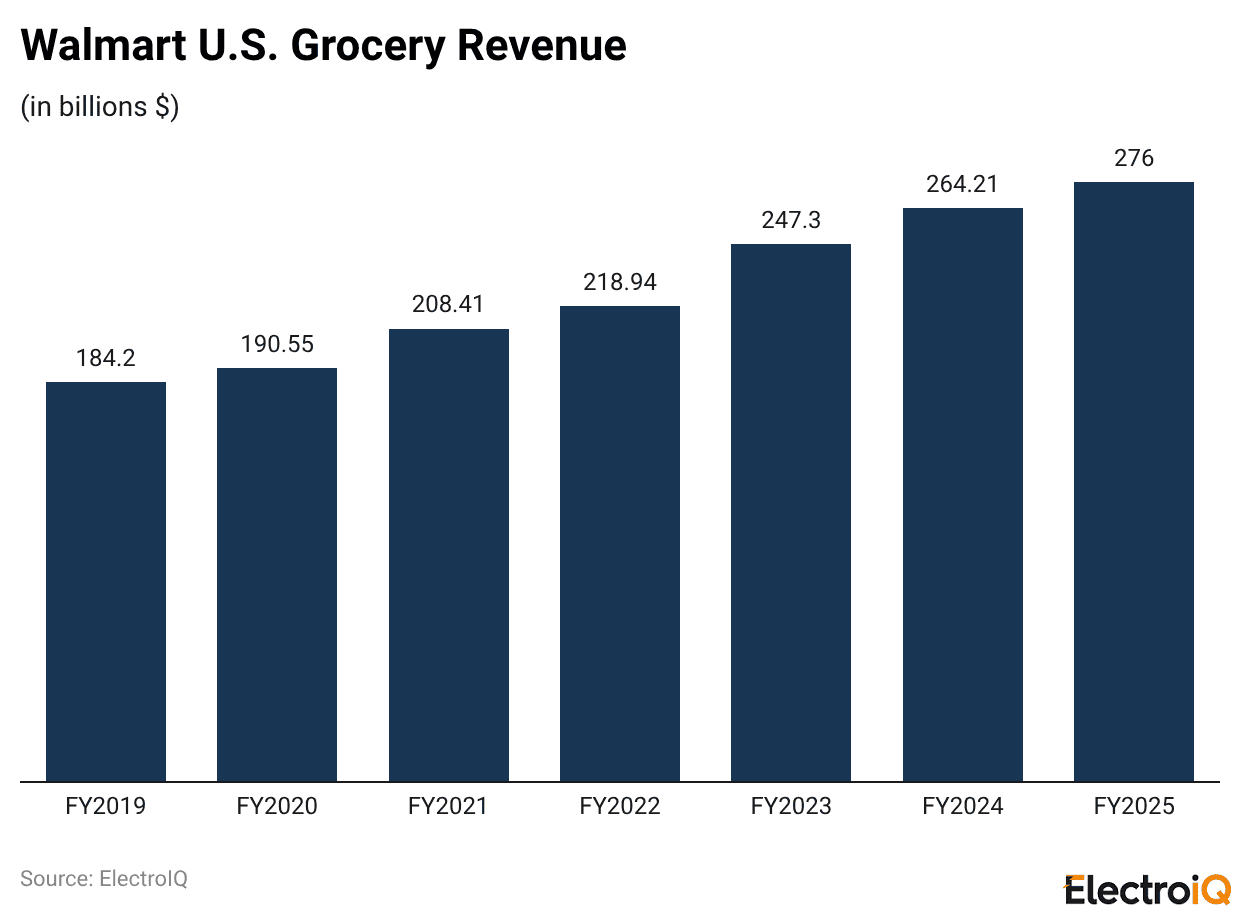
- According to Capital One Shopping, the above chart shows that Walmart’s U.S. grocery business has demonstrated strong and reliable growth throughout its existence.
- The revenue increased from USD 184.2 billion during FY2019 to USD 276.0 billion during FY2025, which resulted in a 50 % revenue growth over six years, plus an approximate 7 % annual growth rate.
- The period after FY2022, which shows acceleration, demonstrates that Walmart maintains its power over value-based pricing during times of rising prices.
- The COVID-19 grocery statistics show that grocery stores have developed into a defensive growth engine for Walmart because they bring customers into the store and increase digital platform usage.
- The grocery business will generate extra profits for Walmart, which will bring the company almost USD 12 billion in annual revenue during FY2025.
- Walmart statistics show that grocery serves as a profit generator, which helps the company achieve stability while becoming an essential element of its long-term success in retailing.
Walmart’s State-Level Economic Footprint Across the U.S.
The state-by-state distribution shows that Walmart operates as a retail business while simultaneously serving as an economic force that drives growth in regional markets through its extensive operations. The Walmart data demonstrate how all the required measurements establish Walmart as a crucial element within American state structures.
Alabama Walmart
- Alabama functions as a logistical hub through five distribution centers, which enable operations from 541 local suppliers to generate USD 1.60 billion in economic activity and create 26,701 supplier employment positions.
- The 68,760 jobs created by Walmart demonstrate Alabama’s importance as a location that Walmart uses to analyze its supply chain operations and employment distribution.
Alaska Walmart
- Alaska Walmart generates USD 73.4 million in annual revenue while employing 2,707 associates who receive an average hourly wage of USD 19.31, which reflects the regional labour market wage.
- Alaska Walmart operates stores at a rate of one per 82,237 residents while working with 77 local suppliers to create 3,712 jobs and generate USD 33.4 million in earnings.
- Alaska Walmart creates 6,419 jobs throughout the state, which demonstrates how monitoring Walmart statistics reveals economic impact even when operating in areas with low population density.
Arizona Walmart
- Arizona demonstrates how Walmart achieves business expansion while maintaining effective execution of its various sales channels.
- The company generates USD 2.44 billion in yearly revenue while employing 37,098 workers who earn an average hourly wage of USD 19.34.
- The store network consists of one store for every 61,148 residents because the company operates three distribution centers and one fulfillment center.
- The strong supplier relationships with 516 local suppliers who produce 1.50 billion dollars in earnings and create 27260 jobs demonstrate Walmart’s regional economic impact, which reaches 65358 total employment.
California Walmart
- The company generates annual revenue of 8.70 billion dollars while employing 104525 workers who receive an average hourly wage of 20.72 dollars.
- The supplier ecosystem reaches extensive proportions because stores operate at a lower density of one store for every 130136 residents.
- Through its collaboration with 4633 local suppliers, Walmart generates 324 billion dollars in supplier revenue while delivering employment to 343848 workers in the supplier sector.
- Walmart creates 448373 jobs in California through its operations,s which makes the state a key element of Walmart’s economic impact research based on supplier data.
Walmart Employee Statistics
(Reference: market.us)
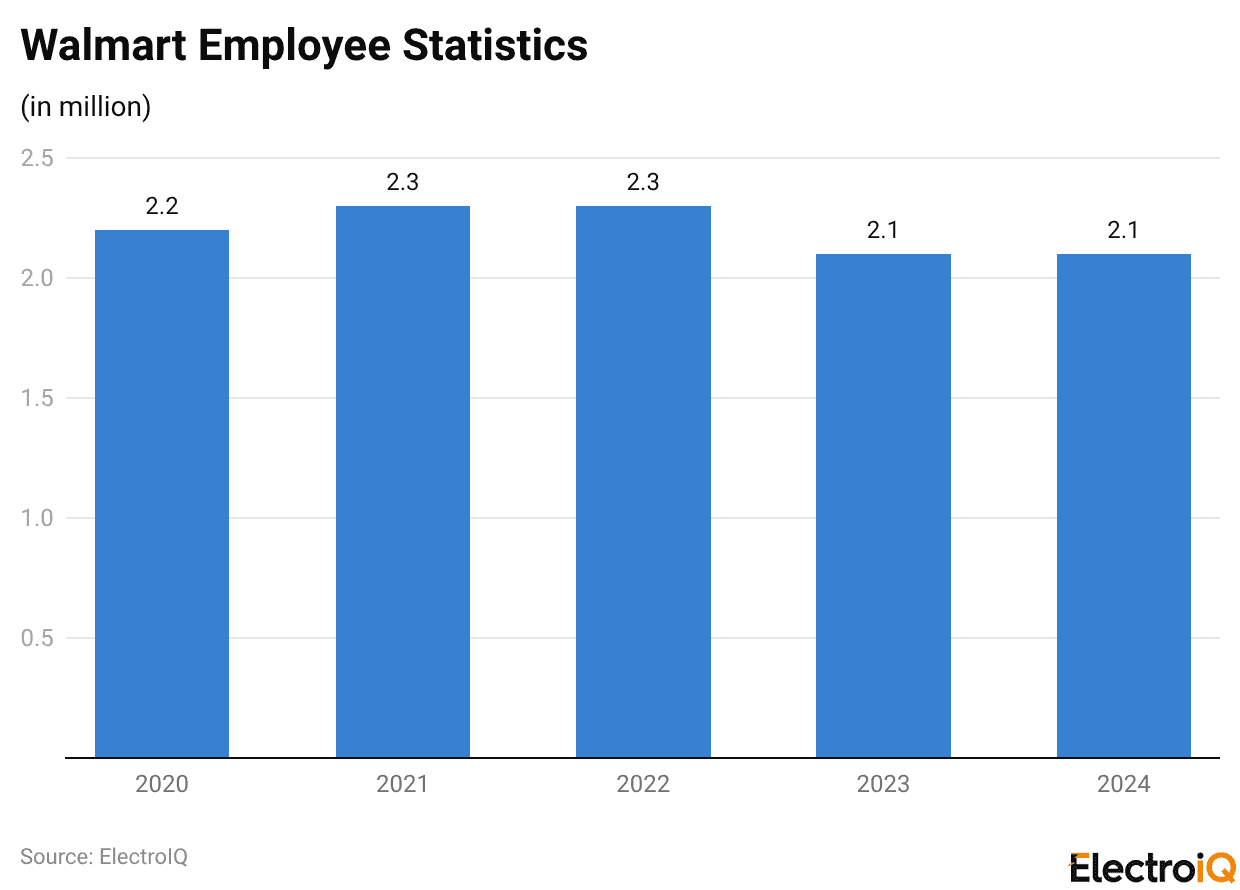
- The statistics from Walmart demonstrate the company’s status as a major global employer that reflects the employment patterns observed in extensive retail operations.
- With 2.1 million employees worldwide and 1.6 million in the U.S. alone, Walmart remains the largest private workforce globally—an anchor in national employment data.
- The employee demographic data shows that 6250 employees identify as white, while 57% of the workforce is female, which results in a labor distribution pattern that workers at retail front lines usually show.
- The workforce shows stable employment patterns because 50% of workers belong to the 40 and older demographic.
- The retail industry faces margin challenges, which the retail sector experiences through its average hourly wage of 14.76.
- The Walmart statistics demonstrate how business size, employee characteristics, and employee pay rates create the labor economic dynamics that explain why Walmart statistics serve as essential data for analyzing U.S. employment patterns.
Walmart Return On Investment
(Source: walmart.com)
- Walmart statistics show that the company has maintained disciplined capital management, which has resulted in progressive capital efficiency advancements.
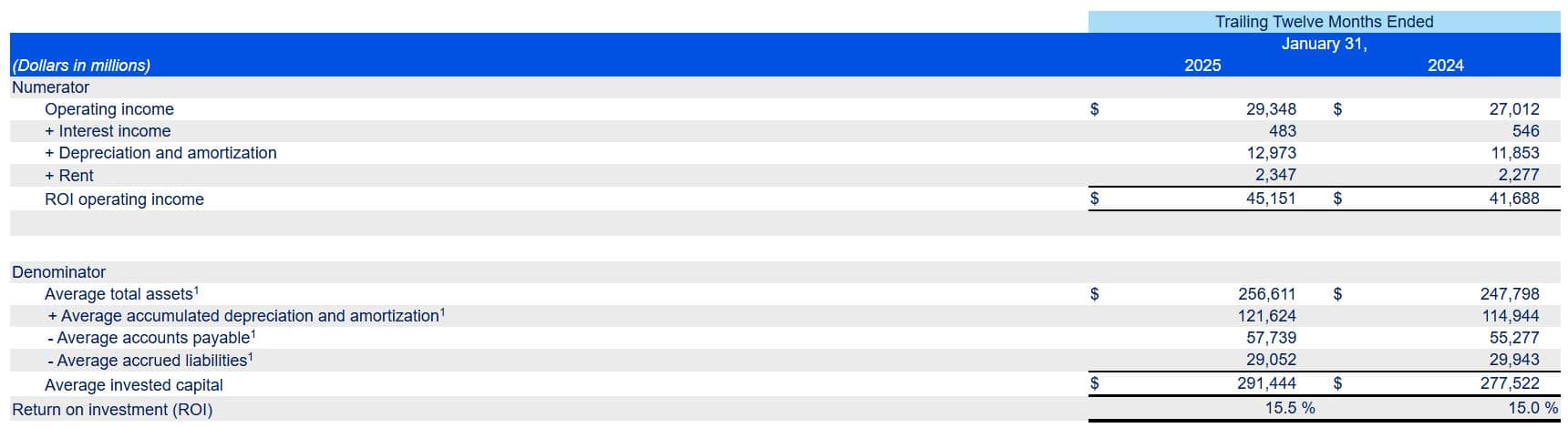
- Walmart achieved USD 45.15 billion in ROI operating income during the twelve months ending January 31 2025, which increased from the previous year’s sar total of USD 41.69 billion because of better operational performance and increased revenue streams.
- Walmart’s asset-intensive business model produces cash flows that drive its operating income growth to USD 29.35 billion through USD 12.97 billion in depreciation and amortization addbacks and USD 2.35 billion in rent expenses.
- The company experienced an increase in average invested capital, which reached USD 291.44 billion compared to the previous year’s total of USD 277.52 billion because of higher average asset values and expanded infrastructure development projects.
- Walmart achieved a higher return on investment, which reached 15.5% compared to the previous year’s total of 15.0%, because the company had a larger capital base.
- Walmart statistics demonstrate that the retailer operates as a mature business that generates cash at increasing efficiency through its international retail operations.
Walmart Customers
| Year |
Weekly Customer Visits
|
| 2025 | 270 million |
| 2024 | 255 million |
| 2023 | 240 million |
| 2022 | 230 million |
| 2021 | 240 million |
| 2020 | 265 million |
| 2019 | 275 million |
| 2018 | 270 million |
| 2017 | 260 million |
(Source: demandsage.com)
- According to Walmart statistics given by Demaud Sage, the company has achieved a level of size that no other retailer can match while experiencing a resurgence in both physical store and online shopping activities.
- Walmart achieved 270 million weekly customer visits worldwide in 2025, which represented an increase from 255 million and 240 million visits that occurred in 2024 and 2023, respectively.
- The current recovery process has reached an important point because previous periods showed significant fluctuation, which included two pandemic spikes that brought 275 million weekly visits in 2019 and 265 million visits in 2020.
- Walmart has demonstrated its ability to recover customer shopping frequency since 2022 because of its control over pricing,d its leadership in the grocery market, and its ability to deliver products quickly to customers.
- The data about customer behavior provides additional support for the existing narrative. Walmart attracts 95% of American shoppers who make two yearly visits to its stores, while the typical customer visits the store 67 times each year, which includes trips to Sam’s Club.
- Walmart achieves a steady stream of sales from its retail locations because customers spend an average of USD 54 to buy 13 items, which creates a constant flow of transactions throughout the day.
- Walmart attracts customers who prioritize value and earn less than USD 80,000 each year, which helps the company maintain its defensive business strategy during times of inflation.
- The Walmart statistics demonstrate that rising store traffic does not create additional revenue because the company operates as the most popular retail destination in the world.
Sam’s Club Stores
| Year |
Number of Sam’s Club Stores
|
| 2025 | 602 |
| 2024 | 600 |
| 2023 | 600 |
| 2022 | 600 |
| 2021 | 599 |
| 2020 | 599 |
| 2019 | 599 |
| 2018 | 597 |
| 2017 | 660 |
| 2016 | 655 |
(Source: demandsage.com)
- The Walmart data demonstrates that Sam’s Club develops through operational improvement instead of business growth.
- The warehouse club operates 602 U.S. locations because its 2017 store network of 660 locations has decreased to approximately 600 locations for 2024 operations.
- The store count has remained between 599 and 602 since 2019, which shows the company maintains operational stability while making careful decisions about its capital resources.
- Sam’s Club operates as a Walmart membership-based store that provides customers with bulk products and private brand items and generates income from membership fees.
- The Walmart statistics show consistent results because the company seeks to maintain member relationships while managing expenses through multiple sales channels and developing existing store operations, which establishes Sam’s Club as a profitable business that operates as an essential component of Walmart’s retail system.
Walmart’s Net Income
| Fiscal Year |
Walmart’s Net Income Worldwide
|
| 2025 | $21.34 billion |
| 2024 | $15.51 billion |
| 2023 | $11.68 billion |
| 2022 | $13.67 billion |
| 2021 | $13.51 billion |
| 2020 | $14.88 billion |
| 2019 | $6.67 billion |
| 2018 | $9.86 billion |
| 2017 | $13.64 billion |
| 2016 | $14.69 billion |
| 2015 | $16.36 billion |
(Source: demandsage.com)
- Walmart statistics show that the company achieved substantial financial recovery through its commitment to operational excellence and its ability to expand its business operations.
- The company recorded net income of USD 15.51 billion for fiscal year 2024, which represents a 32.8% increase from the previous year after fiscal year 2023 had recorded net income of USD 11.68 billion, which had decreased by 14.6 % from the fiscal year 2022 total.
- The business reached its most profitable period in ten years when profits increased to USD 21.34 billion during fiscal year 2025.
- The company has experienced net income volatility throughout its history because investment patterns have determined its earnings, with net income reaching USD 6.67 billion in 2019 before increasing to more than USD 13 billion in later periods.
Walmart Theft Statistics
(Source: dealaid.org)
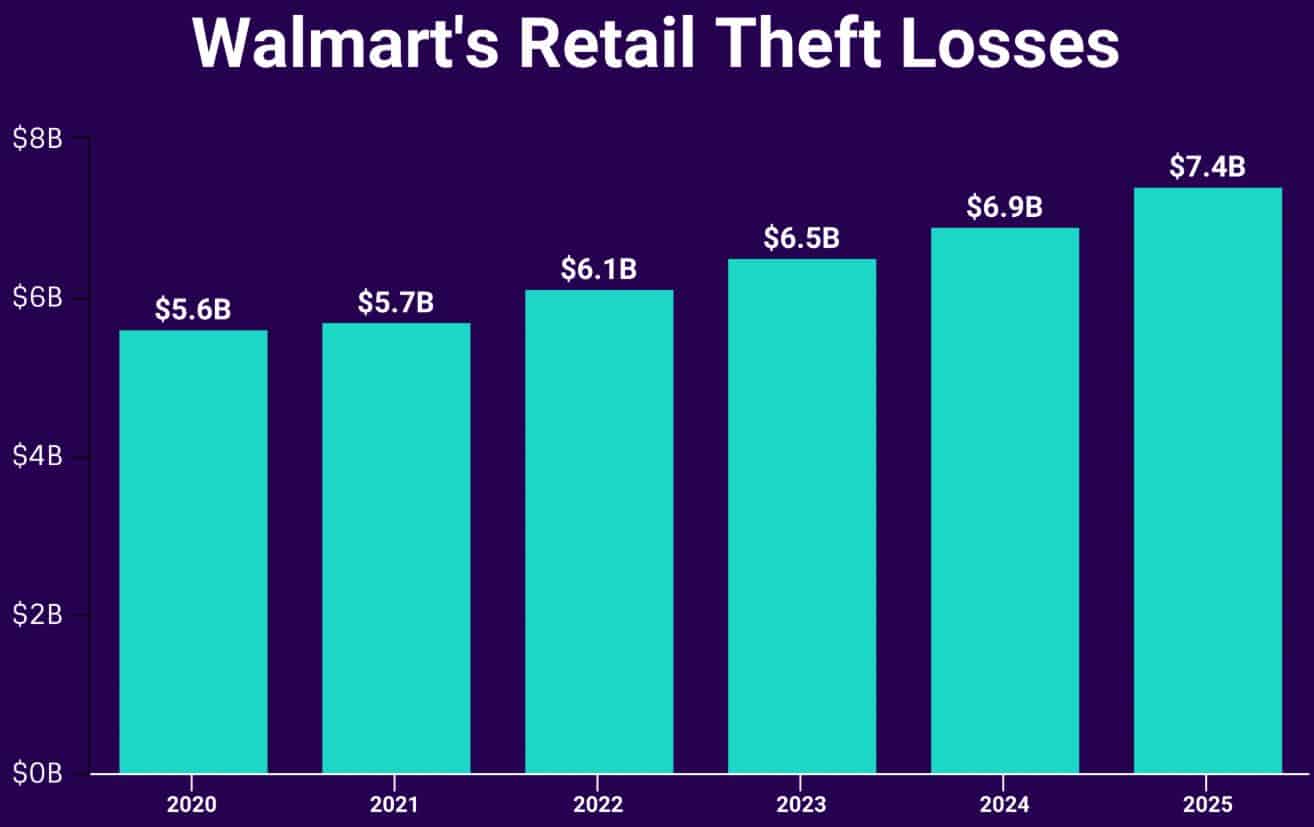
- Walmart statistics demonstrate that retail theft has changed from a manageable expense to a major threat that affects both their profit margins and business operations.
- The theft loss for Walmart in 2022 reached approximately 6.1 billion dollars, which represented about 1% of their 611.3 billion dollar revenue for the year, according to estimates.
- The fact that Walmart lost 14.7 % of all retail theft losses nationwide shows how its size increases its potential theft losses.
- The 2023 projections estimate losses will reach 6.5 billion dollars, which represents a 400 million dollar increase from the previous year,r while it will affect both net income and pricing control.
- Shrinkage patterns display the hidden fundamental problems that exist within organizations.
- High-theft categories—electronics, cosmetics, deli food, and personal care—combine high resale value with easy concealment, making them prime targets.
- The geographic data indicate that shoplifting enforcement shows stronger results in areas that experience high prosecution rates than in regions with less active enforcement.
- Walmart has established a no-chase policy, which protects customer safety during their security operations because retail theft incidents have increased violence and aggression by 81.2%.
- The need to lock up even low-priced essentials like batteries and cleaning products demonstrates how theft has transformed the entire in-store shopping experience.
- Organized retail crime extends the problem because thieves sell their stolen merchandise through major online marketplaces, which leads to additional financial losses beyond those experienced by physical stores.
- The retailer Target anticipates theft losses that will exceed USD 600 million in 2023, which represents a 50% increase compared to the previous year, thus establishing this problem as a widespread industry concern.
- The United States experiences shoplifting incidents that result in average costs of USD 524 per case, which indicates that Walmart suffers losses that reach their highest point through multiple theft incidents.
- The combined statistics from Walmart demonstrate that theft functions as a strategic threat, which could result in increased product price,d enhanced security measures, and complete store shutdowns within areas that present high theft risks.
Recent Developments And Future Outlook
- Walmart develops its operational strategy through two main approaches, which include business expansion through innovation and complete dedication to long-term process development.
- Walmart demonstrated its interest in building experiential retail and personalized shopping through its acquisition of Memomi, an augmented reality optical technology company, which it completed in 2022.
- The company should enact this change because multiple Walmart business indicators show that the company needs to expand its online and physical store operations to preserve its market position against competitors who prioritize eCommerce first.
- Walmart achieved annual sales of USD 611 billion in February 2023, which represents a strong 7% growth from the previous year despite the economic challenges created by inflation and reduced consumer spending.
- The introduction of the new logo, which marks the first design change in 17 years,s will serve as a brand repositioning tool that helps Walmart establish a modern brand image while maintaining its core value-based identity.
- Walmart demonstrates its upcoming expansion plans through its commitment to physical store operations.
- The company plans to establish more than 150 new U.S. stores while redesigning 650 current facilities within five years because it believes, based on data evidence, that stores function as essential centers for both product delivery and customer interaction.
- Stock forecasts project a maximum price of USD 119.27 by 2028, which leads to 2030 price estimates that range between USD 55.96 and USD 73.10. This data confirmsthat Walmart operates as a stable defensive stock which does not offer investors high growth potential.
Conclusion
Walmart Statistics: Walmart became a diversified data-driven commerce platform, which developed through its 2025 performance results from its original scale-based retail business model. The combination of massive physical reach, rapidly growing eCommerce, retail media monetization, and automation-led efficiency has created a structurally stronger profit model. Walmart’s statistics demonstrate ongoing business strength because the company can withstand inflation, supply-chain disruption, and changes in consumer behaviour.
The combination of grocery business strength, digital service expansion, and strategic capital spending produces better business results. Walmart maintains a competitive position against Amazon through its online sales, while its cross-channel system and protective measures establish it as one of the most durable and flexible retail businesses across the world.
Sources
FAQ.
Walmart serves about 270 million weekly customers worldwide as of 2025.
Walmart generated approximately USD 681 billion in revenue in FY2025.
Walmart operates around 11,150 properties worldwide, including over 10,700 retail stores.
Walmart holds about 6.3% of the U.S. e-commerce market.
Walmart’s theft-related losses exceeded USD 6 billion annually, impacting margins and store strategy.

I hold an MBA in Finance and Marketing, bringing a unique blend of business acumen and creative communication skills. With experience as a content in crafting statistical and research-backed content across multiple domains, including education, technology, product reviews, and company website analytics, I specialize in producing engaging, informative, and SEO-optimized content tailored to diverse audiences. My work bridges technical accuracy with compelling storytelling, helping brands educate, inform, and connect with their target markets.