Computer Vision Statistics And Facts By Market Growth, Adoption, Usage, Key Insights, Revenue & Emerging Trends (2025)

Updated · Dec 07, 2025


Table of Contents
Introduction
Computer Vision Statistics: Computer vision is one of the branches of artificial intelligence (AI) that equips computers and machines with the ability to comprehend and interpret the visual world to such a high level that they can even detect patterns, objects, and regions. A few years ago, computer vision was already in the process of revolutionizing several sectors manufacturing, retail, healthcare, automotive, and security, when it started to be used for automating tasks that required human vision. In 2024, the computer vision market continued to expand rapidly, driven by deep learning, edge computing, improved camera technology, and real-time data.
In this article, we present the key computer vision statistics for 2025: the market size, growth regions, leading segments, and remaining challenges.
Editor’s Choice
- The worldwide computer vision market has grown from US$13.84 billion in 2020 to US$22.28 billion in 2023 and is expected to reach US$51 billion by 2030, indicating solid long-term growth.
- The top industrial areas that utilise computer vision the most are manufacturing (35.1%), healthcare (27.3%), and security (26.0%), while retail/business/legal takes up 11.7% but is on the rise.
- Generative AI is the most prominent AI trend at present, with a 76% market share, followed by data-centric AI (11%), mixed reality (7%), and facial recognition (6%).
- The image recognition technology sector is the largest, valued at US$10.53 billion in 2023 and estimated to surpass US$21 billion by 2030; next are speech and facial recognition technologies, which are also experiencing rapid growth.
- The adoption of computer vision technology by the end of 2022 is estimated to have reached 34% of all organizations, while the use of AI tools by marketers is 88%, with a significant number depending on CV for content generation, insights, and quicker decisions.
- The market for computer vision systems is predominantly hardware (approximately 66%), with cloud-based solutions accounting for another 37%, highlighting the necessity of both physical and adaptable digital infrastructures.
- The AI-based computer vision market in the retail sector is projected to grow from US$1.66 billion in 2024 to US$12.56 billion in 2033, making it one of the fastest-growing sectors.
- The performance enhancement for businesses that adopt AI and computer vision technologies is about 15%, and the forecasting accuracy of fashion brands has increased while the content production time has been reduced by up to 90%.
- In the US, computer vision-powered automation in manufacturing is forecast to reach US$359 billion by 2029, and the total global output of the manufacturing sector is expected to exceed US$40 trillion.
- Apple, Meta, Nvidia, and Google have been making notable investments in and launching products in computer vision and AI to reinforce their AR, healthcare, and enterprise solutions.
- Investors have demonstrated strong belief in the industry by participating in major funding rounds, including US$1 billion for SenseTime and US$235 million for AnyVision.
Computer Vision Market Size
(Source: scoop.market.us)
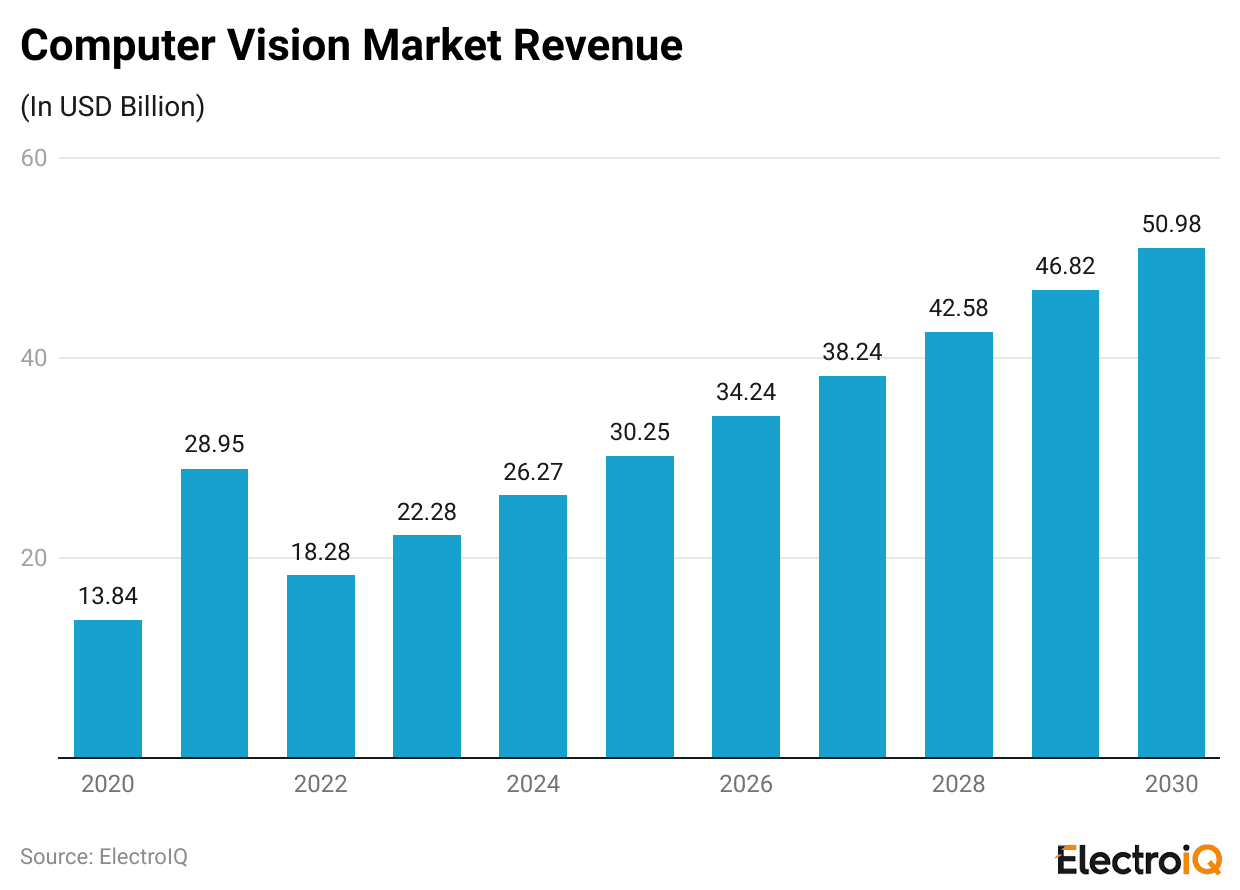
- In recent years, the computer vision market has been characterized by a strong but uneven growth trend, indicating both rapid and resilient expansion.
- The market price in 2020 was already US$13.84 billion, indicating that computer vision had reached early-stage adoption and was becoming more widely adopted across industrial sectors such as manufacturing, security, healthcare, and retail.
- Just a year later, in 2021, the market value exploded to US$28.95 billion, suggesting a remarkable hike over a short span of time.
- Nonetheless, the rapid growth in demand for computer vision applications was reflected by a sharp market decline in 2022 to a value of US$18.28 billion.
- Despite this, the market did not take long to revive. In 2023, revenue from computer vision applications reached US$22.28 billion, indicating a return of confidence and a rise in demand for AI applications based on vision.
- Moreover, the data from 2024 starts to exhibit a clear, slow but constant upward trend.
- The expectation is that the market will be valued at US$26.27 billion in 2024, at US$30.25 billion in 2025, and at US$34.24 billion in 2026.
- The industry will have moved from its earlier demand to a more consistent and stable growth phase that is characterized by the greater acceptance of AI technologies in regular business operations, hardware and software innovation, and stable economic conditions.
- By 2027, the market is estimated to be worth US$38.24 billion, thus indicating that computer vision is already becoming a mainstream technology rather than just an experiment.
- It has been estimated that by 2028, revenues will reach US$42.58 billion and further increase to US$46.82 billion by 2029, culminating in the milestone of US$50.98 billion in sales by the end of 2030.
- This implies that the market is expected to double almost its 2023 value in just seven years.
- The projection clearly marks computer vision as a technology already in high demand across automation, robotics, self-driving cars, smart cities, medical imaging, and retail analytics.
(Reference: amraandelma.com)
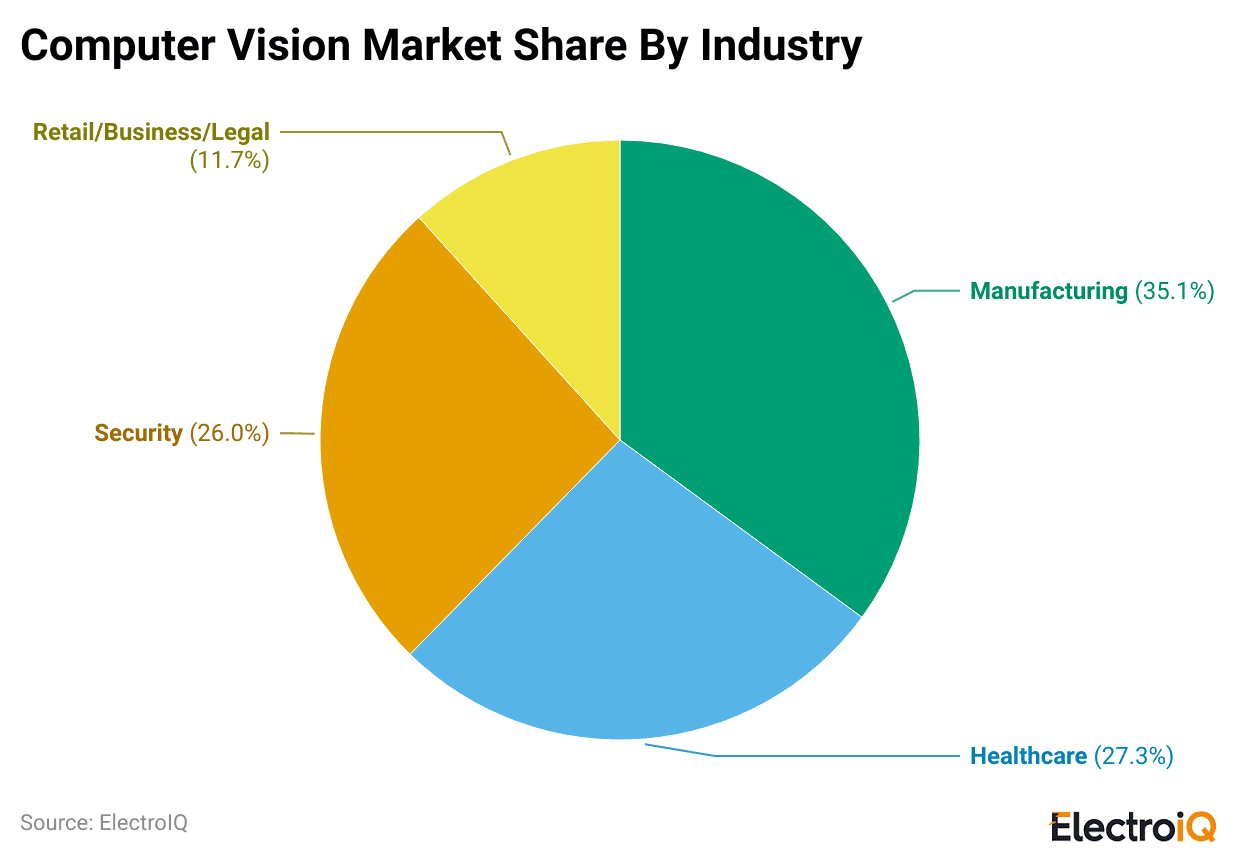
- According to the data, the manufacturing industry is the one that uses computer vision technology most, with a 35.1% share of the total market.
- Besides, the healthcare sector comes next with a considerable 27.3% share, which indicates the increasing adoption of computer vision in medical imaging, diagnostics, patient monitoring, and surgical assistance.
- These technologies are not only facilitating precision but also speeding up diagnosis and, consequently, improving patient care.
- The security business claims a quarter (26.0%) of the market, underscoring the reliance on computer vision for applications such as large-scale surveillance, automated facial recognition, threat detection, and access control.
- Besides, the retail, business, and legal sectors all together form the smallest segment of the market with only 11.7% share, where computer vision is applied in customer behaviour analysis, inventory management, visual search, fraud detection, and evidence analysis, among others.
- Despite being a smaller market segment, it is steadily growing as more companies consider visual AI to boost decision-making and operational efficiency.
Trends in Computer Vision
(Reference: enterpriseappstoday.com)
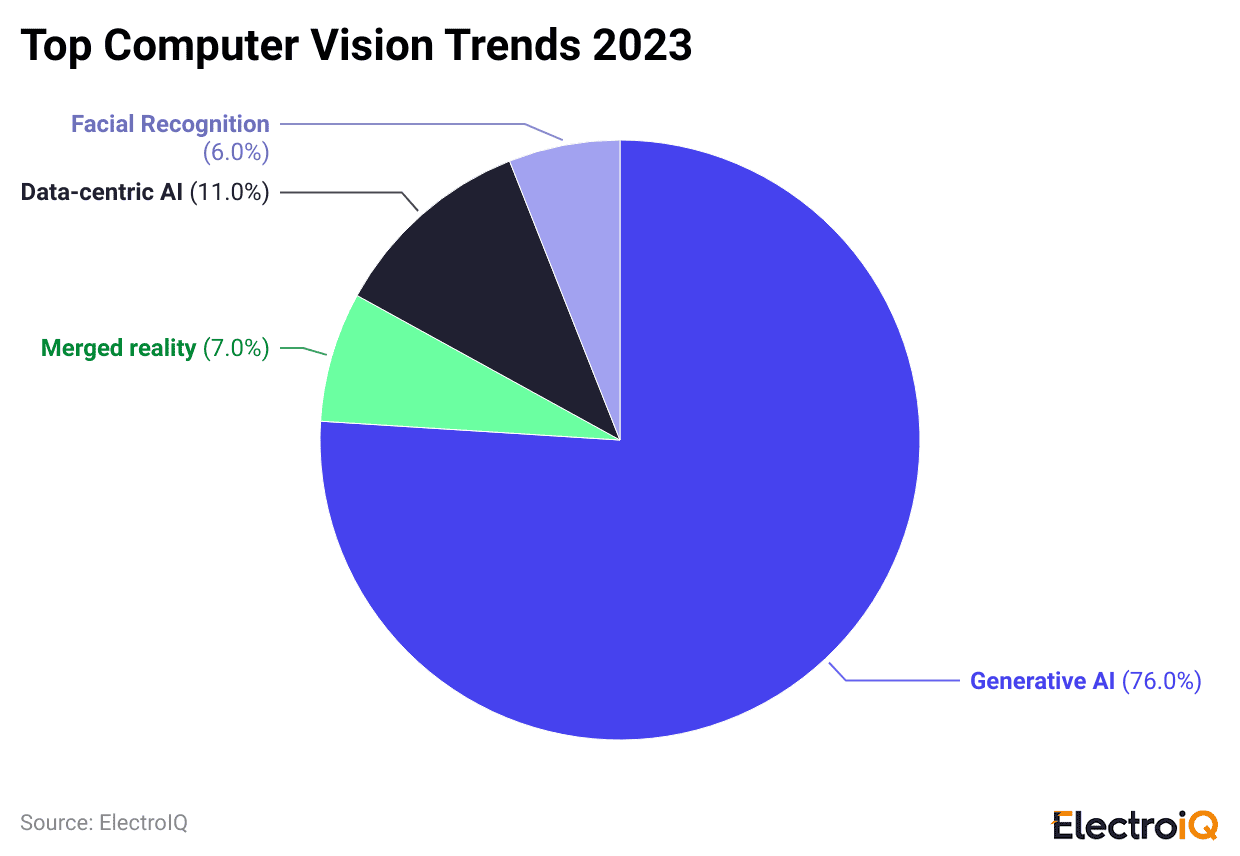
- The research indicates that Generative AI is the most widely used technology in the current global tech trends, with a remarkable 76% share.
- Next in line is data-centric AI, with an 11% share, which points to the need to improve data quality rather than merely focusing on model sophistication.
- The blended reality is now capturing 7% of the market due to its wide utilization in the areas of training, entertainment, and industrial applications, as the inflatable and digital environments are mixed together.
- The facial recognition, on the other hand, holds a 6% share as its main applications are in security, authentication, and surveillance systems.
- Speech recognition is another fast-growing area, estimated at US$6.80 billion in 2023 and forecast to reach US$19.57 billion in 2030, indicating its applications in virtual assistants, transcription, and accessibility tools.
- Facial recognition, however, smaller in size, is still a growing segment with a value of approximately US$4.95 billion in 2023 and a forecast of reaching US$10.34 billion by 0.
- The United States is ahead of the pack in all three segments, securing the largest global market share, reflecting the country’s heavy investments in AI technology, research, and commercial implementation.
- The global computer vision (CV) market was already worth US$19.82 billion in 2024 and is poised for even greater growth, reaching US$58.29 billion in 2030, with a CAGR of 19.8%.
- In the longer term, the entire CV systems market is expected to be US$111.3 billion by 2034, with a projected CAGR of 18.2% highlighting strong and sustained growth.
- This technology has not only seen continuous growth, but confidence in it has been reinforced by consistent upward projections, with earlier estimates valuing the market at US$13.45 billion in 2022 and US$48.6 billion in 2026.
- The AI market in the CV industry is expected to grow from US$19.52 billion in 2024 to US$63.48 billion by 2030, with a CAGR of 22.1%.
- The integration of AI across many parts of tech is evident in the growing use of AI-based video and image analysis systems in the marketing, retail, healthcare, and manufacturing sectors.
- Adoption rates are also indicating strong enthusiasm. It is already estimated that around one-third (34%) of the organizations worldwide have integrated computer vision functionality into their operations by 2022. In the area of marketing specifically, AI has been adopted by 88% of marketers as a part of their daily work, and among them 93% for content creation, 81% for insights, and 90% for faster decision-making, indicating a heavy reliance on AI-powered tools, which include computer vision as well.
- The distribution of CV (computer vision) market share by industry reveals that manufacturing leads with 25.98%, followed by healthcare with 20.21%, security with 19.25%, and retail/business/legal with 8.66%.
- Even though the retail sector has a small share, it is still considered one of the fastest-growing application areas.
- The market for AI-powered computer vision in retail was worth US$1.66 billion in 2024, and it is projected to reach US$12.56 billion by 2033, with a CAGR of 25.4%.
- In the fashion industry, for instance, incorporating CV-based image data into demand forecasting models increased accuracy by up to 7%. One of the most remarkable cases is Zalando, which applied artificial intelligence and computer vision as the main drivers of the company’s transformation, eventually shortening campaign imagery production time by close to 90%, making preparation a matter of days rather than weeks.
Computer Vision’s Impact on the Manufacturing Industry
- The manufacturing industry is embracing radical technological change, and computer vision and related technologies are the primary drivers.
- The U.S. market for industrial automation in the near future, driven by computer vision, will be around US$359 billion by 2029, which means that automation is already recognized by the industry as a crucial factor in increasing productivity, efficiency, and quality control.
- Worldwide, manufacturing output is projected to exceed US$40 trillion, underscoring not only the market’s huge size but also its attractive potential for technology-driven innovation.
- Once computer vision was implemented together with IoT, artificial intelligence, and robots, the scene was set for what is now recognized as the Fourth Industrial Revolution (4IR).
- The use of computer vision in manufacturing is broad and spans many applications. Some of them are, for example, bin picking, where robots can locate and take out components from bins, palletizing and depalletizing—automating the processes of packaging and sorting, machine tending, which involves monitoring and helping operate equipment, and finally, defect detection, which applies image processing to reveal faults in products.
- Another application is predictive maintenance, which is a step ahead of equipment failure by preventing it.
- The combination of these applications is responsible for a dramatic decrease in errors, reduced operational costs, increased production output, and improved overall safety and efficiency in modern manufacturing environments.
Recent Developments
- Technology giants have taken the last couple of years on the road through their computer vision and AI capabilities.
- At the beginning of 2023, which brought about the integration of Apple and Xnor.ai for 200 million dollars, a firm that is widely recognized for its cutting-edge AI and computer vision solutions.
- This buyout is believed to play a crucial role in enhancing Apple’s on-device intelligence, thereby benefiting the areas of image recognition and augmented reality experiences.
- Around this same period, Meta (the company formerly known as Facebook) was involved in the purchase of Scape Technologies for 250 million dollars.
- Scape’s technology for location determination and mapping is to be the foundation upon which Meta’s lofty dreams in augmented reality will be built, as it will allow for a much better understanding of the physical world around us.
- The last quarter of 2023 saw Nvidia unveil Clara Guardian, a medical care platform driven by AI that uses computer vision to monitor, protect, and make medical facilities more efficient when it comes to patient care.
- In the first quarter of 2024, Google introduced an updated version of Cloud Vision AI that came with advanced image recognition, more powerful optical character recognition, and better integration with Google Cloud for enterprise applications.
- On the other hand, AnyVision got 235 million dollars in the first quarter of 2024 to grow its facial recognition and retail-oriented offerings.
- At the same time, organizations are under more and more pressure to meet the requirements of data privacy regulations and to practice ethical AI to a certain degree, whereby they would be able to prevent bias and keep user data safe.
- In addition, there is ongoing research in domains such as 3D computer vision and multi-modal learning, where visual, audio, and text data are combined to develop more intelligent and context-aware systems.
Conclusion
Computer Vision Statistics: The computer vision market is moving so fast that its status is changing from an emerging technology to a critical one for modern industries. There are really strong growth predictions going up to 2030 and beyond, and the manufacturing, health care, retail, security, and marketing applications are the areas that are driving the major productivity gains and cost reductions.
The combination of AI, edge computing, and advanced imaging systems is paving the way for real-time decision-making and a higher level of automation in the various sectors. The issues of data privacy and ethical concerns are still there as hurdles, but they will never get in the way, since continuous innovation and responsible practices will always make computer vision a key player in the future of digital transformation and intelligent systems.
FAQ.
The computer vision market across the globe was assessed at US$22.28 billion for the year 2023 and a further increase of almost US$51 billion by 2030 has been estimated. The overall computer vision market is estimated to be even higher, at US$111.3 billion by 2034, with a forecasted increase of around 18–20% annually through the next decade.
Manufacturing comes on top as the largest sector using computer vision, with a share of 35.1% market, followed by healthcare with 27.3% and security with 26.0%. Retail, business, and legal applications together hold about 11.7% of the market but their growth is fastest because of the increasing need for automation and customer analytics.
Image recognition is the current largest application with a worth of US$10.53 billion in 2023 and it is expected to surpass US$21 billion by 2030. Speech recognition demand is followed from US$6.8 billion in 2023 to US$19.57 billion by 2030, while facial recognition is expected to expand from US$4.95 billion to over US$10 billion in the same duration.
Businesses practicing AI and computer vision claim a 15% enhancement in difficult performance. In marketing and creating, brands have realized a maximum of 7% more precise forecasts and have almost completely (90%) cut down the time to produce content thus the effectiveness, speed, and cost reduction have been very significant.
In the United States, computer vision–driven industrial automation is expected to reach US$359 billion by 2029. Globally, manufacturing output is projected to exceed US$40 trillion. Applications such as defect detection, bin picking, machine tending, and predictive maintenance are reducing errors, improving safety, and increasing production efficiency as part of the Fourth Industrial Revolution (4IR).

Tajammul Pangarkar is the co-founder of a PR firm and the Chief Technology Officer at Prudour Research Firm. With a Bachelor of Engineering in Information Technology from Shivaji University, Tajammul brings over ten years of expertise in digital marketing to his roles. He excels at gathering and analyzing data, producing detailed statistics on various trending topics that help shape industry perspectives. Tajammul's deep-seated experience in mobile technology and industry research often shines through in his insightful analyses. He is keen on decoding tech trends, examining mobile applications, and enhancing general tech awareness. His writings frequently appear in numerous industry-specific magazines and forums, where he shares his knowledge and insights. When he's not immersed in technology, Tajammul enjoys playing table tennis. This hobby provides him with a refreshing break and allows him to engage in something he loves outside of his professional life. Whether he's analyzing data or serving a fast ball, Tajammul demonstrates dedication and passion in every endeavor.